


 Скачать презентацию Innovative Community Transportation Services Responding to Change Dan
96046c2092608687de72eac0fcef9a36.ppt
- Количество слайдов: 28
 Innovative Community Transportation Services: Responding to Change Dan Dalton, KFH Group, Inc. Florida Commission for the Transportation Disadvantaged 22 nd Annual Best Practices and Training Workshop July, 2014
 Session Overview • Adapting to change – why do some community transportation providers thrive in this environment, yet some are unable to make needed changes? • We’ll review some examples from around the country • So, how can this be applied to Florida?
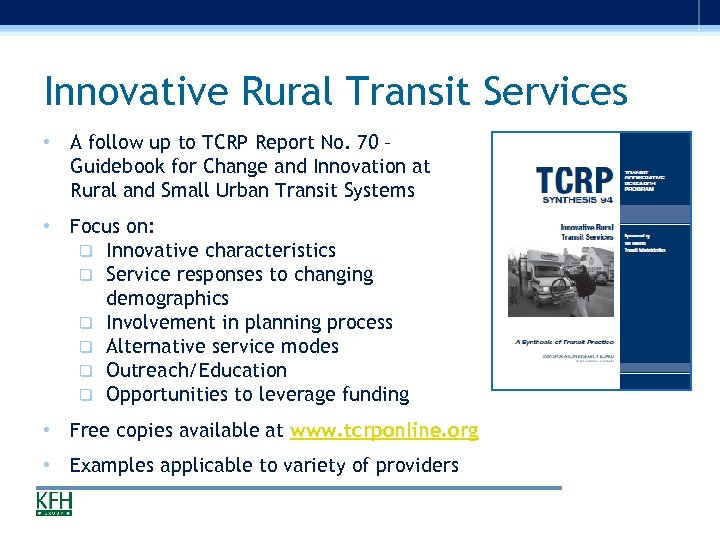 Innovative Rural Transit Services • A follow up to TCRP Report No. 70 – Guidebook for Change and Innovation at Rural and Small Urban Transit Systems • Focus on: q Innovative characteristics q Service responses to changing demographics q Involvement in planning process q Alternative service modes q Outreach/Education q Opportunities to leverage funding • Free copies available at www. tcrponline. org • Examples applicable to variety of providers
 Some Realities • Community transportation providers face a variety of challenges on a daily basis • Unique nature — each system has its own dynamics related to geography, quality of service, political issues, service design, and a host of other factors
 And Some More Realities • Demand for community transportation services in rural areas will continue to increase, i. e. as residents “age in place” • Expenses to operate services will continue to go up • Funding levels may not keep pace
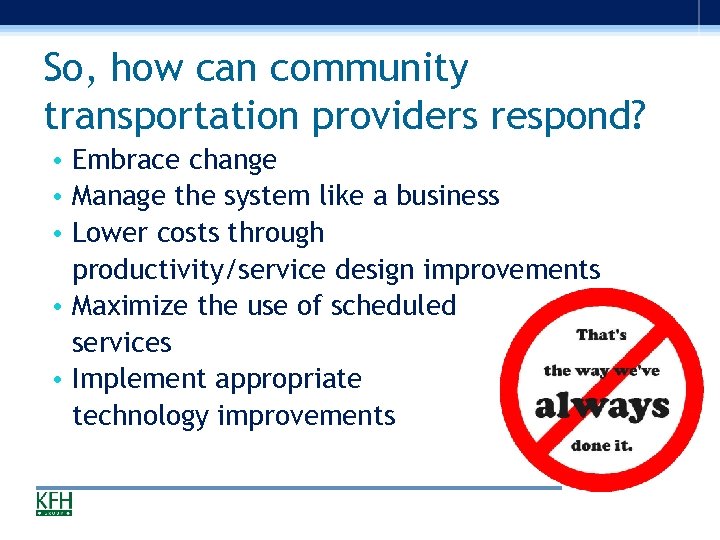 So, how can community transportation providers respond? • Embrace change • Manage the system like a business • Lower costs through productivity/service design improvements • Maximize the use of scheduled services • Implement appropriate technology improvements
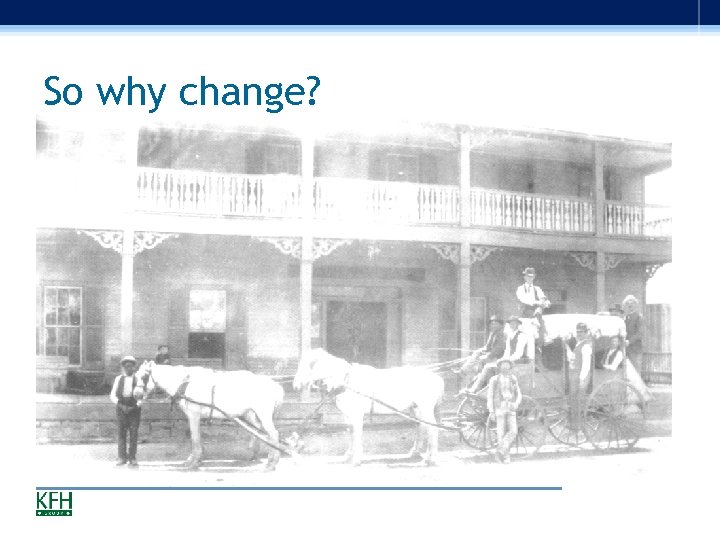 So why change? • Add horse drawn carriage picture
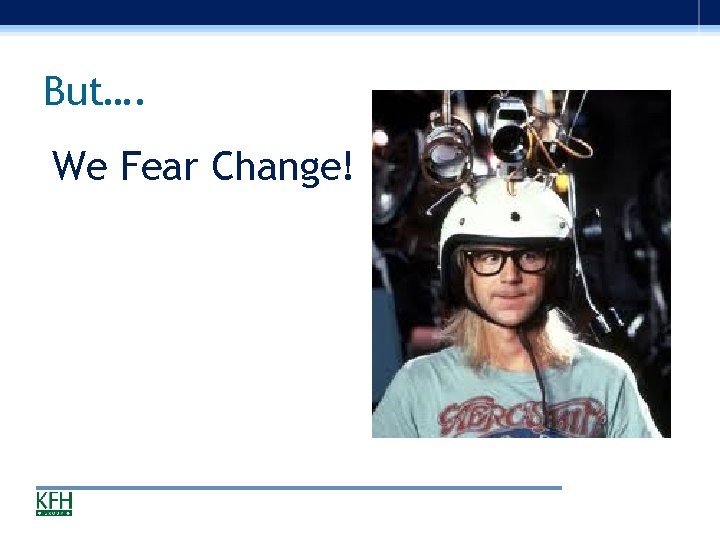 But…. We Fear Change!
 THE CASE FOR CHANGE • Community transportation providers face many new challenges in a rapidly changing environment • Systems must be responsive; they must identify better ways of doing things and adapt to new ways of conducting business • Transportation needs do not end at the service area boundary, so systems should connect in a seamless manner • Always look for greater ridership – make a difference or run the risk of becoming irrelevant in your community
 What is Innovation? • For our purposes innovation is: ▫ New, different and unique technique, practice or approach ▫ Newly applied, not necessarily unique ▫ A modification of an existing practice that has a nuance or twist that makes it innovative
 Common Themes • Unique nature of community transportation services requires management to adapt to their specific needs, making innovation important • The real innovation appears to be the change and reinvention of the organization to meet ever-changing dynamics in demographics, technology, and economic factors • It is a culture of innovation, a willingness to change and improve • INNOVATION STEMS FROM AN ORGANIZATION’S ABILITY TO CHANGE
 Organizational Culture of Innovation • Organizational and Staff “Buy in” • Systems with successful programs/practices: ▫ ▫ ▫ Serve as community agents of change Optimize resources Embrace technology Act as entrepreneurs Provide effective, quality service Maintain fiscal diversity
 Proactive Innovators • Display Innovative Agency Characteristics ▫ Need to re-invent, especially when faced with loss of funding or services • Respond to Changing Demographics ▫ Modify services in response to shifting demographics • Actively Engage in Transportation Planning Process ▫ Lead planning efforts and activities
 Proactive Innovators • Implement Alternative Service Modes ▫ Identify opportunities to reduce role of paratransit, most expensive form of transportation to operate • Consider New Outreach and Education Approaches ▫ New ways to engage the public and expand knowledge of services • Leverage Funding Opportunities ▫ Explore new ways to partner and generate funds
 Thinking in the Future Tense • Certain organizations are better positioned to “think in the future tense, ” through management style and practice that fosters creativity and innovation • Understanding and anticipating future patterns, trends, and needs will allow an organization to change in a timely manner rather than continually playing “catch up”
 Some Examples • • Addison County Transit Resources, VT Ark-Tex TRAX, TX JAUNT, VA Treasure Valley Transit, ID
 ACTR • Total reinvention when new executive director arrived • Services virtually dormant in 2002 • Many choice riders – 350% increase in 9 years • Takes advantage of attributes: ▫ ▫ • • Fixed route service targeting the college community Ski service Local service Commuter service both north and south in coordination with other systems Many collaborations with public and private entities Now well respected
 Ark-Tex Council of Governments TRAX • • Nine county transit system in northeast Texas Lost its Medicaid contract and half its business -- faced with catastrophic loss Changed its focus and became entrepreneurs, finding new sources of funding and new services Contracted with private sector for service, human service agencies, colleges and other organizations Now also operates the Texarkana Urban Transit District Is becoming a Greyhound agent and feeder Now has more service than before the loss
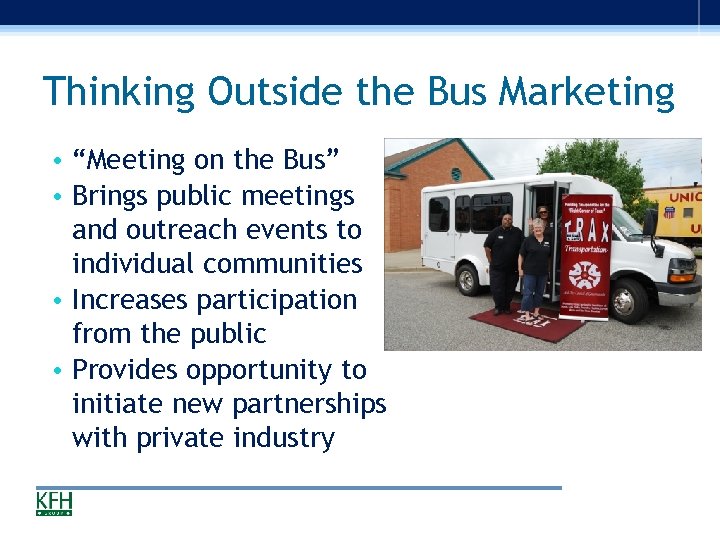 Thinking Outside the Bus Marketing • “Meeting on the Bus” • Brings public meetings and outreach events to individual communities • Increases participation from the public • Provides opportunity to initiate new partnerships with private industry
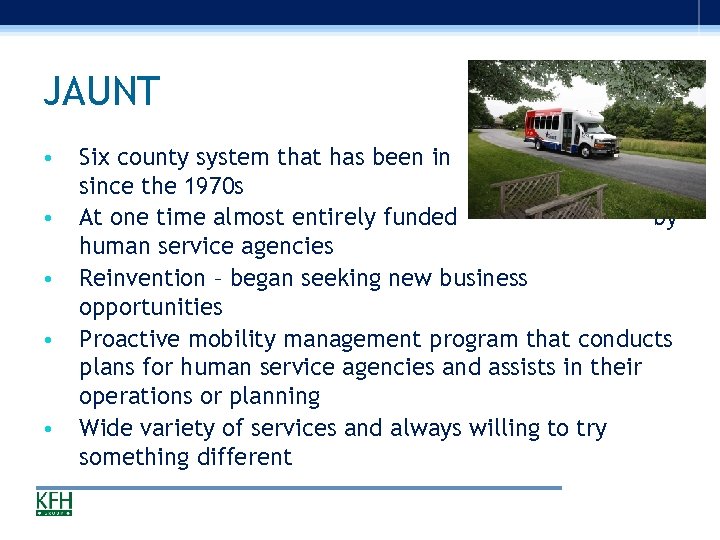 JAUNT • • • Six county system that has been in existence since the 1970 s At one time almost entirely funded by human service agencies Reinvention – began seeking new business opportunities Proactive mobility management program that conducts plans for human service agencies and assists in their operations or planning Wide variety of services and always willing to try something different
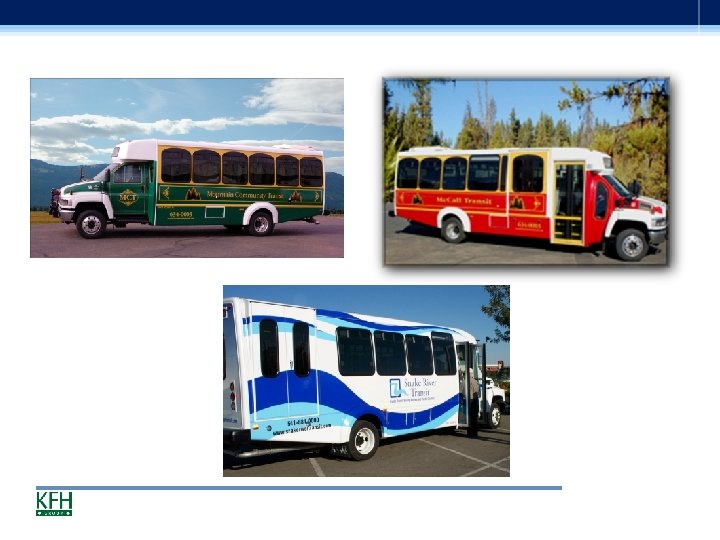
 Treasure Valley Transit When Nampa-Caldwell became small urban, TVT lost the service -- about 65% of their business • TVT reached out to 8 rural counties and worked with local communities to initiate service in an area over 250 miles long • Tailor service for each community, taking advantage of local characteristics • Service branded and marketed to raise visibility: • ▫ Community branding to facilitate local ownership ▫ Specially painted vehicles ▫ Entry point for new partnerships and additional revenue sources
 The Innovators Think in the future tense Toss out conventional wisdom Diversify, diversify, and diversify Remain in tune with community needs, i. e. attend local meetings, participate in events • Take advantage of their attributes • Work closely with the local businesses and human service communities • •
 Innovative Ranking • • • Serving as community agents of change – leading the way with a proactive approach Optimizing rural resources – Leveraging local funding and using maximizing the use of other funds Embracing technology – Not for technology sake, but to the level necessary to improve service Acting as entrepreneurs – They look for business deals or partnerships: apply business sense to transit management Providing effective service – Looks good, is good Maintaining fiscal diversity – Do not rely on one funding source… if it goes south
 So Time to Answer the Tough Questions • Does your system change out of necessity as a reaction to a problem, and do you change as a proactive measure? • Does your system serve as community agents of change —are you “out front” in the community, gaining a reputation for successful change and innovation? • Is your system optimizing resources, such as generating local match and other operating and capital funds?
 And Some More Questions • Does your system embrace technology -- which, after all, is all about change? • Does you act as an entrepreneur — looking for business deals or partnerships? • Are you building ridership by providing quality services that meet the local needs and ensuring your drivers and staff are well-trained and your vehicles maintained to high standards? • Does your system maintain fiscal diversity or do you rely primarily on a single funding source?
 Additional Resources • Embracing Change in a Changing World: Applying New Paradigms for Rural and Small Urban Transit Service Delivery, Report No. 99 • Transit Markets of the Future The Challenge of Change TCRP Report No. 28 • Management Toolkit for Rural and Small Urban Transportation Systems TCRP Report No. 54 • James, Jennifer, Thinking in the Future Tense, Simon and Schuster, New York, 1996 • Amabile, Teresa, How to Kill Creativity, Harvard Business Review on Breakthrough Thinking, Harvard Business School Press, Boston, 1999 • Drucker, Peter, The Discipline of Innovation, Harvard Business Review, Harvard Business School Press, Boston, November – December 1998
 Contact Information • Dan Dalton, 301 -951 -8660, ddalton@kfhgroup. com