


 Скачать презентацию Innovation Management along the Supply Chain of the
0f5c4b29f75a31c065ff602162712925.ppt
- Количество слайдов: 21
 Innovation Management along the Supply Chain of the European Aviation Industry: Measuring its Impact on Company’s Success with Structural Equation Models Dipl. -Kfm. Andreas Potzner Doctoral Candidate Advisor: Prof. Dr. Christopher Jahns ebs European Business School Supply Management Institute SMI™ International Research and Training Center for Purchasing, Logistics and Supply Chain Management Academy of Management Atlanta August 12 th, 2006
 Summary n Stage in the dissertation research: • Proposal defended in March 2006 and halfway through data collection. n Dissertation topic: • Measuring the impact of cooperative idea generation within the supply chain. n Practical contribution: • In both core markets European network airlines are loosing market shares but they could increase their market shares through a cooperative idea generation with customers and suppliers. n Academic/ scholarly/ theoretical contribution: • It is remarked by Hauschildt that especially in the research field of the success of innovations (or innovative ideas), cooperation between companies hardly ever been conducted. (Hauschildt, 2004) • Scientific theories (e. g. Game Theory, Transaction Cost Theory and the Relational View) are applied to a real world problem. n Primary research methodology employed: • Survey and Structural Equation Modeling n Unit of observation: • Deutsche Lufthansa AG © Supply Management Institute SMI ™ • ebs European Business School • D-65201 Wiesbaden • Tel. : +49 (0) 611 36 018 800 • E-Mail: ebs@supplyinstitute. org -2 -
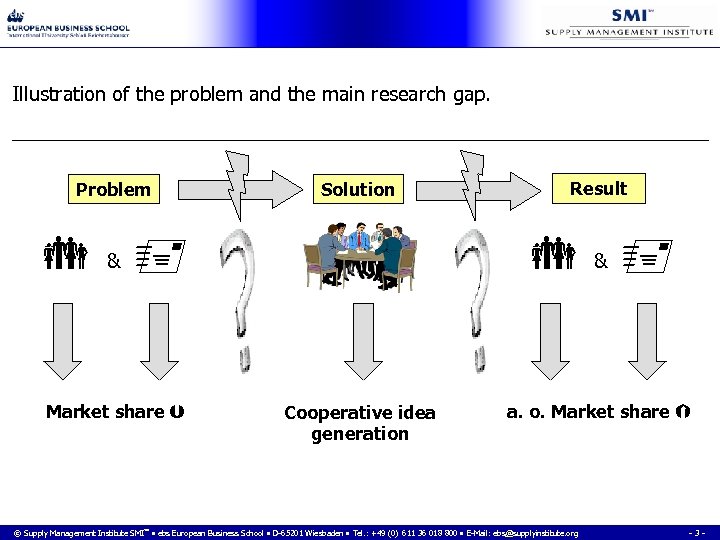 Illustration of the problem and the main research gap. Problem Solution & Market share Result & Cooperative idea generation a. o. Market share © Supply Management Institute SMI ™ • ebs European Business School • D-65201 Wiesbaden • Tel. : +49 (0) 611 36 018 800 • E-Mail: ebs@supplyinstitute. org -3 -
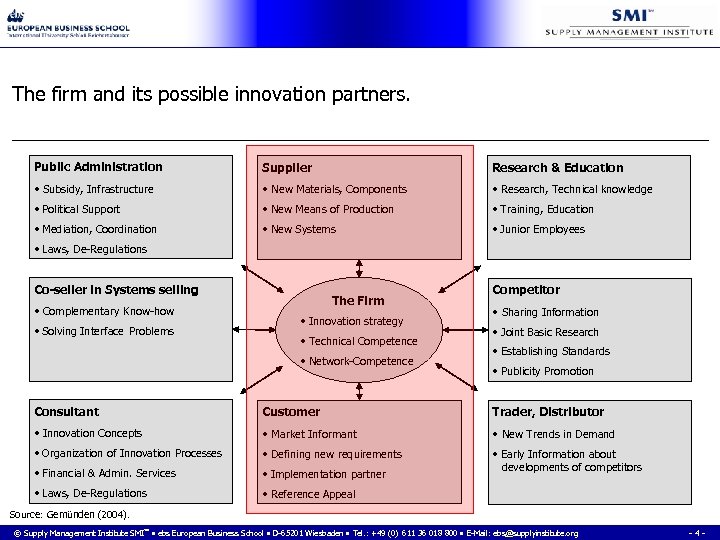 The firm and its possible innovation partners. Public Administration Supplier Research & Education • Subsidy, Infrastructure • New Materials, Components • Research, Technical knowledge • Political Support • New Means of Production • Training, Education • Mediation, Coordination • New Systems • Junior Employees • Laws, De-Regulations Co-seller in Systems selling • Complementary Know-how • Solving Interface Problems The Firm • Innovation strategy • Technical Competence • Network-Competence Competitor • Sharing Information • Joint Basic Research • Establishing Standards • Publicity Promotion Consultant Customer Trader, Distributor • Innovation Concepts • Market Informant • New Trends in Demand • Organization of Innovation Processes • Defining new requirements • Financial & Admin. Services • Implementation partner • Early Information about developments of competitors • Laws, De-Regulations • Reference Appeal Source: Gemünden (2004). © Supply Management Institute SMI ™ • ebs European Business School • D-65201 Wiesbaden • Tel. : +49 (0) 611 36 018 800 • E-Mail: ebs@supplyinstitute. org -4 -
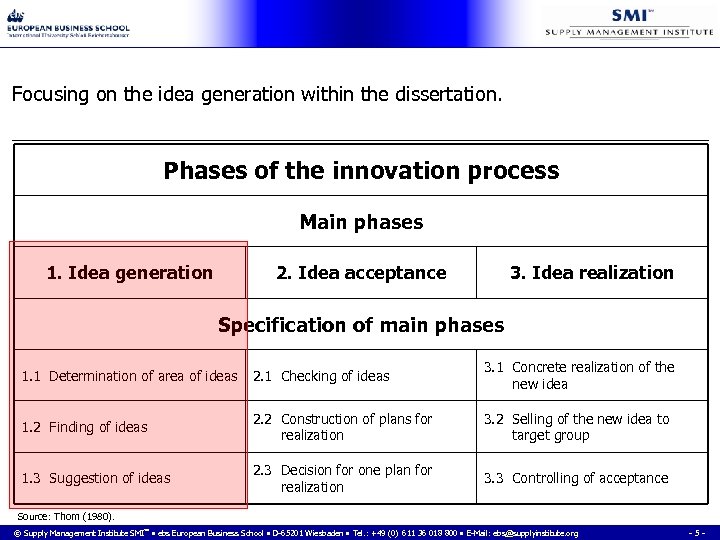 Focusing on the idea generation within the dissertation. Phases of the innovation process Main phases 1. Idea generation 2. Idea acceptance 3. Idea realization Specification of main phases 1. 1 Determination of area of ideas 2. 1 Checking of ideas 3. 1 Concrete realization of the new idea 1. 2 Finding of ideas 2. 2 Construction of plans for realization 3. 2 Selling of the new idea to target group 1. 3 Suggestion of ideas 2. 3 Decision for one plan for realization 3. 3 Controlling of acceptance Source: Thom (1980). © Supply Management Institute SMI ™ • ebs European Business School • D-65201 Wiesbaden • Tel. : +49 (0) 611 36 018 800 • E-Mail: ebs@supplyinstitute. org -5 -
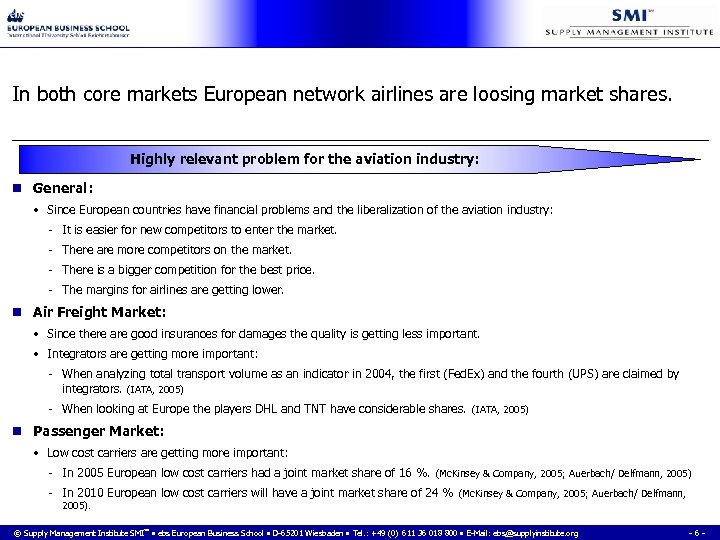 In both core markets European network airlines are loosing market shares. Highly relevant problem for the aviation industry: n General: • Since European countries have financial problems and the liberalization of the aviation industry: - It is easier for new competitors to enter the market. - There are more competitors on the market. - There is a bigger competition for the best price. - The margins for airlines are getting lower. n Air Freight Market: • Since there are good insurances for damages the quality is getting less important. • Integrators are getting more important: - When analyzing total transport volume as an indicator in 2004, the first (Fed. Ex) and the fourth (UPS) are claimed by integrators. (IATA, 2005) - When looking at Europe the players DHL and TNT have considerable shares. (IATA, 2005) n Passenger Market: • Low cost carriers are getting more important: - In 2005 European low cost carriers had a joint market share of 16 %. (Mc. Kinsey & Company, 2005; Auerbach/ Delfmann, 2005) - In 2010 European low cost carriers will have a joint market share of 24 % (Mc. Kinsey & Company, 2005; Auerbach/ Delfmann, 2005). © Supply Management Institute SMI ™ • ebs European Business School • D-65201 Wiesbaden • Tel. : +49 (0) 611 36 018 800 • E-Mail: ebs@supplyinstitute. org -6 -
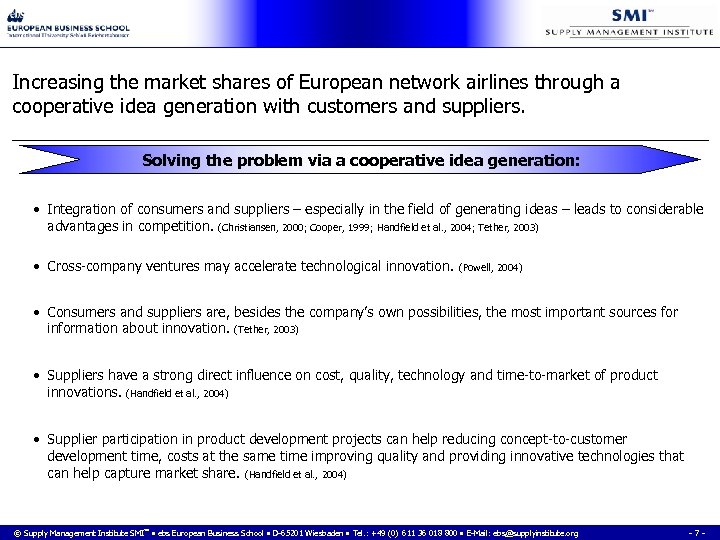 Increasing the market shares of European network airlines through a cooperative idea generation with customers and suppliers. Solving the problem via a cooperative idea generation: • Integration of consumers and suppliers – especially in the field of generating ideas – leads to considerable advantages in competition. (Christiansen, 2000; Cooper, 1999; Handfield et al. , 2004; Tether, 2003) • Cross-company ventures may accelerate technological innovation. (Powell, 2004) • Consumers and suppliers are, besides the company’s own possibilities, the most important sources for information about innovation. (Tether, 2003) • Suppliers have a strong direct influence on cost, quality, technology and time-to-market of product innovations. (Handfield et al. , 2004) • Supplier participation in product development projects can help reducing concept-to-customer development time, costs at the same time improving quality and providing innovative technologies that can help capture market share. (Handfield et al. , 2004) © Supply Management Institute SMI ™ • ebs European Business School • D-65201 Wiesbaden • Tel. : +49 (0) 611 36 018 800 • E-Mail: ebs@supplyinstitute. org -7 -
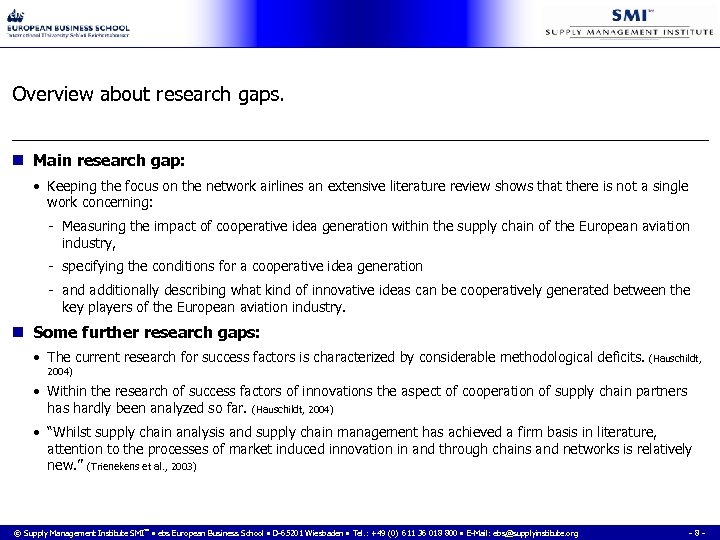 Overview about research gaps. n Main research gap: • Keeping the focus on the network airlines an extensive literature review shows that there is not a single work concerning: - Measuring the impact of cooperative idea generation within the supply chain of the European aviation industry, - specifying the conditions for a cooperative idea generation - and additionally describing what kind of innovative ideas can be cooperatively generated between the key players of the European aviation industry. n Some further research gaps: • The current research for success factors is characterized by considerable methodological deficits. (Hauschildt, 2004) • Within the research of success factors of innovations the aspect of cooperation of supply chain partners hardly been analyzed so far. (Hauschildt, 2004) • “Whilst supply chain analysis and supply chain management has achieved a firm basis in literature, attention to the processes of market induced innovation in and through chains and networks is relatively new. ” (Trienekens et al. , 2003) © Supply Management Institute SMI ™ • ebs European Business School • D-65201 Wiesbaden • Tel. : +49 (0) 611 36 018 800 • E-Mail: ebs@supplyinstitute. org -8 -
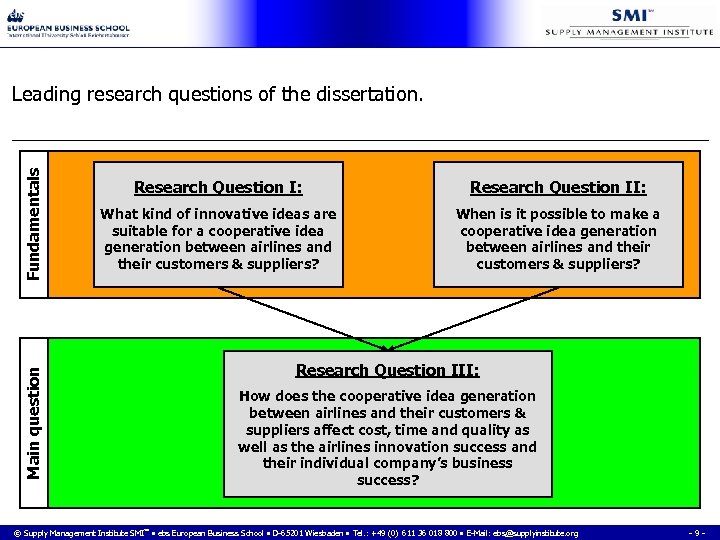 Main question Fundamentals Leading research questions of the dissertation. Research Question I: Research Question II: What kind of innovative ideas are suitable for a cooperative idea generation between airlines and their customers & suppliers? When is it possible to make a cooperative idea generation between airlines and their customers & suppliers? Research Question III: How does the cooperative idea generation between airlines and their customers & suppliers affect cost, time and quality as well as the airlines innovation success and their individual company’s business success? © Supply Management Institute SMI ™ • ebs European Business School • D-65201 Wiesbaden • Tel. : +49 (0) 611 36 018 800 • E-Mail: ebs@supplyinstitute. org -9 -
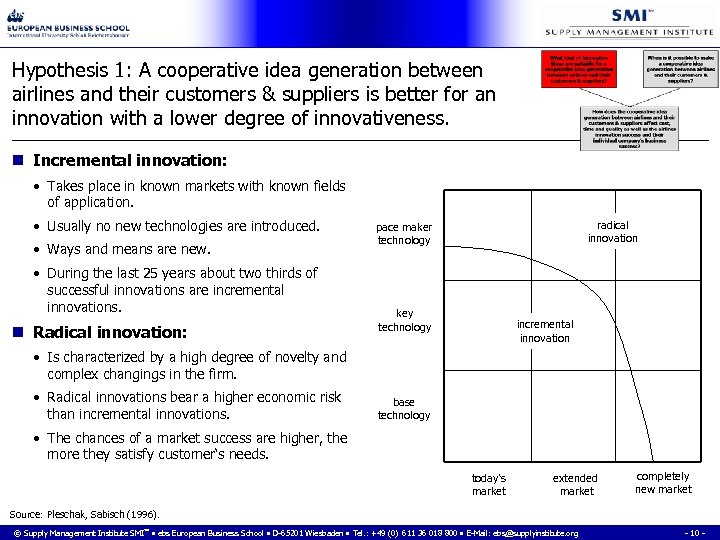 Hypothesis 1: A cooperative idea generation between airlines and their customers & suppliers is better for an innovation with a lower degree of innovativeness. n Incremental innovation: • Takes place in known markets with known fields of application. • Usually no new technologies are introduced. • Ways and means are new. • During the last 25 years about two thirds of successful innovations are incremental innovations. n Radical innovation: radical innovation pace maker technology key technology incremental innovation • Is characterized by a high degree of novelty and complex changings in the firm. • Radical innovations bear a higher economic risk than incremental innovations. base technology • The chances of a market success are higher, the more they satisfy customer‘s needs. today‘s market extended market completely new market Source: Pleschak, Sabisch (1996). © Supply Management Institute SMI ™ • ebs European Business School • D-65201 Wiesbaden • Tel. : +49 (0) 611 36 018 800 • E-Mail: ebs@supplyinstitute. org - 10 -
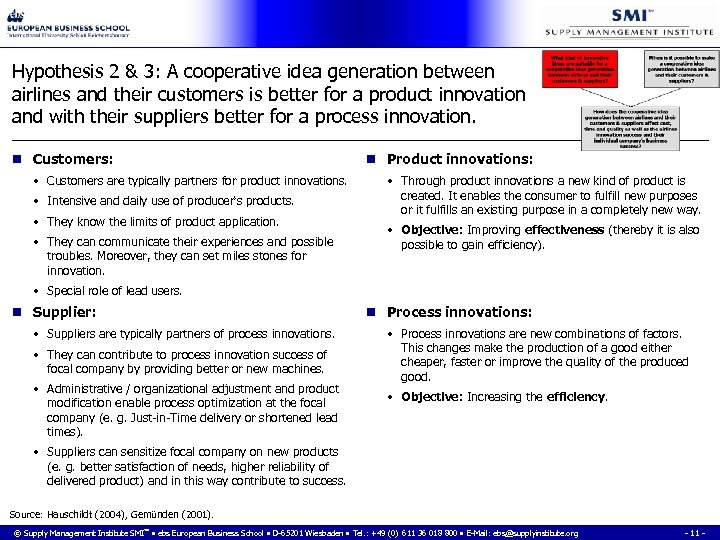 Hypothesis 2 & 3: A cooperative idea generation between airlines and their customers is better for a product innovation and with their suppliers better for a process innovation. n Customers: • Customers are typically partners for product innovations. • Intensive and daily use of producer‘s products. • They know the limits of product application. • They can communicate their experiences and possible troubles. Moreover, they can set miles stones for innovation. n Product innovations: • Through product innovations a new kind of product is created. It enables the consumer to fulfill new purposes or it fulfills an existing purpose in a completely new way. • Objective: Improving effectiveness (thereby it is also possible to gain efficiency). • Special role of lead users. n Supplier: • Suppliers are typically partners of process innovations. • They can contribute to process innovation success of focal company by providing better or new machines. • Administrative / organizational adjustment and product modification enable process optimization at the focal company (e. g. Just-in-Time delivery or shortened lead times). n Process innovations: • Process innovations are new combinations of factors. This changes make the production of a good either cheaper, faster or improve the quality of the produced good. • Objective: Increasing the efficiency. • Suppliers can sensitize focal company on new products (e. g. better satisfaction of needs, higher reliability of delivered product) and in this way contribute to success. Source: Hauschildt (2004), Gemünden (2001). © Supply Management Institute SMI ™ • ebs European Business School • D-65201 Wiesbaden • Tel. : +49 (0) 611 36 018 800 • E-Mail: ebs@supplyinstitute. org - 11 -
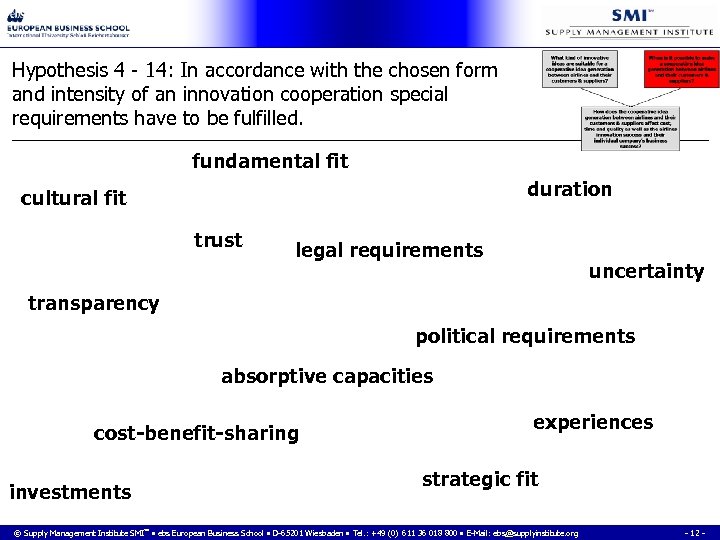 Hypothesis 4 - 14: In accordance with the chosen form and intensity of an innovation cooperation special requirements have to be fulfilled. fundamental fit duration cultural fit trust legal requirements uncertainty transparency political requirements absorptive capacities cost-benefit-sharing investments experiences strategic fit © Supply Management Institute SMI ™ • ebs European Business School • D-65201 Wiesbaden • Tel. : +49 (0) 611 36 018 800 • E-Mail: ebs@supplyinstitute. org - 12 -
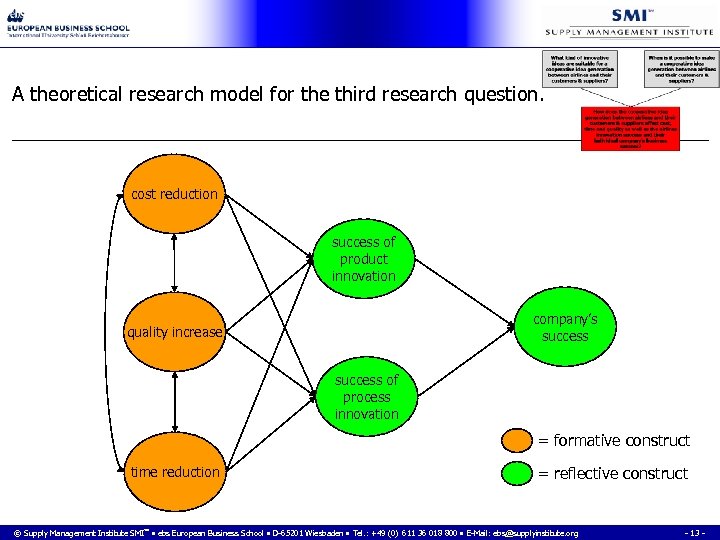 A theoretical research model for the third research question. cost reduction success of product innovation company’s success quality increase success of process innovation = formative construct time reduction = reflective construct © Supply Management Institute SMI ™ • ebs European Business School • D-65201 Wiesbaden • Tel. : +49 (0) 611 36 018 800 • E-Mail: ebs@supplyinstitute. org - 13 -
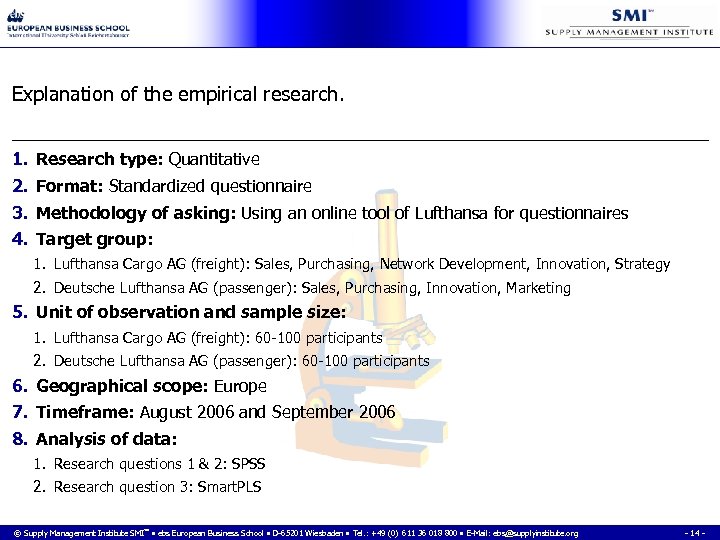 Explanation of the empirical research. 1. Research type: Quantitative 2. Format: Standardized questionnaire 3. Methodology of asking: Using an online tool of Lufthansa for questionnaires 4. Target group: 1. Lufthansa Cargo AG (freight): Sales, Purchasing, Network Development, Innovation, Strategy 2. Deutsche Lufthansa AG (passenger): Sales, Purchasing, Innovation, Marketing 5. Unit of observation and sample size: 1. Lufthansa Cargo AG (freight): 60 -100 participants 2. Deutsche Lufthansa AG (passenger): 60 -100 participants 6. Geographical scope: Europe 7. Timeframe: August 2006 and September 2006 8. Analysis of data: 1. Research questions 1 & 2: SPSS 2. Research question 3: Smart. PLS © Supply Management Institute SMI ™ • ebs European Business School • D-65201 Wiesbaden • Tel. : +49 (0) 611 36 018 800 • E-Mail: ebs@supplyinstitute. org - 14 -
 Some open questions are left. 1. How can I justify that I only ask Lufthansa (air freight market and passenger market)? 2. How many participants do I need for using SPSS? 3. Is it to much for one dissertation? 4. Do you have any relevant literature concerning my topic? © Supply Management Institute SMI ™ • ebs European Business School • D-65201 Wiesbaden • Tel. : +49 (0) 611 36 018 800 • E-Mail: ebs@supplyinstitute. org - 15 -
 Thank you very much for your attention and support! © Supply Management Institute SMI ™ • ebs European Business School • D-65201 Wiesbaden • Tel. : +49 (0) 611 36 018 800 • E-Mail: ebs@supplyinstitute. org - 16 -
 Back up Slides
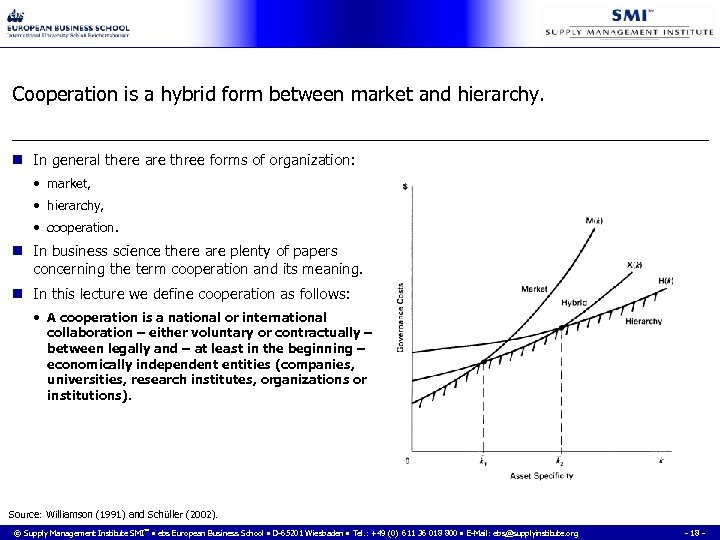 Cooperation is a hybrid form between market and hierarchy. n In general there are three forms of organization: • market, • hierarchy, • cooperation. n In business science there are plenty of papers concerning the term cooperation and its meaning. n In this lecture we define cooperation as follows: • A cooperation is a national or international collaboration – either voluntary or contractually – between legally and – at least in the beginning – economically independent entities (companies, universities, research institutes, organizations or institutions). Source: Williamson (1991) and Schüller (2002). © Supply Management Institute SMI ™ • ebs European Business School • D-65201 Wiesbaden • Tel. : +49 (0) 611 36 018 800 • E-Mail: ebs@supplyinstitute. org - 18 -
![Organizational forms of innovation cooperation: [1/2] n One can distinguish between four types of](https://present5.com/presentation/0f5c4b29f75a31c065ff602162712925/image-19.jpg "Organizational forms of innovation cooperation: [1/2] n One can distinguish between four types of") Organizational forms of innovation cooperation: [1/2] n One can distinguish between four types of innovation cooperation, namely (1) horizontal, (2) vertical, (3) diagonal and (4) conglomerate innovation cooperations. (1) Horizontal relationships: - Between companies of the same industry. - Companies compete on sales market. - Value chains of partners are not affected. - Common between direct competitors in order to save money and time further to get know-how advantages. - Example: Star Alliance. (2) Vertical relationships: - Between companies that are on different tiers of the same value chain (consumer-supplier-relationship). - Cooperations between producer and supplier are typical. - Various characteristics (reaching from simple supplier-relationships with manufacturing of components to partnerships in development). - Exist between producer and customers of products and services as well (e. g. pilot applications of new products). - Example: Cooperation between Lufthansa and Airbus. Source: Pleschak/ Sabisch (1996). © Supply Management Institute SMI ™ • ebs European Business School • D-65201 Wiesbaden • Tel. : +49 (0) 611 36 018 800 • E-Mail: ebs@supplyinstitute. org - 19 -
Organizational forms of innovation cooperation: [1/2] n One can distinguish between four types of innovation cooperation, namely (1) horizontal, (2) vertical, (3) diagonal and (4) conglomerate innovation cooperations. (1) Horizontal relationships: - Between companies of the same industry. - Companies compete on sales market. - Value chains of partners are not affected. - Common between direct competitors in order to save money and time further to get know-how advantages. - Example: Star Alliance. (2) Vertical relationships: - Between companies that are on different tiers of the same value chain (consumer-supplier-relationship). - Cooperations between producer and supplier are typical. - Various characteristics (reaching from simple supplier-relationships with manufacturing of components to partnerships in development). - Exist between producer and customers of products and services as well (e. g. pilot applications of new products). - Example: Cooperation between Lufthansa and Airbus. Source: Pleschak/ Sabisch (1996). © Supply Management Institute SMI ™ • ebs European Business School • D-65201 Wiesbaden • Tel. : +49 (0) 611 36 018 800 • E-Mail: ebs@supplyinstitute. org - 19 -
![Organizational forms of innovation cooperation: [2/2] n They subdivide (1) horizontal, (2) vertical, (3)](https://present5.com/presentation/0f5c4b29f75a31c065ff602162712925/image-20.jpg "Organizational forms of innovation cooperation: [2/2] n They subdivide (1) horizontal, (2) vertical, (3)") Organizational forms of innovation cooperation: [2/2] n They subdivide (1) horizontal, (2) vertical, (3) diagonal and (4) conglomerate innovation cooperation. (3) Diagonal relationships: - Companies from different industries and different tiers of the value chain cooperate. - Players are acting on different markets but cooperation on neighboring markets. - Increasing application on new technology field with broad application spectrum. (4) Conglomerate relationships: - Cooperation on markets that are unrelated to the markets of the cooperation partners. Source: Pleschak/ Sabisch (1996). © Supply Management Institute SMI ™ • ebs European Business School • D-65201 Wiesbaden • Tel. : +49 (0) 611 36 018 800 • E-Mail: ebs@supplyinstitute. org - 20 -
Organizational forms of innovation cooperation: [2/2] n They subdivide (1) horizontal, (2) vertical, (3) diagonal and (4) conglomerate innovation cooperation. (3) Diagonal relationships: - Companies from different industries and different tiers of the value chain cooperate. - Players are acting on different markets but cooperation on neighboring markets. - Increasing application on new technology field with broad application spectrum. (4) Conglomerate relationships: - Cooperation on markets that are unrelated to the markets of the cooperation partners. Source: Pleschak/ Sabisch (1996). © Supply Management Institute SMI ™ • ebs European Business School • D-65201 Wiesbaden • Tel. : +49 (0) 611 36 018 800 • E-Mail: ebs@supplyinstitute. org - 20 -
 References. n n n n Christiansen JA (2000) Competitive Innovation Management. Techniques to Improve Innovation Performance. Mac. Millan Press ltd. , Houndmills et al. Cooper RG (1999) The Invisible Success Factors in Product Innovation. In: Journal of Product Innovation Management, vol. 16: 115 -133. Handfield RB, Ragatz GL, Petersen KJ, Monczka RM (2004) Involving Suppliers in New Product Development. In: Tushman ML, Anderson P (ed) Managing Strategic Innovation and Change. A Collection of Readings. 2. edn, Oxford University Press, Inc. , New York, pp 506 -522. Tether BS (2003) The Sources and Aims of Innovation in Services: Variety between and within Sectors. In: Economics of Innovation and New Technology, vol. 12, No. 6: 481 -505. Powell WW (2004) Learning from Collaboration. Knowledge and Network in the Biotechnology and Pharmaceutical Industries. In: Tushman ML, Anderson P (eds): Managing Strategic Innovation and Change. A Collection of Readings. 2. edn, Oxford University Press, Inc. , New York pp 393 -401. Hauschildt J (2004) Innovationsmanagement. 3. edn, Verlag Franz Vahlen Gmb. H, München. Williamson OE (1991) Comparative Economic Organization: The Analysis of Discrete Structural Alternatives. In: Administrative Science Quarterly, vol. 36: 269 -296. Schüller M (2002) Strategieentwicklung airlinegeführter Supply Chains. Spezifische Erfolgsfaktoren des Supply Chain Managements in der Luftfracht und Handlungsempfehlungen für Luftfracht-Carrier, Dissertation. Verlag Dr. Kovač, Hamburg. Pleschak F, Sabisch H (1996) Innovationsmanagement. Schäffer-Poeschel Verlag, Stuttgart. Gemünden HG (2004) Innovation Networks: The Karlsruhe and Berlin Studies. In: Albers S (ed): Cross-functional Innovation Management: Perspectives from Different Disciplines. Betriebswirtschaftlicher Verlag Dr. Th. Gabler/ GWV Fachverlag Gmb. H, Wiesbaden, pp 37 -53. Gemünden HG (2001) Innovationsmanagement als Kooperationsmanagement. In: Albers S, Brockhoff K, Hauschildt J (eds): Technologie- und Innovationsmanagement: Leistungsbilanz des Kieler Graduiertenkollegs. Deutscher Universitäts-Verlag Gmb. H, Wiesbaden, pp 117 -161. Thom N (1980) Grundlagen des betrieblichen Innovationsmanagements, 2. edn, Hanstein, Königstein. IATA (2005) Ranking Tables from WATS for 2004. http: //www. iata. org/pressroom/wats_freight_flown. htm (call date: 14. 12. 2005). Auerbach S, Delfmann W (2005) Consolidating the Network Carrier Business Model in the European Airline Industry. In: Delfmann W, Baum H, Auerbach S, Albers S (eds): Strategic Management in the Aviation Industry. Ashgate Publishing Ltd. , Hampshire, pp. 65 -96. Mc. Kinsey & Company (2005) Pressemitteilung: Mc. Kinsey-Studie: Sinkendes Wachstum belastet Billigflieger. http: //www. mckinsey. de/_downloads/Presse/pm_050623_bb_airlines. pdf (call date: 14. 12. 2005). Trienekens JH, Hagen JM, Beulens AJM, Omta SWF (2003) Innovation Through (International) Food Supply Chain Development: A Research Agenda. In: The International Food and Agribusiness Management Review, vol. 6, Iss. 1: 84 -98. © Supply Management Institute SMI ™ • ebs European Business School • D-65201 Wiesbaden • Tel. : +49 (0) 611 36 018 800 • E-Mail: ebs@supplyinstitute. org - 21 -