


 Скачать презентацию Innovation IP Summit 2015 International IP Litigation
7809fd831ff81c373d9533f92d6c028d.ppt
- Количество слайдов: 20
 Innovation & IP Summit 2015 International IP Litigation Strategy by Michael C. Elmer ©Copyright Global IP Project, 2015
 Background - - Founded in January 2002 Goal: Compile patentee win rates and other objective patent litigation metrics for countries around the world - Members: Attorneys from firms representing 30 countries/districts Argentina, Australia, Austria, Brazil, Canada, Chile, China (mainland), Denmark, England & Wales, Finland, France, Germany, India, Ireland, Israel, Italy, Japan, Mexico, Netherlands, New Zealand, Norway, Russia, Scotland, South Africa, Spain, South Korea, Sweden, Switzerland, China Taiwan, and United States - Current Activities - Collaboration agreement with - New Book: Global Patent Litigation: How and Where to Win - Annual Report (current trends, data, and global strategies) - GIP website ( www. globalpatentmetrics. com ) 2
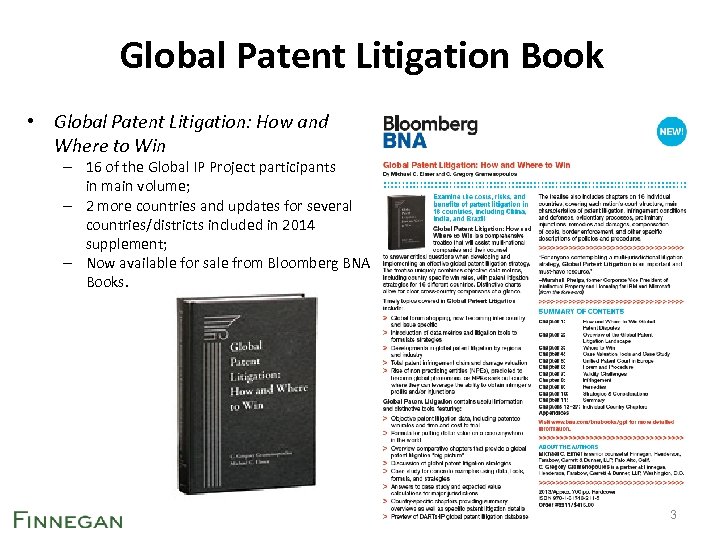 Global Patent Litigation Book • Global Patent Litigation: How and Where to Win – 16 of the Global IP Project participants in main volume; – 2 more countries and updates for several countries/districts included in 2014 supplement; – Now available for sale from Bloomberg BNA Books. 3
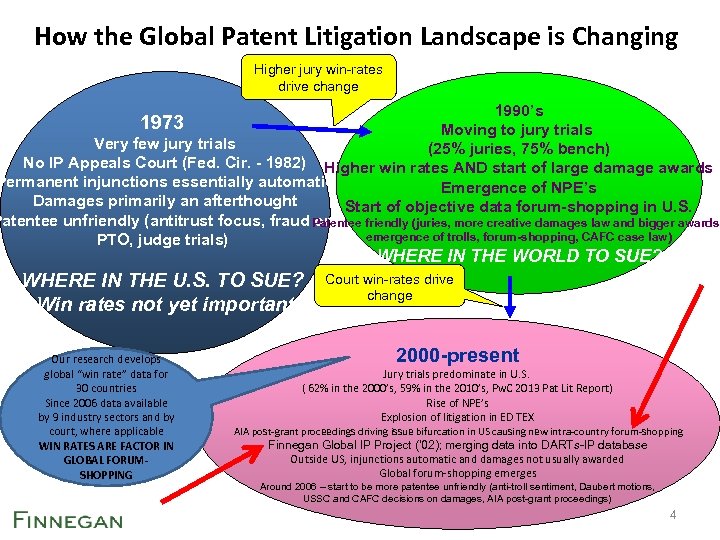 How the Global Patent Litigation Landscape is Changing Higher jury win-rates drive change 1990’s 1973 Moving to jury trials Very few jury trials (25% juries, 75% bench) No IP Appeals Court (Fed. Cir. - 1982) Higher win rates AND start of large damage awards Permanent injunctions essentially automatic Emergence of NPE’s Damages primarily an afterthought Start of objective data forum-shopping in U. S. Patentee unfriendly (antitrust focus, fraud Patentee friendly (juries, more creative damages law and bigger awards, on emergence of trolls, forum-shopping, CAFC case law) PTO, judge trials) WHERE IN THE WORLD TO SUE? WHERE IN THE U. S. TO SUE? Win rates not yet important Our research develops global “win rate” data for 30 countries Since 2006 data available by 9 industry sectors and by court, where applicable WIN RATES ARE FACTOR IN GLOBAL FORUMSHOPPING Court win-rates drive change 2000 -present Jury trials predominate in U. S. ( 62% in the 2000’s, 59% in the 2010’s, Pw. C 2013 Pat Lit Report) Rise of NPE’s Explosion of litigation in ED TEX AIA post-grant proceedings driving issue bifurcation in US causing new intra-country forum-shopping Finnegan Global IP Project ('02); merging data into DARTs-IP database Outside US, injunctions automatic and damages not usually awarded Global forum-shopping emerges Around 2006 – start to be more patentee unfriendly (anti-troll sentiment, Daubert motions, USSC and CAFC decisions on damages, AIA post-grant proceedings) 4
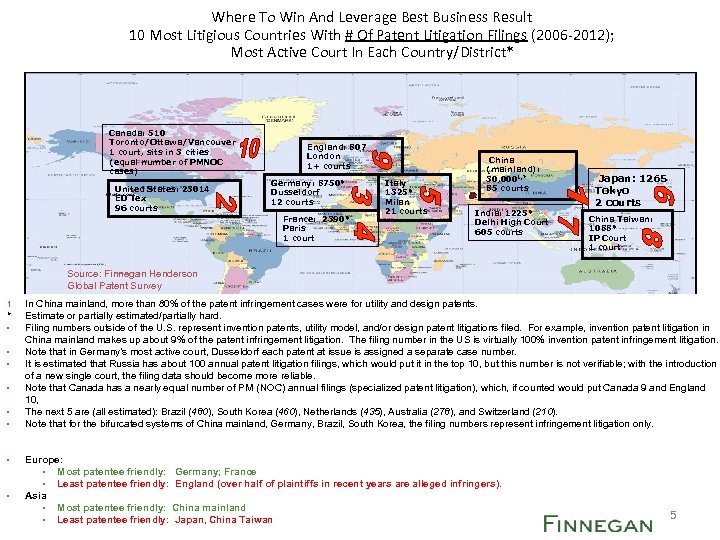 Where To Win And Leverage Best Business Result 10 Most Litigious Countries With # Of Patent Litigation Filings (2006 -2012); Most Active Court In Each Country/District* Canada: 510 Toronto/Ottawa/Vancouver 1 court, sits in 3 cities (equal number of PMNOC cases) United States: 23014 ED Tex 96 courts England: 807 London 1+ courts Germany: 8750* Dusseldorf 12 courts France: 2390* Paris 1 court Italy 1325* Milan 21 courts China (mainland): 30, 0001, * 85 courts India: 1225* Delhi High Court 605 courts Japan: 1265 Tokyo 2 courts China Taiwan: 1088* IP Court 1 court Source: Finnegan Henderson Global Patent Survey 1 * • • In China mainland, more than 80% of the patent infringement cases were for utility and design patents. Estimate or partially estimated/partially hard. Filing numbers outside of the U. S. represent invention patents, utility model, and/or design patent litigations filed. For example, invention patent litigation in China mainland makes up about 9% of the patent infringement litigation. The filing number in the US is virtually 100% invention patent infringement litigation. Note that in Germany’s most active court, Dusseldorf each patent at issue is assigned a separate case number. It is estimated that Russia has about 100 annual patent litigation filings, which would put it in the top 10, but this number is not verifiable; with the introduction of a new single court, the filing data should become more reliable. Note that Canada has a nearly equal number of PM (NOC) annual filings (specialized patent litigation), which, if counted would put Canada 9 and England 10, The next 5 are (all estimated): Brazil (480), South Korea (460), Netherlands (435), Australia (278), and Switzerland (210). Note that for the bifurcated systems of China mainland, Germany, Brazil, South Korea, the filing numbers represent infringement litigation only. Europe: • Most patentee friendly: Germany; France • Least patentee friendly: England (over half of plaintiffs in recent years are alleged infringers). Asia • Most patentee friendly: China mainland • Least patentee friendly: Japan, China Taiwan 5
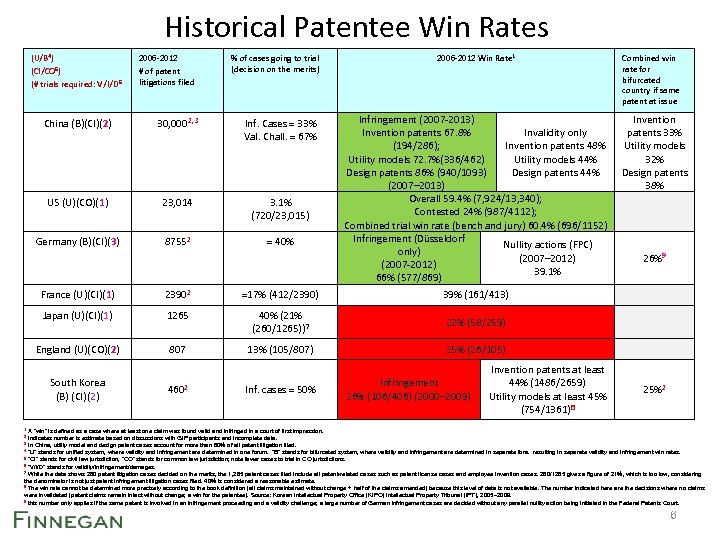 Historical Patentee Win Rates (U/B 4) (CI/CO 5) (# trials required: V/I/D 6 2006 -2012 # of patent litigations filed % of cases going to trial (decision on the merits) China (B)(CI)(2) 30, 0002, 3 Inf. Cases ≈ 33% Val. Chall. ≈ 67% US (U)(CO)(1) 23, 014 3. 1% (720/23, 015) Germany (B)(CI)(3) 87552 ≈ 40% 2006 -2012 Win Rate 1 Infringement (2007 -2013) Invalidity only Invention patents 67. 8% Invention patents 48% (194/286); Utility models 72. 7%(336/462) Utility models 44% Design patents 86% (940/1093) Design patents 44% (2007– 2013) Overall 59. 4% (7, 924/13, 340); Contested 24% (987/4112); Combined trial win rate (bench and jury) 60. 4% (696/1152) Infringement (Düsseldorf Nullity actions (FPC) only) (2007– 2012) (2007 -2012) 39. 1% 66% (577/869) France (U)(CI)(1) 23902 ≈17% (412/2390) 1265 40% (21% (260/1265)) 7 807 13% (105/807) 26%9 22% (58/259) England (U)(CO)(2) Invention patents 33% Utility models 32% Design patents 38% 39% (161/413) Japan (U)(CI)(1) Combined win rate for bifurcated country if same patent at issue 25% (26/105) South Korea (B) (CI)(2) 4602 Inf. cases ≈ 50% Infringement 26% (106/406) (2000– 2009) Invention patents at least 44% (1486/2659) Utility models at least 45% (754/1361) 8 25%2 A “win” is defined as a case where at least one claim was found valid and infringed in a court of first impression. Indicates number is estimate based on discussions with GIP participants and incomplete data. In China, utility model and design patent cases account for more than 80% of all patent litigation filed. 4 “U” stands for unified system, where validity and infringement are determined in one forum. “B” stands for bifurcated system, where validity and infringement are determined in separate fora. resulting in separate validity and infringement win rates. 5 “CI” stands for civil law jurisdiction, “CO” stands for common law jurisdiction; note fewer cases to trial in CO jurisdictions. 6 “V/I/D” stands for validity/infringement/damages. 7 While the data shows 260 patent litigation cases decided on the merits, the 1, 265 patent cases filed include all patent-related cases such as patent license cases and employee invention cases. 260/1265 gives a figure of 21%, which is too low, considering the denominator is not just patent infringement litigation cases filed. 40% is considered a reasonable estimate. 8 The win rate cannot be determined more precisely according to the book definition (all claims maintained without change + half of the claims amended) because this level of data is not available. The number indicated here are the decisions where no claims were invalidated (patent claims remain intact without change; a win for the patentee). Source: Korean Intellectual Property Office (KIPO) Intellectual Property Tribunal (IPT), 2005– 2009. 9 this number only applies if the same patent is involved in an infringement proceeding and a validity challenge; a large number of German infringement cases are decided without any parallel nullity action being initiated in the Federal Patents Court. 1 2 3 6
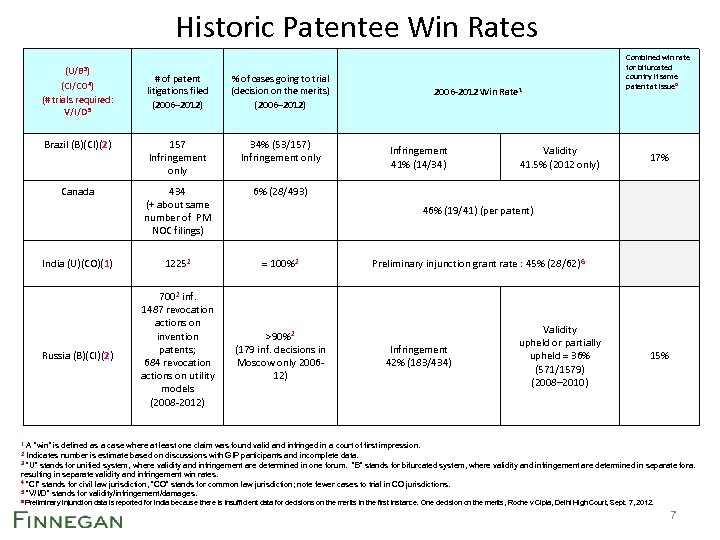 Historic Patentee Win Rates (U/B 3) # of patent litigations filed (2006– 2012) % of cases going to trial (decision on the merits) (2006– 2012) Brazil (B)(CI)(2) 157 Infringement only 34% (53/157) Infringement only Canada 434 (+ about same number of PM NOC filings) 6% (28/493) 12252 ≈ 100%2 Combined win rate for bifurcated country if same patent at issue 6 (CI/CO 4) (# trials required: V/I/D 5 India (U)(CO)(1) Russia (B)(CI)(2) 7002 inf. 1487 revocation actions on invention patents; 684 revocation actions on utility models (2008 -2012) 2006 -2012 Win Rate 1 Infringement 41% (14/34) Validity 41. 5% (2012 only) 17% 46% (19/41) (per patent) >90%2 (179 inf. decisions in Moscow only 200612) Preliminary injunction grant rate : 45% (28/62)6 Infringement 42% (183/434) Validity upheld or partially upheld ≈ 36% (571/1579) (2008– 2010) 15% A “win” is defined as a case where at least one claim was found valid and infringed in a court of first impression. Indicates number is estimate based on discussions with GIP participants and incomplete data. 3 “U” stands for unified system, where validity and infringement are determined in one forum. “B” stands for bifurcated system, where validity and infringement are determined in separate fora. resulting in separate validity and infringement win rates. 4 “CI” stands for civil law jurisdiction, “CO” stands for common law jurisdiction; note fewer cases to trial in CO jurisdictions. 5 “V/I/D” stands for validity/infringement/damages. 1 2 6 Preliminary injunction data is reported for India because there is insufficient data for decisions on the merits in the first instance. One decision on the merits, Roche v Cipla, Delhi High Court, Sept. 7, 2012. 7
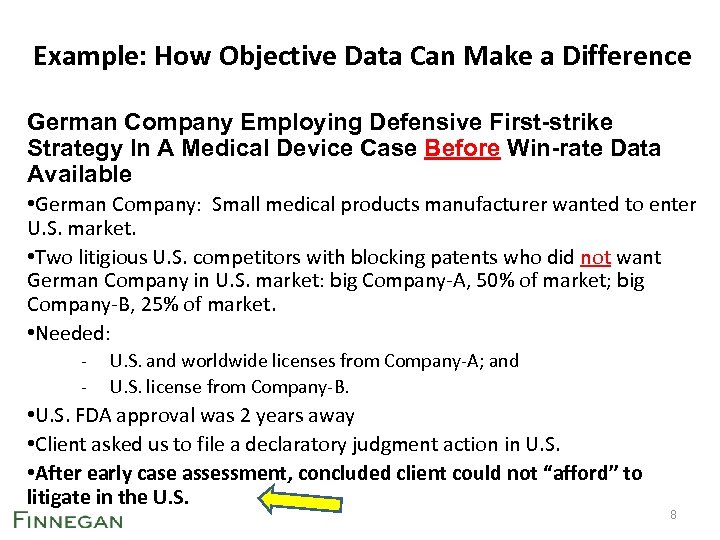 Example: How Objective Data Can Make a Difference German Company Employing Defensive First-strike Strategy In A Medical Device Case Before Win-rate Data Available • German Company: Small medical products manufacturer wanted to enter U. S. market. • Two litigious U. S. competitors with blocking patents who did not want German Company in U. S. market: big Company-A, 50% of market; big Company-B, 25% of market. • Needed: - U. S. and worldwide licenses from Company-A; and - U. S. license from Company-B. • U. S. FDA approval was 2 years away • Client asked us to file a declaratory judgment action in U. S. • After early case assessment, concluded client could not “afford” to litigate in the U. S. 8
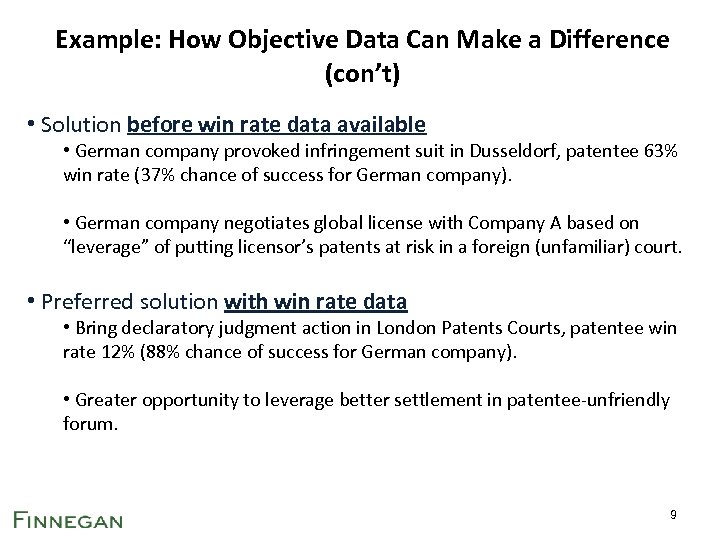 Example: How Objective Data Can Make a Difference (con’t) • Solution before win rate data available • German company provoked infringement suit in Dusseldorf, patentee 63% win rate (37% chance of success for German company). • German company negotiates global license with Company A based on “leverage” of putting licensor’s patents at risk in a foreign (unfamiliar) court. • Preferred solution with win rate data • Bring declaratory judgment action in London Patents Courts, patentee win rate 12% (88% chance of success for German company). • Greater opportunity to leverage better settlement in patentee-unfriendly forum. 9
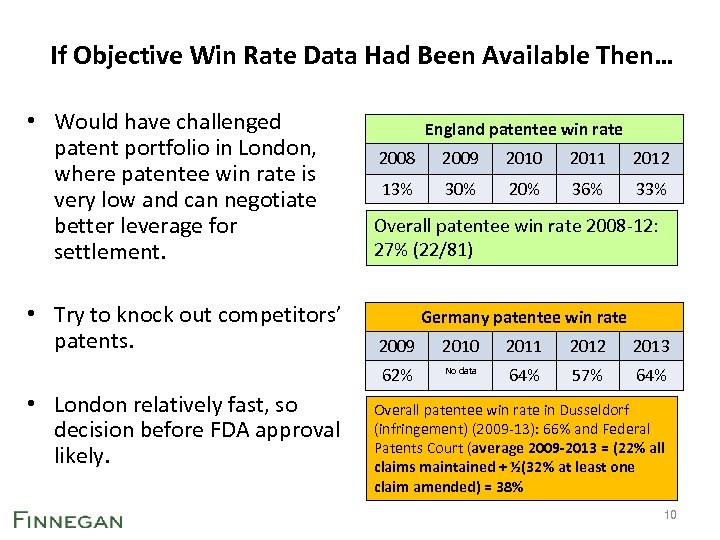 If Objective Win Rate Data Had Been Available Then… • Would have challenged patent portfolio in London, where patentee win rate is very low and can negotiate better leverage for settlement. • Try to knock out competitors’ patents. England patentee win rate 2008 2009 2010 2011 2012 13% 30% 20% 36% 33% Overall patentee win rate 2008 -12: 27% (22/81) Germany patentee win rate 2010 2011 2012 2013 62% • London relatively fast, so decision before FDA approval likely. 2009 No data 64% 57% 64% Overall patentee win rate in Dusseldorf (infringement) (2009 -13): 66% and Federal Patents Court (average 2009 -2013 = (22% all claims maintained + ½(32% at least one claim amended) = 38% 10
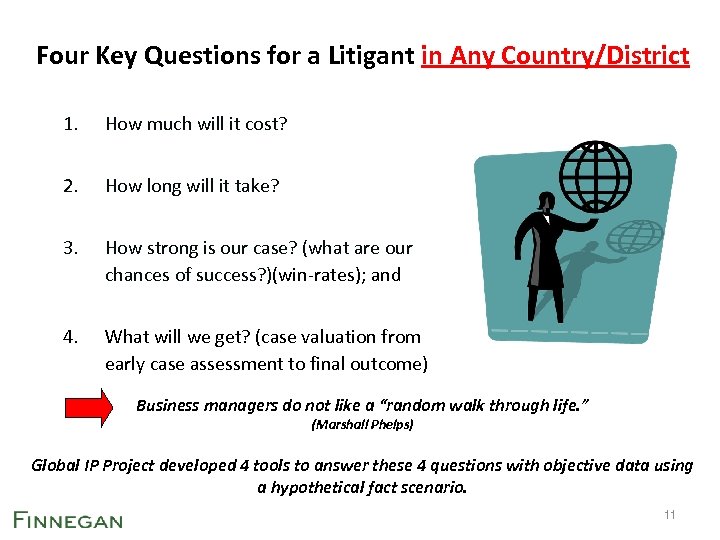 Four Key Questions for a Litigant in Any Country/District 1. How much will it cost? 2. How long will it take? 3. How strong is our case? (what are our chances of success? )(win-rates); and 4. What will we get? (case valuation from early case assessment to final outcome) Business managers do not like a “random walk through life. ” (Marshall Phelps) Global IP Project developed 4 tools to answer these 4 questions with objective data using a hypothetical fact scenario. 11
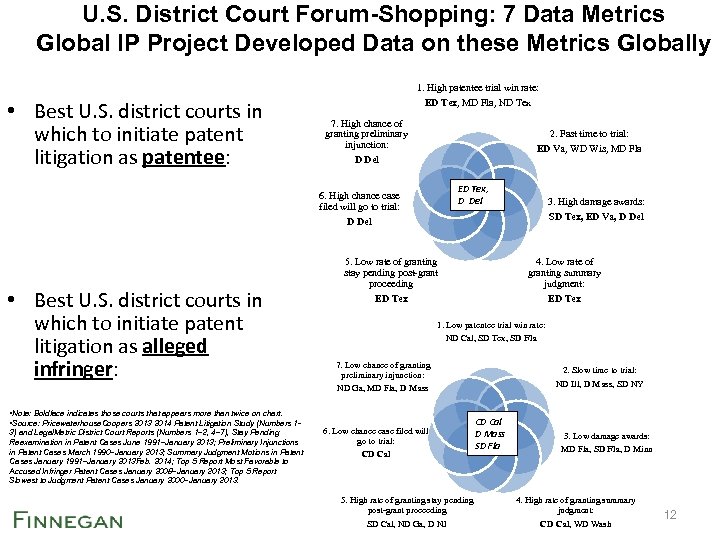 U. S. District Court Forum-Shopping: 7 Data Metrics Global IP Project Developed Data on these Metrics Globally 1. High patentee trial win rate: • Best U. S. district courts in which to initiate patent litigation as patentee: ED Tex, MD Fla, ND Tex 7. High chance of granting preliminary injunction: D Del 2. Fast time to trial: ED Va, WD Wis, MD Fla ED Tex, D Del 6. High chance case filed will go to trial: 3. High damage awards: SD Tex, ED Va, D Del • Best U. S. district courts in which to initiate patent litigation as alleged infringer: • Note: Boldface indicates those courts that appears more than twice on chart. • Source: Pricewaterhouse. Coopers 2013 2014 Patent Litigation Study (Numbers 13) and Legal. Metric District Court Reports (Numbers 1– 2, 4– 7), Stay Pending Reexamination in Patent Cases June 1991–January 2013; Preliminary Injunctions in Patent Cases March 1990–January 2013; Summary Judgment Motions in Patent Cases January 1991–January 2013 Feb. 2014; Top 5 Report Most Favorable to Accused Infringer Patent Cases January 2008–January 2013; Top 5 Report Slowest to Judgment Patent Cases January 2000–January 2013. 5. Low rate of granting stay pending post-grant proceeding 4. Low rate of granting summary judgment: ED Tex 1. Low patentee trial win rate: ND Cal, SD Tex, SD Fla 7. Low chance of granting preliminary injunction: ND Ga, MD Fla, D Mass 6. Low chance case filed will go to trial: CD Cal 5. High rate of granting stay pending post-grant proceeding SD Cal, ND Ga, D NJ 2. Slow time to trial: ND Ill, D Mass, SD NY CD Cal D Mass SD Fla 3. Low damage awards: MD Fla, SD Fla, D Minn 4. High rate of granting summary judgment: CD Cal, WD Wash 12
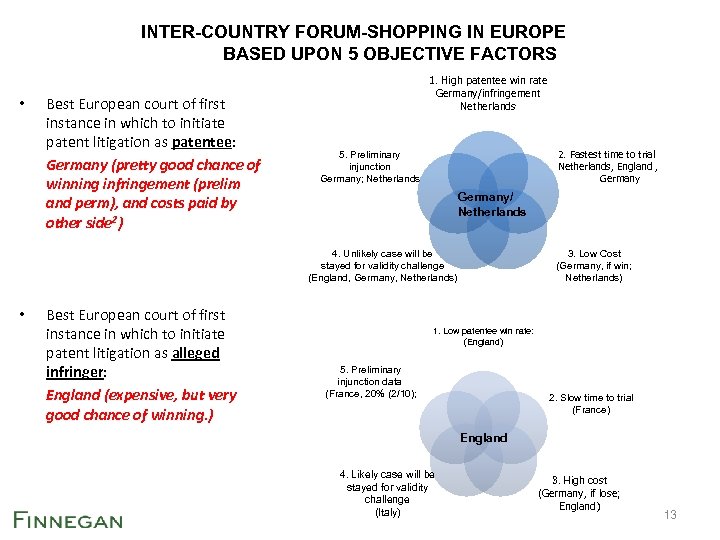 INTER-COUNTRY FORUM-SHOPPING IN EUROPE BASED UPON 5 OBJECTIVE FACTORS • Best European court of first instance in which to initiate patent litigation as patentee: Germany (pretty good chance of winning infringement (prelim and perm), and costs paid by other side 2) 1. High patentee win rate Germany/infringement Netherlands 2. Fastest time to trial Netherlands, England , Germany 5. Preliminary injunction Germany; Netherlands Germany/ Netherlands 4. Unlikely case will be stayed for validity challenge (England, Germany, Netherlands) • Best European court of first instance in which to initiate patent litigation as alleged infringer: England (expensive, but very good chance of winning. ) 3. Low Cost (Germany, if win; Netherlands) 1. Low patentee win rate: (England) 5. Preliminary injunction data (France, 20% (2/10); 2. Slow time to trial (France) England 4. Likely case will be stayed for validity challenge (Italy) 3. High cost (Germany, if lose; England) 13
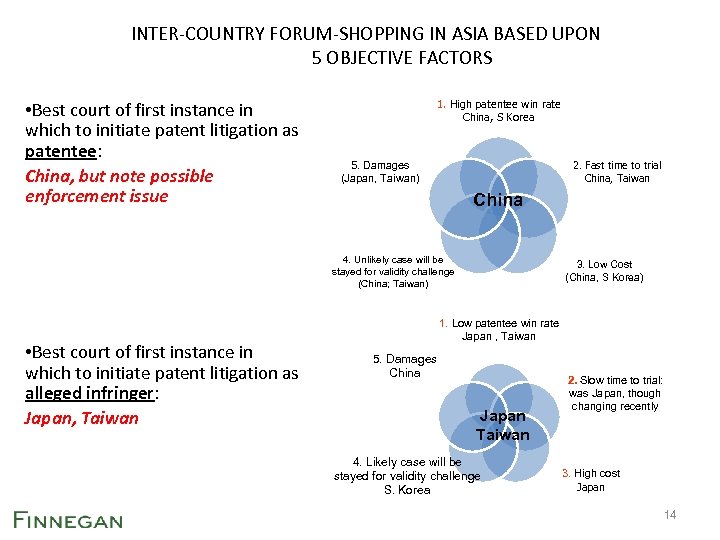 INTER-COUNTRY FORUM-SHOPPING IN ASIA BASED UPON 5 OBJECTIVE FACTORS • Best court of first instance in which to initiate patent litigation as patentee: China, but note possible enforcement issue 1. High patentee win rate China, S Korea 2. Fast time to trial China, Taiwan 5. Damages (Japan, Taiwan) China 4. Unlikely case will be stayed for validity challenge (China; Taiwan) • Best court of first instance in which to initiate patent litigation as alleged infringer: Japan, Taiwan 3. Low Cost (China, S Korea) 1. Low patentee win rate Japan , Taiwan 5. Damages China Japan Taiwan 4. Likely case will be stayed for validity challenge S. Korea 2. Slow time to trial: was Japan, though changing recently 3. High cost Japan 14
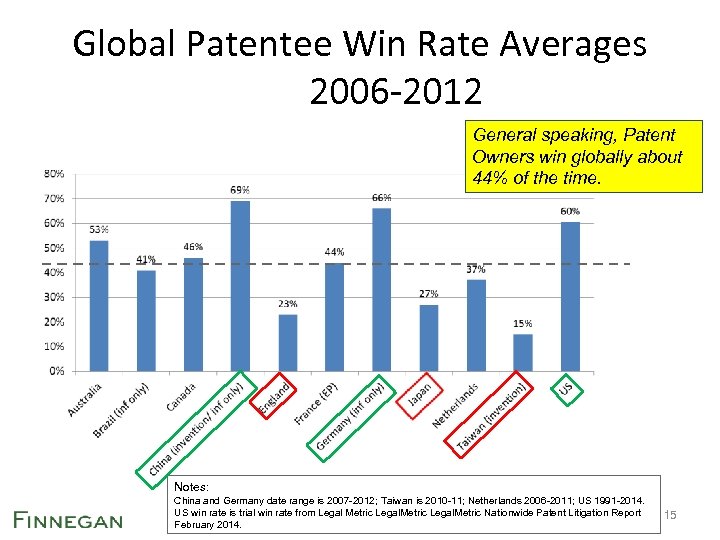 Global Patentee Win Rate Averages 2006 -2012 General speaking, Patent Owners win globally about 44% of the time. Notes: China and Germany date range is 2007 -2012; Taiwan is 2010 -11; Netherlands 2006 -2011; US 1991 -2014. US win rate is trial win rate from Legal Metric Legal. Metric Nationwide Patent Litigation Report February 2014. 15
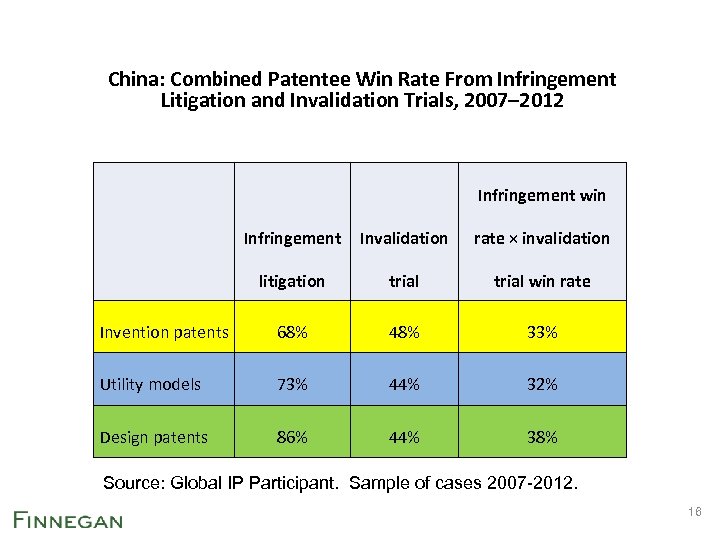 China: Combined Patentee Win Rate From Infringement Litigation and Invalidation Trials, 2007– 2012 Infringement win Infringement Invalidation rate × invalidation litigation trial win rate Invention patents 68% 48% 33% Utility models 73% 44% 32% Design patents 86% 44% 38% Source: Global IP Participant. Sample of cases 2007 -2012. 16
 “First-Strike” Strategy • IN THEORY: No res judicata effect of litigation outcome in one country on litigation outcome in another country/district (limited collateral estoppel). • IN PRACTICE: Leverage power of first litigation outcome to settle disputes globally/other jurisdictions. Clients want to settle conflict globally (exception is pharma). – Leverage historical win rate to increase case value. – First litigation outcome to settle dispute globally. Develop patent enforcement strategies (“where sue first”) with patentee win rate in mind. 17
 Thank You! For further information, please contact Mike Elmer 650 -849 -6610 949 -715 -5263 michael. elmer@finnegan. com 18
 19
19
 Disclaimer These materials have been prepared solely for educational and entertainment purposes to contribute to the understanding of intellectual property laws. These materials reflect only the personal views of the authors and are not individualized legal advice. It is understood that each case is fact specific, and that the appropriate solution in any case will vary. Therefore, these materials may or may not be relevant to any particular situation. Thus, the authors and their respective law firms cannot be bound either philosophically or as representatives of their various present and future clients to the comments expressed in these materials. The presentation of these materials does not establish any form of attorney-client relationship with these authors or their respective law firms. While every attempt was made to ensure that these materials are accurate, errors or omissions may be contained therein, for which any liability is disclaimed. 20