 Скачать презентацию Innovation Guided by Culture Lessons from the Amish
4d39b16ad78cda5743ae4d6f7c0c9dae.ppt
- Количество слайдов: 25




Innovation Guided by Culture Lessons from the Amish
SARE supported research project Integrating Quality of Life, Economic and Environmental Issues: Agroecosystem Analysis of Amish Farming Investigators Deborah Stinner, anthropological ag. ecologist Richard Moore, ecological ag. anthropologist Benjamin Stinner, agricultural ecologist Fred Hitzhusen, ag. resource economist
Why Study Amish Agriculture? Interesting culture and OARDC is located very close to the largest Amish settlement in the world. The Amish worldview is inherently more holistic than ours. We might be able to learn some fundamental principles of sustainability. Well managed Amish farms with a long history can serve as valuable reference points for important agroecological processes.
Objectives 1. Determine quality of life and community values for case study Amish families. 2. Analyze the economic efficiency of Amish agriculture with particular emphasis on economic benefits of community. 3. Evaluate nutrient cycling efficiency of case study Amish farms. 4. Facilitate discussion on what we learn from the Amish to help mainstream farm families be more sustainable.
Approach Three case study families in three different church communities in Holmes County, OH Ecosystem perspective and methods, ecologically Participatory research, anthropologically
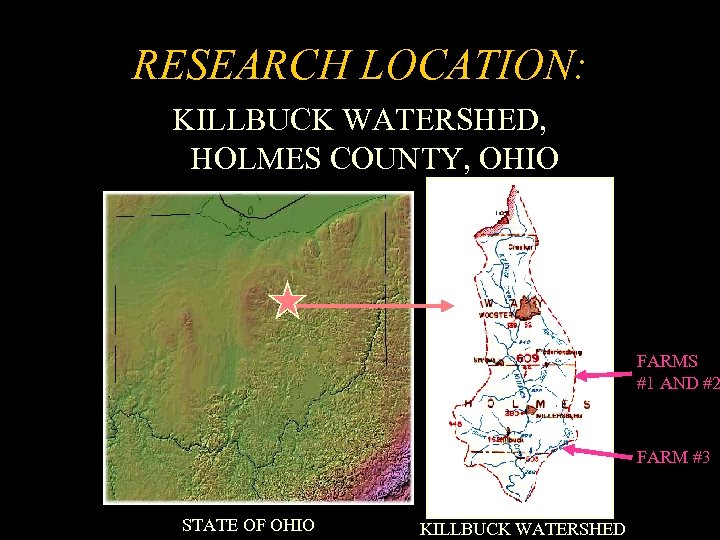
RESEARCH LOCATION: KILLBUCK WATERSHED, HOLMES COUNTY, OHIO FARMS #1 AND #2 FARM #3 STATE OF OHIO KILLBUCK WATERSHED
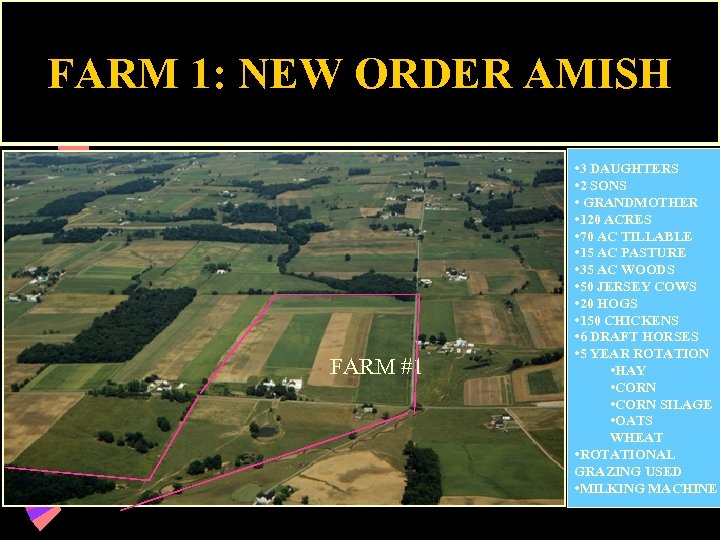
FARM 1: NEW ORDER AMISH FARM #1 • 3 DAUGHTERS • 2 SONS • GRANDMOTHER • 120 ACRES • 70 AC TILLABLE • 15 AC PASTURE • 35 AC WOODS • 50 JERSEY COWS • 20 HOGS • 150 CHICKENS • 6 DRAFT HORSES • 5 YEAR ROTATION • HAY • CORN SILAGE • OATS WHEAT • ROTATIONAL GRAZING USED • MILKING MACHINE
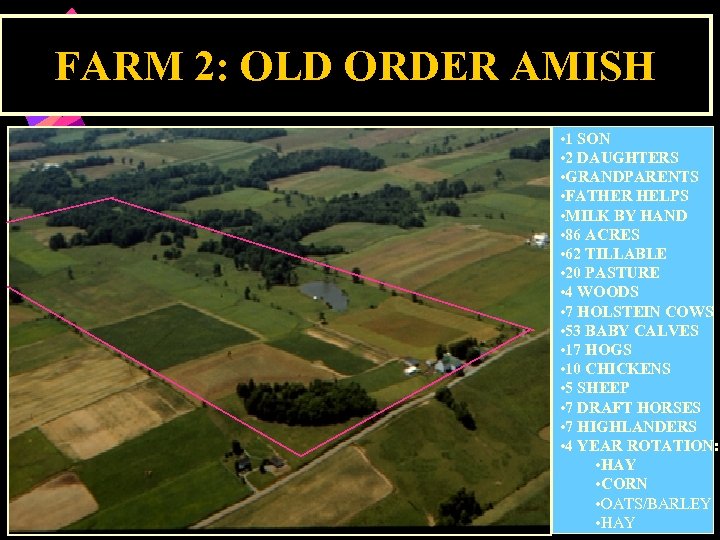
FARM 2: OLD ORDER AMISH • 1 SON • 2 DAUGHTERS • GRANDPARENTS • FATHER HELPS • MILK BY HAND • 86 ACRES • 62 TILLABLE • 20 PASTURE • 4 WOODS • 7 HOLSTEIN COWS • 53 BABY CALVES • 17 HOGS • 10 CHICKENS • 5 SHEEP • 7 DRAFT HORSES • 7 HIGHLANDERS • 4 YEAR ROTATION: • HAY • CORN • OATS/BARLEY • HAY
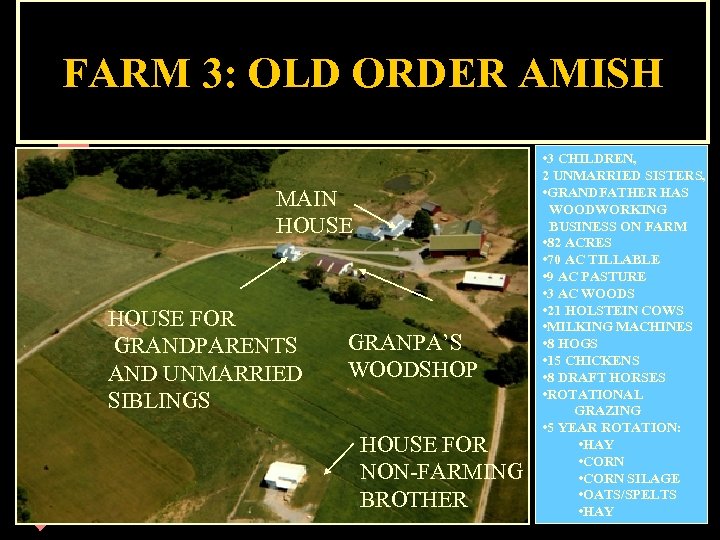
FARM 3: OLD ORDER AMISH MAIN HOUSE FOR GRANDPARENTS AND UNMARRIED SIBLINGS GRANPA’S WOODSHOP HOUSE FOR NON-FARMING BROTHER • 3 CHILDREN, 2 UNMARRIED SISTERS, • GRANDFATHER HAS WOODWORKING BUSINESS ON FARM • 82 ACRES • 70 AC TILLABLE • 9 AC PASTURE • 3 AC WOODS • 21 HOLSTEIN COWS • MILKING MACHINES • 8 HOGS • 15 CHICKENS • 8 DRAFT HORSES • ROTATIONAL GRAZING • 5 YEAR ROTATION: • HAY • CORN SILAGE • OATS/SPELTS • HAY
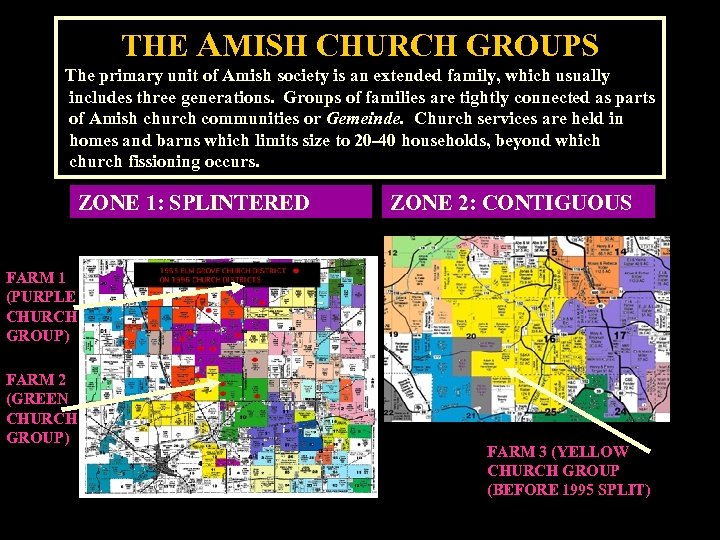
THE AMISH CHURCH GROUPS The primary unit of Amish society is an extended family, which usually includes three generations. Groups of families are tightly connected as parts of Amish church communities or Gemeinde. Church services are held in homes and barns which limits size to 20 -40 households, beyond which church fissioning occurs. ZONE 1: SPLINTERED ZONE 2: CONTIGUOUS FARM 1 (PURPLE CHURCH GROUP) FARM 2 (GREEN CHURCH GROUP) FARM 3 (YELLOW CHURCH GROUP (BEFORE 1995 SPLIT)
Quality of Life Values integrity of family and church community minimal materialism, self-sufficiency, living a simple life of Christian faithfulness farming preferred as means of support and raising a family, living in a pastoral setting shared labor with neighbors love of creation frugality
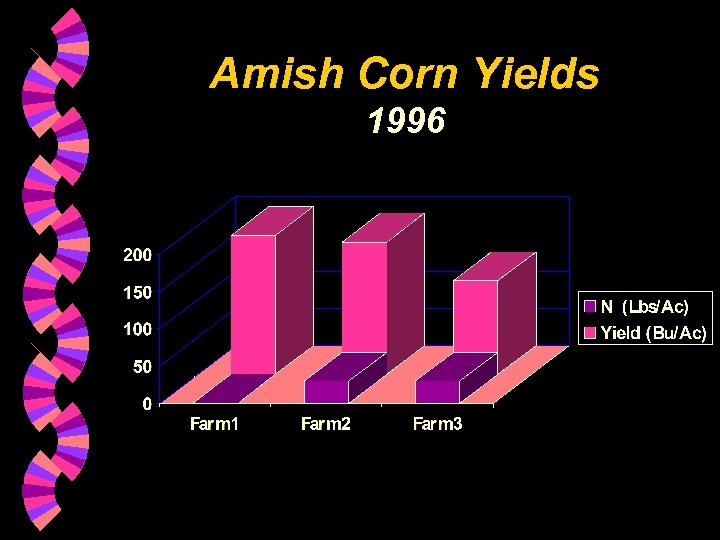
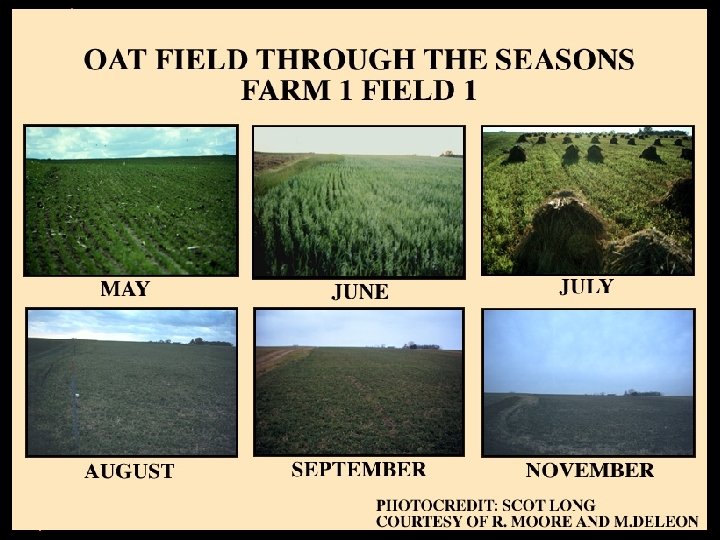
Amish Corn Yields 1996
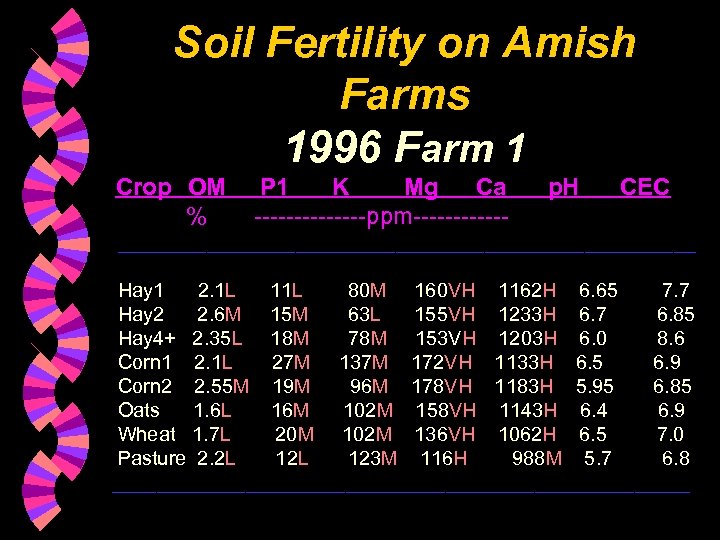
Soil Fertility on Amish Farms 1996 Farm 1 Crop OM % P 1 K Mg Ca -------ppm------ p. H CEC __________________________ Hay 1 2. 1 L 11 L 80 M 160 VH 1162 H 6. 65 7. 7 Hay 2 2. 6 M 15 M 63 L 155 VH 1233 H 6. 7 6. 85 Hay 4+ 2. 35 L 18 M 78 M 153 VH 1203 H 6. 0 8. 6 Corn 1 2. 1 L 27 M 137 M 172 VH 1133 H 6. 5 6. 9 Corn 2 2. 55 M 19 M 96 M 178 VH 1183 H 5. 95 6. 85 Oats 1. 6 L 16 M 102 M 158 VH 1143 H 6. 4 6. 9 Wheat 1. 7 L 20 M 102 M 136 VH 1062 H 6. 5 7. 0 Pasture 2. 2 L 123 M 116 H 988 M 5. 7 6. 8 __________________________
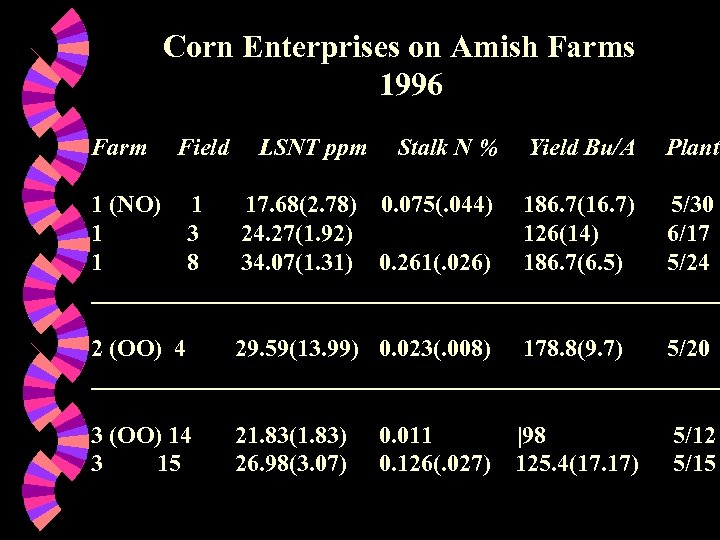
Corn Enterprises on Amish Farms 1996 Farm Field LSNT ppm Stalk N % Yield Bu/A Plant 1 (NO) 1 17. 68(2. 78) 0. 075(. 044) 186. 7(16. 7) 5/30 1 3 24. 27(1. 92) 126(14) 6/17 1 8 34. 07(1. 31) 0. 261(. 026) 186. 7(6. 5) 5/24 ___________________________ 2 (OO) 4 29. 59(13. 99) 0. 023(. 008) 178. 8(9. 7) 5/20 ___________________________ 3 (OO) 14 3 15 21. 83(1. 83) 26. 98(3. 07) 0. 011 0. 126(. 027) |98 125. 4(17. 17) 5/12 5/15
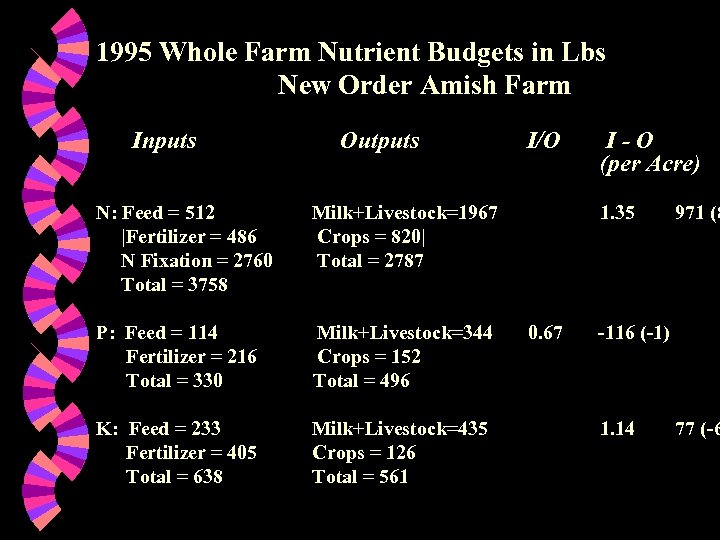
1995 Whole Farm Nutrient Budgets in Lbs New Order Amish Farm Inputs Outputs N: Feed = 512 |Fertilizer = 486 N Fixation = 2760 Total = 3758 Milk+Livestock=1967 Crops = 820| Total = 2787 P: Feed = 114 Fertilizer = 216 Total = 330 Milk+Livestock=344 Crops = 152 Total = 496 K: Feed = 233 Fertilizer = 405 Total = 638 Milk+Livestock=435 Crops = 126 Total = 561 I/O I-O (per Acre) 1. 35 0. 67 971 (8 -116 (-1) 1. 14 77 (-6
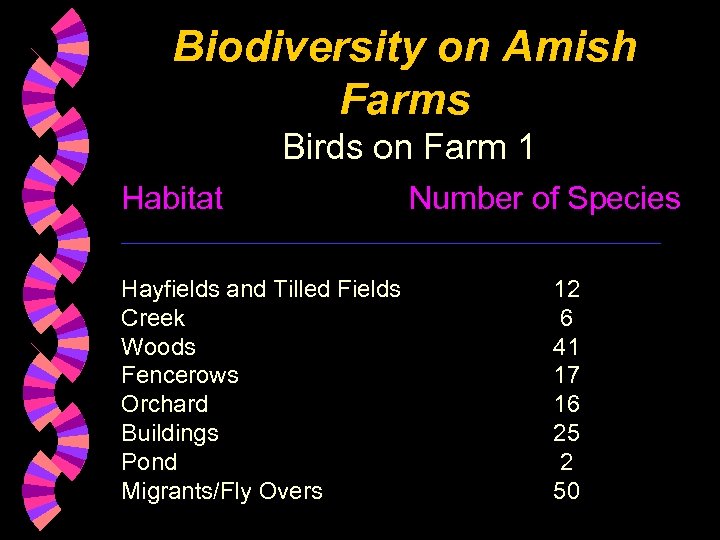
Biodiversity on Amish Farms Birds on Farm 1 Habitat Number of Species _______________________ Hayfields and Tilled Fields Creek Woods Fencerows Orchard Buildings Pond Migrants/Fly Overs 12 6 41 17 16 25 2 50

DRAWING BY ELSIE KLINE
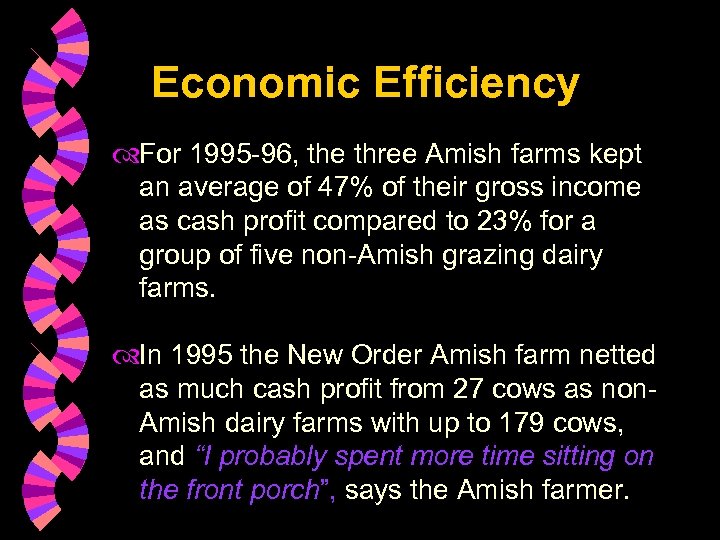
Economic Efficiency For 1995 -96, the three Amish farms kept an average of 47% of their gross income as cash profit compared to 23% for a group of five non-Amish grazing dairy farms. In 1995 the New Order Amish farm netted as much cash profit from 27 cows as non. Amish dairy farms with up to 179 cows, and “I probably spent more time sitting on the front porch”, says the Amish farmer.
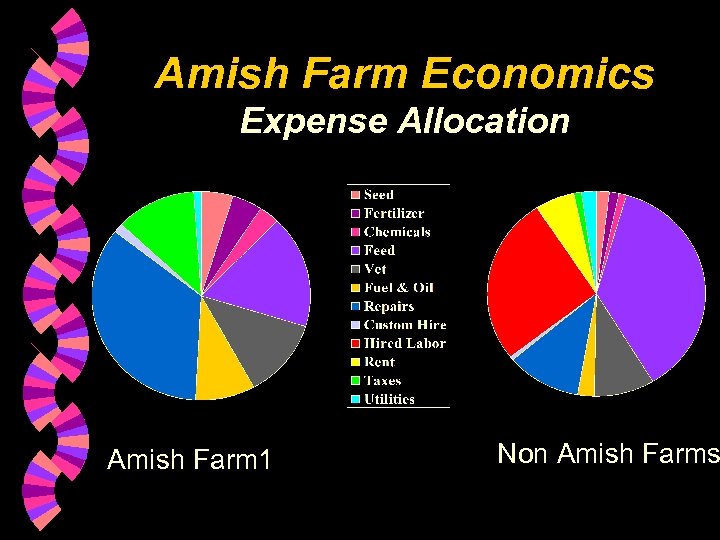
Amish Farm Economics Expense Allocation Amish Farm 1 Non Amish Farms
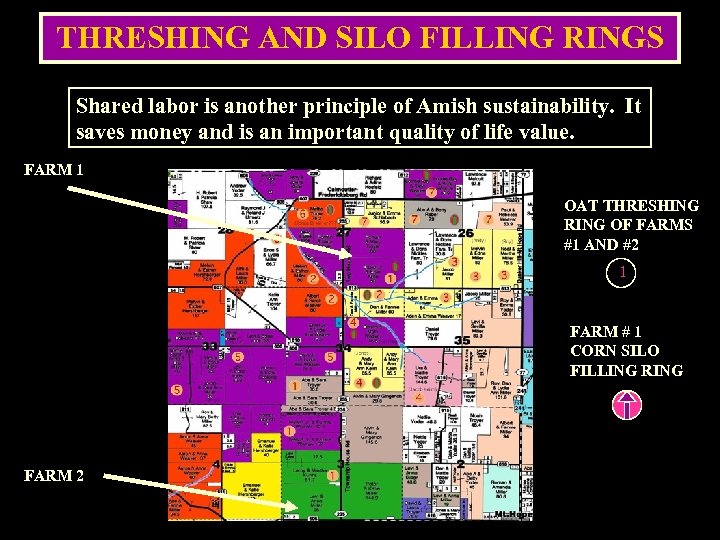
THRESHING AND SILO FILLING RINGS Shared labor is another principle of Amish sustainability. It saves money and is an important quality of life value. FARM 1 OAT THRESHING RING OF FARMS #1 AND #2 1 FARM # 1 CORN SILO FILLING RING FARM 2
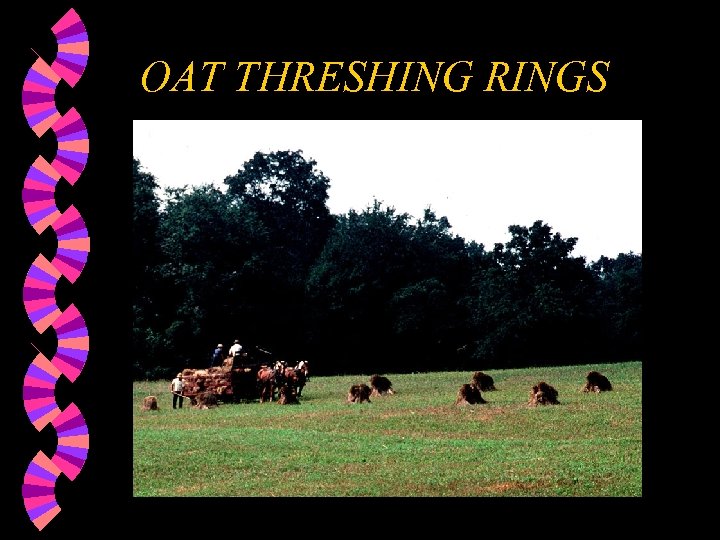
OAT THRESHING RINGS
Elements of Economic Efficiency on Amish Farms Free shared labor - lowers hired labor and machinery costs Horse farming - requires much less expensive equipment than tractor farming Minimal purchased feed costs - high ecological efficiency for whole farm Minimal hired labor costs - usually a teenage boy and an important way indigenous farming knowledge is passed on
Principles of Amish Sustainability Strong cultural integrity Interdependency and self-sufficiency Spiritual optimism Stewardship ethic Industriousness and thriftiness Control of technology Think holistically Small scale Non-materialistic Indigenous knowledge highly valued Integration of home, family, farm/business Teenage children home to learn and help
Скачать презентацию Innovation Guided by Culture Lessons from the Amish
4d39b16ad78cda5743ae4d6f7c0c9dae.ppt