 Скачать презентацию Innovation for Balanced and Sustained Growth Taiwan Chien
bed9cdb9293c42be1d33d5efd6693294.ppt
- Количество слайдов: 13



Innovation for Balanced and Sustained Growth (Taiwan) Chien Nan Wang Central Bank of the ROC (Taiwan)
I. Current Status and Outlook of Taiwan’s Industrial Innovation Activities 2
Taiwan’s Status: Comparisons of R&D and Innovation After the financial tsunami, strengthening a country’s innovation system and competitiveness in order to drive balanced sustainable growth becomes a main concern for each country. According to international comparison, Taiwan’s innovation still exhibits various gaps, but the overall performance is good. 3
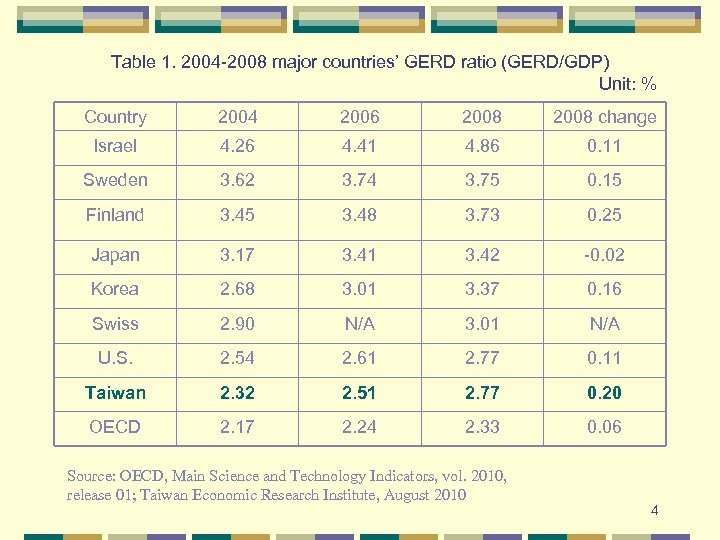
Table 1. 2004 -2008 major countries’ GERD ratio (GERD/GDP) Unit: % Country 2004 2006 2008 change Israel 4. 26 4. 41 4. 86 0. 11 Sweden 3. 62 3. 74 3. 75 0. 15 Finland 3. 45 3. 48 3. 73 0. 25 Japan 3. 17 3. 41 3. 42 -0. 02 Korea 2. 68 3. 01 3. 37 0. 16 Swiss 2. 90 N/A 3. 01 N/A U. S. 2. 54 2. 61 2. 77 0. 11 Taiwan 2. 32 2. 51 2. 77 0. 20 OECD 2. 17 2. 24 2. 33 0. 06 Source: OECD, Main Science and Technology Indicators, vol. 2010, release 01; Taiwan Economic Research Institute, August 2010 4
Table 1 shows Taiwan’s Gross Expenditure on R&D (GERD) ratio (GERD/GDP) ranked about 8 th-10 th position among major countries during 2004 -2008. Table 2 shows Taiwan’s major source of R&D funds came from private enterprises. The share increased from 64. 96% in 2000 to 70. 41% in 2008. In 2008, Taiwan private companies’ share ranked the 6 th among major countries. 5
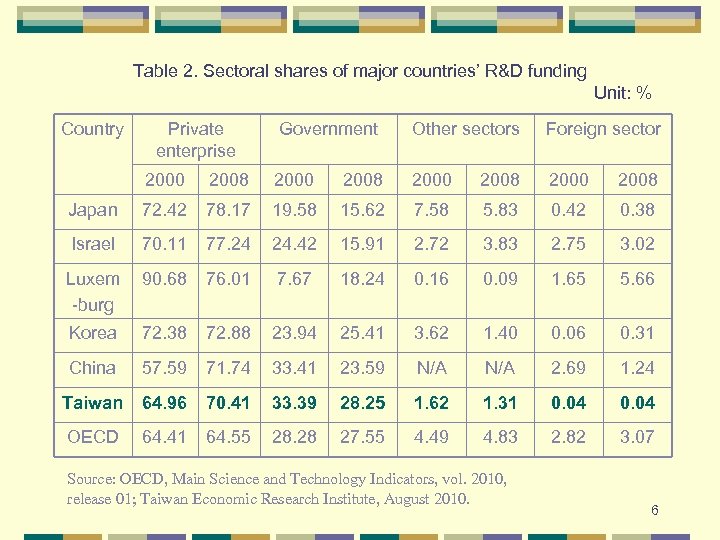
Table 2. Sectoral shares of major countries’ R&D funding Unit: % Country Private enterprise Government Other sectors Foreign sector 2000 2008 Japan 72. 42 78. 17 19. 58 15. 62 7. 58 5. 83 0. 42 0. 38 Israel 70. 11 77. 24 24. 42 15. 91 2. 72 3. 83 2. 75 3. 02 Luxem -burg 90. 68 76. 01 7. 67 18. 24 0. 16 0. 09 1. 65 5. 66 Korea 72. 38 72. 88 23. 94 25. 41 3. 62 1. 40 0. 06 0. 31 China 57. 59 71. 74 33. 41 23. 59 N/A 2. 69 1. 24 Taiwan 64. 96 70. 41 33. 39 28. 25 1. 62 1. 31 0. 04 OECD 64. 41 64. 55 28. 28 27. 55 4. 49 4. 83 2. 82 3. 07 Source: OECD, Main Science and Technology Indicators, vol. 2010, release 01; Taiwan Economic Research Institute, August 2010. 6
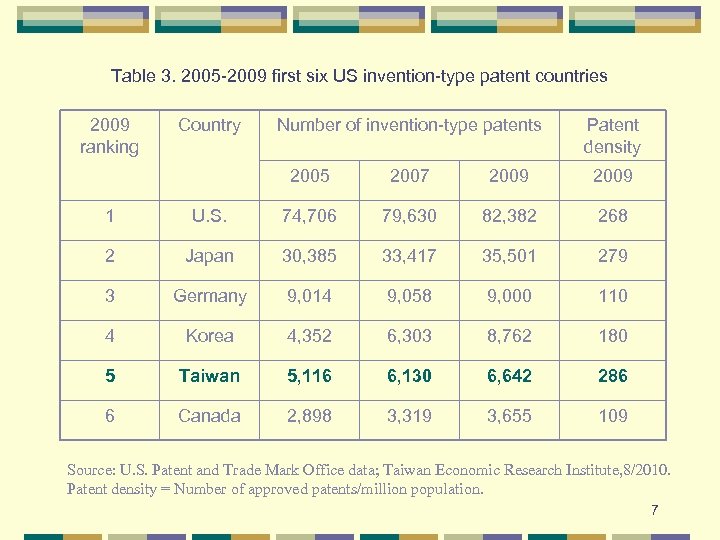
Table 3. 2005 -2009 first six US invention-type patent countries 2009 ranking Country Number of invention-type patents Patent density 2005 2007 2009 1 U. S. 74, 706 79, 630 82, 382 268 2 Japan 30, 385 33, 417 35, 501 279 3 Germany 9, 014 9, 058 9, 000 110 4 Korea 4, 352 6, 303 8, 762 180 5 Taiwan 5, 116 6, 130 6, 642 286 6 Canada 2, 898 3, 319 3, 655 109 Source: U. S. Patent and Trade Mark Office data; Taiwan Economic Research Institute, 8/2010. Patent density = Number of approved patents/million population. 7
Table 3 shows that U. S. approved 6, 642 Taiwan invention-type patents in 2009, ranked 5 th in the world. Taiwan’s patent density in 2009 was 286, ranked No. 1 in the world. Patent is a strength of Taiwan’s innovation. According to the May 2010 rating by IMD regarding national technology innovation competitiveness, Taiwan ranked 8 th in the world, rising from 23 rd in 2009. 8
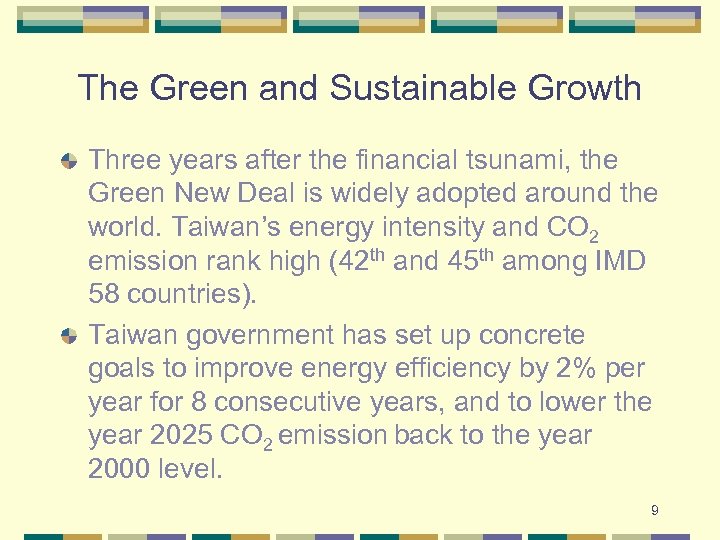
The Green and Sustainable Growth Three years after the financial tsunami, the Green New Deal is widely adopted around the world. Taiwan’s energy intensity and CO 2 emission rank high (42 th and 45 th among IMD 58 countries). Taiwan government has set up concrete goals to improve energy efficiency by 2% per year for 8 consecutive years, and to lower the year 2025 CO 2 emission back to the year 2000 level. 9
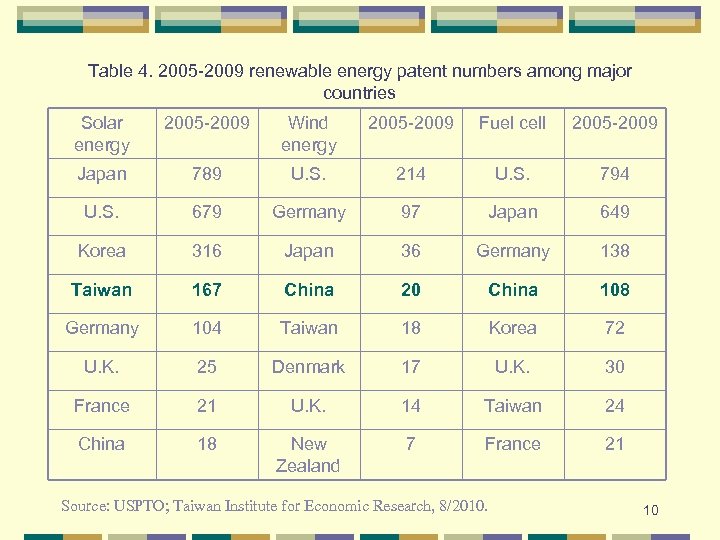
Table 4. 2005 -2009 renewable energy patent numbers among major countries Solar energy 2005 -2009 Wind energy 2005 -2009 Fuel cell 2005 -2009 Japan 789 U. S. 214 U. S. 794 U. S. 679 Germany 97 Japan 649 Korea 316 Japan 36 Germany 138 Taiwan 167 China 20 China 108 Germany 104 Taiwan 18 Korea 72 U. K. 25 Denmark 17 U. K. 30 France 21 U. K. 14 Taiwan 24 China 18 New Zealand 7 France 21 Source: USPTO; Taiwan Institute for Economic Research, 8/2010. 10
Table 4 shows that Taiwan has developed innovation capability in renewable energy. Taiwan ranked No. 4 in solar energy, No. 5 in wind energy and No. 7 in fuel cell among the world. 11
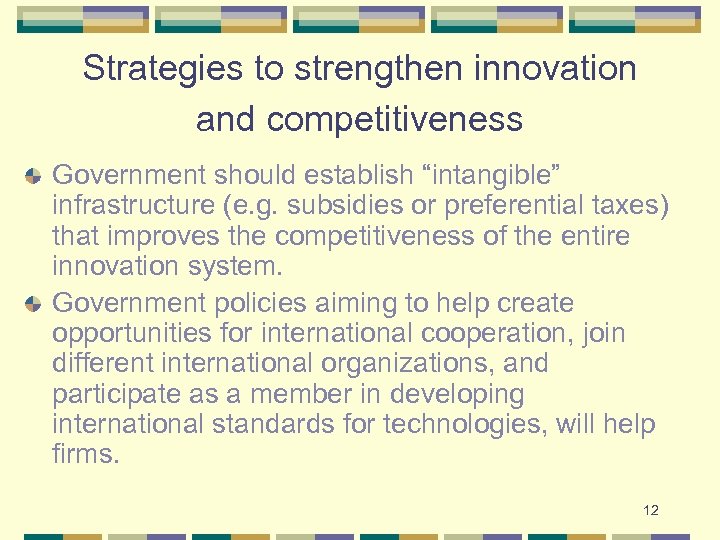
Strategies to strengthen innovation and competitiveness Government should establish “intangible” infrastructure (e. g. subsidies or preferential taxes) that improves the competitiveness of the entire innovation system. Government policies aiming to help create opportunities for international cooperation, join different international organizations, and participate as a member in developing international standards for technologies, will help firms. 12
Interactive channels should be established that encourage domestic engineers to acquire knowledge from external sources and attract foreign skill labors for Taiwan’s industrial and technological development. Industrial policies should consider the economic cycle, and S&T policies should consider long-term implications with a broad perspective. 13
Скачать презентацию Innovation for Balanced and Sustained Growth Taiwan Chien
bed9cdb9293c42be1d33d5efd6693294.ppt