


 Скачать презентацию Innovation Corps I-Corps at NIH Hypothesis-Driven Customer Discovery
22f3a296a271a492ce5aadf5d9e9a7b1.ppt
- Количество слайдов: 18
 Innovation Corps (I-Corps) at NIH: Hypothesis-Driven Customer Discovery for SBIR/STTR Grantees Bench 2 Business (B 2 B) – University of Kentucky May 19, 2015 Andrew J. Kurtz National Cancer Institute (NCI)
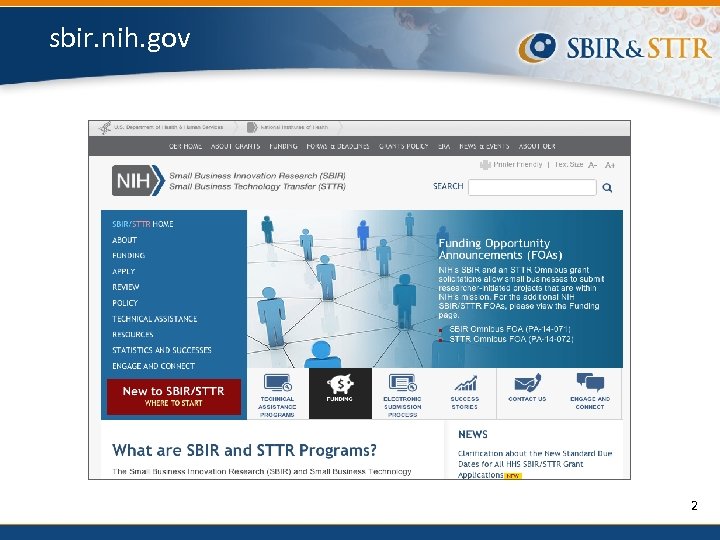 sbir. nih. gov 2
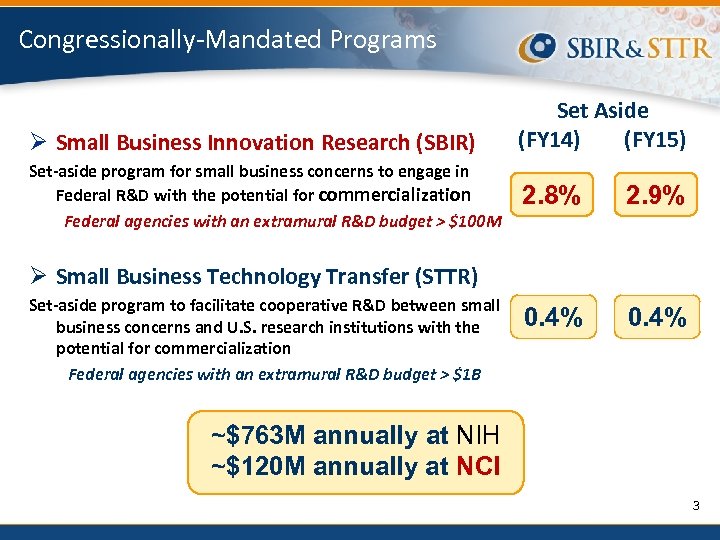 Congressionally-Mandated Programs Ø Small Business Innovation Research (SBIR) Set-aside program for small business concerns to engage in Federal R&D with the potential for commercialization Federal agencies with an extramural R&D budget > $100 M Set Aside (FY 14) (FY 15) 2. 8% 2. 9% 0. 4% Ø Small Business Technology Transfer (STTR) Set-aside program to facilitate cooperative R&D between small business concerns and U. S. research institutions with the potential for commercialization Federal agencies with an extramural R&D budget > $1 B ~$763 M annually at NIH ~$120 M annually at NCI 3
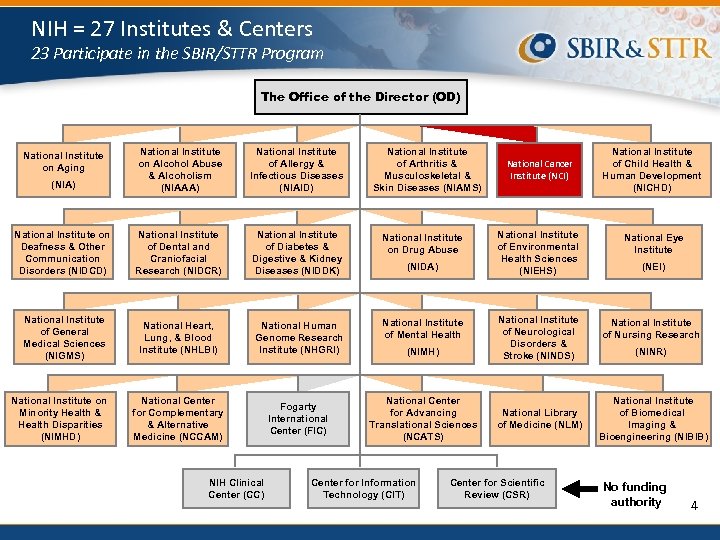 NIH = 27 Institutes & Centers 23 Participate in the SBIR/STTR Program The Office of the Director (OD) (NIA) National Institute on Alcohol Abuse & Alcoholism (NIAAA) National Institute of Allergy & Infectious Diseases (NIAID) National Institute on Deafness & Other Communication Disorders (NIDCD) National Institute of Dental and Craniofacial Research (NIDCR) National Institute of Diabetes & Digestive & Kidney Diseases (NIDDK) National Institute on Drug Abuse National Institute of General Medical Sciences (NIGMS) National Heart, Lung, & Blood Institute (NHLBI) National Human Genome Research Institute (NHGRI) National Institute of Mental Health National Center for Complementary & Alternative Medicine (NCCAM) Fogarty International Center (FIC) National Institute on Aging National Institute on Minority Health & Health Disparities (NIMHD) NIH Clinical Center (CC) National Institute of Arthritis & Musculoskeletal & Skin Diseases (NIAMS) (NIDA) (NIMH) National Center for Advancing Translational Sciences (NCATS) Center for Information Technology (CIT) National Cancer Institute (NCI) National Institute of Child Health & Human Development (NICHD) National Institute of Environmental Health Sciences (NIEHS) National Eye Institute National Institute of Neurological Disorders & Stroke (NINDS) National Institute of Nursing Research National Library of Medicine (NLM) Center for Scientific Review (CSR) (NEI) (NINR) National Institute of Biomedical Imaging & Bioengineering (NIBIB) No funding authority 4
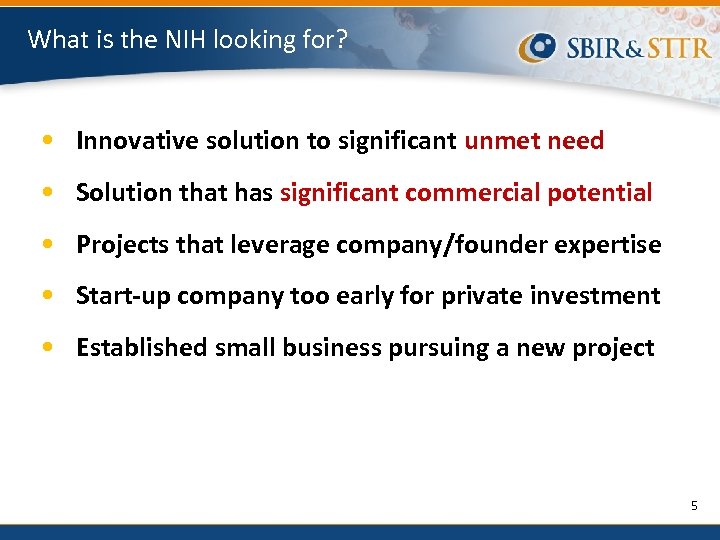 What is the NIH looking for? • Innovative solution to significant unmet need • Solution that has significant commercial potential • Projects that leverage company/founder expertise • Start-up company too early for private investment • Established small business pursuing a new project 5
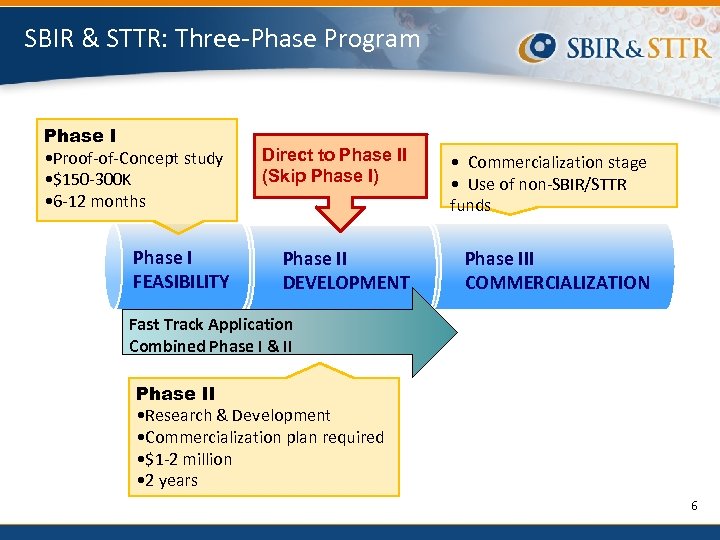 SBIR & STTR: Three-Phase Program Phase I • Proof-of-Concept study • $150 -300 K • 6 -12 months Phase I FEASIBILITY Direct to Phase II (Skip Phase I) • Commercialization stage • Use of non-SBIR/STTR funds Phase II DEVELOPMENT Phase III COMMERCIALIZATION Fast Track Application Combined Phase I & II Phase II • Research & Development • Commercialization plan required • $1 -2 million • 2 years 6
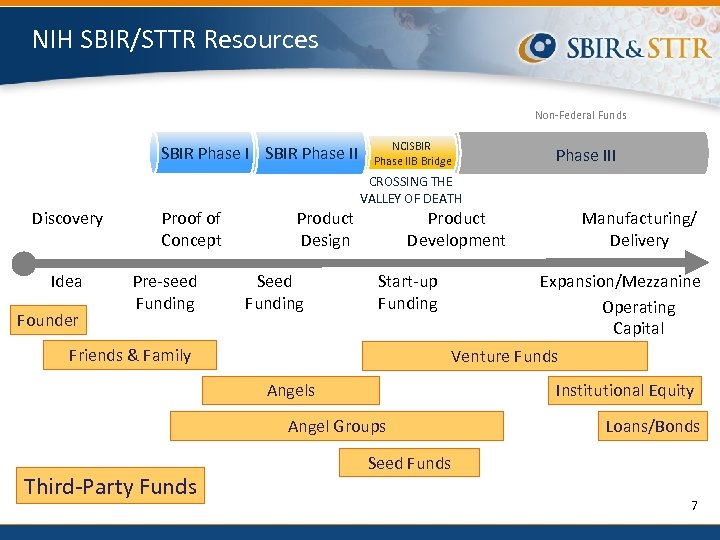 NIH SBIR/STTR Resources Non-Federal Funds SBIR Phase II NCISBIR Phase IIB Bridge Phase III CROSSING THE VALLEY OF DEATH Discovery Idea Founder Proof of Concept Pre-seed Funding Product Design Seed Funding Product Development Expansion/Mezzanine Operating Capital Start-up Funding Friends & Family Venture Funds Angels Institutional Equity Angel Groups Third-Party Funds Manufacturing/ Delivery Loans/Bonds Seed Funds 7
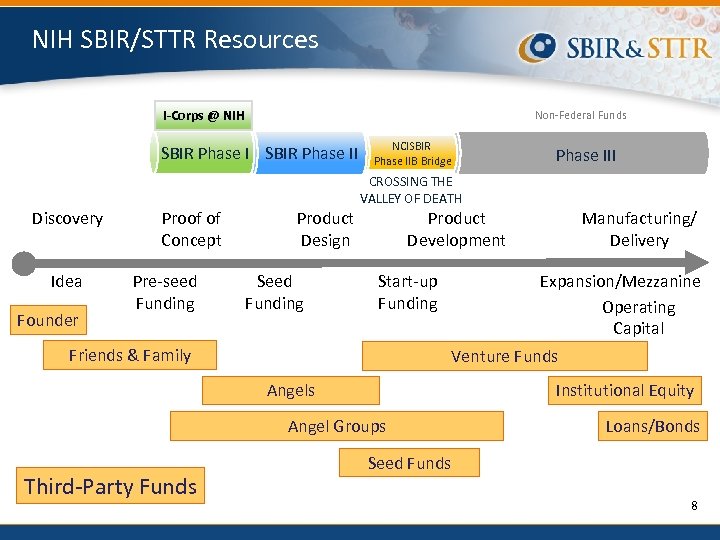 NIH SBIR/STTR Resources I-Corps @ NIH Non-Federal Funds SBIR Phase II NCISBIR Phase IIB Bridge Phase III CROSSING THE VALLEY OF DEATH Discovery Idea Founder Proof of Concept Pre-seed Funding Product Design Seed Funding Product Development Expansion/Mezzanine Operating Capital Start-up Funding Friends & Family Venture Funds Angels Institutional Equity Angel Groups Third-Party Funds Manufacturing/ Delivery Loans/Bonds Seed Funds 8
 I-Corps™ at NIH Pilot Program was developed specifically for NIH SBIR & STTR Phase I grantees • $25 K administrative supplements to current SBIR/STTR Phase I grantees to support I-Corps™ training • Three-member project teams • Same fundamental curriculum that was pioneered at NSF • A few programmatic adjustments to develop a format tailored for life science companies 9
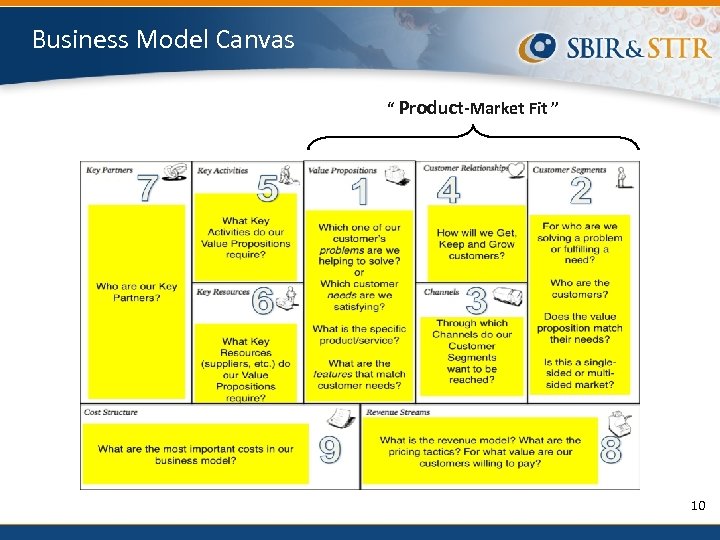 Business Model Canvas “ Product-Market Fit ” 10
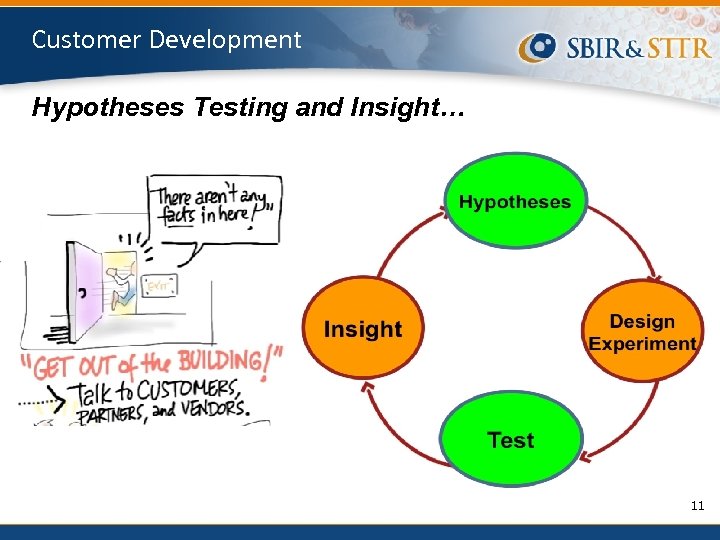 Customer Development Hypotheses Testing and Insight… 11
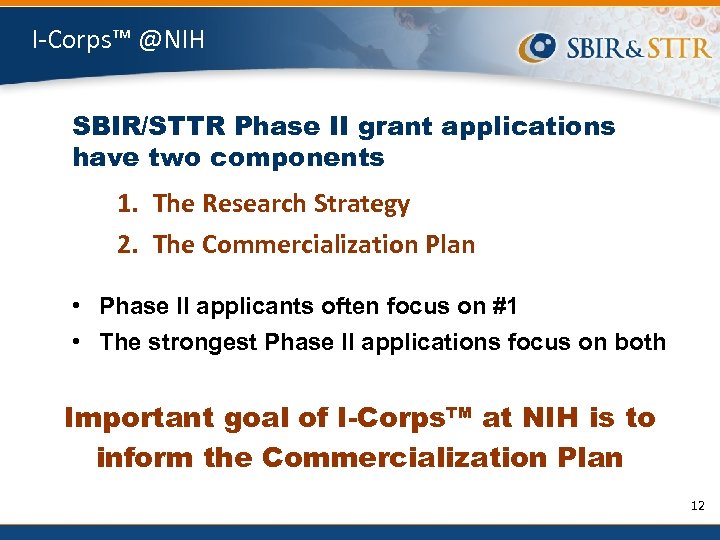 I-Corps™ @NIH SBIR/STTR Phase II grant applications have two components 1. The Research Strategy 2. The Commercialization Plan • Phase II applicants often focus on #1 • The strongest Phase II applications focus on both Important goal of I-Corps™ at NIH is to inform the Commercialization Plan 12
 I-Corps™ @NIH I-Corps participants gain new insights into: • Value proposition (e. g. , clinical utility) • Customers / customer segments • Aspects of the product that are (& are not) valuable • Data & data quality that is needed • Roles of partners and collaborators We are also learning something else very important at the NIH… 13
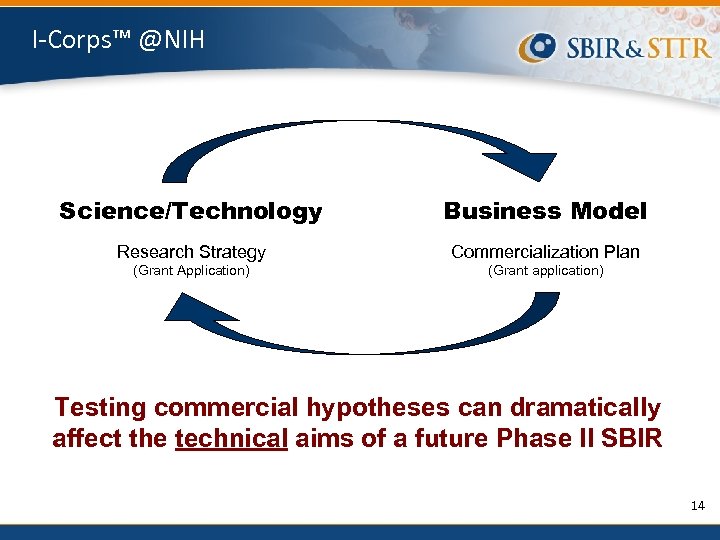 I-Corps™ @NIH Science/Technology Business Model Research Strategy Commercialization Plan (Grant Application) (Grant application) Testing commercial hypotheses can dramatically affect the technical aims of a future Phase II SBIR 14
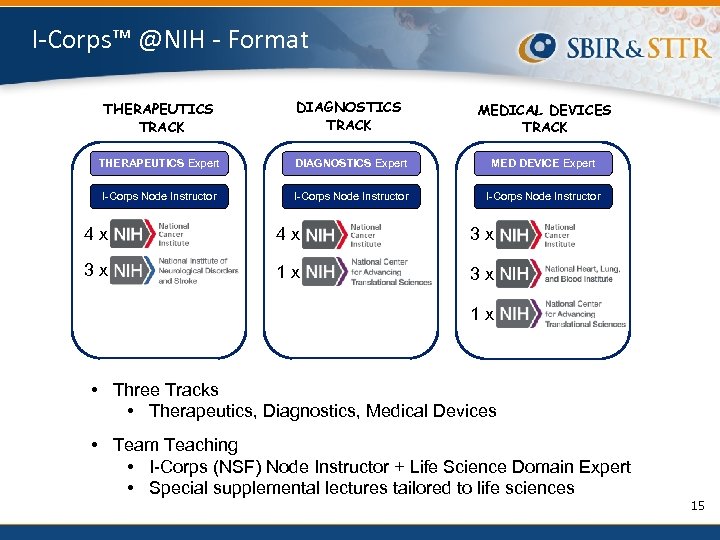 I-Corps™ @NIH - Format THERAPEUTICS TRACK DIAGNOSTICS TRACK MEDICAL DEVICES TRACK THERAPEUTICS Expert DIAGNOSTICS Expert MED DEVICE Expert I-Corps Node Instructor 4 x 4 x 3 x 3 x 1 x • Three Tracks • Therapeutics, Diagnostics, Medical Devices • Team Teaching • I-Corps (NSF) Node Instructor + Life Science Domain Expert • Special supplemental lectures tailored to life sciences 15
 Three-Member Teams • C-Level Corporate Officer • • “Chief” Executive Officer (CEO), “Chief” Operating Officer (COO), etc. Relevant knowledge of the technology Deep commitment to investigate the commercial landscape Substantial decision-making authority within the company • Industry Expert • Experience in translating technologies to the marketplace • Can be someone that has an established relationship with the company OR someone selected as a third-party resource • PD/PI on the SBIR/STTR Phase I award 16
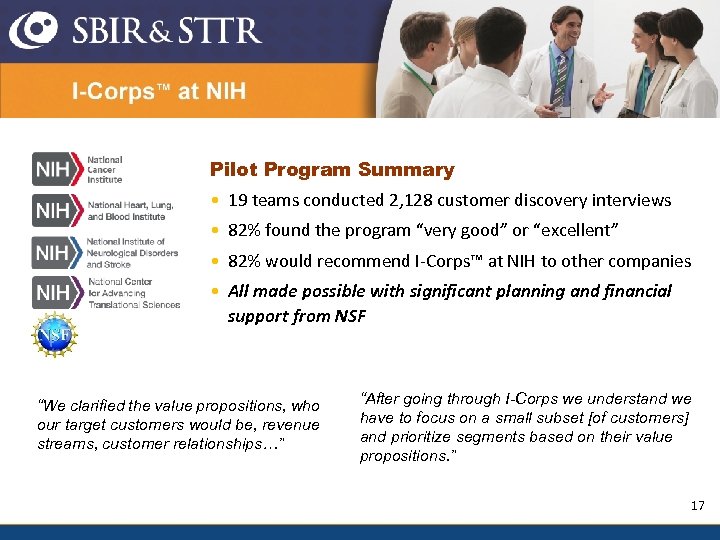 From I-Corps™ at NIH Pilot Program Summary • 19 teams conducted 2, 128 customer discovery interviews • 82% found the program “very good” or “excellent” • 82% would recommend I-Corps™ at NIH to other companies • All made possible with significant planning and financial support from NSF “We clarified the value propositions, who our target customers would be, revenue streams, customer relationships…” “After going through I-Corps we understand we have to focus on a small subset [of customers] and prioritize segments based on their value propositions. ” 17
 Innovation Corps (I-Corps) at NIH: Hypothesis-Driven Customer Discovery for SBIR/STTR Grantees Bench 2 Business (B 2 B) – University of Kentucky May 19, 2015 Andrew J. Kurtz National Cancer Institute (NCI)