 Скачать презентацию Innovation-based Growth the Development and the Future
81d534bf3839325e68dcb3fe50b2520a.ppt
- Количество слайдов: 16



"Innovation-based Growth – the Development and the Future Challenges of the Finnish Innovation Environment” Timo Kekkonen Director, Confederation of Finnish Industries, EK
1. R&D statistics and main features of the Finnish Innovation System 2. Historical overview 3. Economic growth and future challenges 4. 12. 2006 2 Timo Kekkonen
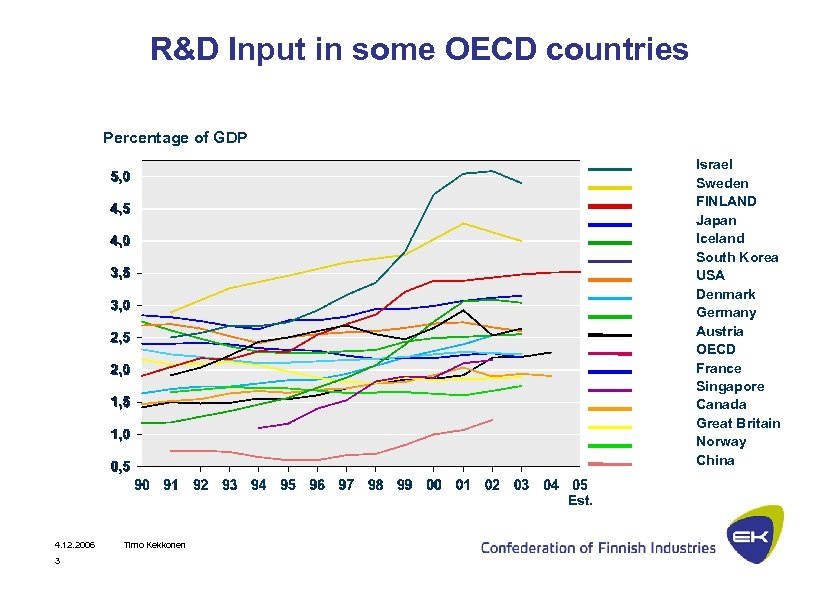
R&D Input in some OECD countries Percentage of GDP Israel Sweden FINLAND Japan Iceland South Korea USA Denmark Germany Austria OECD France Singapore Canada Great Britain Norway China 5. 0 4. 5 4. 0 3. 5 3. 0 2. 5 2. 0 1. 5 1. 0 0. 5 Est. 4. 12. 2006 3 Timo Kekkonen
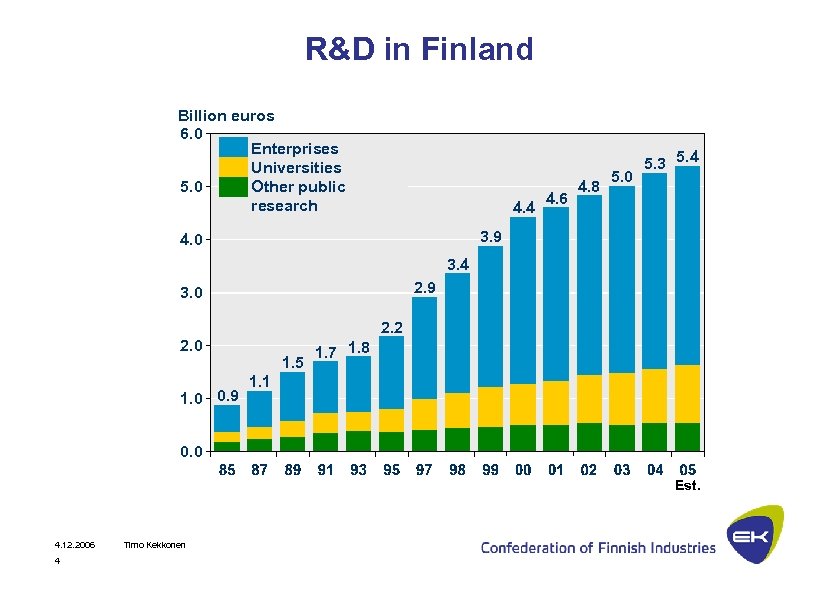
R&D in Finland Billion euros 6. 0 Enterprises Universities 5. 0 Other public research 4. 4 4. 6 4. 8 5. 0 5. 3 5. 4 3. 9 4. 0 3. 4 2. 9 3. 0 2. 2 2. 0 1. 0 0. 9 1. 5 1. 7 1. 8 1. 1 0. 0 Est. 4. 12. 2006 4 Timo Kekkonen
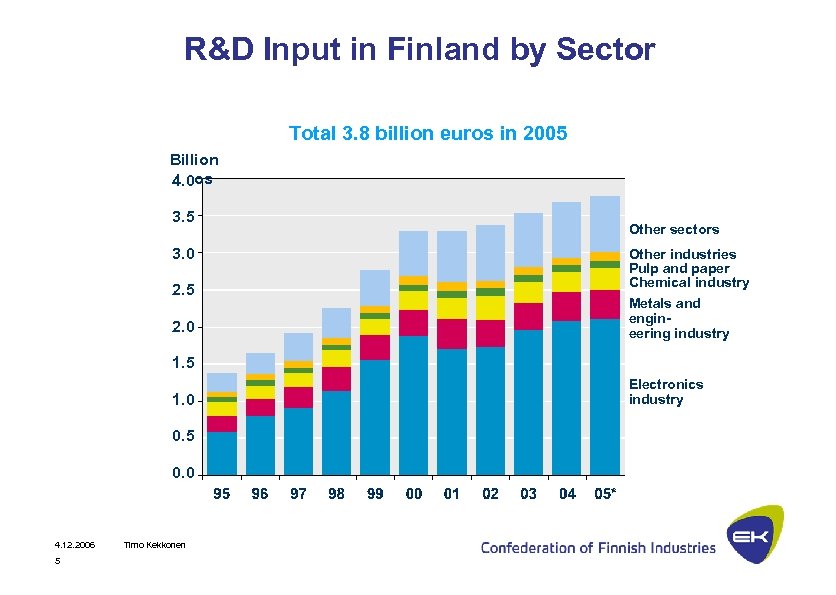
R&D Input in Finland by Sector Total 3. 8 billion euros in 2005 Billion euros 4. 0 3. 5 3. 0 2. 5 2. 0 Other sectors Other industries Pulp and paper Chemical industry Metals and engineering industry 1. 5 1. 0 0. 5 0. 0 4. 12. 2006 5 Timo Kekkonen Electronics industry
Science, Technology and Innovation in Finland • • • High R&D investment (3. 5% of GDP – 30/70 public/private ratio) Long term political commitment Strong cooperation & networking between industry and academia An effective and dynamic public innovation environment Finland is ranked high in international competitiveness comparisons High level of education Productivity in our industry has developed rapidly Rapid growth of the high tech sector Global competitivity of most industrial sectors 4. 12. 2006 6 Timo Kekkonen
1. R&D statistics and main features of the Finnish Innovation System 2. Historical overview 3. Economic growth and future challenges 4. 12. 2006 7 Timo Kekkonen
Long term development of Finnish industry and science/technology/innovation policy (1/2) 1950’s establishment of basic industries for domestic needs 1960’s gradual diversification of industrial base opening up foreign trade 1970’s rapid development of traditional industries industrial policy to encourage investments/regional development setting up new universities 1980’s beginning of modern science and technology policy technology financing systems and organisations were set up first targets regarding the share of RTD of GNP were set special attention was paid to education and training 4. 12. 2006 8 Timo Kekkonen
Long term development of Finnish industry and science/technology/innovation policy (2/2) 1990’s rapid growth of knowledge intensive sectors (ICT) rapid growth of RTD investments especially by the private sector increase of international cooperation adaption of the Finnish educational system to changing needs 2000’s new global division of labour continues rapidly globalization of the Finnish industry increases the share of services increases of Finlands GDP increases the shift from technology policy to innovation policy continues 4. 12. 2006 9 Timo Kekkonen
Innovation as a growth strategy - the Finnish experience 1. R&D statistics and main features of the Finnish Innovation System 2. Historical overview 3. Economic growth and future challenges 4. 12. 2006 10 Timo Kekkonen
Sources of innovation-based economic growth Fundamental drivers of growth – Human capital – R&D – Innovations Countries respond differently to fundamental drivers – Opening up of product and service markets – Flexibility of the regulatory framework – Opening the way for small highly innovative companies to flourish – Macroeconomic policies • low and stable inflation • moderate tax burdens • openness to international trade 4. 12. 2006 Timo Kekkonen 11 Source: True growth Understanding Economic Growth, OECD, 2004 3/16/2018
What is our competitive advantage in the future? • The ability to create a growing number of radical innovations • Ensuring a world-class knowledge-base (in selected areas) • An excellent capability to transform knowledge into a competitive advantage … into innovations 4. 12. 2006 12 Timo Kekkonen
Innovation based economies need a paradigm shift towards a new innovation policy ”Old Innovation policy” Innovation activities concentrate on improving existing products, processes and services within existing companies and clusters 4. 12. 2006 13 Timo Kekkonen ”New Innovation Policy” Innovation activities are based on needs and possibilities opening up new markets, changing markets or enabling new businessa areas
What have we done/should we do in Finland ? • Continue to increase public R&D investments • Make further efforts to internationalize our innovation environment – especially our university system • Make strategic choices – implent the SCSTI-strategy – reform our university structure – reform our public research institutes • Encourage development of ”radical innovations” • Mobilise private capital for start-ups and growth companies ( eg. by introducing tax incentives) • Promote the productivity within the service sector (private & public) 4. 12. 2006 14 Timo Kekkonen
International Cooperation – Why is it an essential element of innovation policy ? • Knowledge is created globally • The role of knowledge-based economic growth is increasing • World economy is more and more global and the challenges we are facing can best be solved together • An open global market based on common rules benefits everybody 4. 12. 2006 15 Timo Kekkonen
What should be done in Europe … what is the European competitive advantage? Simultaneous and synchronous actions are neeeded at all levels 1) • • Creation of a market for innovative products and services Providing sufficient resources for R&D and innovation Improving the structural mobility of Europe, and Building positive attitudes and a culture favourable towards entrepreneurship and risk taking 1) As presented in the report by the ”Aho group” – Creating an Innovative Europe 4. 12. 2006 16 Timo Kekkonen
Скачать презентацию Innovation-based Growth the Development and the Future
81d534bf3839325e68dcb3fe50b2520a.ppt