


 Скачать презентацию Initialization Prediction and Diagnosis of the Rapid Intensification
a48f0327c562b82fb043d2c03f7993fb.ppt
- Количество слайдов: 37
 Initialization, Prediction and Diagnosis of the Rapid Intensification of Tropical Cyclones using ACCESS www. cawcr. gov. au Jeff Kepert Head, High Impact Weather Research Feb 25, 2011 The Centre for Australian Weather and Climate Research A partnership between CSIRO and the Bureau of Meteorology
 Outline • ACCESS and ACCESS-TC. • Prior work that we are building on. • Results so far. The Centre for Australian Weather and Climate Research A partnership between CSIRO and the Bureau of Meteorology
 Project personnel • Michael Reeder • School of Mathematical Sciences, Monash University (Uni funded) • plus a postgraduate student (project funded) • Noel Davidson, Yi Xiao, Jeff Kepert, Peter Steinle and Kevin Tory • Centre for Australian Weather and Climate Research (Bureau of Meteorology funded) • Yimin Ma and Richard Dare • Centre for Australian Weather and Climate Research (project funded) • Craig H. Bishop • Naval Research Laboratory, Monterey (US Navy and project funded) • Plus strong support from ACCESS Modelling and Assimilation Teams, Australian NMOC, etc. The Centre for Australian Weather and Climate Research A partnership between CSIRO and the Bureau of Meteorology
 ACCESS • ACCESS = Australian Community Climate Earth Simulation System. • Atmospheric model from U. K. Met Office. • Nonhydrostatic; global and limited area; climate, meteorology and idealised applications. • Assimilation from Met Office 4 D-Var. • State-of-the-art 4 D-Var assimilation, capable of global to mesoscale assimilation. • NWP system operational since August 2009. • Ocean model based on MOM-4. • Ocean assimilation developed in-house. • Collaboration with Australian Navy, ensemble-based, moving to En. KF. • Coupled ocean-atmosphere prediction system under development. • Wave model Wave. Watch. • Coupled land surface, chemistry, etc models. The Centre for Australian Weather and Climate Research A partnership between CSIRO and the Bureau of Meteorology
 Met Office NWP Partners • • Australia (ACCESS) Korea New Zealand South Africa Norway Poland NRL The Centre for Australian Weather and Climate Research A partnership between CSIRO and the Bureau of Meteorology
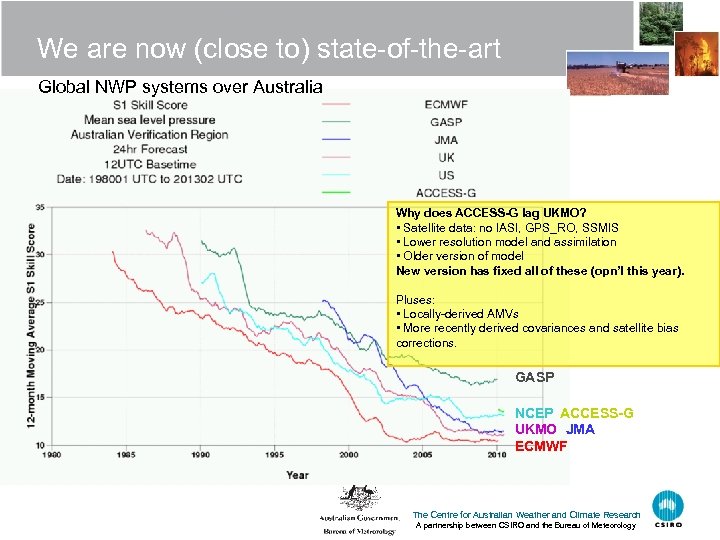 We are now (close to) state-of-the-art Global NWP systems over Australia Why does ACCESS-G lag UKMO? • Satellite data: no IASI, GPS_RO, SSMIS • Lower resolution model and assimilation • Older version of model New version has fixed all of these (opn’l this year). Pluses: • Locally-derived AMVs • More recently derived covariances and satellite bias corrections. GASP NCEP ACCESS-G UKMO JMA ECMWF The Centre for Australian Weather and Climate Research A partnership between CSIRO and the Bureau of Meteorology
 Strategic Radar Enhancement Project • 7 year project, funded by Australian Government. • 4 new Doppler radars. • 6 new staff to develop use of radar data in NWP at very high resolution (~1. 5 km). • Radar assimilation code in 4 D-Var is general enough to handle at least some airborne (belly radar ok, tail radar may need some small mods). • Provides an opportunity to experiment with inner core radar data from field programs later in project. • e. g. TCS-08, ITOP, PREDICT, HFP, RAINEX, etc. The Centre for Australian Weather and Climate Research A partnership between CSIRO and the Bureau of Meteorology
 Coupled ocean-atmosphere model • CAWCR Oceanographers have developed a coupled oceanatmosphere prediction system based on ACCESS NWP. • Available at all resolutions and domains of the atmospheric model, including ACCESS-TC. • Potential to explore impact of ocean coupling on prediction of rapid intensification. The Centre for Australian Weather and Climate Research A partnership between CSIRO and the Bureau of Meteorology
 ACCESS-TC: Initialisation strategy • Our previous system (TC-LAPS, Davidson and Weber 2000) • Remove vortex from background • 24 hours of assimilation including sophisticated vortex specification • Diabatic dynamical initialisation: Nudge to analysed rotational winds with latent heating diagnosed from satellite imagery to develop consistent moisture and secondary circulation. • 4 D-Var has flow-dependent covariances, better balance operators, etc. • Can we get good performance with analysis and initialisation procedure that is closer to standard NWP? The Centre for Australian Weather and Climate Research A partnership between CSIRO and the Bureau of Meteorology
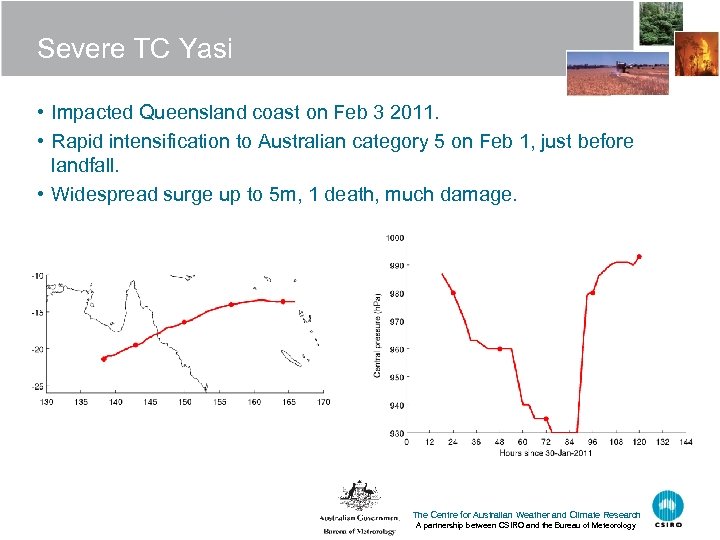 Severe TC Yasi • Impacted Queensland coast on Feb 3 2011. • Rapid intensification to Australian category 5 on Feb 1, just before landfall. • Widespread surge up to 5 m, 1 death, much damage. The Centre for Australian Weather and Climate Research A partnership between CSIRO and the Bureau of Meteorology
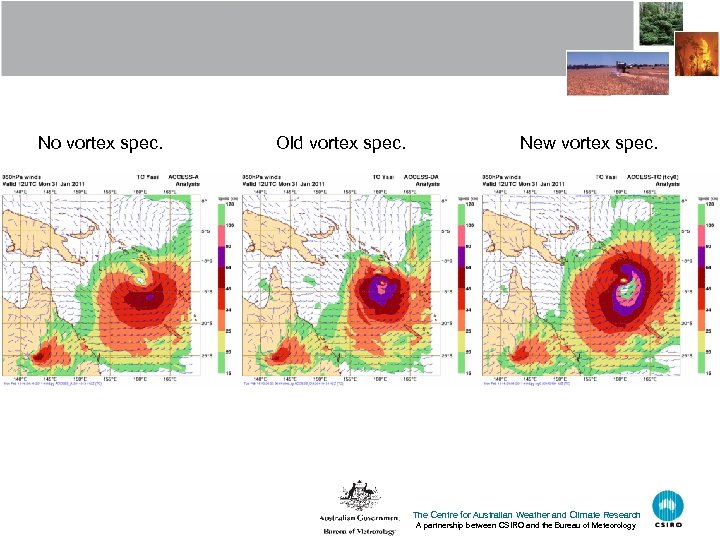
 Compare three configurations • Work of Noel Davidson, Yi Xiao (CAWCR), Harry Weber (U. Innsbruck) • All 11 -km grid, 50 levels, 4 D-Var assimilation • No vortex specification • Operational mesoscale NWP system (ACCESS-A) • Old vortex specification • Similar to TC-LAPS but no vortex removal, no diabatic initialisation • Multiple levels of wind and pressure observations inserted into assimilation • New vortex specification • Insert MSLP observations only • Allows 4 D-Var to develop both the rotational and divergent wind components. The Centre for Australian Weather and Climate Research A partnership between CSIRO and the Bureau of Meteorology
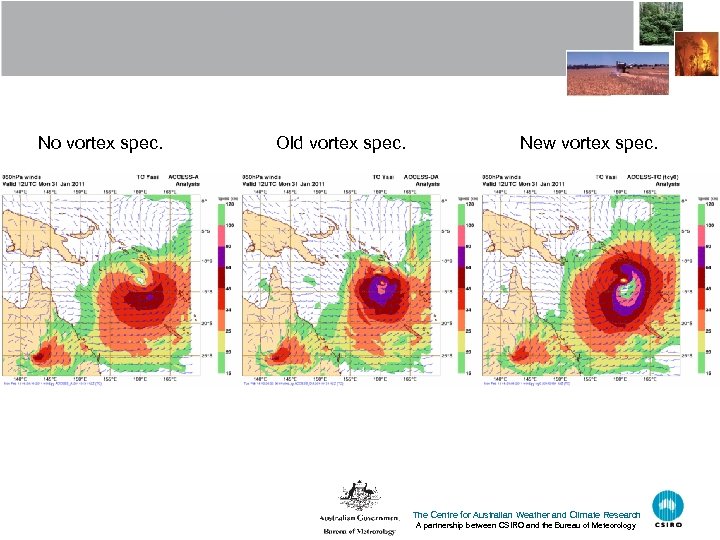 No vortex spec. Old vortex spec. New vortex spec. The Centre for Australian Weather and Climate Research A partnership between CSIRO and the Bureau of Meteorology
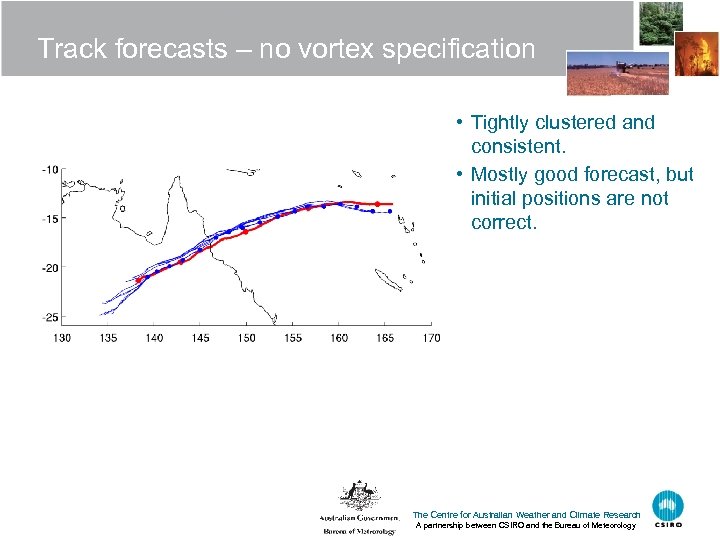 Track forecasts – no vortex specification • Tightly clustered and consistent. • Mostly good forecast, but initial positions are not correct. The Centre for Australian Weather and Climate Research A partnership between CSIRO and the Bureau of Meteorology
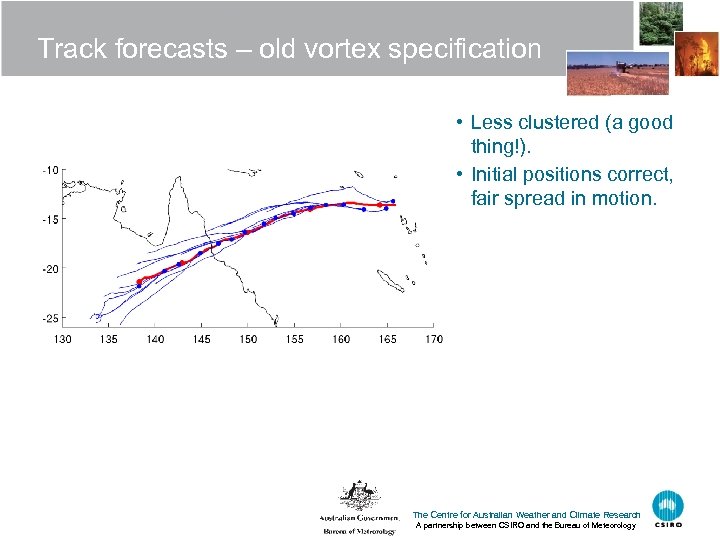 Track forecasts – old vortex specification • Less clustered (a good thing!). • Initial positions correct, fair spread in motion. The Centre for Australian Weather and Climate Research A partnership between CSIRO and the Bureau of Meteorology
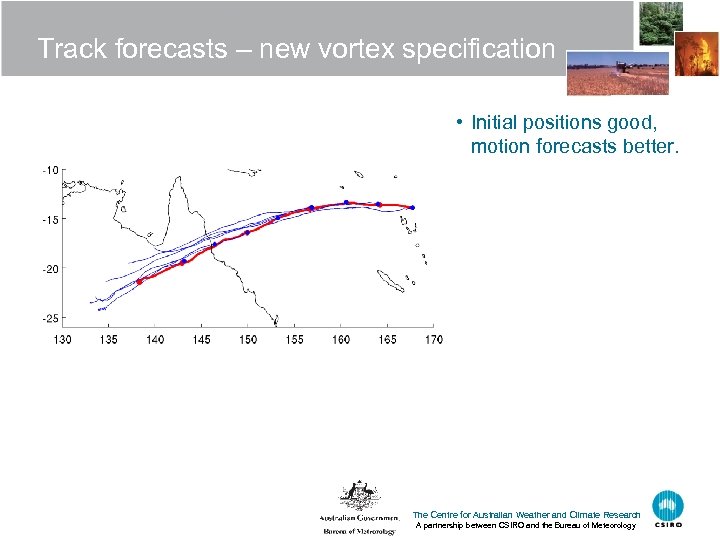 Track forecasts – new vortex specification • Initial positions good, motion forecasts better. The Centre for Australian Weather and Climate Research A partnership between CSIRO and the Bureau of Meteorology
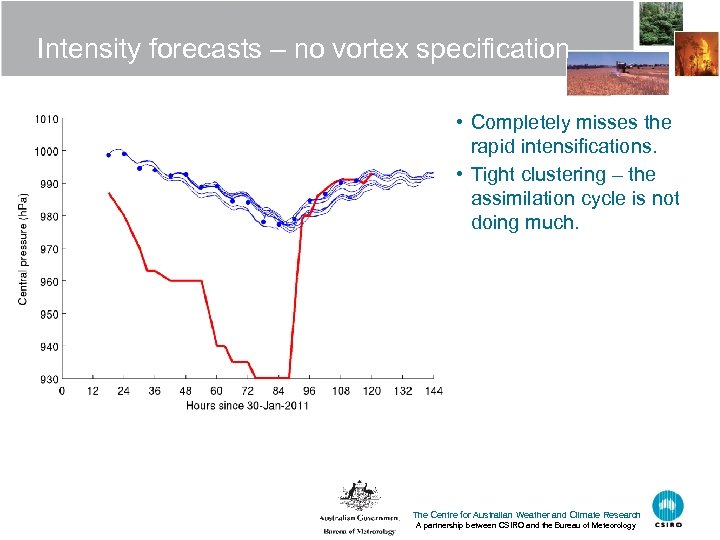 Intensity forecasts – no vortex specification • Completely misses the rapid intensifications. • Tight clustering – the assimilation cycle is not doing much. The Centre for Australian Weather and Climate Research A partnership between CSIRO and the Bureau of Meteorology
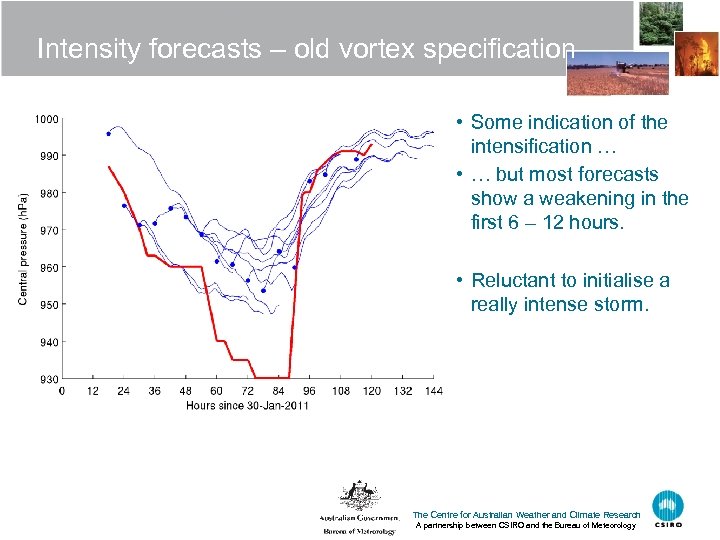 Intensity forecasts – old vortex specification • Some indication of the intensification … • … but most forecasts show a weakening in the first 6 – 12 hours. • Reluctant to initialise a really intense storm. The Centre for Australian Weather and Climate Research A partnership between CSIRO and the Bureau of Meteorology
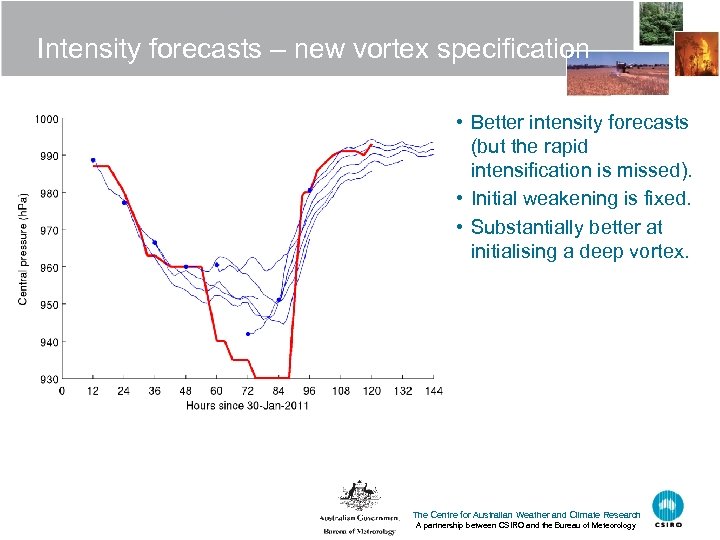 Intensity forecasts – new vortex specification • Better intensity forecasts (but the rapid intensification is missed). • Initial weakening is fixed. • Substantially better at initialising a deep vortex. The Centre for Australian Weather and Climate Research A partnership between CSIRO and the Bureau of Meteorology
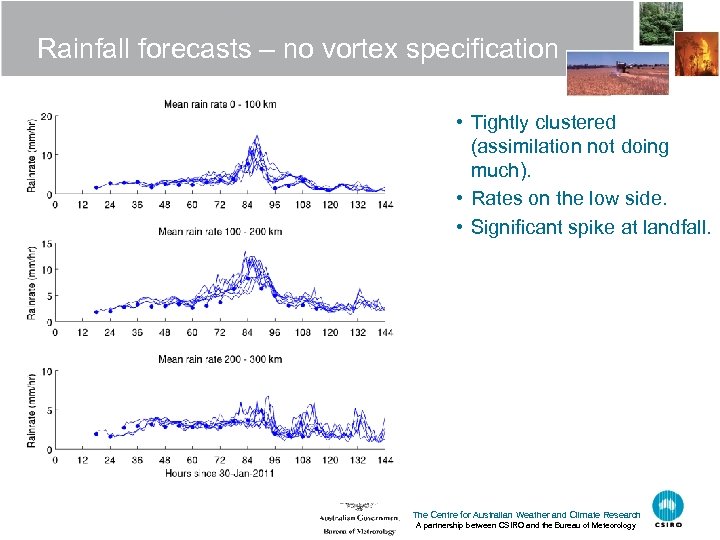 Rainfall forecasts – no vortex specification • Tightly clustered (assimilation not doing much). • Rates on the low side. • Significant spike at landfall. The Centre for Australian Weather and Climate Research A partnership between CSIRO and the Bureau of Meteorology
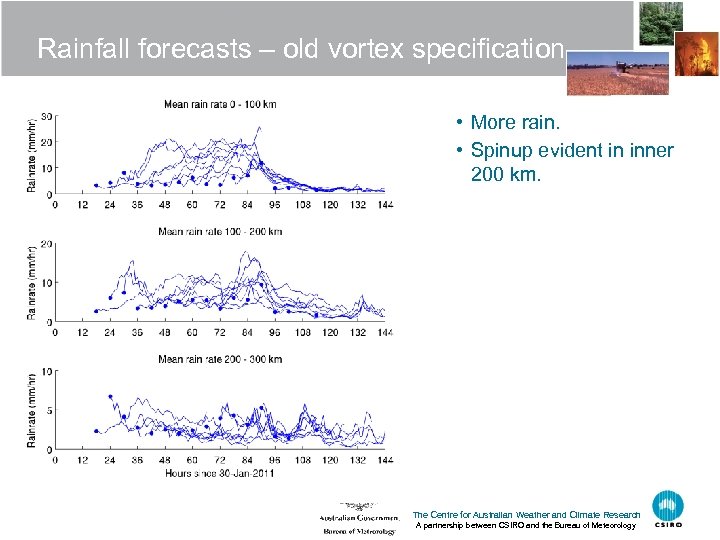 Rainfall forecasts – old vortex specification • More rain. • Spinup evident in inner 200 km. The Centre for Australian Weather and Climate Research A partnership between CSIRO and the Bureau of Meteorology
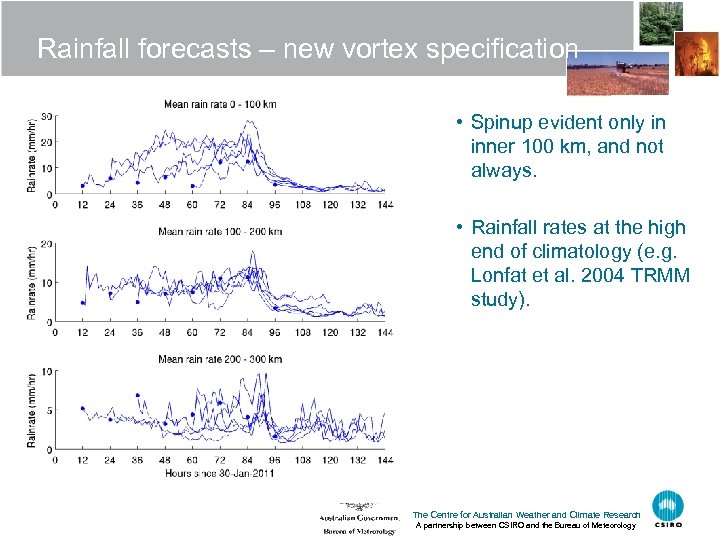 Rainfall forecasts – new vortex specification • Spinup evident only in inner 100 km, and not always. • Rainfall rates at the high end of climatology (e. g. Lonfat et al. 2004 TRMM study). The Centre for Australian Weather and Climate Research A partnership between CSIRO and the Bureau of Meteorology
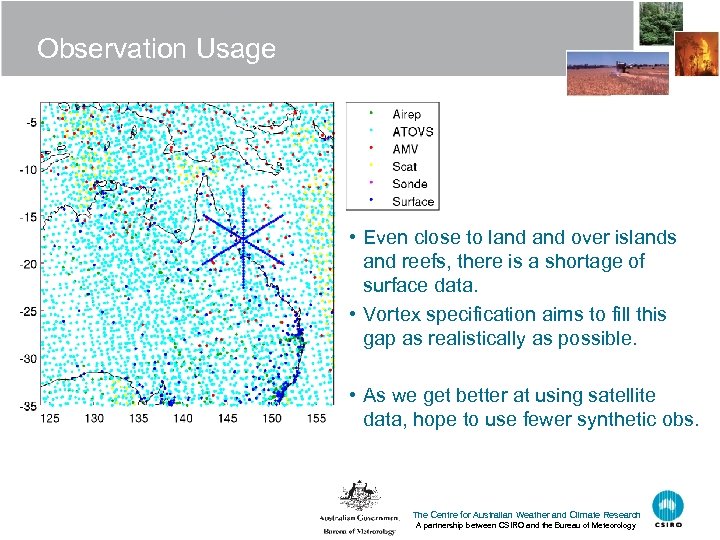 Observation Usage • Even close to land over islands and reefs, there is a shortage of surface data. • Vortex specification aims to fill this gap as realistically as possible. • As we get better at using satellite data, hope to use fewer synthetic obs. The Centre for Australian Weather and Climate Research A partnership between CSIRO and the Bureau of Meteorology
 Yasi • Vortex specification clearly beneficial • Original vortex specification (transfer from TC-LAPS) has initialisation problems • TC weakens in first 6 – 12 hours. • 4 D-Var reluctant to analyse a very intense TC. • Rain in inner core starts off too low. • Reformulated vortex specification is better • No spurious weakening at start of forecast. • Can analyse a deeper vortex (but not deep enough? ). • Rain spinup problem is much reduced. The Centre for Australian Weather and Climate Research A partnership between CSIRO and the Bureau of Meteorology
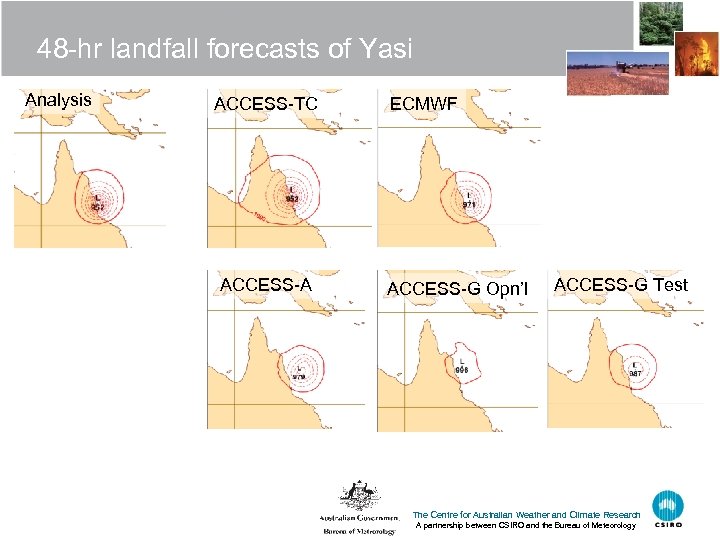 48 -hr landfall forecasts of Yasi Analysis ACCESS-TC ACCESS-A ECMWF ACCESS-G Opn’l ACCESS-G Test The Centre for Australian Weather and Climate Research A partnership between CSIRO and the Bureau of Meteorology
 What’s in the vortex specification? • Analytical profile (with dynamical basis) with modifications based on thousands of observations taken from reconnaissance flights • Presently uses Central Pressure (CP) and Radius of Outer Closed Isobar (ROCI) to construct the vortex. • Other critical vortex parameters (RMW, VMAX, R 34) derived from these. • ROCI can be difficult to estimate and operational estimates sometimes seem to be in error by up to 300 km. • This has caused difficulties with some forecasts (e. g. TC Zelia). • ROCI is important because it determines much of the vortex structure, and affects how the vortex merges with the environment. • Work of Harry Weber, Noel Davidson, Yimin Ma. The Centre for Australian Weather and Climate Research A partnership between CSIRO and the Bureau of Meteorology
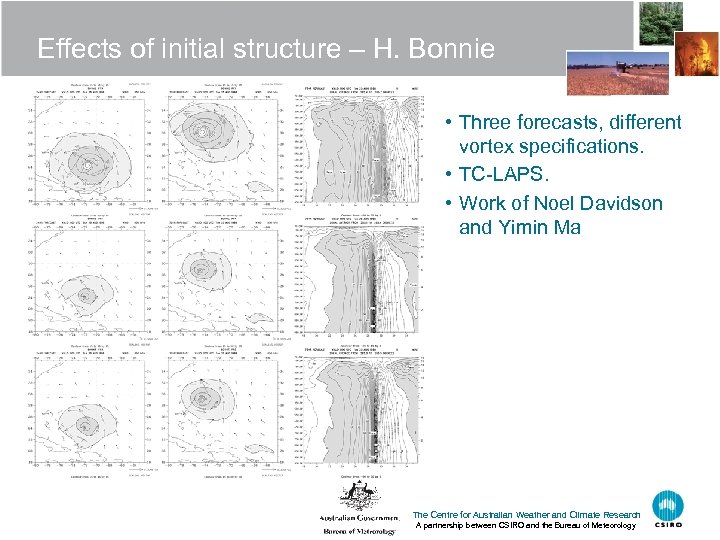 Effects of initial structure – H. Bonnie • Three forecasts, different vortex specifications. • TC-LAPS. • Work of Noel Davidson and Yimin Ma The Centre for Australian Weather and Climate Research A partnership between CSIRO and the Bureau of Meteorology
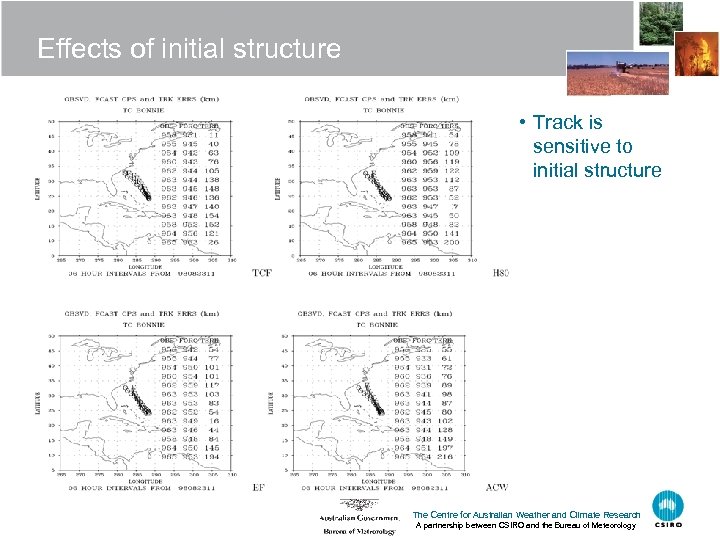 Effects of initial structure • Track is sensitive to initial structure The Centre for Australian Weather and Climate Research A partnership between CSIRO and the Bureau of Meteorology
 Vortex specifications compared • Old vortex specification • operationally-provided estimates of ROCI • inserts observations of wind and pressure at multiple levels • VS did not contain the secondary circulation and seemed to over-constrain model (not a problem in TC-LAPS due to dynamical diabatic initialisation) • New vortex specification • • • Uses new estimates of ROCI Uses synthetic obs of MSLP only 4 D-Var develops a secondary circulation* 4 D-Var handles the nonlinear mass-wind coupling* *further study needed, work in progress • … and the next 4 D-Var upgrade has the moist adjoint. The Centre for Australian Weather and Climate Research A partnership between CSIRO and the Bureau of Meteorology
 Aspirations • To initialize a vortex based on standard observations only and appropriate assimilation techniques … i. e. no vortex specification. • But for our current configuration, we have so far not even come close to achieving this for intense storms. • Of the forecast experiments we have run, the largest impact almost always comes from the use of the VS. • Although as always with NWP, very occasionally it is worse than non-VS. The Centre for Australian Weather and Climate Research A partnership between CSIRO and the Bureau of Meteorology
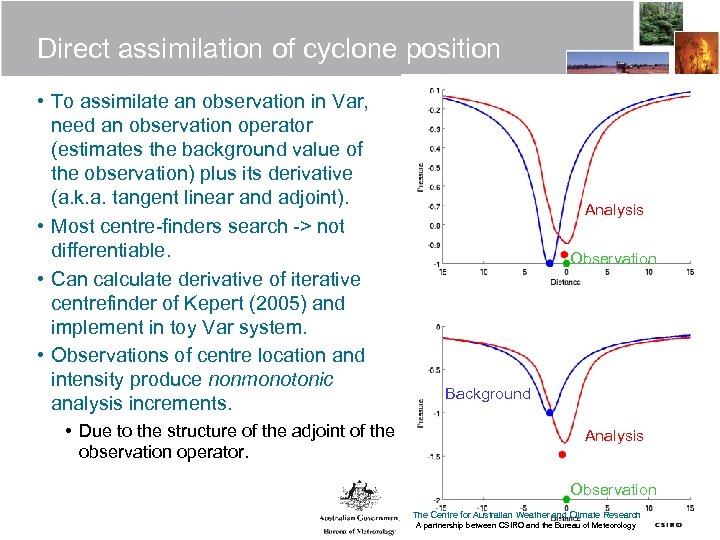 Direct assimilation of cyclone position • To assimilate an observation in Var, need an observation operator (estimates the background value of the observation) plus its derivative (a. k. a. tangent linear and adjoint). • Most centre-finders search -> not differentiable. • Can calculate derivative of iterative centrefinder of Kepert (2005) and implement in toy Var system. • Observations of centre location and intensity produce nonmonotonic analysis increments. • Due to the structure of the adjoint of the observation operator. Background Analysis Observation The Centre for Australian Weather and Climate Research A partnership between CSIRO and the Bureau of Meteorology
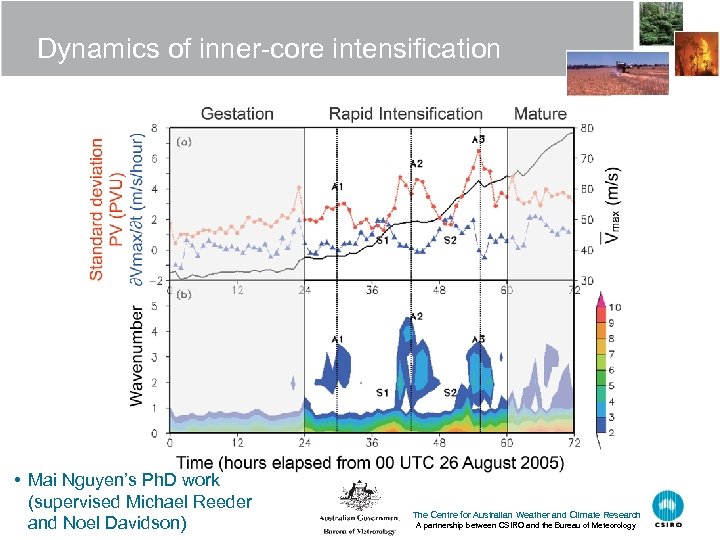 Dynamics of inner-core intensification • Mai Nguyen’s Ph. D work (supervised Michael Reeder and Noel Davidson) The Centre for Australian Weather and Climate Research A partnership between CSIRO and the Bureau of Meteorology
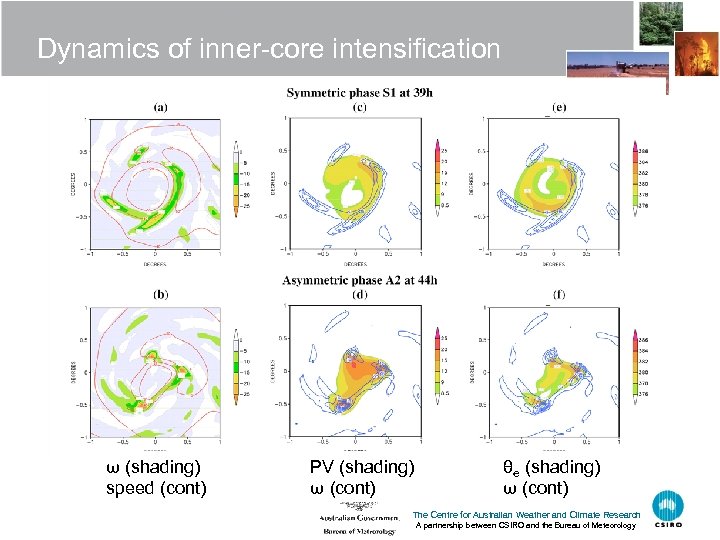 Dynamics of inner-core intensification ω (shading) speed (cont) PV (shading) ω (cont) θe (shading) ω (cont) The Centre for Australian Weather and Climate Research A partnership between CSIRO and the Bureau of Meteorology
 Dynamics of inner-core intensification • Rapid intensification in this simulation involves alternating symmetric and asymmetric cycles of the inner core. • Symmetric phase • Ring PV, circular updraft, CAPE increases, strong Vmax increase • Asymmetric phase • PV pools into VHTs which merge towards a monopole structure, updraft initially follows VHTs, CAPE consumed, strong central pressure fall • Michael Reeder and Mai Nguyen have begun to look at TC Yasi simulation, we plan higher-resolution runs to facilitate this. The Centre for Australian Weather and Climate Research A partnership between CSIRO and the Bureau of Meteorology
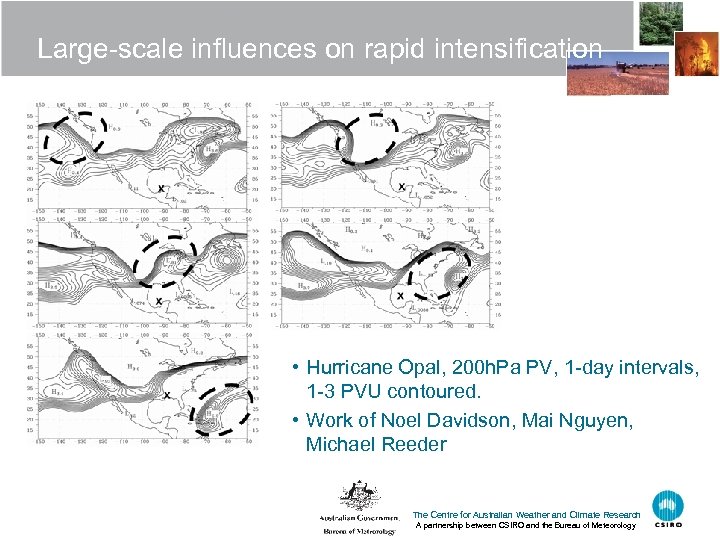 Large-scale influences on rapid intensification • Hurricane Opal, 200 h. Pa PV, 1 -day intervals, 1 -3 PVU contoured. • Work of Noel Davidson, Mai Nguyen, Michael Reeder The Centre for Australian Weather and Climate Research A partnership between CSIRO and the Bureau of Meteorology
 Plans and opportunities • Study storms from field programs (PREDICT, TCS-08, ITOP, HFP) • Assimilate airborne in situ and radar(? ), dropsonde, SFMR, etc. • Good opportunity for En. KF comparison with HFIP • What resolution is necessary? • Detailed analysis of cases of rapid intensification • Use field program obs to help validate NWP • Study processes and dynamics of rapid intensification • Detailed study of 4 D-Var on TCs • • Moist adjoint available soon – how does this improve the analysis? Impact of extra satellite data (especially SSMIS) Error covariance modelling, 4 D vs 3 D Assimilation of vortex specification data at multiple times Strong storms, weak storms, sheared storms, … Outer loops, multi-incremental 4 D-Var, hybrid Ensemble-Var assimilation, … Direct assimilation of cyclone position? The Centre for Australian Weather and Climate Research A partnership between CSIRO and the Bureau of Meteorology
 Summary • Unique and exciting opportunity – study TC rapid intensification dynamics and predictability using 4 D-Var and state-of-the-art NWP. • Great facilities at CAWCR. • ACCESS – excellent NWP with 4 D-Var and (nearly) full suite of obs. • Big centre, lots going on, much expertise and work we can tap into if necessary. • Radar assimilation, coupled model, etc. • Complements strong En. KF effort in US with HFIP. • Intercomparison will help to determine what is important in assimilation, what is needed to improve predictability, etc. • Very encouraging initial results. The Centre for Australian Weather and Climate Research A partnership between CSIRO and the Bureau of Meteorology
 No vortex spec. Old vortex spec. New vortex spec. The Centre for Australian Weather and Climate Research A partnership between CSIRO and the Bureau of Meteorology