 Скачать презентацию Initial Results of the ECR Charge Breeder for
32e83e82728188b3c4449c932a4f1b66.ppt
- Количество слайдов: 17



Initial Results of the ECR Charge Breeder for the 252 Cf Fission Source Project at ATLAS Richard Vondrasek, John Carr, Richard Pardo, Robert Scott
Overview n The CARIBU project n Charge breeder system – Stable sources, beamline, ECR source n Charge breeding results • Faraday cup problems • Background effect – Current results with Cesium and Rubidium n Future plans HIAT 09 June 8 -12, 2009 Richard Vondrasek 2
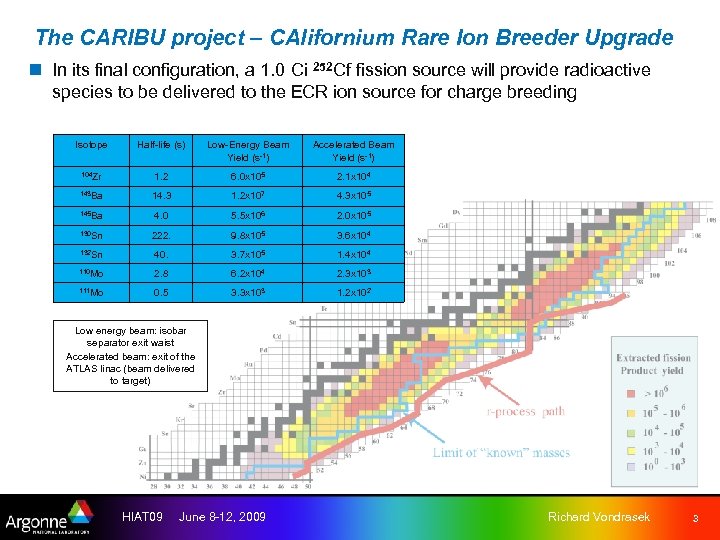
The CARIBU project – CAlifornium Rare Ion Breeder Upgrade n In its final configuration, a 1. 0 Ci 252 Cf fission source will provide radioactive species to be delivered to the ECR ion source for charge breeding Isotope Half-life (s) Low-Energy Beam Yield (s-1) Accelerated Beam Yield (s-1) 104 Zr 1. 2 6. 0 x 105 2. 1 x 10⁴ 143 Ba 14. 3 1. 2 x 10⁷ 4. 3 x 10⁵ 145 Ba 4. 0 5. 5 x 10⁶ 2. 0 x 105 130 Sn 222. 9. 8 x 10⁵ 3. 6 x 10⁴ 132 Sn 40. 3. 7 x 10⁵ 1. 4 x 10⁴ 110 Mo 2. 8 6. 2 x 10⁴ 2. 3 x 10³ 111 Mo 0. 5 3. 3 x 10³ 1. 2 x 10² Low energy beam: isobar separator exit waist Accelerated beam: exit of the ATLAS linac (beam delivered to target) HIAT 09 June 8 -12, 2009 Richard Vondrasek 3
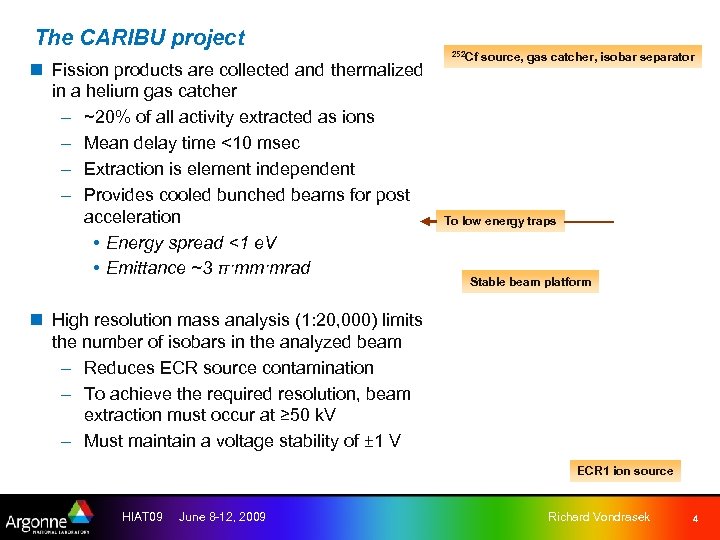
The CARIBU project n Fission products are collected and thermalized in a helium gas catcher – ~20% of all activity extracted as ions – Mean delay time <10 msec – Extraction is element independent – Provides cooled bunched beams for post acceleration • Energy spread <1 e. V • Emittance ~3 π·mm·mrad 252 Cf source, gas catcher, isobar separator To low energy traps Stable beam platform n High resolution mass analysis (1: 20, 000) limits the number of isobars in the analyzed beam – Reduces ECR source contamination – To achieve the required resolution, beam extraction must occur at ≥ 50 k. V – Must maintain a voltage stability of ± 1 V ECR 1 ion source HIAT 09 June 8 -12, 2009 Richard Vondrasek 4
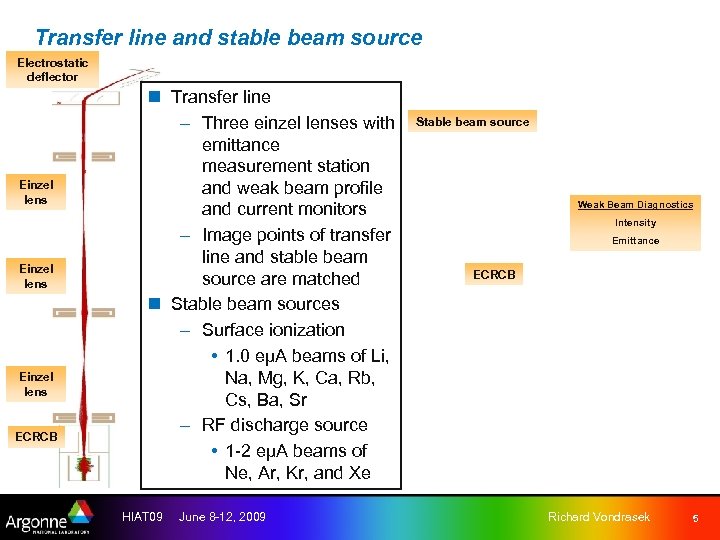
Transfer line and stable beam source Electrostatic deflector Einzel lens ECRCB n Transfer line – Three einzel lenses with emittance measurement station and weak beam profile and current monitors – Image points of transfer line and stable beam source are matched n Stable beam sources – Surface ionization • 1. 0 eµA beams of Li, Na, Mg, K, Ca, Rb, Cs, Ba, Sr – RF discharge source • 1 -2 eµA beams of Ne, Ar, Kr, and Xe HIAT 09 June 8 -12, 2009 Stable beam source Weak Beam Diagnostics Intensity Emittance ECRCB Richard Vondrasek 5
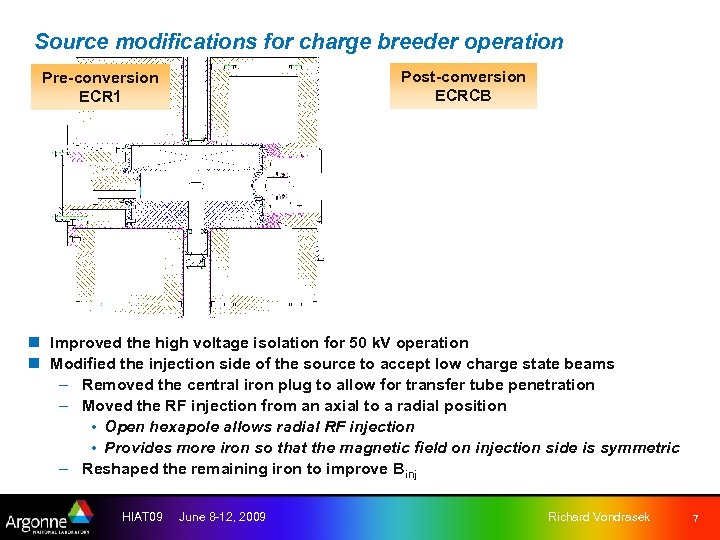
Source modifications for charge breeder operation Post-conversion ECRCB Pre-conversion ECR 1 n Improved the high voltage isolation for 50 k. V operation n Modified the injection side of the source to accept low charge state beams – Removed the central iron plug to allow for transfer tube penetration – Moved the RF injection from an axial to a radial position • Open hexapole allows radial RF injection • Provides more iron so that the magnetic field on injection side is symmetric – Reshaped the remaining iron to improve Binj HIAT 09 June 8 -12, 2009 Richard Vondrasek 7
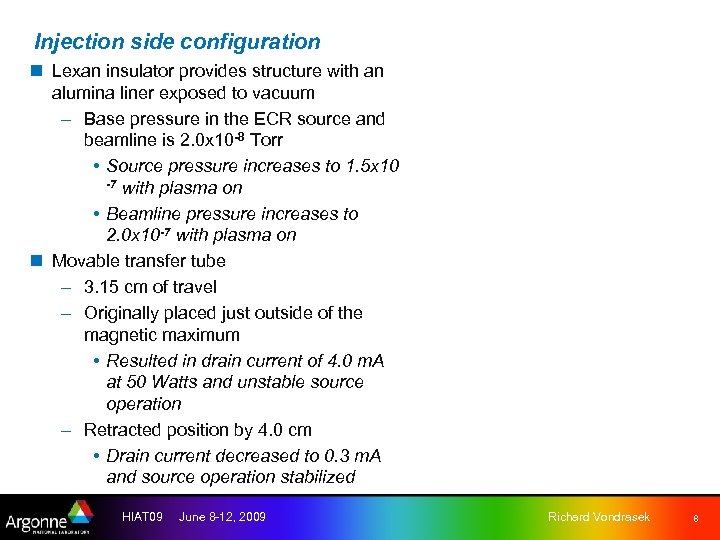
Injection side configuration n Lexan insulator provides structure with an alumina liner exposed to vacuum – Base pressure in the ECR source and beamline is 2. 0 x 10 -8 Torr • Source pressure increases to 1. 5 x 10 -7 with plasma on • Beamline pressure increases to 2. 0 x 10 -7 with plasma on n Movable transfer tube – 3. 15 cm of travel – Originally placed just outside of the magnetic maximum • Resulted in drain current of 4. 0 m. A at 50 Watts and unstable source operation – Retracted position by 4. 0 cm • Drain current decreased to 0. 3 m. A and source operation stabilized HIAT 09 June 8 -12, 2009 Richard Vondrasek 8
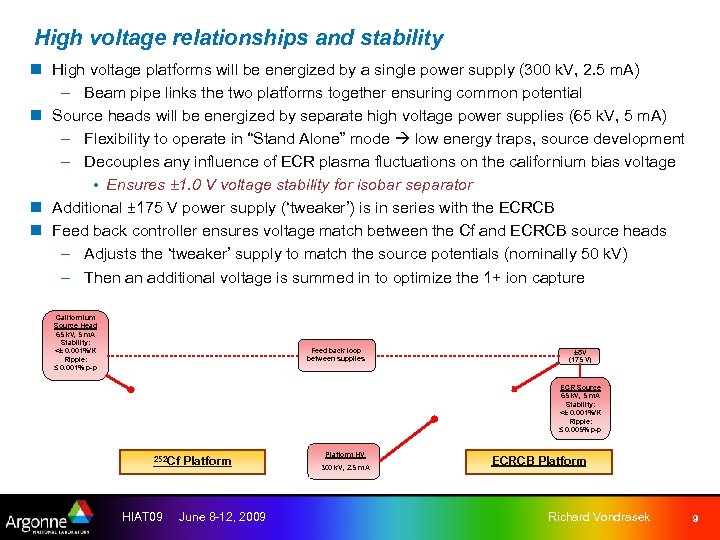
High voltage relationships and stability n High voltage platforms will be energized by a single power supply (300 k. V, 2. 5 m. A) – Beam pipe links the two platforms together ensuring common potential n Source heads will be energized by separate high voltage power supplies (65 k. V, 5 m. A) – Flexibility to operate in “Stand Alone” mode low energy traps, source development – Decouples any influence of ECR plasma fluctuations on the californium bias voltage • Ensures ± 1. 0 V voltage stability for isobar separator n Additional ± 175 V power supply (‘tweaker’) is in series with the ECRCB n Feed back controller ensures voltage match between the Cf and ECRCB source heads – Adjusts the ‘tweaker’ supply to match the source potentials (nominally 50 k. V) – Then an additional voltage is summed in to optimize the 1+ ion capture Californium Source Head 65 k. V, 5 m. A Stability: <± 0. 001%/K Ripple: ≤ 0. 001% p-p Feed back loop between supplies ±δV (175 V) ECR Source 65 k. V, 5 m. A Stability: <± 0. 001%/K Ripple: ≤ 0. 005% p-p 252 Cf HIAT 09 Platform June 8 -12, 2009 Platform HV 300 k. V, 2. 5 m. A ECRCB Platform Richard Vondrasek 9
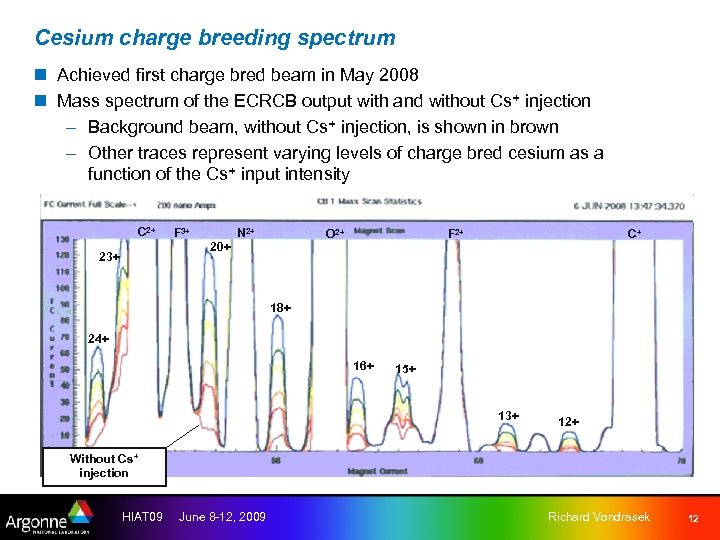
Cesium charge breeding spectrum n Achieved first charge bred beam in May 2008 n Mass spectrum of the ECRCB output with and without Cs+ injection – Background beam, without Cs+ injection, is shown in brown – Other traces represent varying levels of charge bred cesium as a function of the Cs+ input intensity C 2+ F 3+ N 2+ O 2+ 20+ 23+ F 2+ C+ 18+ 24+ 16+ 15+ 13+ 12+ Without Cs+ injection HIAT 09 June 8 -12, 2009 Richard Vondrasek 12
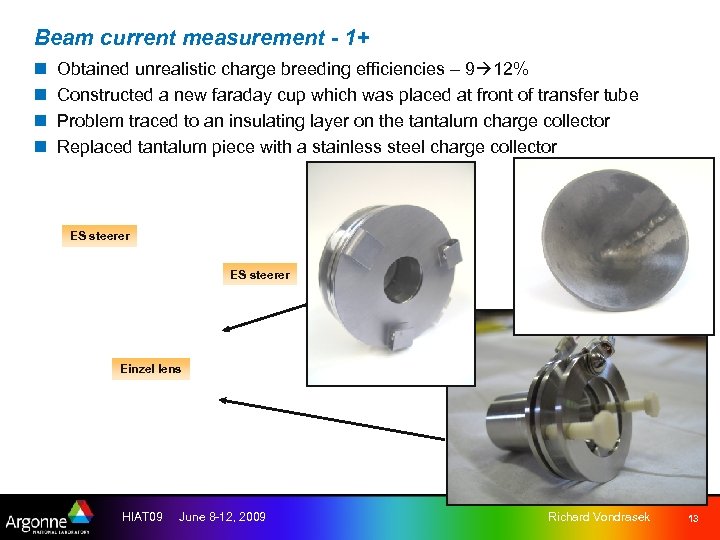
Beam current measurement - 1+ n n Obtained unrealistic charge breeding efficiencies – 9 12% Constructed a new faraday cup which was placed at front of transfer tube Problem traced to an insulating layer on the tantalum charge collector Replaced tantalum piece with a stainless steel charge collector ES steerer Einzel lens HIAT 09 June 8 -12, 2009 Richard Vondrasek 13
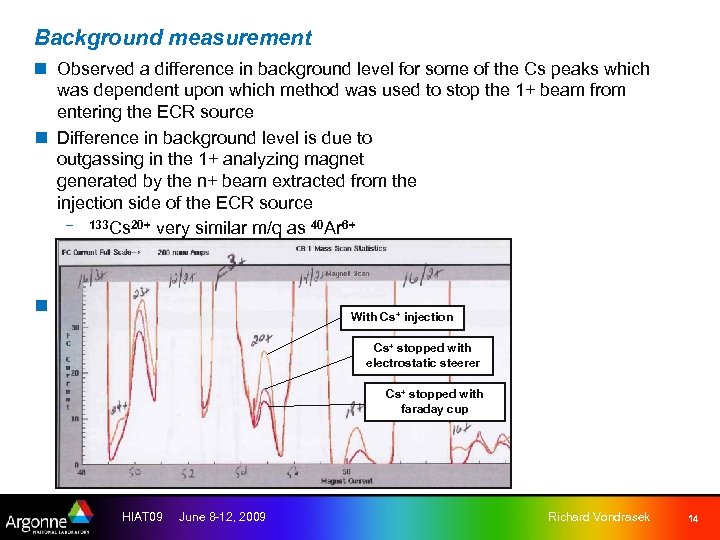
Background measurement n Observed a difference in background level for some of the Cs peaks which was dependent upon which method was used to stop the 1+ beam from entering the ECR source n Difference in background level is due to outgassing in the 1+ analyzing magnet generated by the n+ beam extracted from the injection side of the ECR source – 133 Cs 20+ very similar m/q as 40 Ar 6+ – 133 Cs 23+ very similar m/q as 40 Ar 7+ – 133 Cs 16+, 18+, 24+ do not exhibit this behavior n For 133 Cs 20+, with the same incoming With+Cs+ injection Cs intensity, the effect is clear Cs+ stopped with – Saturating the steerer electrostatic steerer • 2. 6% efficiency Cs+ stopped with – Putting the faraday cup in faraday cup • 6. 5% efficiency HIAT 09 June 8 -12, 2009 Richard Vondrasek 14
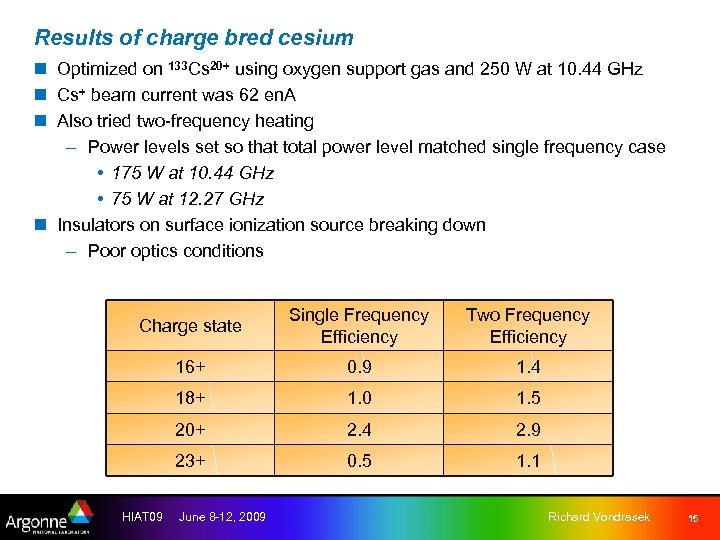
Results of charge bred cesium n Optimized on 133 Cs 20+ using oxygen support gas and 250 W at 10. 44 GHz n Cs+ beam current was 62 en. A n Also tried two-frequency heating – Power levels set so that total power level matched single frequency case • 175 W at 10. 44 GHz • 75 W at 12. 27 GHz n Insulators on surface ionization source breaking down – Poor optics conditions Charge state Single Frequency Efficiency Two Frequency Efficiency 16+ 0. 9 1. 4 18+ 1. 0 1. 5 20+ 2. 4 2. 9 23+ 0. 5 1. 1 HIAT 09 June 8 -12, 2009 Richard Vondrasek 15
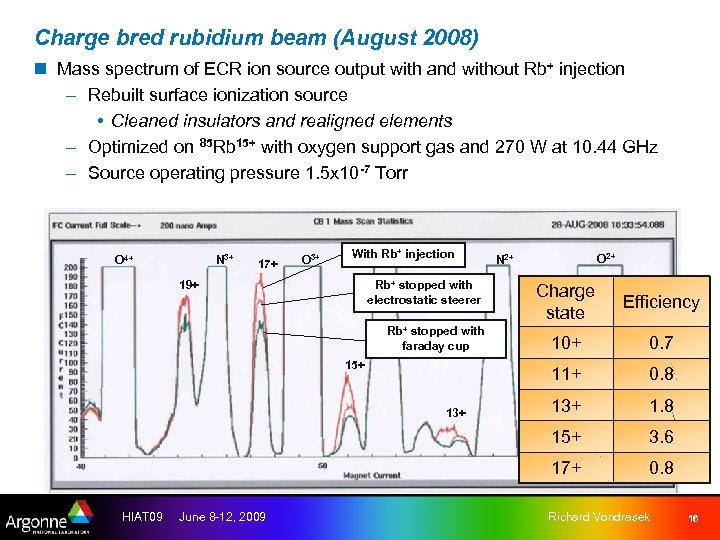
Charge bred rubidium beam (August 2008) n Mass spectrum of ECR ion source output with and without Rb+ injection – Rebuilt surface ionization source • Cleaned insulators and realigned elements – Optimized on 85 Rb 15+ with oxygen support gas and 270 W at 10. 44 GHz – Source operating pressure 1. 5 x 10 -7 Torr N 3+ O 4+ 17+ O 3+ With Rb+ injection C 2+ 19+ Rb+ stopped with electrostatic steerer O 2+ N 2+ HIAT 09 June 8 -12, 2009 0. 7 0. 8 13+ 1. 8 3. 6 17+ 13+ 10+ 15+ 11+ 15+ Efficiency 11+ Rb+ stopped with faraday cup Charge state 0. 8 Richard Vondrasek 16
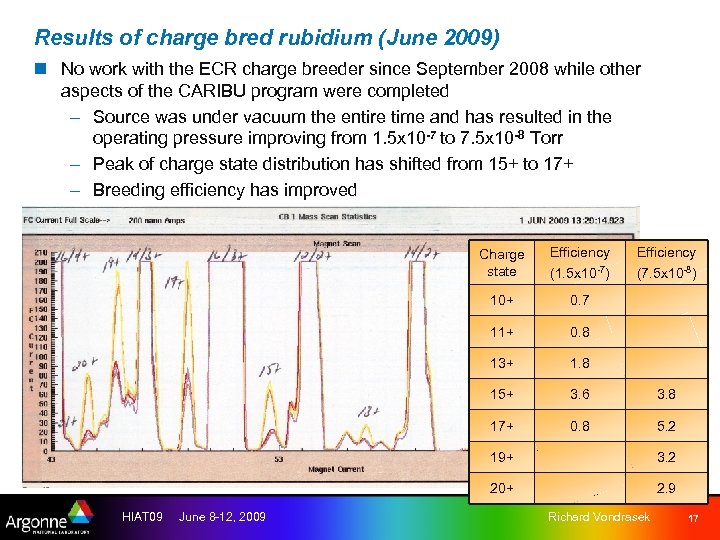
Results of charge bred rubidium (June 2009) n No work with the ECR charge breeder since September 2008 while other aspects of the CARIBU program were completed – Source was under vacuum the entire time and has resulted in the operating pressure improving from 1. 5 x 10 -7 to 7. 5 x 10 -8 Torr – Peak of charge state distribution has shifted from 15+ to 17+ – Breeding efficiency has improved Charge state Efficiency (1. 5 x 10 -7) Efficiency (7. 5 x 10 -8) 10+ 0. 7 11+ 0. 8 13+ 1. 8 15+ 3. 6 3. 8 17+ 0. 8 5. 2 19+ 20+ HIAT 09 June 8 -12, 2009 3. 2 2. 9 Richard Vondrasek 17
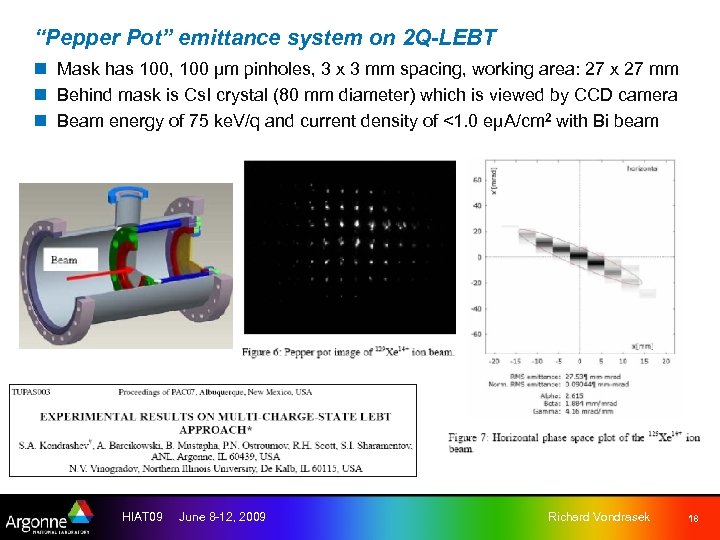
“Pepper Pot” emittance system on 2 Q-LEBT n Mask has 100, 100 µm pinholes, 3 x 3 mm spacing, working area: 27 x 27 mm n Behind mask is Cs. I crystal (80 mm diameter) which is viewed by CCD camera n Beam energy of 75 ke. V/q and current density of <1. 0 eµA/cm 2 with Bi beam HIAT 09 June 8 -12, 2009 Richard Vondrasek 18
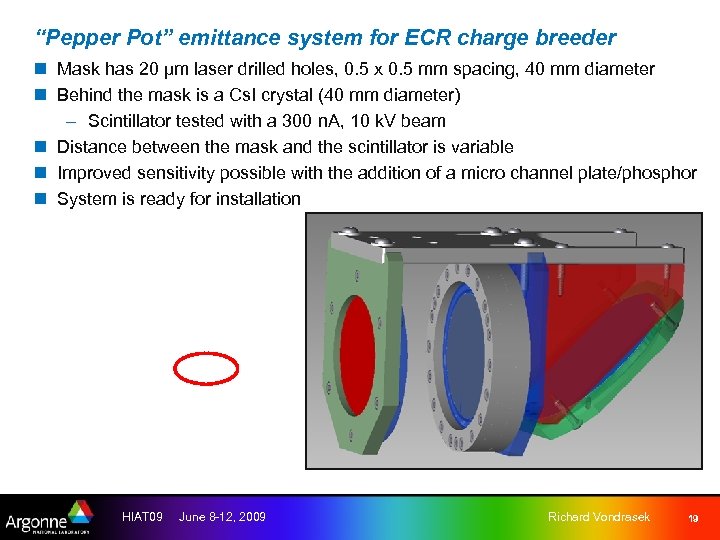
“Pepper Pot” emittance system for ECR charge breeder n Mask has 20 µm laser drilled holes, 0. 5 x 0. 5 mm spacing, 40 mm diameter n Behind the mask is a Cs. I crystal (40 mm diameter) – Scintillator tested with a 300 n. A, 10 k. V beam n Distance between the mask and the scintillator is variable n Improved sensitivity possible with the addition of a micro channel plate/phosphor n System is ready for installation HIAT 09 June 8 -12, 2009 Richard Vondrasek 19
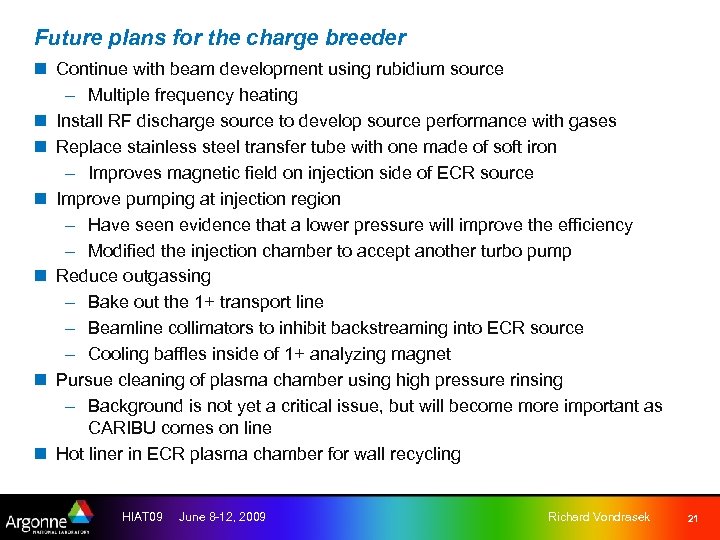
Future plans for the charge breeder n Continue with beam development using rubidium source – Multiple frequency heating n Install RF discharge source to develop source performance with gases n Replace stainless steel transfer tube with one made of soft iron – Improves magnetic field on injection side of ECR source n Improve pumping at injection region – Have seen evidence that a lower pressure will improve the efficiency – Modified the injection chamber to accept another turbo pump n Reduce outgassing – Bake out the 1+ transport line – Beamline collimators to inhibit backstreaming into ECR source – Cooling baffles inside of 1+ analyzing magnet n Pursue cleaning of plasma chamber using high pressure rinsing – Background is not yet a critical issue, but will become more important as CARIBU comes on line n Hot liner in ECR plasma chamber for wall recycling HIAT 09 June 8 -12, 2009 Richard Vondrasek 21
Скачать презентацию Initial Results of the ECR Charge Breeder for
32e83e82728188b3c4449c932a4f1b66.ppt