 Скачать презентацию INIS Training Seminar 23 -27 November 2009 INDEXING
19fa7cfe0e0370db2bcf8a2d3f15ef2e.ppt
- Количество слайдов: 33



INIS Training Seminar 23 -27 November 2009 INDEXING AND CLASSIFICATION: SUBJECT ANALYSIS IMPROVEMENT Neviana Rashkova Content Management Group, INIS and NKM Section IAEA International Atomic Energy Agency
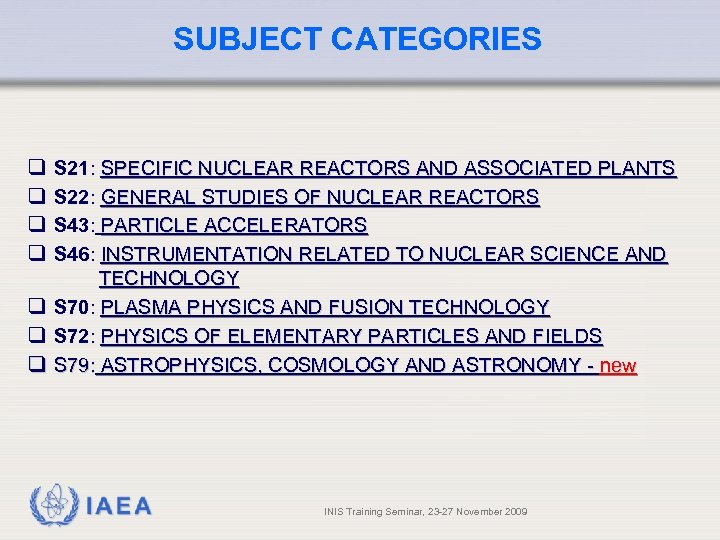
SUBJECT CATEGORIES q q q q S 21: SPECIFIC NUCLEAR REACTORS AND ASSOCIATED PLANTS S 22: GENERAL STUDIES OF NUCLEAR REACTORS S 43: PARTICLE ACCELERATORS S 46: INSTRUMENTATION RELATED TO NUCLEAR SCIENCE AND TECHNOLOGY S 70: PLASMA PHYSICS AND FUSION TECHNOLOGY S 72: PHYSICS OF ELEMENTARY PARTICLES AND FIELDS S 79: ASTROPHYSICS, COSMOLOGY AND ASTRONOMY - new IAEA INIS Training Seminar, 23 -27 November 2009
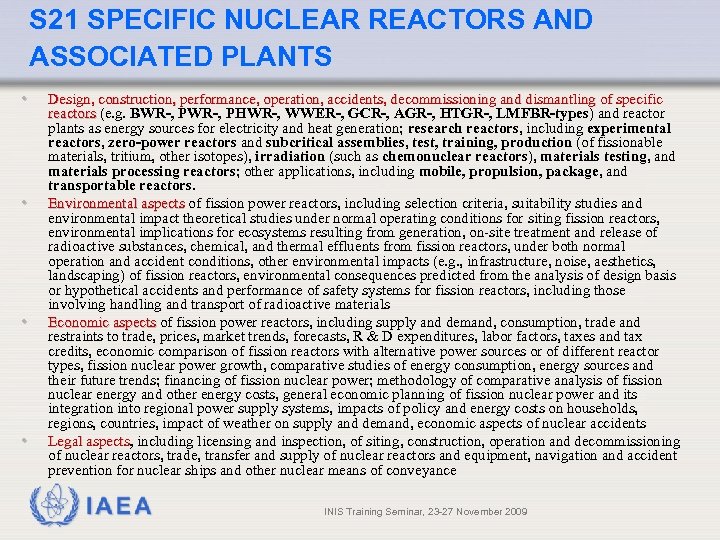
S 21 SPECIFIC NUCLEAR REACTORS AND ASSOCIATED PLANTS • • Design, construction, performance, operation, accidents, decommissioning and dismantling of specific reactors (e. g. BWR-, PHWR-, WWER-, GCR-, AGR-, HTGR-, LMFBR-types) and reactor plants as energy sources for electricity and heat generation; research reactors, including experimental reactors, zero-power reactors and subcritical assemblies, test, training, production (of fissionable materials, tritium, other isotopes), irradiation (such as chemonuclear reactors), materials testing, and materials processing reactors; other applications, including mobile, propulsion, package, and transportable reactors. Environmental aspects of fission power reactors, including selection criteria, suitability studies and environmental impact theoretical studies under normal operating conditions for siting fission reactors, environmental implications for ecosystems resulting from generation, on-site treatment and release of radioactive substances, chemical, and thermal effluents from fission reactors, under both normal operation and accident conditions, other environmental impacts (e. g. , infrastructure, noise, aesthetics, landscaping) of fission reactors, environmental consequences predicted from the analysis of design basis or hypothetical accidents and performance of safety systems for fission reactors, including those involving handling and transport of radioactive materials Economic aspects of fission power reactors, including supply and demand, consumption, trade and restraints to trade, prices, market trends, forecasts, R & D expenditures, labor factors, taxes and tax credits, economic comparison of fission reactors with alternative power sources or of different reactor types, fission nuclear power growth, comparative studies of energy consumption, energy sources and their future trends; financing of fission nuclear power; methodology of comparative analysis of fission nuclear energy and other energy costs, general economic planning of fission nuclear power and its integration into regional power supply systems, impacts of policy and energy costs on households, regions, countries, impact of weather on supply and demand, economic aspects of nuclear accidents Legal aspects, including licensing and inspection, of siting, construction, operation and decommissioning aspects of nuclear reactors, trade, transfer and supply of nuclear reactors and equipment, navigation and accident prevention for nuclear ships and other nuclear means of conveyance IAEA INIS Training Seminar, 23 -27 November 2009
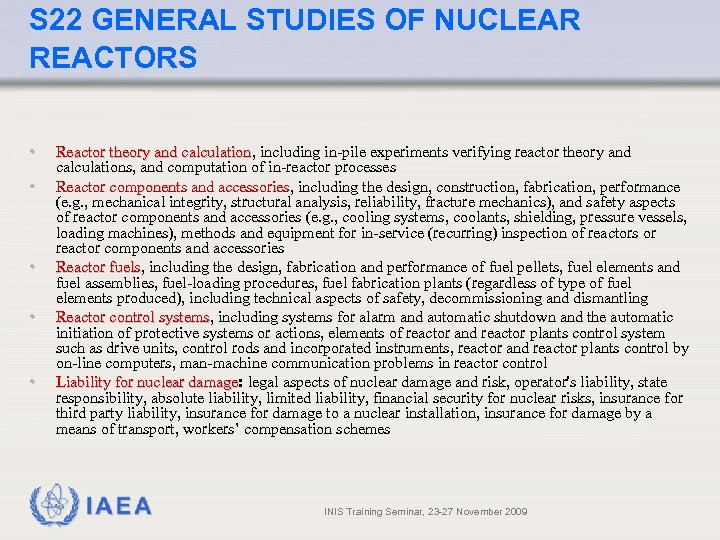
S 22 GENERAL STUDIES OF NUCLEAR REACTORS • • • Reactor theory and calculation, including in-pile experiments verifying reactor theory and calculations, and computation of in-reactor processes Reactor components and accessories, including the design, construction, fabrication, performance accessories (e. g. , mechanical integrity, structural analysis, reliability, fracture mechanics), and safety aspects of reactor components and accessories (e. g. , cooling systems, coolants, shielding, pressure vessels, loading machines), methods and equipment for in-service (recurring) inspection of reactors or reactor components and accessories Reactor fuels, including the design, fabrication and performance of fuel pellets, fuel elements and fuels fuel assemblies, fuel-loading procedures, fuel fabrication plants (regardless of type of fuel elements produced), including technical aspects of safety, decommissioning and dismantling Reactor control systems, including systems for alarm and automatic shutdown and the automatic systems initiation of protective systems or actions, elements of reactor and reactor plants control system such as drive units, control rods and incorporated instruments, reactor and reactor plants control by on-line computers, man-machine communication problems in reactor control Liability for nuclear damage: legal aspects of nuclear damage and risk, operator's liability, state damage responsibility, absolute liability, limited liability, financial security for nuclear risks, insurance for third party liability, insurance for damage to a nuclear installation, insurance for damage by a means of transport, workers’ compensation schemes IAEA INIS Training Seminar, 23 -27 November 2009
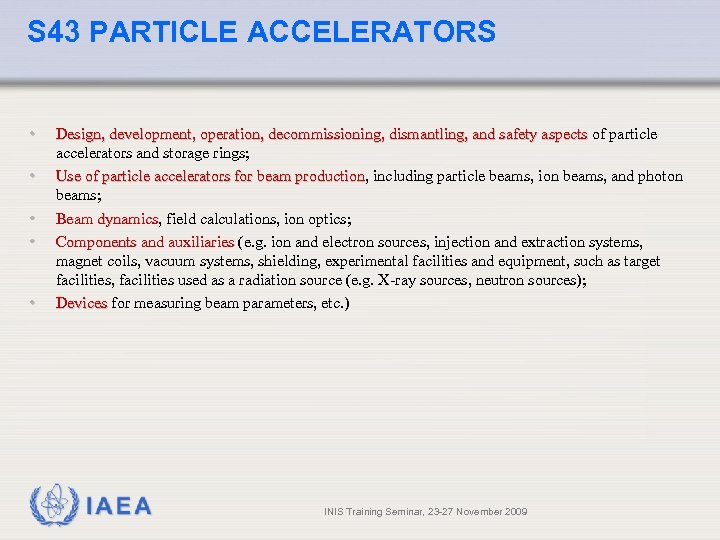
S 43 PARTICLE ACCELERATORS • • • Design, development, operation, decommissioning, dismantling, and safety aspects of particle accelerators and storage rings; Use of particle accelerators for beam production, including particle beams, ion beams, and photon production beams; Beam dynamics, field calculations, ion optics; dynamics Components and auxiliaries (e. g. ion and electron sources, injection and extraction systems, magnet coils, vacuum systems, shielding, experimental facilities and equipment, such as target facilities, facilities used as a radiation source (e. g. X-ray sources, neutron sources); Devices for measuring beam parameters, etc. ) IAEA INIS Training Seminar, 23 -27 November 2009
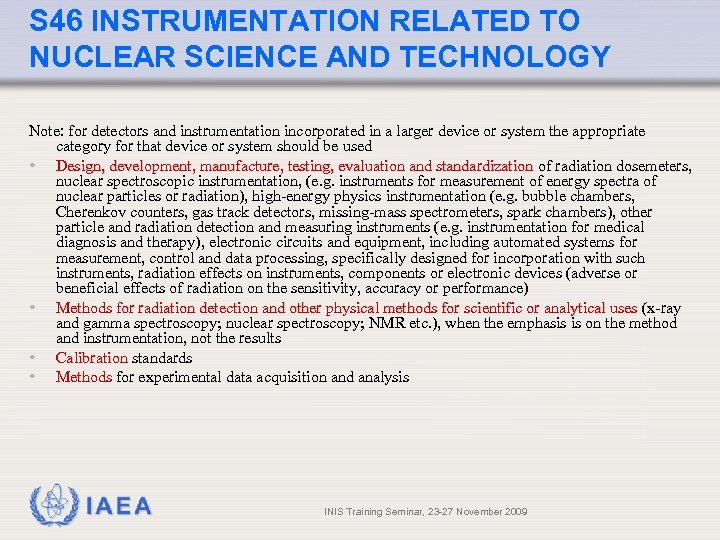
S 46 INSTRUMENTATION RELATED TO NUCLEAR SCIENCE AND TECHNOLOGY Note: for detectors and instrumentation incorporated in a larger device or system the appropriate category for that device or system should be used • Design, development, manufacture, testing, evaluation and standardization of radiation dosemeters, nuclear spectroscopic instrumentation, (e. g. instruments for measurement of energy spectra of nuclear particles or radiation), high-energy physics instrumentation (e. g. bubble chambers, Cherenkov counters, gas track detectors, missing-mass spectrometers, spark chambers), other particle and radiation detection and measuring instruments (e. g. instrumentation for medical diagnosis and therapy), electronic circuits and equipment, including automated systems for measurement, control and data processing, specifically designed for incorporation with such instruments, radiation effects on instruments, components or electronic devices (adverse or beneficial effects of radiation on the sensitivity, accuracy or performance) • Methods for radiation detection and other physical methods for scientific or analytical uses (x-ray and gamma spectroscopy; nuclear spectroscopy; NMR etc. ), when the emphasis is on the method and instrumentation, not the results • Calibration standards • Methods for experimental data acquisition and analysis IAEA INIS Training Seminar, 23 -27 November 2009
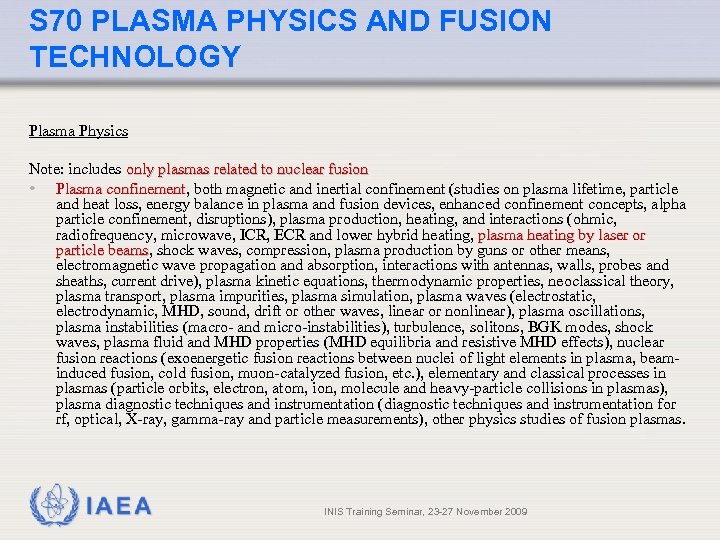
S 70 PLASMA PHYSICS AND FUSION TECHNOLOGY Plasma Physics Note: includes only plasmas related to nuclear fusion • Plasma confinement, both magnetic and inertial confinement (studies on plasma lifetime, particle confinement and heat loss, energy balance in plasma and fusion devices, enhanced confinement concepts, alpha particle confinement, disruptions), plasma production, heating, and interactions (ohmic, radiofrequency, microwave, ICR, ECR and lower hybrid heating, plasma heating by laser or particle beams, shock waves, compression, plasma production by guns or other means, beams electromagnetic wave propagation and absorption, interactions with antennas, walls, probes and sheaths, current drive), plasma kinetic equations, thermodynamic properties, neoclassical theory, plasma transport, plasma impurities, plasma simulation, plasma waves (electrostatic, electrodynamic, MHD, sound, drift or other waves, linear or nonlinear), plasma oscillations, plasma instabilities (macro- and micro-instabilities), turbulence, solitons, BGK modes, shock waves, plasma fluid and MHD properties (MHD equilibria and resistive MHD effects), nuclear fusion reactions (exoenergetic fusion reactions between nuclei of light elements in plasma, beaminduced fusion, cold fusion, muon-catalyzed fusion, etc. ), elementary and classical processes in plasmas (particle orbits, electron, atom, ion, molecule and heavy-particle collisions in plasmas), plasma diagnostic techniques and instrumentation (diagnostic techniques and instrumentation for rf, optical, X-ray, gamma-ray and particle measurements), other physics studies of fusion plasmas. IAEA INIS Training Seminar, 23 -27 November 2009
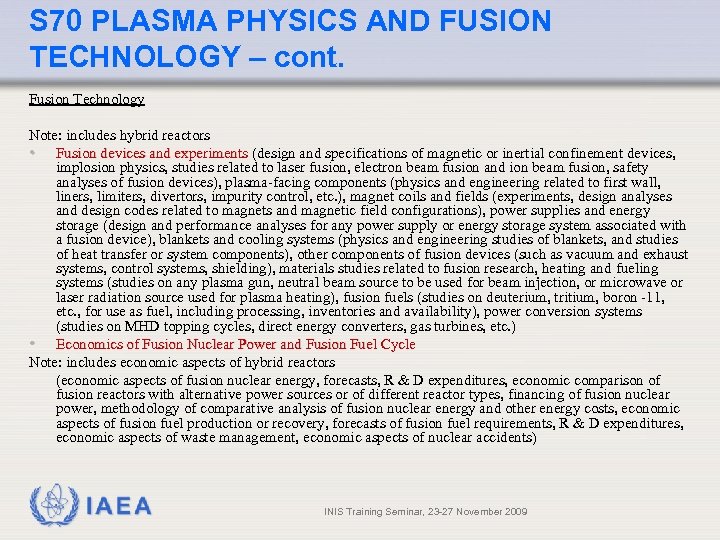
S 70 PLASMA PHYSICS AND FUSION TECHNOLOGY – cont. Fusion Technology Note: includes hybrid reactors • Fusion devices and experiments (design and specifications of magnetic or inertial confinement devices, implosion physics, studies related to laser fusion, electron beam fusion and ion beam fusion, safety analyses of fusion devices), plasma-facing components (physics and engineering related to first wall, liners, limiters, divertors, impurity control, etc. ), magnet coils and fields (experiments, design analyses and design codes related to magnets and magnetic field configurations), power supplies and energy storage (design and performance analyses for any power supply or energy storage system associated with a fusion device), blankets and cooling systems (physics and engineering studies of blankets, and studies of heat transfer or system components), other components of fusion devices (such as vacuum and exhaust systems, control systems, shielding), materials studies related to fusion research, heating and fueling systems (studies on any plasma gun, neutral beam source to be used for beam injection, or microwave or laser radiation source used for plasma heating), fusion fuels (studies on deuterium, tritium, boron -11, etc. , for use as fuel, including processing, inventories and availability), power conversion systems (studies on MHD topping cycles, direct energy converters, gas turbines, etc. ) • Economics of Fusion Nuclear Power and Fusion Fuel Cycle Note: includes economic aspects of hybrid reactors (economic aspects of fusion nuclear energy, forecasts, R & D expenditures, economic comparison of fusion reactors with alternative power sources or of different reactor types, financing of fusion nuclear power, methodology of comparative analysis of fusion nuclear energy and other energy costs, economic aspects of fusion fuel production or recovery, forecasts of fusion fuel requirements, R & D expenditures, economic aspects of waste management, economic aspects of nuclear accidents ) IAEA INIS Training Seminar, 23 -27 November 2009
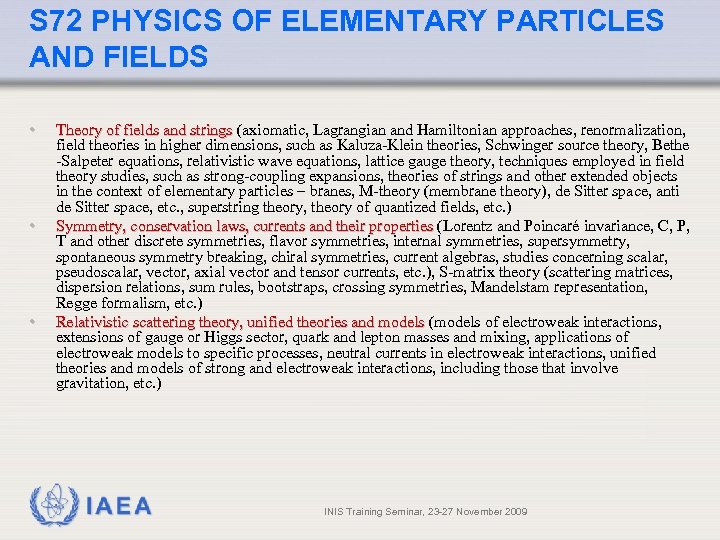
S 72 PHYSICS OF ELEMENTARY PARTICLES AND FIELDS • • • Theory of fields and strings (axiomatic, Lagrangian and Hamiltonian approaches, renormalization, field theories in higher dimensions, such as Kaluza-Klein theories, Schwinger source theory, Bethe -Salpeter equations, relativistic wave equations, lattice gauge theory, techniques employed in field theory studies, such as strong-coupling expansions, theories of strings and other extended objects in the context of elementary particles – branes, M-theory (membrane theory), de Sitter space, anti de Sitter space, etc. , superstring theory, theory of quantized fields, etc. ) Symmetry, conservation laws, currents and their properties (Lorentz and Poincaré invariance, C, P, T and other discrete symmetries, flavor symmetries, internal symmetries, supersymmetry, spontaneous symmetry breaking, chiral symmetries, current algebras, studies concerning scalar, pseudoscalar, vector, axial vector and tensor currents, etc. ), S-matrix theory (scattering matrices, dispersion relations, sum rules, bootstraps, crossing symmetries, Mandelstam representation, Regge formalism, etc. ) Relativistic scattering theory, unified theories and models (models of electroweak interactions, extensions of gauge or Higgs sector, quark and lepton masses and mixing, applications of electroweak models to specific processes, neutral currents in electroweak interactions, unified theories and models of strong and electroweak interactions, including those that involve gravitation, etc. ) IAEA INIS Training Seminar, 23 -27 November 2009
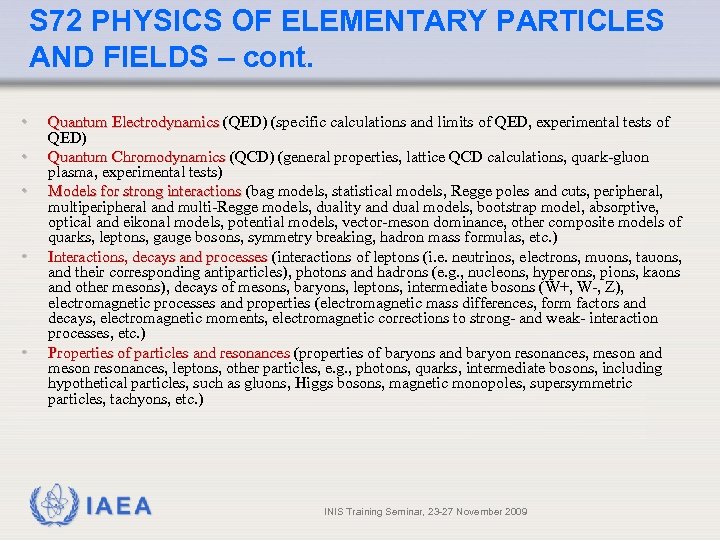
S 72 PHYSICS OF ELEMENTARY PARTICLES AND FIELDS – cont. • • • Quantum Electrodynamics (QED) (specific calculations and limits of QED, experimental tests of QED) Quantum Chromodynamics (QCD) (general properties, lattice QCD calculations, quark-gluon plasma, experimental tests) Models for strong interactions (bag models, statistical models, Regge poles and cuts, peripheral, multiperipheral and multi-Regge models, duality and dual models, bootstrap model, absorptive, optical and eikonal models, potential models, vector-meson dominance, other composite models of quarks, leptons, gauge bosons, symmetry breaking, hadron mass formulas, etc. ) Interactions, decays and processes (interactions of leptons (i. e. neutrinos, electrons, muons, tauons, and their corresponding antiparticles), photons and hadrons (e. g. , nucleons, hyperons, pions, kaons and other mesons), decays of mesons, baryons, leptons, intermediate bosons (W+, W-, Z), electromagnetic processes and properties (electromagnetic mass differences, form factors and decays, electromagnetic moments, electromagnetic corrections to strong- and weak- interaction processes, etc. ) Properties of particles and resonances (properties of baryons and baryon resonances, meson and meson resonances, leptons, other particles, e. g. , photons, quarks, intermediate bosons, including hypothetical particles, such as gluons, Higgs bosons, magnetic monopoles, supersymmetric particles, tachyons, etc. ) IAEA INIS Training Seminar, 23 -27 November 2009
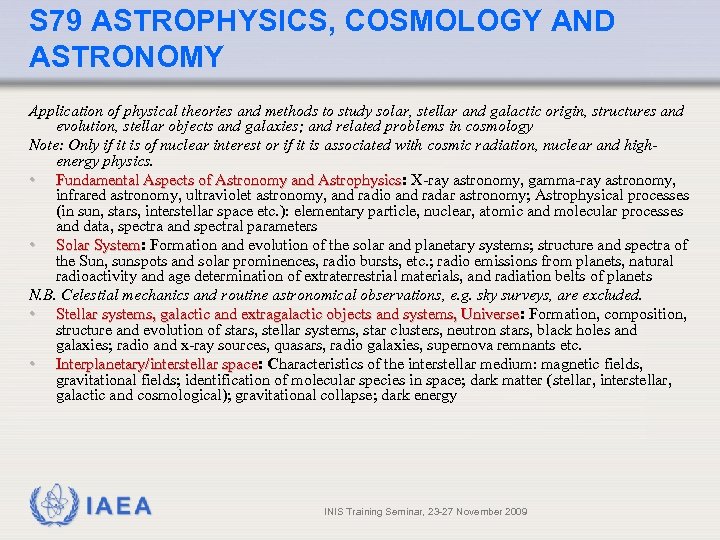
S 79 ASTROPHYSICS, COSMOLOGY AND ASTRONOMY Application of physical theories and methods to study solar, stellar and galactic origin, structures and evolution, stellar objects and galaxies; and related problems in cosmology Note: Only if it is of nuclear interest or if it is associated with cosmic radiation, nuclear and highenergy physics. • Fundamental Aspects of Astronomy and Astrophysics: X-ray astronomy, gamma-ray astronomy, Astrophysics infrared astronomy, ultraviolet astronomy, and radio and radar astronomy; Astrophysical processes (in sun, stars, interstellar space etc. ): elementary particle, nuclear, atomic and molecular processes and data, spectra and spectral parameters • Solar System: Formation and evolution of the solar and planetary systems; structure and spectra of System the Sun, sunspots and solar prominences, radio bursts, etc. ; radio emissions from planets, natural radioactivity and age determination of extraterrestrial materials, and radiation belts of planets N. B. Celestial mechanics and routine astronomical observations, e. g. sky surveys, are excluded. • Stellar systems, galactic and extragalactic objects and systems, Universe: Formation, composition, Universe structure and evolution of stars, stellar systems, star clusters, neutron stars, black holes and galaxies; radio and x-ray sources, quasars, radio galaxies, supernova remnants etc. • Interplanetary/interstellar space: Characteristics of the interstellar medium: magnetic fields, space gravitational fields; identification of molecular species in space; dark matter (stellar, interstellar, galactic and cosmological); gravitational collapse; dark energy IAEA INIS Training Seminar, 23 -27 November 2009
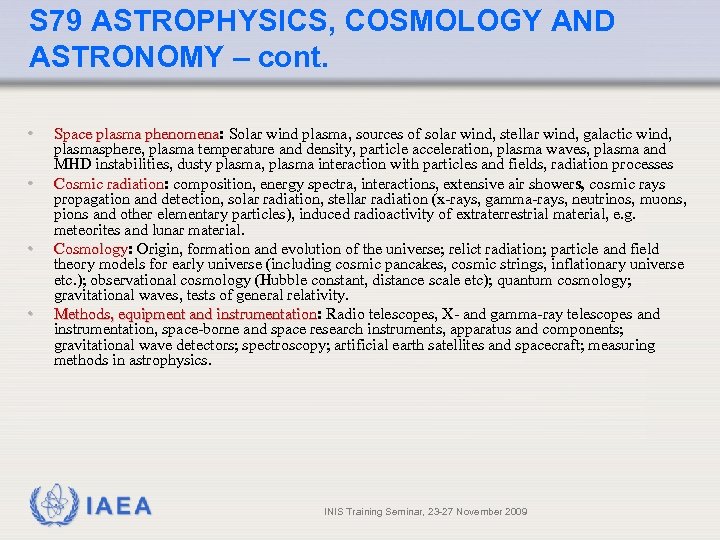
S 79 ASTROPHYSICS, COSMOLOGY AND ASTRONOMY – cont. • • Space plasma phenomena: Solar wind plasma, sources of solar wind, stellar wind, galactic wind, phenomena plasmasphere, plasma temperature and density, particle acceleration, plasma waves, plasma and MHD instabilities, dusty plasma, plasma interaction with particles and fields, radiation processes Cosmic radiation: composition, energy spectra, interactions, extensive air showers, cosmic rays radiation propagation and detection, solar radiation, stellar radiation (x-rays, gamma-rays, neutrinos, muons, pions and other elementary particles), induced radioactivity of extraterrestrial material, e. g. meteorites and lunar material. Cosmology: Origin, formation and evolution of the universe; relict radiation; particle and field Cosmology theory models for early universe (including cosmic pancakes, cosmic strings, inflationary universe etc. ); observational cosmology (Hubble constant, distance scale etc); quantum cosmology; gravitational waves, tests of general relativity. Methods, equipment and instrumentation: Radio telescopes, X- and gamma-ray telescopes and instrumentation, space-borne and space research instruments, apparatus and components; gravitational wave detectors; spectroscopy; artificial earth satellites and spacecraft; measuring methods in astrophysics. IAEA INIS Training Seminar, 23 -27 November 2009
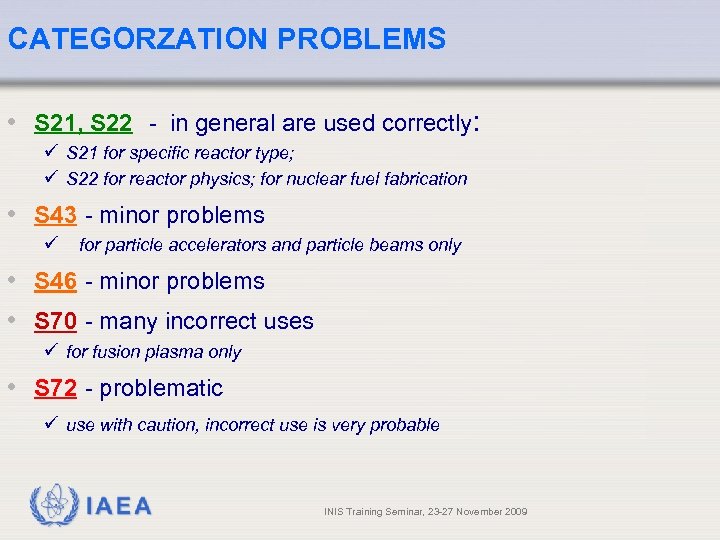
CATEGORZATION PROBLEMS • S 21, S 22 - in general are used correctly: ü S 21 for specific reactor type; ü S 22 for reactor physics; for nuclear fuel fabrication • S 43 - minor problems ü for particle accelerators and particle beams only • S 46 - minor problems • S 70 - many incorrect uses ü for fusion plasma only • S 72 - problematic ü use with caution, incorrect use is very probable IAEA INIS Training Seminar, 23 -27 November 2009
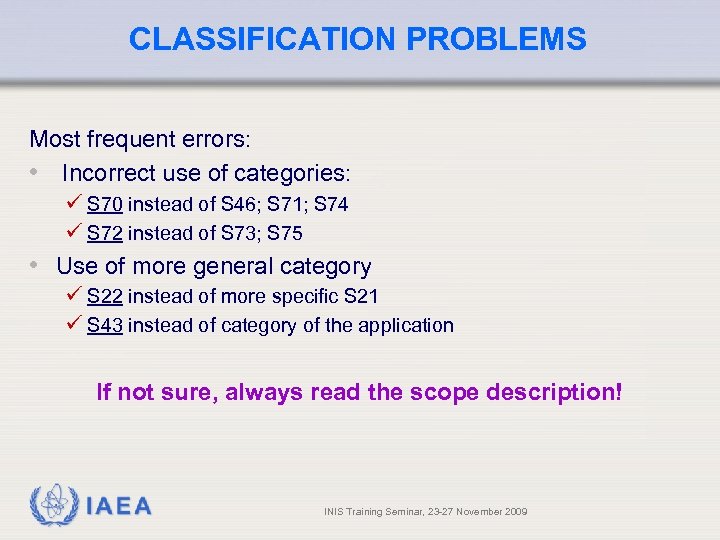
CLASSIFICATION PROBLEMS Most frequent errors: • Incorrect use of categories: ü S 70 instead of S 46; S 71; S 74 ü S 72 instead of S 73; S 75 • Use of more general category ü S 22 instead of more specific S 21 ü S 43 instead of category of the application If not sure, always read the scope description! IAEA INIS Training Seminar, 23 -27 November 2009
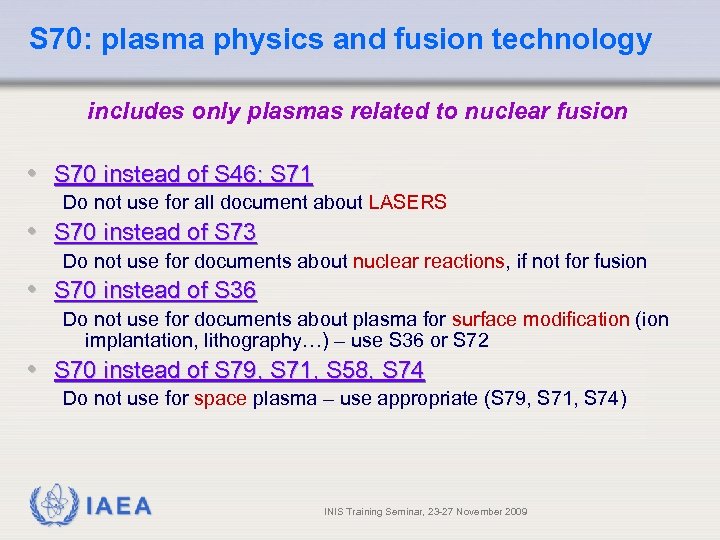
S 70: plasma physics and fusion technology includes only plasmas related to nuclear fusion • S 70 instead of S 46; S 71 Do not use for all document about LASERS • S 70 instead of S 73 Do not use for documents about nuclear reactions, if not for fusion • S 70 instead of S 36 Do not use for documents about plasma for surface modification (ion implantation, lithography…) – use S 36 or S 72 • S 70 instead of S 79, S 71, S 58, S 74 Do not use for space plasma – use appropriate (S 79, S 71, S 74) IAEA INIS Training Seminar, 23 -27 November 2009
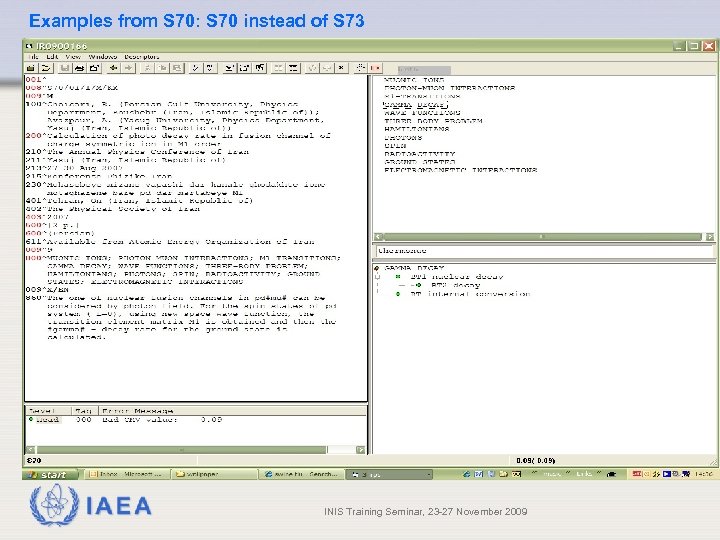
Examples from S 70: S 70 instead of S 73 IAEA INIS Training Seminar, 23 -27 November 2009
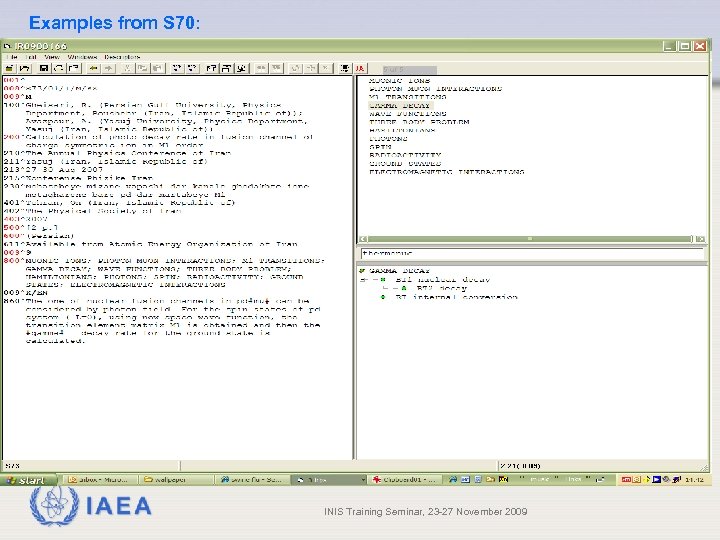
Examples from S 70: IAEA INIS Training Seminar, 23 -27 November 2009
S 72: Physics of elementary particles and fields for high energy physics only • S 72 instead of S 73 – the most frequent error! S 72 instead of S 73 Do not use for every document discussing elementary particles (in many cases this is wrong); Ex. Interacting Bosons Model (IBM) – nuclear models; nucleons in nuclear structure; nuclear potentials are S 73 Do not use for nuclear reactions and spectroscopy • S 72 instead of S 71 Do not use for classical relativity theory • S 72 instead of S 75 Do not use for models in condensed matter physics; Ex. Phonones use S 72 very carefully ! IAEA INIS Training Seminar, 23 -27 November 2009
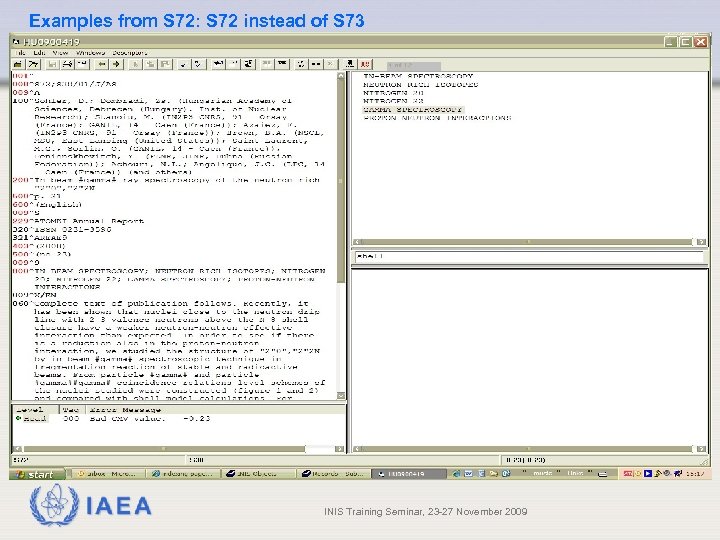
Examples from S 72: S 72 instead of S 73 IAEA INIS Training Seminar, 23 -27 November 2009
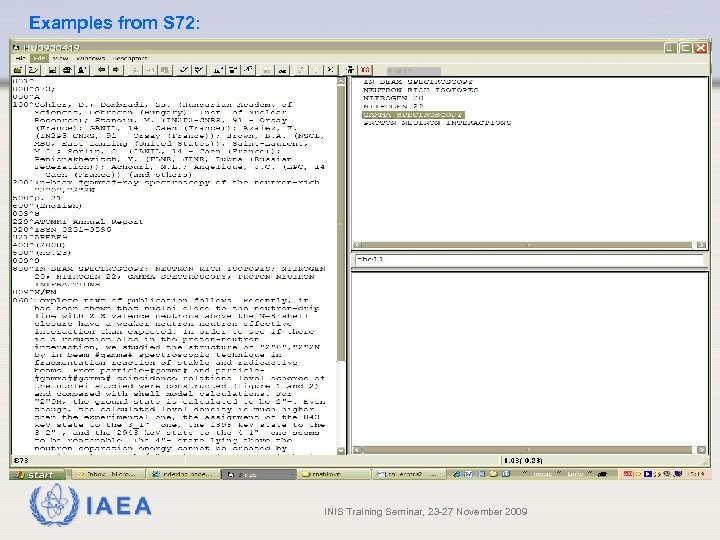
Examples from S 72: IAEA INIS Training Seminar, 23 -27 November 2009
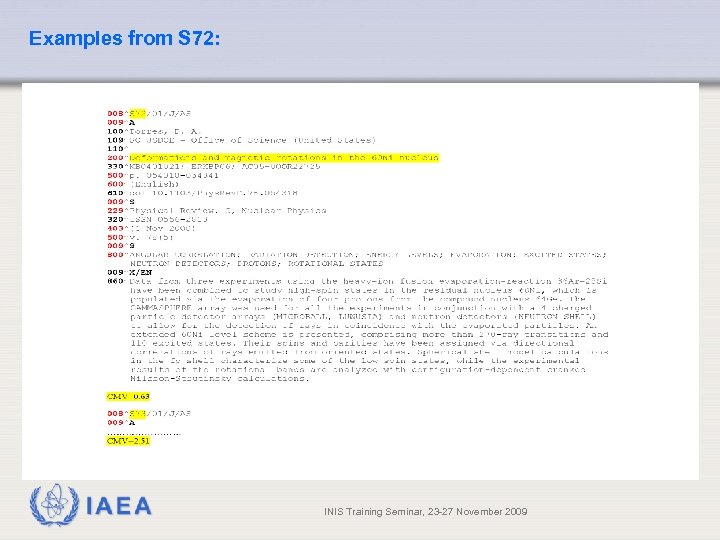
Examples from S 72: IAEA INIS Training Seminar, 23 -27 November 2009
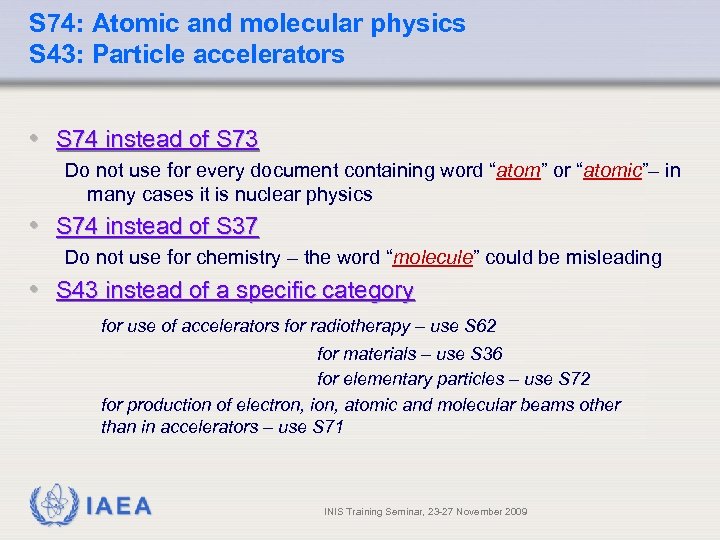
S 74: Atomic and molecular physics S 43: Particle accelerators • S 74 instead of S 73 Do not use for every document containing word “atom” or “atomic”– in many cases it is nuclear physics • S 74 instead of S 37 Do not use for chemistry – the word “molecule” could be misleading • S 43 instead of a specific category for use of accelerators for radiotherapy – use S 62 for materials – use S 36 for elementary particles – use S 72 for production of electron, ion, atomic and molecular beams other than in accelerators – use S 71 IAEA INIS Training Seminar, 23 -27 November 2009
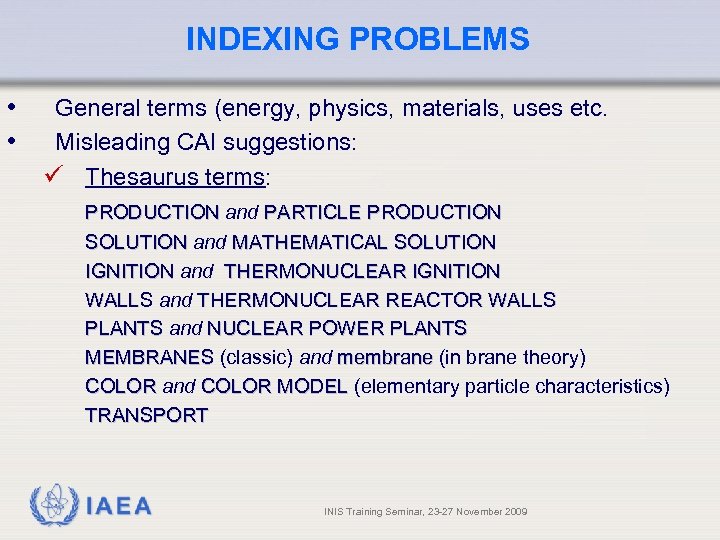
INDEXING PROBLEMS • • General terms (energy, physics, materials, uses etc. Misleading CAI suggestions: ü Thesaurus terms: PRODUCTION and PARTICLE PRODUCTION SOLUTION and MATHEMATICAL SOLUTION IGNITION and THERMONUCLEAR IGNITION WALLS and THERMONUCLEAR REACTOR WALLS PLANTS and NUCLEAR POWER PLANTS MEMBRANES (classic) and membrane (in brane theory) MEMBRANES membrane COLOR and COLOR MODEL (elementary particle characteristics) COLOR MODEL TRANSPORT IAEA INIS Training Seminar, 23 -27 November 2009
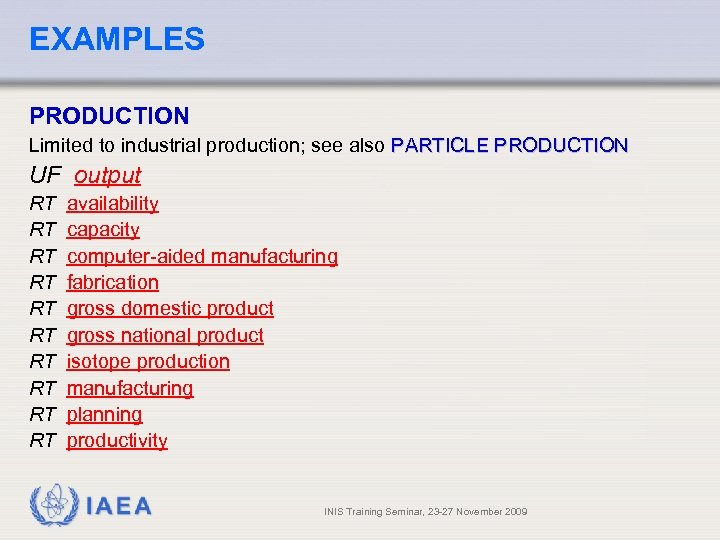
EXAMPLES PRODUCTION Limited to industrial production; see also PARTICLE PRODUCTION UF output RT availability RT capacity RT computer-aided manufacturing RT fabrication RT gross domestic product RT gross national product RT isotope production RT manufacturing RT planning RT productivity IAEA INIS Training Seminar, 23 -27 November 2009
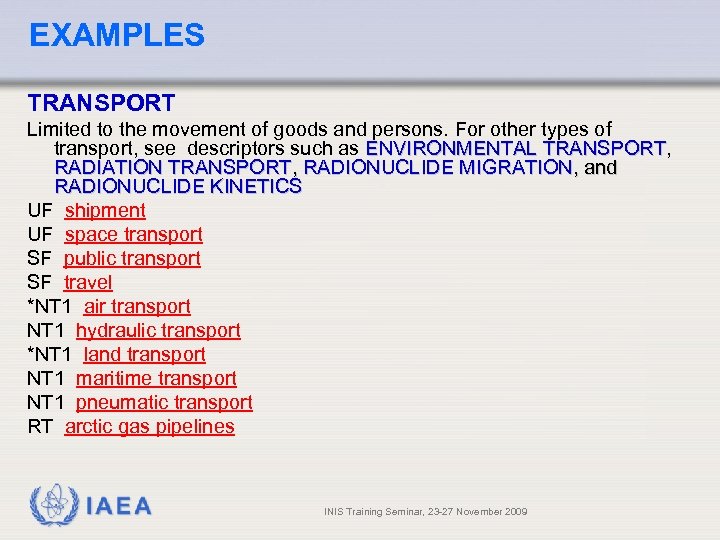
EXAMPLES TRANSPORT Limited to the movement of goods and persons. For other types of transport, see descriptors such as ENVIRONMENTAL TRANSPORT, ENVIRONMENTAL TRANSPORT RADIATION TRANSPORT, RADIONUCLIDE MIGRATION, and RADIONUCLIDE KINETICS UF shipment UF space transport SF public transport SF travel *NT 1 air transport NT 1 hydraulic transport *NT 1 land transport NT 1 maritime transport NT 1 pneumatic transport RT arctic gas pipelines IAEA INIS Training Seminar, 23 -27 November 2009
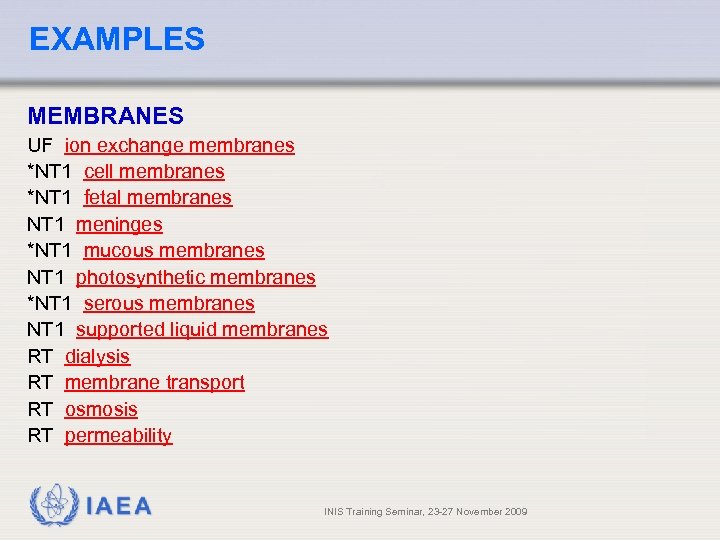
EXAMPLES MEMBRANES UF ion exchange membranes *NT 1 cell membranes *NT 1 fetal membranes NT 1 meninges *NT 1 mucous membranes NT 1 photosynthetic membranes *NT 1 serous membranes NT 1 supported liquid membranes RT dialysis RT membrane transport RT osmosis RT permeability IAEA INIS Training Seminar, 23 -27 November 2009
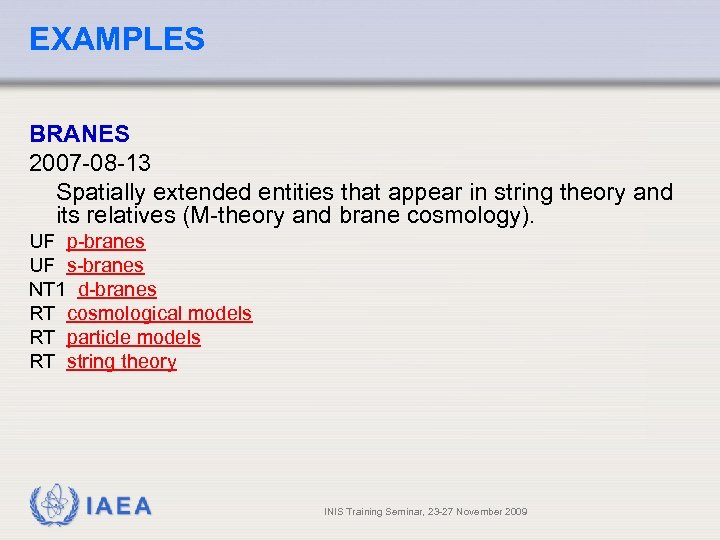
EXAMPLES BRANES 2007 -08 -13 Spatially extended entities that appear in string theory and its relatives (M-theory and brane cosmology). UF p-branes UF s-branes NT 1 d-branes RT cosmological models RT particle models RT string theory IAEA INIS Training Seminar, 23 -27 November 2009
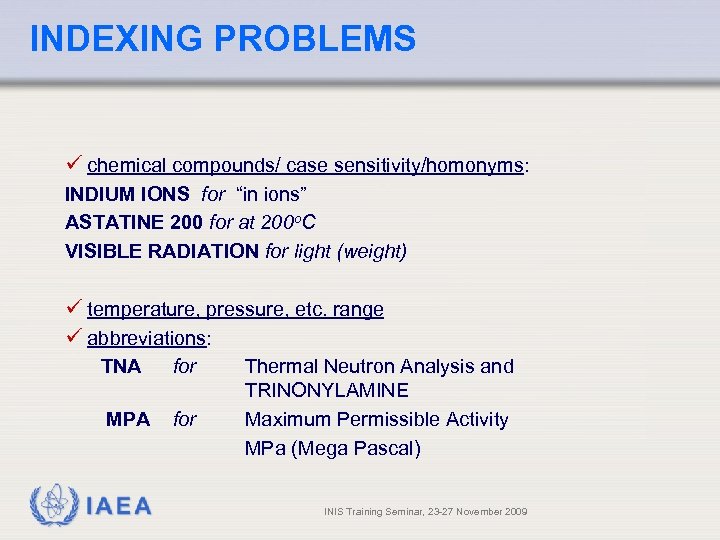
INDEXING PROBLEMS ü chemical compounds/ case sensitivity/homonyms: INDIUM IONS for “in ions” ASTATINE 200 for at 200 o. C VISIBLE RADIATION for light (weight) ü temperature, pressure, etc. range ü abbreviations: TNA for MPA for IAEA Thermal Neutron Analysis and TRINONYLAMINE Maximum Permissible Activity MPa (Mega Pascal) INIS Training Seminar, 23 -27 November 2009
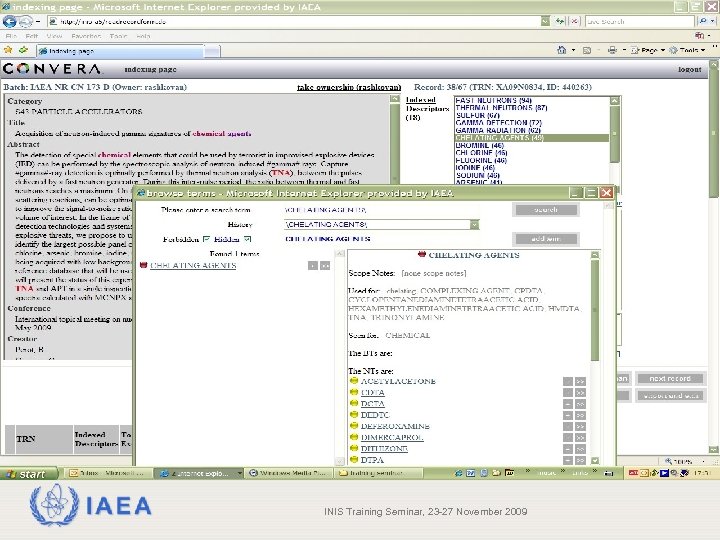
IAEA INIS Training Seminar, 23 -27 November 2009
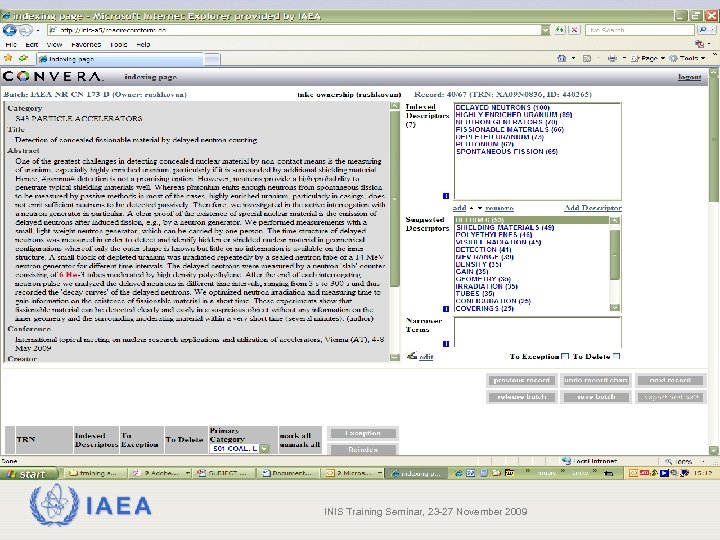
IAEA INIS Training Seminar, 23 -27 November 2009
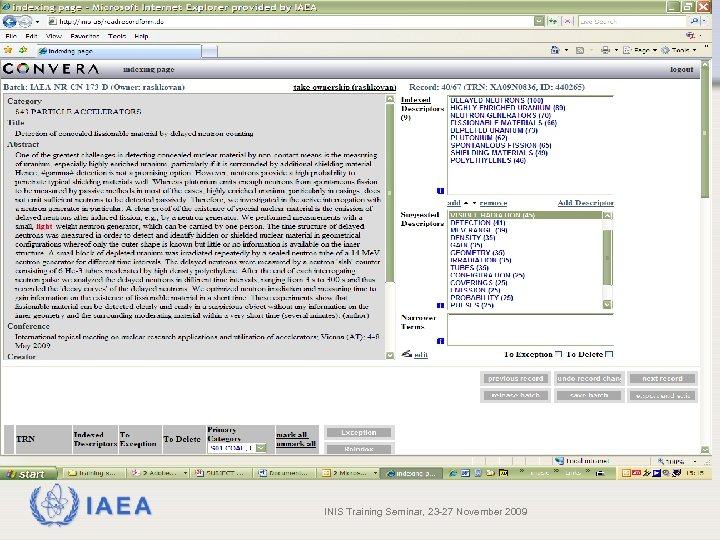
IAEA INIS Training Seminar, 23 -27 November 2009
SUBJECT ANALYSIS IMPROVEMENT SUGGESTIONS: • Carefully read the title; look for the Journal title or conference title – it • • • gives information about the category Look for key phases in the scope description Pay attention to the context (especially for CAI indexing) Pay attention to the ranges (temperature, energy, …) Check the word block in the Thesaurus if the word has several meanings Use: SCOPE DESCRIPTIONS THESAURUS IAEA INIS Training Seminar, 23 -27 November 2009
INIS Training Seminar 23 -27 November 2009 THANK YOU! IAEA
Скачать презентацию INIS Training Seminar 23 -27 November 2009 INDEXING
19fa7cfe0e0370db2bcf8a2d3f15ef2e.ppt