



 - ING FORM
 The -ing form is used As a noon: Travelling is a great way to learn about other cultures.
 After certain verbs : Admit - допускать, соглашаться Accuse sb of - обвинять Apologise for – приносить извинения за Appreciate-оценивать, быть благодарным Avoid-избегать, остерегаться, сторониться,
 Complain to sb of Continue - жаловаться, - продолжать Deny - отрицать, отвергать, не признавать существование Fancy - очень хотеть, страстно желать, воображать себе Imagine - воображать, представлять себе
 Miss - потерпеть неудачу, упустить пропустить Quit - оставлять, покидать, уходить, уезхать Save - спасать Practise -применять Consider - рассматривать, обсуждать Prevent - предотвращать, предупреждать Risk- рисковать, отважиться
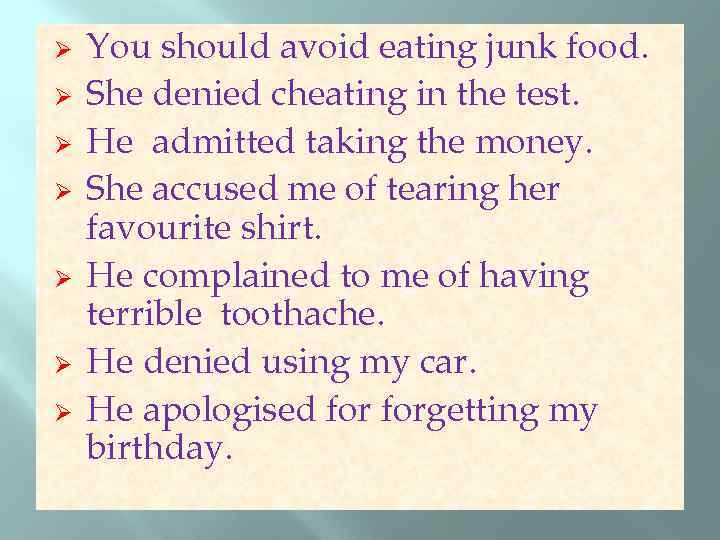 Ø Ø Ø Ø You should avoid eating junk food. She denied cheating in the test. He admitted taking the money. She accused me of tearing her favourite shirt. He complained to me of having terrible toothache. He denied using my car. He apologised forgetting my birthday.
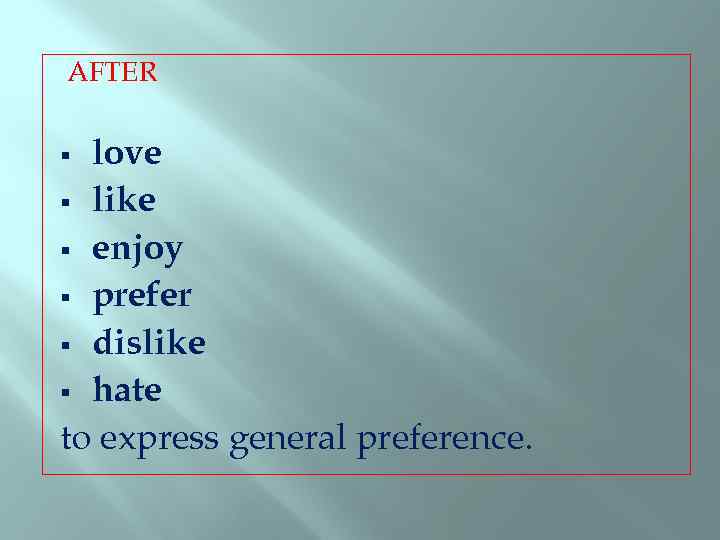 AFTER love § like § enjoy § prefer § dislike § hate to express general preference. §
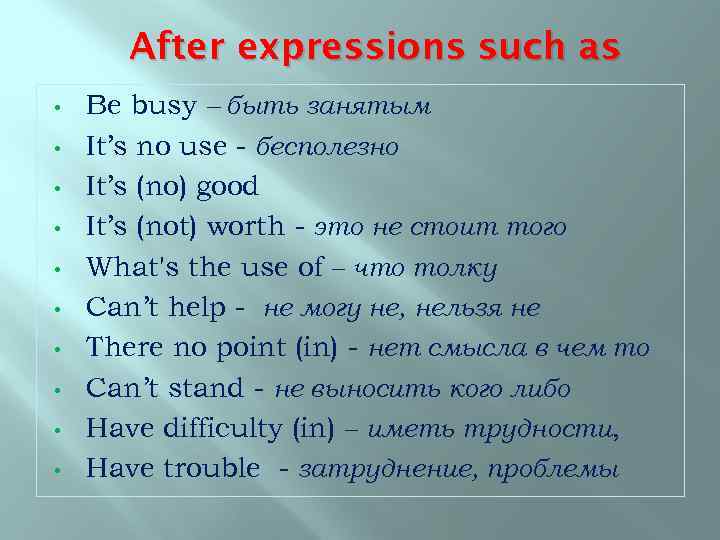 After expressions such as • • • Be busy – быть занятым It’s no use - бесполезно It’s (no) good It’s (not) worth - это не стоит того What's the use of – что толку Can’t help - не могу не, нельзя не There no point (in) - нет смысла в чем то Can’t stand - не выносить кого либо Have difficulty (in) – иметь трудности, Have trouble - затруднение, проблемы
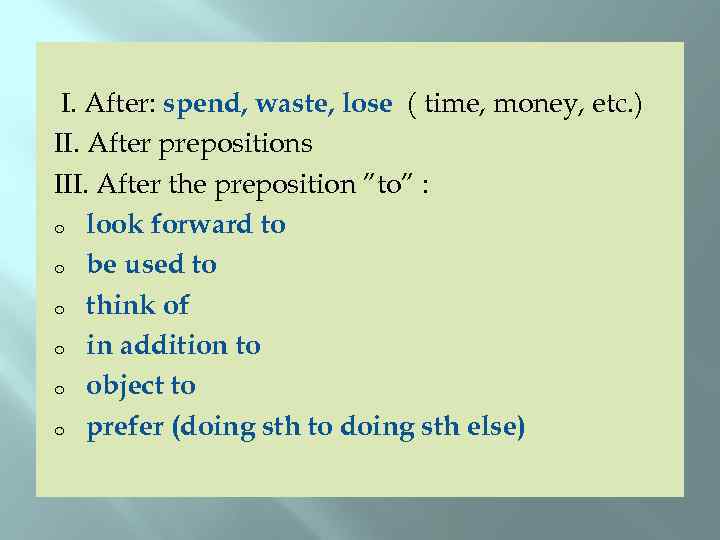 I. After: spend, waste, lose ( time, money, etc. ) II. After prepositions III. After the preposition ”to” : o look forward to o be used to o think of o in addition to o object to o prefer (doing sth to doing sth else)
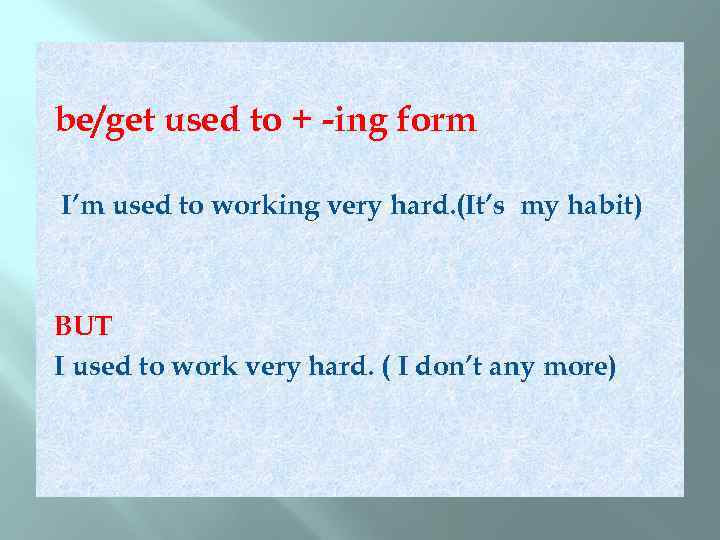 be/get used to + -ing form I’m used to working very hard. (It’s my habit) BUT I used to work very hard. ( I don’t any more)
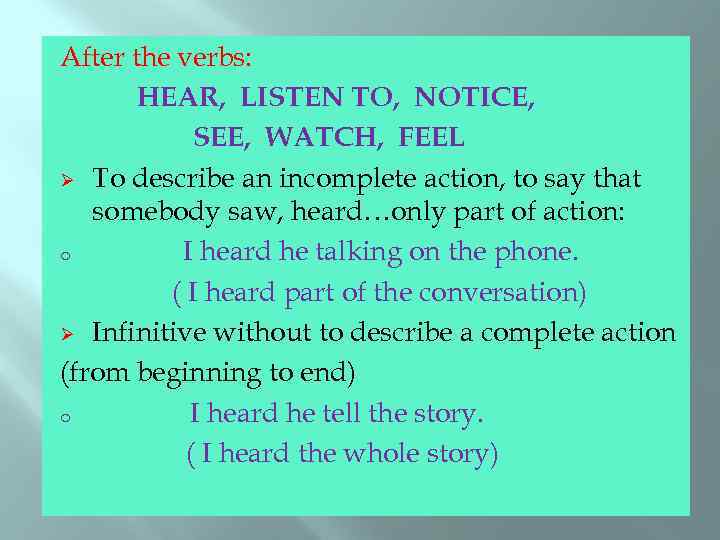 After the verbs: HEAR, LISTEN TO, NOTICE, SEE, WATCH, FEEL Ø To describe an incomplete action, to say that somebody saw, heard…only part of action: o I heard he talking on the phone. ( I heard part of the conversation) Ø Infinitive without to describe a complete action (from beginning to end) o I heard he tell the story. ( I heard the whole story)
 t. O-INFINITIVE
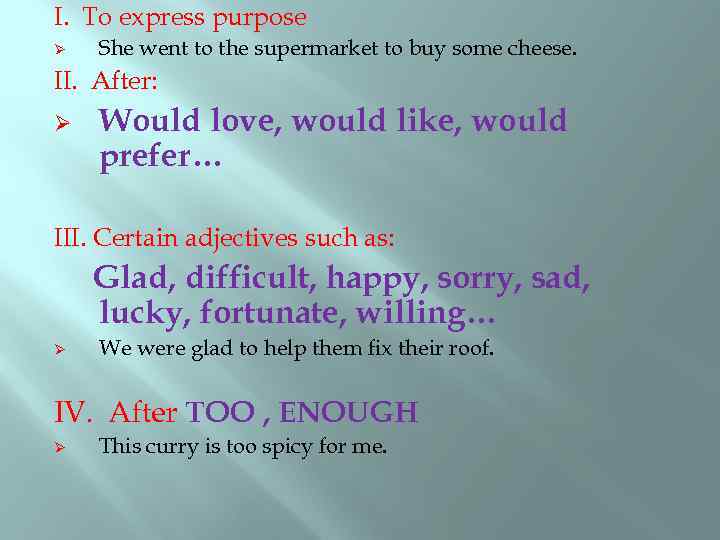 I. To express purpose Ø She went to the supermarket to buy some cheese. II. After: Ø Would love, would like, would prefer… III. Certain adjectives such as: Glad, difficult, happy, sorry, sad, lucky, fortunate, willing… Ø We were glad to help them fix their roof. IV. After TOO , ENOUGH Ø This curry is too spicy for me.
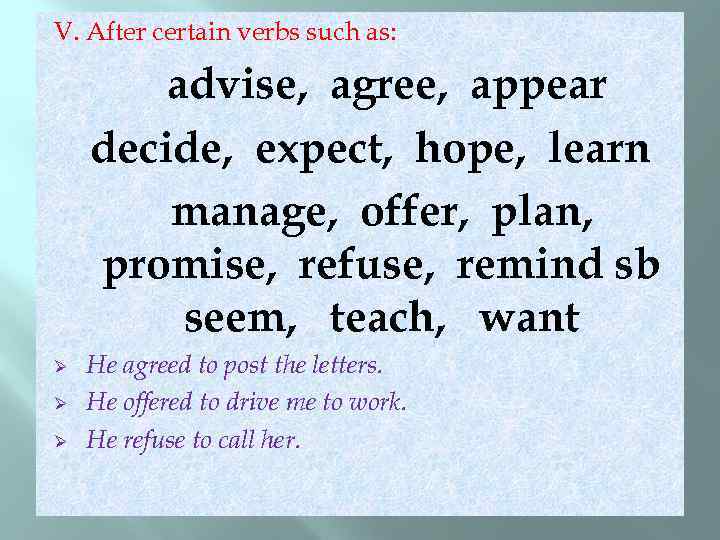 V. After certain verbs such as: advise, agree, appear decide, expect, hope, learn manage, offer, plan, promise, refuse, remind sb seem, teach, want Ø Ø Ø He agreed to post the letters. He offered to drive me to work. He refuse to call her.
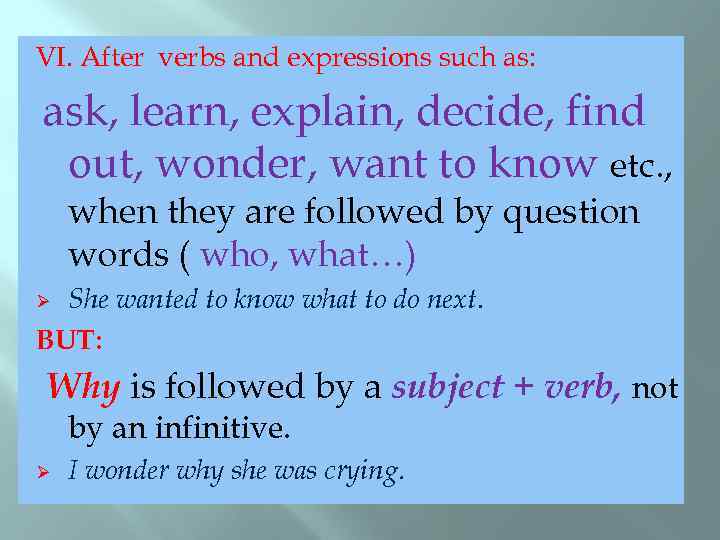 VI. After verbs and expressions such as: ask, learn, explain, decide, find out, wonder, want to know etc. , when they are followed by question words ( who, what…) She wanted to know what to do next. BUT: Ø Why is followed by a subject + verb, not by an infinitive. Ø I wonder why she was crying.
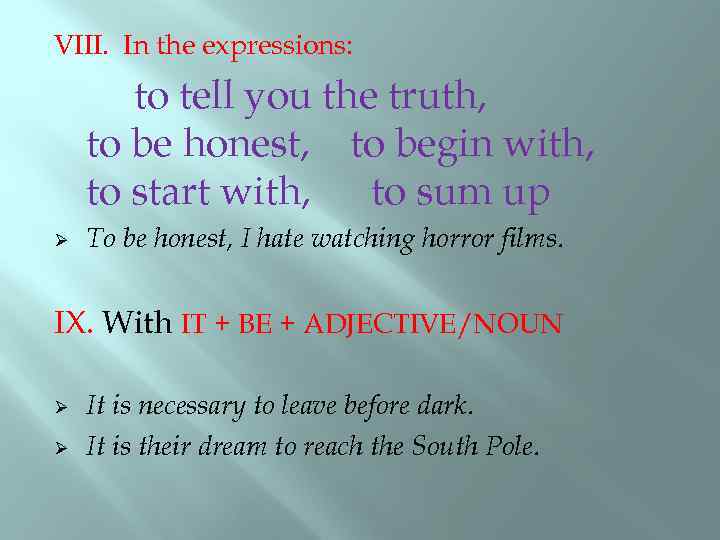 VIII. In the expressions: to tell you the truth, to be honest, to begin with, to start with, to sum up Ø To be honest, I hate watching horror films. IX. With IT + BE + ADJECTIVE/NOUN Ø Ø It is necessary to leave before dark. It is their dream to reach the South Pole.
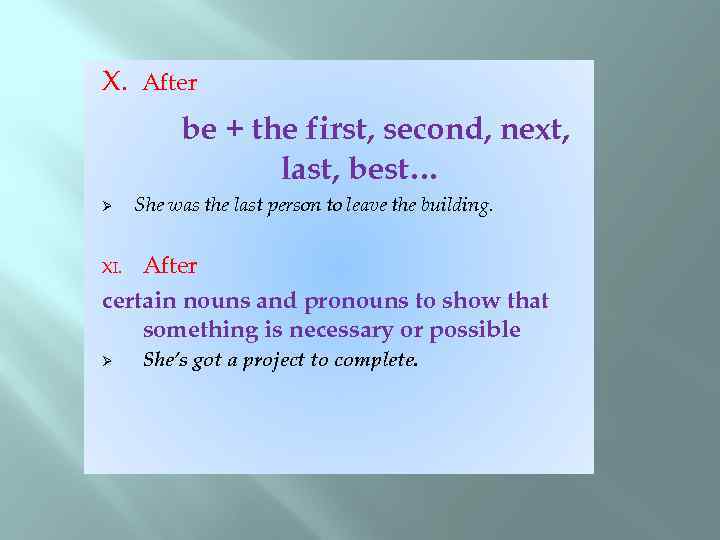 X. After be + the first, second, next, last, best… Ø She was the last person to leave the building. After certain nouns and pronouns to show that something is necessary or possible XI. Ø She’s got a project to complete.
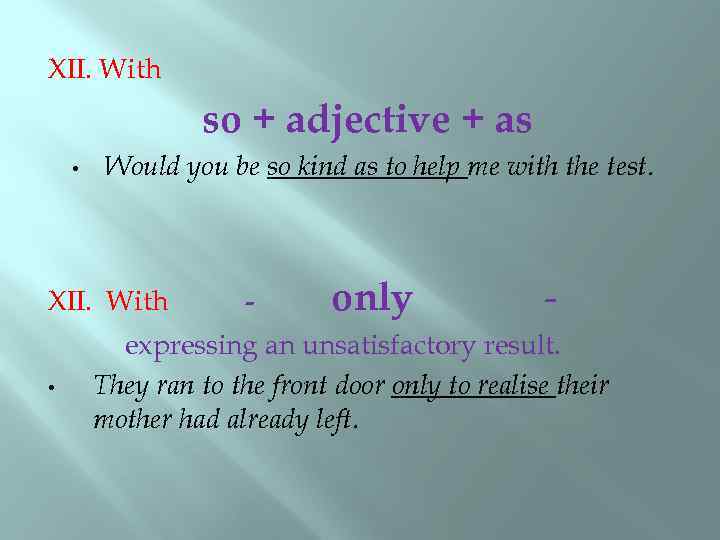 XII. With so + adjective + as • Would you be so kind as to help me with the test. XII. With • - only - expressing an unsatisfactory result. They ran to the front door only to realise their mother had already left.
 INFINITIVE without to
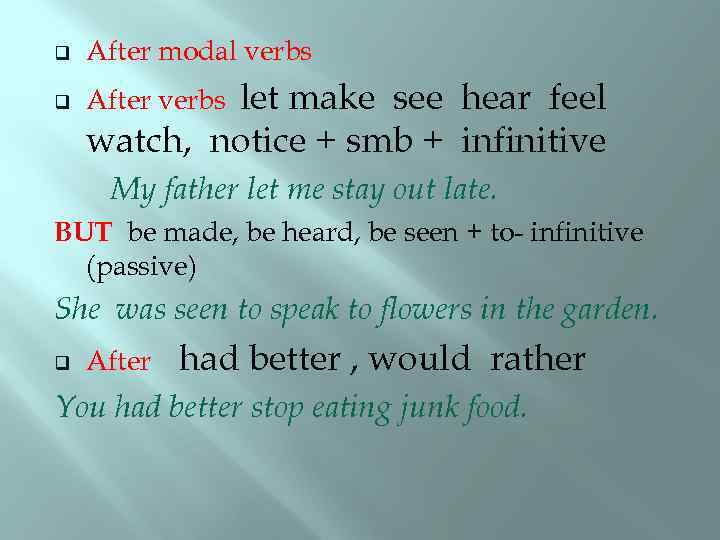 q After modal verbs q After verbs let make see hear feel watch, notice + smb + infinitive My father let me stay out late. BUT be made, be heard, be seen + to- infinitive (passive) She was seen to speak to flowers in the garden. q After had better , would rather You had better stop eating junk food.
 Verbs taking the to-infinitive or the –ing form with a change in meaning
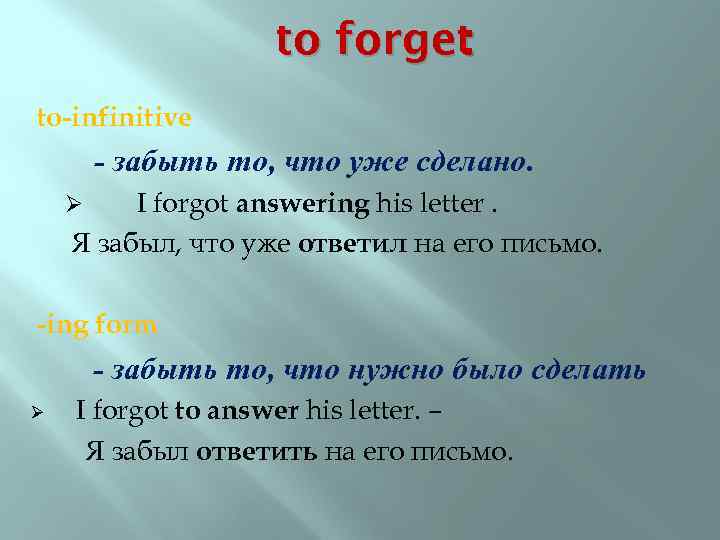 to forget : to-infinitive - забыть то, что уже сделано. I forgot answering his letter. Я забыл, что уже ответил на его письмо. Ø -ing form - забыть то, что нужно было сделать Ø I forgot to answer his letter. – Я забыл ответить на его письмо.
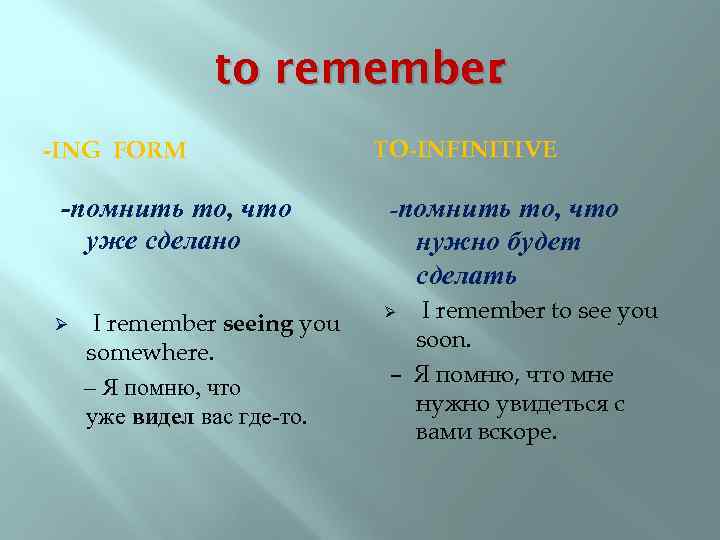 to remember : -ING FORM -помнить то, что уже сделано Ø I remember seeing you somewhere. – Я помню, что уже видел вас где-то. TO-INFINITIVE -помнить то, что нужно будет сделать I remember to see you soon. – Я помню, что мне нужно увидеться с вами вскоре. Ø
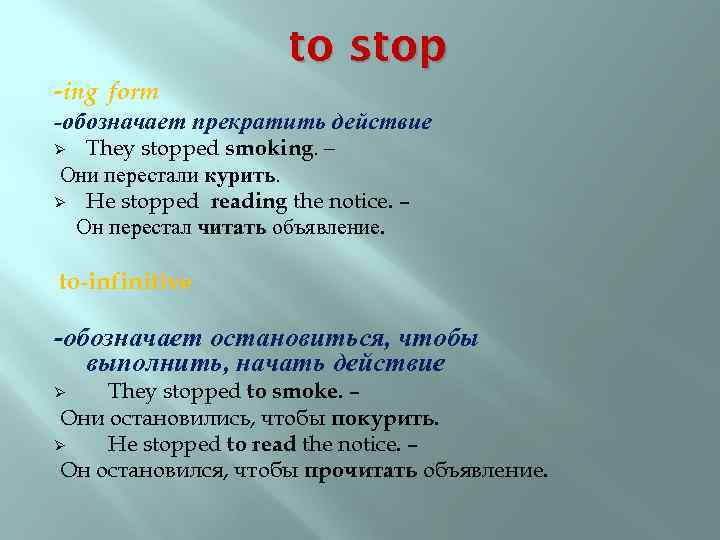 to stop -ing form -обозначает прекратить действие They stopped smoking. – Они перестали курить. Ø He stopped reading the notice. – Он перестал читать объявление. Ø to-infinitive -обозначает остановиться, чтобы выполнить, начать действие They stopped to smoke. – Они остановились, чтобы покурить. Ø He stopped to read the notice. – Он остановился, чтобы прочитать объявление. Ø
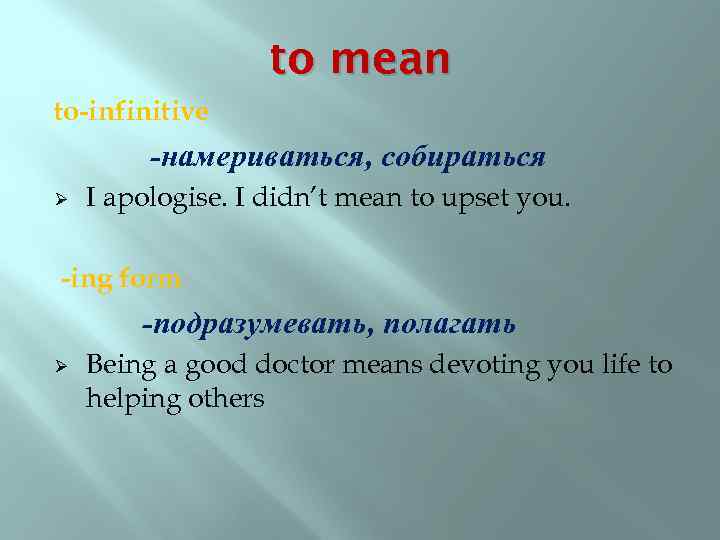 to mean to-infinitive -намериваться, собираться Ø I apologise. I didn’t mean to upset you. -ing form -подразумевать, полагать Ø Being a good doctor means devoting you life to helping others
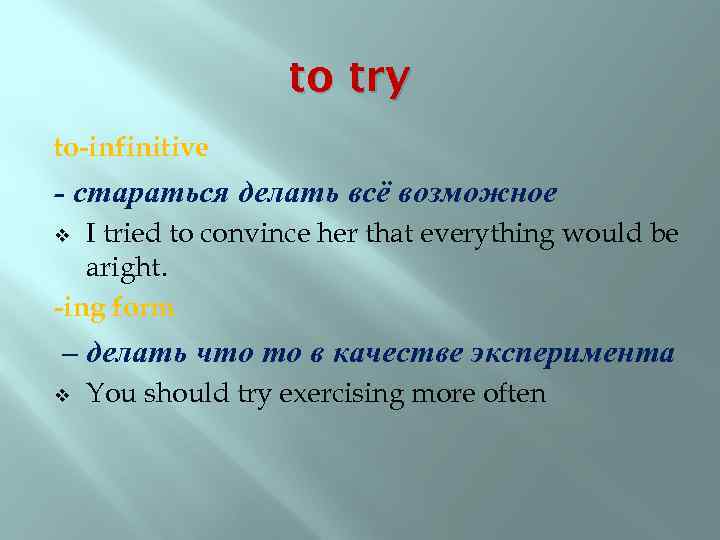 to try to-infinitive - стараться делать всё возможное I tried to convince her that everything would be aright. -ing form v – делать что то в качестве эксперимента v You should try exercising more often
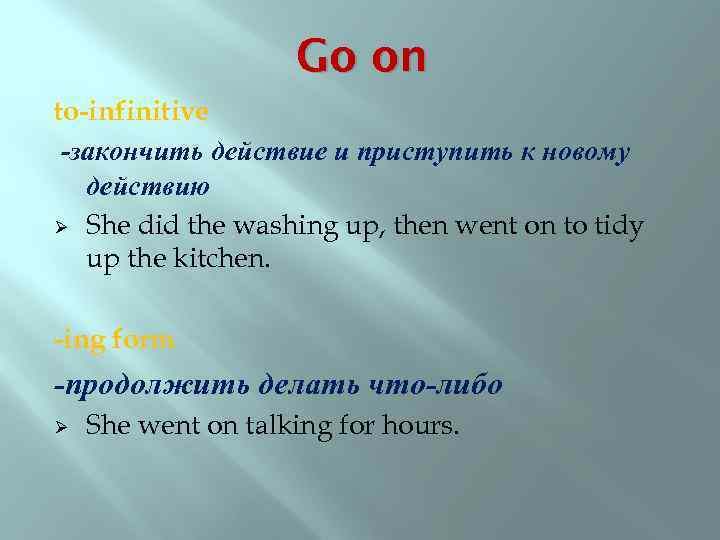 Go on to-infinitive -закончить действие и приступить к новому действию Ø She did the washing up, then went on to tidy up the kitchen. -ing form -продолжить делать что-либо Ø She went on talking for hours.
 to want to-infinitive - хотеть, желать Ø I want to travel to Africa -ing form -что то требует какого то действия Ø My car wants cleaning.
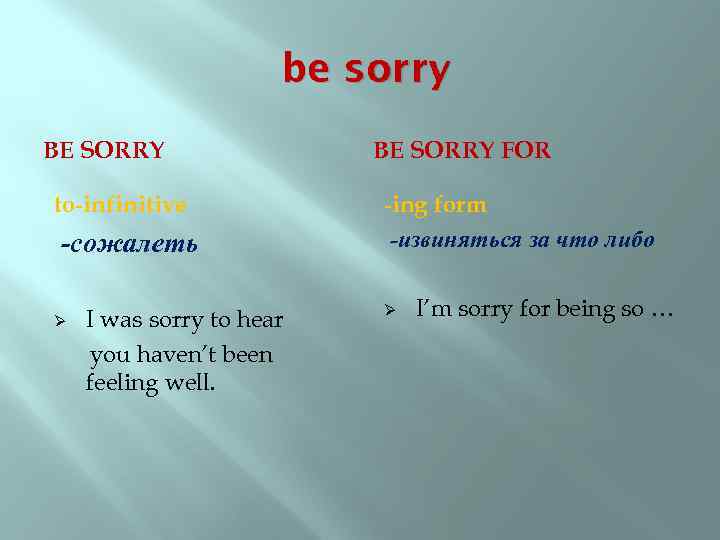 be sorry BE SORRY to-infinitive -сожалеть Ø I was sorry to hear you haven’t been feeling well. BE SORRY FOR -ing form -извиняться за что либо Ø I’m sorry for being so …
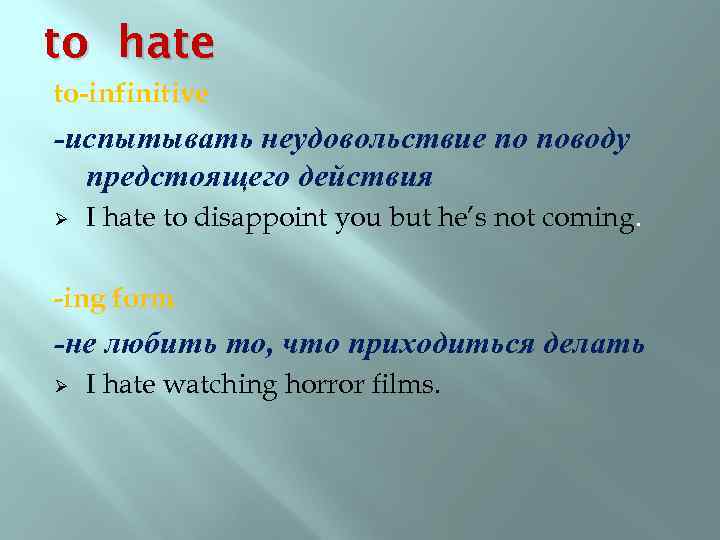 to hate to-infinitive -испытывать неудовольствие по поводу предстоящего действия Ø I hate to disappoint you but he’s not coming. -ing form -не любить то, что приходиться делать Ø I hate watching horror films.
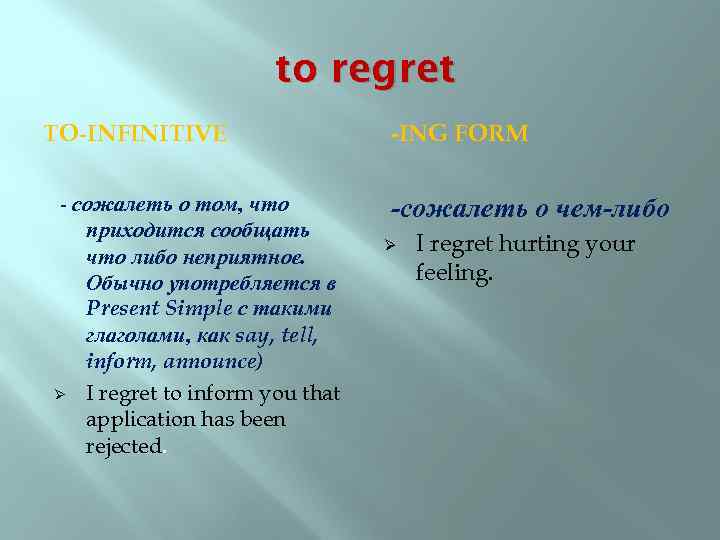 to regret TO-INFINITIVE - сожалеть о том, что приходится сообщать что либо неприятное. Обычно употребляется в Present Simple с такими глаголами, как say, tell, inform, announce) Ø I regret to inform you that application has been rejected. -ING FORM -сожалеть о чем-либо Ø I regret hurting your feeling.