


 Скачать презентацию INFRASTRUCTURE IN VICTORIA JULY 2010 Agenda 1
50c9eafe14ef5ec1111c40a8e02f2ba9.ppt
- Количество слайдов: 19
 INFRASTRUCTURE IN VICTORIA JULY 2010
 Agenda 1 Doing Business in Victoria 2 Winning Projects in Victoria 3 Infrastructure Opportunities in Victoria 1
 1. Doing Business in Victoria
 Infrastructure projects in Victoria is generally considered to be a leading proponent of PPPs in Australia ― Proven use of PPPs have been used for a large number of infrastructure projects across a wide range of sectors and assets; including both economic and social infrastructure ― Leading role in PPP policy Victoria takes a leading role in PPP policy and practice (other States often wait for Victoria to solve policy issues and Victoria provided template for Brisbane toll road projects) ― Partnerships Victoria was introduced in 2000 to provide the framework for a whole-ofgovernment approach to the provision of public infrastructure and related ancillary services through PPPs ― Experienced Procurers Victoria has a core team of public servants experienced in delivering PPP projects ― Process reliability Victoria has a well-earned reputation of process reliability — i. e. getting potential projects to market and then having decision made (in other States projects have been withdrawn, sometimes at the last minute) ― Consistent results Victoria completed PPPs during the GFC when other jurisdictions were withdrawing or not proceeding (and thus suffered reputational damage) 3
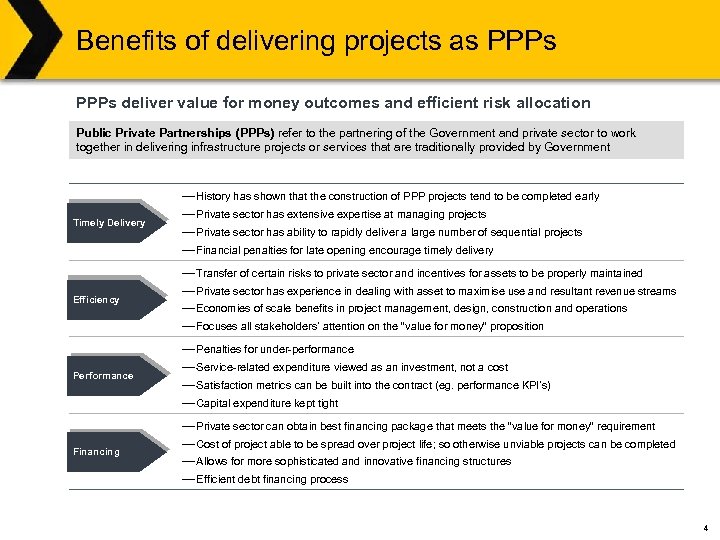 Benefits of delivering projects as PPPs deliver value for money outcomes and efficient risk allocation Public Private Partnerships (PPPs) refer to the partnering of the Government and private sector to work together in delivering infrastructure projects or services that are traditionally provided by Government ―History has shown that the construction of PPP projects tend to be completed early The PPP model provides sector has extensive expertise at delivery infrastructure projects: ―Private substantial benefit for the managing projects Timely Delivery ―Private sector has ability to rapidly deliver a large number of sequential projects ―Financial penalties for late opening encourage timely delivery Efficiency ―Transfer of certain risks to private sector and incentives for assets to be properly maintained ―Private sector has experience in dealing with asset to maximise use and resultant revenue streams ―Economies of scale benefits in project management, design, construction and operations ―Focuses all stakeholders’ attention on the “value for money” proposition Performance ―Penalties for under-performance ―Service-related expenditure viewed as an investment, not a cost ―Satisfaction metrics can be built into the contract (eg. performance KPI’s) ―Capital expenditure kept tight Financing ―Private sector can obtain best financing package that meets the “value for money” requirement ―Cost of project able to be spread over project life; so otherwise unviable projects can be completed ―Allows for more sophisticated and innovative financing structures ―Efficient debt financing process 4
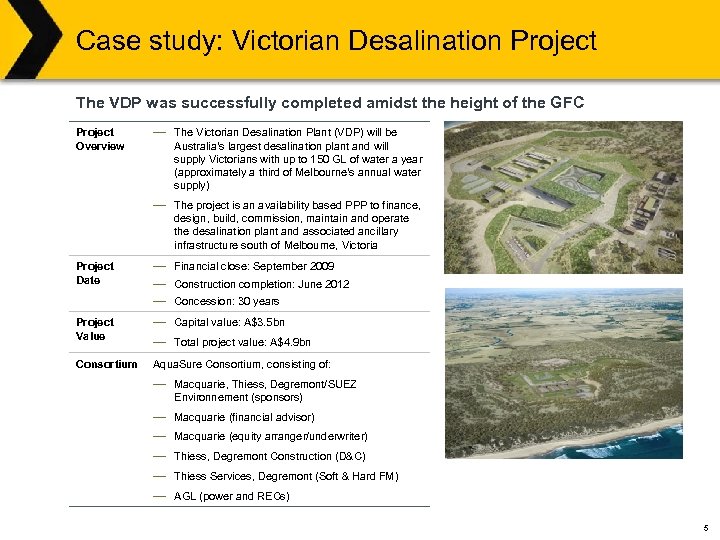 Case study: Victorian Desalination Project The VDP was successfully completed amidst the height of the GFC Project Overview ― The Victorian Desalination Plant (VDP) will be Australia's largest desalination plant and will supply Victorians with up to 150 GL of water a year (approximately a third of Melbourne's annual water supply) ― The project is an availability based PPP to finance, design, build, commission, maintain and operate the desalination plant and associated ancillary infrastructure south of Melbourne, Victoria Project Date ― Financial close: September 2009 ― Construction completion: June 2012 ― Concession: 30 years Project Value ― Capital value: A$3. 5 bn ― Total project value: A$4. 9 bn Consortium Aqua. Sure Consortium, consisting of: ― Macquarie, Thiess, Degremont/SUEZ Environnement (sponsors) ― ― ― Macquarie (financial advisor) Macquarie (equity arranger/underwriter) Thiess, Degremont Construction (D&C) Thiess Services, Degremont (Soft & Hard FM) AGL (power and RECs) 5
 Case study: Victorian Desalination Project achievements and highlights ― ― ― The VDP is a vital piece of Victoria’s water infrastructure with the capacity to supply up to onethird of Melbourne’s water demand from a rainfallindependent source World’s largest desalination plant ($3. 5 bn capital costs), the largest availability PPP world-wide in the last 5 years The largest PPP and PPP debt package in history since the GFC and in top-ten ever Innovative financing structure involving contingent State support to provide certainty and allow financing volume Financial Close achieved within 30 days of Preferred Bidder / Contractual Close The VDP also involved the delivery of a competitive green power solution which provided certainty to the State via a fixed price, long term solution on black power and RECs over the project life The VDP consists of: ― Reverse Osmosis seawater desalination treatment plant ― Tunnels supplying plant with seawater and discharging higher concentrated seawater back to the sea ― 85 kilometre pipeline transporting treated water to the Melbourne Water network ― 88 kilometre underground HVAC transmission line (to be transferred to the Electricity Operator on Handover) ― Design specifications on all project components to allow future expansion to 200 GL/year ― Green power solution for the project 100% offset via RECs 6
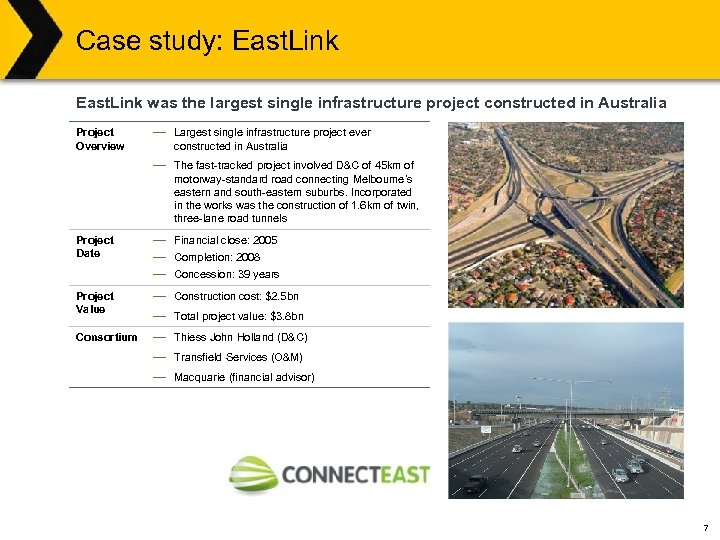 Case study: East. Link was the largest single infrastructure project constructed in Australia Project Overview ― Largest single infrastructure project ever constructed in Australia ― The fast-tracked project involved D&C of 45 km of motorway-standard road connecting Melbourne’s eastern and south-eastern suburbs. Incorporated in the works was the construction of 1. 6 km of twin, three-lane road tunnels Project Date ― Financial close: 2005 ― Completion: 2008 ― Concession: 39 years Project Value ― Construction cost: $2. 5 bn ― Total project value: $3. 8 bn Consortium ― Thiess John Holland (D&C) ― Transfield Services (O&M) ― Macquarie (financial advisor) 7
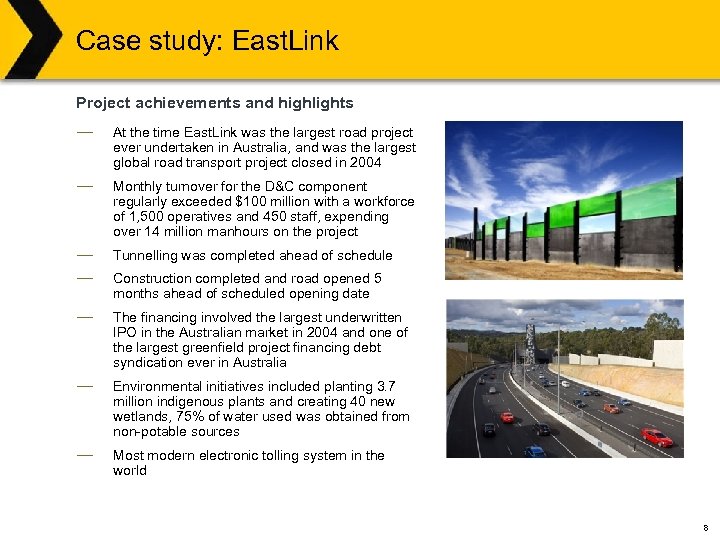 Case study: East. Link Project achievements and highlights ― At the time East. Link was the largest road project ever undertaken in Australia, and was the largest global road transport project closed in 2004 ― Monthly turnover for the D&C component regularly exceeded $100 million with a workforce of 1, 500 operatives and 450 staff, expending over 14 million manhours on the project ― ― Tunnelling was completed ahead of schedule ― The financing involved the largest underwritten IPO in the Australian market in 2004 and one of the largest greenfield project financing debt syndication ever in Australia ― Environmental initiatives included planting 3. 7 million indigenous plants and creating 40 new wetlands, 75% of water used was obtained from non-potable sources ― Most modern electronic tolling system in the world Construction completed and road opened 5 months ahead of scheduled opening date 8
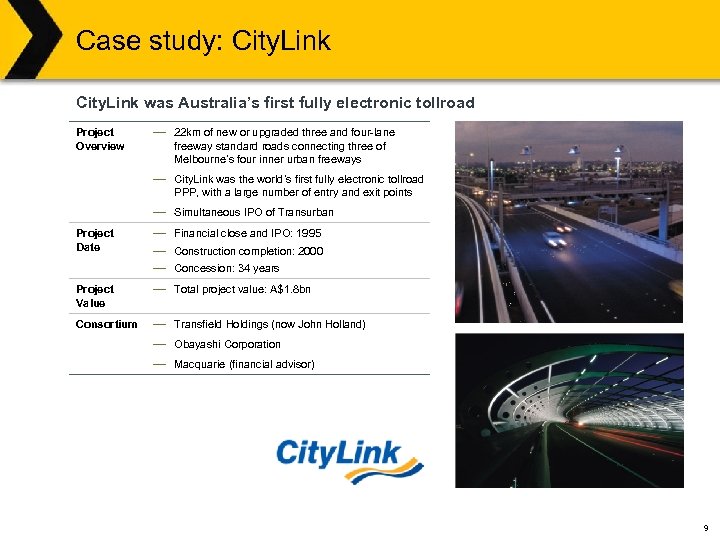 Case study: City. Link was Australia’s first fully electronic tollroad Project Overview ― 22 km of new or upgraded three and four-lane freeway standard roads connecting three of Melbourne’s four inner urban freeways ― City. Link was the world’s first fully electronic tollroad PPP, with a large number of entry and exit points ― Simultaneous IPO of Transurban Project Date ― Financial close and IPO: 1995 ― Construction completion: 2000 ― Concession: 34 years Project Value ― Total project value: A$1. 8 bn Consortium ― Transfield Holdings (now John Holland) ― Obayashi Corporation ― Macquarie (financial advisor) 9
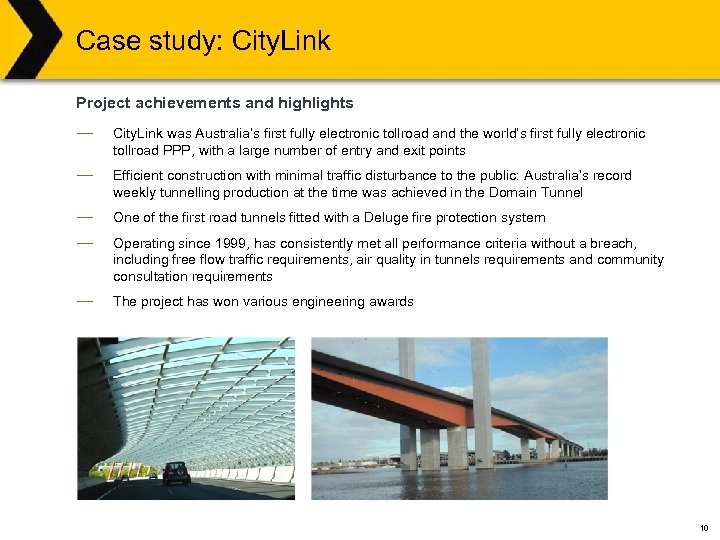 Case study: City. Link Project achievements and highlights ― City. Link was Australia’s first fully electronic tollroad and the world’s first fully electronic tollroad PPP, with a large number of entry and exit points ― Efficient construction with minimal traffic disturbance to the public: Australia’s record weekly tunnelling production at the time was achieved in the Domain Tunnel ― ― One of the first road tunnels fitted with a Deluge fire protection system ― The project has won various engineering awards Operating since 1999, has consistently met all performance criteria without a breach, including free flow traffic requirements, air quality in tunnels requirements and community consultation requirements 10
 2. Winning Projects in Victoria
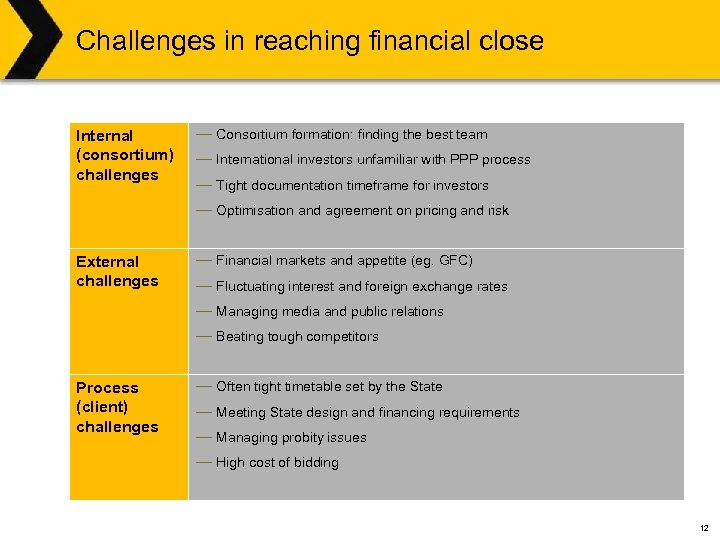 Challenges in reaching financial close Internal (consortium) challenges ― Consortium formation: finding the best team ― International investors unfamiliar with PPP process ― Tight documentation timeframe for investors ― Optimisation and agreement on pricing and risk External challenges ― Financial markets and appetite (eg. GFC) ― Fluctuating interest and foreign exchange rates ― Managing media and public relations ― Beating tough competitors Process (client) challenges ― Often tight timetable set by the State ― Meeting State design and financing requirements ― Managing probity issues ― High cost of bidding 12
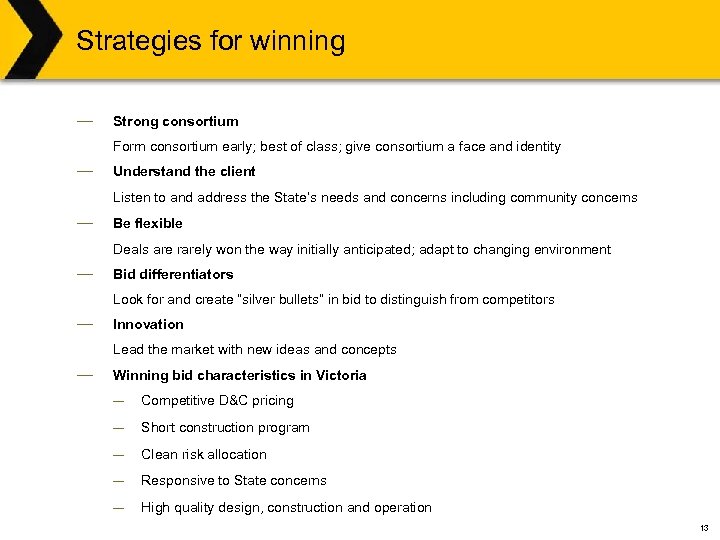 Strategies for winning ― Strong consortium Form consortium early; best of class; give consortium a face and identity ― Understand the client Listen to and address the State’s needs and concerns including community concerns ― Be flexible Deals are rarely won the way initially anticipated; adapt to changing environment ― Bid differentiators Look for and create “silver bullets” in bid to distinguish from competitors ― Innovation Lead the market with new ideas and concepts ― Winning bid characteristics in Victoria ― Competitive D&C pricing ― Short construction program ― Clean risk allocation ― Responsive to State concerns ― High quality design, construction and operation 13
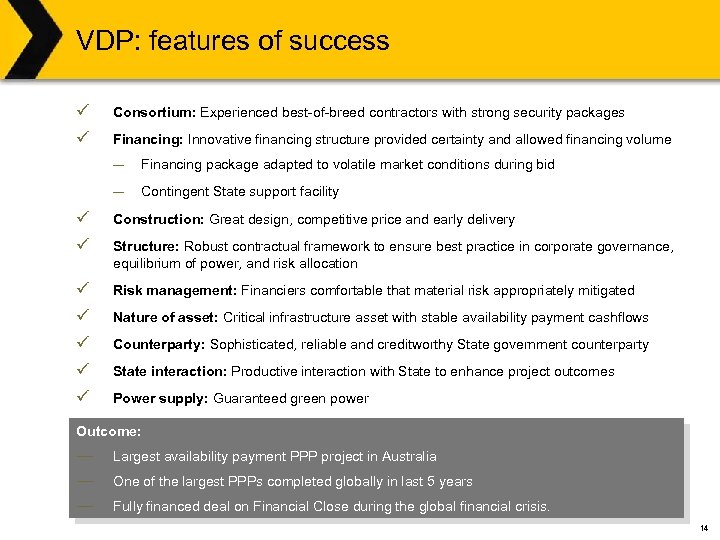 VDP: features of success ü Consortium: Experienced best-of-breed contractors with strong security packages ü Financing: Innovative financing structure provided certainty and allowed financing volume ― Financing package adapted to volatile market conditions during bid ― Contingent State support facility ü Construction: Great design, competitive price and early delivery ü Structure: Robust contractual framework to ensure best practice in corporate governance, equilibrium of power, and risk allocation ü Risk management: Financiers comfortable that material risk appropriately mitigated ü Nature of asset: Critical infrastructure asset with stable availability payment cashflows ü Counterparty: Sophisticated, reliable and creditworthy State government counterparty ü State interaction: Productive interaction with State to enhance project outcomes ü Power supply: Guaranteed green power Outcome: ― ― ― Largest availability payment PPP project in Australia One of the largest PPPs completed globally in last 5 years Fully financed deal on Financial Close during the global financial crisis. 14
 3. Infrastructure Opportunities in Victoria
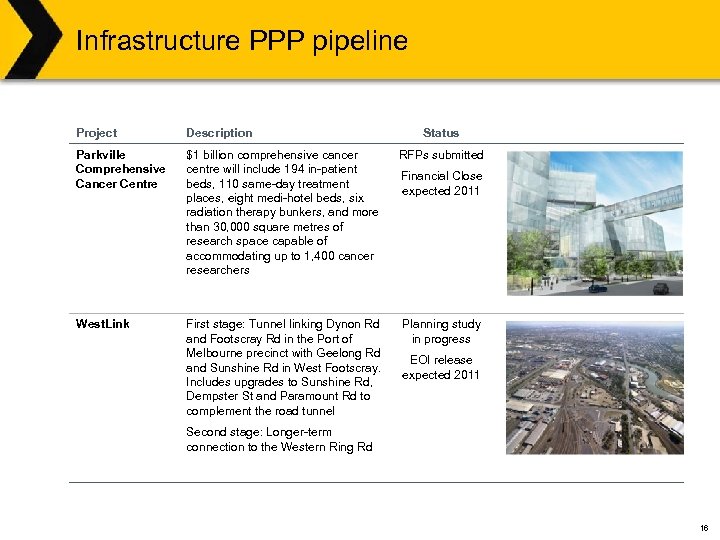 Infrastructure PPP pipeline Project Description Status Parkville Comprehensive Cancer Centre $1 billion comprehensive cancer centre will include 194 in-patient beds, 110 same-day treatment places, eight medi-hotel beds, six radiation therapy bunkers, and more than 30, 000 square metres of research space capable of accommodating up to 1, 400 cancer researchers RFPs submitted West. Link First stage: Tunnel linking Dynon Rd and Footscray Rd in the Port of Melbourne precinct with Geelong Rd and Sunshine Rd in West Footscray. Includes upgrades to Sunshine Rd, Dempster St and Paramount Rd to complement the road tunnel Planning study in progress Financial Close expected 2011 EOI release expected 2011 Second stage: Longer-term connection to the Western Ring Rd 16
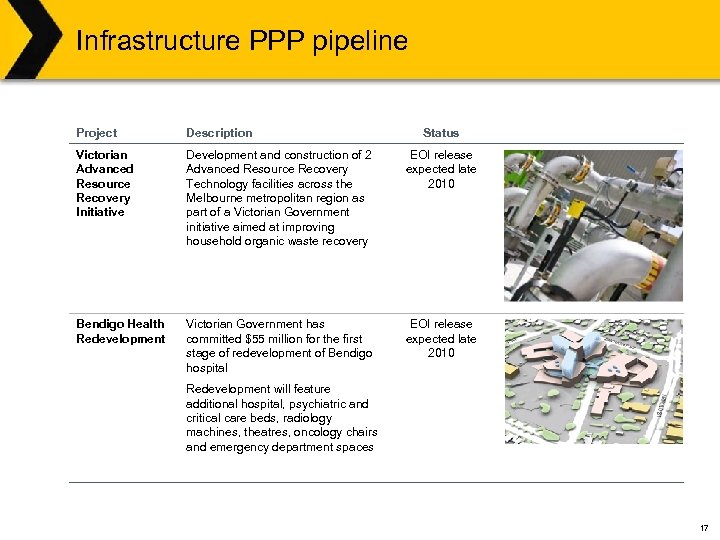 Infrastructure PPP pipeline Project Description Status Victorian Advanced Resource Recovery Initiative Development and construction of 2 Advanced Resource Recovery Technology facilities across the Melbourne metropolitan region as part of a Victorian Government initiative aimed at improving household organic waste recovery EOI release expected late 2010 Bendigo Health Redevelopment Victorian Government has committed $55 million for the first stage of redevelopment of Bendigo hospital EOI release expected late 2010 Redevelopment will feature additional hospital, psychiatric and critical care beds, radiology machines, theatres, oncology chairs and emergency department spaces 17
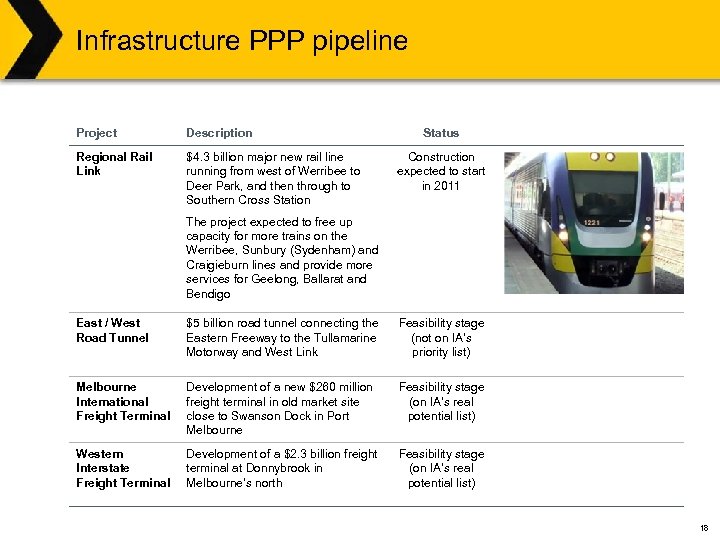 Infrastructure PPP pipeline Project Description Regional Rail Link $4. 3 billion major new rail line running from west of Werribee to Deer Park, and then through to Southern Cross Station Status Construction expected to start in 2011 The project expected to free up capacity for more trains on the Werribee, Sunbury (Sydenham) and Craigieburn lines and provide more services for Geelong, Ballarat and Bendigo East / West Road Tunnel $5 billion road tunnel connecting the Eastern Freeway to the Tullamarine Motorway and West Link Feasibility stage (not on IA’s priority list) Melbourne International Freight Terminal Development of a new $260 million freight terminal in old market site close to Swanson Dock in Port Melbourne Feasibility stage (on IA’s real potential list) Western Interstate Freight Terminal Development of a $2. 3 billion freight terminal at Donnybrook in Melbourne’s north Feasibility stage (on IA’s real potential list) 18