


 Скачать презентацию Informing solutions together Camp Profiling Workshop Myitkyina Myanmar
b504081d38d12e4ddc899333a3e160e8.ppt
- Количество слайдов: 25
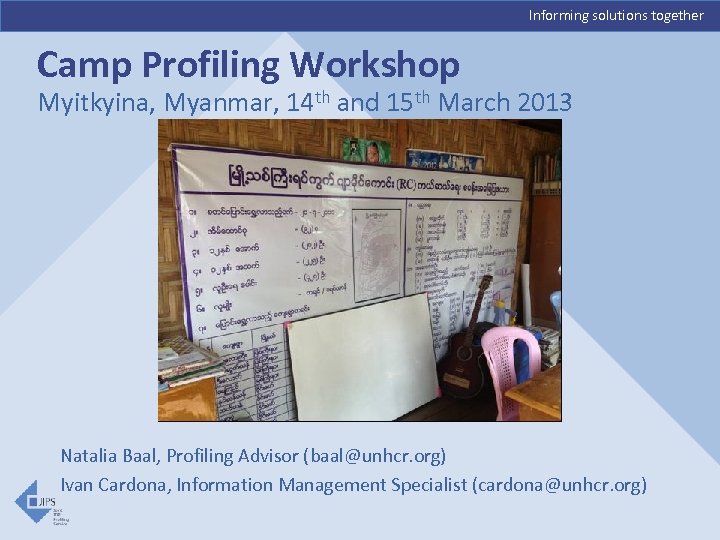 Informing solutions together Camp Profiling Workshop Myitkyina, Myanmar, 14 th and 15 th March 2013 Natalia Baal, Profiling Advisor (baal@unhcr. org) Ivan Cardona, Information Management Specialist (cardona@unhcr. org)
 Informing solutions together • DAY ONE th • 14 March
 Informing solutions together What is JIPS? • Technical & coordination support for profiling processes upon request • Interagency service: DRC, NRC-IDMC, IOM, UNHCR, OCHA, UNFPA and Special Rapporteur for the Human Rights of IDPs • Activities: – Field support – Training & capacity building – Methodology & tool development – Advocacy
 Informing solutions together Workshop Objectives • Learn from experiences of partners during the camp profiling pilot exercise • Clarify and agree upon camp profiling system (including roles and responsibilities) • Revise camp profiling tools (including camp level questionnaire) • Discuss JIPS proposal for other profiling opportunities in Kachin • Output documents (of workshop and JIPS mission): revised questionnaire, accompanying manual, revised data entry template, camp profiling concept note, ‘strategy options’ discussion document
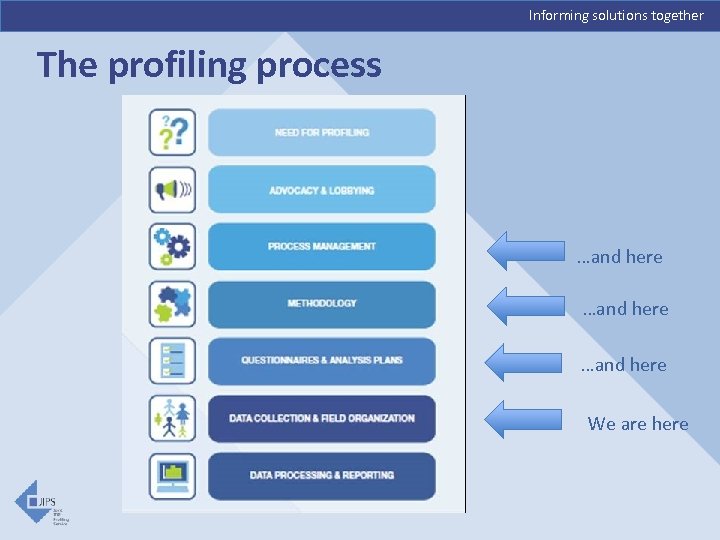 Informing solutions together The profiling process …and here We are here
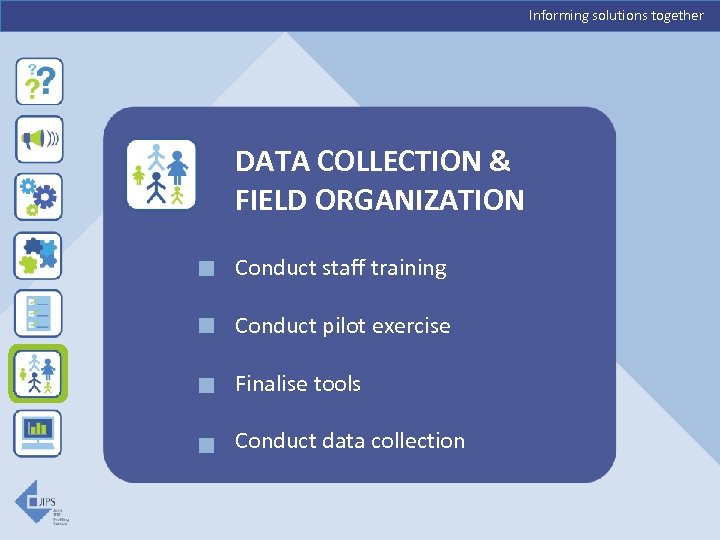 Informing solutions together DATA COLLECTION & FIELD ORGANIZATION Conduct staff training Conduct pilot exercise Finalise tools Conduct data collection
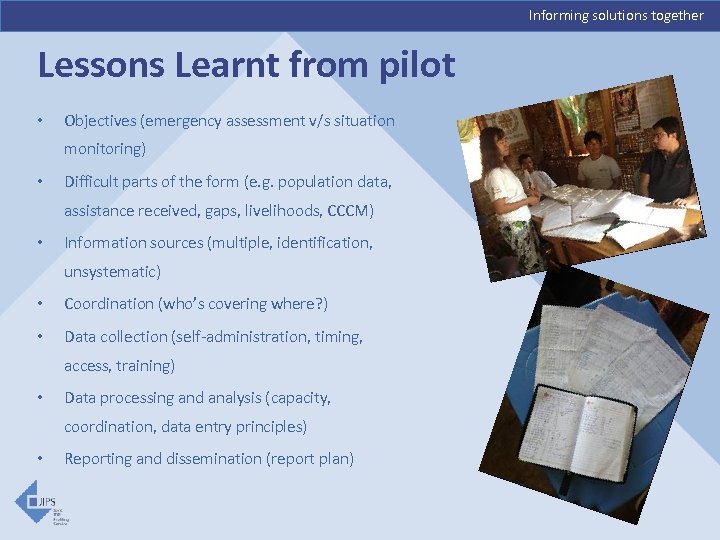 Informing solutions together Lessons Learnt from pilot • Objectives (emergency assessment v/s situation monitoring) • Difficult parts of the form (e. g. population data, assistance received, gaps, livelihoods, CCCM) • Information sources (multiple, identification, unsystematic) • Coordination (who’s covering where? ) • Data collection (self-administration, timing, access, training) • Data processing and analysis (capacity, coordination, data entry principles) • Reporting and dissemination (report plan)
 Informing solutions together More lessons learnt (discussed during workshop) • Data collection/enumerator capacity: need for thorough training before data collection and accompanying manual to the questionnaire to limit different interpretations and ensure data collected as systematically as possible • Camp level questionnaire: need to review to avoid answers being ‘guessed’ and ensure ‘right’ questions are asked to the ‘best’ sources; reduce ambiguous/incomplete questions and answer options; ensure version control across partners; how to handle sensitive questions • Manual: need manual for technical definitions/indicators, guidance for communication/introduction from enumerator to interviewee (reasons for data collection etc. ); • Data processing: need for data entry and cleaning training to deal with missing data, verification etc. • Translation: challenging for data collection and data entry as currently no standard translation of questionnaire and data entry in English • Agency buy-in: need to strengthen support from regional and capital level leadership; ensure profile addresses need of different partners; need to strengthen support/trust from external organizations • Data flow responsibilities: collection, entry, analysis, dissemination
 Informing solutions together Camp Profiling Objectives (agreed during workshop) • Provide a regularly updated OVERVIEW of the situation in camps hosting internally displaced persons (IDPs) • Consolidate information for ADVOCACY efforts on behalf of IDPs living in camps • Indicate need for more detailed thematic ASSSESSMENTS • Strengthen COORDINATION of camp level information collection, analysis and response • Support CAPACITY BUILDING for camp managers over-time • Camp profiling is not: detailed needs assessment, household level profiling, OR emergency/rapid assessment
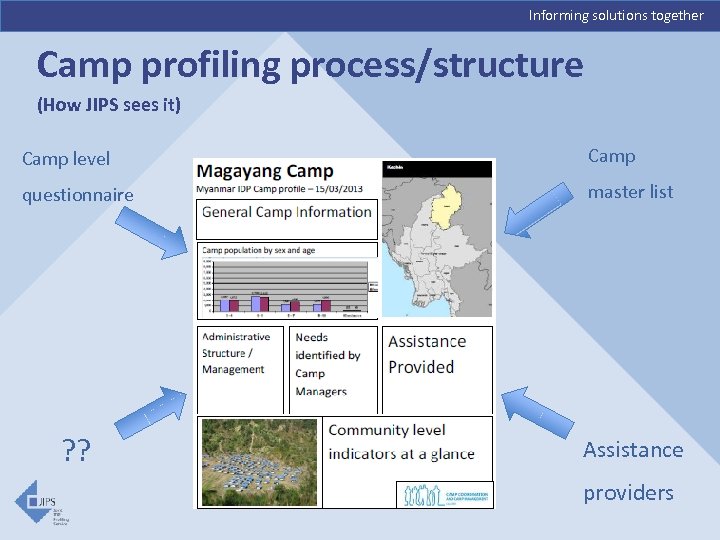 Informing solutions together Camp profiling process/structure (How JIPS sees it) Camp level Camp questionnaire master list ? ? Assistance providers
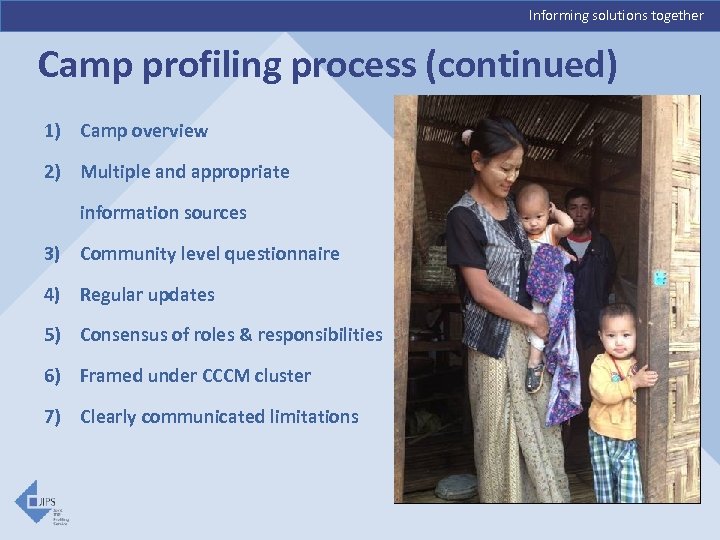 Informing solutions together Camp profiling process (continued) 1) Camp overview 2) Multiple and appropriate information sources 3) Community level questionnaire 4) Regular updates 5) Consensus of roles & responsibilities 6) Framed under CCCM cluster 7) Clearly communicated limitations
 Informing solutions together Other profiling options… Since camp profiling is limited, it can be complemented by other profiling initiatives: 1) Comprehensive sample-based profiling • Comprehensive picture in and out of camps • Household survey of IDP sample & focus group discussions • Identification of forced displacement • Intentions for durable solutions 2) IDP registration support • Individual level information collected at the household level • Capacity building for camp management focal points • Identification of forced displacement 3) Movement tracking system (not recommended at present)
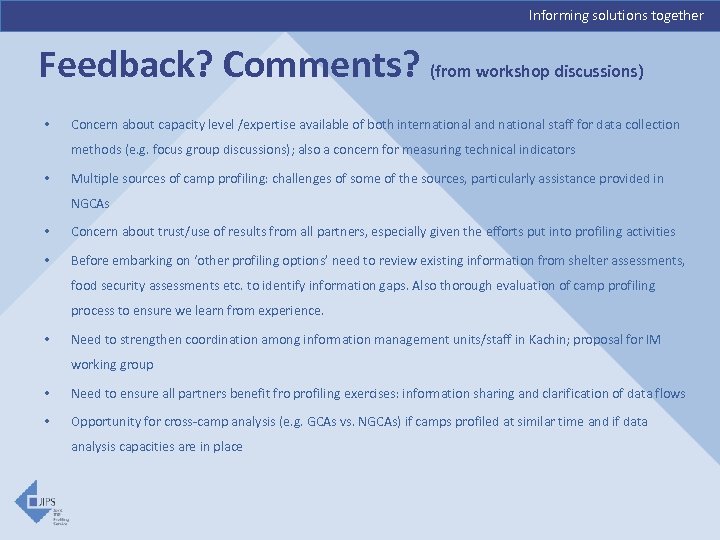 Informing solutions together Feedback? Comments? (from workshop discussions) • Concern about capacity level /expertise available of both international and national staff for data collection methods (e. g. focus group discussions); also a concern for measuring technical indicators • Multiple sources of camp profiling: challenges of some of the sources, particularly assistance provided in NGCAs • Concern about trust/use of results from all partners, especially given the efforts put into profiling activities • Before embarking on ‘other profiling options’ need to review existing information from shelter assessments, food security assessments etc. to identify information gaps. Also thorough evaluation of camp profiling process to ensure we learn from experience. • Need to strengthen coordination among information management units/staff in Kachin; proposal for IM working group • Need to ensure all partners benefit fro profiling exercises: information sharing and clarification of data flows • Opportunity for cross-camp analysis (e. g. GCAs vs. NGCAs) if camps profiled at similar time and if data analysis capacities are in place
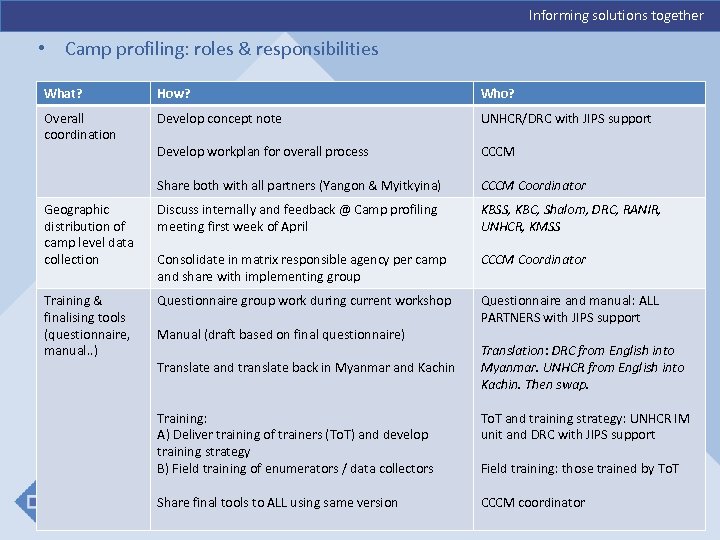 Informing solutions together • Camp profiling: roles & responsibilities What? How? Who? Overall coordination Develop concept note UNHCR/DRC with JIPS support Develop workplan for overall process CCCM Share both with all partners (Yangon & Myitkyina) CCCM Coordinator Geographic distribution of camp level data collection Discuss internally and feedback @ Camp profiling meeting first week of April KBSS, KBC, Shalom, DRC, RANIR, UNHCR, KMSS Consolidate in matrix responsible agency per camp and share with implementing group CCCM Coordinator Training & finalising tools (questionnaire, manual. . ) Questionnaire group work during current workshop Questionnaire and manual: ALL PARTNERS with JIPS support Manual (draft based on final questionnaire) Translate and translate back in Myanmar and Kachin Translation: DRC from English into Myanmar. UNHCR from English into Kachin. Then swap. Training: A) Deliver training of trainers (To. T) and develop training strategy B) Field training of enumerators / data collectors To. T and training strategy: UNHCR IM unit and DRC with JIPS support Share final tools to ALL using same version CCCM coordinator Field training: those trained by To. T
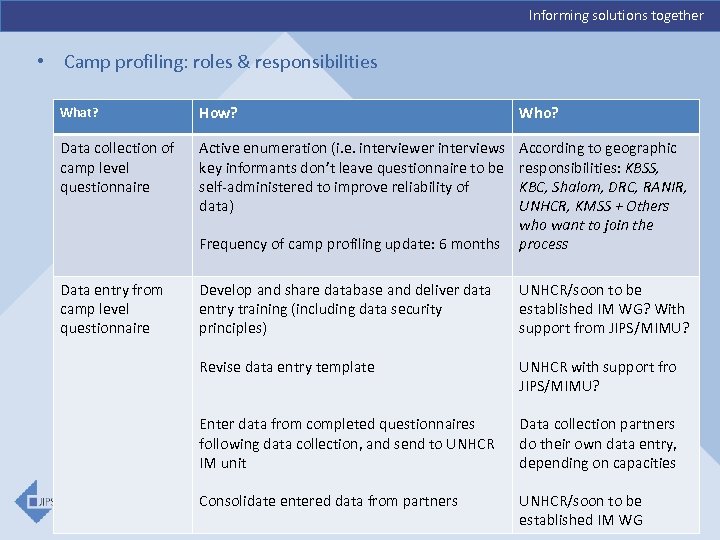 Informing solutions together • Camp profiling: roles & responsibilities What? How? Who? Data collection of camp level questionnaire Active enumeration (i. e. interviewer interviews key informants don’t leave questionnaire to be self-administered to improve reliability of data) Frequency of camp profiling update: 6 months According to geographic responsibilities: KBSS, KBC, Shalom, DRC, RANIR, UNHCR, KMSS + Others who want to join the process Develop and share database and deliver data entry training (including data security principles) UNHCR/soon to be established IM WG? With support from JIPS/MIMU? Revise data entry template UNHCR with support fro JIPS/MIMU? Enter data from completed questionnaires following data collection, and send to UNHCR IM unit Data collection partners do their own data entry, depending on capacities Consolidate entered data from partners UNHCR/soon to be established IM WG Data entry from camp level questionnaire
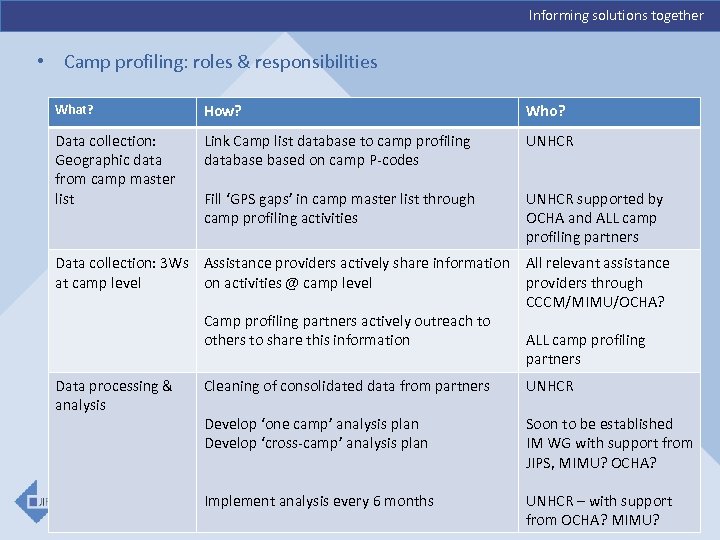 Informing solutions together • Camp profiling: roles & responsibilities What? How? Who? Data collection: Geographic data from camp master list Link Camp list database to camp profiling databased on camp P-codes UNHCR Fill ‘GPS gaps’ in camp master list through camp profiling activities UNHCR supported by OCHA and ALL camp profiling partners Data collection: 3 Ws Assistance providers actively share information All relevant assistance at camp level on activities @ camp level providers through CCCM/MIMU/OCHA? Camp profiling partners actively outreach to others to share this information ALL camp profiling partners Data processing & analysis Cleaning of consolidated data from partners UNHCR Develop ‘one camp’ analysis plan Develop ‘cross-camp’ analysis plan Soon to be established IM WG with support from JIPS, MIMU? OCHA? Implement analysis every 6 months UNHCR – with support from OCHA? MIMU?
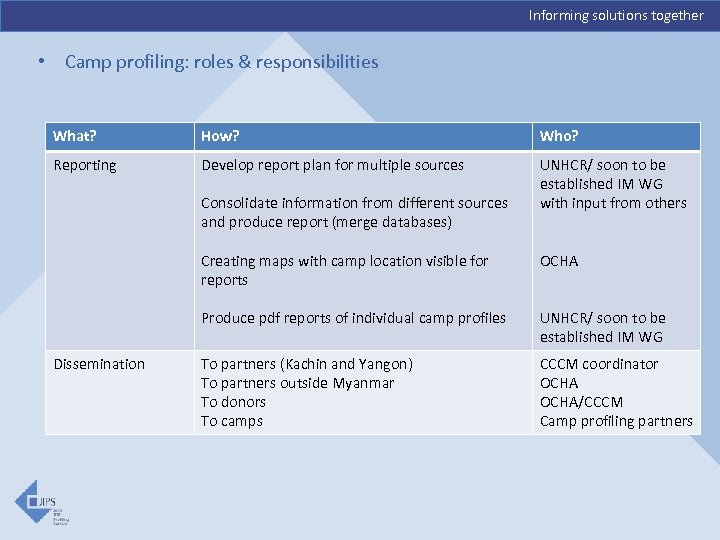 Informing solutions together • Camp profiling: roles & responsibilities What? How? Who? Reporting Develop report plan for multiple sources UNHCR/ soon to be established IM WG with input from others Consolidate information from different sources and produce report (merge databases) Creating maps with camp location visible for reports Produce pdf reports of individual camp profiles Dissemination OCHA UNHCR/ soon to be established IM WG To partners (Kachin and Yangon) To partners outside Myanmar To donors To camps CCCM coordinator OCHA/CCCM Camp profiling partners
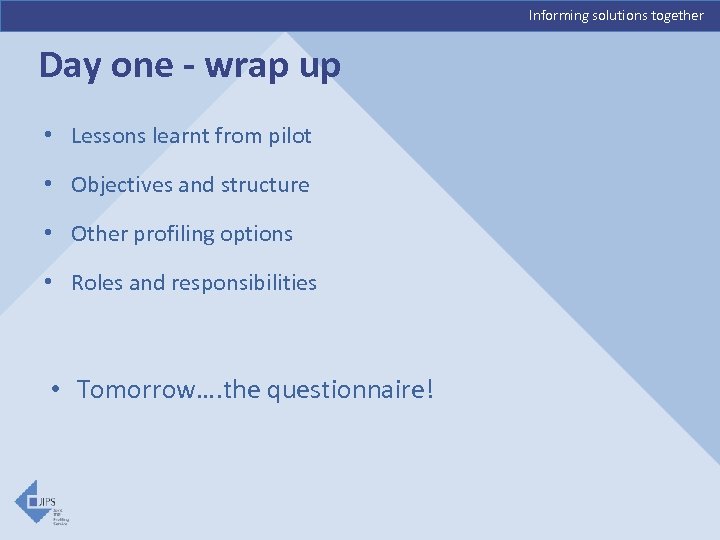 Informing solutions together Day one - wrap up • Lessons learnt from pilot • Objectives and structure • Other profiling options • Roles and responsibilities • Tomorrow…. the questionnaire!
 Informing solutions together • DAY TWO th • 15 March
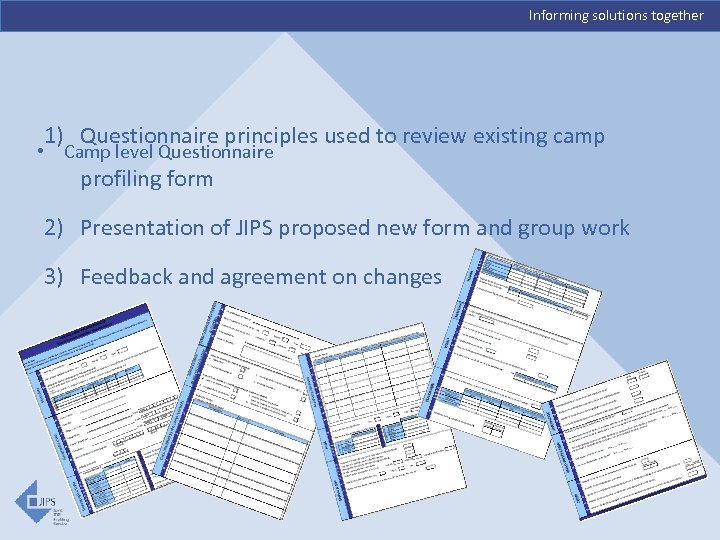 Informing solutions together 1) Questionnaire principles used to review existing camp • Camp level Questionnaire profiling form 2) Presentation of JIPS proposed new form and group work 3) Feedback and agreement on changes
 Informing solutions together Questionnaire design principles used to review camp level form: • Camp level Questionnaire • Community v/s household level questions • Complementarity with other information sources • Structure, logic and flow (for interviewer and interviewee!) • Enumerator instructions (different in form and manual) • Open/closed question and answer structure • Systematic use of information sources • Be specific and avoid ambiguities • User-friendliness and comprehension
 Informing solutions together Questionnaire: Group Work • Split into groups to discuss new questionnaire • Report back to big group and agree on changes • Chocolate from Switzerland for every good idea!
 Informing solutions together • Wrap up • Lessons learnt from pilot discussed • Objectives for camp profiling agreed • Revised structure of camp profiling process presented • Roles and responsibilities discussed • New questionnaire developed • Other complimentary profiling options discussed
 Informing solutions together Next Steps/Action points: JIPS continued support: • Share ‘tidied-up’ PPT with workshop participants • Develop camp profiling concept note, including roles & responsibilities • Implement agreed upon changes to questionnaire • Draft accompanying enumerator manual and analysis plan • Support UNHCR and DRC with To. T • Debrief in Yangon for buy-in and input Camp profiling partners: • Myitkyina: Consideration of roles & responsibilities discussed and collective agreement @ camp profiling meeting in first week of April • Yangon: Input to process and support to partners in Myitkyina
 Informing solutions together info@jips. org +41 22 739 8973 www. idp-profiling. org www. parkdatabase. org