


 Скачать презентацию INFORMING EDUCATING EMPOWERING FAMILIES 617 -236 -7210
fe2223f26a31197a426c3b83f407be70.ppt
- Количество слайдов: 37
 INFORMING, EDUCATING, EMPOWERING FAMILIES 617 -236 -7210 | www. fcsn. org | fcsninfo@fcsn. org
 Creating a Postsecondary Vision The LINK Center Parent Training and Information Center © Federation for Children with Special Needs, 2015 The Schrafft Center ● 529 Main Street, Suite 1 M 3 ● Boston, MA 02129 617 -236 -7210 ● Toll Free 1 -800 -33 -0688 ● Fax 617 -241 -0330
 Who We Are … The Federation for Children with Special Needs advocates for quality education, parent participation and access to quality health care services for all children, especially those with disabilities.
 The Parent Training and Information Center (PTIC), provides free information, support, technical assistance and affordable workshops to families who have children with disabilities and the professionals who work with them. The LINK Center connects families and individuals with disabilities who are transition age (14 -26) to information, supports and services to achieve their future vision.
 Workshop Agenda • • What is a Postsecondary Vision Student Driven Where to Start Person Centered Planning Transition Assessment IDEA and Vision in School Writing a Vision Statement Vision Steps
 What is a Postsecondary Vision? • A plan for life after high school • Includes ideas for: – Employment – More Education – Adult Living • A dream for the future
 What is Vision? Definitions: Vision = Postsecondary Vision (Goals) Individualized Education Program (IEP) Vision Statement: What is the vision for this student? Consider the next 1 to 5 year period when developing this statement. Beginning no later than age 14, the statement should be based on the student’s preferences and interest, and should include desired outcomes in adult living, post-secondary and working environments. Transition Planning Form (TPF) Postsecondary Vision: In collaboration with the family, consider the student’s preferences and interests, and the desired outcomes for post-secondary education/ training, employment, and adult living. This section should correspond with the vision statement on IEP 1.
 Vision is a Process Fun Stressful Creative Exploration Personalized Different Vision is a part of the school IEP and TPF process BUT GO Beyond!! It starts with transition planning Failure to Plan is Planning to Fail
 Vision
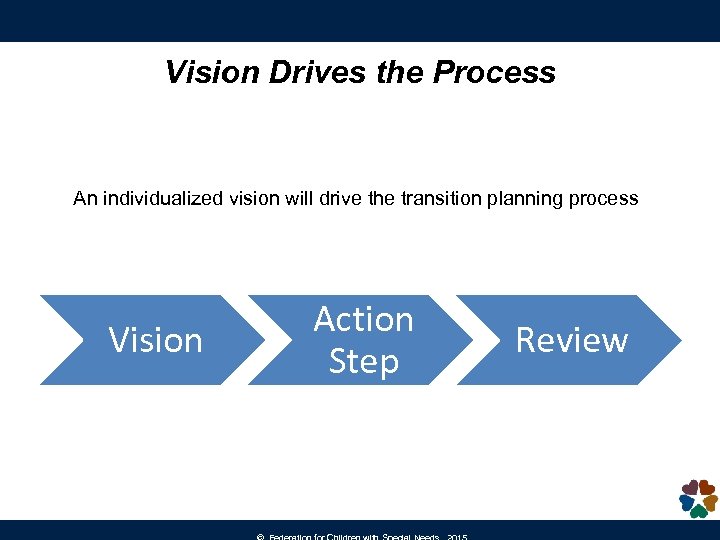 Vision Drives the Process An individualized vision will drive the transition planning process Vision Action Step Review
 Student Driven Students should be the focus of the special education process – their preferences, interests and desired outcomes “The more students are engaged in planning their own futures, the more promising those futures are likely to be. ” Technical Assistance Advisory SPED 2013 -1: Postsecondary Goals and Annual IEP Goals in the Transition Planning Process
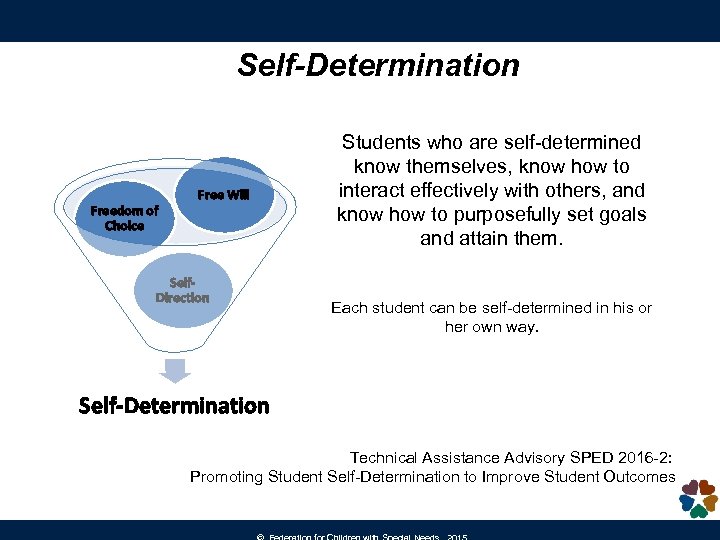 Self-Determination Freedom of Choice Free Will Self. Direction Students who are self-determined know themselves, know how to interact effectively with others, and know how to purposefully set goals and attain them. Each student can be self-determined in his or her own way. Self-Determination Technical Assistance Advisory SPED 2016 -2: Promoting Student Self-Determination to Improve Student Outcomes
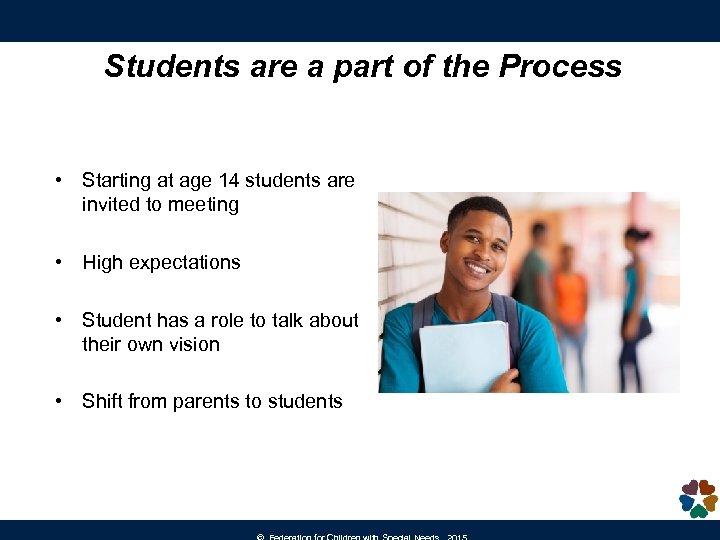 Students are a part of the Process • Starting at age 14 students are invited to meeting • High expectations • Student has a role to talk about their own vision • Shift from parents to students
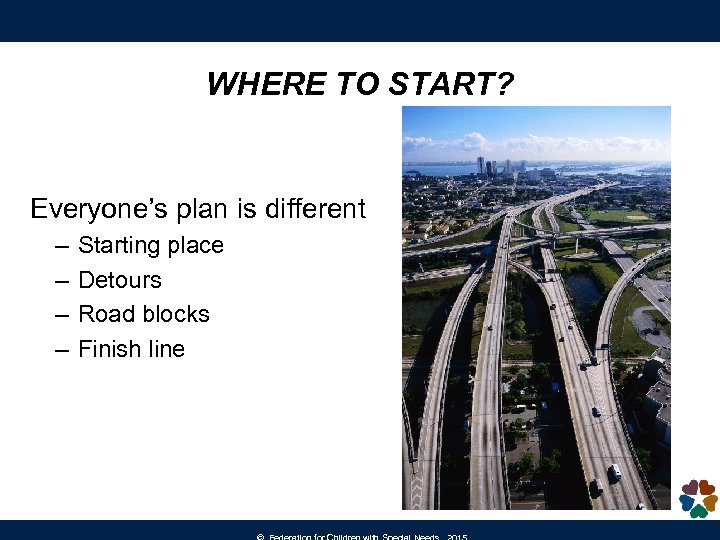 WHERE TO START? Everyone’s plan is different – – Starting place Detours Road blocks Finish line
 Person Centered Planning An ongoing process for a team to think about what an individual would like to do in their future. Everyone sees a young adult differently… Teachers Specialists Coaches/Tutors Agency Representatives Community Leaders/Employers Friends and Family
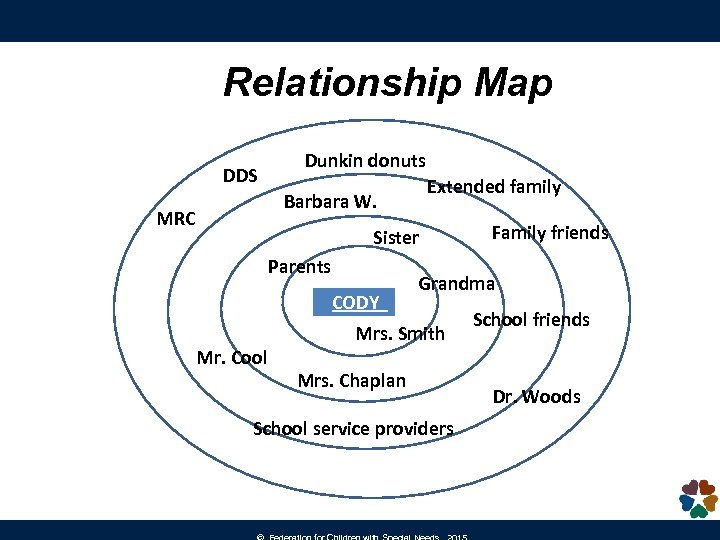 Relationship Map DDS Dunkin donuts Extended family Barbara W. MRC Sister Parents CODY Mr. Cool Family friends Grandma Mrs. Smith Mrs. Chaplan School service providers School friends Dr. Woods
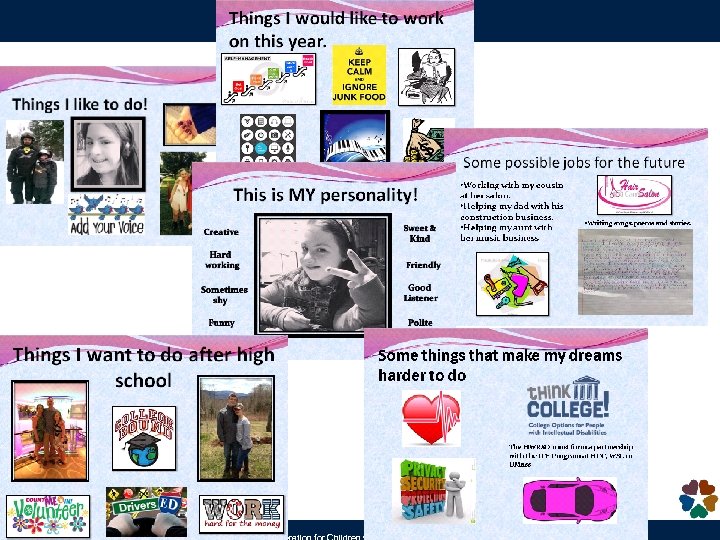
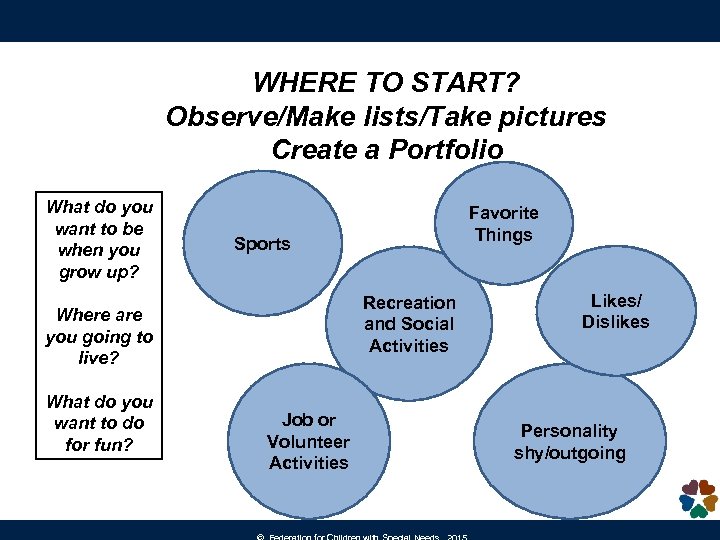 WHERE TO START? Observe/Make lists/Take pictures Create a Portfolio What do you want to be when you grow up? Sports Recreation and Social Activities Where are you going to live? What do you want to do for fun? Favorite Things Job or Volunteer Activities Likes/ Dislikes Personality shy/outgoing
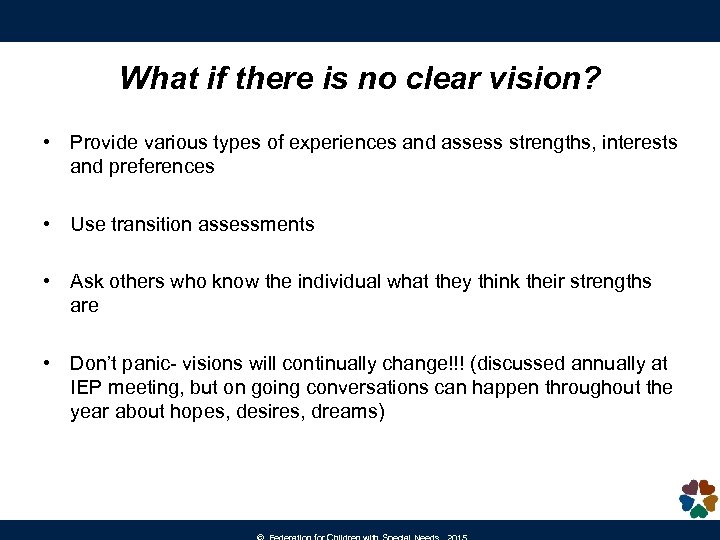 What if there is no clear vision? • Provide various types of experiences and assess strengths, interests and preferences • Use transition assessments • Ask others who know the individual what they think their strengths are • Don’t panic- visions will continually change!!! (discussed annually at IEP meeting, but on going conversations can happen throughout the year about hopes, desires, dreams)
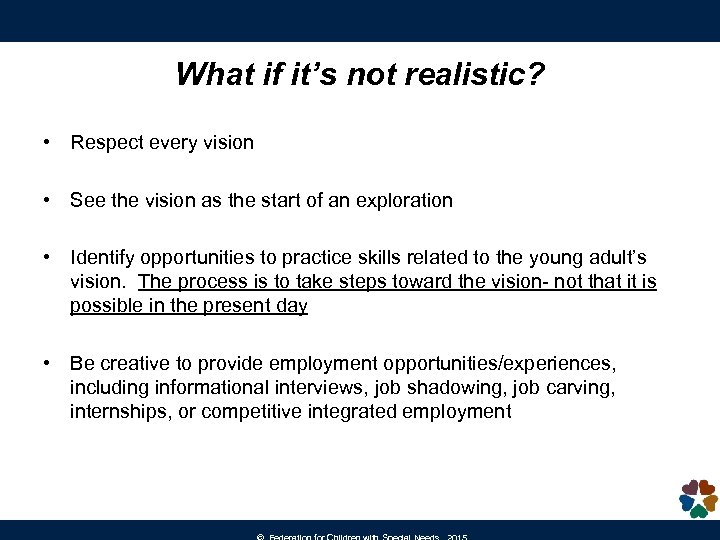 What if it’s not realistic? • Respect every vision • See the vision as the start of an exploration • Identify opportunities to practice skills related to the young adult’s vision. The process is to take steps toward the vision- not that it is possible in the present day • Be creative to provide employment opportunities/experiences, including informational interviews, job shadowing, job carving, internships, or competitive integrated employment
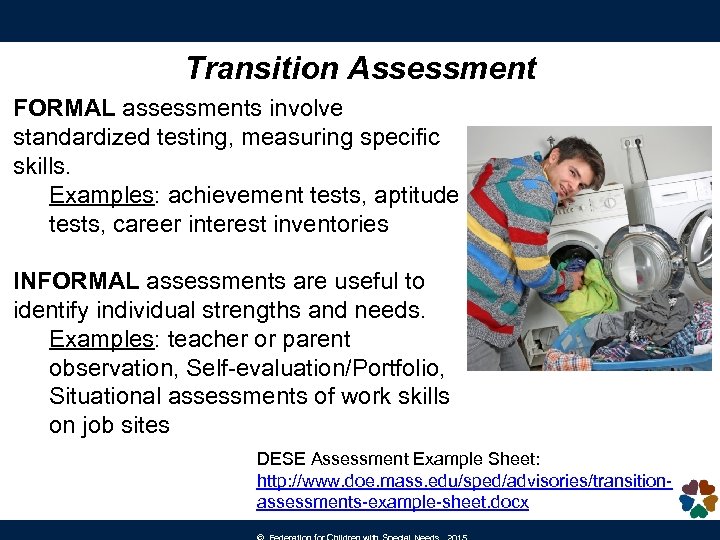 Transition Assessment FORMAL assessments involve standardized testing, measuring specific skills. Examples: achievement tests, aptitude tests, career interest inventories INFORMAL assessments are useful to identify individual strengths and needs. Examples: teacher or parent observation, Self-evaluation/Portfolio, Situational assessments of work skills on job sites DESE Assessment Example Sheet: http: //www. doe. mass. edu/sped/advisories/transitionassessments-example-sheet. docx
 Transition Assessments for Vision 1. NO ONE Test!! 2. Ask school what assessments they use 3. Learn about assessments • Career Interest Inventory- Career Cluster, Interest Profiler https: //masscis. intocareers. org/materials/portal/home 2. html • Transition Assessment Matrix http: //www. iidc. indiana. edu/styles/iidc/defiles/CCLC/transition_matrix/Tr ansition_Matrix. html
 Sandy’s Postsecondary Vision: I want to attend a culinary program at a community college and work part -time in a restaurant and live at home. Potential Transition Assessments: • Work based learning assessment- Observe Sandy working at a restaurant. What does she do well? Does she listen to instruction? Does she use safety skills in the kitchen? • Achievement tests- what are the requirements for the culinary program? Will Sandy need to pass MCAS? What experience will she need for the culinary program? • Personality test- what does Sandy enjoy doing in her free time? Does she like to be in a loud, fast moving environment? How does she handle stress?
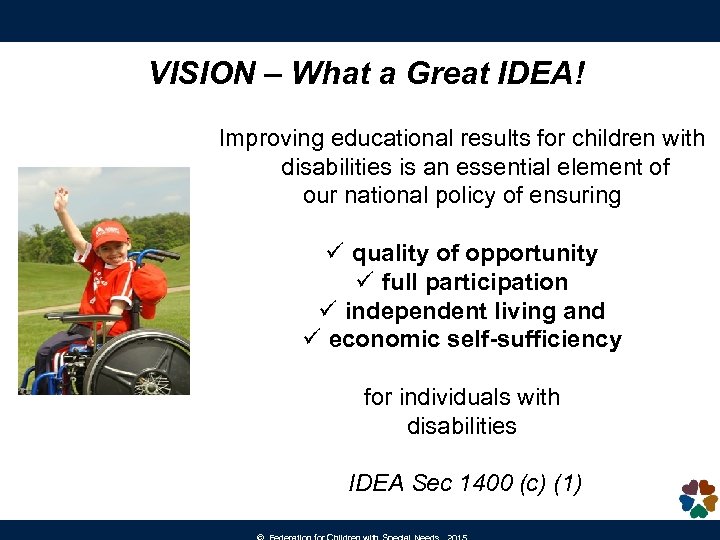 VISION – What a Great IDEA! Improving educational results for children with disabilities is an essential element of our national policy of ensuring ü quality of opportunity ü full participation ü independent living and ü economic self-sufficiency for individuals with disabilities IDEA Sec 1400 (c) (1)
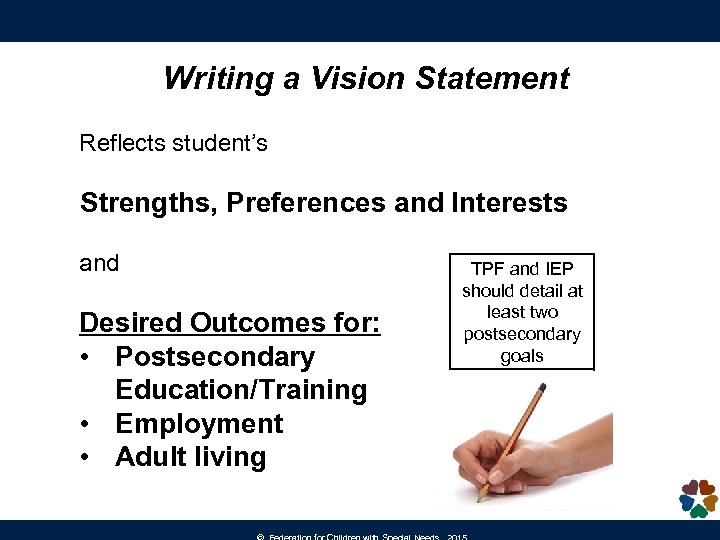 Writing a Vision Statement Reflects student’s Strengths, Preferences and Interests and Desired Outcomes for: • Postsecondary Education/Training • Employment • Adult living TPF and IEP should detail at least two postsecondary goals
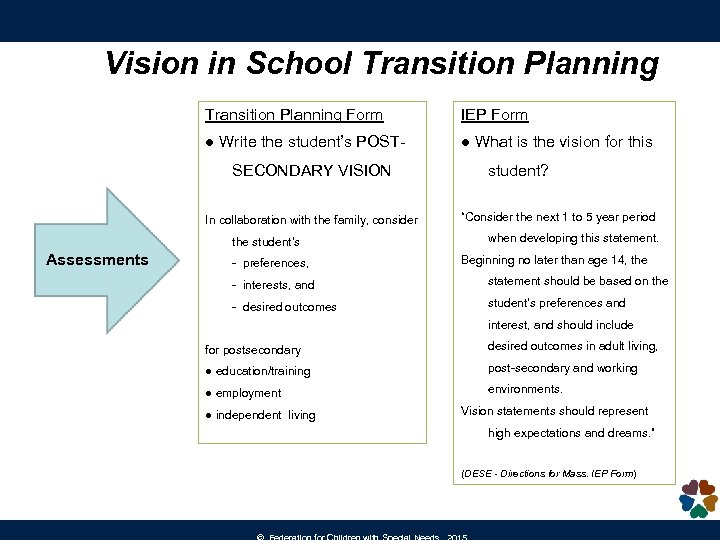 Vision in School Transition Planning Form IEP Form ● Write the student’s POST- ● What is the vision for this SECONDARY VISION In collaboration with the family, consider the student’s Assessments - preferences, student? “Consider the next 1 to 5 year period when developing this statement. Beginning no later than age 14, the - interests, and statement should be based on the - desired outcomes student’s preferences and interest, and should include for postsecondary desired outcomes in adult living, ● education/training post-secondary and working ● employment environments. ● independent living Vision statements should represent high expectations and dreams. ” (DESE - Directions for Mass. IEP Form)
 Martin Luther King Jr. “You don't have to see the whole staircase, just take the first step”
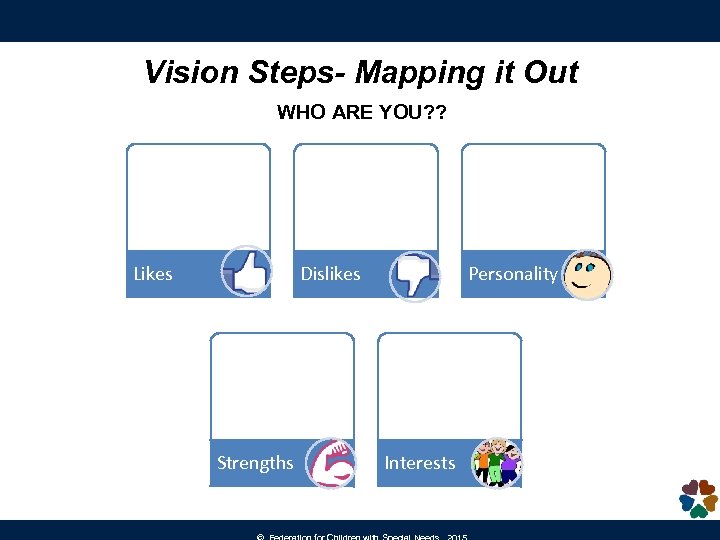 Vision Steps- Mapping it Out WHO ARE YOU? ? Likes Dislikes Strengths Personality Interests
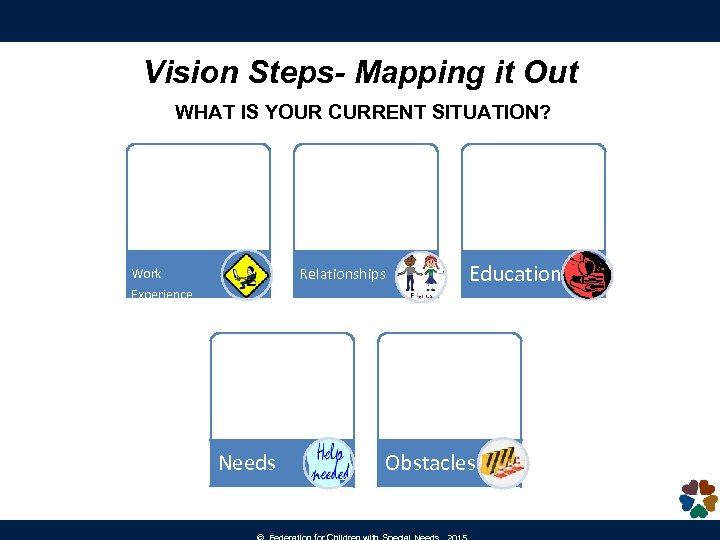 Vision Steps- Mapping it Out WHAT IS YOUR CURRENT SITUATION? Relationships Work Experience Needs Education Obstacles
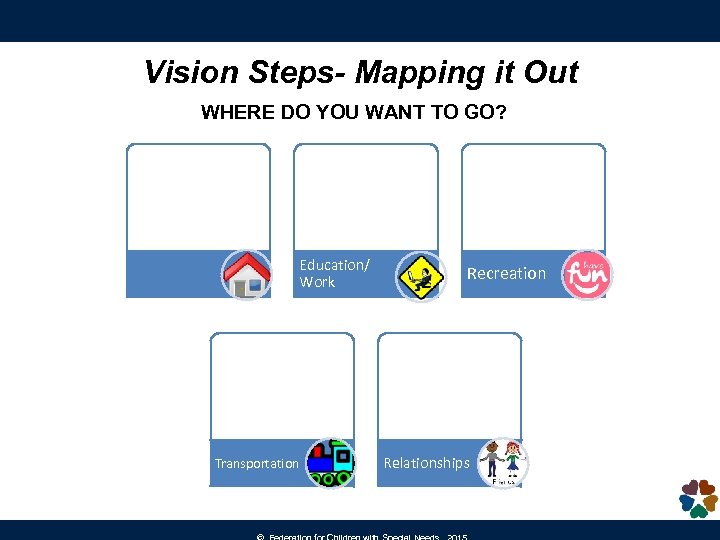 Vision Steps- Mapping it Out WHERE DO YOU WANT TO GO? Education/ Work Recreation Live Transportation Relationships
 Things to Consider • Where are some gaps in activity/skill building? • What needs and obstacles need to be addressed? • What can be a first step toward the future vision? • Who can help in taking some first steps? • When can this happen by? • Make sure you have student buy-in
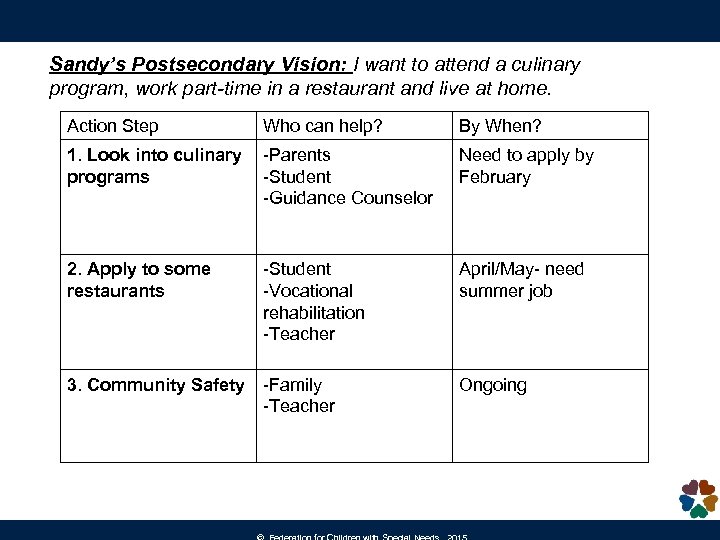 Sandy’s Postsecondary Vision: I want to attend a culinary program, work part-time in a restaurant and live at home. Action Step Who can help? By When? 1. Look into culinary -Parents programs -Student -Guidance Counselor Need to apply by February 2. Apply to some restaurants -Student -Vocational rehabilitation -Teacher April/May- need summer job 3. Community Safety -Family -Teacher Ongoing
 Stay Informed about Transition • Join the Conversation! FCSNTransition Listserv – a free Yahoo group for parents and professionals fcsntransition-subscribe@yahoogroups. com • Learn More! FCSN’s The LINK Center website www. fcsn. org/linkcenter DESE Secondary Transition website http: //www. doe. mass. edu/sped/secondarytransition/default. html
 Planning a Life Two day conference with information and resources for families and professionals. 2017/2018 dates to be determined
 Resources A Family Guide to Transition Services in Massachusetts http: //fcsn. org/transition_guide/english. pdf http: //fcsn. org/transition_guide/spanish. pdf Transition Planning Form http: //www. doe. mass. edu/sped/28 MR/28 m 9. pdf DESE Technical Assistance SPED Advisories: Postsecondary Goals and Annual IEP Goals in the Transition Planning Process http: //www. doe. mass. edu/sped/advisories/13_1 ta. html Transition Assessment in the Secondary Transition Planning Process http: //www. doe. mass. edu/sped/advisories/2014 -4 ta. html Promoting Student Self-Determination to Improve Student Outcomes http: //www. doe. mass. edu/sped/advisories/2016 -2 ta. pdf
 How Can We Help You? Contact our Call Center 617 -236 -7210 Visit our website www. fcsn. org Email Us info@fcsn. org Follow Us on. . .
 Thank you for coming! Any questions? Parent Training and Information Center (PTIC) and The Link Center are supported in part by grants from the U. S. Dept. of Education, Office of Special Education Programs, the Rehabilitation Services Administration and the MA Dept. of Elementary and Secondary Education INFORMING, EDUCATING, EMPOWERING FAMILIES 617 -236 -7210 | www. fcsn. org | fcsninfo@fcsn. org