 Скачать презентацию INFORMATION TECHNOLOGY STRATEGIC PLANNING FOR LIBRARIES A PRESENTATION
edadc728306598b8c1b766dc9b08a125.ppt
- Количество слайдов: 53



INFORMATION TECHNOLOGY STRATEGIC PLANNING FOR LIBRARIES A PRESENTATION BY Rob Mc. Gee, President RMG Consultants, Inc. AT THE SHANGHAI INTERNATIONAL LIBRARY FORUM (SILF) on Friday, August 18, 2006 54 Slide Version © Copyright 2006 RMG Consultants, Inc. 900 N Franklin #709 Chicago IL USA 60610 1
Introduction • • RMG’s Planning methodology developed in 1999 By adapting two public sector IT Strategic Planning best practice models: ° ° Template for Information Management Strategic Planning, prepared by the State of Maryland Information Technology Support Center (ITSC), December 1995, April 1999. Committee on Institutional Cooperation, CIC Center for Library Initiatives Homepage, CIC Libraries Strategic Plan, Strategic Directions for 1998. © Copyright 2006 RMG Consultants, Inc. 900 N Franklin #709 Chicago IL USA 60610 2
What is a Library IT Strategic Plan? • Defines the Library’s strategic directions for technology • Specifies technologies and IT projects for ° The next year ° Each of the next three years ° Each of the next five years with technology budgets for each year. © Copyright 2006 RMG Consultants, Inc. 900 N Franklin #709 Chicago IL USA 60610 3
What is a Library IT Strategic Plan? - continued Is consistent with the Library’s • mission • vision • values and those of its host institution. Substantiates the needs for technology funding. © Copyright 2006 RMG Consultants, Inc. 900 N Franklin #709 Chicago IL USA 60610 4
What is a Library IT Strategic Plan? - continued Answers key questions like • What technologies should my library consider? • How will they improve Library services? • Which technologies should my library implement? ° When? ° In what order/priority? © Copyright 2006 RMG Consultants, Inc. 900 N Franklin #709 Chicago IL USA 60610 5
What is a Library IT Strategic Plan? - continued Answers key questions like, cont’d • How much will this cost? ° Money? ° In Human Resources? © Copyright 2006 RMG Consultants, Inc. 900 N Franklin #709 Chicago IL USA 60610 6
What is a Library IT Strategic Plan? - continued Has performance measures to determine • Progress • Problems with actionable items. © Copyright 2006 RMG Consultants, Inc. 900 N Franklin #709 Chicago IL USA 60610 7
What is a Library IT Strategic Plan? - continued • The plan should be updated annually – or more frequently as needed ! • Be easy to update • To keep technology plans and budgets ° Current with innovations ° Responsive to opportunities. © Copyright 2006 RMG Consultants, Inc. 900 N Franklin #709 Chicago IL USA 60610 8
Why Undertake IT Strategic Planning? Objectives of planning are • To determine the Library’s strategic directions for technology, • To provide needed technology tools, and • To re-invent the organization to the point where everyone becomes part of the information technology process. © Copyright 2006 RMG Consultants, Inc. 900 N Franklin #709 Chicago IL USA 60610 9
Why Undertake IT Strategic Planning? - continued Above all, The IT Strategic Plan must ensure that the Library remains technologically relevant to the needs of its constituents © Copyright 2006 RMG Consultants, Inc. 900 N Franklin #709 Chicago IL USA 60610 10
Why Undertake IT Strategic Planning? - continued Libraries should become Learning Organizations • Highly proficient • Technology-driven Where • Workflows are efficient • Employees are well-trained and equipped © Copyright 2006 RMG Consultants, Inc. 900 N Franklin #709 Chicago IL USA 60610 11
Why Undertake IT Strategic Planning? - continued Libraries should become Learning Organizations • To provide the best service possible • To master change • To provide new technology-based services. © Copyright 2006 RMG Consultants, Inc. 900 N Franklin #709 Chicago IL USA 60610 12
Why Undertake IT Strategic Planning? - continued Staff with technical talent should be • Welcomed • Challenged • Motivated, and • Made to feel that the Library is a place for them to contribute and grow. © Copyright 2006 RMG Consultants, Inc. 900 N Franklin #709 Chicago IL USA 60610 13
Why Undertake IT Strategic Planning? - continued In this kind of learning environment • Staff stay attuned to new information resources and service possibilities • The organization constantly seeks and adapts best practices in delivering information resources and services to its patrons. © Copyright 2006 RMG Consultants, Inc. 900 N Franklin #709 Chicago IL USA 60610 14
Designing the Process Design of the IT Strategic Planning process is the key to its success -- and to that of any major IT procurement © Copyright 2006 RMG Consultants, Inc. 900 N Franklin #709 Chicago IL USA 60610 15
Designing the Process, cont’d The planning project should be conducted as a team-based enterprise learning process that • Educates the institution about choices and consequences, • Decides on technology priorities and investments. © Copyright 2006 RMG Consultants, Inc. 900 N Franklin #709 Chicago IL USA 60610 16
Designing the Process, cont’d The planning project should be conducted as a team-based enterprise learning process that • Makes informed decisions with confidence • Delivers consensus-based outcomes and stakeholders’ buyin © Copyright 2006 RMG Consultants, Inc. 900 N Franklin #709 Chicago IL USA 60610 17
Designing the Process, cont’d A well-designed project conducted with the right organization, methodologies, and facilitating skills will achieve consensus-based outcomes and stakeholders’ buy-in that are invaluable for the next stages – funding and implementation of technology projects. © Copyright 2006 RMG Consultants, Inc. 900 N Franklin #709 Chicago IL USA 60610 18
The Steering Committee and IT Planning Team Critical to Quality, Acceptance, and Buy-in • Top management must ° Endorse and support plans for the design, organization, and schedule of the IT Strategic Planning process ° Make it a priority © Copyright 2006 RMG Consultants, Inc. 900 N Franklin #709 Chicago IL USA 60610 19
The Steering Committee and IT Planning Team • Selecting members of the “IT Planning Team” is the key step ° It will be the primary work group entrusted by management to develop the plan. © Copyright 2006 RMG Consultants, Inc. 900 N Franklin #709 Chicago IL USA 60610 20
The Steering Committee and IT Planning Team continued • Top management can either be included in the Planning Team, or in a Steering Committee. BUT • The Planning Team, will be responsible on behalf of the organization for learning and mastering the information and issues required to develop the IT Strategic Plan. © Copyright 2006 RMG Consultants, Inc. 900 N Franklin #709 Chicago IL USA 60610 21
IT Planning Team • Its membership is critical to the success of the planning process: • it needs to be right-sized and rightly-constituted. • Small group dynamics govern the efficiency and success of discussions, learning, and decisionmaking • 7 to 9 member Team usually works well. © Copyright 2006 RMG Consultants, Inc. 900 N Franklin #709 Chicago IL USA 60610 22
IT Planning Team, cont’d Members must represent. • technical, policy, and operational aspects of the Library • Issues, concerns, and goals for enhanced Information Technology. Collectively, the Team must have • Credibility and judgment • To produce and lead in acceptance of the plan © Copyright 2006 RMG Consultants, Inc. 900 N Franklin #709 Chicago IL USA 60610 23
Making Informed Decisions with Consensus and Confidence IT planning and procurement processes should always be consensus based, to ensure • That all points of view are heard • That all participants support the outcomes. © Copyright 2006 RMG Consultants, Inc. 900 N Franklin #709 Chicago IL USA 60610 24
Making Informed Decisions with Consensus and Confidence, cont’d • If a team is uncomfortable making a decision, or Unable to reach consensus, ° Usually more information is needed, or ° The information in hand has not been sufficiently discussed or understood. © Copyright 2006 RMG Consultants, Inc. 900 N Franklin #709 Chicago IL USA 60610 25
Making Informed Decisions with Consensus and Confidence, cont’d • Adjusting the process to gather and evaluate more information likely will position a team to make a decision it is comfortable with and can justify to others, and the institution. © Copyright 2006 RMG Consultants, Inc. 900 N Franklin #709 Chicago IL USA 60610 26
The Planning Project as Preparation and Practice for Implementation • A team-based planning process develops ° Individuals’ team skills and ° Shared understandings and trust. • Developing key players and institutional experience with ° Team-based project organization and reporting ° structured decision-making are valuable lead-ins to the implementation phases of the targeted technology projects. © Copyright 2006 RMG Consultants, Inc. 900 N Franklin #709 Chicago IL USA 60610 27
Undertaking IT Planning (and Procurement) Projects as Learning Processes Designing the project as an enterprise learning process will educate people about possible technologies and service enhancements, obtain and share inputs from across the organization, and explain perceptions from different points of view. © Copyright 2006 RMG Consultants, Inc. 900 N Franklin #709 Chicago IL USA 60610 28
Taking a Holistic Approach: Enterprise IT Strategic Planning vs. Silo Planning • Waves of new technology bring many challenges and opportunities • This invites a holistic approach to enterprise planning – in contrast to silo planning for individual organizational units or subsets of IT resources. © Copyright 2006 RMG Consultants, Inc. 900 N Franklin #709 Chicago IL USA 60610 29
Taking a Holistic Approach: Enterprise IT Strategic Planning vs. Silo Planning, cont’d The impact of new and commonly used technologies and highly specialized IT solutions invites the organization to take a holistic, enterprise approach to IT strategic planning. © Copyright 2006 RMG Consultants, Inc. 900 N Franklin #709 Chicago IL USA 60610 30
Steps in the IT Strategic Planning Process Ø Signing-off on Project Plans with Management q Detailed design of steps in the planning process q Membership of the IT Planning Team, and optionally as needed, a Steering Committee q Detailed schedule for the process q Allocation of people’s time. © Copyright 2006 RMG Consultants, Inc. 900 N Franklin #709 Chicago IL USA 60610 31
Steps in the IT Strategic Planning Process - continued Ø Orienting the IT Strategic Planning Team and Performing a SWOT Analysis q Assigning readings to recognize what may be possible q IT Strategic Planning Questionnaire q Review of the library’s current environment and use of information © Copyright 2006 RMG Consultants, Inc. 900 N Franklin #709 Chicago IL USA 60610 32
Steps in the IT Strategic Planning Process - continued Ø Environmental Scan of the Library’s current environment and use of information technology • Walkthroughs of the facilities and operations • Comprehensive review with the Planning Team of the political, technical, and financial issues of the Library and overall situation. • Gathering and analyzing statistical and qualitative data. © Copyright 2006 RMG Consultants, Inc. 900 N Franklin #709 Chicago IL USA 60610 33
Steps in the IT Strategic Planning Process - continued Ø Assessing the library’s current environment and use of information technology, cont’d • Should identify needed organizational changes in culture management support staff development. • May conclude with formal approval of a Technology Needs Assessment (or sometimes, a Gap Analysis) document. © Copyright 2006 RMG Consultants, Inc. 900 N Franklin #709 Chicago IL USA 60610 34
Steps in the IT Strategic Planning Process - continued Ø Assessing information technologies with the Planning Team Identifying and assessing current and oncoming information technologies for the foreseeable future q Anticipating the impact of technologies on the library’s mission, goals, objectives, and roles within the library’s environment – and on services q Reviewing possibilities, issues, alternatives, and strategic directions q Discussing the issues, concerns, and goals for enhanced information technology to provide expanded services. q © Copyright 2006 RMG Consultants, Inc. 900 N Franklin #709 Chicago IL USA 60610 35
Steps in the IT Strategic Planning Process - continued Reviewing with Focus Groups of staff and patrons key questions/topics the possibilities, issues, and general courses of direction identified with the Planning Team. Ø Conducting interviews with key individuals on possibilities, issues, etc. Ø Public and targeted Web surveys. Ø © Copyright 2006 RMG Consultants, Inc. 900 N Franklin #709 Chicago IL USA 60610 36
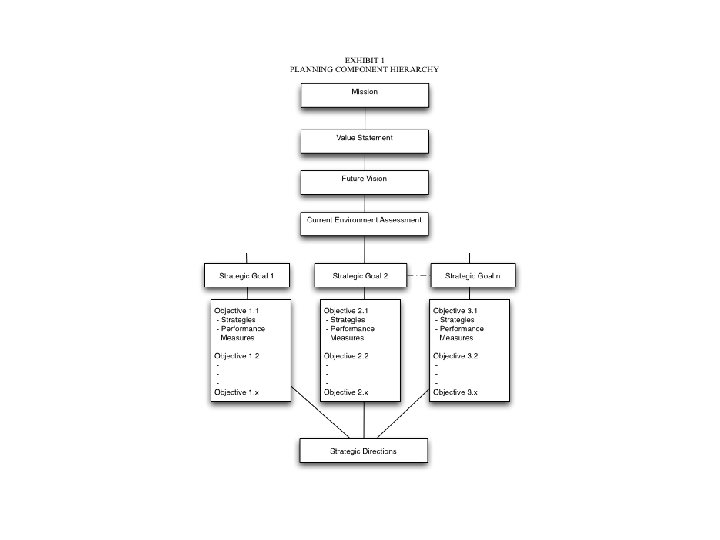
Steps in the IT Strategic Planning Process - continued Ø Wrapping-up the planning phase • Define, prioritize, budget, and schedule technology implementation projects through working sessions with the Planning Team • Fulfill the planning component hierarchy illustrated by Exhibit 1: Mission, Vision, IT Strategic Goals, Objectives, Performance Measures, and Strategies © Copyright 2006 RMG Consultants, Inc. 900 N Franklin #709 Chicago IL USA 60610 37
Steps in the IT Strategic Planning Process - continued Ø Wrapping-up the planning phase, cont’d • Define, evaluate, prioritize, and schedule implementation years for Possible projects for implementing technologies and technology- based services for the Library • Validate the Strategic Fit of key recommendations • Define the resulting Strategic Directions © Copyright 2006 RMG Consultants, Inc. 900 N Franklin #709 Chicago IL USA 60610 38
Steps in the IT Strategic Planning Process - continued Ø Wrapping-up the planning phase, cont’d • Develop one-year, three-year, five-year (and longer, as needed) Information Technology and IT Project plans, budgets, and schedules • Define requirements for Library organization and staffing to accomplish the IT Strategic Plan and the targeted technology implementation projects. © Copyright 2006 RMG Consultants, Inc. 900 N Franklin #709 Chicago IL USA 60610 39
Steps in the IT Strategic Planning Process - continued Ø Reviewing, revising, and finalizing the Information Technology Strategic Plan with top management/Steering Committee until final acceptance. Ø Presenting the Information Technology Strategic Plan for the Library to the organization, institution, and key stakeholders. © Copyright 2006 RMG Consultants, Inc. 900 N Franklin #709 Chicago IL USA 60610 40
Steps in the IT Strategic Planning Process - continued Ø Publishing and communicating the Information Technology Strategic Plan to targeted constituencies q. A communications plan may be developed to accomplish this. Ø Planning for annual – or more frequent – review and update of the Plan. © Copyright 2006 RMG Consultants, Inc. 900 N Franklin #709 Chicago IL USA 60610 41
The Planning Component Hierarchy Exhibit 1 illustrates the planning component hierarchy that has been used to develop the IT Strategic Planning Process for Libraries described by this paper; the following paragraphs that explain it are based on the State of Maryland template that is cited. ____ Ø Template for Information Management Strategic Planning, prepared by the State of Maryland Information Technology Support Center (ITSC), December 1995, April 1999. © Copyright 2006 RMG Consultants, Inc. 900 N Franklin #709 Chicago IL USA 60610 42
The Planning Component Hierarchy - continued Ø The IT Strategic Plan flows from the mission, vision, and objectives of the organization, and is developed with methodologies, templates, and practices for each component. It is not unusual to revise the mission statement during the strategic planning exercise. Institutional value statements may be included in the hierarchy. © Copyright 2006 RMG Consultants, Inc. 900 N Franklin #709 Chicago IL USA 60610 44
The Planning Component Hierarchy - continued Ø Ø The Technology Vision typically will be a single paragraph that describes the library’s desired organizational end-state with respect to services and technology. The IT Strategic Goals will be statements about where the library wants to be in the future, in order to achieve the overall mission of the organization and the vision of its future. The Technology Vision is a statement about where to go, and the IT Strategic Goals are statements about how to get there. © Copyright 2006 RMG Consultants, Inc. 900 N Franklin #709 Chicago IL USA 60610 45
The Planning Component Hierarchy - continued Ø Ø Objectives represent specific courses of action that are bounded by and support the strategies. They contain definitions of targets and performance measures for evaluating progress during the planning period toward achieving the strategic goals. Strategies are more defined statements that set forth how the organization will achieve its strategic goals. There are typically many ways to achieve strategic goals; the strategies define the alternatives selected by the Planning Team. © Copyright 2006 RMG Consultants, Inc. 900 N Franklin #709 Chicago IL USA 60610 46
The Planning Component Hierarchy - continued Ø Performance measures will be defined in order to measure progress and identify problems in achieving these goals. Exhibit 2 provides a sample. © Copyright 2006 RMG Consultants, Inc. 900 N Franklin #709 Chicago IL USA 60610 47
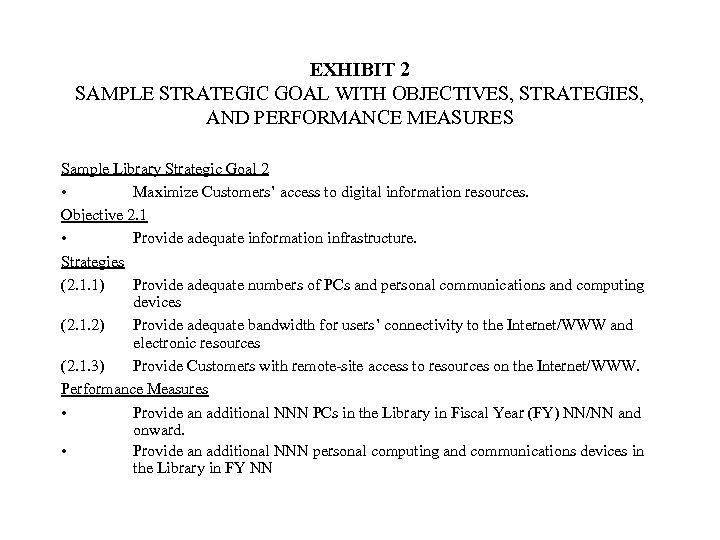
EXHIBIT 2 SAMPLE STRATEGIC GOAL WITH OBJECTIVES, STRATEGIES, AND PERFORMANCE MEASURES Sample Library Strategic Goal 2 • Maximize Customers’ access to digital information resources. Objective 2. 1 • Provide adequate information infrastructure. Strategies (2. 1. 1) Provide adequate numbers of PCs and personal communications and computing devices (2. 1. 2) Provide adequate bandwidth for users’ connectivity to the Internet/WWW and electronic resources (2. 1. 3) Provide Customers with remote-site access to resources on the Internet/WWW. Performance Measures • Provide an additional NNN PCs in the Library in Fiscal Year (FY) NN/NN and onward. • Provide an additional NNN personal computing and communications devices in the Library in FY NN
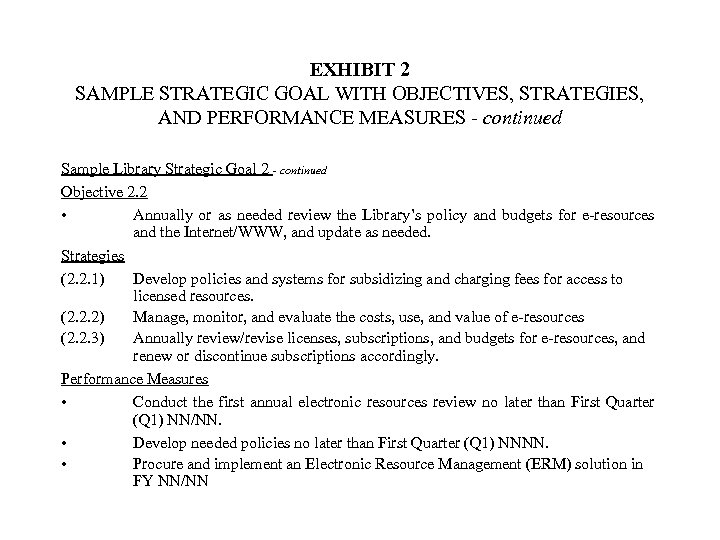
EXHIBIT 2 SAMPLE STRATEGIC GOAL WITH OBJECTIVES, STRATEGIES, AND PERFORMANCE MEASURES - continued Sample Library Strategic Goal 2 - continued Objective 2. 2 • Annually or as needed review the Library’s policy and budgets for e-resources and the Internet/WWW, and update as needed. Strategies (2. 2. 1) Develop policies and systems for subsidizing and charging fees for access to licensed resources. (2. 2. 2) Manage, monitor, and evaluate the costs, use, and value of e-resources (2. 2. 3) Annually review/revise licenses, subscriptions, and budgets for e-resources, and renew or discontinue subscriptions accordingly. Performance Measures • Conduct the first annual electronic resources review no later than First Quarter (Q 1) NN/NN. • Develop needed policies no later than First Quarter (Q 1) NNNN. • Procure and implement an Electronic Resource Management (ERM) solution in FY NN/NN
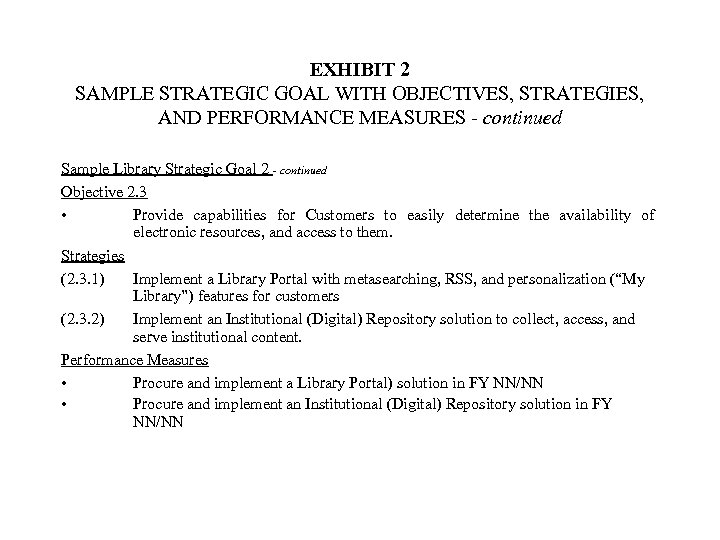
EXHIBIT 2 SAMPLE STRATEGIC GOAL WITH OBJECTIVES, STRATEGIES, AND PERFORMANCE MEASURES - continued Sample Library Strategic Goal 2 - continued Objective 2. 3 • Provide capabilities for Customers to easily determine the availability of electronic resources, and access to them. Strategies (2. 3. 1) Implement a Library Portal with metasearching, RSS, and personalization (“My Library”) features for customers (2. 3. 2) Implement an Institutional (Digital) Repository solution to collect, access, and serve institutional content. Performance Measures • Procure and implement a Library Portal) solution in FY NN/NN • Procure and implement an Institutional (Digital) Repository solution in FY NN/NN
EXHIBIT 3 SAMPLE RECOMMENDED THREE-YEAR TECHNOLOGY BUDGET
EXHIBIT 3 SAMPLE RECOMMENDED THREE-YEAR TECHNOLOGY BUDGET - continued
EXHIBIT 3 SAMPLE RECOMMENDED THREE-YEAR TECHNOLOGY BUDGET - continued
Скачать презентацию INFORMATION TECHNOLOGY STRATEGIC PLANNING FOR LIBRARIES A PRESENTATION
edadc728306598b8c1b766dc9b08a125.ppt