


 Скачать презентацию Information Technology IT Industries in the S 4
9cf327015c0236c041afb01d7965f8bd.ppt
- Количество слайдов: 26
 Information Technology (IT) Industries in the S 4 -5 Geography Curriculum Dr. Becky P. Y. Loo Associate Professor Department of Geography, HKU
 Information Technology (IT) Industries in the S 4 -5 Geography Curriculum n What? n Where? n Why? n How? n Conclusion
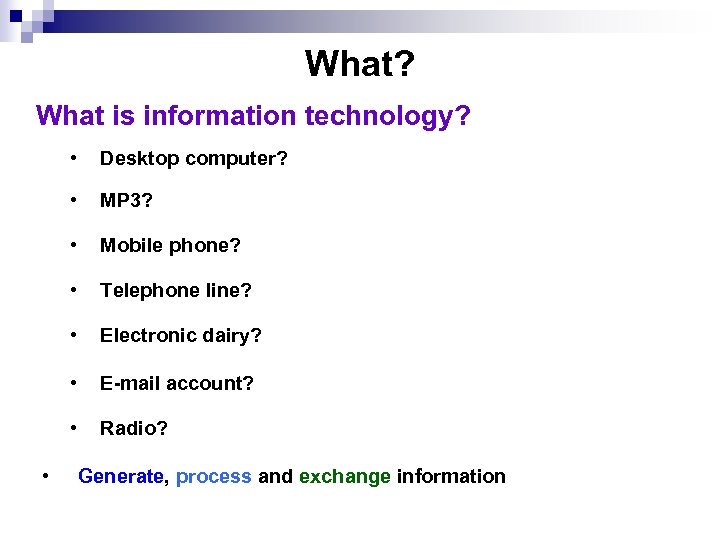 What? What is information technology? • • MP 3? • Mobile phone? • Telephone line? • Electronic dairy? • E-mail account? • • Desktop computer? Radio? Generate, process and exchange information
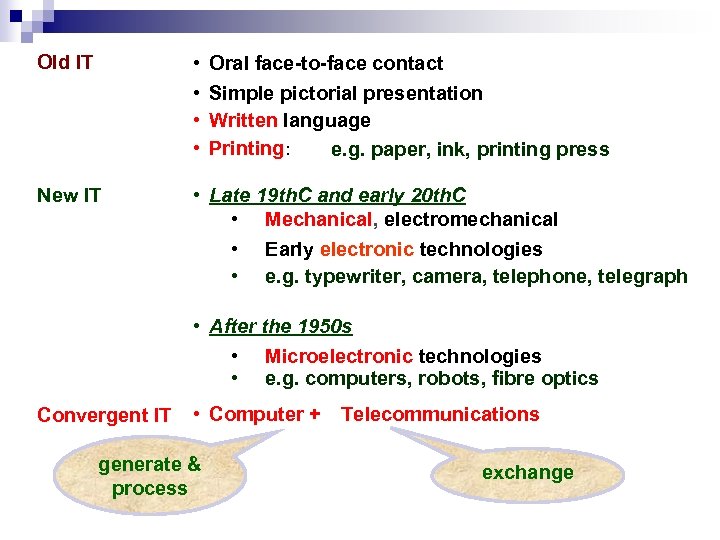 Old IT • • New IT • Late 19 th. C and early 20 th. C • Mechanical, electromechanical • Early electronic technologies • e. g. typewriter, camera, telephone, telegraph Oral face-to-face contact Simple pictorial presentation Written language Printing: e. g. paper, ink, printing press • After the 1950 s • Microelectronic technologies • e. g. computers, robots, fibre optics Convergent IT • Computer + generate & process Telecommunications exchange
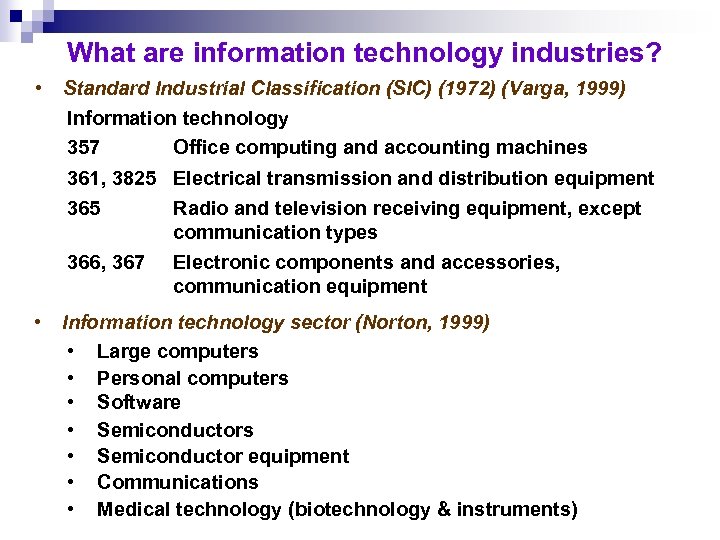 What are information technology industries? • Standard Industrial Classification (SIC) (1972) (Varga, 1999) Information technology 357 Office computing and accounting machines 361, 3825 Electrical transmission and distribution equipment 365 Radio and television receiving equipment, except communication types 366, 367 Electronic components and accessories, communication equipment • Information technology sector (Norton, 1999) • Large computers • Personal computers • Software • Semiconductors • Semiconductor equipment • Communications • Medical technology (biotechnology & instruments)
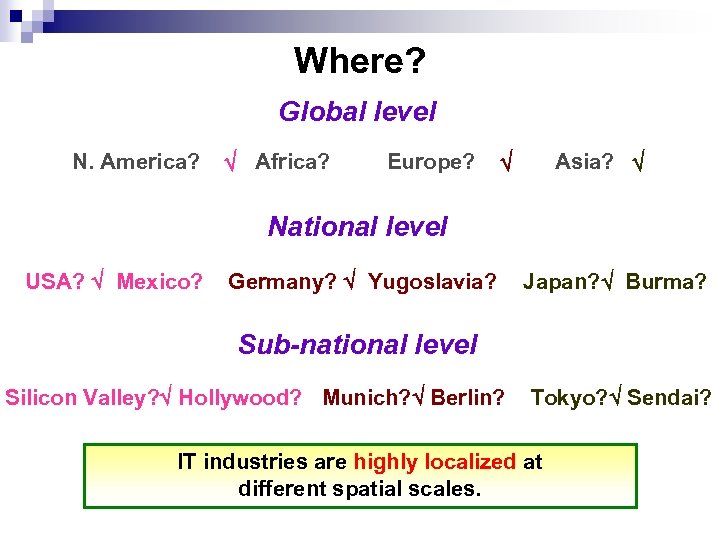 Where? Global level N. America? Africa? Europe? Asia? National level USA? Mexico? Germany? Yugoslavia? Japan? Burma? Sub-national level Silicon Valley? Hollywood? Munich? Berlin? Tokyo? Sendai? IT industries are highly localized at different spatial scales.
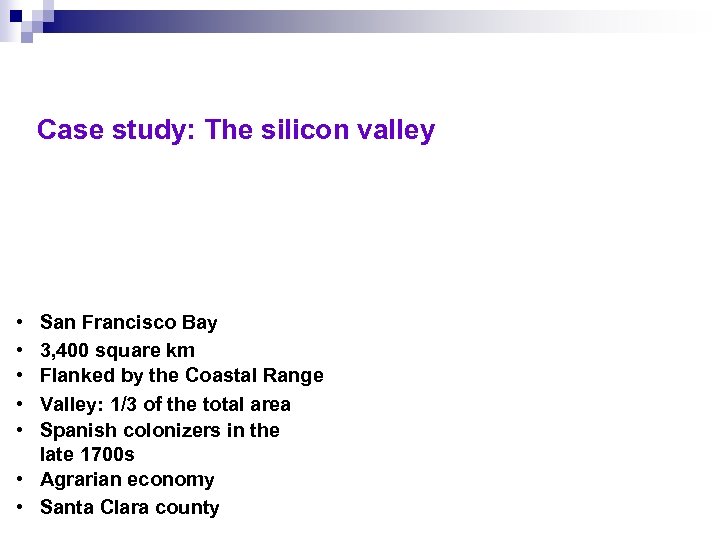 Case study: The silicon valley • • • San Francisco Bay 3, 400 square km Flanked by the Coastal Range Valley: 1/3 of the total area Spanish colonizers in the late 1700 s • Agrarian economy • Santa Clara county
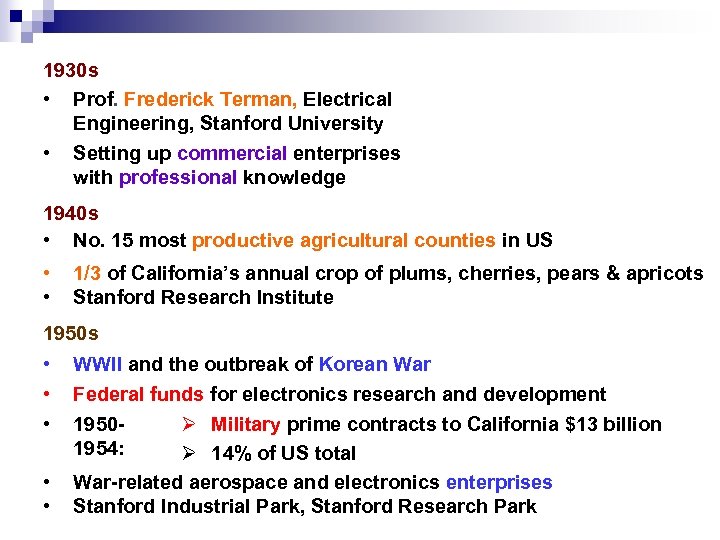 1930 s • Prof. Frederick Terman, Electrical Engineering, Stanford University • Setting up commercial enterprises with professional knowledge 1940 s • No. 15 most productive agricultural counties in US • • 1/3 of California’s annual crop of plums, cherries, pears & apricots Stanford Research Institute 1950 s • • • WWII and the outbreak of Korean War Federal funds for electronics research and development Ø Military prime contracts to California $13 billion 19501954: Ø 14% of US total War-related aerospace and electronics enterprises Stanford Industrial Park, Stanford Research Park
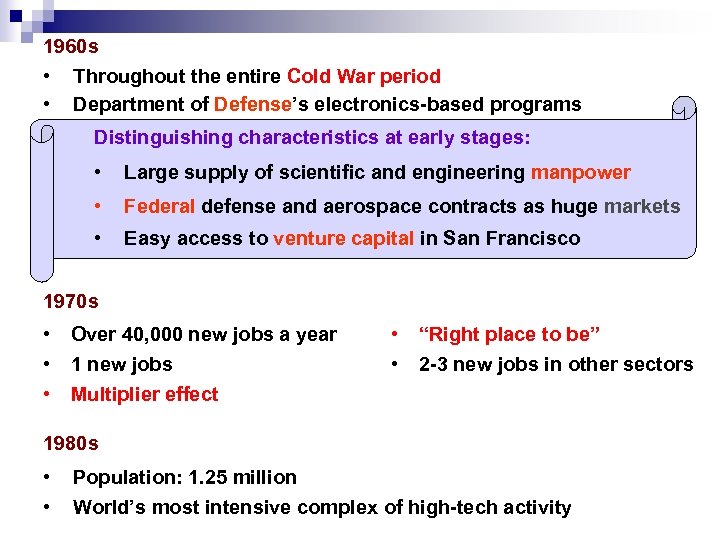 1960 s • Throughout the entire Cold War period • Department of Defense’s electronics-based programs Distinguishing characteristics at early stages: • Large supply of scientific and engineering manpower • Federal defense and aerospace contracts as huge markets • Easy access to venture capital in San Francisco 1970 s • Over 40, 000 new jobs a year • 1 new jobs • Multiplier effect • “Right place to be” • 2 -3 new jobs in other sectors 1980 s • • Population: 1. 25 million World’s most intensive complex of high-tech activity
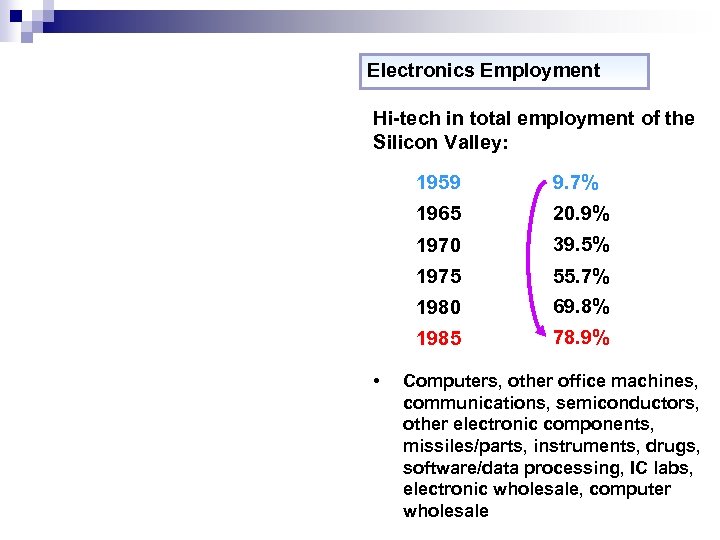 Electronics Employment Hi-tech in total employment of the Silicon Valley: 1959 1965 20. 9% 1970 39. 5% 1975 55. 7% 1980 69. 8% 1985 • 9. 7% 78. 9% Computers, other office machines, communications, semiconductors, other electronic components, missiles/parts, instruments, drugs, software/data processing, IC labs, electronic wholesale, computer wholesale
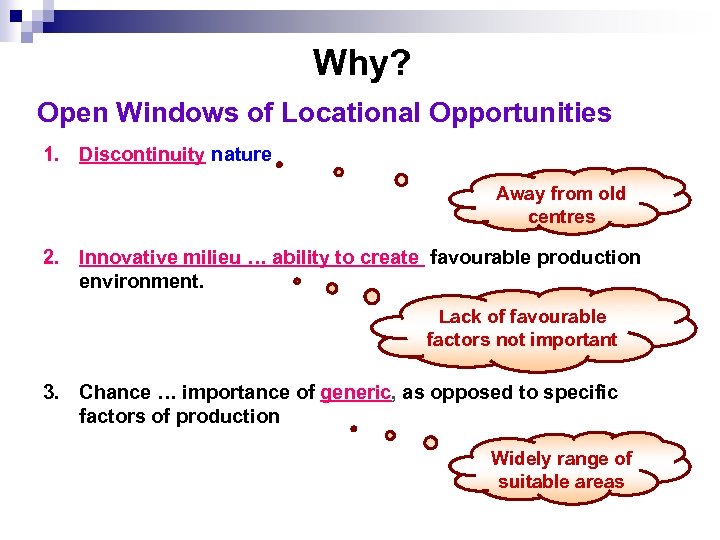 Why? Open Windows of Locational Opportunities 1. Discontinuity nature Away from old centres 2. Innovative milieu … ability to create favourable production environment. Lack of favourable factors not important 3. Chance … importance of generic, as opposed to specific factors of production Widely range of suitable areas
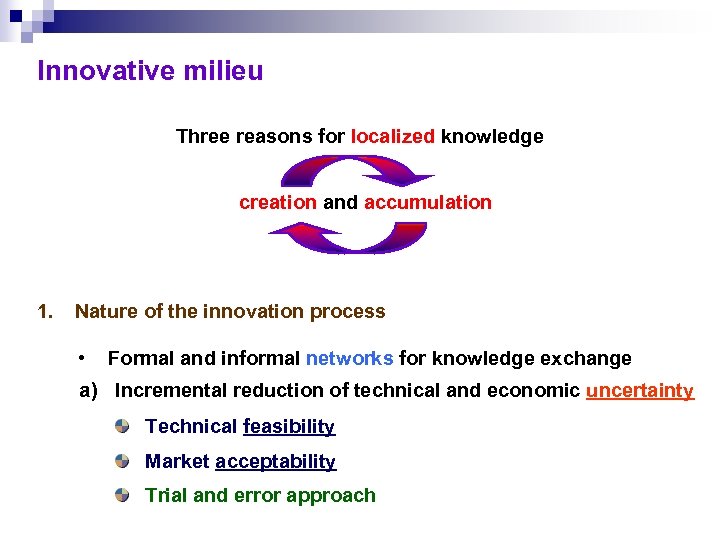 Innovative milieu Three reasons for localized knowledge creation and accumulation 1. Nature of the innovation process • Formal and informal networks for knowledge exchange a) Incremental reduction of technical and economic uncertainty Technical feasibility Market acceptability Trial and error approach
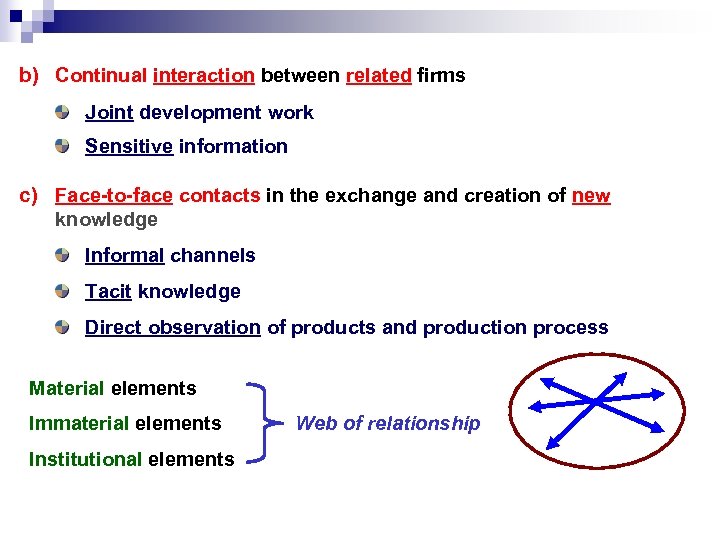 b) Continual interaction between related firms Joint development work Sensitive information c) Face-to-face contacts in the exchange and creation of new knowledge Informal channels Tacit knowledge Direct observation of products and production process Material elements Immaterial elements Institutional elements Web of relationship
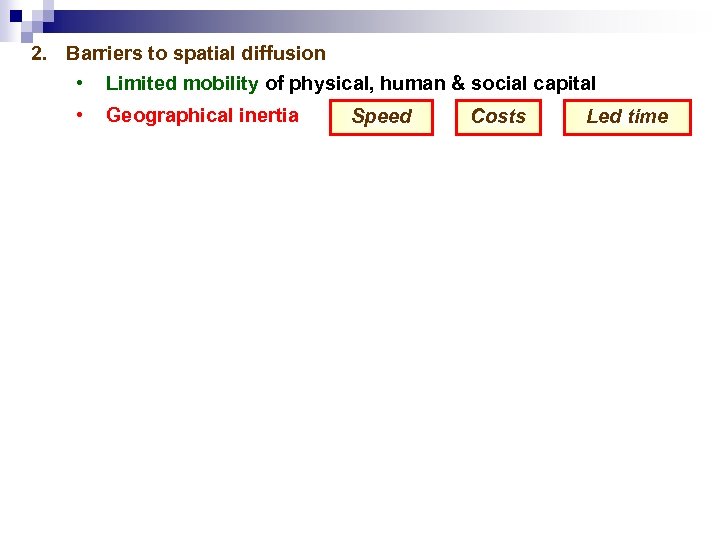 2. Barriers to spatial diffusion • Limited mobility of physical, human & social capital • Geographical inertia Speed Costs Led time
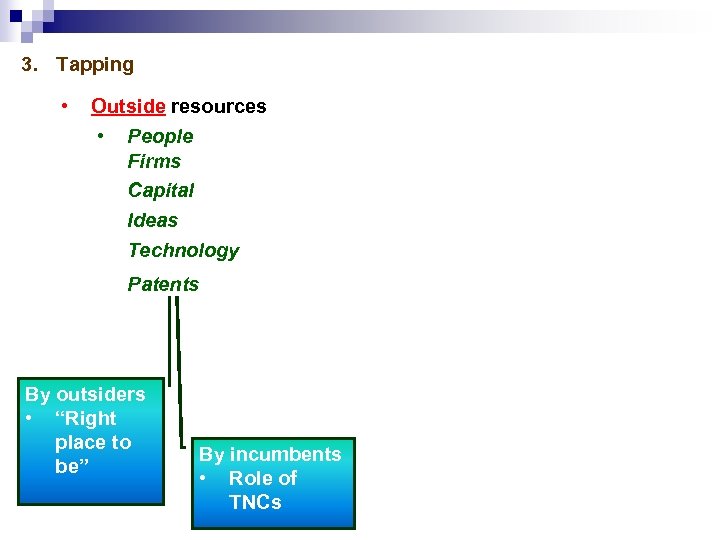 3. Tapping • Outside resources • People Firms Capital Ideas Technology Patents By outsiders • “Right place to be” By incumbents • Role of TNCs
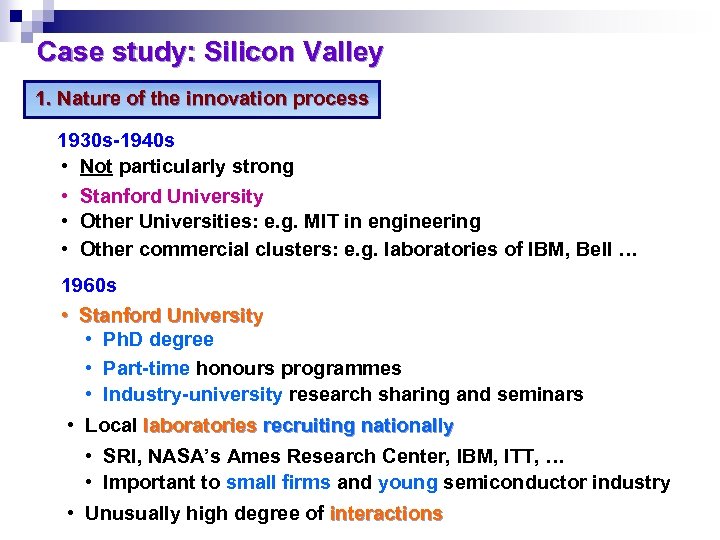 Case study: Silicon Valley 1. Nature of the innovation process 1930 s-1940 s • Not particularly strong • Stanford University • Other Universities: e. g. MIT in engineering • Other commercial clusters: e. g. laboratories of IBM, Bell … 1960 s • Stanford University • Ph. D degree • Part-time honours programmes • Industry-university research sharing and seminars • Local laboratories recruiting nationally • SRI, NASA’s Ames Research Center, IBM, ITT, … • Important to small firms and young semiconductor industry • Unusually high degree of interactions
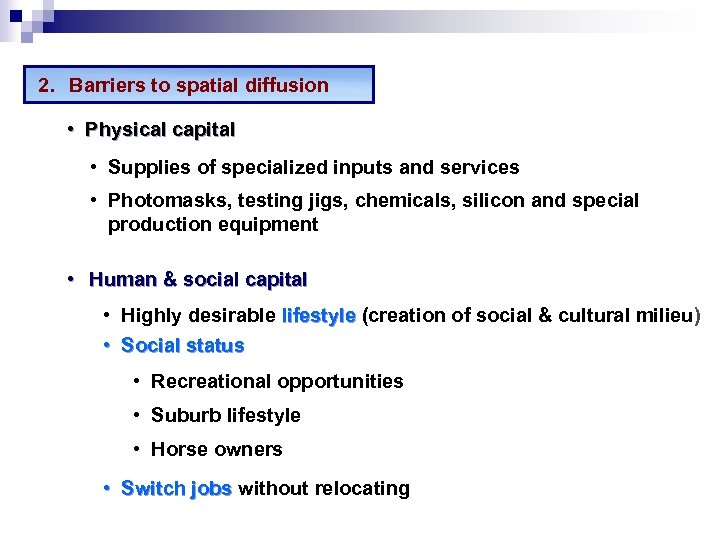 2. Barriers to spatial diffusion • Physical capital • Supplies of specialized inputs and services • Photomasks, testing jigs, chemicals, silicon and special production equipment • Human & social capital • Highly desirable lifestyle (creation of social & cultural milieu) • Social status • Recreational opportunities • Suburb lifestyle • Horse owners • Switch jobs without relocating
 3. Tapping • Outside people Young scientists from all over the country • To land jobs • To start their own firms
 • • • Outside technology New firms Inflow of capital • Local industry liberally financed with venture capital • Success of Fairchild
 • Financial support from San Francisco • A large pool of wealthy individuals and families with discretionary incomes • Management consulting house
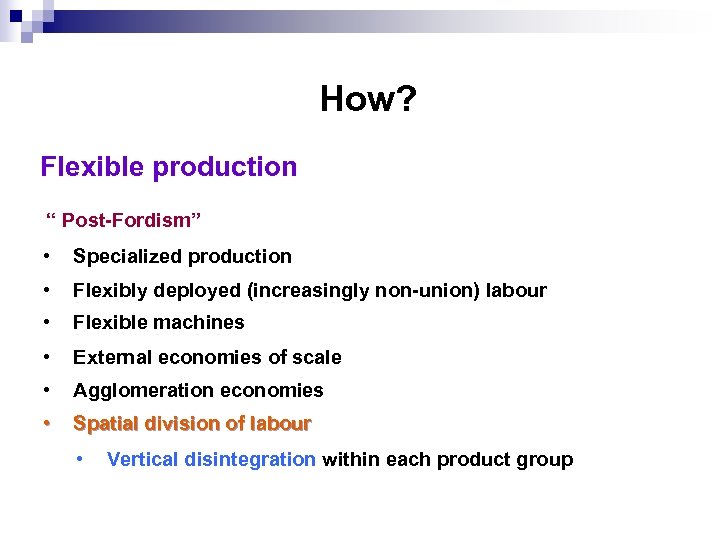 How? Flexible production “ Post-Fordism” • Specialized production • Flexibly deployed (increasingly non-union) labour • Flexible machines • External economies of scale • Agglomeration economies • Spatial division of labour • Vertical disintegration within each product group
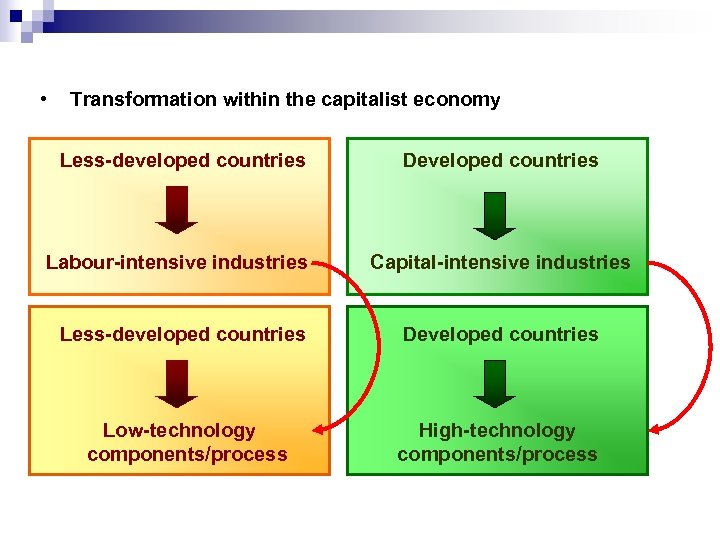 • Transformation within the capitalist economy Less-developed countries Developed countries Labour-intensive industries Capital-intensive industries Less-developed countries Developed countries Low-technology components/process High-technology components/process
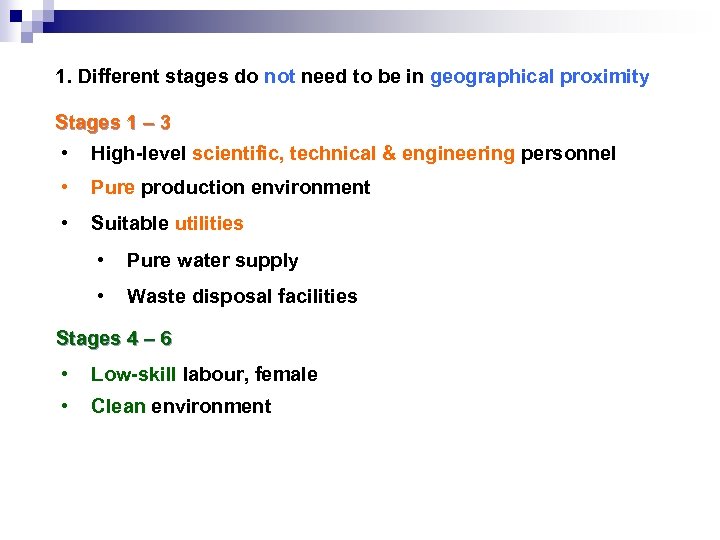 1. Different stages do not need to be in geographical proximity Stages 1 – 3 • High-level scientific, technical & engineering personnel • Pure production environment • Suitable utilities • Pure water supply • Waste disposal facilities Stages 4 – 6 • Low-skill labour, female • Clean environment
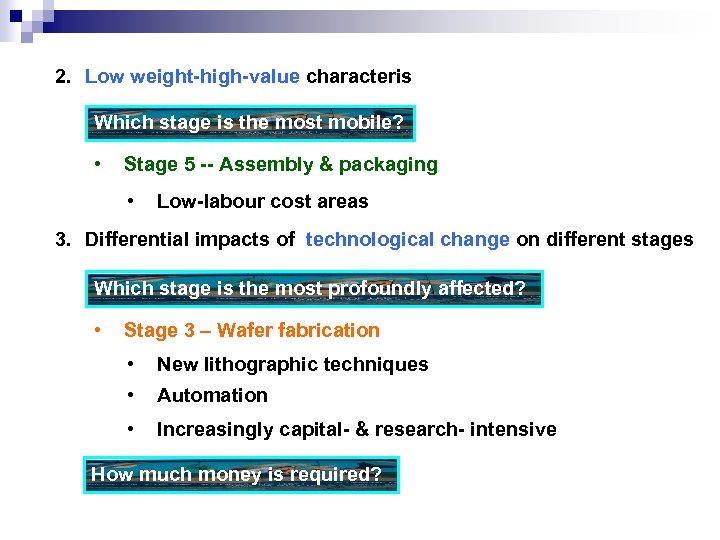 2. Low weight-high-value characteristics Which stage is the most mobile? • Stage 5 -- Assembly & packaging • Low-labour cost areas 3. Differential impacts of technological change on different stages Which stage is the most profoundly affected? • Stage 3 – Wafer fabrication • New lithographic techniques • Automation • Increasingly capital- & research- intensive How much money is required?
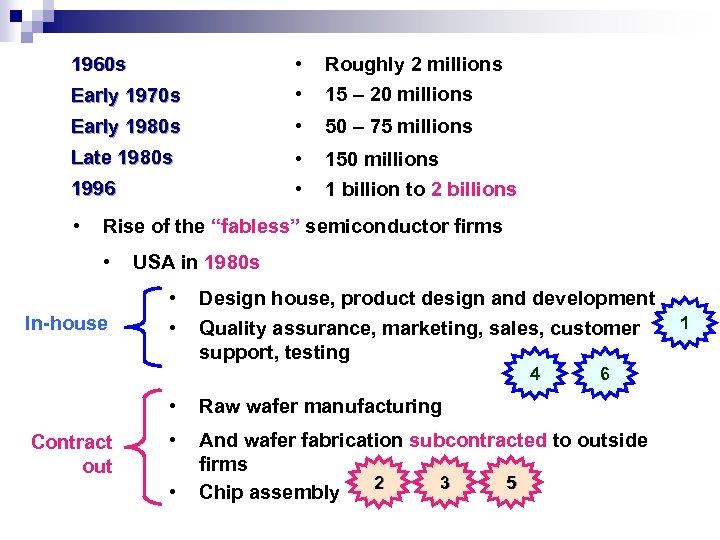 Roughly 2 millions Early 1970 s • • Early 1980 s • 50 – 75 millions Late 1980 s • • 150 millions 1 billion to 2 billions 1960 s 1996 • 15 – 20 millions Rise of the “fabless” semiconductor firms • In-house USA in 1980 s • • Design house, product design and development Quality assurance, marketing, sales, customer support, testing 4 6 • Contract out Raw wafer manufacturing • And wafer fabrication subcontracted to outside firms 2 3 5 Chip assembly • 1
 Conclusion • One of the many approaches • Industrial geography is always changing • Some major trends and characteristics • Information sharing vs teaching kit guides