 Скачать презентацию Information Technology and the Supply Chain Ombati Thomas
59d1927449d51ed8a94c6e03171ffb34.ppt
- Количество слайдов: 17



Information Technology and the Supply Chain Ombati Thomas 17 -1
Role of Information Technology in a Supply Chain u Information is the driver that serves as the “glue” to create a coordinated supply chain u Information must have the following characteristics to be useful: – Accurate – Accessible in a timely manner – Information must be of the right kind u Information provides the basis for supply chain management decisions – Inventory – Transportation – Facility 17 -2
Characteristics of Useful Supply Chain Information u. Accurate u. Accessible in a timely manner u. The right kind u. Provides supply chain visibility 17 -3
Use of Information in a Supply Chain u. Information used at all phases of decision making: strategic, planning, operational u. Examples: – Strategic: location decisions – Operational: what products will be produced during today’s production run 17 -4
Use of Information in a Supply Chain u. Inventory: demand patterns, carrying costs, stockout costs, ordering costs u. Transportation: costs, customer locations, shipment sizes u. Facility: location, capacity, schedules of a facility; need information about trade-offs between flexibility and efficiency, demand, exchange rates, taxes, etc. 17 -5
Role of Information Technology in a Supply Chain u. Information technology (IT) – Hardware and software used throughout the supply chain to gather and analyze information – Captures and delivers information needed to make good decisions u. Effective use of IT in the supply chain can have a significant impact on supply chain performance 17 -6
The Importance of Information in a Supply Chain u. Relevant information available throughout the supply chain allows managers to make decisions that take into account all stages of the supply chain u. Allows performance to be optimized for the entire supply chain, not just for one stage – leads to higher performance for each individual firm in the supply chain 17 -7
The Supply Chain IT Framework u. The Supply Chain Macro Processes – – – Customer Relationship Management (CRM) Internal Supply Chain Management (ISCM) Supplier Relationship Management (SRM) Plus: Transaction Management Foundation Figure 16. 1 u. Why Focus on the Macro Processes? u. Macro Processes Applied to the Evolution of Software 17 -8
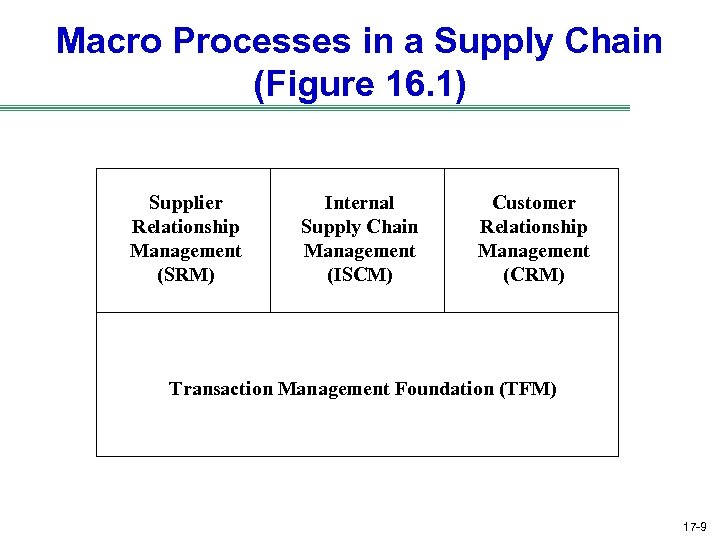
Macro Processes in a Supply Chain (Figure 16. 1) Supplier Relationship Management (SRM) Internal Supply Chain Management (ISCM) Customer Relationship Management (CRM) Transaction Management Foundation (TFM) 17 -9
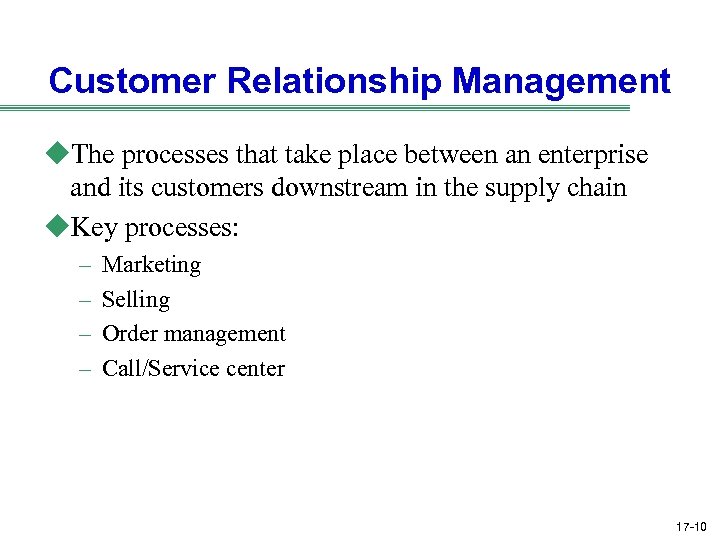
Customer Relationship Management u. The processes that take place between an enterprise and its customers downstream in the supply chain u. Key processes: – – Marketing Selling Order management Call/Service center 17 -10
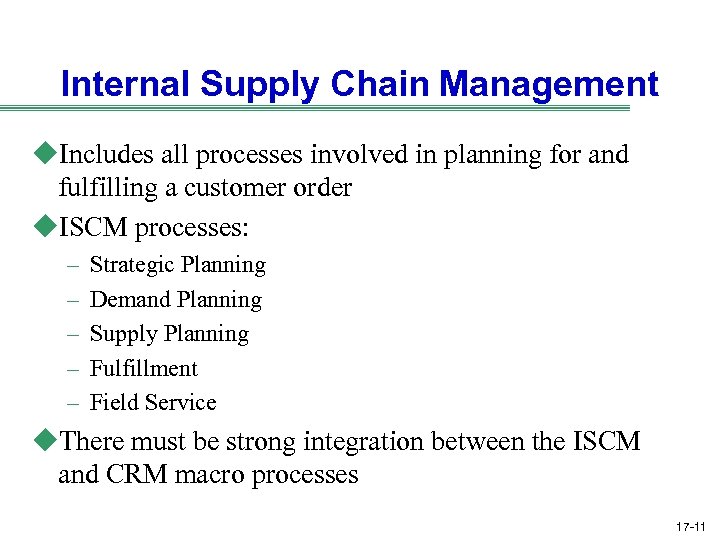
Internal Supply Chain Management u. Includes all processes involved in planning for and fulfilling a customer order u. ISCM processes: – – – Strategic Planning Demand Planning Supply Planning Fulfillment Field Service u. There must be strong integration between the ISCM and CRM macro processes 17 -11
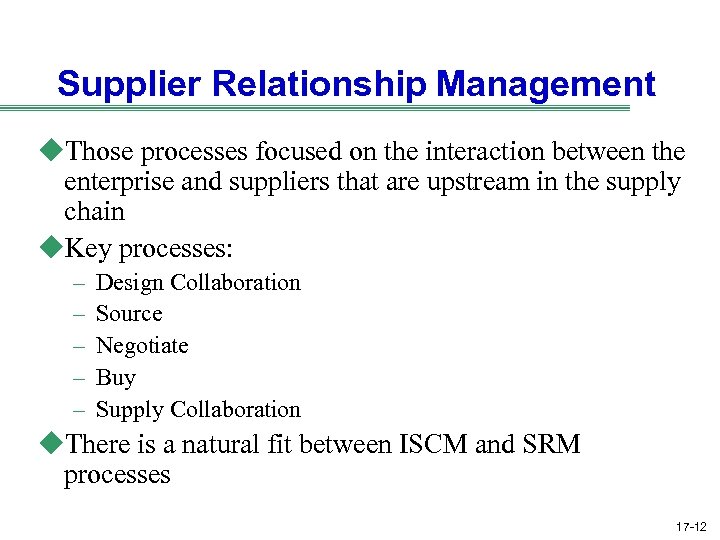
Supplier Relationship Management u. Those processes focused on the interaction between the enterprise and suppliers that are upstream in the supply chain u. Key processes: – – – Design Collaboration Source Negotiate Buy Supply Collaboration u. There is a natural fit between ISCM and SRM processes 17 -12
The Transaction Management Foundation u. Enterprise software systems (ERP) u. Earlier systems focused on automation of simple transactions and the creation of an integrated method of storing and viewing data across the enterprise u. Real value of the TMF exists only if decision making is improved u. The extent to which the TMF enables integration across the three macro processes determines its value 17 -13
The Future of IT in the Supply Chain u. At the highest level, the three SCM macro processes will continue to drive the evolution of enterprise software u. Software focused on the macro processes will become a larger share of the total enterprise software market and the firms producing this software will become more successful u. Functionality, the ability to integrate across macro processes, and the strength of their ecosystems, will be keys to success 17 -14
Supply Chain Information Technology in Practice u. Select an IT system that addresses the company’s key success factors u. Take incremental steps and measure value u. Align the level of sophistication with the need for sophistication u. Use IT systems to support decision making, not to make decisions u. Think about the future 17 -15
17 -16
Summary of Learning Objectives u. What is the importance of information and IT in the supply chain? u. How does each supply chain driver use information? u. What are the major applications of supply chain IT and what processes do they enable? 17 -17
Скачать презентацию Information Technology and the Supply Chain Ombati Thomas
59d1927449d51ed8a94c6e03171ffb34.ppt