


 Скачать презентацию Information Technology and Nursing Excellence The Catalyst to
29b926c7d6bb1d5ef53dd2401acd6bee.ppt
- Количество слайдов: 73
 Information Technology and Nursing Excellence: The Catalyst to a Successful Magnet Journey Carlene Anteau, MS, RN VP, Clinical Practice
 Agenda Information Technology and Nursing Excellence: The Catalyst to a Successful Magnet Journey 1. Overview of “Magnet” designation 2. The 14 forces and Information Technology 3. Case study: The University of Colorado Health System 2
 Mag’- net something that attracts Ø Merriam-Webster Dictionary a person, place or thing that other people feel strongly attracted to Ø Cambridge Dictionary Highest level of recognition that the ANCC can accord organized nursing services in the national and international health care communities Ø American Nurses Credentialing Corporation 3
 What Is Magnet Status? The Magnet Recognition Program® was developed by the American Nurses Credentialing Center (ANCC) Goal: To recognize health care organizations that provide the very best in nursing care and uphold the tradition within nursing of professional practice. http: //nursecredentialing. org/magnet/ Ø Ø Ø Standards that facilities must meet to obtain Magnet Status are called Forces of Magnetism Magnet research started in 1983 First Magnet hospital designated in 1994 Currently 238 Magnet hospitals (March 2007) Hospitals are called magnets because they attract and keep good nurses 4
 Objectives Of Magnet Program Ø Recognize nursing services that use Scope & Standards for Nursing Administration to build programs of nursing excellence for delivery of nursing care to patients Ø Promote quality milieu that support professional nursing practice Ø Provide vehicle for dissemination of successful nursing practices and strategies Ø Promote positive patient outcomes Ø Includes appraisal of both quantitative and qualitative factors in nursing Ø Provides consumers with benchmark to measure quality of care Ø Elevates the reputation and standards of nursing profession 5
 Evidence/Research indicates Magnet Facilities have: Ø Ø Ø Reduced Medicare mortality/morbidity rates Increased patient satisfaction Lower rates of burnout Reduced needle stick injury rates Improved nurse to patient ratios Higher educational preparation of the RN workforce Ø High levels of nurse autonomy and control over practice Ø Positive relationships with physicians Ø A powerful & influential CNO Ø Decreased likelihood nurses are dissatisfied 6
 Agenda Information Technology and Nursing Excellence: The Catalyst to a Successful Magnet Journey 1. Overview of “Magnet” designation 2. The 14 forces and Information Technology 3. Case study: The University of Colorado Health System 7
 Forces Of Magnetism 14 Areas Evaluated For Excellence 1. Quality of Leadership Knowledgeable, strong risk-taking leaders who follow an articulated philosophy in the day-to-day operations of the nursing department. Nursing leaders that convey a strong sense of advocacy and support on behalf of the staff. Regarding Information Technology: Ø Key Success Factor #1 - Unwavering project support from executive leadership Ø Key Success Factor #2 - Defined vision and goals with validation of achievement 8
 1: Quality of Leadership Key Success Factor #1 Unwavering project support from executive leadership Ø Executives emphasize that change is NOT optional Ø Leaders anticipate and plan for resistance to change Ø Leadership participation spans entire project Ø Multidisciplinary leaders advocate change—not an ‘IT project’ Through the Executive & IT unified front, clinicians knew that the system and its new processes were not optional. St. Luke’s Houston Trying to implement a clinical system without a clinical sponsor will cause repeated failure. Regional West 9
 1: Quality of Leadership Key Success Factor #2 Defined vision and goals with validation of achievement Ø Project Vision: a universal rallying point – Every decision, process change, and metric supports the goal Ø Project sponsor communicates vision effectively Ø Set expectations with managers and staff Ø Define measures of “success” according to stakeholders and communicate results Ø Utilize reports to identify issues with compliance Every time the team talks about quality and the safest way to care for patients, people get on the same page. St. Luke’s Houston As a result of the attention received by the utilization reports, 96% of all meds are being scanned (bar-code) today. St. Vincent’s 10
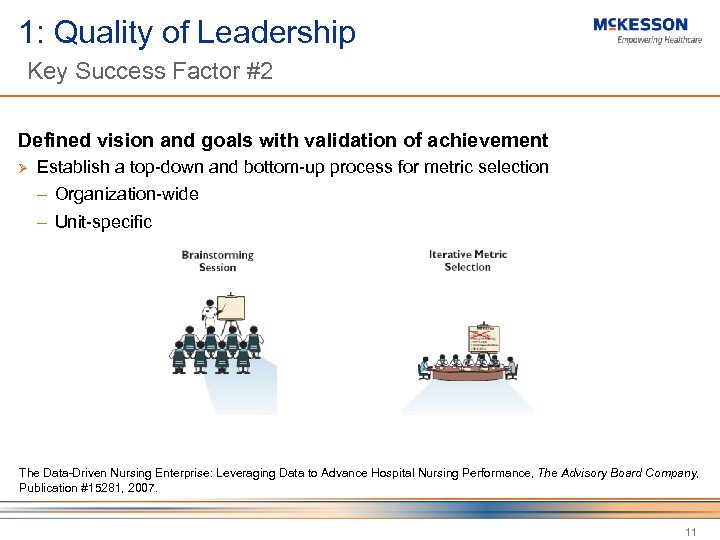 1: Quality of Leadership Key Success Factor #2 Defined vision and goals with validation of achievement Ø Establish a top-down and bottom-up process for metric selection – Organization-wide – Unit-specific The Data-Driven Nursing Enterprise: Leveraging Data to Advance Hospital Nursing Performance, The Advisory Board Company, Publication #15281, 2007. 11
 Forces Of Magnetism 14 Areas Evaluated For Excellence 2. Organizational Structure Organizational structures are generally flat, rather than tall, and unit-based decision making prevails. Strong nursing representation is evident in the organizational committee structure. Executive level nursing leaders serve at the executive level of the organization. Regarding Information Technology: Involvement spans entire project Ø IT selection process ä Educated Nurse Consumers Ø Creating “future-state” workflow with IT implementation Ø Key success factor #3: Strategic preparation, roll-out and follow-up support Ø Continuous improvement and quality monitoring 12
 2: Organizational Structure IT Selection Process An “organization” approach Ø What does the organization want to accomplish by implementing a system? – Strategic goals? – Quality goals? – Capacity and throughput goals? – Safety goals? – Continuity of care goals? Ø How do departmental system fit into the “bigger picture”? Ø How large is the current IT investment, and how much needs to be preserved? Ø What is “possible” today regarding interfaces / sharing of information between disparate systems? Ø What role will budget play in the selection? Ø Who will make the final decision? 13
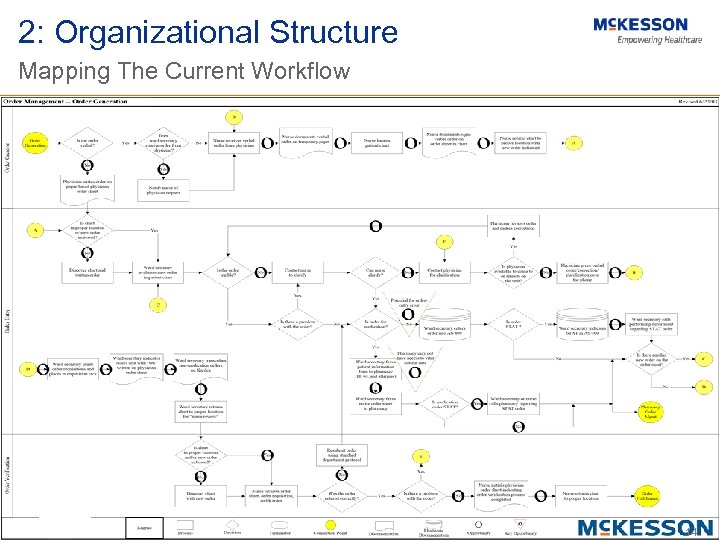 2: Organizational Structure Mapping The Current Workflow X 14
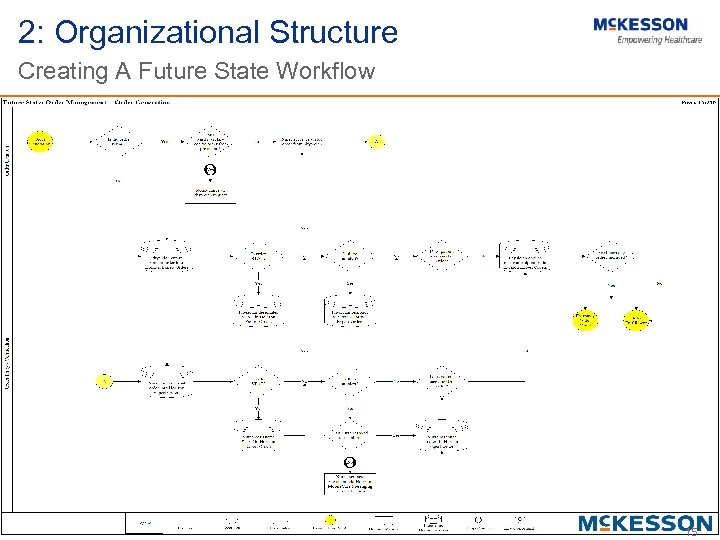 2: Organizational Structure Creating A Future State Workflow x x 15
 2: Organizational Structure Key Success Factor #3 Strategic preparation, roll-out and follow-up support Ø Preparation – Ensure comfort with system and processes through shadow system usage Ø Roll-out – Start with supporting units, end with the tough sell – Sequence similar units together Ø Follow-up – Offer full, co-located support for at least 1 week after go-live (consider staffing patterns) – Reinforce classroom training with on-the-job mentoring Roll-outs started in the unit with the strongest nursing advocate, went to similar units next and ended in ICU. St. Vincent It’s important that users know that they will not be left hanging without support after go-live. Providence 16
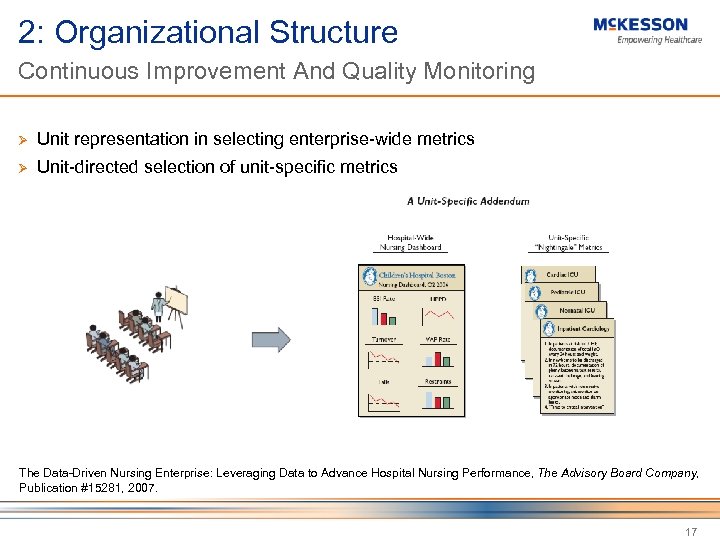 2: Organizational Structure Continuous Improvement And Quality Monitoring Ø Unit representation in selecting enterprise-wide metrics Ø Unit-directed selection of unit-specific metrics The Data-Driven Nursing Enterprise: Leveraging Data to Advance Hospital Nursing Performance, The Advisory Board Company, Publication #15281, 2007. 17
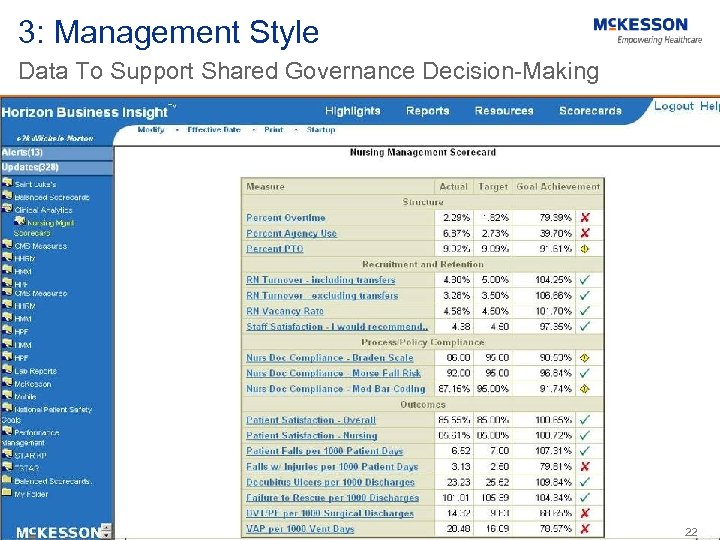
 Forces Of Magnetism 14 Areas Evaluated For Excellence 3. Management Style Hospital and nursing administrators use a participative management style, incorporating feedback from the staff at all levels of the organization. Feedback is encouraged and valued. Nursing leaders are visible, accessible, and communicate effectively with staff. Regarding Information Technology: Ø Key Success Factor #4 – Strong clinical representation Ø Key Success Factor #5 – Willingness to examine processes Ø Data to support shared governance committee decision-making on practice, management, quality, and education Ø Acuity-driven staffing 18
 3: Management Style Key Success Factor #4 Strong Clinical Representation Ø Involve physicians, nurses, pharmacists and ancillaries in the implementation process – Informal unit leaders are key participants Ø Clinicians define “what the users want” – Creatively tailor the system – Foster support in their departments Ø Demonstrate the system’s value through reporting Critical Care focus groups determined the customization of the system. This won over Critical Care. St. Dominic The team was willing to equally address everyone’s needs, whether they were ancillary, nurse or physician. Regional West Reports are the ‘carrot’ to solidify nurse manager acceptance of the system. Covenant 19
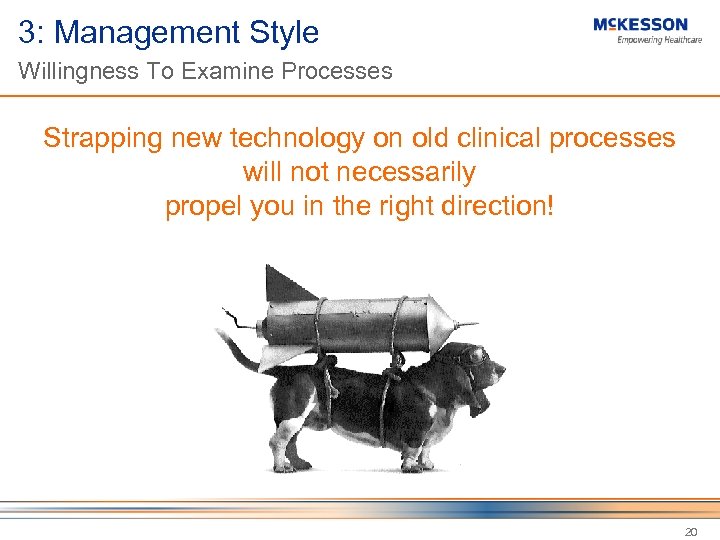 3: Management Style Willingness To Examine Processes Strapping new technology on old clinical processes will not necessarily propel you in the right direction! 20
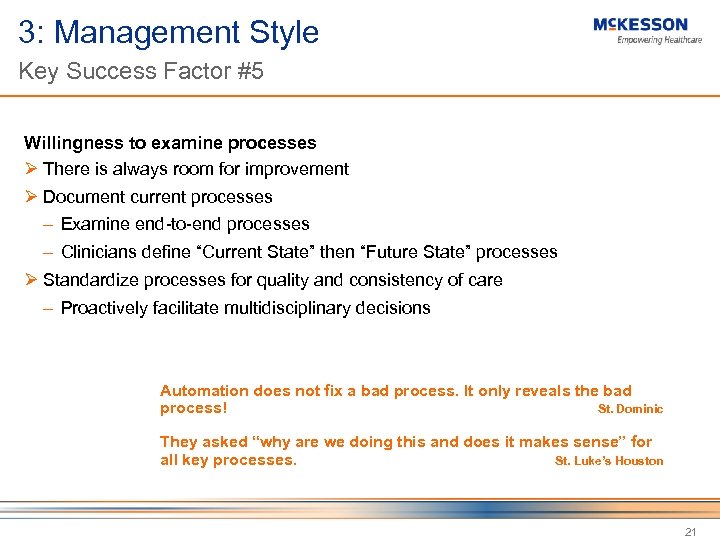 3: Management Style Key Success Factor #5 Willingness to examine processes Ø There is always room for improvement Ø Document current processes – Examine end-to-end processes – Clinicians define “Current State” then “Future State” processes Ø Standardize processes for quality and consistency of care – Proactively facilitate multidisciplinary decisions Automation does not fix a bad process. It only reveals the bad process! St. Dominic They asked “why are we doing this and does it makes sense” for all key processes. St. Luke’s Houston 21
 3: Management Style Data To Support Shared Governance Decision-Making 22
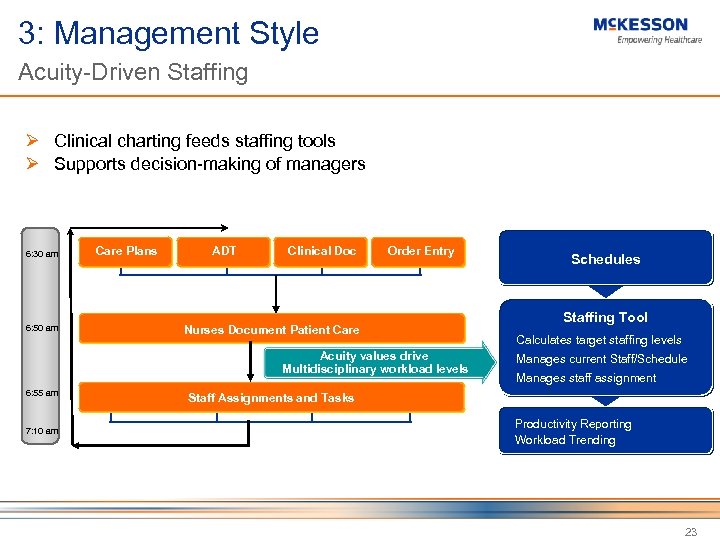 3: Management Style Acuity-Driven Staffing Ø Clinical charting feeds staffing tools Ø Supports decision-making of managers 6: 30 am 6: 50 am Care Plans ADT Clinical Doc Order Entry Nurses Document Patient Care Acuity values drive Multidisciplinary workload levels 6: 55 am 7: 10 am Schedules Staffing Tool Calculates target staffing levels Manages current Staff/Schedule Manages staff assignment Staff Assignments and Tasks Productivity Reporting Workload Trending 23
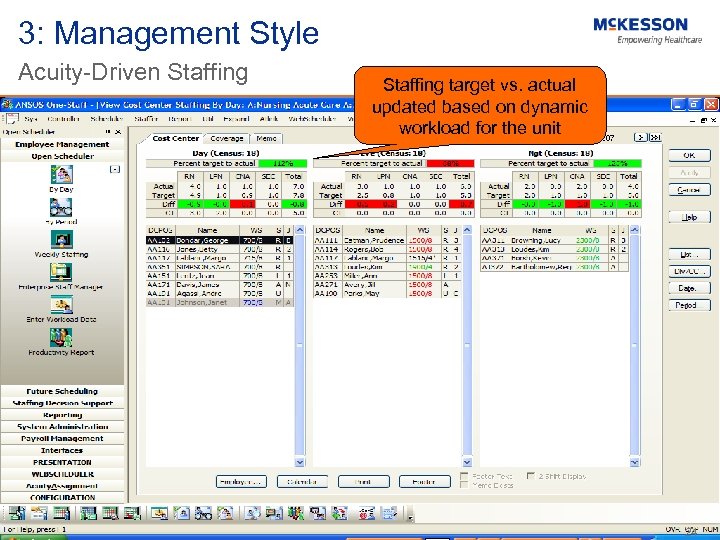 3: Management Style Acuity-Driven Staffing target vs. actual updated based on dynamic workload for the unit 24
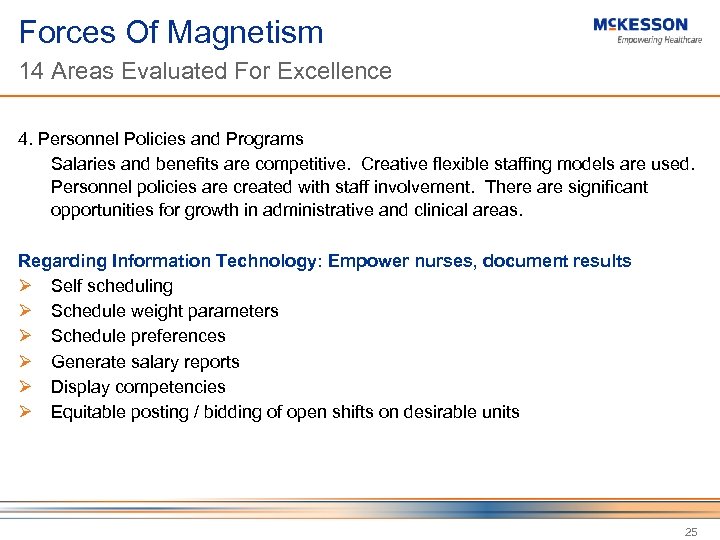 Forces Of Magnetism 14 Areas Evaluated For Excellence 4. Personnel Policies and Programs Salaries and benefits are competitive. Creative flexible staffing models are used. Personnel policies are created with staff involvement. There are significant opportunities for growth in administrative and clinical areas. Regarding Information Technology: Empower nurses, document results Ø Self scheduling Ø Schedule weight parameters Ø Schedule preferences Ø Generate salary reports Ø Display competencies Ø Equitable posting / bidding of open shifts on desirable units 25
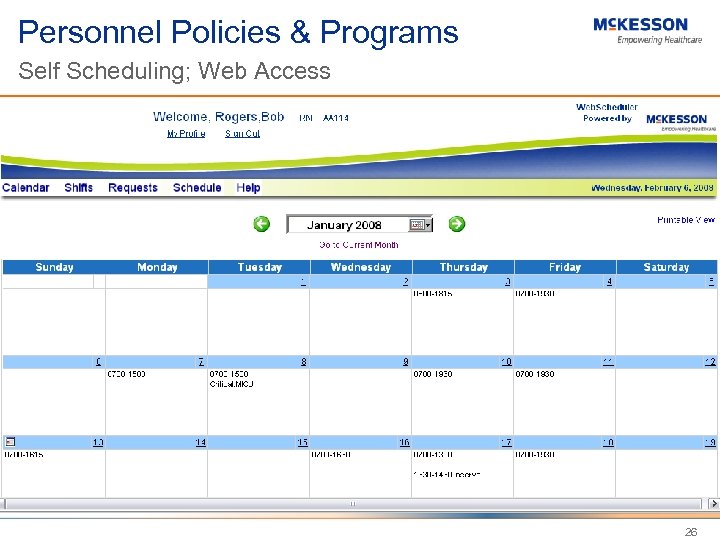 Personnel Policies & Programs Self Scheduling; Web Access 26
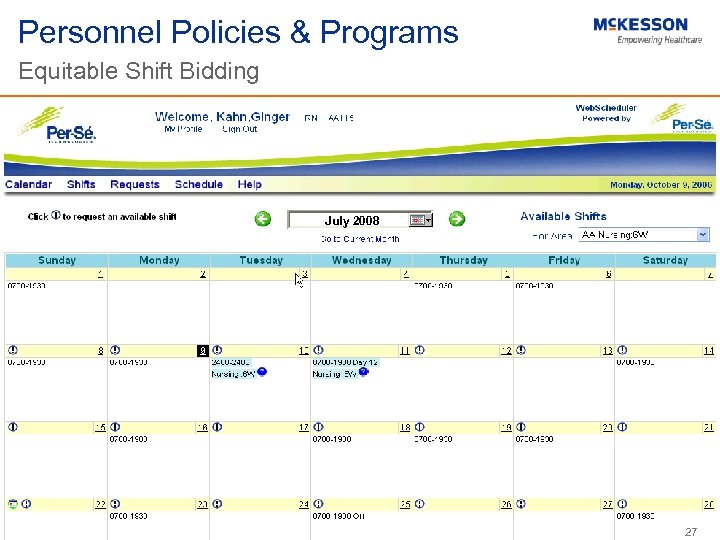 Personnel Policies & Programs Equitable Shift Bidding July 2008 27
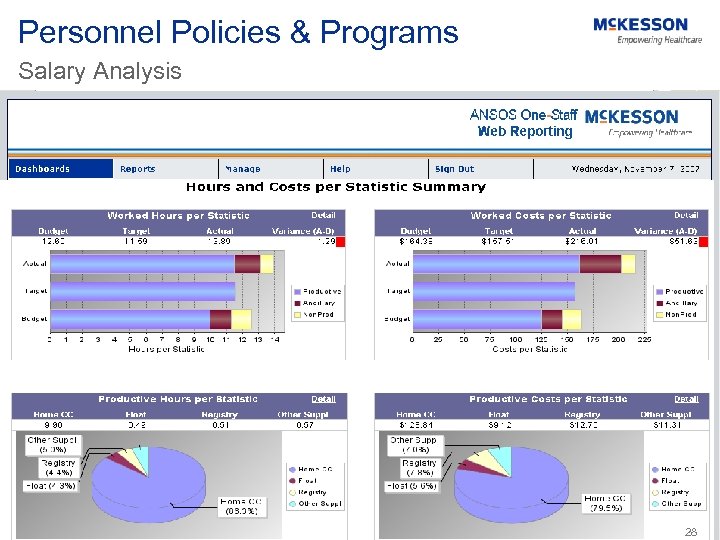 Personnel Policies & Programs Salary Analysis 28
 Forces Of Magnetism 14 Areas Evaluated For Excellence 5. Professional Models of Care Models of care that give nurses the responsibility and authority for the provision of direct nursing care. Nurses are accountable for their own practice as well as the coordination of care. Regarding Information Technology: Ø Incorporate model of care into documentation – Structure – Terminology – Decision support Ø Interdisciplinary documentation and coordination of plan of care 29
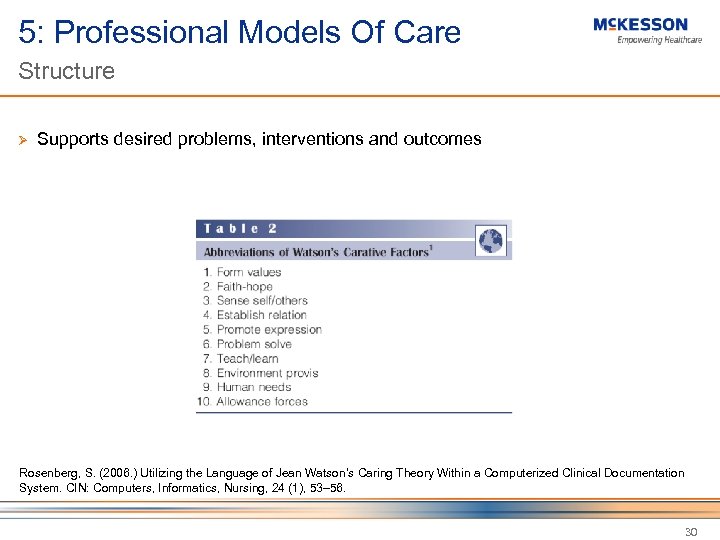 5: Professional Models Of Care Structure Ø Supports desired problems, interventions and outcomes Rosenberg, S. (2006. ) Utilizing the Language of Jean Watson’s Caring Theory Within a Computerized Clinical Documentation System. CIN: Computers, Informatics, Nursing, 24 (1), 53– 56. 30
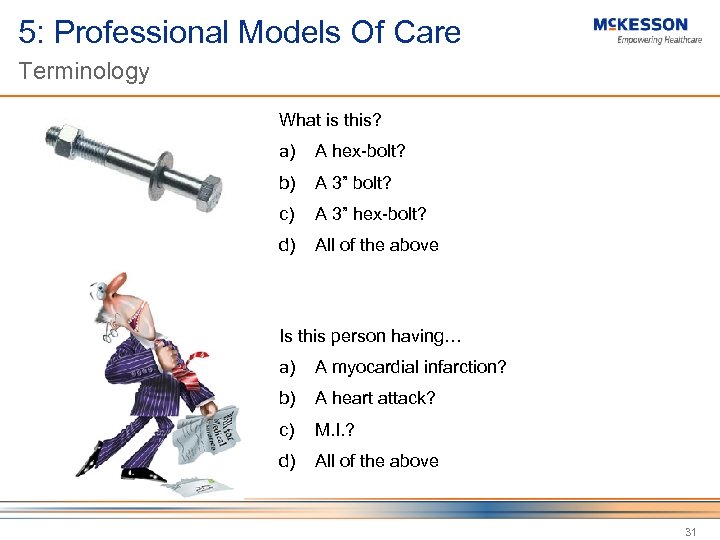 5: Professional Models Of Care Terminology What is this? a) A hex-bolt? b) A 3” bolt? c) A 3” hex-bolt? d) All of the above Is this person having… a) A myocardial infarction? b) A heart attack? c) M. I. ? d) All of the above 31
 5: Professional Models Of Care Terminology Systematized Nomenclature of Medicine Clinical Terms® (SNOMED CT) Ø A clinical terminology covering diseases, clinical findings, and procedures Ø Allows for a consistent way of indexing, storing, retrieving and aggregating clinical data across specialties of care Ø Helps to structure and computerize the medical record, reducing the variability in the way data is captured, encoded and used for clinical care of patients and research 32
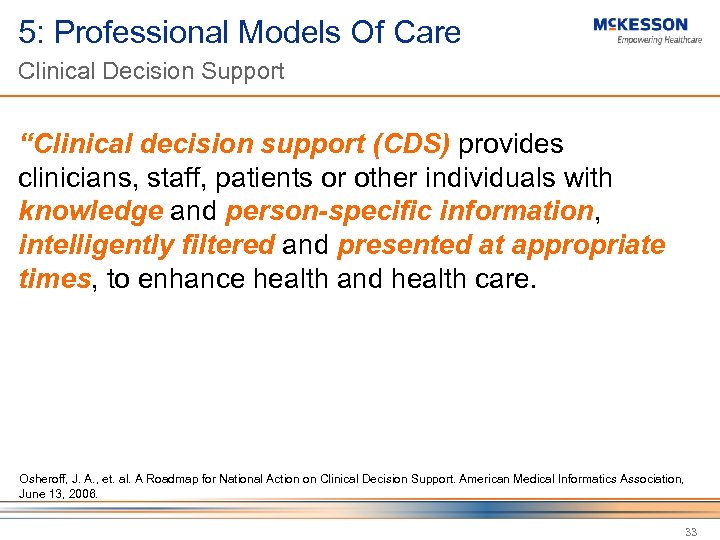 5: Professional Models Of Care Clinical Decision Support “Clinical decision support (CDS) provides clinicians, staff, patients or other individuals with knowledge and person-specific information, intelligently filtered and presented at appropriate times, to enhance health and health care. Osheroff, J. A. , et. al. A Roadmap for National Action on Clinical Decision Support. American Medical Informatics Association, June 13, 2006. 33
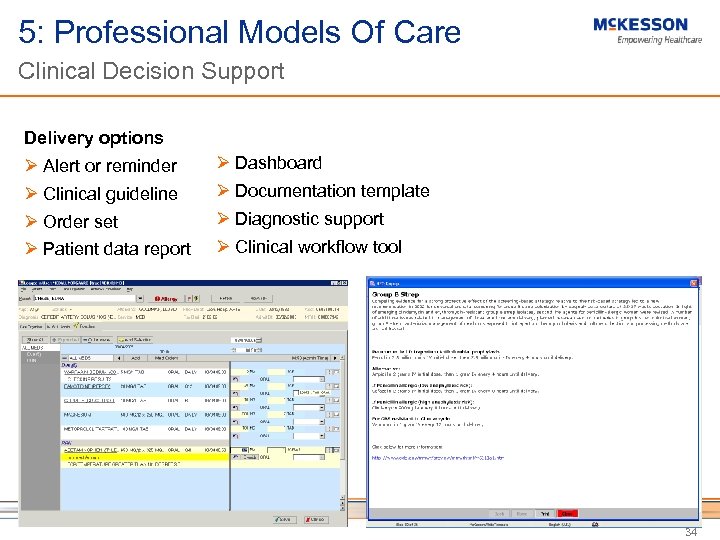 5: Professional Models Of Care Clinical Decision Support Delivery options Ø Alert or reminder Ø Dashboard Ø Clinical guideline Ø Documentation template Ø Order set Ø Diagnostic support Ø Patient data report Ø Clinical workflow tool 34
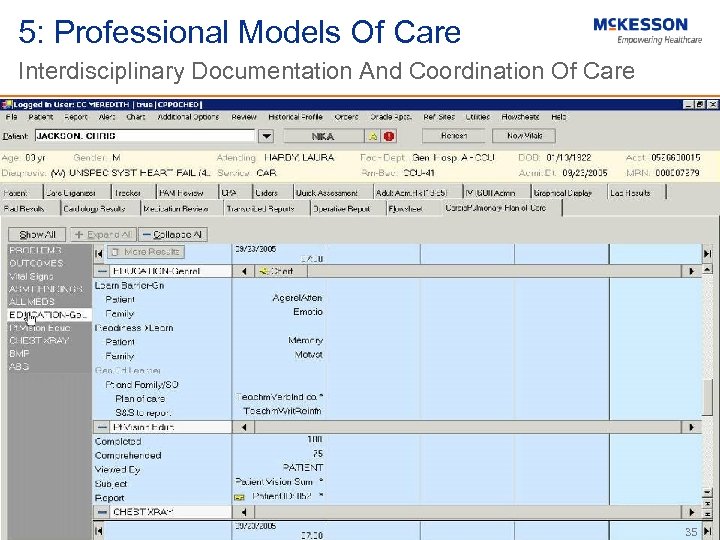 5: Professional Models Of Care Interdisciplinary Documentation And Coordination Of Care 35
 Forces Of Magnetism 14 Areas Evaluated For Excellence 6. Quality of Care and Services Providing quality care is an organizational priority. Nurses serving in leadership positions are seen as responsible for developing the environment in which highquality care can be provided. There is a perception among nurses that they provide high quality care to patients. Regarding Information Technology: Support the CQI Process 36
 6: Quality Of Care And Services What Are Your Metrics For Success? Ø How do you measure the success of your Clinical IT system? Ø Can you quantify the improvements you have made in patient care from these reports in terms of outcomes, cost or reimbursement? Ø How do you know when undesirable patterns of trends in performance have been identified? Ø How do you track improvement in outcomes and processes once a new initiative is in place? Ø Do you find you have too much data, making meaningful actionable data hard to find? Ø How do you know you’ve improved workflow? 37
 Forces Of Magnetism 14 Areas Evaluated For Excellence 7. Quality Improvement A process that improves the quality of care delivered within the organization is in place. Staff nurses believe that quality improvement improves patient care and they are involved in the development of the plan. Regarding Information Technology: Transparency drives quality and service Ø Multiple reporting tools to address a variety of workflows and user needs Ø Drive the CQI process with information 38
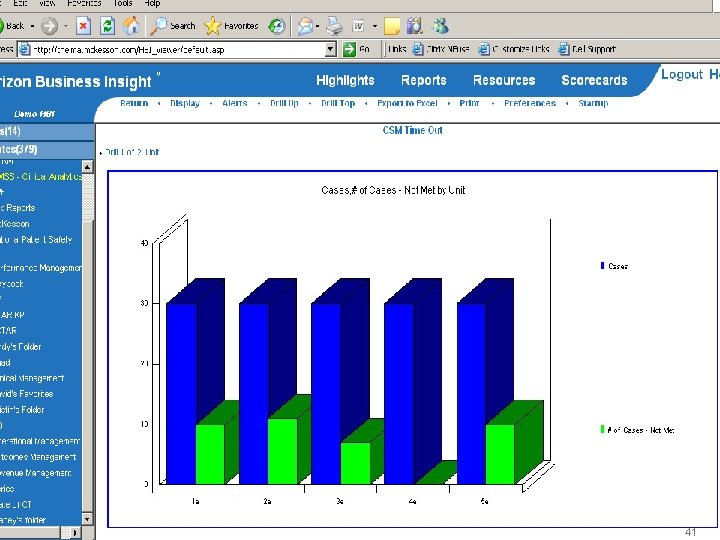
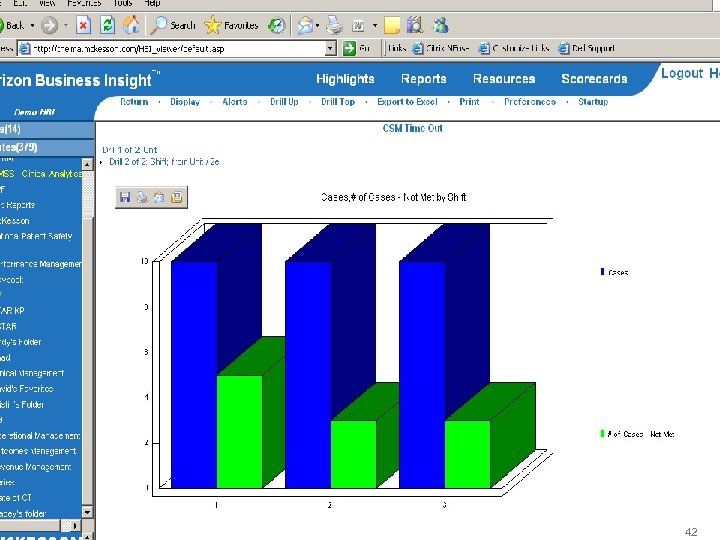
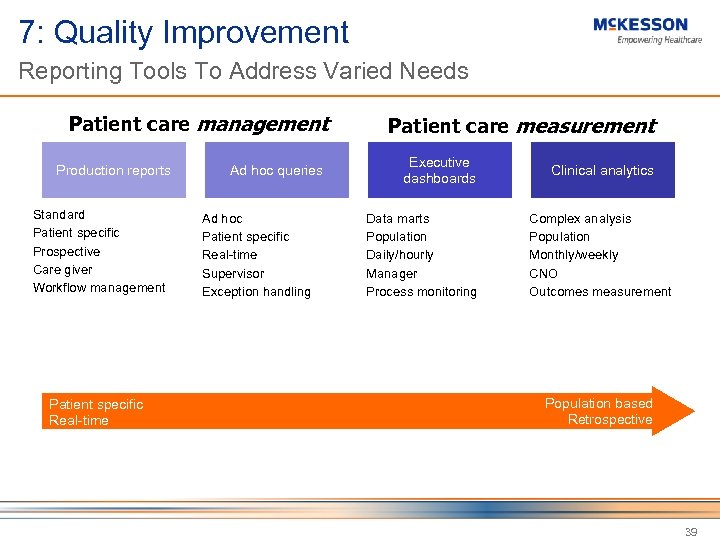 7: Quality Improvement Reporting Tools To Address Varied Needs Patient care management Production reports Standard Patient specific Prospective Care giver Workflow management Patient specific Real-time Ad hoc queries Ad hoc Patient specific Real-time Supervisor Exception handling Patient care measurement Executive dashboards Data marts Population Daily/hourly Manager Process monitoring Clinical analytics Complex analysis Population Monthly/weekly CNO Outcomes measurement Population based Retrospective 39
 40
40
 41
41
 42
42
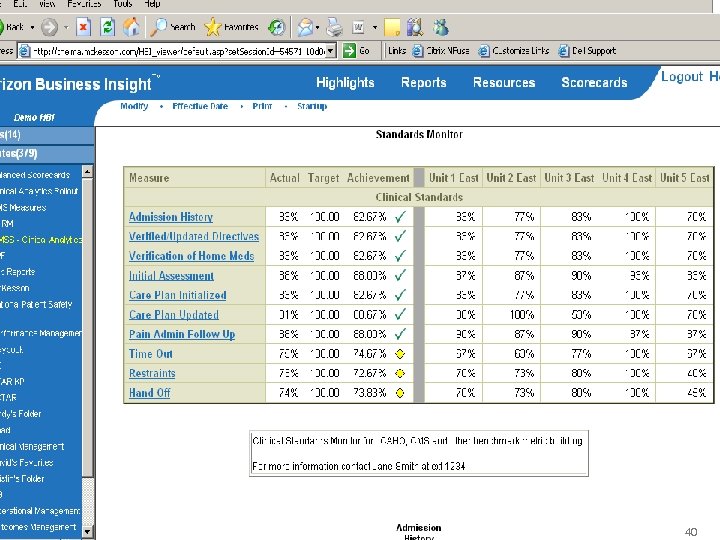
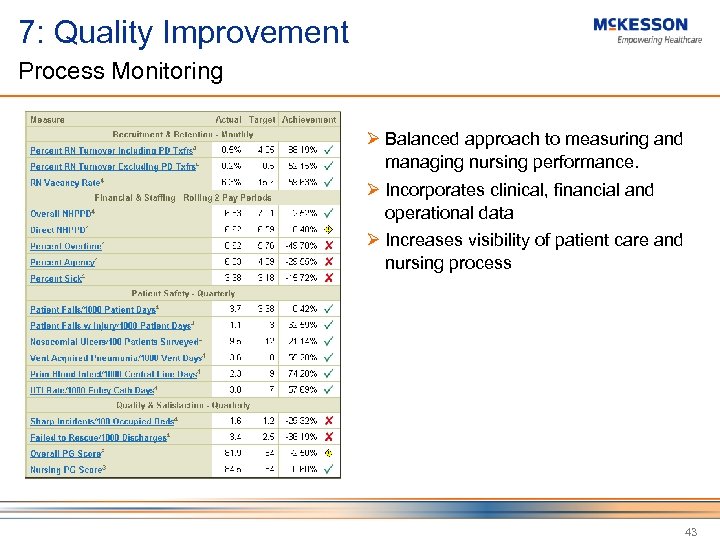 7: Quality Improvement Process Monitoring Ø Balanced approach to measuring and managing nursing performance. Ø Incorporates clinical, financial and operational data Ø Increases visibility of patient care and nursing process 43
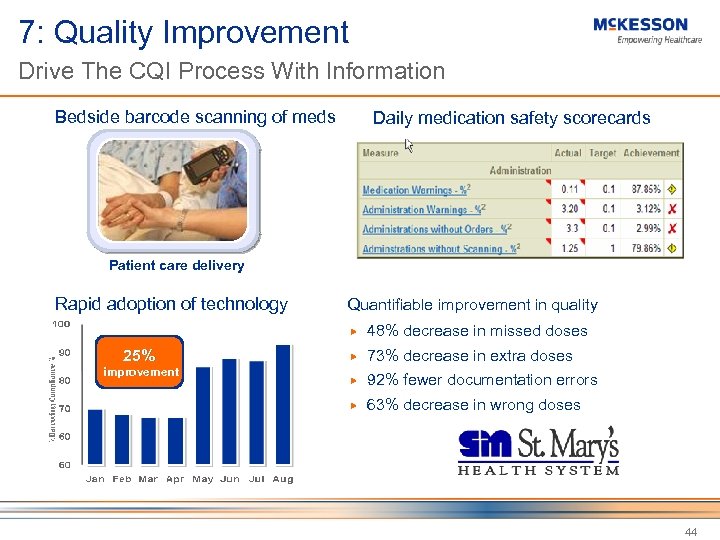 7: Quality Improvement Drive The CQI Process With Information Bedside barcode scanning of meds Daily medication safety scorecards Patient care delivery Rapid adoption of technology Quantifiable improvement in quality 25% improvement 48% decrease in missed doses 73% decrease in extra doses 92% fewer documentation errors 63% decrease in wrong doses 44
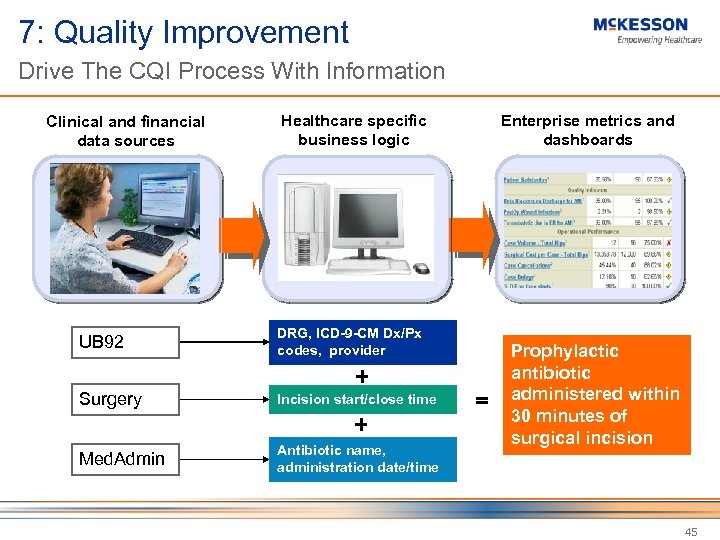 7: Quality Improvement Drive The CQI Process With Information Clinical and financial data sources UB 92 Healthcare specific business logic DRG, ICD-9 -CM Dx/Px codes, provider + Surgery Incision start/close time + Med. Admin Enterprise metrics and dashboards Antibiotic name, administration date/time = Prophylactic antibiotic administered within 30 minutes of surgical incision 45
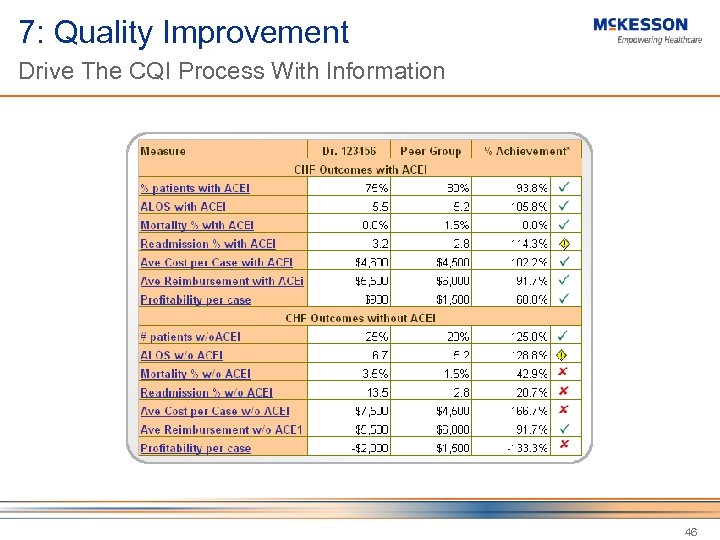 7: Quality Improvement Drive The CQI Process With Information 46
 Forces Of Magnetism 14 Areas Evaluated For Excellence 8. Consultation and Resources There is an availability of knowledgeable experts, particularly of advanced practice nurses, for peer support and consultation within and outside the nursing division. Regarding Information Technology: Document availability of resources Ø Generate reports, monitor trends Ø On-line access to resources 47
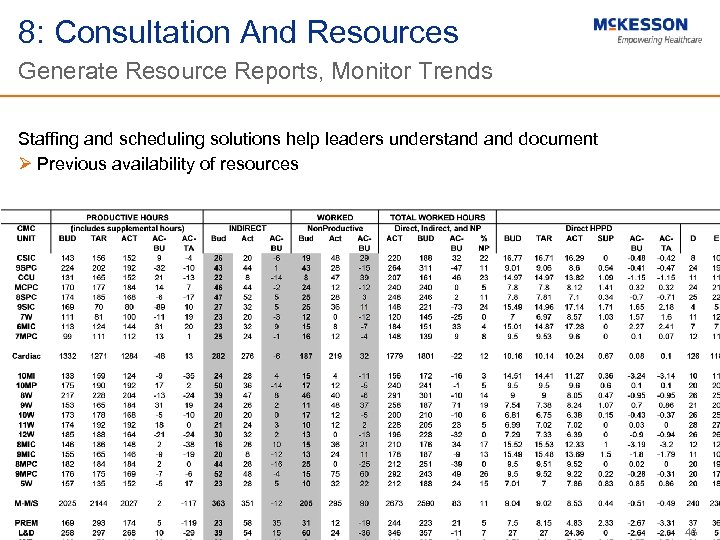 8: Consultation And Resources Generate Resource Reports, Monitor Trends Staffing and scheduling solutions help leaders understand document Ø Previous availability of resources 48
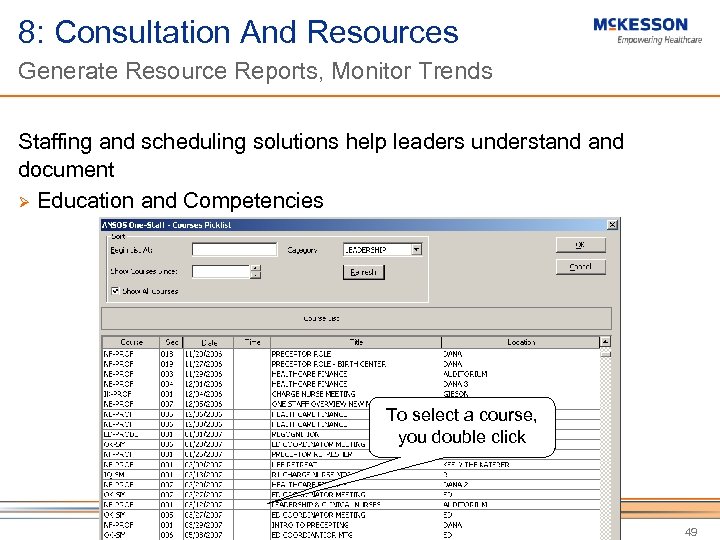 8: Consultation And Resources Generate Resource Reports, Monitor Trends Staffing and scheduling solutions help leaders understand document Ø Education and Competencies To select a course, you double click 49
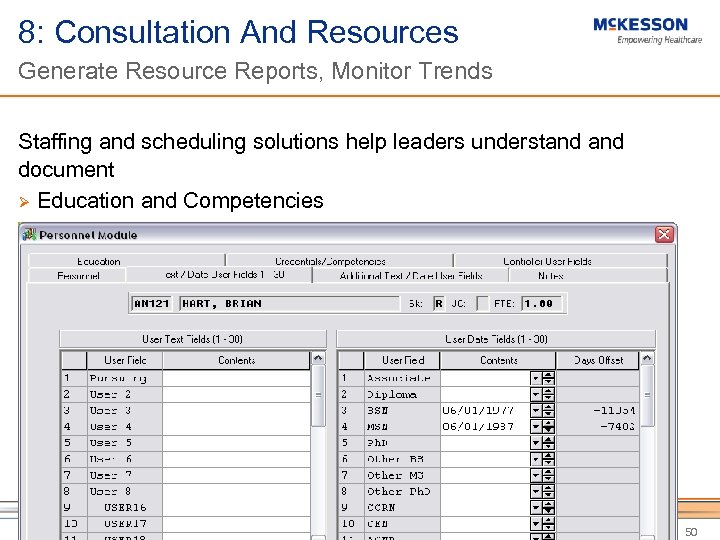 8: Consultation And Resources Generate Resource Reports, Monitor Trends Staffing and scheduling solutions help leaders understand document Ø Education and Competencies 50
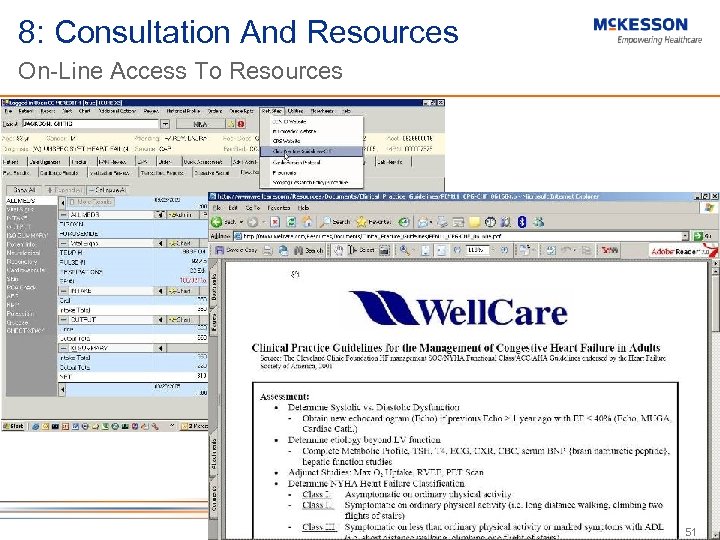 8: Consultation And Resources On-Line Access To Resources 51
 Forces Of Magnetism 14 Areas Evaluated For Excellence 9. Autonomy The nurse is permitted and expected to practice autonomously, consistent with professional standards. Independent judgment is expected to be exercised within the context of multidisciplinary approach to patient care. Regarding Information Technology: Ø Decision support (as described in force #5) 52
 Forces Of Magnetism 14 Areas Evaluated For Excellence 10. Community and the Institution Community presence is often established through ongoing long-term outreach programs resulting in the hospital being perceived as a strong, positive, and productive corporate citizens. Regarding Information Technology: Ø Inpatient – Involving patients in their care Ø Outpatient – Web-based access to clinicians, personal health record 53
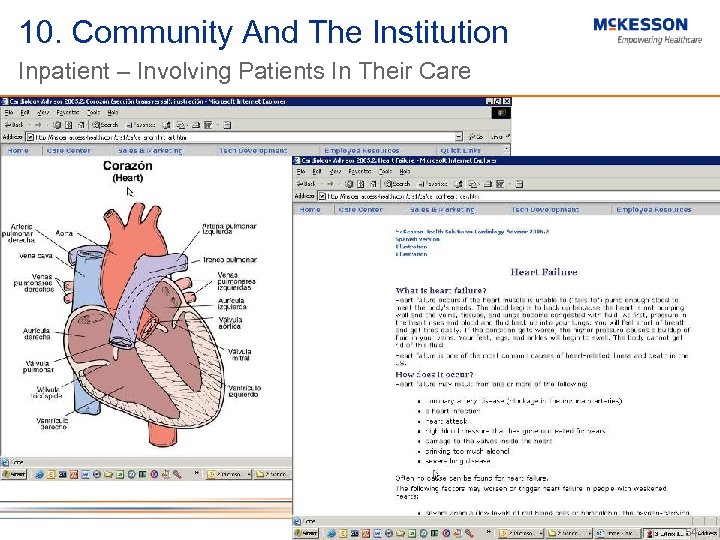 10. Community And The Institution Inpatient – Involving Patients In Their Care 54
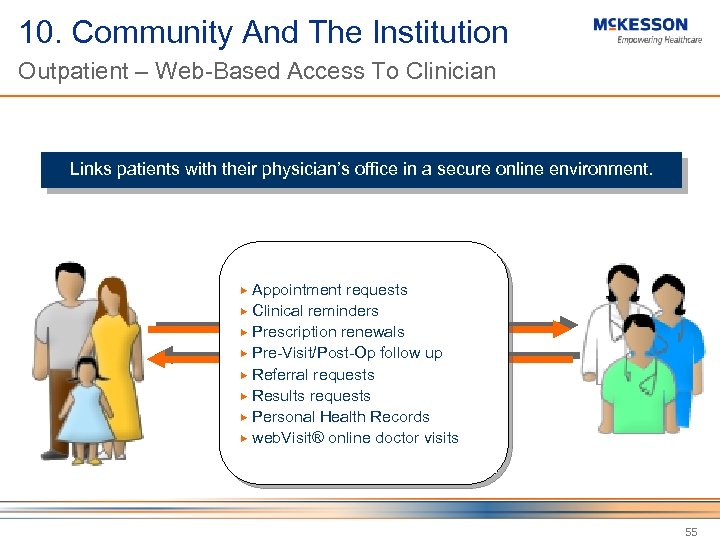 10. Community And The Institution Outpatient – Web-Based Access To Clinician Links patients with their physician’s office in a secure online environment. Appointment requests Clinical reminders Prescription renewals Pre-Visit/Post-Op follow up Referral requests Results requests Personal Health Records web. Visit® online doctor visits 55
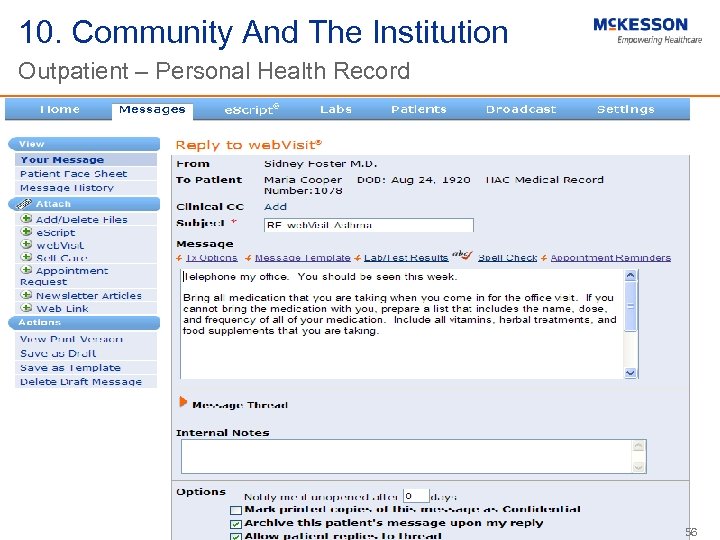 10. Community And The Institution Outpatient – Personal Health Record 56
 Forces Of Magnetism 14 Areas Evaluated For Excellence 11. Staff as Teachers Nurses are permitted and expected to incorporate teaching in all aspects of their practice. Regarding Information Technology: Ø Interdisciplinary coordination of care and education (as described in force #5) Ø Access to education tools (as described in force #10) 57
 Forces Of Magnetism 14 Areas Evaluated For Excellence 12. Image of Nursing and Staff Services provided by nurses are characterized as essential by other members of the health care team. Nurses are viewed as an integral part of the hospital’s ability to provide patient care. Regarding Information Technology: Ø Clinical decision support Ø Ensure that clinicians are trained on a script to educate patients regarding information technology 58
 Forces Of Magnetism 14 Areas Evaluated For Excellence 13. Interdisciplinary Relations A sense of mutual respect among all disciplines results in positive interdisciplinary relationships. Regarding Information Technology: Ø Interdisciplinary coordination of care (as described in force #5) 59
 Forces Of Magnetism 14 Areas Evaluated For Excellence 14. Professional Development Value is placed on personal and professional growth and development. Emphasis is placed on orientation, in-service education, continuing education, and career development. There are opportunities for competency based clinical advancement along with resources to maintain competency. Regarding Information Technology: Ø Degree, certification and competency tracking (as described in force #8) 60
 Agenda Information Technology and Nursing Excellence: The Catalyst to a Successful Magnet Journey 1. Overview of “Magnet” designation 2. The 14 forces and Information Technology 3. Case study: The University of Colorado Hospital 61
 University Of Colorado Hospital Denver 120 Beds at Anschutz Medical Campus 62
 University of Colorado Hospital Demographics Ø 400 bed facility Ø Academic teaching hospital for Rocky Mountain region Ø Magnet Hospital designation since 2002, re-designated in 2005 Ø Nursing at UCH – Evidence serves as basis for UCH nursing practice – All RNs must meet annual research competencies 63
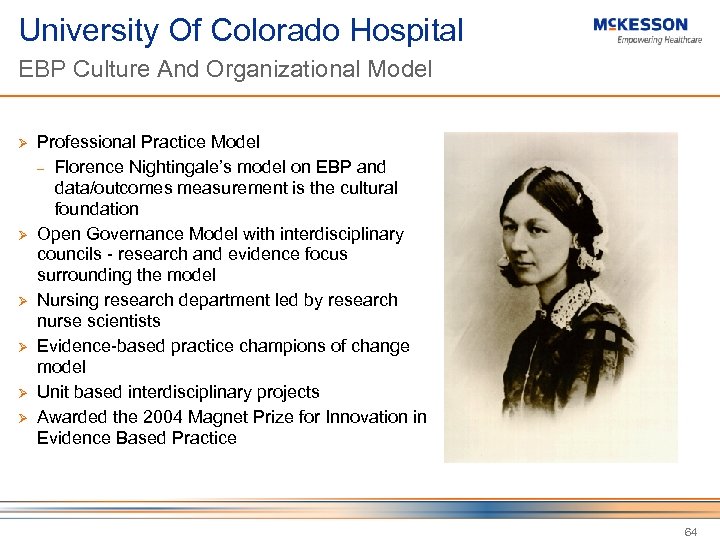 University Of Colorado Hospital EBP Culture And Organizational Model Ø Ø Ø Professional Practice Model – Florence Nightingale’s model on EBP and data/outcomes measurement is the cultural foundation Open Governance Model with interdisciplinary councils - research and evidence focus surrounding the model Nursing research department led by research nurse scientists Evidence-based practice champions of change model Unit based interdisciplinary projects Awarded the 2004 Magnet Prize for Innovation in Evidence Based Practice 64
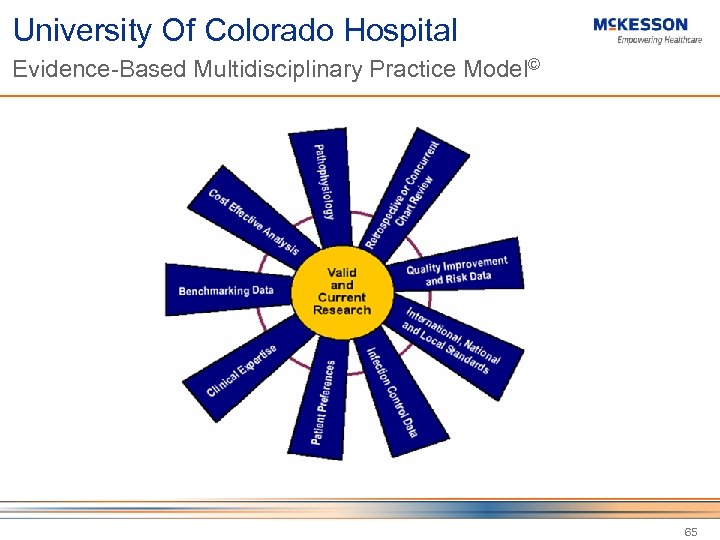 University Of Colorado Hospital Evidence-Based Multidisciplinary Practice Model© 65
 University Of Colorado Hospital The Role Of IT In The Magnet Journey “A big proportion of health care is ‘nursing care’. IT gives nurses the opportunity to document the interventions they do for patients and families and to determine their effectiveness. ” “Our computerized documentation system was key in helping us to meet the Magnet standards for ‘Quality of Care’ and ‘Quality Improvement’. The Magnet appraisers could clearly visualize how our evidence based practice protocols were integrated into our documentation and they understood how we could track the effectiveness of these interventions. ” “We could not have demonstrated this without our IT systems and reporting. ” Colleen J. Goode, RN, Ph. D, FAAN Vice President Patient Services & Chief Nursing Officer University of Colorado Hospital Authority 66
 University Of Colorado Hospital The Role Of IT In The Magnet Journey Use of Standard Terms: Pressure Ulcer Prevalence Ø Was skin compromised on admission or hospital acquired? − NANDA: Skin Integrity, Risk for Impaired − NOC: Tissue Integrity, Skin & Mucous Membranes − NIC: Skin Surveillance § Braden Risk Assessment − NIC: Pressure Ulcer Care § Ulcer staged q 12 hr § Evidence– based treatment 67
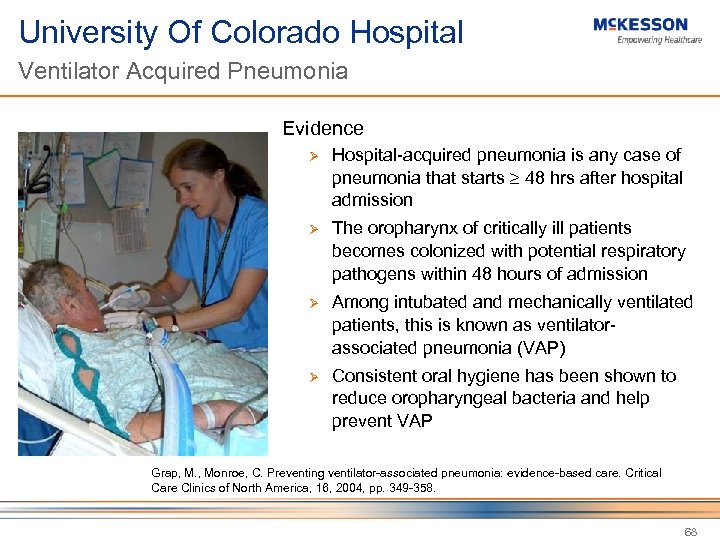 University Of Colorado Hospital Ventilator Acquired Pneumonia Evidence Ø Hospital-acquired pneumonia is any case of pneumonia that starts 48 hrs after hospital admission Ø The oropharynx of critically ill patients becomes colonized with potential respiratory pathogens within 48 hours of admission Ø Among intubated and mechanically ventilated patients, this is known as ventilatorassociated pneumonia (VAP) Ø Consistent oral hygiene has been shown to reduce oropharyngeal bacteria and help prevent VAP Grap, M. , Monroe, C. Preventing ventilator-associated pneumonia: evidence-based care. Critical Care Clinics of North America, 16, 2004, pp. 349 -358. 68
 University Of Colorado Hospital Ventilator Acquired Pneumonia Protocol Implementation Ø Competency training of all staff, RNs and CNAs/NITs for oral health promotion Ø Implementation of unit protocol − Oral care every 4 hours − Use of a toothbrush − Thorough suctioning of oral secretions − HOB >30 Degrees − Embedded Evidence Based Protocols into documentation tools § Able to track outcomes related to EBP using protocols and standard terminology 69
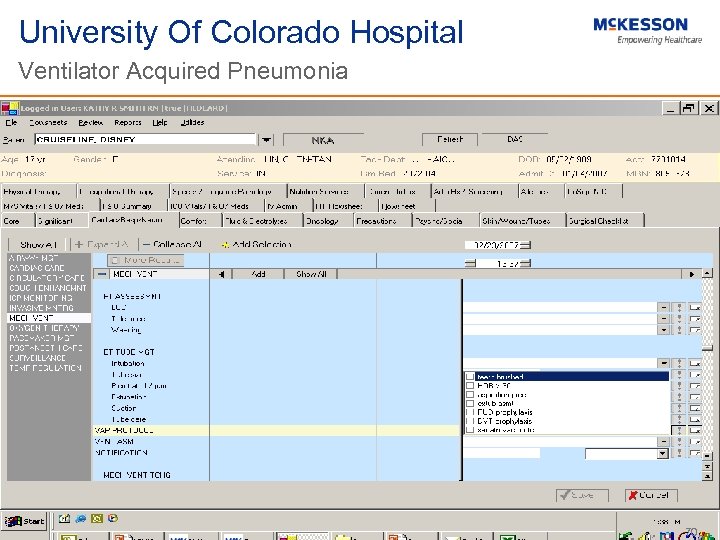 University Of Colorado Hospital Ventilator Acquired Pneumonia 70
 University Of Colorado Hospital EBP Projects Ø Artificial Nails Ø Skin Care Ø Hand Hygiene Ø Vascular Access Management Ø Male Catheterization Ø Pain Assessment and Management Ø Flushing Intermittent Infusion Devices: Neonatal ICU Ø Alcohol Withdrawal Management Ø Ventilator-Associated Pneumonia Ø Ventilator Circuit Change Ø Treatment of Acute Cystitis Ø Protocol for Hyperglycemia Ø Fall Prevention Ø Ventilator Sedation Management Ø Failure to Rescue Ø Rapid Response Team 71
 University Of Colorado Hospital Magnet Outcomes UCH benchmark is to be above the mean for NDNQI* database of hospitals on all measures Continuous monitoring and evaluation during and after Magnet Designation Ø Increase in RN job satisfaction Ø Increase in patient satisfaction Ø Decrease in vacancy rate Ø EBP improvements *National Database for Nursing Quality Indicators 72
 References Aiken, L. , Havens, D. & Sloane, D. The Magnet Nursing Services Recognition Program: A Comparison of Two Groups of Magnet Hospitals. AJN. 100(3): 26 -36, March 2000. Kirkley, D. , Johnson, P. & Anderson, M. 2004. Technology Support of Nursing Excellence: The Magnet Connection. Nursing Economics. 22 (2) 94 -98. Upenieks, V. What Constitutes Effective Leadership. 2003. JONA. 33 (9) 456 -467. 73