


 Скачать презентацию Information Systems Week 12 l Last week
dee1e660614d46a52b29faa040fa991f.ppt
- Количество слайдов: 20
 Information Systems – Week 12 l Last week: Your presentations » Some excellent performances » I’ll mark your materials after Christmas l This week » Preparation for the Exam – Notes on structure – Ganesh Case Study – Key disciplines involved l l l Knowledge Management Security Strategic aspects of IS » Review of Course » International Business BS 3909 Week 12 1
 Examination l See end of previous handout, consisting of: » Notes on the examination structure » Case Study for “Ganesh Corporation” l You should review the case study & make notes » Annotated case-study can be brought in with you; up to four sides including full case-study (>= 8 -point) » But not any books l Focus of case study is on » Knowledge Management, Security and Strategy » Don’t constrain your thinking to the case study BS 3909 Week 12 2
 (1) Course introduction l Driving forces include: » The emergence of the global economy » The transformation of industrial economies » The Transformation of the business enterprise l Information Systems can improve: » Communication within organizations » Analysis for setting strategies » Implementation of Business processes l Transforming Businesses with IS BS 3909 Week 12 3
 (2) Strategic role of information systems l Information Systems » have become critical for supporting organizational goals » enable firms to stay ahead of competition l Types of information systems in an organization » » » Discuss how firms can gain competitive advantage Summarize types of information systems Describe relationships that exist between systems A strategic information system Determine how information systems can be used to support three levels of strategy used in business » Consider why an IS may be difficult to implement BS 3909 Week 12 4
 (3) Enhancing management decisions l Katrina Easterling’s slides covered use of IS in HRM » Operational (payroll etc) » Strategic l Eric covered Brian Freeman’s use of information systems in a Patent Attorney’s business » Financial management » Simplify tasks with better access to internal information » Research and expedited searches – Generate extra business through rapid response (competitive edge plus “impulse ordering”) » Process management – Very high exposure to process failures BS 3909 Week 12 5
 (4) Approaches to systems building l Ch 12 -13 of Laudon & Laudon 8 th edition (Ch 10 -11 in 7 th) l Off-shore development – lecture by Stephen Bullas » Bespoke systems at a lower cost l Focus on System Lifecycle » It doesn’t finish when the product is delivered » Alternatives to traditional product development – Prototyping – Application software packages – End-user development – Outsourcing BS 3909 Week 12 6
 (5) Redesigning with information systems See Chapter 12 of Laudon & Laudon 7 th (Ch 10 in 7 th, Ch 11 in 6 th) l l My take is that it’s a bit “new technology” based You don’t need the latest fashionable systems to transform a business – » get understanding of costs and sources of funding » rationalize processes to manage costs and profitability l Can go on to re-engineer fundamental processes BS 3909 Week 12 7
 (6) IS Project Management l l See also Chapter 13 of Laudon & Laudon 8 th edition Too many disasters to count » Projects not properly defined (or definition changed) » Inadequate user buy-in » Underestimates of scale of project l l l PRINCE introduced to help manage these aspects Need to Quantify objectives, and. . Control risks, progress, costs and quality Cost, duration, function and quality are interrelated » Change one and the others will be impacted » It’s better to cut function than to cut quality BS 3909 Week 12 8
 (7) e-Commerce and e-Business l l See Chapter 9 of Laudon & Laudon 8 th and 7 th eds e-Commerce – Main focus is communication between business and outside » B 2 C: Business to Consumer » B 2 B: Business to Business » Different technological demands, but both depend on wide-area networking » Concerned with supply chain (up- and down-stream) Explain the main differences l e-Business – adds use of IS for internal processes » Typified by Enterprise Resource Planning systems BS 3909 Week 12 9
 (8) IS Security and Control l Chapter 14 in Laudon & Laudon (7 th and 8 th editions) Business exposures What are threats? » Security breaches » System failure l Defence mechanisms » Encryption and authentication » Back-up and Recovery » Disaster fall-back l l Safety-critical systems Legal responsibilities BS 3909 Week 12 10
 (9) Ethical and Social Impact of IS l l l Moral risks inherent in Information Systems Risks caused by unethical behaviour – from viruses and worms to improper synthesis of personal data Legal controls » » l l l Data Protection Acts Computer Misuse Act Credit information laws in UK and USA Human Rights Act Intellectual Property Rights Risks to Health and Wellbeing “Ethical Organizations” BS 3909 Week 12 Laudon and Laudon Ch. 15 11
 (10) Managing Knowledge l l See Chapter 10 of Laudon & Laudon 8 th (Ch 12 in 7 th) Concept of Data => Information => Knowledge » Need to manage explicit and tacit knowledge l Information supply is exploding » Articles published – Journals > 360, 000/year by 2000 » Gartner Group predicted that knowledge management will become a $2 billion market by 2004 l Knowledge management market borders on » data-mining (mainly in transactional/financial data) » search tools (finding what you know to be there) l With additional goal of capturing understanding BS 3909 Week 12 12
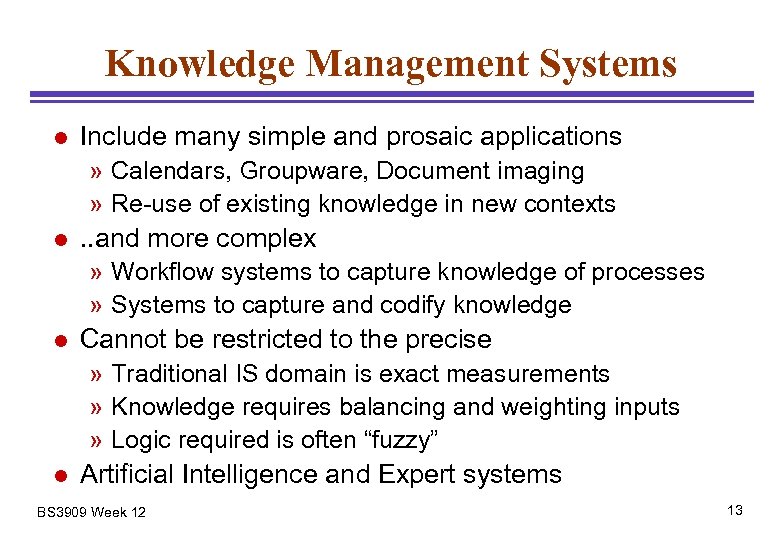 Knowledge Management Systems l Include many simple and prosaic applications » Calendars, Groupware, Document imaging » Re-use of existing knowledge in new contexts l . . and more complex » Workflow systems to capture knowledge of processes » Systems to capture and codify knowledge l Cannot be restricted to the precise » Traditional IS domain is exact measurements » Knowledge requires balancing and weighting inputs » Logic required is often “fuzzy” l Artificial Intelligence and Expert systems BS 3909 Week 12 13
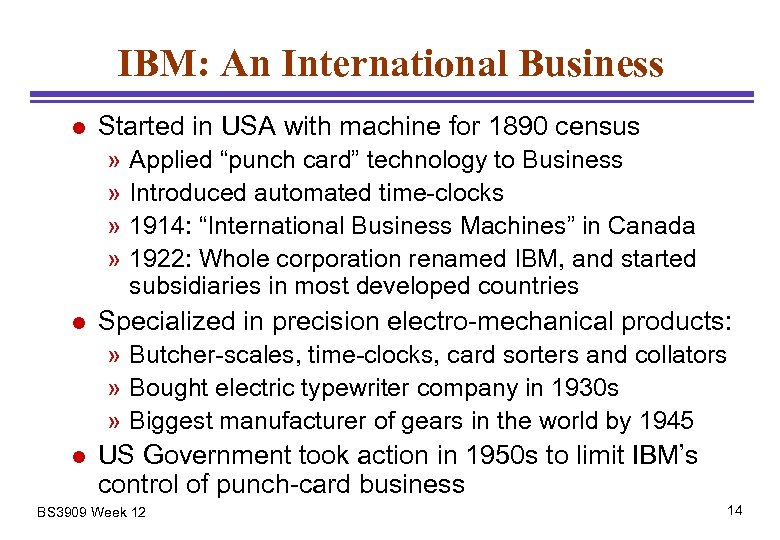 IBM: An International Business l Started in USA with machine for 1890 census » » l Applied “punch card” technology to Business Introduced automated time-clocks 1914: “International Business Machines” in Canada 1922: Whole corporation renamed IBM, and started subsidiaries in most developed countries Specialized in precision electro-mechanical products: » Butcher-scales, time-clocks, card sorters and collators » Bought electric typewriter company in 1930 s » Biggest manufacturer of gears in the world by 1945 l US Government took action in 1950 s to limit IBM’s control of punch-card business BS 3909 Week 12 14
 What about Computers? l IBM sponsored Columbia University to produce high-speed number-crunchers in 1940 s » NOT a stored-program computer (Britain did that first!) » Main US developer of computers was Univac l Around 1955, IBM was brave (and lucky) » Decided to invest in computer development » Invented magnetic disk drive » Sperry bought Univac and slowed investment l Set up laboratory in UK in 1957 » Britain was at leading-edge of scientific computing l Introduced “Systems Engineers” to develop market BS 3909 Week 12 15
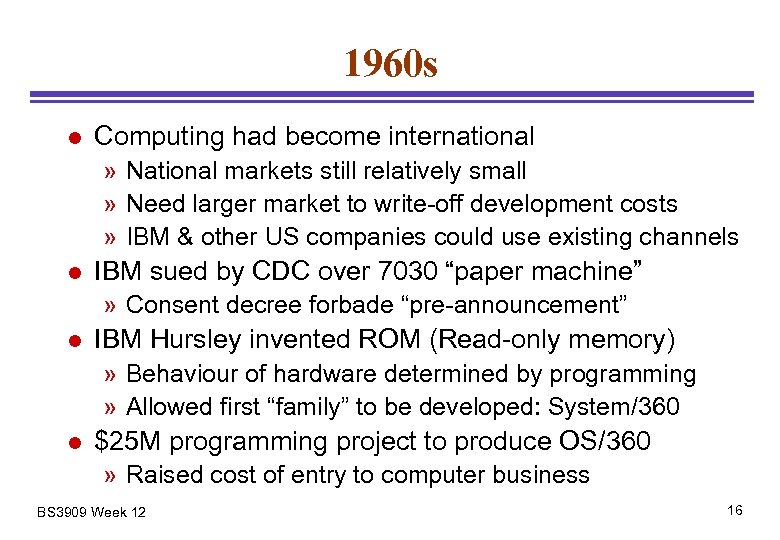 1960 s l Computing had become international » National markets still relatively small » Need larger market to write-off development costs » IBM & other US companies could use existing channels l IBM sued by CDC over 7030 “paper machine” » Consent decree forbade “pre-announcement” l IBM Hursley invented ROM (Read-only memory) » Behaviour of hardware determined by programming » Allowed first “family” to be developed: System/360 l $25 M programming project to produce OS/360 » Raised cost of entry to computer business BS 3909 Week 12 16
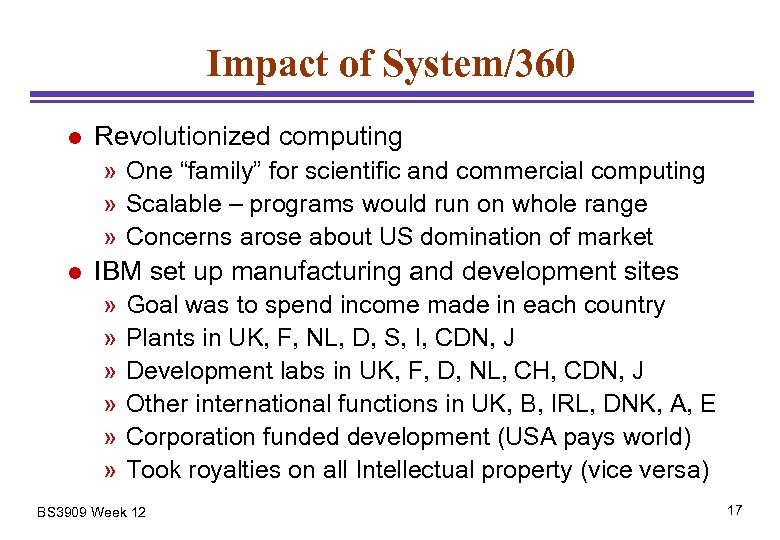 Impact of System/360 l Revolutionized computing » One “family” for scientific and commercial computing » Scalable – programs would run on whole range » Concerns arose about US domination of market l IBM set up manufacturing and development sites » » » Goal was to spend income made in each country Plants in UK, F, NL, D, S, I, CDN, J Development labs in UK, F, D, NL, CH, CDN, J Other international functions in UK, B, IRL, DNK, A, E Corporation funded development (USA pays world) Took royalties on all Intellectual property (vice versa) BS 3909 Week 12 17
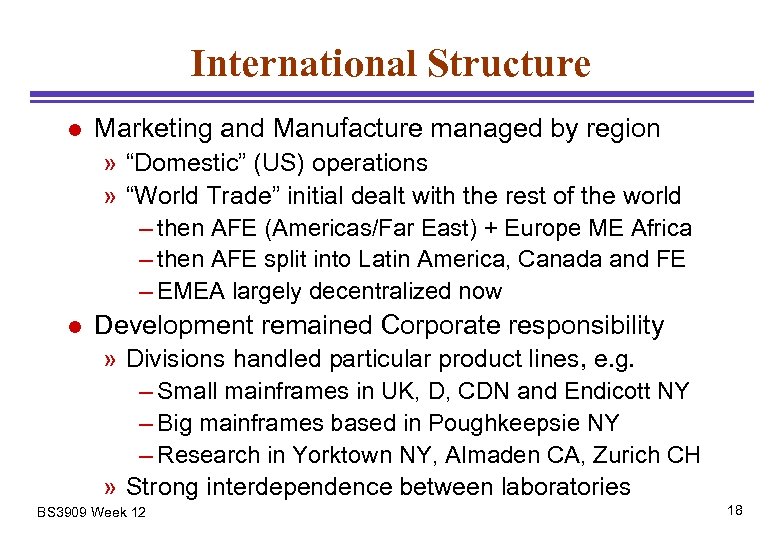 International Structure l Marketing and Manufacture managed by region » “Domestic” (US) operations » “World Trade” initial dealt with the rest of the world – then AFE (Americas/Far East) + Europe ME Africa – then AFE split into Latin America, Canada and FE – EMEA largely decentralized now l Development remained Corporate responsibility » Divisions handled particular product lines, e. g. – Small mainframes in UK, D, CDN and Endicott NY – Big mainframes based in Poughkeepsie NY – Research in Yorktown NY, Almaden CA, Zurich CH » Strong interdependence between laboratories BS 3909 Week 12 18
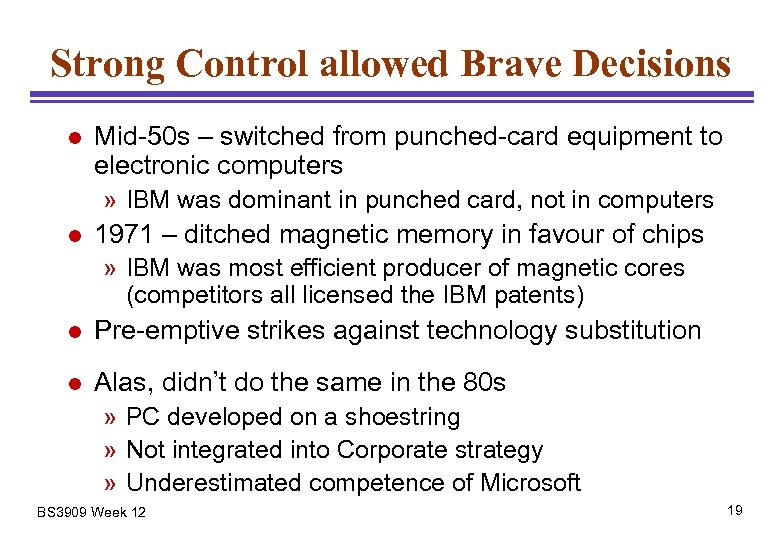 Strong Control allowed Brave Decisions l Mid-50 s – switched from punched-card equipment to electronic computers » IBM was dominant in punched card, not in computers l 1971 – ditched magnetic memory in favour of chips » IBM was most efficient producer of magnetic cores (competitors all licensed the IBM patents) l Pre-emptive strikes against technology substitution l Alas, didn’t do the same in the 80 s » PC developed on a shoestring » Not integrated into Corporate strategy » Underestimated competence of Microsoft BS 3909 Week 12 19
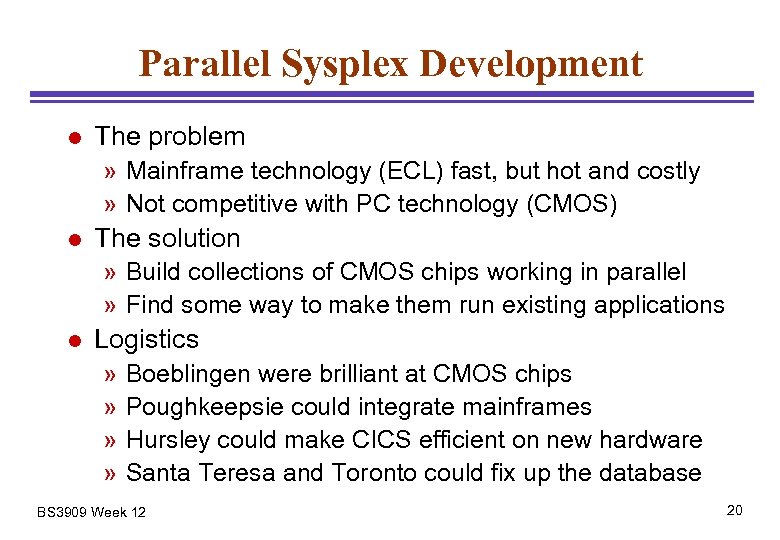 Parallel Sysplex Development l The problem » Mainframe technology (ECL) fast, but hot and costly » Not competitive with PC technology (CMOS) l The solution » Build collections of CMOS chips working in parallel » Find some way to make them run existing applications l Logistics » » Boeblingen were brilliant at CMOS chips Poughkeepsie could integrate mainframes Hursley could make CICS efficient on new hardware Santa Teresa and Toronto could fix up the database BS 3909 Week 12 20