


 Скачать презентацию Information Society Approaches and ICT Processes IFI 8101
56c8c1072864947a499bea40d7282700.ppt
- Количество слайдов: 58
 Information Society Approaches and ICT Processes (IFI 8101) Information Society – Development Trends Peeter Normak 1
 Home assignments 1. Based on the first chapters of NETIS Course Book (until page 47) and the description of information society (pages 212 -224) answer the following questions: a) What aspects of information society is your research going to contribute at most. b) Name five buzzwords or sub-fields from pages 212 -213 that at most characterize your research. 2. Formulate three words of wisdom you in William J. Kettinger, Yuan Li (2010). The infological equation extended: towards conceptual clarity in the relationship between data, information and knowledge. European Journal of Information Systems 19, 409 -421. 3. Compare IDI, WSIS-SDG and Network Readiness Index 2016: name 3 strengths and 3 weaknesses of each of them. 4. Start preparation of your seminar session. 2
 Objective of the lecture We attempt to answer the following questions: 1. What are the visions for the future of information society? 2. What are the most important strategies and programmes for realizing the visions? 3. What are the most widely used knowledge management frameworks, concepts and models? 3
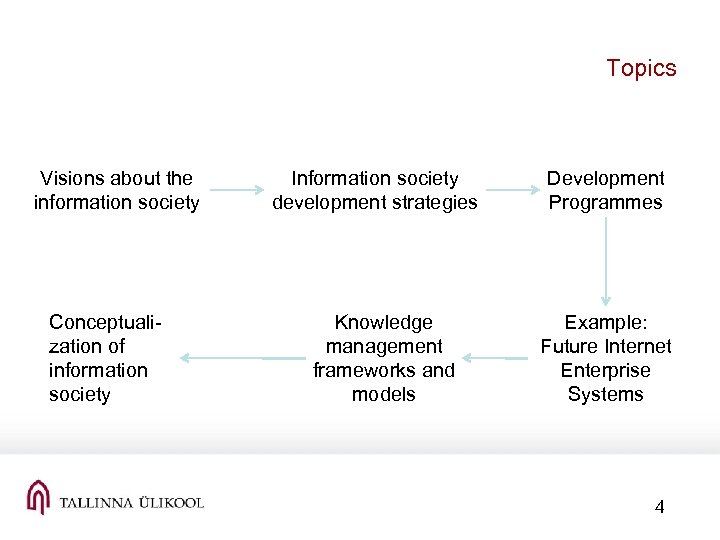 Topics Visions about the information society Conceptualization of information society Information society development strategies Knowledge management frameworks and models Development Programmes Example: Future Internet Enterprise Systems 4
 Discussion Why is it important to be aware of vision, policies and development programmes of information society? 5
 Visions about the information society 6
 Visioon 1: World Summit on the Information Society, 2003 Information Society – everyone can create, access, utilize and share information and knowledge, enabling individuals, communities and peoples to achieve their full potential in promoting their sustainable development and improving their quality of life, premised on the purposes and principles of the Charter of the United Nations and respecting fully and upholding the Universal Declaration of Human Rights. Science has a central role in the development of the Information Society. Education, knowledge, ICT are at the core of human progress, endeavour and well-being. Young people are the future workforce and leading creators and earliest adopters of ICTs. They must therefore be empowered as learners, developers, contributors, entrepreneurs and decision-makers. 7
 Vision 2: EU 2020 Flagship initiatives 1) • • Digital agenda for Europe Innovation Union Youth on the move (education) Resource efficient Europe An industrial policy for the globalisation era An agenda for new skills and jobs European platform against poverty Europe 2020. A European strategy for smart, sustainable and inclusive growth http: //ec. europa. eu/europe 2020/europe-2020 -in-a-nutshell/flagshipinitiatives/index_en. htm 1) 8
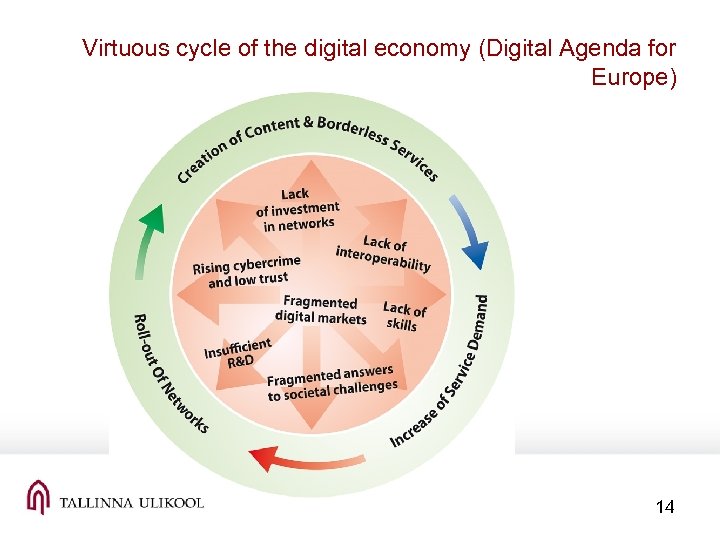
 Vision 2: Digital Agenda for Europe, 2010 The overall aim of the Digital Agenda is to deliver sustainable economic and social benefits from a digital single market based on fast and ultra fast internet and interoperable applications. Work smarter is the only way to guarantee increasing standards of life for Europeans. The creation of attractive online content and services and its free circulation inside the EU and across its borders are fundamental to stimulate the virtuous cycle of demand. The deployment and take-up of faster networks in turn opens the way for innovative services exploiting higher speeds. http: //eur-lex. europa. eu/Lex. Uri. Serv. do? uri=COM: 2010: 0245: FIN: EN: PDF NB! The term “information society” is mentioned only once on 41 pages. 9
 Vision 3: SE 21 – Sustainable Estonia 21 Estonian National Strategy on Sustainable Development (https: //riigikantselei. ee/sites/default/files/contenteditors/Failid/estonia_sds_2005. pdf): A big part of actors from different spheres of society will be engaged into a network-based decision-making mechanism, which increases participation and coherence. The use of new interactive media in recreation will increase. Technological innovation is the key area of the knowledge society. Only the best information and communication technological environment makes the functioning of a knowledge society possible. There is a danger of widening of the digital and cultural gap between different groups of population, the danger that the youth culture escaped into a passive virtual world and “the culture of the elderly” incapsulated into the traditional way of life may become marginalised in a society oriented to active participation and innovation. NB! “knowledge society” – 81, “information society” – 3 times used. 10
 Vision 4: Digital Agenda 2020 for Estonia In Estonia, the possibilities of information and communications technology (ICT) are used to full extent in cooperation between the public, private and third sectors: in order to improve the quality of life for people, increase the employment rate, ensure the viability of Estonian cultural space, increase productivity in the economy, and make the public sector more efficient. NB! Uses the term “information society” (“knowledge society” – 0). 11
 Conclusion 1 - Vision The following keywords dominate in the vision of the information society: • • High quality of life Individuals’ involvement in social life Supporting development of individuals and communities Science based Effective offering cross-border services Sustainable development of the state and economy What else? 12
 Information society development strategies/policies 13
 Virtuous cycle of the digital economy (Digital Agenda for Europe) 14
 EU strategy: A Digital Agenda for Europe, 2010 The action areas: 1. A vibrant digital single market. 2. Interoperability and standards (EC White Paper “Modernising ICT Standardisation in the EU – The Way Forward” 1); EC communication “Towards interoperability for European public services” 2)). 3. Trust and security. 4. Fast and ultra fast internet access (EC communication “European Broadband: investing in digitally driven growth” 3)). 5. Research and innovation. 6. Enhancing digital literacy, skills and inclusion 4). 7. ICT-enabled benefits for EU society. 1) http: //eur-lex. europa. eu/Lex. Uri. Serv. do? uri=COM: 2009: 0324: FIN: EN: PDF 2) http: //eur-lex. europa. eu/Lex. Uri. Serv. do? uri=COM: 2010: 0744: FIN: EN: PDF http: //eur-lex. europa. eu/Lex. Uri. Serv. do? uri=COM: 2010: 0472: FIN: EN: PDF 4) http: //www. insead. edu/facultyresearch/centres/ecompetences/links/index. cfm 3) 15
 Discussion To which of the following action areas does your research benefit at most? 1. 2. 3. 4. 5. 6. 7. A vibrant digital single market. Interoperability and standards (1). Trust and security (2). Fast and ultra fast internet access. Research and innovation (1). Enhancing digital literacy, skills and inclusion (4). ICT-enabled benefits for EU society (sustainable development, ehealth, digital media, e-governments, transportation systems; 1). 16
 Example: EU action area – ICT research and innovation The main policy document: EC communication “Strategy for ICT R&D and Innovation in Europe: Raising the Game”, 2009 1). The share of ICT in R&D: USA – 29%, EU – 17%. The goals of Europe by 2020: • • Europe has doubled its private and public investments in ICT R&D, doubled venture capital investments in high-growth ICT SMEs and tripled its use of precommercial procurement in ICT; Europe has nurtured an additional five ICT poles of world-class excellence, measured by private and public investments in the pole; Europe has grown new innovative businesses in ICT so that 1/3 of all business expenditure in ICT R&D is invested by companies created within the last two decades; Europe's ICT sector supplies at least the equivalent of its share of the global ICT market. 1) http: //eur-lex. europa. eu/Lex. Uri. Serv. do? uri=COM: 2009: 0116: FIN: EN: PDF 17
 Examples of specific strategies 1. Learning, Innovation and ICT. Lessons learned by the ICT cluster Education & Training 2010 programme. 1) Action areas: • • • Leadership and institutional change for a renewed strategy on learning Digital competences and transversal skills as core life and employability skills Towards a new learning paradigm Professional development – the teacher as learner at the centre Research on learning in a digital society Envisioning the future of learning in a digital society 2. European Strategy for a Better Internet for Children. 2) Action areas: • • High-quality content online for children and young people. Stepping up awareness and empowerment. Creating a safe environment for children online. Fighting against child sexual abuse and child sexual exploitation. 1) https: //erte. dge. mec. pt/sites/default/files/Recursos/Estudos/key_lessons_ict_cluster_final_r eport. pdf 2) http: //eur-lex. europa. eu/Lex. Uri. Serv. do? uri=COM: 2012: 0196: FIN: EN: PDF 18
 Sustainable Estonia 21 (SE 21) Goals and the most important information society aspects: 1. Viability of the Estonian cultural space: An essential part of the Estonian culture has “moved to the virtual environment”. 2. Growth of welfare: Services will be both exported through the Internet or through their direct provision in the territory of other countries and provided in Estonia’s own territory. . 3. Coherent society: Difficulties of the Estonian labour market in adapting to the new environment resulting from the EU labour division and development of information technology would be a threat. 4. Ecological balance: Cross-usable national registers of natural resources (incl. landscapes and objects of biological diversity) have been created by the year 2030 and the relevant statistics organised. 19
 National Reform Programme “ESTONIA 2020” 1) 18 priorities of government policy, including: • The broader use of the potential of the creative industries, ICT and other key technologies for raising the value added of other sectors. • Bringing transportation, ICT and other public infrastructure and institutions that support business to an international level. • Increasing the international competitiveness of higher education: attracting talents to areas that are important for the Estonian economy or becoming more active in hiring foreign faculty members to work at Estonian institutions of higher education. 1) http: //valitsus. ee/User. Files/valitsus/en/government-office/growth-and- jobs/Estonia%202020%20 in%202013/ENG%20 national%20 reform%20 programme% 20 Estonia%202020. pdf 20
 Digital Agenda 2020 for Estonia Examples of some priority initiatives: • Superfast internet bases network is completed; at least 60% of households are using it. • A Nordic Innovation Institute of e-government’s basic infrastructure will be established for joint development of X-road, e-identity, digital signature and other components. • A virtual residency will be established – Estonia will issue a digital ID to non-residents allowing them to use Estonian e-services. • A Global Information Society Think Tank will be established, for disseminating our experience in e-government and for dealing with the most important information society issues like internet freedom, privacy protection, etc. 21
 Conclusion 2 – Strategies The smaller will be the scope of the information society development strategy, the more focused it is: • World: there is no world-wide strategy • Europe: lists action lines and underlying principles • Estonia: concrete actions and outcomes 22
 Information society development programmes 23
 Examples of Information Society development programmes 1. World-wide (UNESCO). 2. Regional (Europe). 3. National (Estonia). 4. National sectoral (Estonia - education). 24
 UNESCO No World-wide development programme, but various support schemes*: Access to information • • • Archives Community Multimedia Centers … Capacity Building • • • Gender and ICT Information and Media Literacy … Content Development • • Creative Content: Radio, TV, New Media Multilingualism in Cyberspace * http: //portal. unesco. org/ci/en/ev. php. URL_ID=1645&URL_DO=DO_TOPIC&URL_SECTION=201. html 25
 ICT in Horizon 2020: The EU Framework Programme for Research and Innovation (2014 -2020)1) Work programmes for every two years. Examples from 2016 -2017 WP 2): 1. ICT-01 -2016 Smart Cyber-Physical Systems. 2. ICT-11 -2017 Collective Awareness Platforms for Sustainability and Social Innovation. 3. ICT-22 -2016 Technologies for Learning and Skills. 4. ICT-23 -2017 Interfaces for accessibility. 5. ICT-24 -2016 Gaming and gamification. 6. SMEInst-01 -2016 -2017 Open Disruptive Innovation Scheme. 7. SC 1 -PM-12 -2016 PCP – e. Health innovation in empowering the patient. 8. SCC-1 -2016 -2017 Smart Cities and Communities lighthouse projects. 1) http: //ec. europa. eu/programmes/horizon 2020/en/area/ict-research-innovation 2) https: //www. ideal-ist. eu/sites/default/files/Guide_to_ICTrelated_activities_in_H 2020 WP 2016 -17_0. pdf 26
 National – Estonia Implementation Plan for 2015 -20181, 2 of Digital Agenda 2020 for Estonia (only in Estonian language). Goals: 1. ICT infrastructure for supporting the economic growth, country’s development and welfare of people (2017 – 15, 31 M€). 2. Increasing ICT-skills for creating higher-value-added jobs, increasing international competitiveness and quality of life (1 M€). 3. Smart public administration (15, 349 M€). 4. Promotion of e-Estonia in the World (0, 203 M€). Excel table has 281 rows! 2 https: //www. mkm. ee/et/eesmargid-tegevused/arengukavad 1 27
 National sectoral – ICT Education (Estonia) IT Academy programme for 2016 -2020 (http: //media. voog. com/0000/0034/3577/files/IT%20 Akadeemia%20 programm%202016 -2020. pdf, in Estonian). 1. Supports development of selected ICT study programmes. 2. Scholarships for ICT students on selected study programmes. 3. Development projects for ICT study programmes (Example: “Integration of laboratory-based studies at Tallinn University ICT curricula”). 4. Development projects for supporting ICT studies on non-ICT study programmes (Example: “Development of digital competences of students on the math teacher study programme through subject didactics midule”). 28
 Example: Future Internet Enterprise Systems FIn. ES. Research Roadmap 2025*) *) http: //cordis. europa. eu/fp 7/ict/enet/documents/fines-research-roadmapv 30_en. pdf 29
 FIn. ES - general FIn. ES Research Roadmap 2025 that has been produced by the dedicated FIn. ES Research Roadmap (FRR) Task Force established in 2010 within the FIn. ES (Future Internet Enterprise Systems) Cluster. Four knowledge spaces: 1. Socio-economic Space (context in which enterprises operate). 2. Enterprise Space (key characteristics of future enterprises). 3. Enterprise Systems, Platforms, and Applications Space (ICT solutions and socio-technical systems for supporting enterprises). 4. Enabling Technology Space (ICT solutions for development of FIn. ES). 30
 FIn. ES – The Knowledge Dimension Research challenges: 1. Unified Digital Enterprise, a full digital image of the enterprise. For that purpose, an Enterprise Architectural Framework will be used as a reference in identifying different elements of an enterprise. 2. Linked Open Knowledge. In particular, it will be important to achieve a tight integration between ‘internal’ and ‘external’ knowledge. 3. Complex Systems Modelling (for modelling different sections of an enterprise). 31
 FIn. ES – The Functional Dimension Research challenges: 1. Innovation-oriented enterprise platform. Aims at supporting the everyday business activities and, in parallel, continuous improvement and innovation, based on 6 functional stages – Invent, Plan, Build, Operate, Manage & Monitor, Dismiss. 2. Unified Digital Enterprise (UDE) Management System. The distributed platform providing all the services required to create and maintain the UDE. 3. Cooperation and collaboration platforms. Includes services aimed at supporting a productive exchange of information, knowledge and services, among humans (cooperation, social computing), among computers (interoperability) and between the two (the evolution of human-computer interaction: HCI. 32
 FIn. ES – The Engineering Dimension Research challenges: 1. Proactive FIn. ES Mashup. Includes organizational units and software components to be acquired and integrated in building a FIn. ES. 2. Autonomic Computing Components and Subsystems. Relies on several pre-existing computing elements, including different service clouds that contain large choice of commoditized routine services. 3. Flexible Execution platforms. There will not be a unique ‘killer paradigm’ but rather a coexistence of federated platforms and solutions, from multi-agents platforms to rule-based and best practice systems, from business process engines, to traditional software packages. 33
 FIn. ES – Some specific topics • • • Augmented Reality Autonomic Objects and Networks Business-IT Misalignment Change Management Complex Event Processing Complexity Theory Creative Commons Crowdsourcing Enterprise Architectural Framework From Linked Open Data to Linked Open Knowledge • • • Innovation & Continuous re-design Knowledge Mining Knowledge Pragmatics Knowledge Rendering Semantic Annotation and Filtering Semantic Interoperability Simulation and ‘What-If’ Systems Smart Objects Exploitation Social Computing System Mashup Virtual Reality 34
 Future Technologies for FIn. ES 1. Future networking technologies. 2. Future Knowledge technologies. • • • Diffused Knowledge Repositories From raw data to knowledge assets Innovation-oriented knowledge assets 3. Future application technologies • • • Proactive and autonomic computing From deterministic to fuzzy computing Beyond system consistency Governance application technologies Top-down problems definition and bottom-up systems aggregation 4. Future computation and storage technologies 5. Future Natural Interaction 35
 Conclusion 3 – the scope Although there are only few programmes designed specifically for development of information society, it is possible to execute projects that contribute to the development of information society in the framework of virtually any other programme. 36
 Conceptions, knowledge creation frameworks and models 37
 Example: the conception of digital ecosystems Definition. A digital ecosystem is a distributed, adaptive, open sociotechnical system with properties of self-organisation, scalability and sustainability inspired from natural ecosystems. Initially (2002) the concept was introduced in the context of business enterprises (the term “digital business ecosystems” was used), later the scope was expanded. Peardrop. Synthesis Guide. Planning the Development of Digital Business Ecosystem (DBE) at regional level, 2008. This conception can be considered in different application areas. 38
 Application in education Digital learning ecosystems: A distributed adaptive socio-technical system consisting of subjects of learning (learners, teachers, facilitators), digital learning artefacts (learning environments, learning tools, learning objects) and purposeful subject-subject and subject-artefact interactions. R & D can be conducted on different levels and scope (layers), for example: 1) 2) 3) 4) 5) Conceptual layer Semantic layer Architecture and integration layer Human-Computer interaction layer … 39
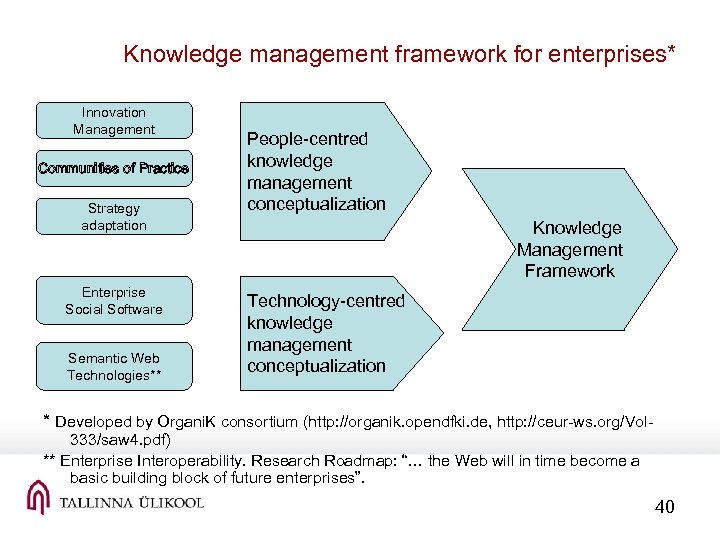 Knowledge management framework for enterprises* Innovation Management Communities of Practice Strategy adaptation Enterprise Social Software Semantic Web Technologies** People-centred knowledge management conceptualization Knowledge Management Framework Technology-centred knowledge management conceptualization * Developed by Organi. K consortium (http: //organik. opendfki. de, http: //ceur-ws. org/Vol 333/saw 4. pdf) ** Enterprise Interoperability. Research Roadmap: “… the Web will in time become a basic building block of future enterprises”. 40
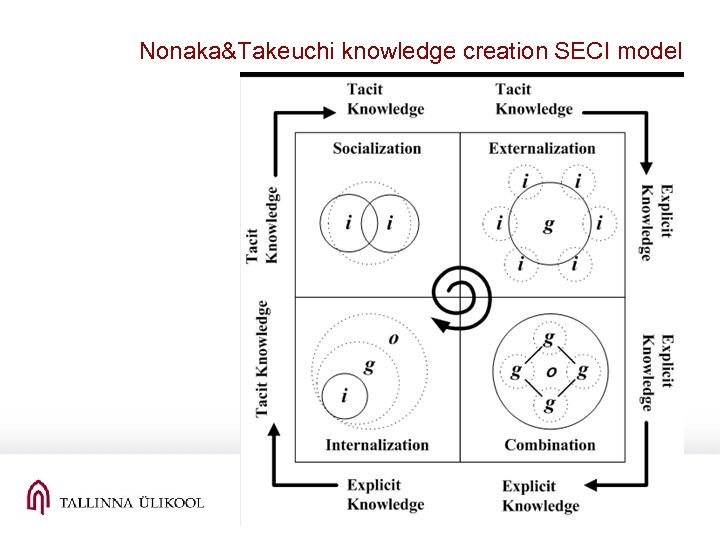 Nonaka&Takeuchi knowledge creation SECI model 41
 Dynamics between knowledge acquisition and creation Knowledge acquisition prevails in static societies – knowledge of yesterday is applicable today and tomorrow. Ability to create new knowledge is more important in dynamically evolving societies where the operating environment today differs from this of yesterday, and of tomorrow. Important factor: consistency of the structures of learning and real life. Cross (Internet Time Group). Informal Learning – the other 80%: 80% of time spent for learning takes place in school, 20% outside of school. From total knowledge and skills, a human uses in real life, 20% is acquired at school, and 80% outside of school. 42
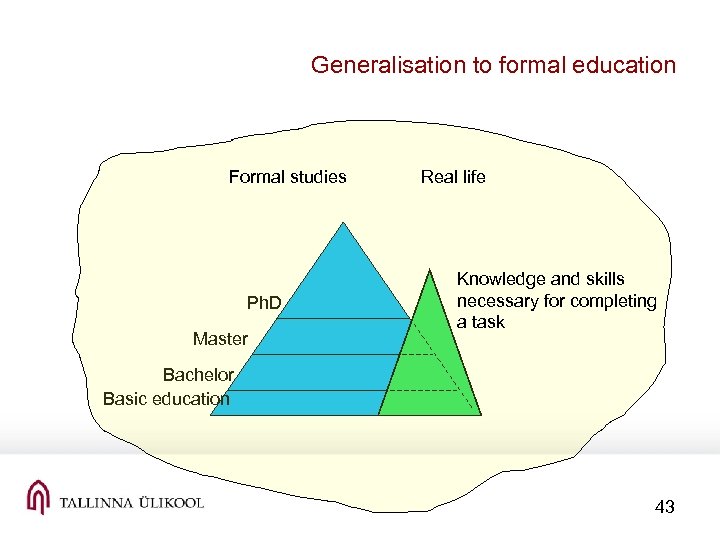 Generalisation to formal education Formal studies Ph. D Master Real life Knowledge and skills necessary for completing a task Bachelor Basic education 43
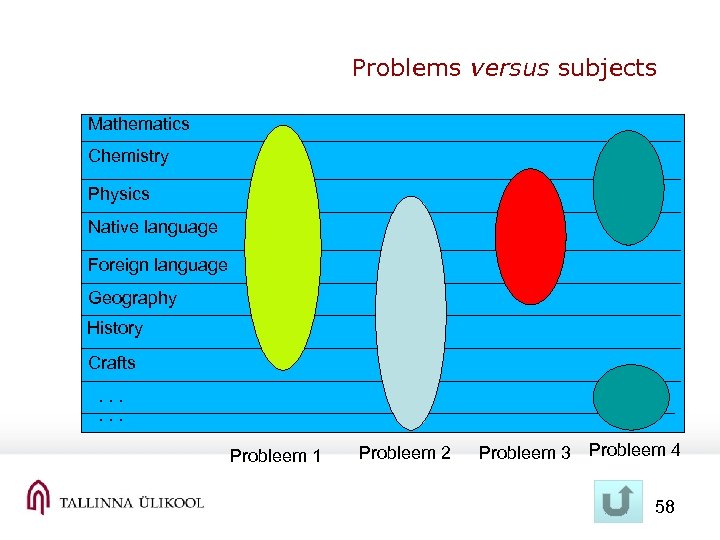
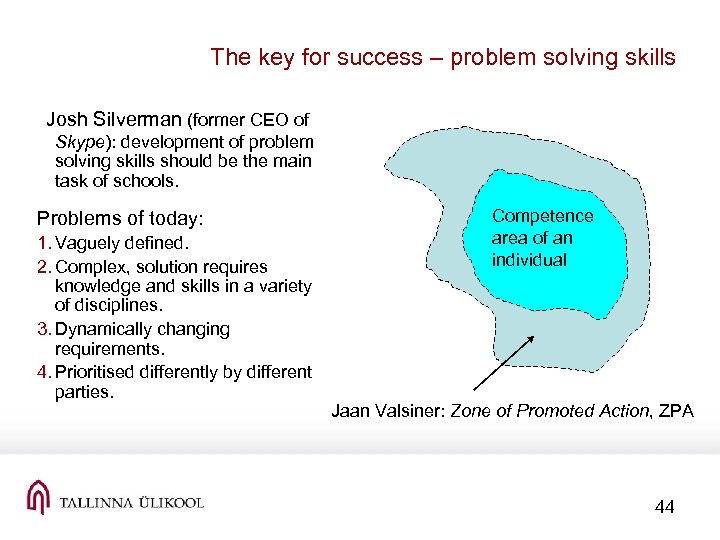 The key for success – problem solving skills Josh Silverman (former CEO of Skype): development of problem solving skills should be the main task of schools. Problems of today: 1. Vaguely defined. 2. Complex, solution requires knowledge and skills in a variety of disciplines. 3. Dynamically changing requirements. 4. Prioritised differently by different parties. Competence area of an individual Jaan Valsiner: Zone of Promoted Action, ZPA 44
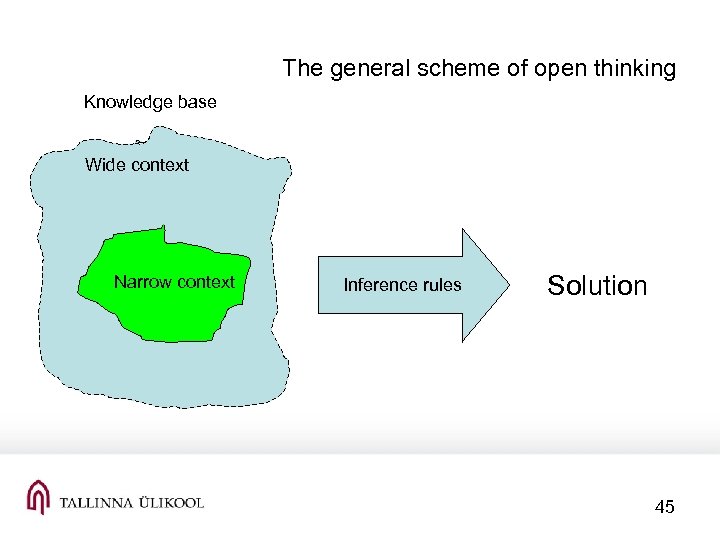 The general scheme of open thinking Knowledge base Wide context Narrow context Inference rules Solution 45
 CBL as a tool for competence development Community-based learning (CBL) is learning that connects individual learning with meaningful community involvement and experiences. CBL is especially purposeful in cases requiring urgent solutions. Some features of CBL: • Learning is proactive – learner-centered, self-driven and problem-oriented. • Learning is situational – learning and takes place in the same context as the acquired knowledge or skills are applied. • Learning takes into account the experience of others, their success and failure. 46
 Example – communities of practice Community of practice (Co. P) is a group of people who share a craft and/or a profession. Rational Application Security Community of Practice 1). Supports: • Creating new learning relationships • Instant and continuous productivity improvements • Access to relevant information to current challenges • Just-in-time guidance • Work on innovative projects with other passionate and smart people • Improve online reputation by providing recognized value to the peers. 1) https: //www. ibm. com/developerworks/mydeveloperworks/groups/service/html/communit yview? community. Uuid=242 fafe 4 -766 c-4 c 93 -bb 7 d-3 d 2 a 5 ee 1 cbd 6 47
 Conclusion 4 – success factor Ability to apply ICT tools effectively and creatively for solving problems, possibly in cooperation with the members of a wider community would be one of the basic prerequisites for success in information society. 48
 Discussion What are the major factors supporting (inhibiting) development of information society on: • international level • country level • institutional level? 49
 Conceptualization (modeling) of information society 50
 Definitions • Conceptualization – an abstract (simplified) view of information society, containing the objects, concepts, and other elements that are of interest for some particular purpose and the relationships between them. • Model – a simplified representation of information society at some particular aspect intended to promote understanding of the real system. • E-government – the use of ICT devices and Internet to provide public services. 51
 Example: e-government 1. Several e-government maturity models. For a list of 25 maturity models see “E-government Maturity Models: a Comparative Study” (http: //airccse. org/journal/ijsea/papers/5314 ijsea 06. pdf). 2. Several analyses of different aspects of e-government. Example: for an assessment of digital public service delivery see “Future-proofing e. Government for the Digital Single Market” (http: //bookshop. europa. eu/en/future-proofing-egovernment-for-the-digitalsingle-market-pb. KK 0115441/). 3. Countries are free to decide on the development of e-government. Example of Estonia: https: //joinup. ec. europa. eu/sites/default/files/ckeditor_files/e. Government %20 in%20 Estonia%20 -%20 February%202016%20 -%2018_00_v 4_00. pdf. 52
 Conclusion 5 There does not exist a commonly agreed concept of information society or of its some aspect. 53
 Some more publications 1. About the components of information society: • 2. Karvalics, Laszlo (2009). Information Society Dimensions. Szeged (https: //www. academia. edu/652113/Information_Society_Dimensions). About the different approaches of information society: • 3. Webster, Frank (2006, 3 rd edition). Theories of the Information Society. Routledge. Interpretation adopted in Estonia: • Põder, Kairit/Taaraste, Heli (editors, 2010). Infoühiskond/Information Society. Eesti Statistika/Statistics Estonia (bilingual – Estonian and English). 54
 Home assignments 1. Find three EU strategy documents that mention importance of the area of your research topic (example for a possible starting point: http: //ec. europa. eu/europe 2020/europe-2020 -in-a-nutshell/flagshipinitiatives/index_en. htm). 2. Find 2+2 strategy or analysis documents or development programmes most relevant to your research topic – two on European and two on national level (any country). 3. Compose “your” definition of information society. 55
 Next class: Wednesday, 22. 02 at 13. 30 Topic: Information Security in Information Society (Raul Rikk). 56
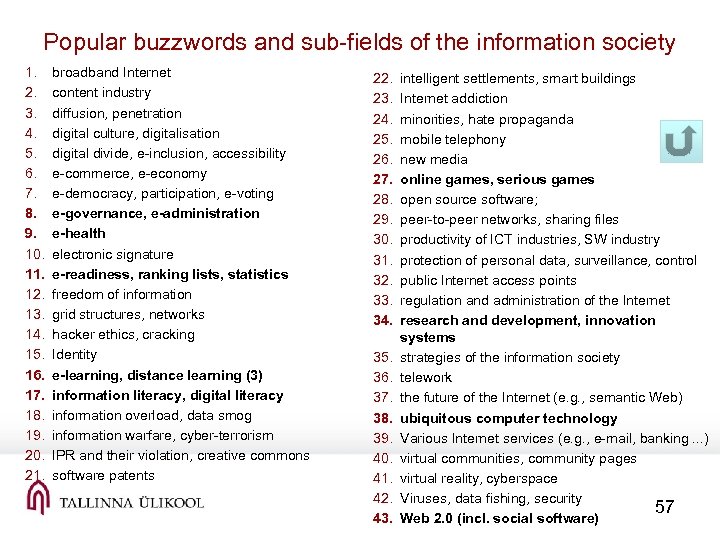 Popular buzzwords and sub-fields of the information society 1. 2. 3. 4. 5. 6. 7. 8. 9. 10. 11. 12. 13. 14. 15. 16. 17. 18. 19. 20. 21. broadband Internet content industry diffusion, penetration digital culture, digitalisation digital divide, e-inclusion, accessibility e-commerce, e-economy e-democracy, participation, e-voting e-governance, e-administration e-health electronic signature e-readiness, ranking lists, statistics freedom of information grid structures, networks hacker ethics, cracking Identity e-learning, distance learning (3) information literacy, digital literacy information overload, data smog information warfare, cyber-terrorism IPR and their violation, creative commons software patents 22. 23. 24. 25. 26. 27. 28. 29. 30. 31. 32. 33. 34. 35. 36. 37. 38. 39. 40. 41. 42. 43. intelligent settlements, smart buildings Internet addiction minorities, hate propaganda mobile telephony new media online games, serious games open source software; peer-to-peer networks, sharing files productivity of ICT industries, SW industry protection of personal data, surveillance, control public Internet access points regulation and administration of the Internet research and development, innovation systems strategies of the information society telework the future of the Internet (e. g. , semantic Web) ubiquitous computer technology Various Internet services (e. g. , e-mail, banking. . . ) virtual communities, community pages virtual reality, cyberspace Viruses, data fishing, security 57 Web 2. 0 (incl. social software)
 Problems versus subjects Mathematics Chemistry Physics Native language Foreign language Geography History Crafts. . . Probleem 1 Probleem 2 Probleem 3 Probleem 4 58