 Скачать презентацию Information Services and Access Mechanism of Mobile Web
bc6ef5a84d7d64c758d2ccb1a0844cd4.ppt
- Количество слайдов: 53



Information Services and Access Mechanism of Mobile Web for the Under-privileged Asoke K Talukder W 3 C Workshop on the Mobile Web in Developing Countries, December 5/6, 2006: Bangalore, India 5 th December 2006 W 3 C Workshop on Mobile Web – Asoke K Talukder 1
The Author • Asoke K Talukder – Vice President Software Engineering, Tyfone CDI Pvt. Ltd. , Bangalore – Daimler. Chrysler Chair and Associate Professor, IIIT – Bangalore • Interests – Information System for the Under-privileged – Next Generation Networks – Artificial Hygiene 5 th December 2006 W 3 C Workshop on Mobile Web – Asoke K Talukder 2
The Scenario 5 th December 2006 W 3 C Workshop on Mobile Web – Asoke K Talukder 3
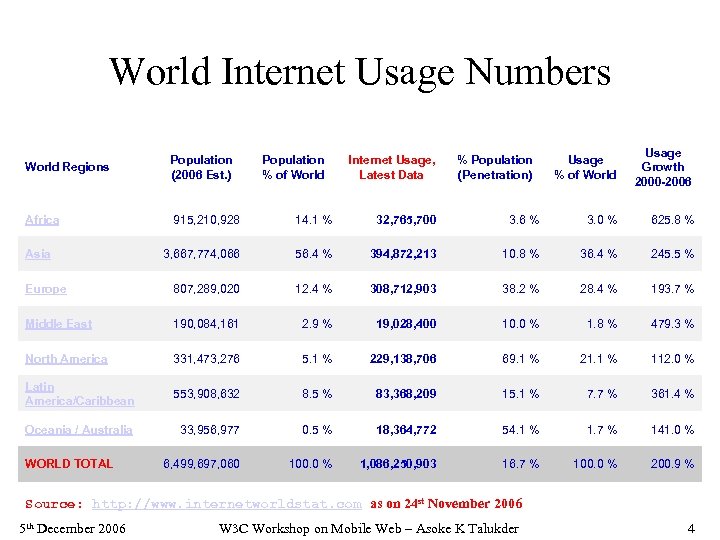
World Internet Usage Numbers Usage % of World Usage Growth 2000 -2006 3. 6 % 3. 0 % 625. 8 % 394, 872, 213 10. 8 % 36. 4 % 245. 5 % 12. 4 % 308, 712, 903 38. 2 % 28. 4 % 193. 7 % 190, 084, 161 2. 9 % 19, 028, 400 10. 0 % 1. 8 % 479. 3 % North America 331, 473, 276 5. 1 % 229, 138, 706 69. 1 % 21. 1 % 112. 0 % Latin America/Caribbean 553, 908, 632 8. 5 % 83, 368, 209 15. 1 % 7. 7 % 361. 4 % Oceania / Australia 33, 956, 977 0. 5 % 18, 364, 772 54. 1 % 1. 7 % 141. 0 % 6, 499, 697, 060 100. 0 % 1, 086, 250, 903 16. 7 % 100. 0 % 200. 9 % World Regions Population (2006 Est. ) Africa 915, 210, 928 14. 1 % 32, 765, 700 3, 667, 774, 066 56. 4 % Europe 807, 289, 020 Middle East Asia WORLD TOTAL Population % of World Internet Usage, Latest Data % Population (Penetration) Source: http: //www. internetworldstat. com as on 24 st November 2006 5 th December 2006 W 3 C Workshop on Mobile Web – Asoke K Talukder 4
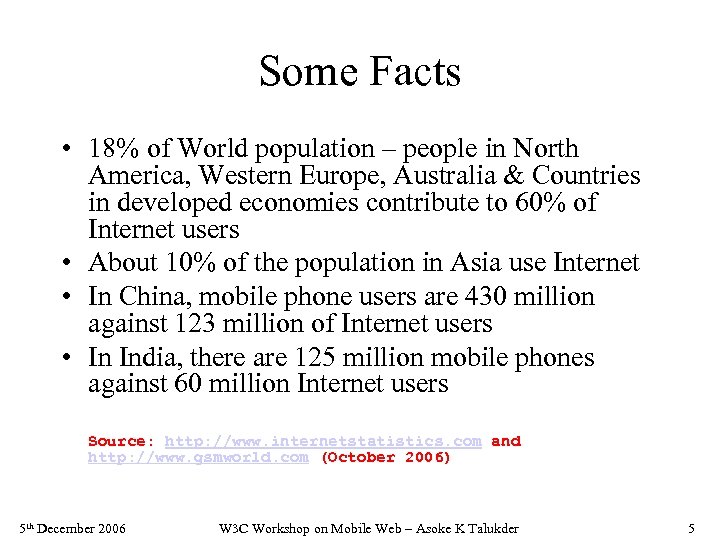
Some Facts • 18% of World population – people in North America, Western Europe, Australia & Countries in developed economies contribute to 60% of Internet users • About 10% of the population in Asia use Internet • In China, mobile phone users are 430 million against 123 million of Internet users • In India, there are 125 million mobile phones against 60 million Internet users Source: http: //www. internetstatistics. com and http: //www. gsmworld. com (October 2006) 5 th December 2006 W 3 C Workshop on Mobile Web – Asoke K Talukder 5
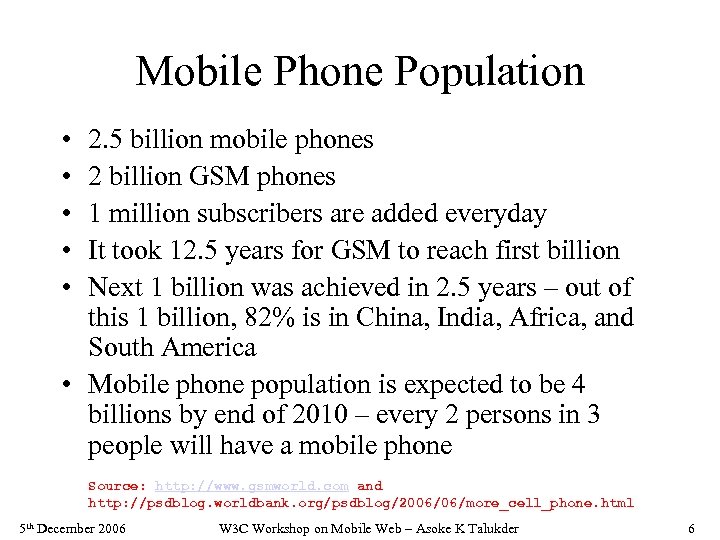
Mobile Phone Population • • • 2. 5 billion mobile phones 2 billion GSM phones 1 million subscribers are added everyday It took 12. 5 years for GSM to reach first billion Next 1 billion was achieved in 2. 5 years – out of this 1 billion, 82% is in China, India, Africa, and South America • Mobile phone population is expected to be 4 billions by end of 2010 – every 2 persons in 3 people will have a mobile phone Source: http: //www. gsmworld. com and http: //psdblog. worldbank. org/psdblog/2006/06/more_cell_phone. html 5 th December 2006 W 3 C Workshop on Mobile Web – Asoke K Talukder 6
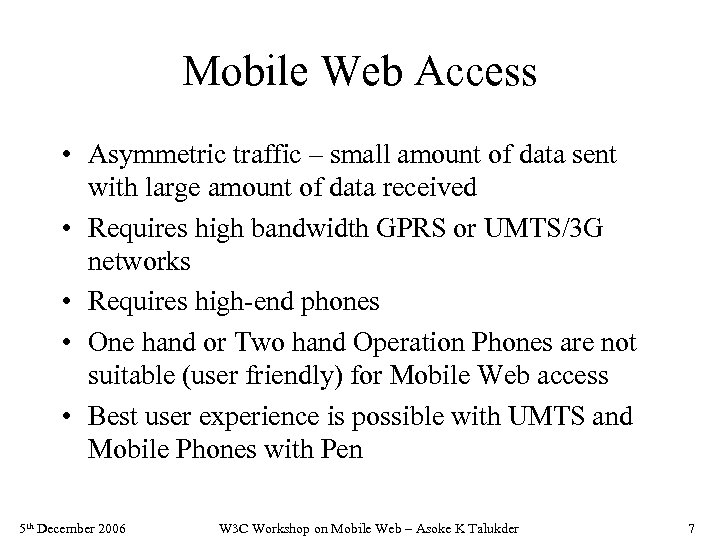
Mobile Web Access • Asymmetric traffic – small amount of data sent with large amount of data received • Requires high bandwidth GPRS or UMTS/3 G networks • Requires high-end phones • One hand or Two hand Operation Phones are not suitable (user friendly) for Mobile Web access • Best user experience is possible with UMTS and Mobile Phones with Pen 5 th December 2006 W 3 C Workshop on Mobile Web – Asoke K Talukder 7
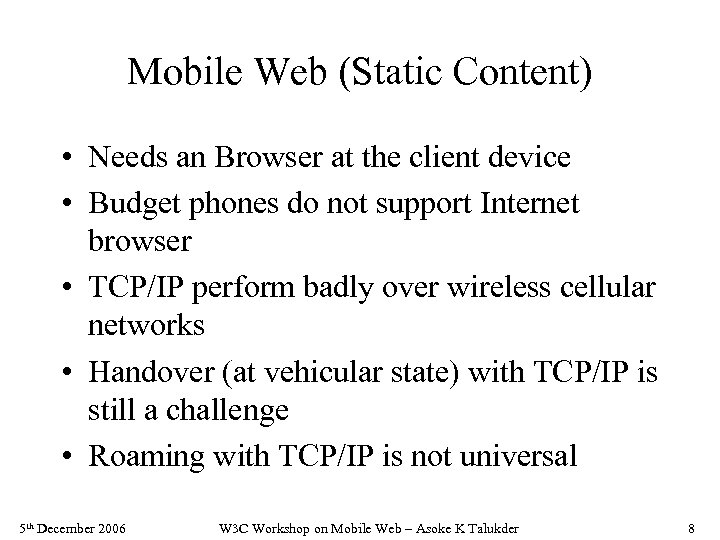
Mobile Web (Static Content) • Needs an Browser at the client device • Budget phones do not support Internet browser • TCP/IP perform badly over wireless cellular networks • Handover (at vehicular state) with TCP/IP is still a challenge • Roaming with TCP/IP is not universal 5 th December 2006 W 3 C Workshop on Mobile Web – Asoke K Talukder 8
Charging in Mobile IP Environment • Telecommunication operators always charged their customers (using voice service) based on volume (time and distance) – service provided by the network • In data service – charging will be on volume (time, mega bytes), Qo. S, Contents, and Events; service provided by third party • IP billing (postpaid and prepaid) is a major challenge for mobile operators. Many of them do not have it yet (other than volume) 5 th December 2006 W 3 C Workshop on Mobile Web – Asoke K Talukder 9
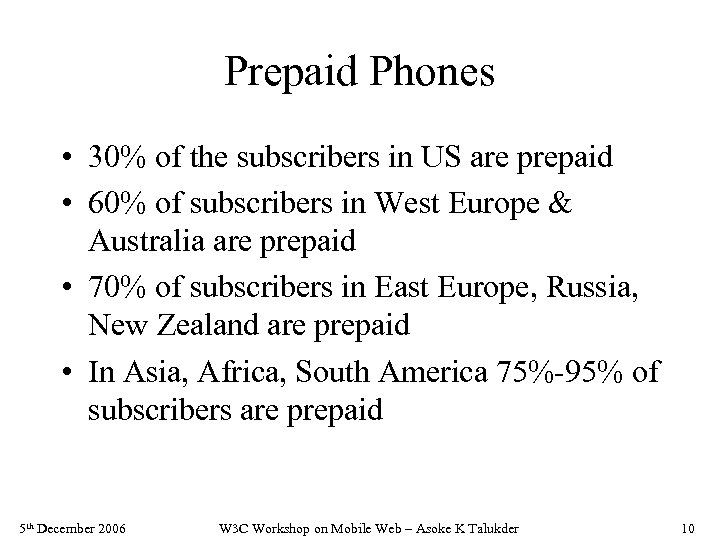
Prepaid Phones • 30% of the subscribers in US are prepaid • 60% of subscribers in West Europe & Australia are prepaid • 70% of subscribers in East Europe, Russia, New Zealand are prepaid • In Asia, Africa, South America 75%-95% of subscribers are prepaid 5 th December 2006 W 3 C Workshop on Mobile Web – Asoke K Talukder 10
Prepaid Connections • Prepaid Subscribers – Under-privileged – Students – Teenagers – Individual subscribers (non corporate) • Prepaid Services – Voice – SMS – MMS 5 th December 2006 W 3 C Workshop on Mobile Web – Asoke K Talukder 11
The Problem 5 th December 2006 W 3 C Workshop on Mobile Web – Asoke K Talukder 12
Prepaid Subscribers and Data • Majority of under-privileged subscribers along with students, teenagers, and non-corporate mobile subscribers use prepaid connections • Due to challenges in Realtime billing infrastructure, TCP/IP based data service is not available to prepaid customers (in general) • Conclusion: Majority of mobile subscribers in Developing countries today use budget phones or prepaid connections, these users do not have access to generic TCP/IP data service 5 th December 2006 W 3 C Workshop on Mobile Web – Asoke K Talukder 13
Data Service for Under-privileged • Mobile Web access through SMS as data bearer (SMS-data) • It will be short input to application and short response • Lifestyle based transactions and Information services do not need large input or output – they are symmetric and small in size • SMS gateway can convert the Web content into small messages even in local languages (through transcoding) 5 th December 2006 W 3 C Workshop on Mobile Web – Asoke K Talukder 14
Short Message Service (SMS) • Perceived as an entertainment tool for teenagers • SMS was originally designed for messaging between mobile phones • Driven by ETSI Standard 03. 40 • Is increasingly being used as data • On September 11, 2001 following the twin tower attack at New York City, telephone lines became inaccessible; SMS was used for communication between emergency service personnel [Reference: The President’s National Security Telecommunications Advisory Committee – “Wireless Task Force Report, Wireless Priority Service”, August 2002] 5 th December 2006 W 3 C Workshop on Mobile Web – Asoke K Talukder 15
SMS Advantages • • • True Ubiquitous media Universal availability of SMS Pay as you use (no license fee or entry barrier) Stateless & Peer-to-peer Asynchronous (store and forward) Self-Configurable Always ON (always connected) – best for alerts Universal Roaming Works at vehicular conditions (across Network boundaries) Resistant to many conditions that break TCP/IP data connection (low signal strength, channel unavailability, weak & intermittent signal) 5 th December 2006 W 3 C Workshop on Mobile Web – Asoke K Talukder 16
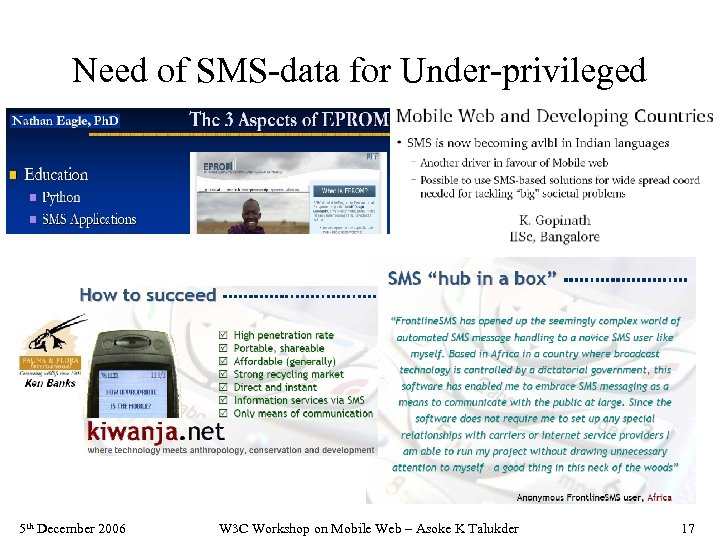
Need of SMS-data for Under-privileged 5 th December 2006 W 3 C Workshop on Mobile Web – Asoke K Talukder 17
The Proposal 5 th December 2006 W 3 C Workshop on Mobile Web – Asoke K Talukder 18
Standardize SMS-data so that it Interoperates, to facilitate SMS as Data Bearer for Mobile Web over existing Infrastructure for Budget phones, Prepaid, and Under-privileged users 5 th December 2006 W 3 C Workshop on Mobile Web – Asoke K Talukder 19
SMS Usage – Healthcare • Compliance monitoring and enforcement • Patient self-monitoring (chronic disease management) • Appointment reminders • Health promotion, e. g. , diabetic healthcare, smoking cessation messaging • Targeted service notification, e. g. , flu vaccination season • Appointment confirmation/ cancellation/ modification 5 th December 2006 W 3 C Workshop on Mobile Web – Asoke K Talukder 20
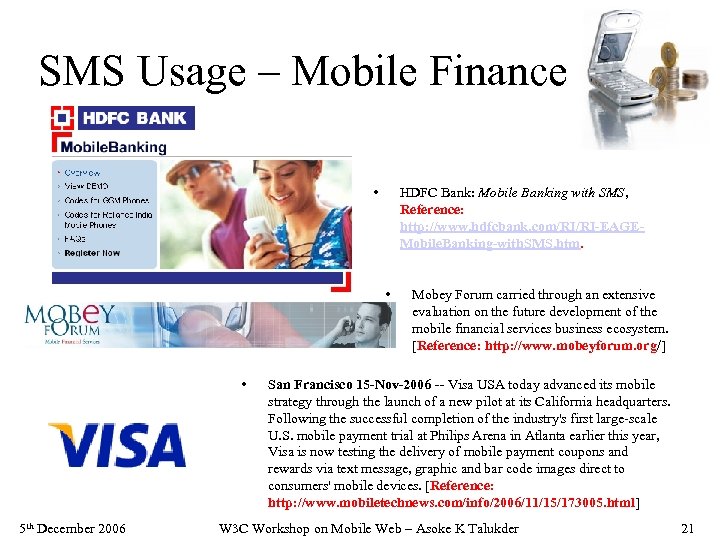
SMS Usage – Mobile Finance • HDFC Bank: Mobile Banking with SMS, Reference: http: //www. hdfcbank. com/RI/RI-EAGEMobile. Banking-with. SMS. htm. • • 5 th December 2006 Mobey Forum carried through an extensive evaluation on the future development of the mobile financial services business ecosystem. [Reference: http: //www. mobeyforum. org/] San Francisco 15 -Nov-2006 -- Visa USA today advanced its mobile strategy through the launch of a new pilot at its California headquarters. Following the successful completion of the industry's first large-scale U. S. mobile payment trial at Philips Arena in Atlanta earlier this year, Visa is now testing the delivery of mobile payment coupons and rewards via text message, graphic and bar code images direct to consumers' mobile devices. [Reference: http: //www. mobiletechnews. com/info/2006/11/15/173005. html] W 3 C Workshop on Mobile Web – Asoke K Talukder 21
SMS-data Applications • • Telemedicine Reality TV shows Reality Radio shows Healthcare Agriculture Exchange Value Added Service (VAS) Emergency & Weather alerts 5 th December 2006 W 3 C Workshop on Mobile Web – Asoke K Talukder 22
Other SMS based Applications • • Sensor Networks Telematics Remote control for vehicle Fleet Management Industrial Automation Notifications and Reminders Tickets, Boarding Pass etc 5 th December 2006 W 3 C Workshop on Mobile Web – Asoke K Talukder 23
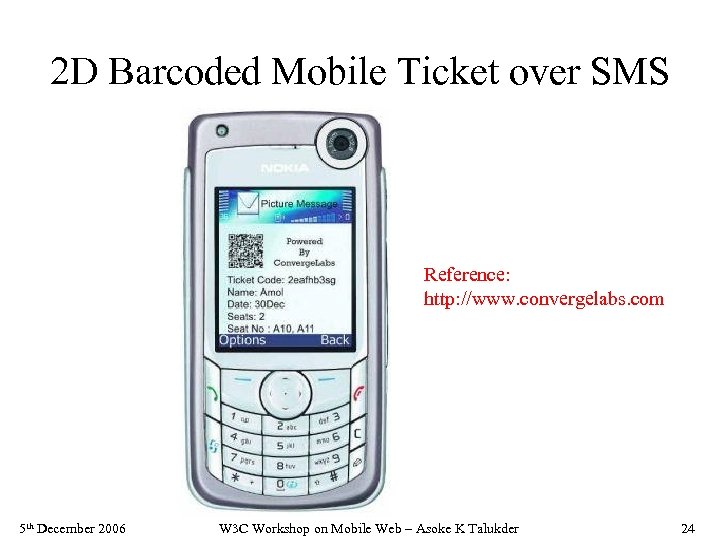
2 D Barcoded Mobile Ticket over SMS Reference: http: //www. convergelabs. com 5 th December 2006 W 3 C Workshop on Mobile Web – Asoke K Talukder 24
SMS as Multifactor Security Enabler • SMS uses SS#7 signaling channel that is Physically Secured • SS#7 & SMS media is not accessible to general public • SMS can be used for Mutual Authentication • SMS can be used to distribute Security keys • SMS and Web can be used for Multifactor, Multicommunication security protocol • SMS can be used for Presence, Spatial, and Contextual security 5 th December 2006 W 3 C Workshop on Mobile Web – Asoke K Talukder 25
All these Services are Network Proprietary and DO NOT Interoperate Network Operators are offering Mobile Web Services over SMS (only to its subscribers) An Independent Service Provider or an Enterprise cannot offer Mobile Web Services over SMS – Unless this happens, Mobile Web usage will be limited 5 th December 2006 W 3 C Workshop on Mobile Web – Asoke K Talukder 26
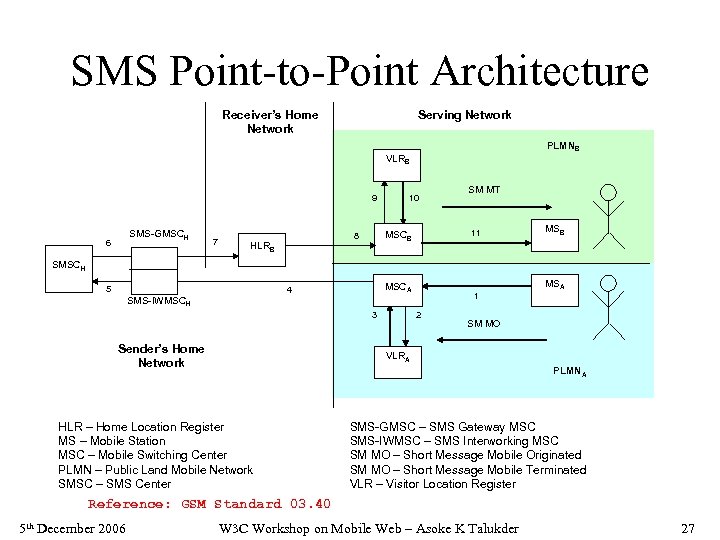
SMS Point-to-Point Architecture Serving Network Receiver’s Home Network PLMNB VLRB 9 SMS-GMSCH 6 7 SM MT 11 MSCB 8 HLRB 10 MSB SMSCH 5 SMS-IWMSCH 3 Sender’s Home Network MSA MSCA 4 1 2 SM MO VLRA PLMNA HLR – Home Location Register MS – Mobile Station MSC – Mobile Switching Center PLMN – Public Land Mobile Network SMSC – SMS Center SMS-GMSC – SMS Gateway MSC SMS-IWMSC – SMS Interworking MSC SM MO – Short Message Mobile Originated SM MO – Short Message Mobile Terminated VLR – Visitor Location Register Reference: GSM Standard 03. 40 5 th December 2006 W 3 C Workshop on Mobile Web – Asoke K Talukder 27
SMS Point-to-Point • Both endpoints are mobile phones • Interoperable • Any mobile phone from any network roaming in any network can send SMS to any phone from any other network roaming in some other network 5 th December 2006 W 3 C Workshop on Mobile Web – Asoke K Talukder 28
The Challenge 5 th December 2006 W 3 C Workshop on Mobile Web – Asoke K Talukder 29
SMS-data Routing Challenges • When a subscriber is roaming, outgoing voice calls are routed by the visiting MSC – The call can be routed from any mobile phone to any other mobile phone or fixedline phone • When a subscriber is roaming, outgoing SMS is routed by the home SMSC – The SMS can be routed from any mobile phone to any mobile phone • As an SMS-data service is connected to the home network, SMS-data can never be routed to non-home services – This is against the fundamental philosophy of telecommunication or data communication 5 th December 2006 W 3 C Workshop on Mobile Web – Asoke K Talukder 30
SMS-data • Does not Interoperate • One endpoint is service (running in computers or Web), other endpoint is mobile phone • Shortcode as SMS Data Service Identifier (SDSI), the port address where SMS gateway is connected • A mobile subscriber can access only these services offered by the home operator • A subscriber from network “A” cannot access services offered by “B” or any service in Web • A subscriber roaming in a foreign network still accesses the service at home network 5 th December 2006 W 3 C Workshop on Mobile Web – Asoke K Talukder 31
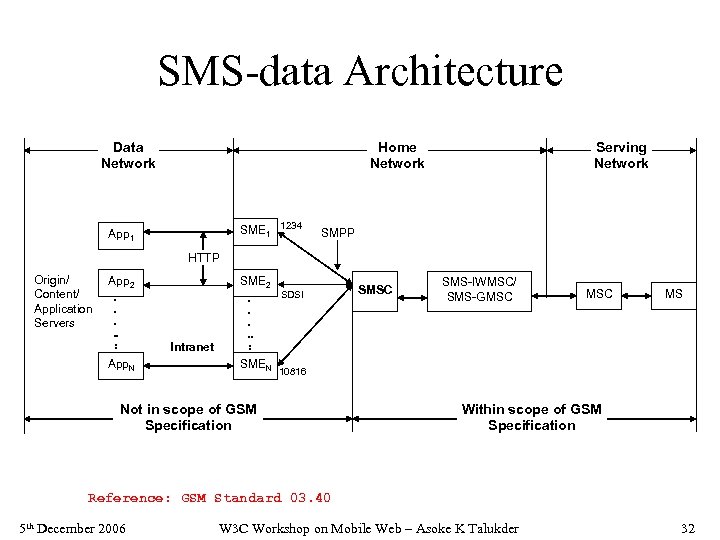
SMS-data Architecture Data Network Home Network SME 1 1234 App 1 Serving Network SMPP HTTP Origin/ Content/ Application Servers App 2. . . : SME 2 Intranet App. N . . . : SMEN SDSI SMSC SMS-IWMSC/ SMS-GMSC MS 10816 Not in scope of GSM Specification Within scope of GSM Specification Reference: GSM Standard 03. 40 5 th December 2006 W 3 C Workshop on Mobile Web – Asoke K Talukder 32
SMS-data Interoperability • SM MO (Short Message Mobile Originated) is not interoperable – an SMS-data from any mobile phone from any network roaming in some other network can be routed to only these applications connected to the home SMSC and offered by the home network • SM MT (Short Message Mobile Terminated) is interoperable – an SMS-data from any application can be routed to any mobile phone from any network roaming in any other network 5 th December 2006 W 3 C Workshop on Mobile Web – Asoke K Talukder 33
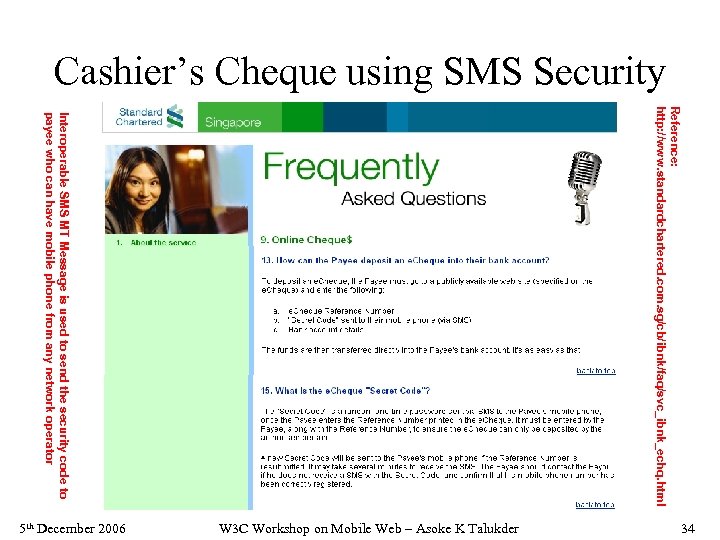
Cashier’s Cheque using SMS Security Reference: http: //www. standardchartered. com. sg/cb/ibnk/faq/svc_ibnk_echq. html Interoperable SMS MT Message is used to send the security code to payee who can have mobile phone from any network operator 34 W 3 C Workshop on Mobile Web – Asoke K Talukder 5 th December 2006
Short Code as SDSI • Short Codes are used as SDSI (SMS Data Service Identifier) • Shortcodes do not follow E. 164 standard for numbering • Shortcodes are Proprietary and does not have any meaning outside of home network • In the US, shortcodes are reserved through , a centralized body [http: //www. usshortcodes. com] to have unique shortcode across USA; though, there is no guarantee that this short code will be available in all networks. It is also possible to find out who owns a mobile short code in the United States [http: //www. usshortcodeswhois. com] • This is not possible in other countries 5 th December 2006 W 3 C Workshop on Mobile Web – Asoke K Talukder 35
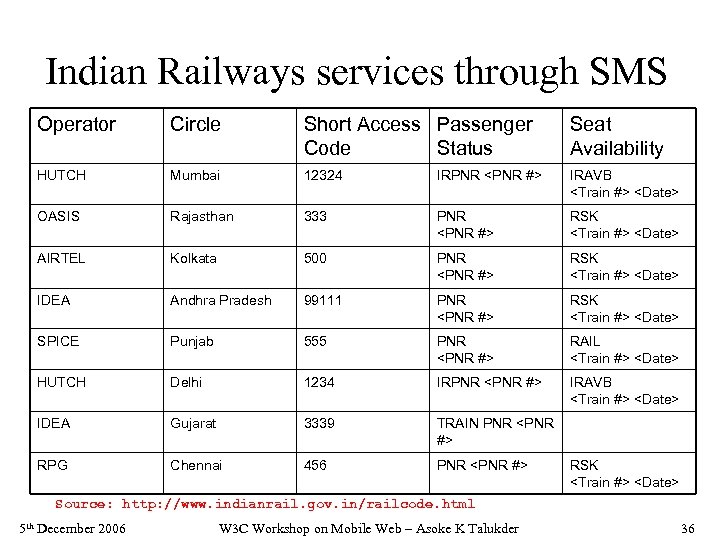
Indian Railways services through SMS Operator Circle Short Access Passenger Code Status Seat Availability HUTCH Mumbai 12324 IRPNR <PNR #> IRAVB <Train #> <Date> OASIS Rajasthan 333 PNR <PNR #> RSK <Train #> <Date> AIRTEL Kolkata 500 PNR <PNR #> RSK <Train #> <Date> IDEA Andhra Pradesh 99111 PNR <PNR #> RSK <Train #> <Date> SPICE Punjab 555 PNR <PNR #> RAIL <Train #> <Date> HUTCH Delhi 1234 IRPNR <PNR #> IRAVB <Train #> <Date> IDEA Gujarat 3339 TRAIN PNR <PNR #> RPG Chennai 456 PNR <PNR #> RSK <Train #> <Date> Source: http: //www. indianrail. gov. in/railcode. html 5 th December 2006 W 3 C Workshop on Mobile Web – Asoke K Talukder 36
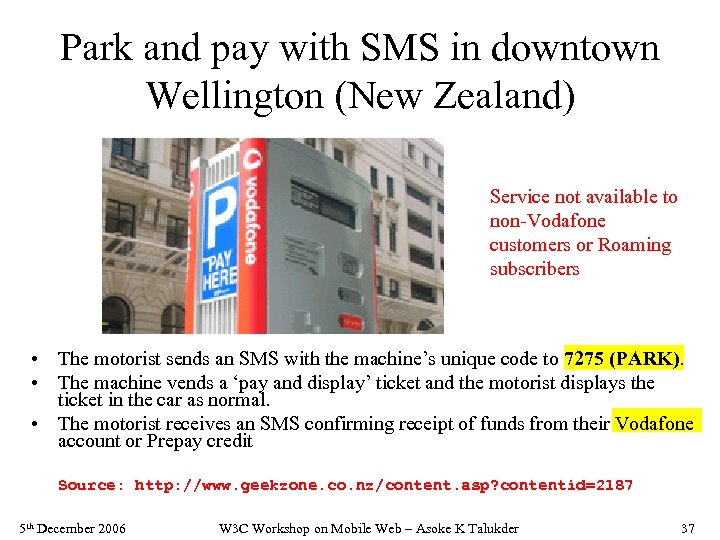
Park and pay with SMS in downtown Wellington (New Zealand) Service not available to non-Vodafone customers or Roaming subscribers • The motorist sends an SMS with the machine’s unique code to 7275 (PARK). • The machine vends a ‘pay and display’ ticket and the motorist displays the ticket in the car as normal. • The motorist receives an SMS confirming receipt of funds from their Vodafone account or Prepay credit Source: http: //www. geekzone. co. nz/content. asp? contentid=2187 5 th December 2006 W 3 C Workshop on Mobile Web – Asoke K Talukder 37
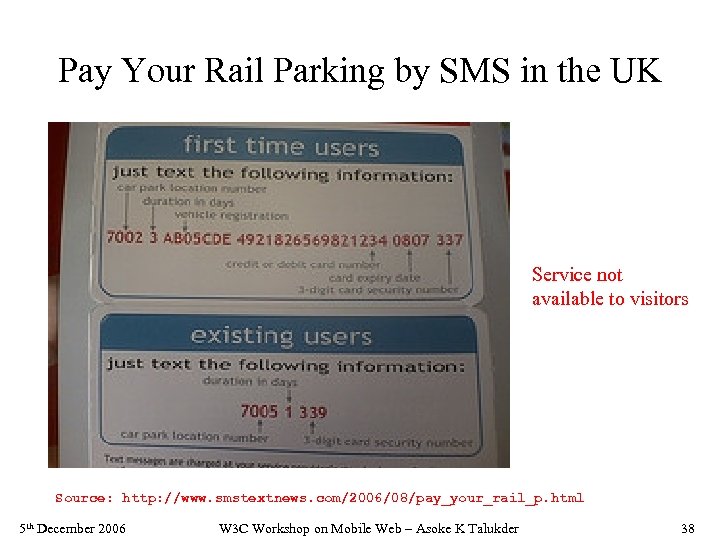
Pay Your Rail Parking by SMS in the UK Service not available to visitors Source: http: //www. smstextnews. com/2006/08/pay_your_rail_p. html 5 th December 2006 W 3 C Workshop on Mobile Web – Asoke K Talukder 38
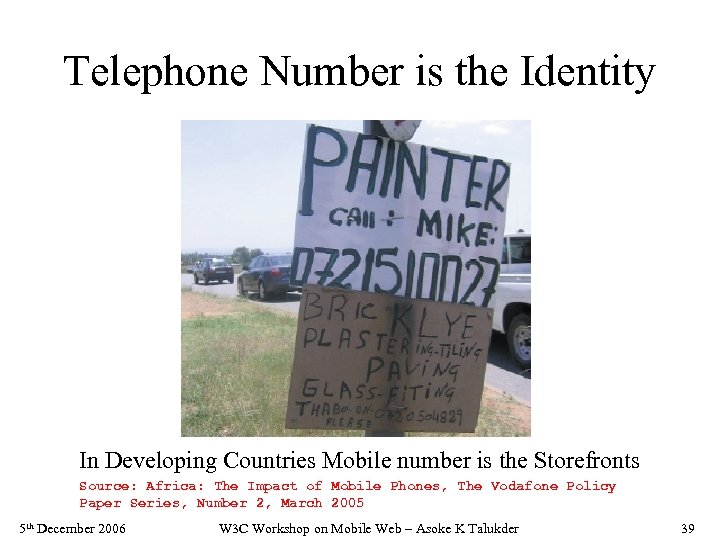
Telephone Number is the Identity In Developing Countries Mobile number is the Storefronts Source: Africa: The Impact of Mobile Phones, The Vodafone Policy Paper Series, Number 2, March 2005 5 th December 2006 W 3 C Workshop on Mobile Web – Asoke K Talukder 39
Mobile Number Portability (MNP) • • Helps the economy Increases competition Helps the consumer In developing countries mobile number plays the role of a Storefront • In MNP, Subscriber carries the old number to new operator • SMS-data accessed through shortcode will cease to operate in MNP (same service may not be available, or use a different shortcode) 5 th December 2006 W 3 C Workshop on Mobile Web – Asoke K Talukder 40
The Solution 5 th December 2006 W 3 C Workshop on Mobile Web – Asoke K Talukder 41
SMS-data Routing for Mobile Web • For Mobile Web access, we need Interoperable SMS-data that can be routed from any home SMSC to any Web service independent of the network with or without Mobile Number Portability • Interoperable & Portable SMS-data needs to be compatible with existing protocols and infrastructure 5 th December 2006 W 3 C Workshop on Mobile Web – Asoke K Talukder 42
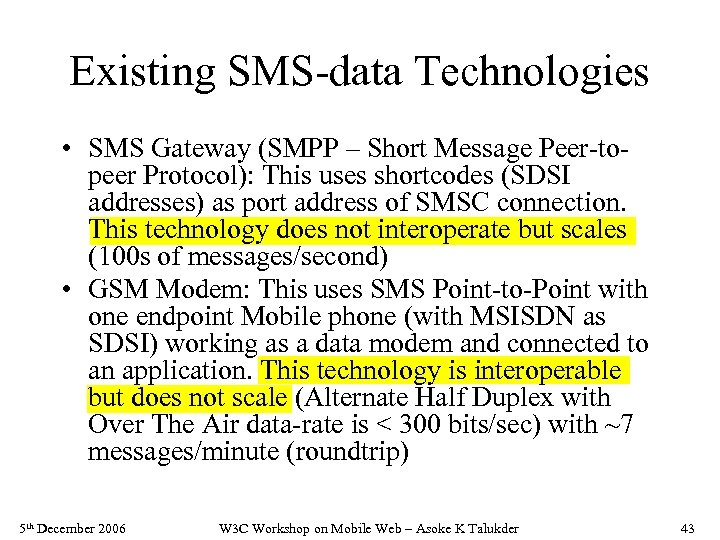
Existing SMS-data Technologies • SMS Gateway (SMPP – Short Message Peer-topeer Protocol): This uses shortcodes (SDSI addresses) as port address of SMSC connection. This technology does not interoperate but scales (100 s of messages/second) • GSM Modem: This uses SMS Point-to-Point with one endpoint Mobile phone (with MSISDN as SDSI) working as a data modem and connected to an application. This technology is interoperable but does not scale (Alternate Half Duplex with Over The Air data-rate is < 300 bits/sec) with ~7 messages/minute (roundtrip) 5 th December 2006 W 3 C Workshop on Mobile Web – Asoke K Talukder 43
Ubiquitous SMS Routing Service • Ubiquitous SMS Routing Service (USRS) routes an SMS-data from any mobile phone of any network roaming in any network to any application in the Web • It routes an SMS from any home SMSC to any Web application [Reference: Ubiquitous SMS Routing and Independent Service Creation, submitted for publication in IEEE Transaction on Vehicular Technology] 5 th December 2006 W 3 C Workshop on Mobile Web – Asoke K Talukder 44
USRS Tunneling • Ubiquitous SMS Routing Service Tunneling routes an SMS-data from any mobile phone of any network roaming in any network to an application that is running in the private network of another mobile operator • It tunnels the SMS-data from any home SMSC to any foreign SMSC which is then routed to the application connected to the foreign network 5 th December 2006 W 3 C Workshop on Mobile Web – Asoke K Talukder 45
Universal SMS Routing Service • Universal SMS Routing Service (USRS) routes an SMS-data from any mobile phone of any network ported to any other network roaming in any network to an application independent of Donor or Recipient network [Reference: Mobile Number Portability: Making SMS Data Services Portable, Journal of Indian Institute of Science, pp 81 -96, Mar-Apr, 2006] 5 th December 2006 W 3 C Workshop on Mobile Web – Asoke K Talukder 46
USRS • USRS Technology offers SMS-data routing algorithm that is Interoperable and Scalable • USRS offers SMS-data routing algorithm – – That is network independent That is MNP neutral That is independent of the end-user device Protects the investment (uses existing infrastructure) • USRS Routing Algorithm has been tested in an Indian GSM network in Meerut near Delhi with mobile phones across India 5 th December 2006 W 3 C Workshop on Mobile Web – Asoke K Talukder 47
USRS Compatibility • USRS Technology is backward & forward compatible • USRS coexists with all other network elements • USRS uses MAP (GSM 09. 02) protocols – Only the USRS node need to be added in SS#7 network • Client interface on phone does not change • Client continues to work with Shortcode through existing interfaces • Client will work with Global-title through USRS interface • Server application continues without any change 5 th December 2006 W 3 C Workshop on Mobile Web – Asoke K Talukder 48
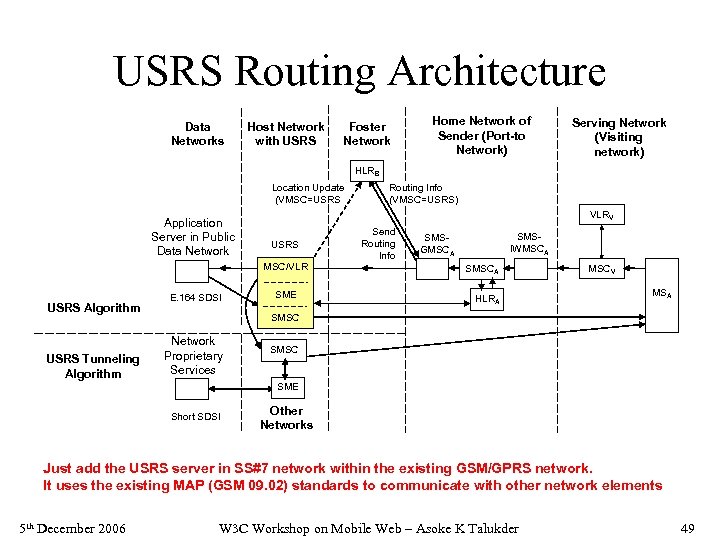
USRS Routing Architecture Data Networks Host Network with USRS Foster Network Home Network of Sender (Port-to Network) Serving Network (Visiting network) HLRB Location Update (VMSC=USRS Application Server in Public Data Network VLRV USRS MSC/VLR USRS Algorithm USRS Tunneling Algorithm E. 164 SDSI Routing Info (VMSC=USRS) SME Send Routing Info SMSIWMSCA SMSGMSCA SMSCA HLRA MSCV MSA SMSC Network Proprietary Services SMSC SME Short SDSI Other Networks Just add the USRS server in SS#7 network within the existing GSM/GPRS network. It uses the existing MAP (GSM 09. 02) standards to communicate with other network elements 5 th December 2006 W 3 C Workshop on Mobile Web – Asoke K Talukder 49
The Proposal 5 th December 2006 W 3 C Workshop on Mobile Web – Asoke K Talukder 50
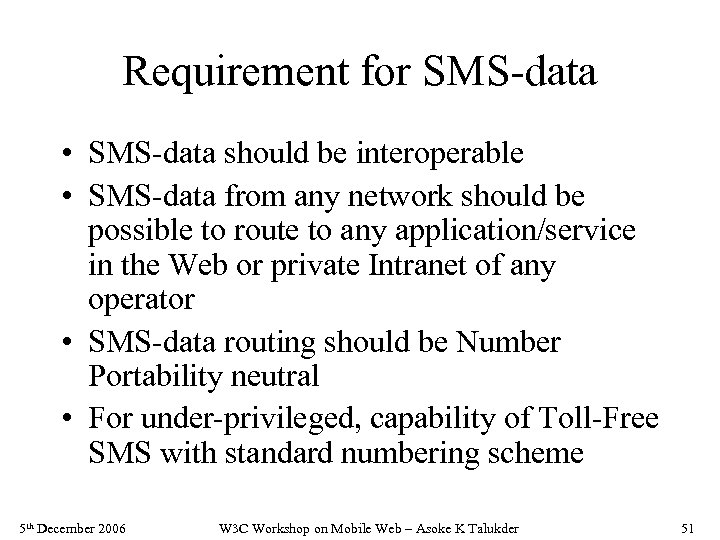
Requirement for SMS-data • SMS-data should be interoperable • SMS-data from any network should be possible to route to any application/service in the Web or private Intranet of any operator • SMS-data routing should be Number Portability neutral • For under-privileged, capability of Toll-Free SMS with standard numbering scheme 5 th December 2006 W 3 C Workshop on Mobile Web – Asoke K Talukder 51
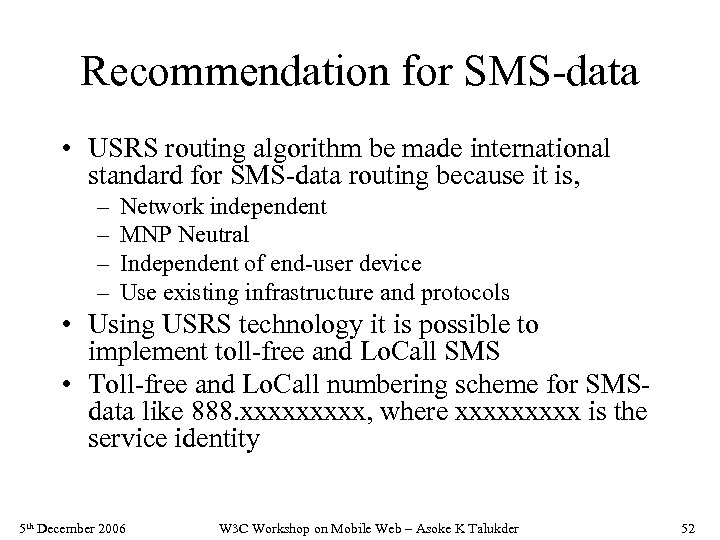
Recommendation for SMS-data • USRS routing algorithm be made international standard for SMS-data routing because it is, – – Network independent MNP Neutral Independent of end-user device Use existing infrastructure and protocols • Using USRS technology it is possible to implement toll-free and Lo. Call SMS • Toll-free and Lo. Call numbering scheme for SMSdata like 888. xxxxx, where xxxxx is the service identity 5 th December 2006 W 3 C Workshop on Mobile Web – Asoke K Talukder 52
Questions? Thank you Email: 5 th December 2006 W 3 C Workshop on Mobile Web – Asoke K Talukder 53
Скачать презентацию Information Services and Access Mechanism of Mobile Web
bc6ef5a84d7d64c758d2ccb1a0844cd4.ppt