


 Скачать презентацию INFORMATION SECURITY MANAGEMENT LECTURE 6 SECURITY MANAGEMENT MODELS
a4edb3b3c62649436a548a133a410f54.ppt
- Количество слайдов: 48
 INFORMATION SECURITY MANAGEMENT LECTURE 6: SECURITY MANAGEMENT MODELS
 Access Control Models • Access controls – Regulate the admission of users into trusted areas of the organization • Key principles of access control
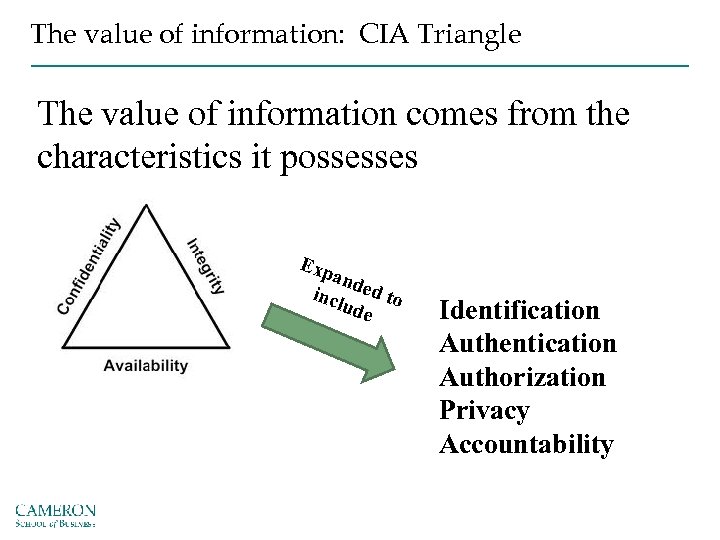 The value of information: CIA Triangle The value of information comes from the characteristics it possesses Exp and incl ed to ude Identification Authentication Authorization Privacy Accountability
 Identification and Authentication Identification – An information system possesses the characteristic of identification when it is able to recognize individual users – Identification and authentication are essential to establishing the level of access or authorization that an individual is granted Authentication – Occurs when a control proves that a user possesses the identity that he or she claims
 Authorization Assures that the user has been specifically and explicitly authorized by the proper authority to access, update, or delete the contents of an information asset Authorization occurs after authentication
 Categories of Access Control
 Categories of Access Control • • • Preventative Deterrent Detective Corrective Recovery Compensating
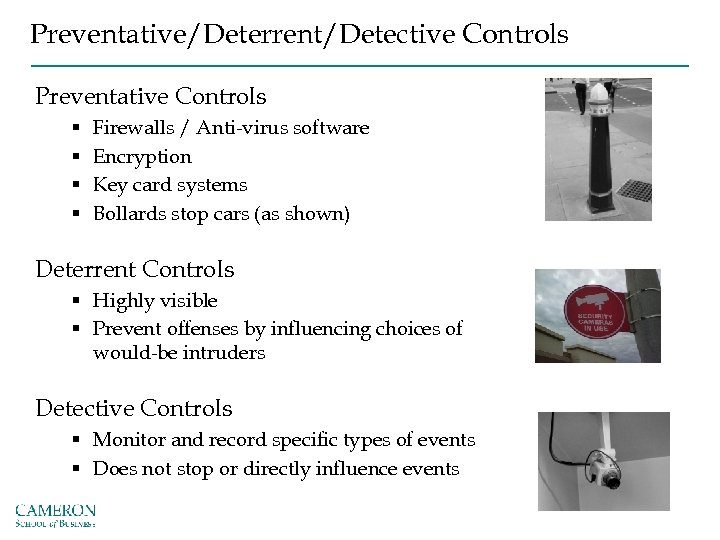 Preventative/Deterrent/Detective Controls Preventative Controls § § Firewalls / Anti-virus software Encryption Key card systems Bollards stop cars (as shown) Deterrent Controls § Highly visible § Prevent offenses by influencing choices of would-be intruders Detective Controls § Monitor and record specific types of events § Does not stop or directly influence events
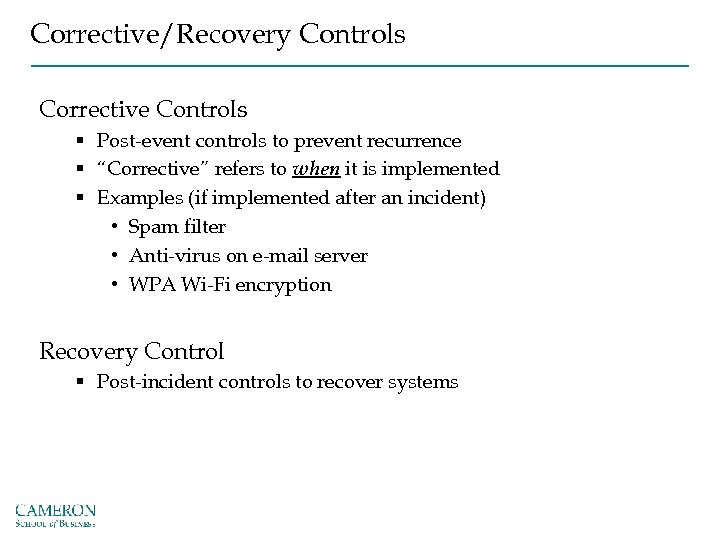 Corrective/Recovery Controls Corrective Controls § Post-event controls to prevent recurrence § “Corrective” refers to when it is implemented § Examples (if implemented after an incident) • Spam filter • Anti-virus on e-mail server • WPA Wi-Fi encryption Recovery Control § Post-incident controls to recover systems
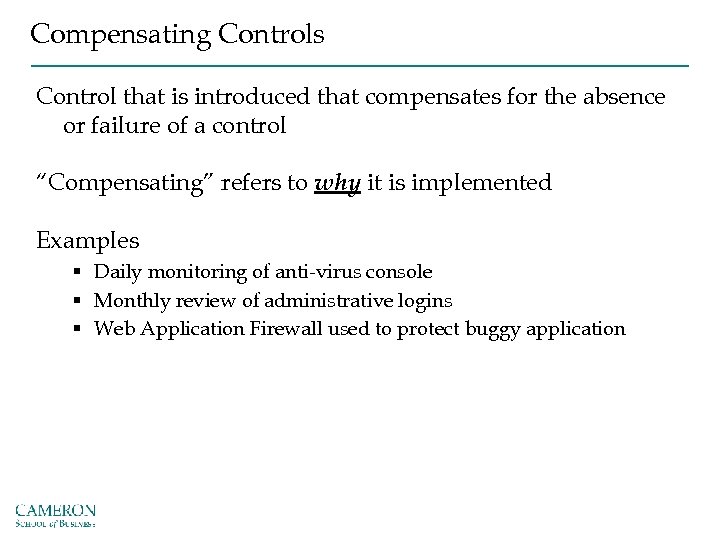 Compensating Controls Control that is introduced that compensates for the absence or failure of a control “Compensating” refers to why it is implemented Examples § Daily monitoring of anti-virus console § Monthly review of administrative logins § Web Application Firewall used to protect buggy application
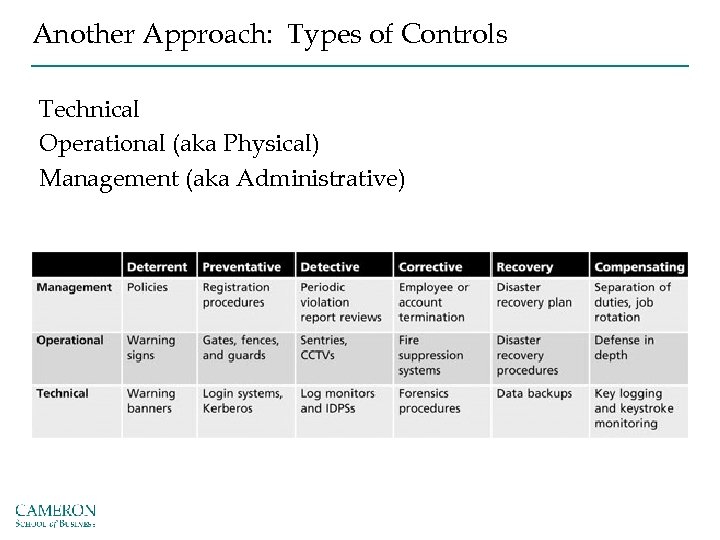 Another Approach: Types of Controls Technical Operational (aka Physical) Management (aka Administrative)
 Controlling Information Access
 Identification and Authentication Identification: unproven assertion of identity § “My name is…” § Userid Authentication: proven assertion of identity § Method Examples: • Password • Token • Biometric
 How Information Systems Authenticate Users Request userid and password § Hash password § Retrieve stored userid and hashed password § Compare Make a function call to a network based authentication service
 How a System Stores Userids and Passwords Typically stored in a database table § Application database or authentication database § Userid stored in plaintext § Password stored encrypted or hashed
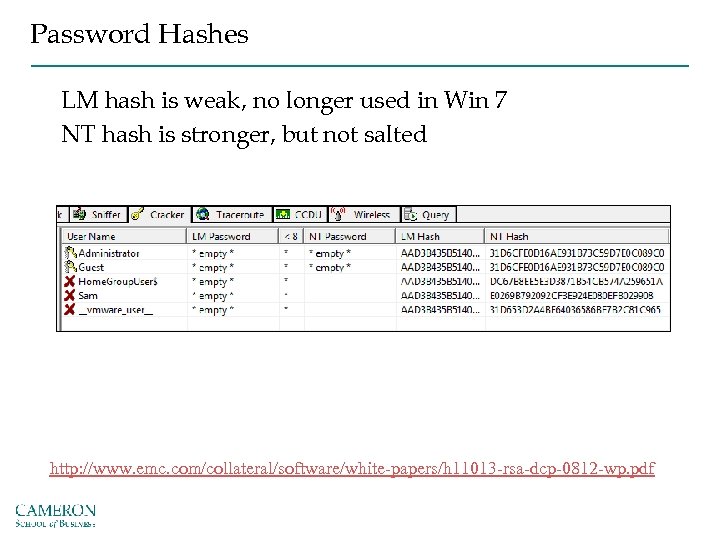 Password Hashes LM hash is weak, no longer used in Win 7 NT hash is stronger, but not salted http: //www. emc. com/collateral/software/white-papers/h 11013 -rsa-dcp-0812 -wp. pdf
 Strong Authentication Traditional userid + password authentication has known weaknesses Stronger types of authentication available, usually referred to as “strong authentication”
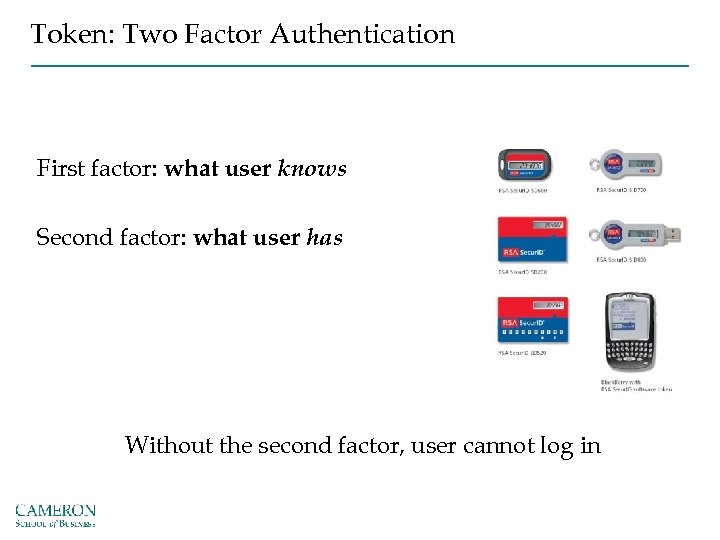 Token: Two Factor Authentication First factor: what user knows Second factor: what user has Without the second factor, user cannot log in
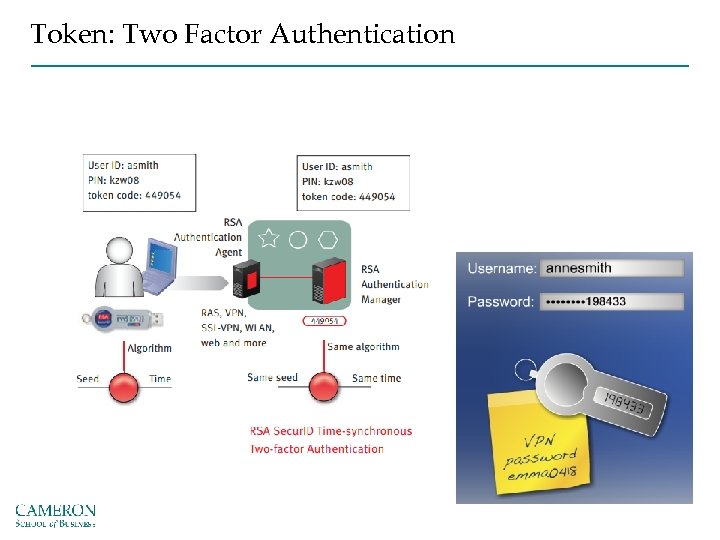 Token: Two Factor Authentication
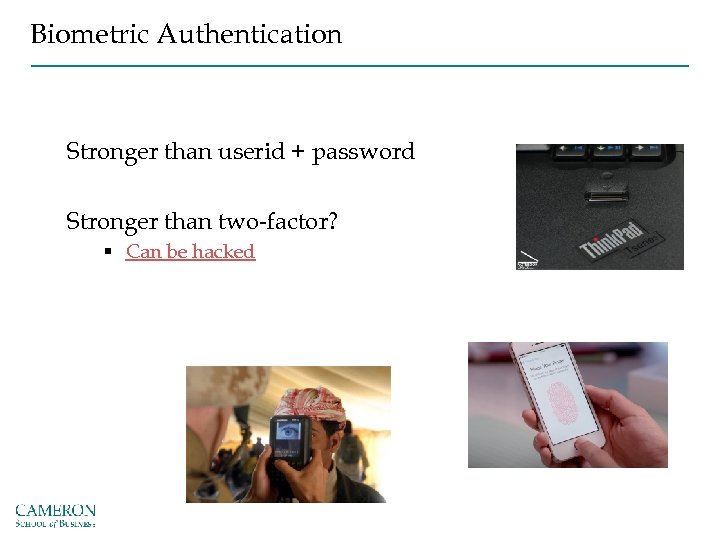 Biometric Authentication Stronger than userid + password Stronger than two-factor? § Can be hacked
 Article: Biometric Scanning Technologies Overview Technologies • Finger-Scan • Facial-Scan • Retinal-Scan
 Authentication Issues Password quality Consistency of user credentials across multiple environments Too many userids and passwords Handling password resets Dealing with compromised passwords Staff terminations
 Authorization: Degree of Authority Mandatory Access Controls Discretionary Access Controls Role Based Access Controls
 Mandatory Access Control Security Model • Data classification scheme • Rates collection of info and user with sensitivity levels • When implemented, users and data owners have limited control over access
 Mandatory Access Control Security Model • Data classification scheme/model – Data owners classify the information assets – Reviews periodically • Security clearance structure – Each user assigned an authorization level – Roles and corresponding security clearances
 Discretionary Access Control (DAC) Security Model The owner of an object controls who and what may access it.
 Role-based Access Control (RBAC) Security Model Nondiscretionary Controls
 Mobile Access Controls http: //sponsored. eweek. com/hid-global/10 -reasons-toembrace-mobile-access-control. html? =sponsored-newsticker
 Testing Access Controls
 Testing Access Controls Access controls are the primary defense that protect assets Types of tests: § Penetration tests § Application vulnerability tests § Code reviews http: //secunia. com/community/
 Penetration Testing Automatic scans to discover vulnerabilities Example tools: Nessus, Nikto, SAINT, Superscan, Retina, ISS, Microsoft Baseline Security Analyzer
 Application Vulnerability Testing Discover vulnerabilities in an application Automated tools and manual tools Example vulnerabilities § Cross-site scripting, injection flaws, malicious file execution, broken authentication, broken session management, information leakage, insecure use of encryption, and many more
 Audit Log Analysis Regular examination of audit and event logs § Detect unwanted events § Audit log protection
 Access Control Attacks
 Access Control Attacks Intruders will try to defeat, bypass, or trick access controls in order to reach their target Attack objectives § § § Guess credentials Malfunction of access controls Bypass access controls Replay known good logins Trick people into giving up credentials
 Types of Access Control Attacks • • • Buffer Overflow Script Injection Data Remanence Do. S Spoofing/Masquerading Social Engineering/Phishing
 Security Architecture Models
 Security Architecture Models • Can help organizations quickly make improvements through adaptation • Can focus on: – – computer hardware and software policies and practices the confidentiality of information the integrity of the information Pick one and go with it
 Bell-La. Padula Confidentiality Model • A state machine model that helps ensure the confidentiality of an information system – Using mandatory access controls (MACs), data classification, and security clearances
 Biba Integrity Model • Provides access controls to ensure that objects or subjects cannot have less integrity as a result of read/write operations • Ensures no information from a subject can be passed on to an object in a higher security level – This prevents contaminating data of higher integrity with data of lower integrity
 Clark-Wilson Integrity Model • Built upon principles of change control rather than integrity levels • Its change control principles – No changes by unauthorized subjects – No unauthorized changes by authorized subjects – The maintenance of internal and external consistency
 Graham-Denning Access Control Model • Composed of three parts – A set of objects – A set of subjects (a process and a domain) – A set of rights • • Primitive protection rights – Create or delete object, create or delete subject – Read, grant, transfer and delete access rights
 Harrison-Ruzzo-Ullman Model • Defines a method to allow changes to access rights and the addition and removal of subjects and objects – Since systems change over time, their protective states need to change • Built on an access control matrix • Includes a set of generic rights and a specific set of commands
 Brewer-Nash Model (aka Chinese Wall) • Designed to prevent a conflict of interest between two parties • Requires users to select one of two conflicting sets of data, after which they cannot access the conflicting data
 The ISO 27000 Series • Information Technology – Code of Practice for Information Security Management – One of the most widely referenced and discussed security models – Originally published as British Standard 7799 and then later as ISO/IEC 17799 – Since been renamed ISO/IEC 27002 • Establishes guidelines for initiating, implementing, maintaining, and improving information security management
 Control Objectives for Information and Related Technology (COBIT) • Control Objectives for Information and Related Technology (COBIT) – Provides advice about the implementation of sound controls and control objectives for Info. Sec – Created by the Information Systems Audit and Control Association (ISACA) and the IT Governance Institute (ITGI) in 1992
 COSO • A U. S. private-sector initiative – Major Objective: identify factors that cause fraudulent financial reporting and to make recommendations to reduce its incidence – Has established a common definition of internal controls, standards and criteria – Helps organizations comply with critical regulations like Sarbanes. Oxley
 COSO (cont’d. ) • Built on five interrelated components: – – – Control environment Risk assessment Control activities Information and communication Monitoring