


 Скачать презентацию Information Security and Risk Management CISSP Guide to
7f30ede4aa5cfa0f84255a52d6d13d3d.ppt
- Количество слайдов: 74
 Information Security and Risk Management CISSP Guide to Security Essentials Chapter 1
 Objectives • How security supports organizational mission, goals and objectives • Risk management • Security management • Personnel security • Professional ethics CISSP Guide to Security Essentials 2
 Mission • Statement of its ongoing purpose and reason for existence. • Usually published, so that employees, customers, suppliers, and partners are aware of the organization’s stated purpose. CISSP Guide to Security Essentials 3
 Mission (cont. ) • Should influence how we will approach the need to protect the organization’s assets. CISSP Guide to Security Essentials 4
 Example Mission Statements • “Promote professionalism among information system security practitioners through the provisioning of professional certification and training. ” – (ISC)² CISSP Guide to Security Essentials 5
 Example Mission Statements • “Help civilize the electronic frontier; to make it truly useful and beneficial not just to a technical elite, but to everyone…” CISSP Guide to Security Essentials 6
 Example Mission Statements • “…and to do this in a way which is in keeping with our society's highest traditions of the free and open flow of information and communication. ” – Electronic Frontier Foundation CISSP Guide to Security Essentials 7
 Example Mission Statements • “Empower and engage people around the world to collect and develop educational content under a free license or in the public domain, and to disseminate it effectively and globally. ” – Wikimedia Foundation CISSP Guide to Security Essentials 8
 Objectives • Statements of activities or end-states that the organization wishes to achieve. • Support the organization’s mission and describe how the organization will fulfill its mission. CISSP Guide to Security Essentials 9
 Objectives (cont. ) • Observable and measurable. • Do not necessarily specify how they will be completed, when, or by whom. CISSP Guide to Security Essentials 10
 Example Objectives • “Improve security audit results. ” • “Develop a security awareness strategy. ” • “Consolidate computer account provisioning processes. ” CISSP Guide to Security Essentials 11
 Goals • Specify specific accomplishments that will enable the organization to meet its objectives. • Measurable, observable, objective, support mission and objectives CISSP Guide to Security Essentials 12
 Example Goals • “Obtain ISO 27001 certification by the end of third quarter. ” • “Reduce development costs by twenty percent in the next fiscal year. ” • “Complete the integration of CRM and ERP systems by the end of November. ” CISSP Guide to Security Essentials 13
 Security Support of Mission, Objectives, and Goals • Influence development of mission, objectives, goals – Become involved in key activities – Risk management provides feedback CISSP Guide to Security Essentials 14
 Risk Management • “The process of determining the maximum acceptable level of overall risk to and from a proposed activity, then using risk assessment techniques to determine the initial level of risk and, if this is excessive, …” CISSP Guide to Security Essentials 15
 Risk Management • “…developing a strategy to ameliorate appropriate individual risks until the overall level of risk is reduced to an acceptable level. ” – Wiktionary – Risk assessments – Risk treatment CISSP Guide to Security Essentials 16
 Qualitative Risk Assessment • For a given scope of assets, identify: – – – Vulnerabilities Threat probability (Low / medium / high) Impact (Low / medium / high) Countermeasures CISSP Guide to Security Essentials 17
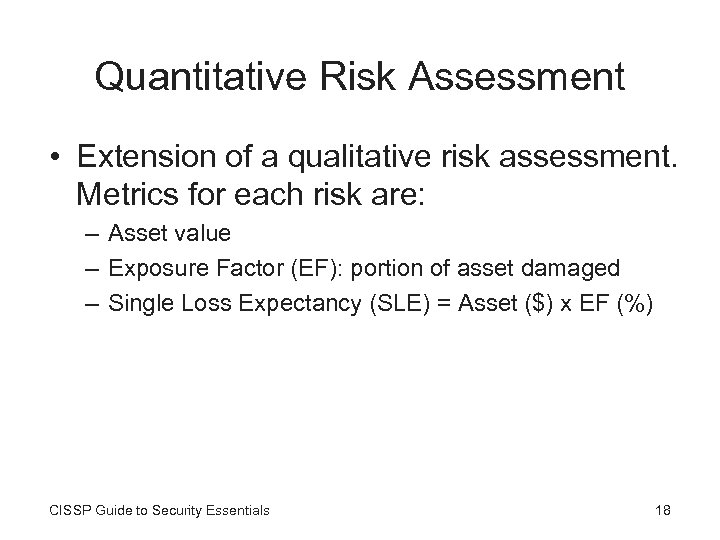 Quantitative Risk Assessment • Extension of a qualitative risk assessment. Metrics for each risk are: – Asset value – Exposure Factor (EF): portion of asset damaged – Single Loss Expectancy (SLE) = Asset ($) x EF (%) CISSP Guide to Security Essentials 18
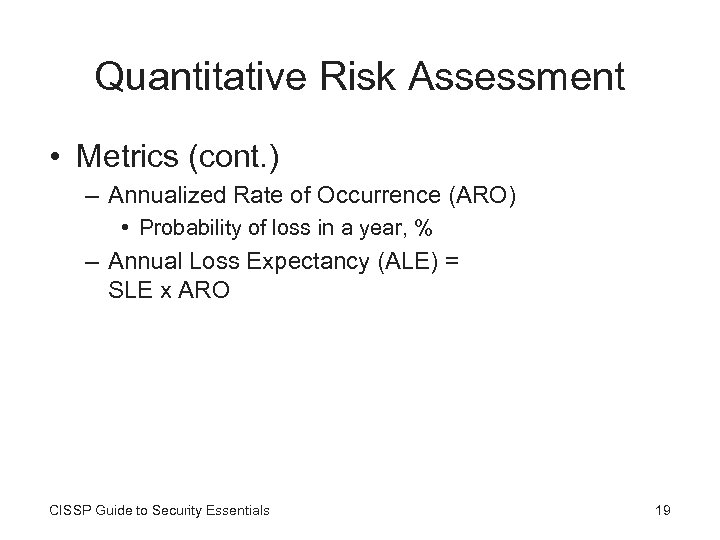 Quantitative Risk Assessment • Metrics (cont. ) – Annualized Rate of Occurrence (ARO) • Probability of loss in a year, % – Annual Loss Expectancy (ALE) = SLE x ARO CISSP Guide to Security Essentials 19
 Quantifying Countermeasures • Goal: reduction of ALE (or the qualitative losses) • Impact of countermeasures: – Cost of countermeasure – Changes in Exposure Factor (EF) – Changes in Single Loss Expectancy (SLE) CISSP Guide to Security Essentials 20
 Geographic Considerations • Replacement and repair costs of assets may vary by location • Exposure Factor may vary by location • Impact may vary by location CISSP Guide to Security Essentials 21
 Risk Assessment Methodologies • NIST 800 -30, Risk Management Guide for Information Technology Systems • OCTAVE (Operationally Critical Threat, Asset, and Vulnerability Evaluation) CISSP Guide to Security Essentials 22
 Risk Assessment Methodologies (cont. ) • FRAP (Facilitated Risk Analysis Process) – qualitative pre-screening • Spanning Tree Analysis – visual, similar to mind map CISSP Guide to Security Essentials 23
 Risk Treatment • One or more outcomes from a risk assessment – Risk acceptance • “yeah, we can live with that” – Risk avoidance • Discontinue the risk-related activity CISSP Guide to Security Essentials 24
 Risk Treatment (cont. ) • Risk Assessment Outcomes (cont. ) – Risk reduction • Mitigate – Risk transfer • Buy insurance CISSP Guide to Security Essentials 25
 Security Management Concepts • • • Security controls CIA Triad Defense in depth Single points of failure Fail open, fail closed Privacy CISSP Guide to Security Essentials 26
 Security Controls • • • Detective Preventive Deterrent Administrative Compensating (covered in depth in Chapter 3) CISSP Guide to Security Essentials 27
 CIA: Confidentiality, Integrity, Availability • The three pillars of security: the CIA Triad – Confidentiality: information and functions can be accessed only by properly authorized parties – Integrity: information and functions can be added, altered, or removed only by authorized persons and means CISSP Guide to Security Essentials 28
 CIA: Confidentiality, Integrity, Availability • The CIA Triad (cont. ) – Availability: systems, functions, and data must be available on-demand according to any agreed-upon parameters regarding levels of service CISSP Guide to Security Essentials 29
 Defense in Depth • A layered defense in which two or more layers or controls are used to protect an asset – Heterogeneity: the different controls should be different types, so as to better resist attack CISSP Guide to Security Essentials 30
 Defense in Depth • Layered defense (cont. ) – Entire protection: each control completely protects the asset from most or all threats CISSP Guide to Security Essentials 31
 Defense in Depth (cont. ) • Defense in depth reduces or eliminates the risks associated by single points of failure, fail open, malfunctions, and successful attacks on individual components CISSP Guide to Security Essentials 32
 Single Points of Failure • A single point of failure (SPOF) is a weakness in a system where the failure of a single component results in the failure of the entire system CISSP Guide to Security Essentials 33
 Fail Open / Fail Closed • When a security mechanism fails, there are usually two possible outcomes: – Fail open – the mechanism permits all activity – Fail closed – the mechanism blocks all activity CISSP Guide to Security Essentials 34
 Fail Open / Fail Closed (cont. ) • Principles – Different types of failures will have different results – Both fail open and fail closed are undesirable, but sometimes one or the other is catastrophic! CISSP Guide to Security Essentials 35
 Privacy • Defined: the protection and proper handling of sensitive personal information • Requires proper technology for protection CISSP Guide to Security Essentials 36
 Privacy (cont. ) • Requires appropriate business processes and controls for appropriate handling • Issues – Inappropriate uses – Unintended disclosures to others CISSP Guide to Security Essentials 37
 Security Management • Executive oversight • Governance • Policy, guidelines, standards, and procedures • Roles and responsibilities CISSP Guide to Security Essentials 38
 Security Management (cont. ) • • • Service level agreements Secure outsourcing Data classification and protection Certification and accreditation Internal audit CISSP Guide to Security Essentials 39
 Security Executive Oversight • • Support and enforcement of policies Allocation of resources Prioritization of activities Risk treatment CISSP Guide to Security Essentials 40
 Governance • Defined: “Security governance is the set of responsibilities and practices exercised by the board and executive management with the goal of providing strategic direction, ensuring that objectives are achieved…” CISSP Guide to Security Essentials 41
 Governance (cont. ) • “…ascertaining that risks are managed appropriately and verifying that the enterprise's resources are used responsibly. ” – IT Governance Institute CISSP Guide to Security Essentials 42
 Governance (cont. ) • • • Steering committee oversight Resource allocation and prioritization Status reporting Strategic decisions The process and action that supports executive oversight CISSP Guide to Security Essentials 43
 Policies, Requirements, Guidelines, Standards, and Procedures • Policies: constraints of behavior on systems and people. Defines what, but not how. • Requirements: required characteristics of a system or process CISSP Guide to Security Essentials 44
 Policies, Requirements, Guidelines, Standards, and Procedures (cont. ) • Guidelines: defines how to support a policy • Standards: what products, technical standards, and methods will be used to support policy • Procedures: step by step instructions CISSP Guide to Security Essentials 45
 Roles and Responsibilities • Formally defined in security policy and job descriptions • These need to be defined: – – Ownership of assets Access to assets Use of assets Managers responsible for employee behavior CISSP Guide to Security Essentials 46
 Service Level Agreements • SLAs define a formal level of service • SLAs for security activities – – Security incident response Security alert / advisory delivery Security investigation Policy and procedure review CISSP Guide to Security Essentials 47
 Secure Outsourcing • Outsourcing risks – Control of confidential information – Loss of control of business activities – Accountability – the organization that outsources activities is still accountable for their activities and outcomes CISSP Guide to Security Essentials 48
 Data Classification and Protection • Components of a classification and protection program – Sensitivity levels • “confidential”, “restricted”, “secret”, etc. – Marking procedures • How to indicate sensitivity on various forms of information CISSP Guide to Security Essentials 49
 Data Classification and Protection (cont. ) • Components (cont. ) – Access procedures – Handling procedures • E-mailing, faxing, mailing, printing, transmitting, destruction CISSP Guide to Security Essentials 50
 Certification and Accreditation • Two-step process for the formal evaluation and approval for use of a system – Certification is the process of evaluating a system against a set of formal standards, policies, or specifications. CISSP Guide to Security Essentials 51
 Certification and Accreditation (cont. ) • Two-step process (cont. ) – Accreditation is the formal approval for the use of a certified system, for a defined period of time (and possibly other conditions). CISSP Guide to Security Essentials 52
 Internal Audit • Evaluation of security controls and policies to measure their effectiveness – – Performed by internal staff Objectivity is of vital importance Formal methodology Required by some regulations, e. g. Sarbanes Oxley CISSP Guide to Security Essentials 53
 Security Strategies • Management is responsible for developing the ongoing strategy for security management CISSP Guide to Security Essentials 54
 Security Strategies (cont. ) • Past incidents can help shape the future – – Incidents SLA performance Certification and accreditation Internal audit CISSP Guide to Security Essentials 55
 Personnel / Staffing Security • • Hiring practices and procedures Periodic performance evaluation Disciplinary action policy and procedures Termination procedures CISSP Guide to Security Essentials 56
 Hiring Practices and Procedures • Effective assessment of qualifications • Background verification (prior employment, education, criminal history, financial history) • Non-disclosure agreement • Intellectual property agreement CISSP Guide to Security Essentials 57
 Hiring Practices and Procedures (cont. ) • Employment agreement • Agreement to abide by all organizational policies • Formal job descriptions CISSP Guide to Security Essentials 58
 Termination • Immediate termination of all logical and physical access • Change passwords known to the employee • Recovery of all assets CISSP Guide to Security Essentials 59
 Termination (cont. ) • Notification of the termination to affected staff, customers, other third parties • And possibly: code reviews, review of recent activities prior to the termination CISSP Guide to Security Essentials 60
 Work Practices • Separation of duties – Designing sensitive processes so that two or more persons are required to complete them • Job rotation – Good for cross-training, and also reduces the likelihood that employees will collude for personal gain CISSP Guide to Security Essentials 61
 Work Practices (cont. ) • Mandatory vacations – Detect / prevent irregularities that violate policy and practices CISSP Guide to Security Essentials 62
 Security Education, Training, and Awareness • Training on security policy, guidelines, standards • Upon hire and periodically thereafter CISSP Guide to Security Essentials 63
 Security Education, Training, and Awareness (cont. ) • Various types of messaging – E-mail, intranet, posters, flyers, trinkets, training classes • Testing – to measure employee knowledge of policy and practices CISSP Guide to Security Essentials 64
 Professional Ethics • (ISC)² code of ethics – Code of Ethics Canons • Protect society, the commonwealth, and the infrastructure. • Act honorably, honestly, justly, responsibly, and legally. CISSP Guide to Security Essentials 65
 Professional Ethics (cont. ) • (ISC)² code of ethics (cont. ) – Code of Ethics Canons (cont. ) • Provide diligent and competent service to principals. • Advance and protect the profession. CISSP Guide to Security Essentials 66
 Summary • An organization’s security program should support its mission, objectives, and goals • The core principles of information security are confidentiality, integrity, and availability. CISSP Guide to Security Essentials 67
 Summary (cont. ) • Privacy is related to the protection and proper handling of personal information. • Security governance is the set of responsibilities and practices related to the development of strategic direction and risk management. CISSP Guide to Security Essentials 68
 Summary (cont. ) • Security policies specify the required characteristics of information systems and the required conduct of employees. • Security roles and responsibilities define the ownership, access, and use of assets, and the general responsibilities of managers and employees. CISSP Guide to Security Essentials 69
 Summary (cont. ) • Data classification and protection defines levels of sensitivity for business information, as well as handling procedures for each level of sensitivity. • Internal audit is the activity of evaluating security controls and policies to measure their effectiveness. CISSP Guide to Security Essentials 70
 Summary (cont. ) • An organization’s hiring process should include the use of non-disclosure, employment, non-compete, intellectual property, and acceptable use agreements, as well as background checks. CISSP Guide to Security Essentials 71
 Summary (cont. ) • Upon termination of employment, the organization should retrieve all assets issued to the terminated employee and immediately rescind the employee’s access to all information systems. CISSP Guide to Security Essentials 72
 Summary (cont. ) • Sound work practices include separation of duties, job rotation, and mandatory vacations. • A security education, training, and awareness program should keep employees regularly informed of their expectations. CISSP Guide to Security Essentials 73
 Summary (cont. ) • Security professionals should adhere to a strict code of professional conduct and ethics. CISSP Guide to Security Essentials 74