 Скачать презентацию INFORMATION MANAGEMENT AND COMMUNICATION Making groundwater visible Albert
8049934db43e5ebddc5d8970bf70f2ea.ppt
- Количество слайдов: 35



INFORMATION MANAGEMENT AND COMMUNICATION Making groundwater visible Albert Tuinhof Groundwater Development and Management GW-MATE Specialist Training of Trainers for AGW –NET MEMBERS Dar es Salaam - November 16 -20, 2009
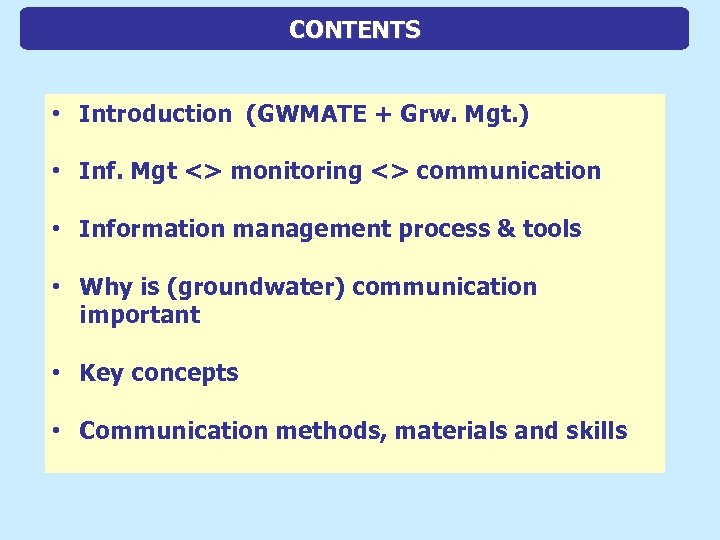
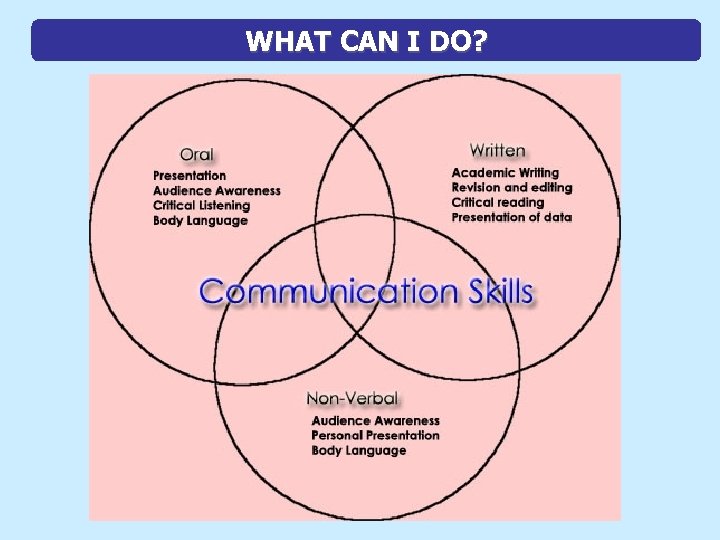
CONTENTS • Introduction (GWMATE + Grw. Mgt. ) • Inf. Mgt <> monitoring <> communication • Information management process & tools • Why is (groundwater) communication important • Key concepts • Communication methods, materials and skills
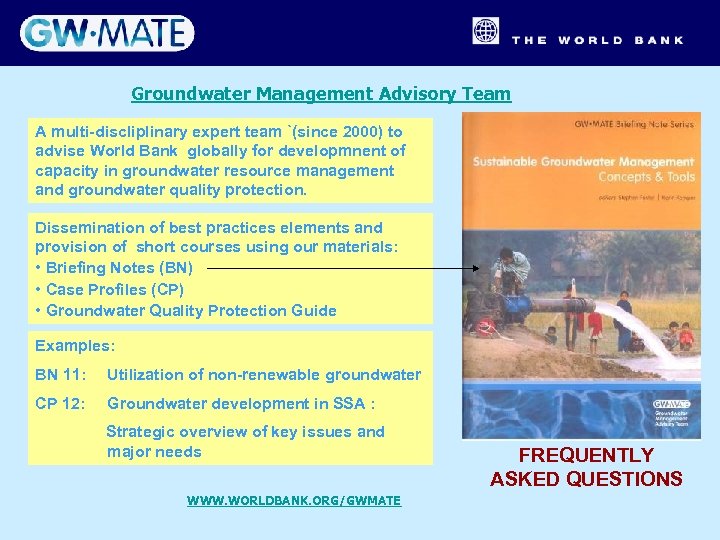
Groundwater Management Advisory Team A multi-discliplinary expert team `(since 2000) to advise World Bank globally for developmnent of capacity in groundwater resource management and groundwater quality protection. Dissemination of best practices elements and provision of short courses using our materials: • Briefing Notes (BN) • Case Profiles (CP) • Groundwater Quality Protection Guide Examples: BN 11: Utilization of non-renewable groundwater CP 12: Groundwater development in SSA : Strategic overview of key issues and major needs WWW. WORLDBANK. ORG/GWMATE FREQUENTLY ASKED QUESTIONS
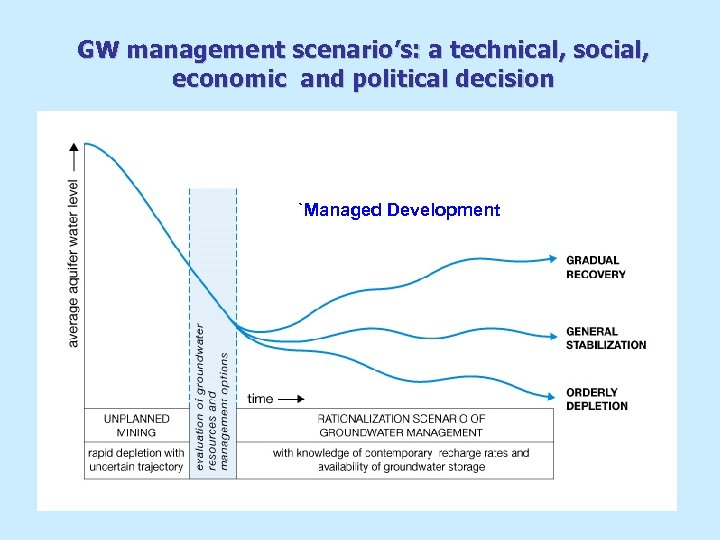
GW management scenario’s: a technical, social, economic and political decision `Managed Development
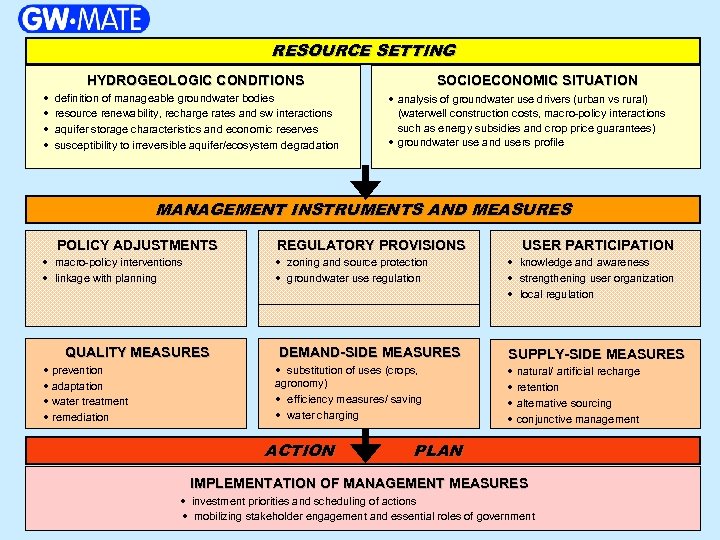
RESOURCE SETTING HYDROGEOLOGIC CONDITIONS definition of manageable groundwater bodies resource renewability, recharge rates and sw interactions aquifer storage characteristics and economic reserves susceptibility to irreversible aquifer/ecosystem degradation SOCIOECONOMIC SITUATION analysis of groundwater use drivers (urban vs rural) (waterwell construction costs, macro-policy interactions such as energy subsidies and crop price guarantees) groundwater use and users profile MANAGEMENT INSTRUMENTS AND MEASURES POLICY ADJUSTMENTS zoning and source protection groundwater use regulation macro-policy interventions linkage with planning QUALITY MEASURES prevention adaptation water treatment remediation REGULATORY PROVISIONS DEMAND-SIDE MEASURES substitution of uses (crops, agronomy) efficiency measures/ saving water charging ACTION USER PARTICIPATION knowledge and awareness strengthening user organization local regulation SUPPLY-SIDE MEASURES natural/ artificial recharge retention alternative sourcing conjunctive management PLAN IMPLEMENTATION OF MANAGEMENT MEASURES investment priorities and scheduling of actions mobilizing stakeholder engagement and essential roles of government
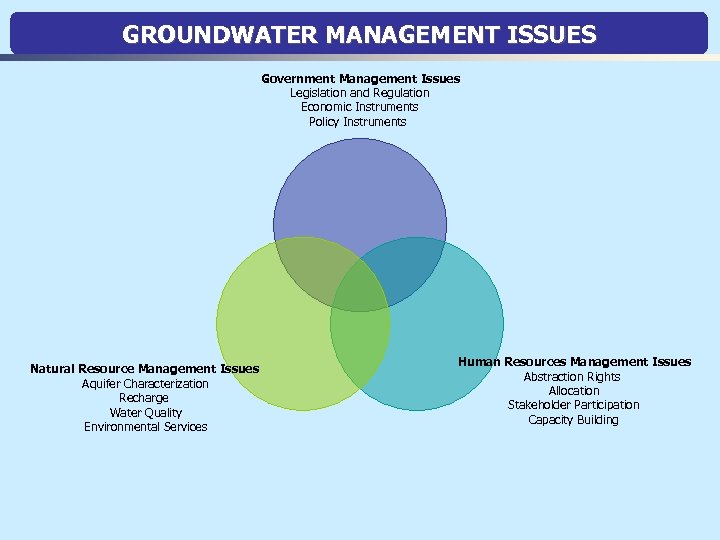
GROUNDWATER MANAGEMENT ISSUES Government Management Issues Legislation and Regulation Economic Instruments Policy Instruments Natural Resource Management Issues Aquifer Characterization Recharge Water Quality Environmental Services Human Resources Management Issues Abstraction Rights Allocation Stakeholder Participation Capacity Building
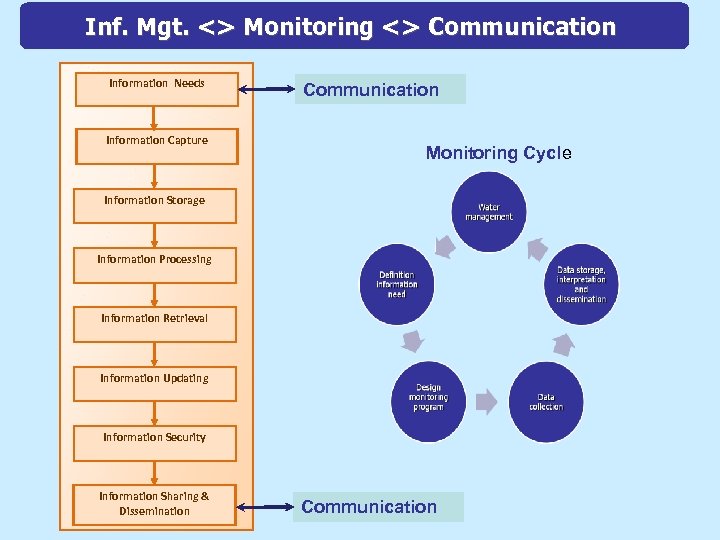
Inf. Mgt. <> Monitoring <> Communication Information Needs Figure 8. 1: Information Management Process Steps Information Capture Communication Monitoring Cycle Information Storage Information Processing Information Retrieval Information Updating Information Security Information Sharing & Dissemination Communication
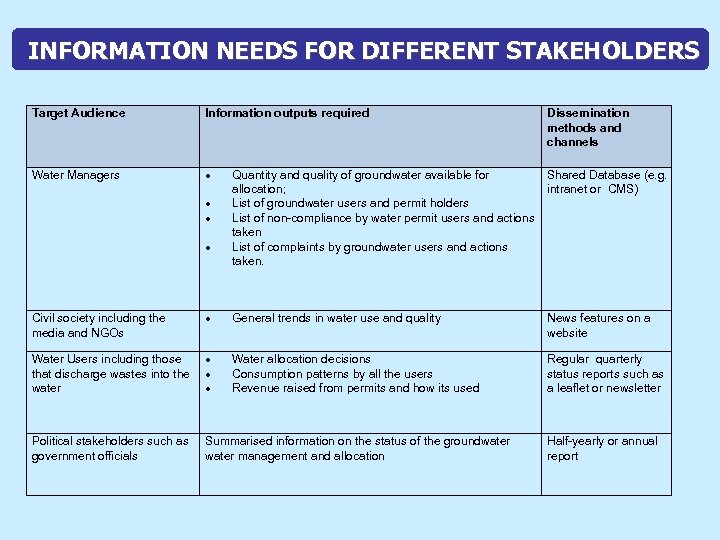
INFORMATION NEEDS FOR DIFFERENT STAKEHOLDERS Target Audience Information outputs required Dissemination methods and channels Water Managers Quantity and quality of groundwater available for allocation; List of groundwater users and permit holders List of non-compliance by water permit users and actions taken List of complaints by groundwater users and actions taken. Shared Database (e. g. intranet or CMS) Civil society including the media and NGOs General trends in water use and quality News features on a website Water Users including those that discharge wastes into the water Water allocation decisions Consumption patterns by all the users Revenue raised from permits and how its used Regular quarterly status reports such as a leaflet or newsletter Political stakeholders such as government officials Summarised information on the status of the groundwater management and allocation Half-yearly or annual report
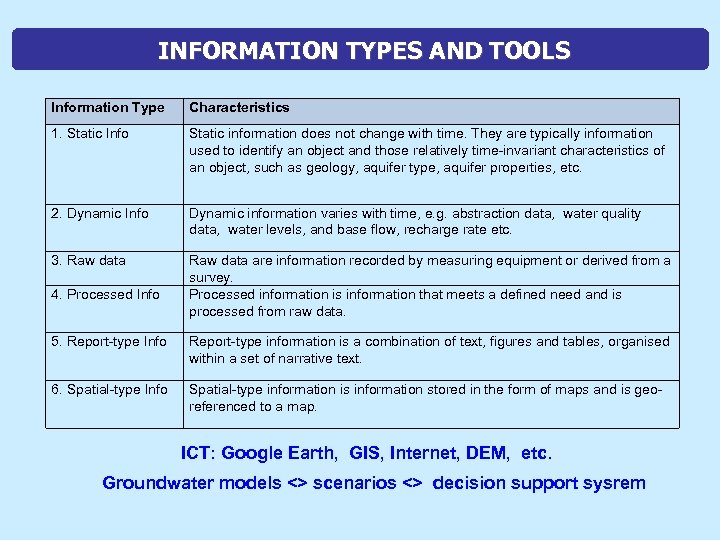
INFORMATION TYPES AND TOOLS Information Type Characteristics 1. Static Info Static information does not change with time. They are typically information used to identify an object and those relatively time-invariant characteristics of an object, such as geology, aquifer type, aquifer properties, etc. 2. Dynamic Info Dynamic information varies with time, e. g. abstraction data, water quality data, water levels, and base flow, recharge rate etc. 3. Raw data are information recorded by measuring equipment or derived from a survey. Processed information is information that meets a defined need and is processed from raw data. 4. Processed Info 5. Report-type Info Report-type information is a combination of text, figures and tables, organised within a set of narrative text. 6. Spatial-type Info Spatial-type information is information stored in the form of maps and is georeferenced to a map. ICT: Google Earth, GIS, Internet, DEM, etc. Groundwater models <> scenarios <> decision support sysrem
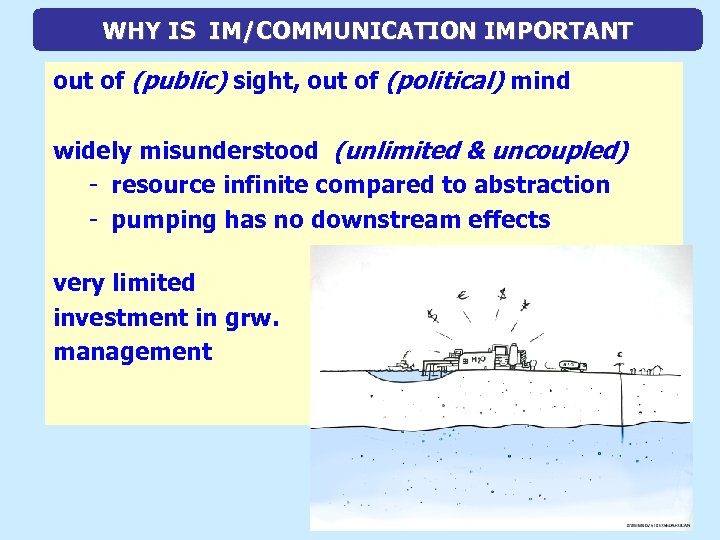
WHY IS IM/COMMUNICATION IMPORTANT out of (public) sight, out of (political) mind widely misunderstood (unlimited & uncoupled) - resource infinite compared to abstraction - pumping has no downstream effects very limited investment in grw. management
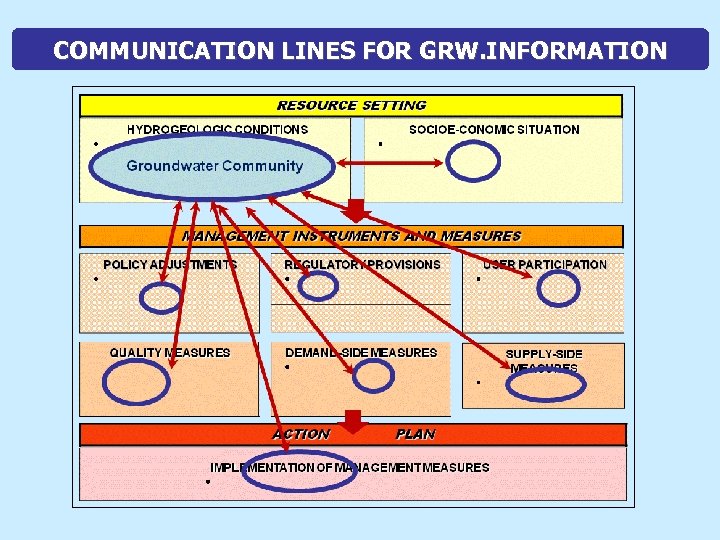
COMMUNICATION LINES FOR GRW. INFORMATION
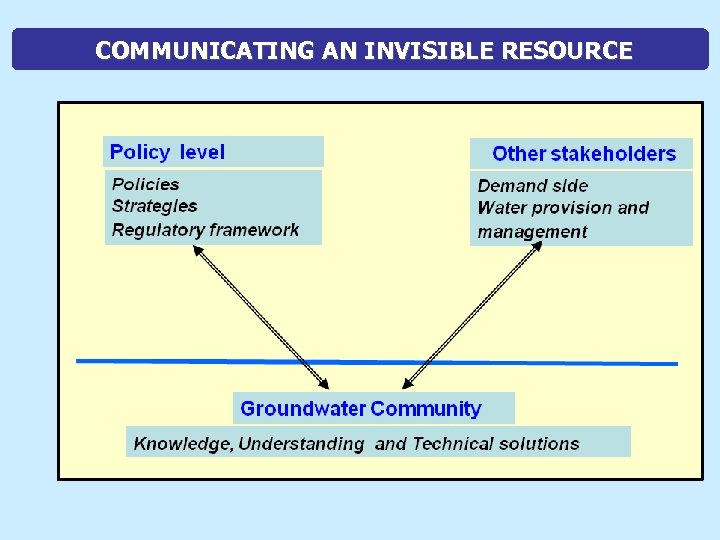
COMMUNICATING AN INVISIBLE RESOURCE
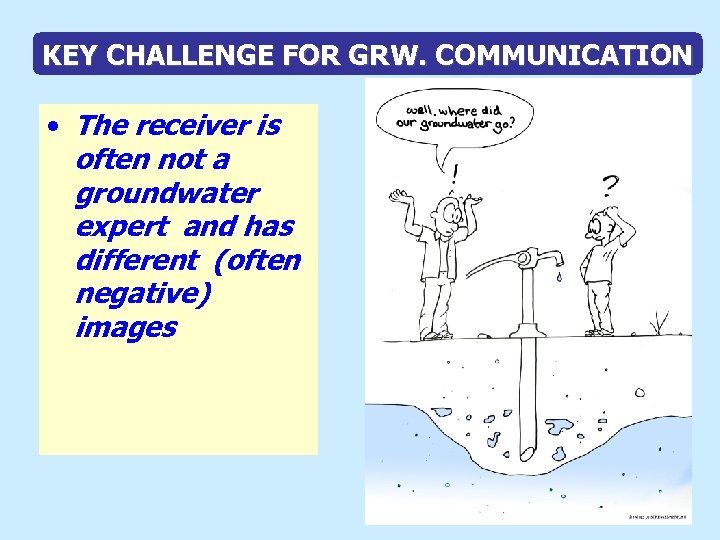
KEY CHALLENGE FOR GRW. COMMUNICATION • The receiver is often not a groundwater expert and has different (often negative) images
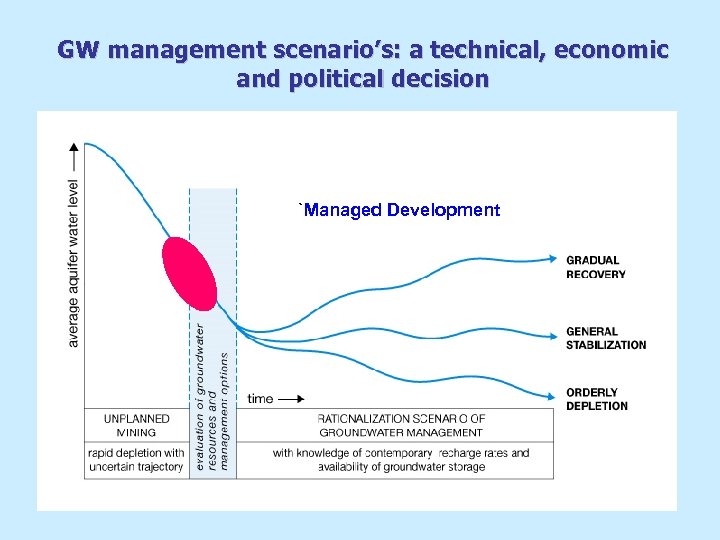
GW management scenario’s: a technical, economic and political decision `Managed Development
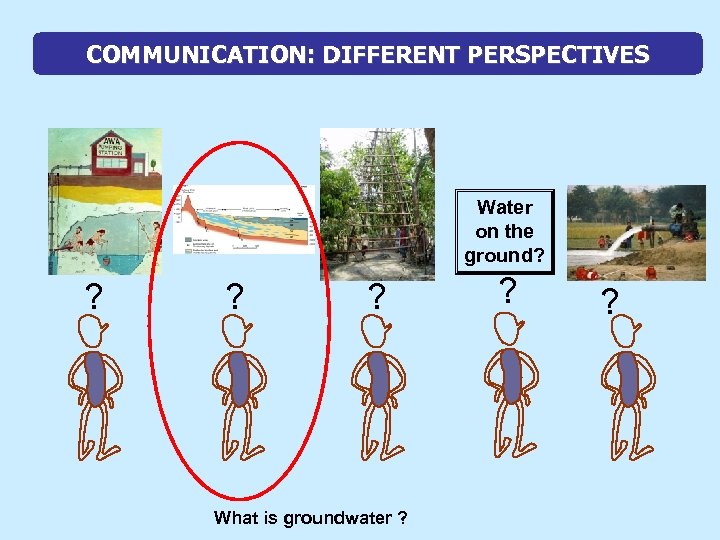
COMMUNICATION: DIFFERENT PERSPECTIVES Water on the ground? ? What is groundwater ? ? ?
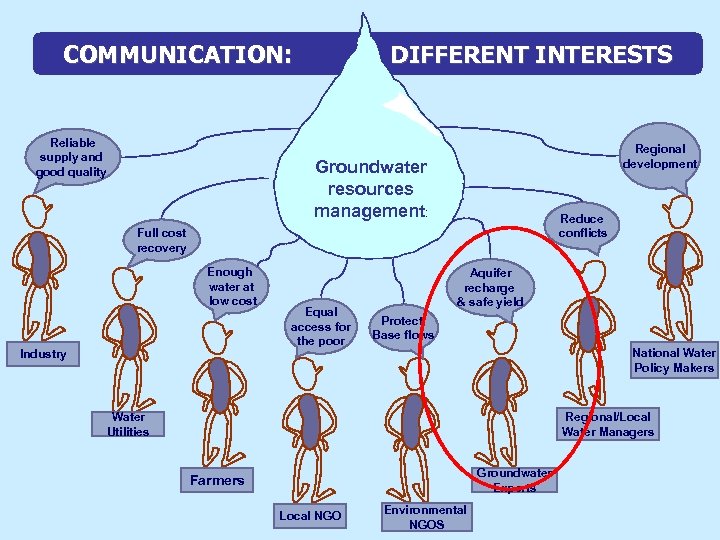
COMMUNICATION: Reliable supply and good quality DIFFERENT INTERESTS Regional development Groundwater resources management: Reduce conflicts Full cost recovery Enough water at low cost Industry Equal access for the poor Aquifer recharge & safe yield Protect Base flows National Water Policy Makers Water Utilities Regional/Local Water Managers Groundwater Experts Farmers Local NGO Environmental NGOS
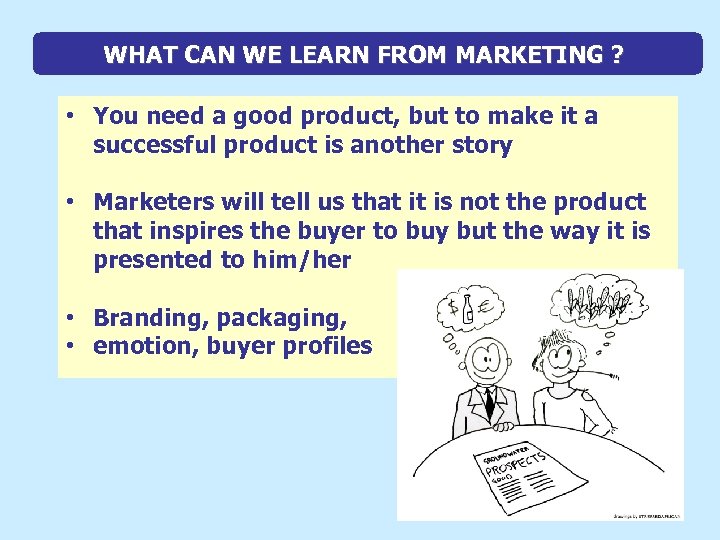
WHAT CAN WE LEARN FROM MARKETING ? • You need a good product, but to make it a successful product is another story • Marketers will tell us that it is not the product that inspires the buyer to buy but the way it is presented to him/her U • Branding, packaging, • emotion, buyer profiles
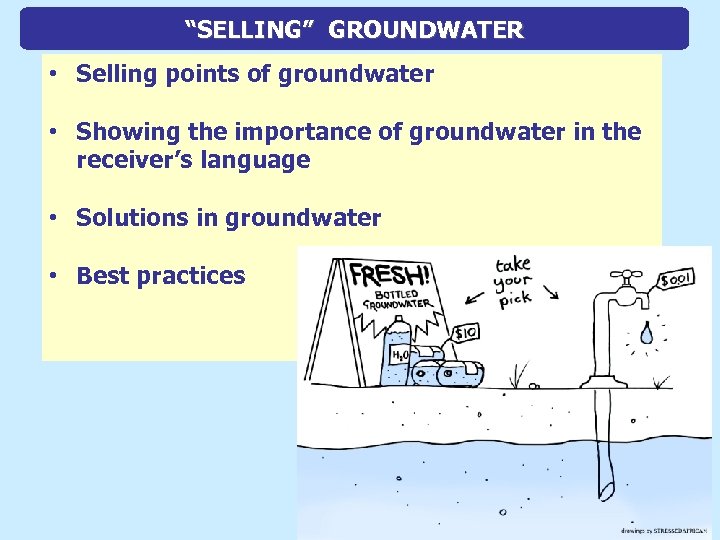
“SELLING” GROUNDWATER • Selling points of groundwater • Showing the importance of groundwater in the receiver’s language • Solutions in groundwater • Best practices
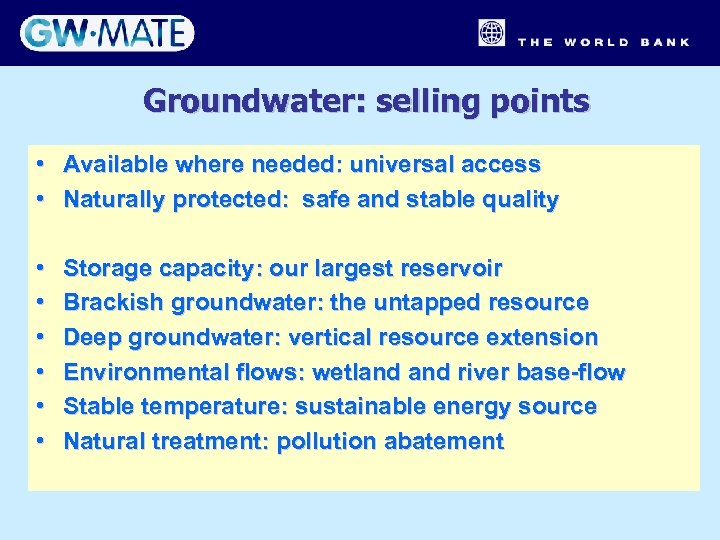
Groundwater: selling points • Available where needed: universal access • Naturally protected: safe and stable quality • • • Storage capacity: our largest reservoir Brackish groundwater: the untapped resource Deep groundwater: vertical resource extension Environmental flows: wetland river base-flow Stable temperature: sustainable energy source Natural treatment: pollution abatement
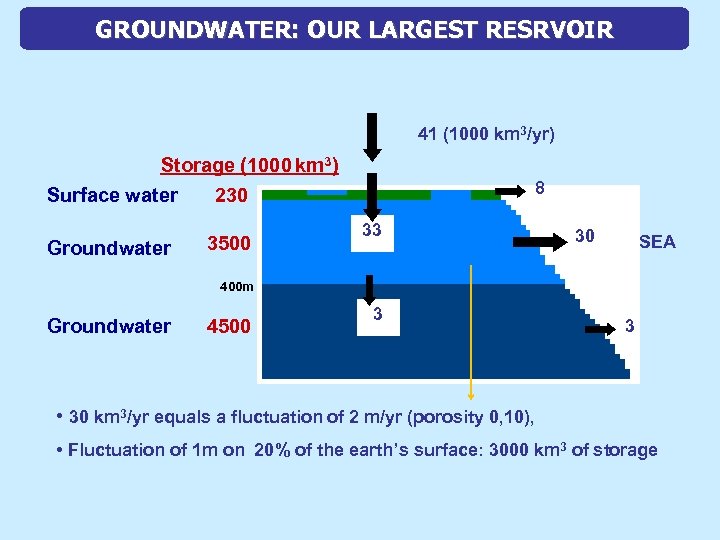
GROUNDWATER: OUR LARGEST Groundwater: our largest reservoir RESRVOIR 41 (1000 km 3/yr) Storage (1000 km 3) Surface water 230 Groundwater 3500 8 33 30 SEA 400 m Groundwater 4500 3 3 • 30 km 3/yr equals a fluctuation of 2 m/yr (porosity 0, 10), • Fluctuation of 1 m on 20% of the earth’s surface: 3000 km 3 of storage
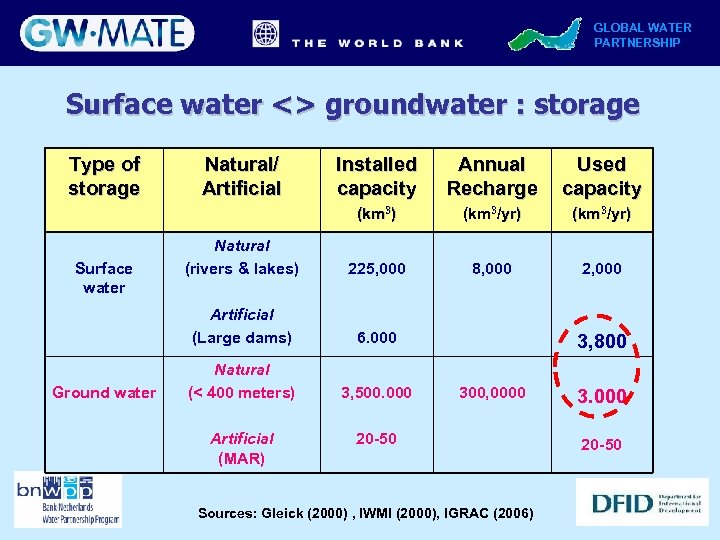
GLOBAL WATER PARTNERSHIP Surface water <> groundwater : storage Type of storage Annual Recharge Used capacity (km 3/yr) Natural (rivers & lakes) 225, 000 8, 000 2, 000 Artificial (Large dams) Ground water Installed capacity (km 3) Surface water Natural/ Artificial 6. 000 Natural (< 400 meters) 3, 500. 000 Artificial (MAR) 3, 800 300, 0000 20 -50 Sources: Gleick (2000) , IWMI (2000), IGRAC (2006) 3. 000 20 -50
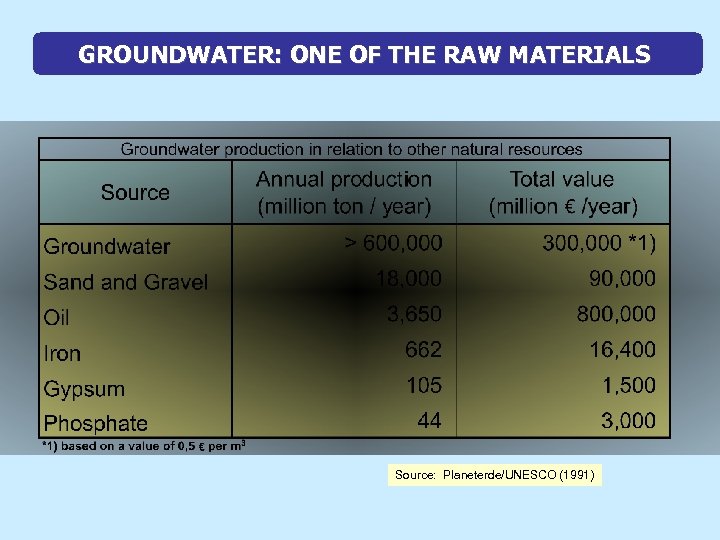
GROUNDWATER: ONE OF THE RAW MATERIALS Source: Planeterde/UNESCO (1991)
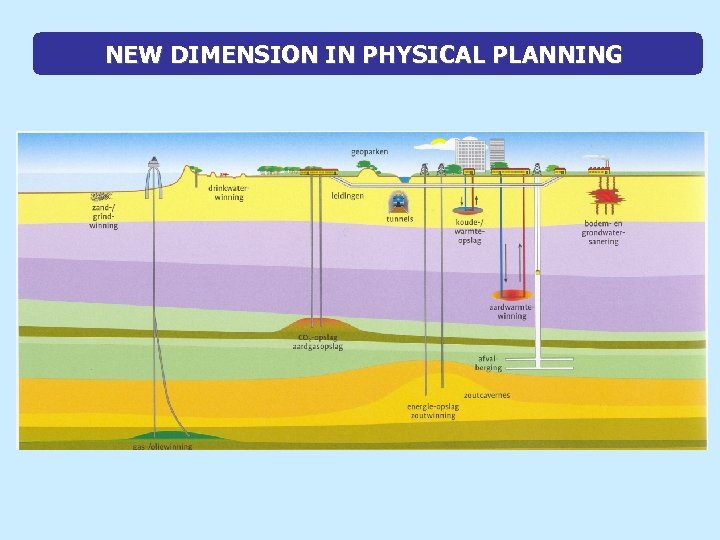
NEW DIMENSION IN PHYSICAL PLANNING
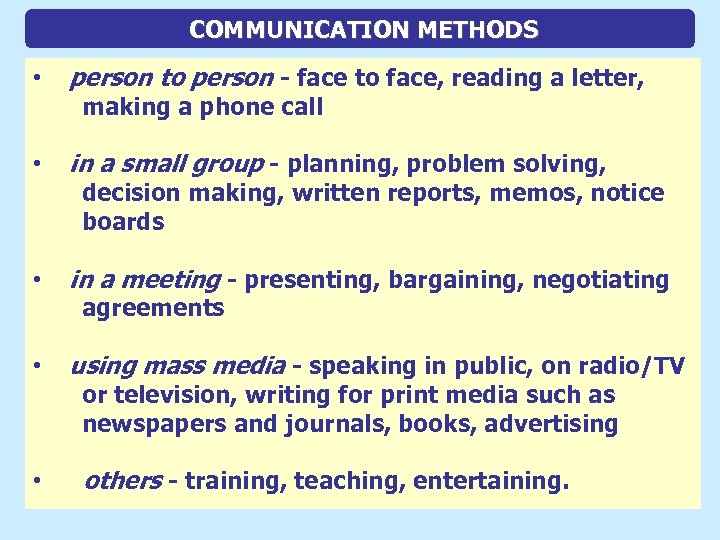
COMMUNICATION METHODS • person to person - face to face, reading a letter, • in a small group - planning, problem solving, • in a meeting - presenting, bargaining, negotiating • using mass media - speaking in public, on radio/TV • making a phone call decision making, written reports, memos, notice boards agreements or television, writing for print media such as newspapers and journals, books, advertising others - training, teaching, entertaining.
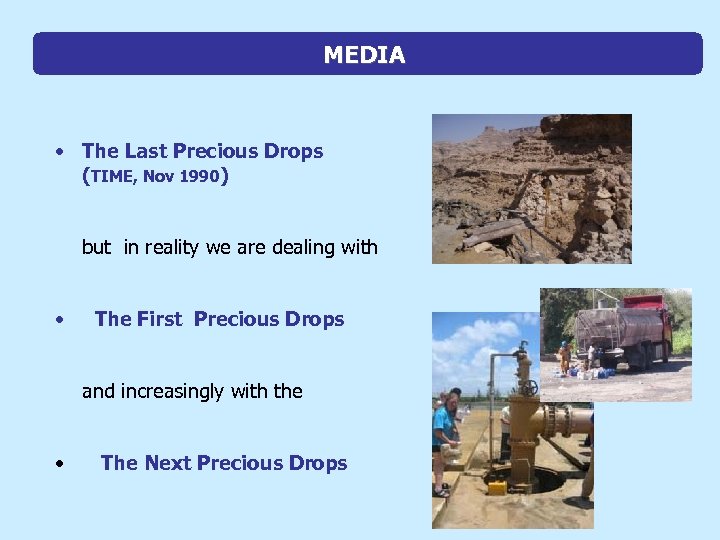
MEDIA • The Last Precious Drops (TIME, Nov 1990) but in reality we are dealing with • The First Precious Drops and increasingly with the • The Next Precious Drops
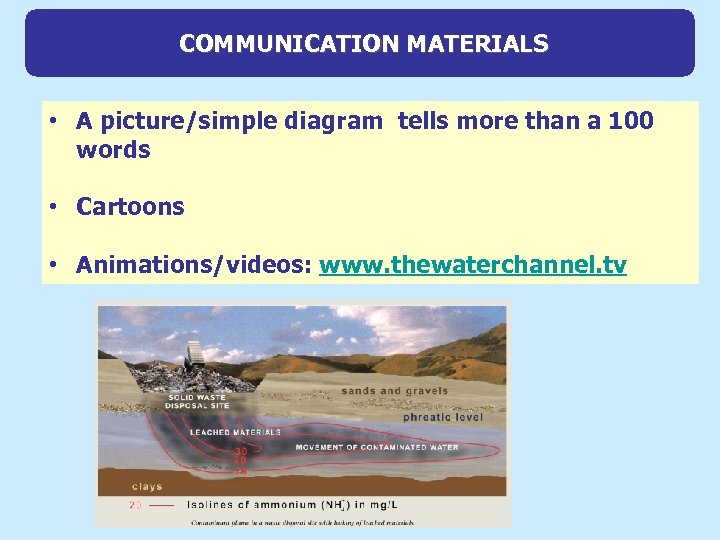
COMMUNICATION MATERIALS • A picture/simple diagram tells more than a 100 words • Cartoons • Animations/videos: www. thewaterchannel. tv
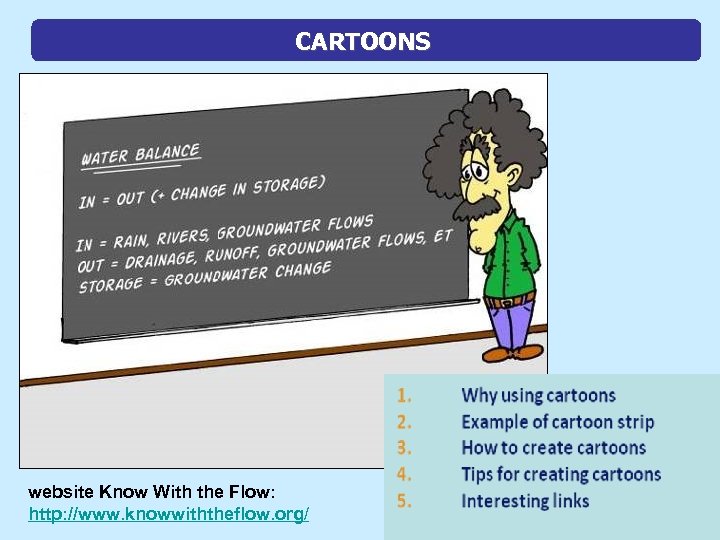
CARTOONS website Know With the Flow: http: //www. knowwiththeflow. org/
WHAT CAN I DO?
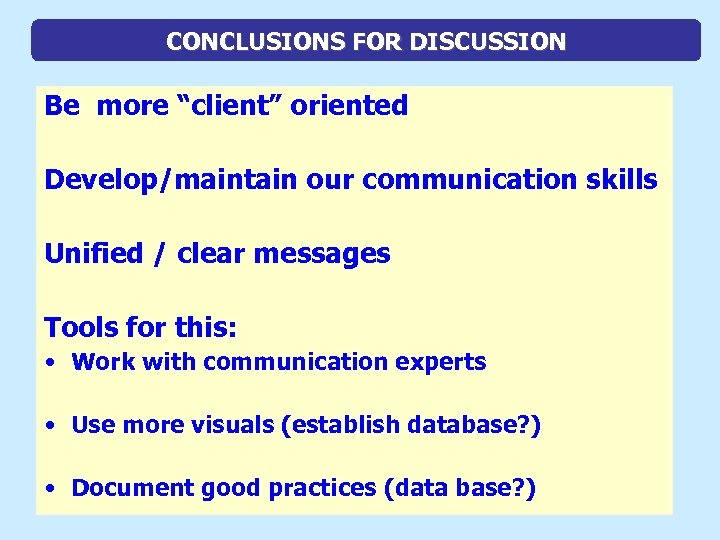
CONCLUSIONS FOR DISCUSSION Be more “client” oriented Develop/maintain our communication skills Unified / clear messages Tools for this: • Work with communication experts • Use more visuals (establish database? ) • Document good practices (data base? )
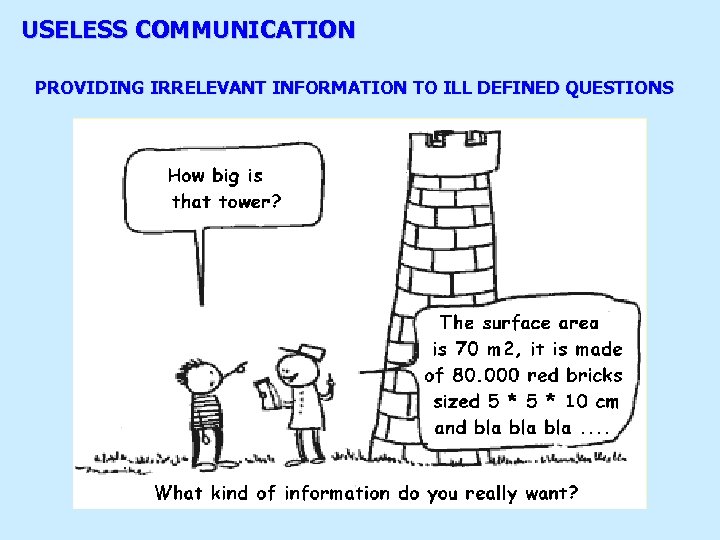
USELESS COMMUNICATION PROVIDING IRRELEVANT INFORMATION TO ILL DEFINED QUESTIONS
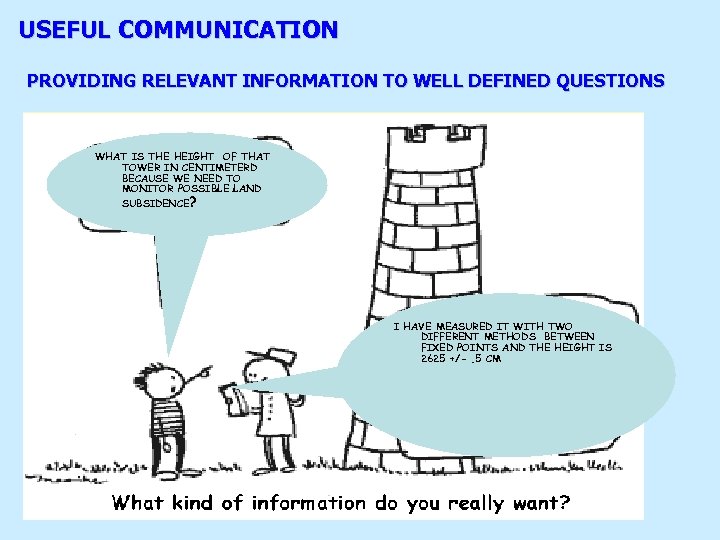
USEFUL COMMUNICATION PROVIDING RELEVANT INFORMATION TO WELL DEFINED QUESTIONS WHAT IS THE HEIGHT OF THAT TOWER IN CENTIMETERD BECAUSE WE NEED TO MONITOR POSSIBLE LAND SUBSIDENCE? I HAVE MEASURED IT WITH TWO DIFFERENT METHODS BETWEEN FIXED POINTS AND THE HEIGHT IS 2625 +/-. 5 CM
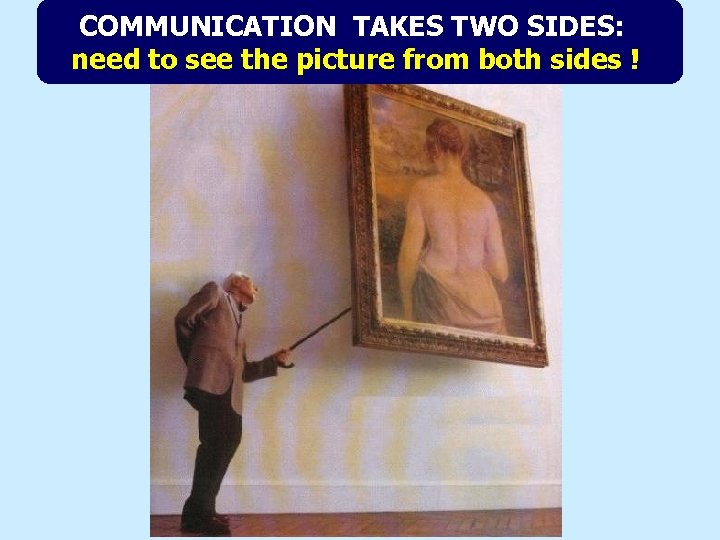
COMMUNICATION TAKES TWO SIDES: need to see the picture from both sides !
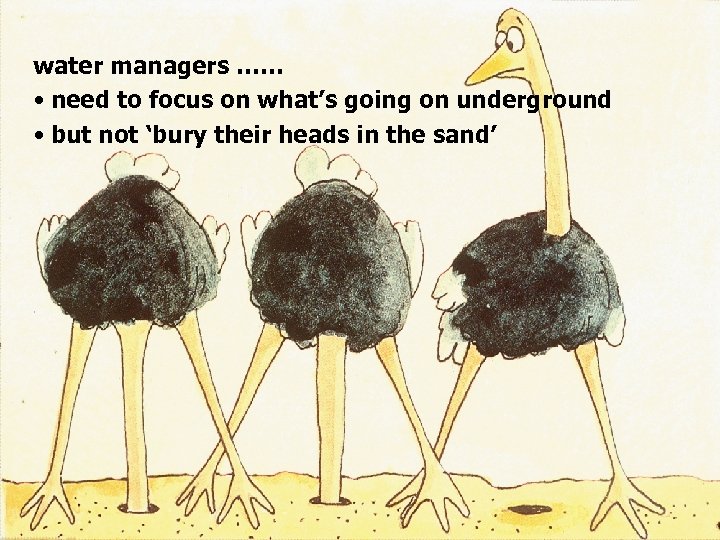
water managers …… • need to focus on what’s going on underground • but not ‘bury their heads in the sand’
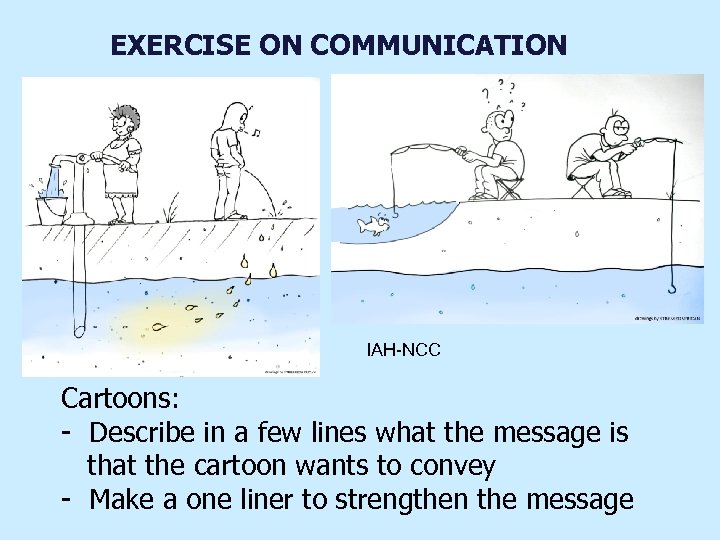
EXERCISE ON COMMUNICATION IAH-NCC Cartoons: - Describe in a few lines what the message is that the cartoon wants to convey - Make a one liner to strengthen the message
Скачать презентацию INFORMATION MANAGEMENT AND COMMUNICATION Making groundwater visible Albert
8049934db43e5ebddc5d8970bf70f2ea.ppt