


 Скачать презентацию Information Lifecycle Management for Oracle Apps Data Erik
af9ababe91119c76e9a656c41b53d3d8.ppt
- Количество слайдов: 30
 Information Lifecycle Management for Oracle Apps Data Erik Jarlstrom Director of North American Pre-sales
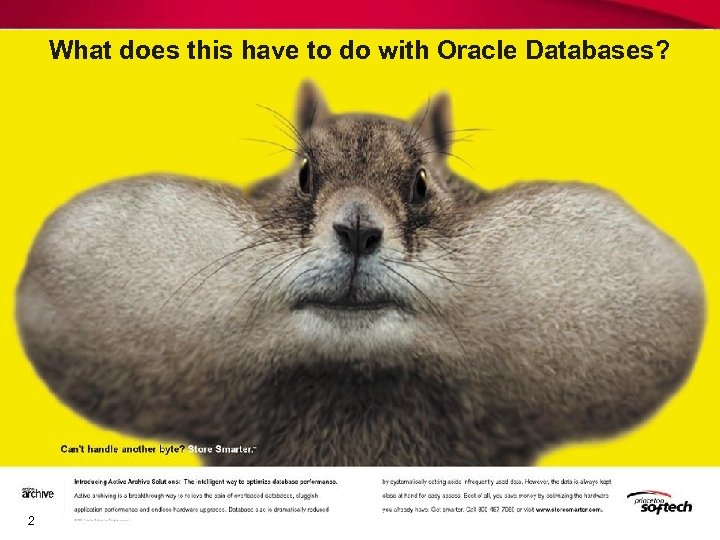 What does this have to do with Oracle Databases? 2
 Corporate Summary · Founded in 1989 · Over 2000 customers in 30 Countries · Committed to providing enterprise database archiving and test data management solutions · Reputation of high quality and reliable products · Partners with industry leading database and storage solution providers · Recognized by Gartner, Giga, and Meta as database archiving market leader 3
 4
4
 Agenda · Database Growth and Impact · Strategy: Information Lifecycle Management · Active Archiving · Enterprise Database Archiving 5
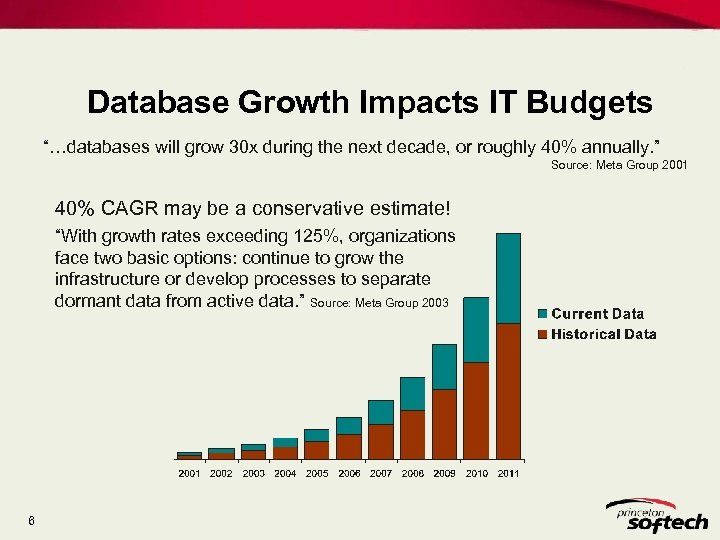 Database Growth Impacts IT Budgets “…databases will grow 30 x during the next decade, or roughly 40% annually. ” Source: Meta Group 2001 40% CAGR may be a conservative estimate! “With growth rates exceeding 125%, organizations face two basic options: continue to grow the infrastructure or develop processes to separate dormant data from active data. ” Source: Meta Group 2003 6
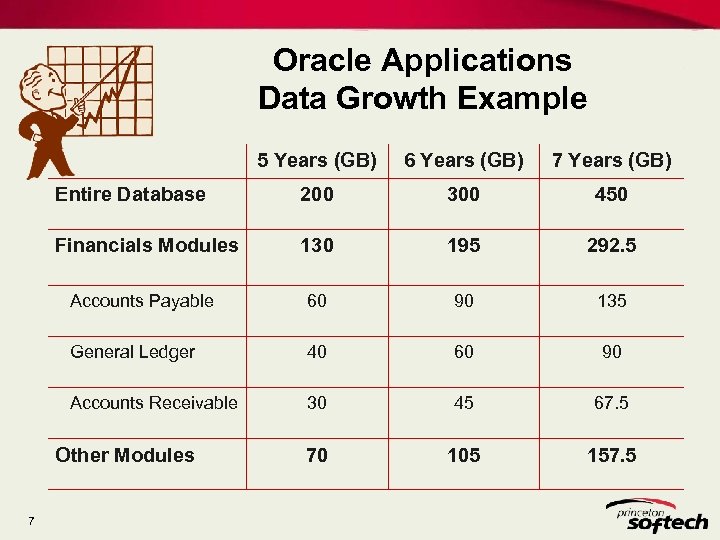 Oracle Applications Data Growth Example 5 Years (GB) 6 Years (GB) 7 Years (GB) Entire Database 200 300 450 Financials Modules 130 195 292. 5 Accounts Payable 60 90 135 General Ledger 40 60 90 Accounts Receivable 30 45 67. 5 70 105 157. 5 Other Modules 7
 Related Symptoms · Application users complain their system is “slow” to: – – Perform online account inquiries and financial period closeouts Enter transactions and process payments Post batches and generate reports Process weekly/monthly/quarterly depreciation runs · Increasing operating costs – – Higher hardware and software license and support costs Longer development and test cycles Labor intensive time and effort for system administrative tasks Extended maintenance times for managing backup, recovery and cloning processes – Additional headcount required to adequately manage a larger environment 8
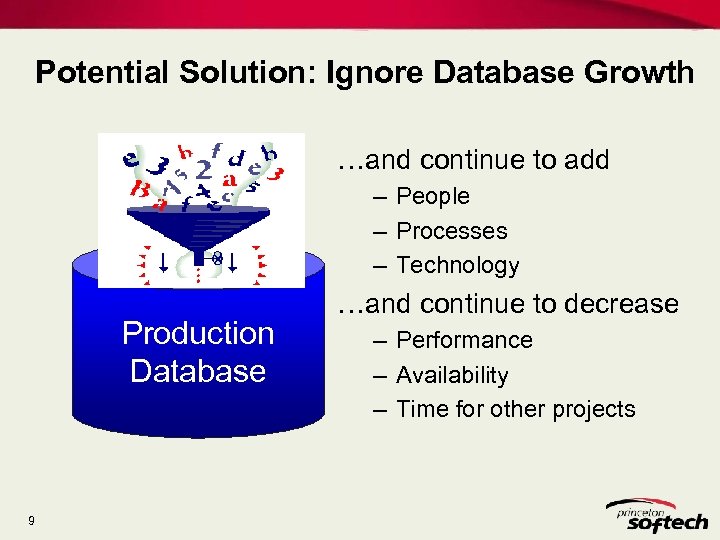 Potential Solution: Ignore Database Growth …and continue to add – People – Processes – Technology Production Database 9 …and continue to decrease – Performance – Availability – Time for other projects
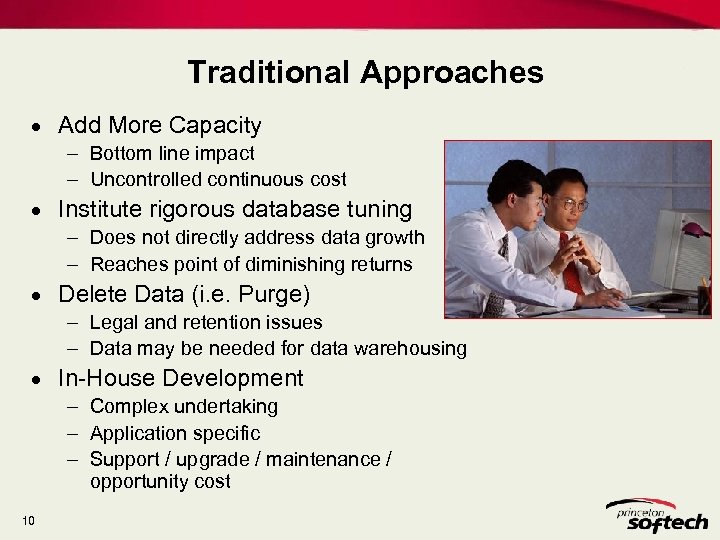 Traditional Approaches · Add More Capacity – Bottom line impact – Uncontrolled continuous cost · Institute rigorous database tuning – Does not directly address data growth – Reaches point of diminishing returns · Delete Data (i. e. Purge) – Legal and retention issues – Data may be needed for data warehousing · In-House Development – Complex undertaking – Application specific – Support / upgrade / maintenance / opportunity cost 10
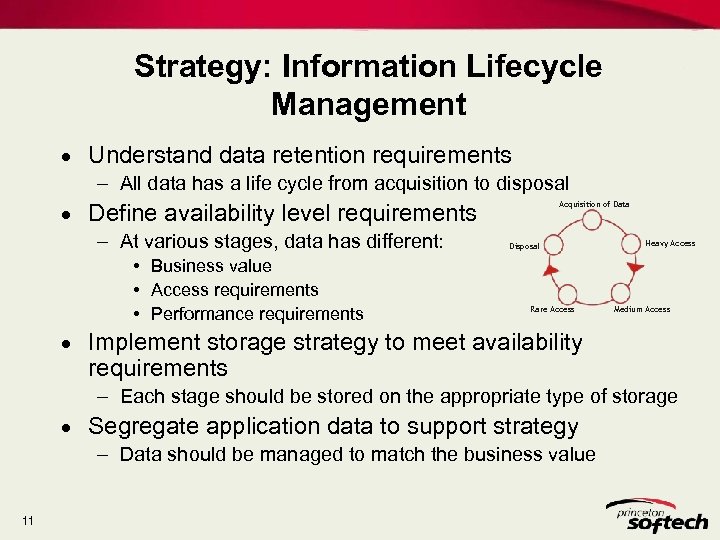 Strategy: Information Lifecycle Management · Understand data retention requirements – All data has a life cycle from acquisition to disposal · Define availability level requirements – At various stages, data has different: • Business value • Access requirements • Performance requirements Acquisition of Data Disposal Rare Access Heavy Access Medium Access · Implement storage strategy to meet availability requirements – Each stage should be stored on the appropriate type of storage · Segregate application data to support strategy – Data should be managed to match the business value 11
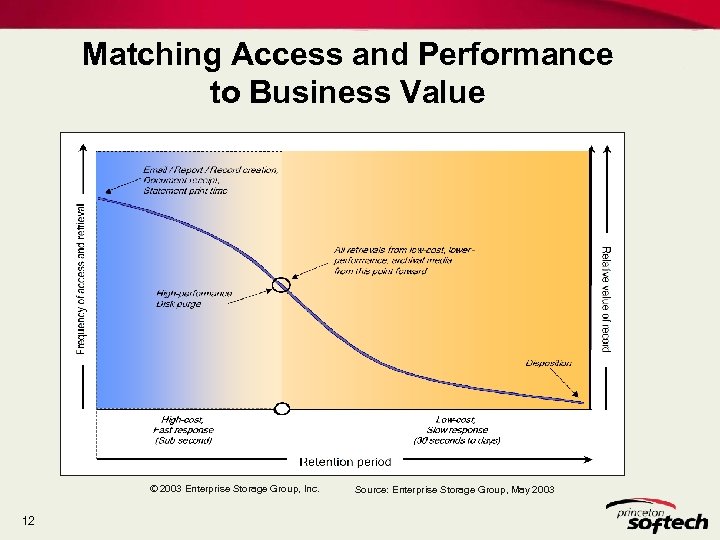 Matching Access and Performance to Business Value © 2003 Enterprise Storage Group, Inc. 12 Source: Enterprise Storage Group, May 2003
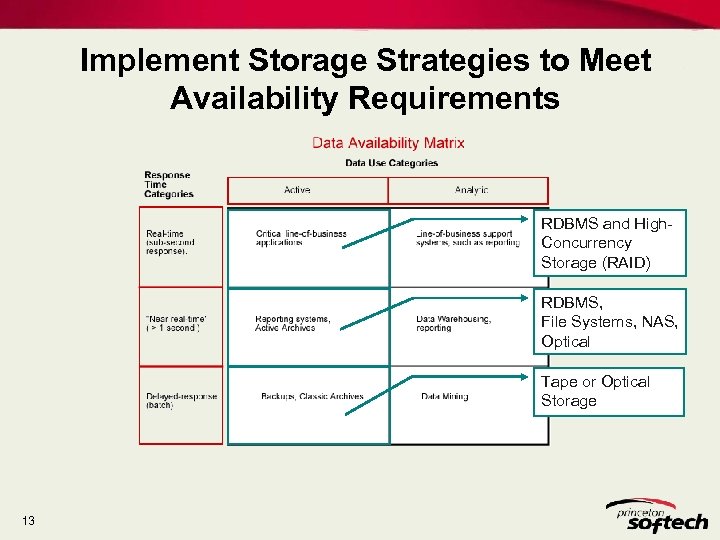 Implement Storage Strategies to Meet Availability Requirements RDBMS and High. Concurrency Storage (RAID) RDBMS, File Systems, NAS, Optical Tape or Optical Storage 13
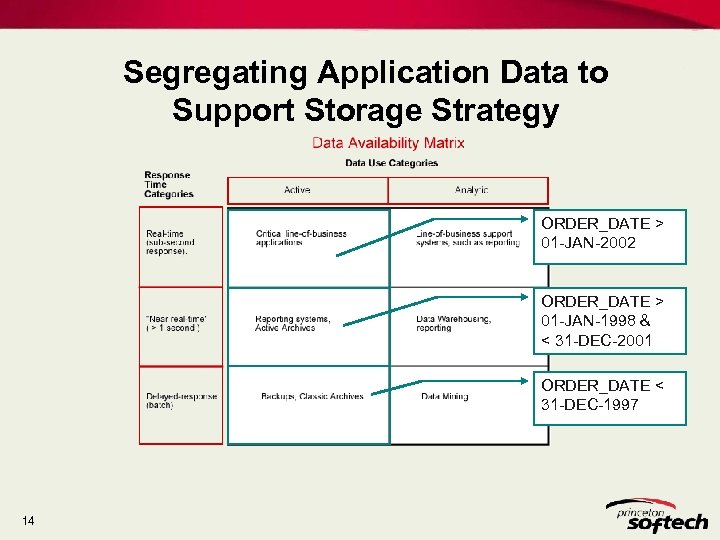 Segregating Application Data to Support Storage Strategy ORDER_DATE > 01 -JAN-2002 ORDER_DATE > 01 -JAN-1998 & < 31 -DEC-2001 ORDER_DATE < 31 -DEC-1997 14
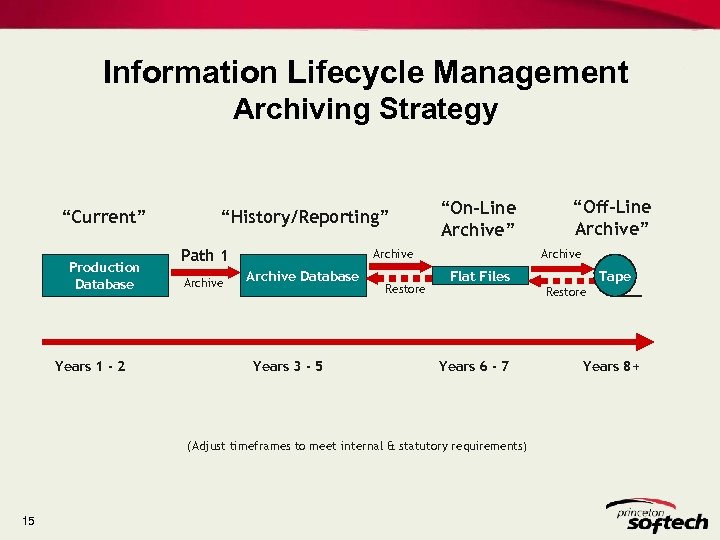 Information Lifecycle Management Archiving Strategy “Current” Production Database Years 1 - 2 “History/Reporting” Archive Path 1 Archive “On-Line Archive” Archive Database Years 3 - 5 Restore Archive Tape Flat Files Restore Years 6 - 7 (Adjust timeframes to meet internal & statutory requirements) 15 “Off-Line Archive” Years 8+
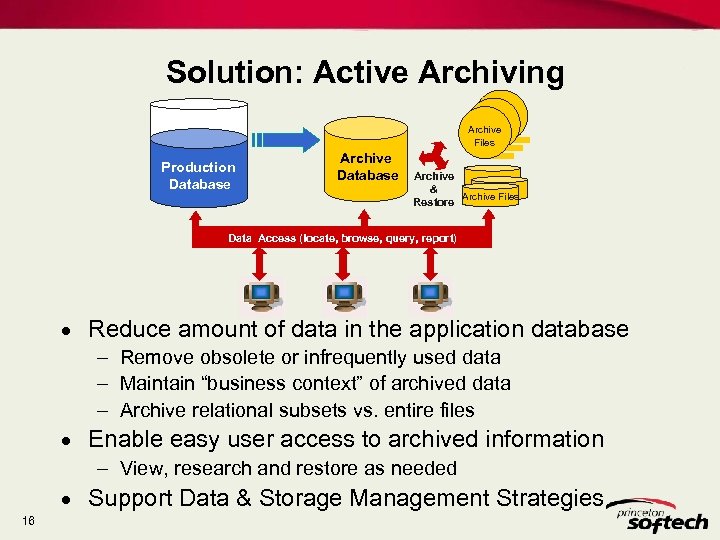 Solution: Active Archiving Archive Files Production Database Archive & Archive Files Restore Data Access (locate, browse, query, report) · Reduce amount of data in the application database – Remove obsolete or infrequently used data – Maintain “business context” of archived data – Archive relational subsets vs. entire files · Enable easy user access to archived information – View, research and restore as needed · Support Data & Storage Management Strategies 16
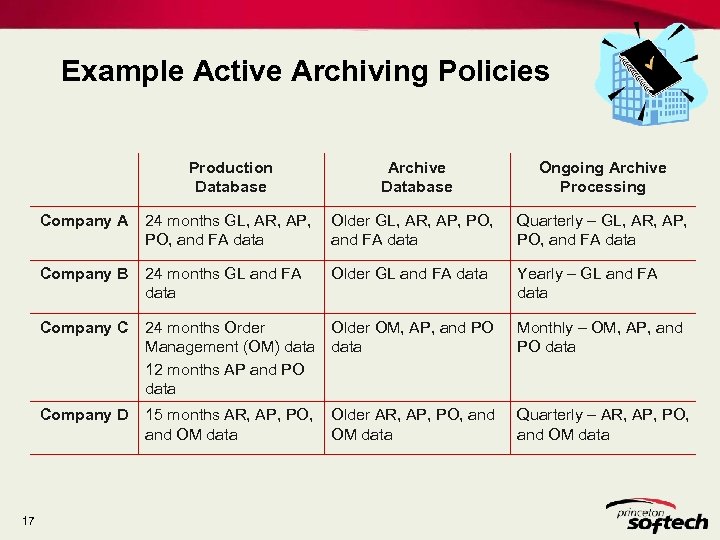 Example Active Archiving Policies Production Database Ongoing Archive Processing Company A 24 months GL, AR, AP, PO, and FA data Older GL, AR, AP, PO, and FA data Quarterly – GL, AR, AP, PO, and FA data Company B 24 months GL and FA data Older GL and FA data Yearly – GL and FA data Company C 24 months Order Management (OM) data 12 months AP and PO data Older OM, AP, and PO data Monthly – OM, AP, and PO data Company D 17 Archive Database 15 months AR, AP, PO, and OM data Older AR, AP, PO, and OM data Quarterly – AR, AP, PO, and OM data
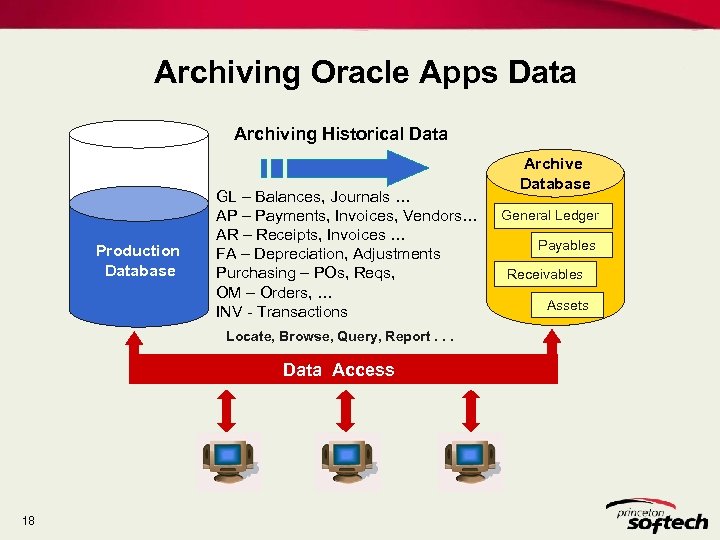 Archiving Oracle Apps Data Archiving Historical Data Production Database GL – Balances, Journals … AP – Payments, Invoices, Vendors… AR – Receipts, Invoices … FA – Depreciation, Adjustments Purchasing – POs, Reqs, OM – Orders, … INV - Transactions Locate, Browse, Query, Report. . . Data Access 18 Archive Database General Ledger Payables Receivables Assets
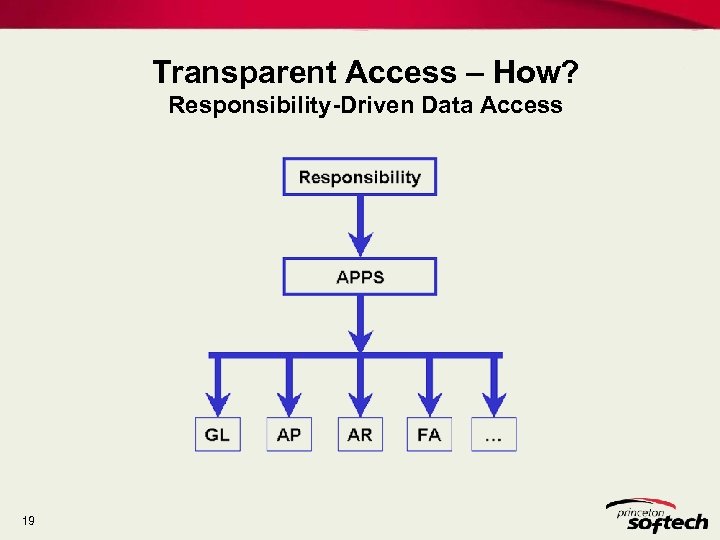 Transparent Access – How? Responsibility-Driven Data Access 19
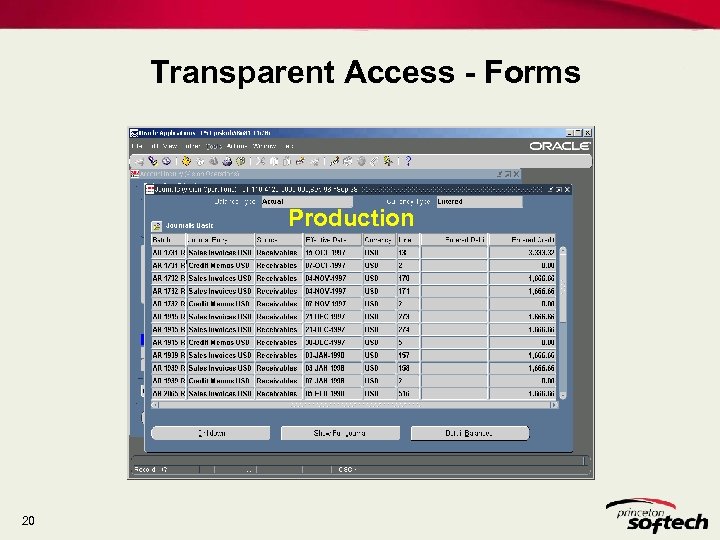 Transparent Access - Forms Production 20
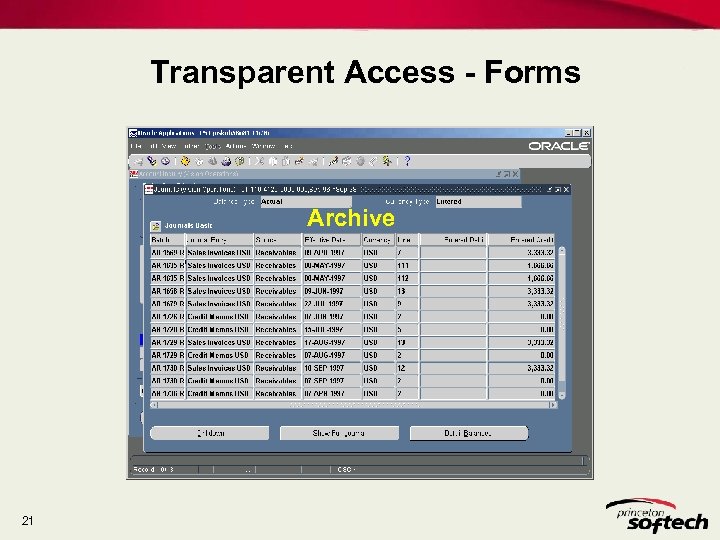 Transparent Access - Forms Archive 21
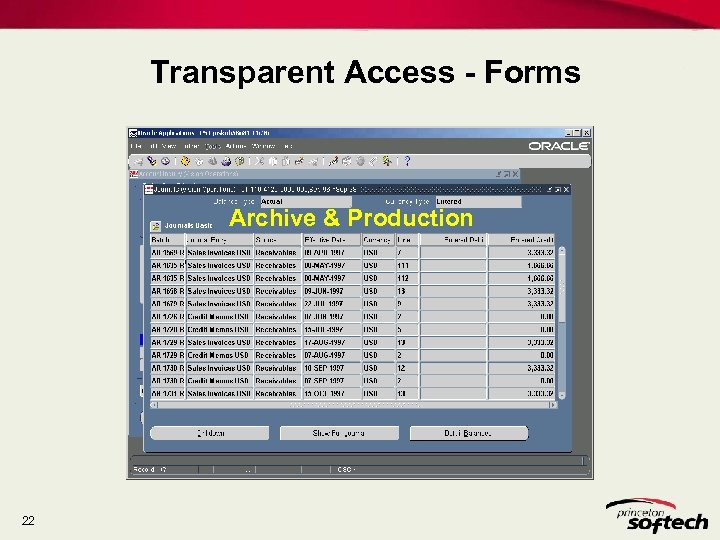 Transparent Access - Forms Archive & Production 22
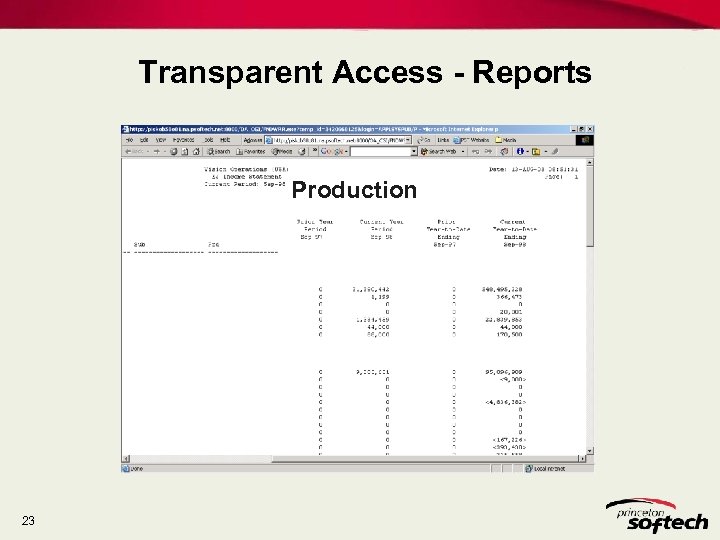 Transparent Access - Reports Production 23
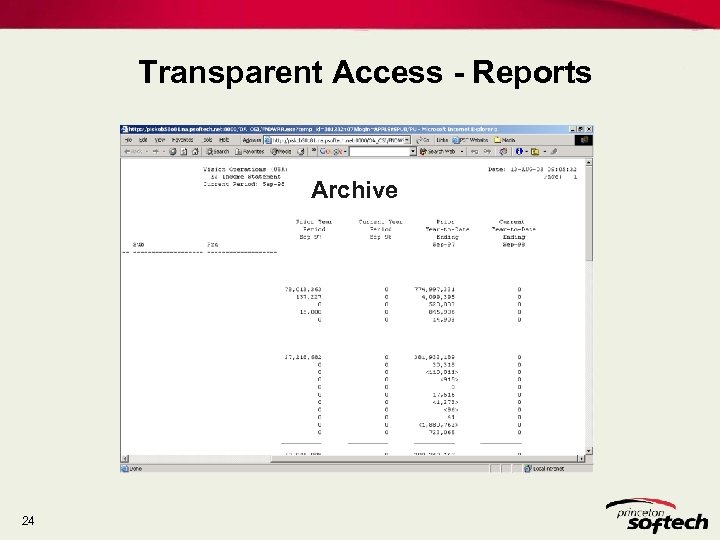 Transparent Access - Reports Archive 24
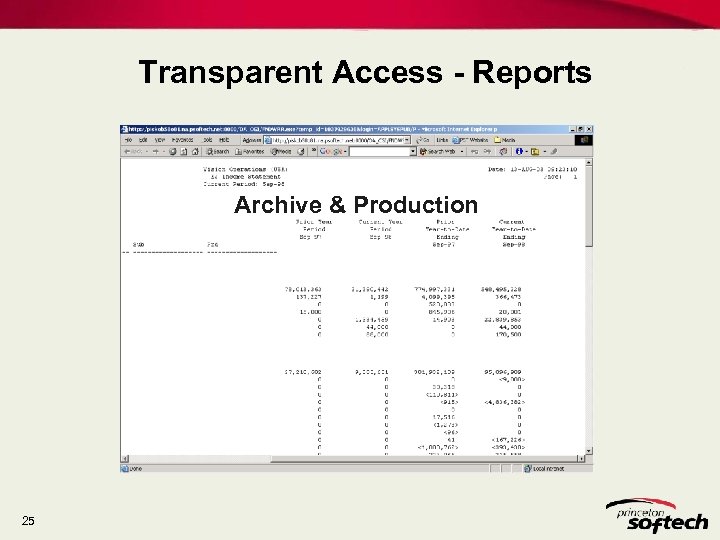 Transparent Access - Reports Archive & Production 25
 Top Requirements for Enterprise Database Archiving · Extract subsets of related data to offload – Able to go beyond catalog-defined relationships · Selectively/relationally delete all or some · · · 26 archived data Selectively/relationally restore Access, browse, query archived data Preserve business context of archived data Comprehensive archive data management Architecture for long term enterprise-wide strategy
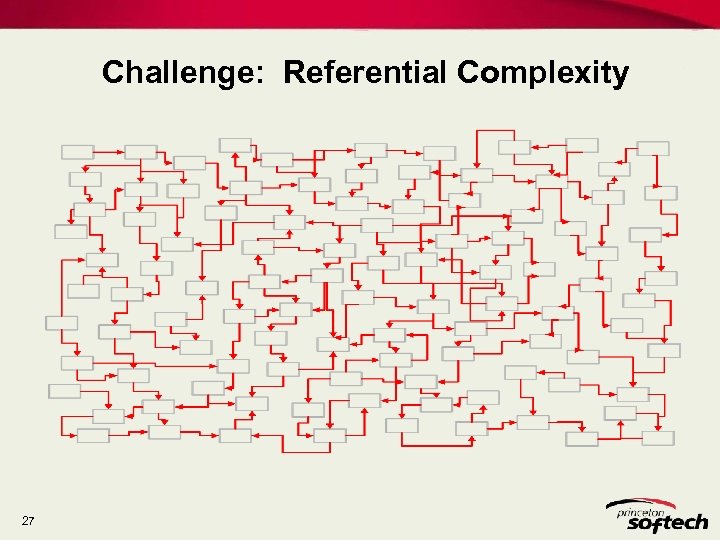 Challenge: Referential Complexity 27
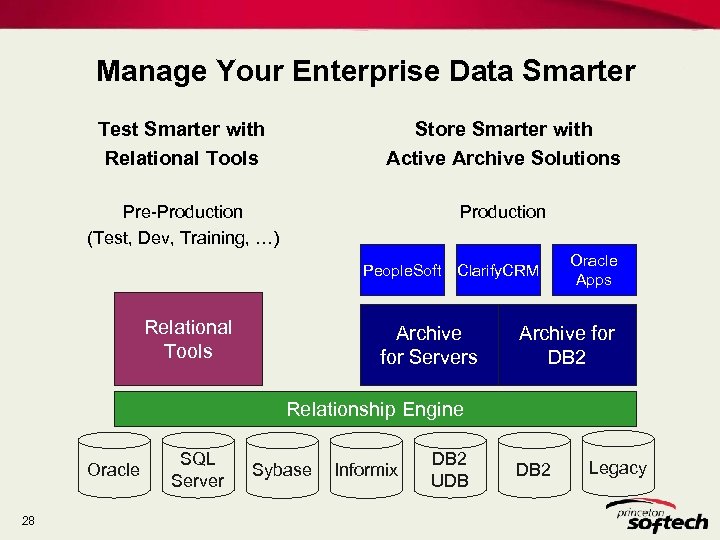 Manage Your Enterprise Data Smarter Test Smarter with Relational Tools Store Smarter with Active Archive Solutions Pre-Production (Test, Dev, Training, …) Production People. Soft Relational Tools Clarify. CRM Archive for Servers Oracle Apps Archive for DB 2 Relationship Engine Oracle 28 SQL Server Sybase Informix DB 2 UDB DB 2 Legacy
 Suggested Resources · Databases on a Diet: Meta - Jan 2003 · Banking on Data: Information. Week – Aug 4, 2003 – Bank of New York implements active archiving · Enterprise Storage Group (ESG) Impact Report on Compliance - May 2003 – The effect on information management and the storage industry · Princeton Softech’s Web site and whitepapers www. princetonsoftech. com 29
 Questions Erik Jarlstrom Princeton Softech ejarlstrom@princetonsoftech. com 916. 939. 8191 30