 Скачать презентацию Information Exchange IAS and the IPPC CAB International s
f4a636e03b8942152ac2217e5e543e0d.ppt
- Количество слайдов: 27



Information Exchange IAS and the IPPC CAB International’s Role Roger Day CABI Africa Nairobi, Kenya CAB International
CAB International Intergovernmental Not-for-profit International Developing countries 90 years old “. . appropriate international organisation” (Art XX) CAB International
CAB International Information Exchange through: 1. Publishing information products 2. Taxonomy, pest identification 3. Networking and coordination 4. Support to standard setting process 5. Global Invasive Species Programme CAB International
Information exchange through. . . Information Products Books, journals w eg Ebbels (2003). Principles of Plant Health and Quarantine w Pest distribution maps with EPPO w Review journals w Primary journals CAB International
Information exchange through. . . Information Products Bibliographic databases, portals w CAB Abstracts (>4 m records) w PEST CD w CAB Direct w ICM Focus CAB International
Information exchange through. . . Information Products Compendia w Animal Health and Production • Full datasheets - 200 diseases; background - 20, 000 • Feed information, drugs & vaccines database • Diagnostic aids w Forestry • Full datasheets - 1200 species; background - 22, 000 • Species selection tool • Seed suppliers database w Crop Protection CAB International
Information exchange through. . . Information Products Crop Protection Compendium (CPC) w w w w w Electronic encyclopaedia on CD/Internet >1900 pests & natural enemies 10, 000 in less detail 125, 000 abstracts Information on distribution, ecology, management etc FAO crop production data; crop loss data 6, 800 images Keys and taxonomic framework Soft links, glossary, notepads Phytosanitary module CAB International
Information exchange through. . . Information Products Crop Protection Compendium (CPC) w Partners • EPPO • FAO • Iowa State University, USA • Plant Resources of South-East Asia PROSEA • University of Bonn, Germany w >1100 commissioned experts from 75 countries CAB International
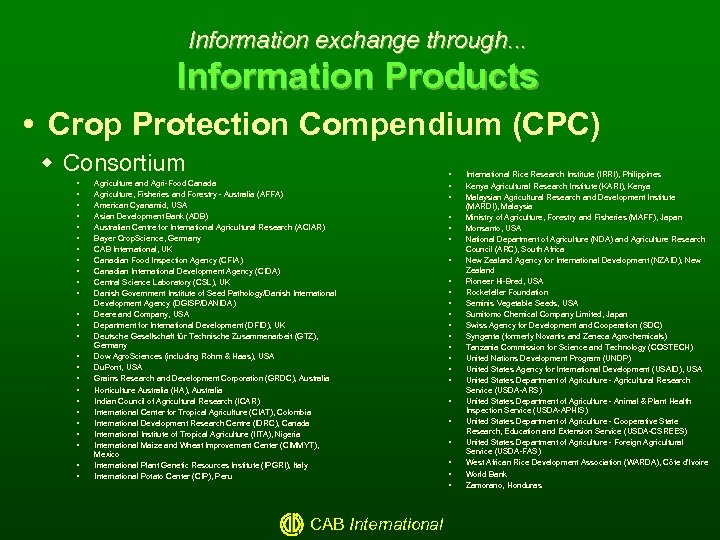
Information exchange through. . . Information Products Crop Protection Compendium (CPC) w Consortium • • • • • • • Agriculture and Agri-Food Canada Agriculture, Fisheries and Forestry - Australia (AFFA) American Cyanamid, USA Asian Development Bank (ADB) Australian Centre for International Agricultural Research (ACIAR) Bayer Crop. Science, Germany CAB International, UK Canadian Food Inspection Agency (CFIA) Canadian International Development Agency (CIDA) Central Science Laboratory (CSL), UK Danish Government Institute of Seed Pathology/Danish International Development Agency (DGISP/DANIDA) Deere and Company, USA Department for International Development (DFID), UK Deutsche Gesellschaft für Technische Zusammenarbeit (GTZ), Germany Dow Agro. Sciences (including Rohm & Haas), USA Du. Pont, USA Grains Research and Development Corporation (GRDC), Australia Horticulture Australia (HA), Australia Indian Council of Agricultural Research (ICAR) International Center for Tropical Agriculture (CIAT), Colombia International Development Research Centre (IDRC), Canada International Institute of Tropical Agriculture (IITA), Nigeria International Maize and Wheat Improvement Center (CIMMYT), Mexico International Plant Genetic Resources Institute (IPGRI), Italy International Potato Center (CIP), Peru CAB International • • • • • • International Rice Research Institute (IRRI), Philippines Kenya Agricultural Research Institute (KARI), Kenya Malaysian Agricultural Research and Development Institute (MARDI), Malaysia Ministry of Agriculture, Forestry and Fisheries (MAFF), Japan Monsanto, USA National Department of Agriculture (NDA) and Agriculture Research Council (ARC), South Africa New Zealand Agency for International Development (NZAID), New Zealand Pioneer Hi-Bred, USA Rockefeller Foundation Seminis Vegetable Seeds, USA Sumitomo Chemical Company Limited, Japan Swiss Agency for Development and Cooperation (SDC) Syngenta (formerly Novartis and Zeneca Agrochemicals) Tanzania Commission for Science and Technology (COSTECH) United Nations Development Program (UNDP) United States Agency for International Development (USAID), USA United States Department of Agriculture - Agricultural Research Service (USDA-ARS) United States Department of Agriculture - Animal & Plant Health Inspection Service (USDA-APHIS) United States Department of Agriculture - Cooperative State Research, Education and Extension Service (USDA-CSREES) United States Department of Agriculture - Foreign Agricultural Service (USDA-FAS) West African Rice Development Association (WARDA), Côte d'Ivoire World Bank Zamorano, Honduras
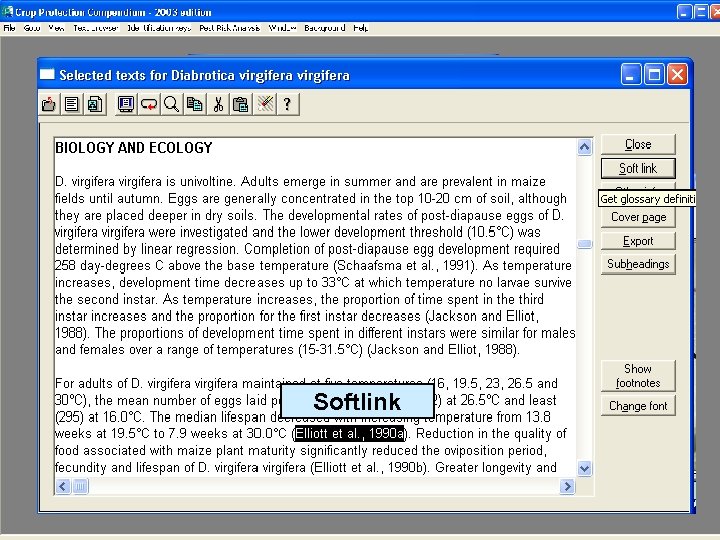
Datasheet cover page Full datasheet contents Softlink CAB International
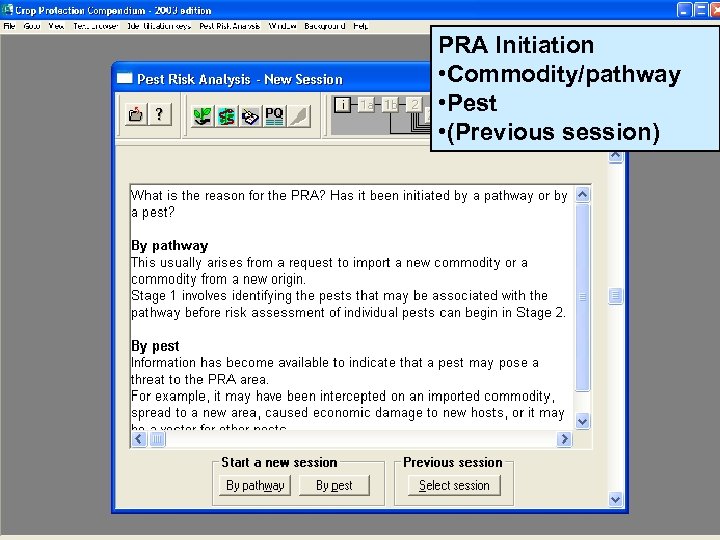
PRA Initiation • Commodity/pathway • Pest • (Previous session) CAB International
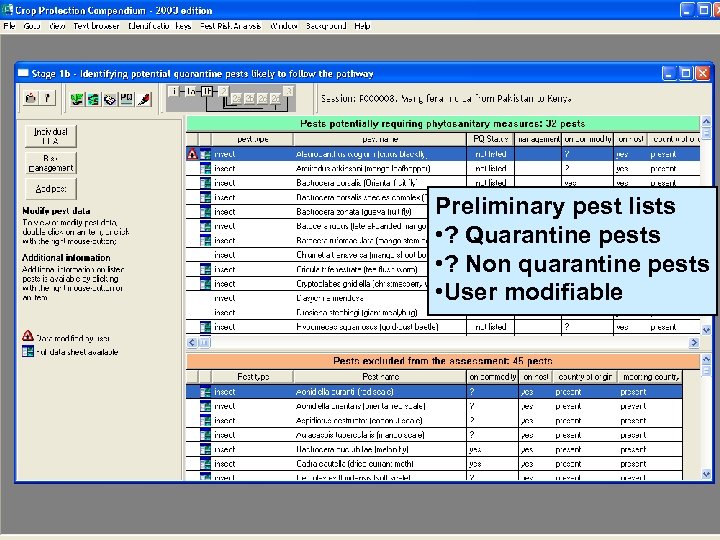
Preliminary pest lists • ? Quarantine pests • ? Non quarantine pests • User modifiable CAB International
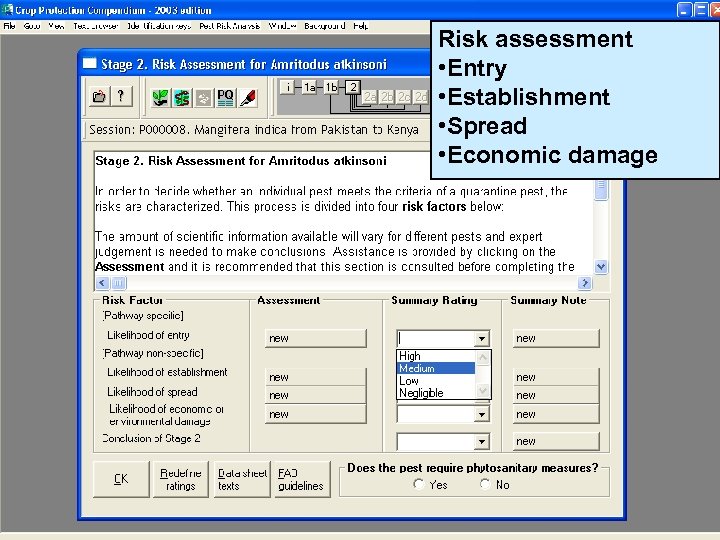
Risk assessment • Entry • Establishment • Spread • Economic damage CAB International
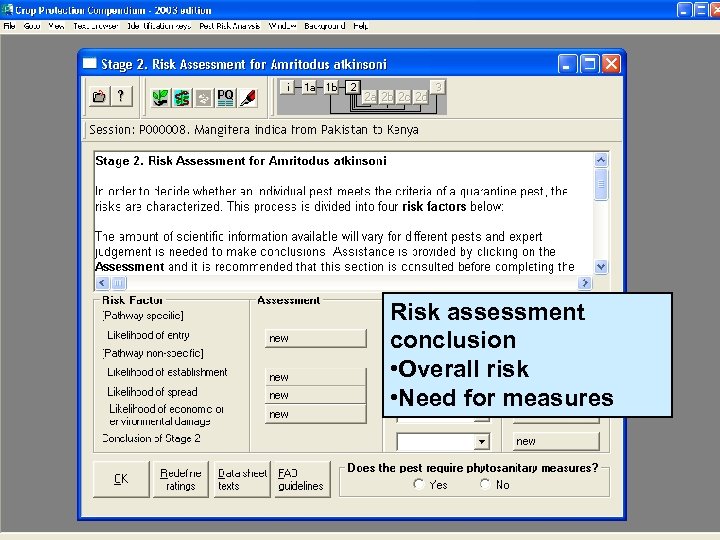
Risk assessment conclusion • Overall risk • Need for measures CAB International
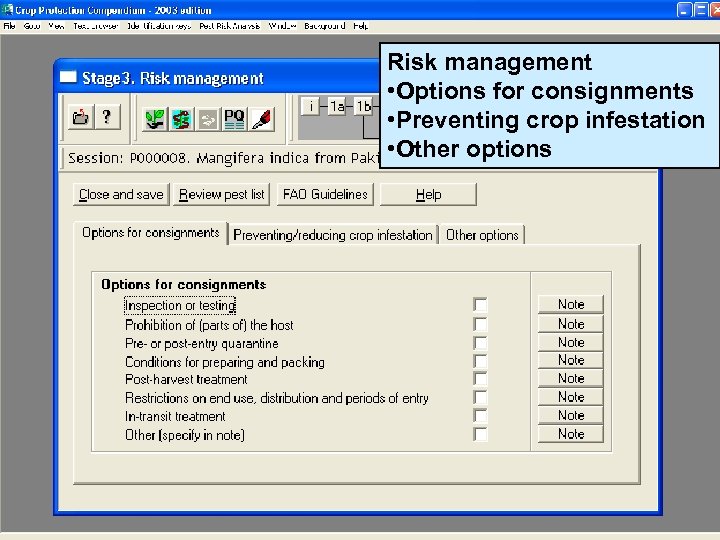
Risk management • Options for consignments • Preventing crop infestation • Other options CAB International
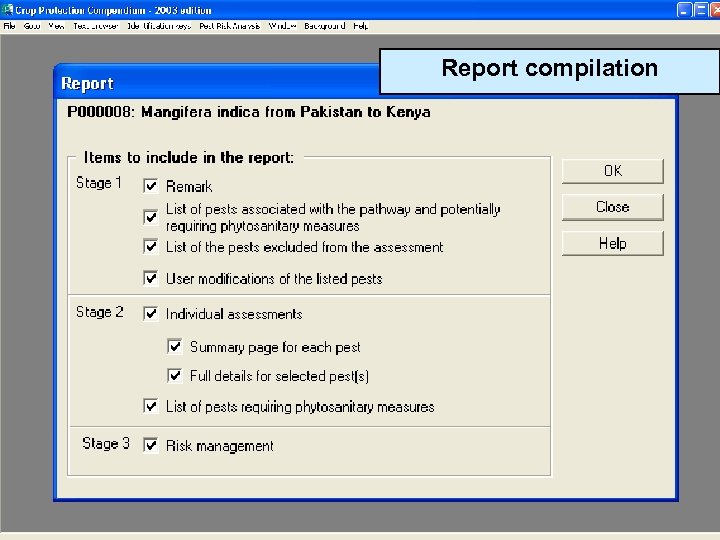
Report compilation CAB International
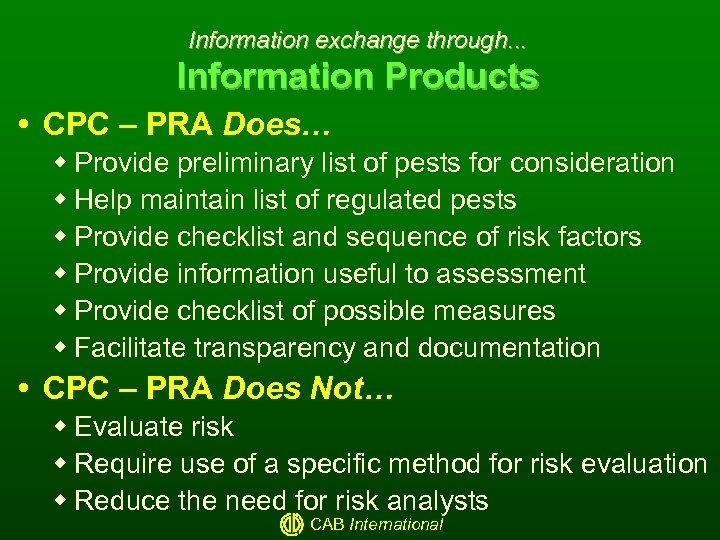
Information exchange through. . . Information Products CPC – PRA Does… w Provide preliminary list of pests for consideration w Help maintain list of regulated pests w Provide checklist and sequence of risk factors w Provide information useful to assessment w Provide checklist of possible measures w Facilitate transparency and documentation CPC – PRA Does Not… w Evaluate risk w Require use of a specific method for risk evaluation w Reduce the need for risk analysts CAB International
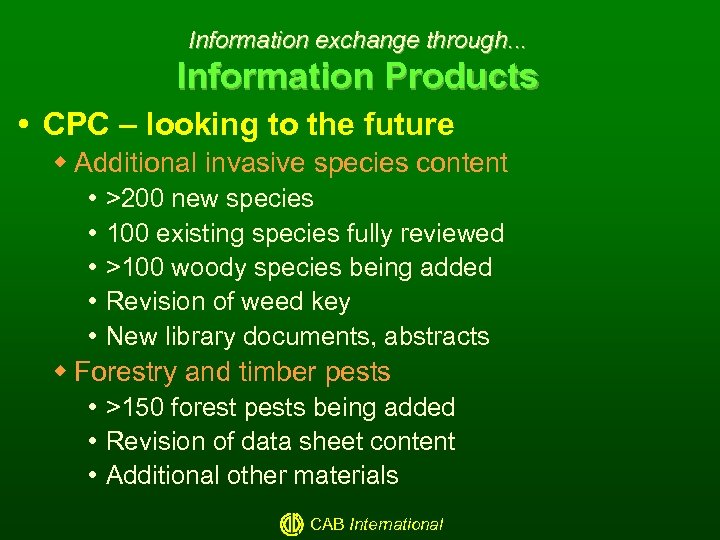
Information exchange through. . . Information Products CPC – looking to the future w Additional invasive species content • • • >200 new species 100 existing species fully reviewed >100 woody species being added Revision of weed key New library documents, abstracts w Forestry and timber pests • >150 forest pests being added • Revision of data sheet content • Additional other materials CAB International
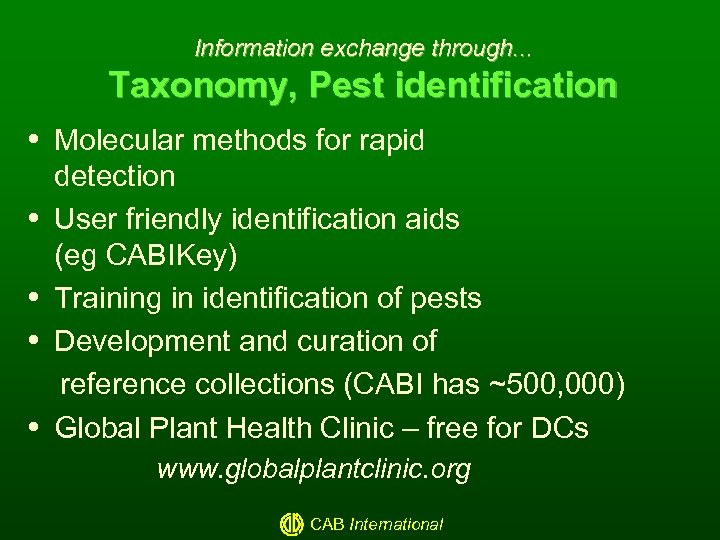
Information exchange through. . . Taxonomy, Pest identification Molecular methods for rapid detection User friendly identification aids (eg CABIKey) Training in identification of pests Development and curation of reference collections (CABI has ~500, 000) Global Plant Health Clinic – free for DCs www. globalplantclinic. org CAB International
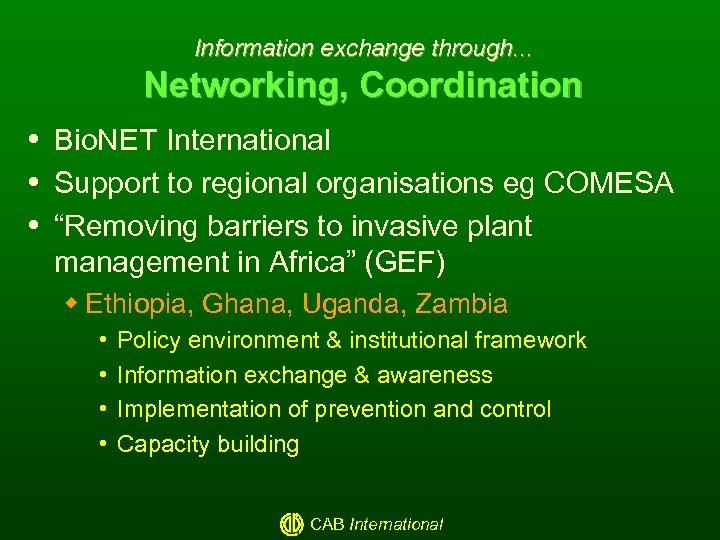
Information exchange through. . . Networking, Coordination Bio. NET International Support to regional organisations eg COMESA “Removing barriers to invasive plant management in Africa” (GEF) w Ethiopia, Ghana, Uganda, Zambia • • Policy environment & institutional framework Information exchange & awareness Implementation of prevention and control Capacity building CAB International
Information exchange through. . . Support to Standards Setting Briefing papers, inputs to working groups w Environmental hazards w Risks from LMOs w Efficacy of phytosanitary measures w Comparison of standard setting procedures Regional consultations w “Environmental” pests in relation to ISPM 11 supplement Application and review of ISPM 3 CAB International
Information exchange through… Global Invasive Species Programme Founded in 1996/97 w CAB International (CABI) w World Conservation Union (IUCN) w Scientific Committee for Problems of the Environment (SCOPE) “To conserve biodiversity and sustain human livelihoods by minimizing the spread and impact of invasive alien species” A framework for international cooperation and capacity building CAB International
Information exchange through… Global Invasive Species Programme w Phase 1 outputs: policy, toolkits, communication • Invasive Species in a Changing World • The Economics of Biological Invasions • A Guide to Designing Legal and Institutional Frameworks and Alien Invasive Species • 100 of the World’s Worst Invasive Alien Species • The Great Reshuffling: Human Dimensions of Invasive Alien Species • Invasive Alien Species: A Toolkit of Best Prevention and Management Practices CAB International
Information exchange through… Global Invasive Species Programme 10 point global strategy Build National capacity Build scientific, social, economic research capacity Promote Information sharing Develop economic policies & tools Incorporate IAS issues into global change programs Strengthen legal institutions & frameworks Institute a system of environmental risk analysis Promote public awareness Build national strategies & plans Promote international cooperation CAB International
Information exchange through… Global Invasive Species Programme COP Decision VI/23 18. Acknowledges the contribution of the Global Invasive Species Programme to the sixth meeting of the Subsidiary Body on Scientific, Technical and Technological Advice, particularly the provision of technical advice and therefore: w Welcomes phase II of the Global Invasive Species Programme and urges Parties, countries and other organizations to support the work of the Global Invasive Species Programme to minimize the spread and impact of invasive alien species, and consider the Global Strategy on Invasive Alien Species when developing national plans and regional strategies w Recommends continuing cooperation with the Global Invasive Species Programme and requests the Executive Secretary to explore the development of arrangements for this further cooperation CAB International
Information exchange through… Global Invasive Species Programme COP Decision VI/23 25. …welcomes the Global Invasive Species Programme as an international thematic focal point for alien species under the clearing-house mechanism, and calls on Parties, countries and relevant organizations to contribute to the creation and maintenance of the global information network, in particular to: w w Ensure effective international cooperation and expertise sharing; Provide information to assist countries to perform effective risk analysis; Provide information on potential pathway of alien invasive species; and Provide support for management and control efforts, particularly for locating technical support for rapid response activities; CAB International
Information exchange through… Global Invasive Species Programme w Phase 2 w Secretariat established in S Africa w Working groups • • • National and Regional Facilitation & Cooperation Communication, Education, & Outreach Global Information Management Pathway Management Evaluation and Assessment Law and Policy CAB International
Скачать презентацию Information Exchange IAS and the IPPC CAB International s
f4a636e03b8942152ac2217e5e543e0d.ppt