


 Скачать презентацию Information day ICT-PSP 2011 THEME 3 ICT FOR
ed7ce59bf66d9c2a7eb232b7148c2cf9.ppt
- Количество слайдов: 38
 Information day ICT-PSP 2011 THEME 3: ICT FOR AGEING WELL AND INCLUSION Katarzyna Bałucka-Dębska Unit H 3: ICT for Inclusion DG Information Society and Media
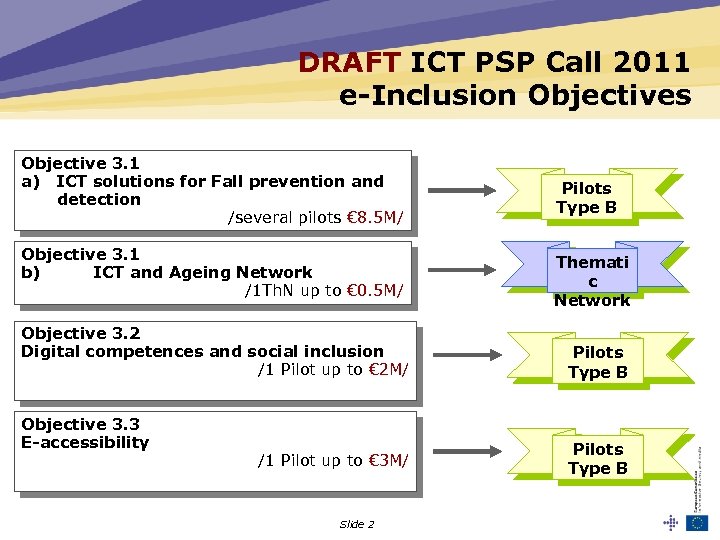 DRAFT ICT PSP Call 2011 e-Inclusion Objectives Objective 3. 1 a) ICT solutions for Fall prevention and detection /several pilots € 8. 5 M/ Objective 3. 1 b) ICT and Ageing Network /1 Th. N up to € 0. 5 M/ Objective 3. 2 Digital competences and social inclusion /1 Pilot up to € 2 M/ Objective 3. 3 E-accessibility /1 Pilot up to € 3 M/ Slide 2 Pilots Type B Themati c Network Pilots Type B
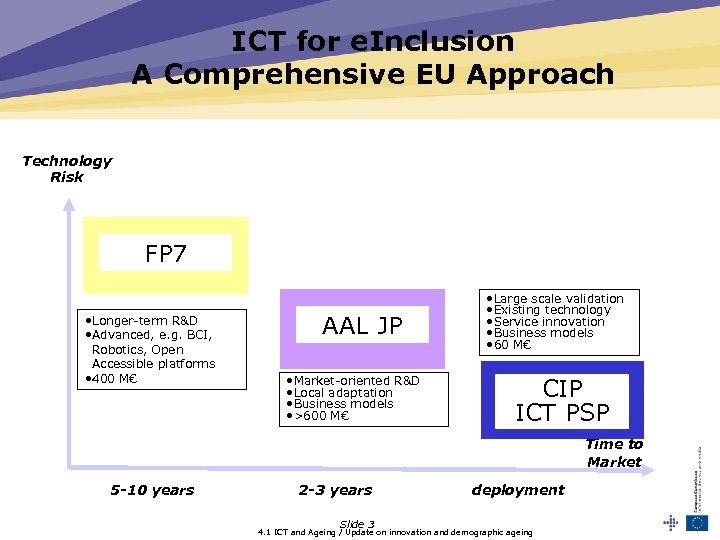 ICT for e. Inclusion A Comprehensive EU Approach Technology Risk FP 7 • Longer-term R&D • Advanced, e. g. BCI, Robotics, Open Accessible platforms • 400 M€ AAL JP • Market-oriented R&D • Local adaptation • Business models • >600 M€ • Large scale validation • Existing technology • Service innovation • Business models • 60 M€ CIP ICT PSP Time to Market 5 -10 years 2 -3 years Slide 3 deployment 4. 1 ICT and Ageing / Update on innovation and demographic ageing
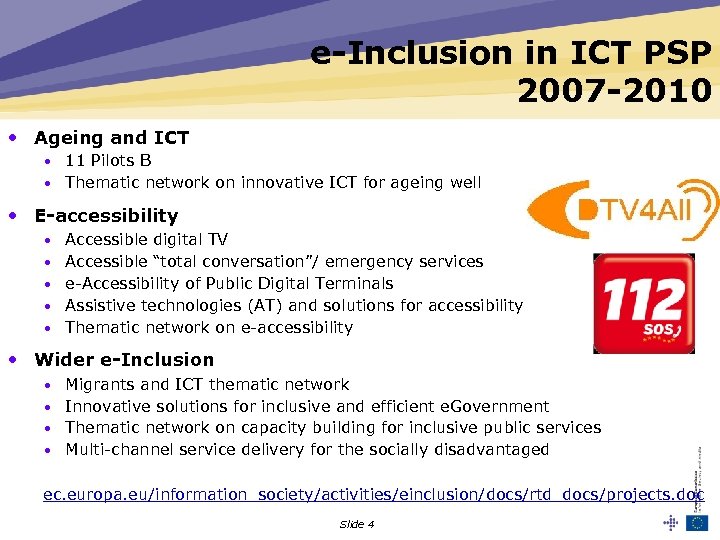 e-Inclusion in ICT PSP 2007 -2010 • Ageing and ICT • 11 Pilots B • Thematic network on innovative ICT for ageing well • E-accessibility • • • Accessible digital TV Accessible “total conversation”/ emergency services e-Accessibility of Public Digital Terminals Assistive technologies (AT) and solutions for accessibility Thematic network on e-accessibility • Wider e-Inclusion • • Migrants and ICT thematic network Innovative solutions for inclusive and efficient e. Government Thematic network on capacity building for inclusive public services Multi-channel service delivery for the socially disadvantaged ec. europa. eu/information_society/activities/einclusion/docs/rtd_docs/projects. doc Slide 4
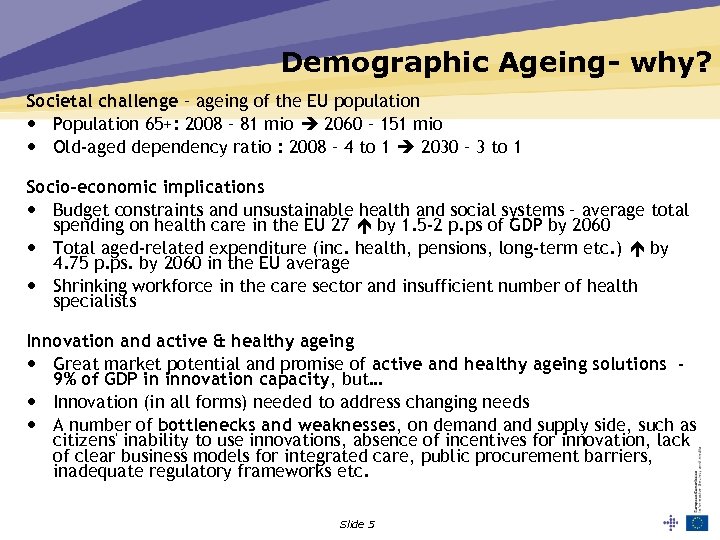 Demographic Ageing- why? Societal challenge – ageing of the EU population • Population 65+: 2008 – 81 mio 2060 – 151 mio • Old-aged dependency ratio : 2008 – 4 to 1 2030 – 3 to 1 Socio-economic implications • Budget constraints and unsustainable health and social systems – average total spending on health care in the EU 27 by 1. 5 -2 p. ps of GDP by 2060 • Total aged-related expenditure (inc. health, pensions, long-term etc. ) by 4. 75 p. ps. by 2060 in the EU average • Shrinking workforce in the care sector and insufficient number of health specialists Innovation and active & healthy ageing • Great market potential and promise of active and healthy ageing solutions 9% of GDP in innovation capacity, but… • Innovation (in all forms) needed to address changing needs • A number of bottlenecks and weaknesses, on demand supply side, such as citizens' inability to use innovations, absence of incentives for innovation, lack of clear business models for integrated care, public procurement barriers, inadequate regulatory frameworks etc. Slide 5
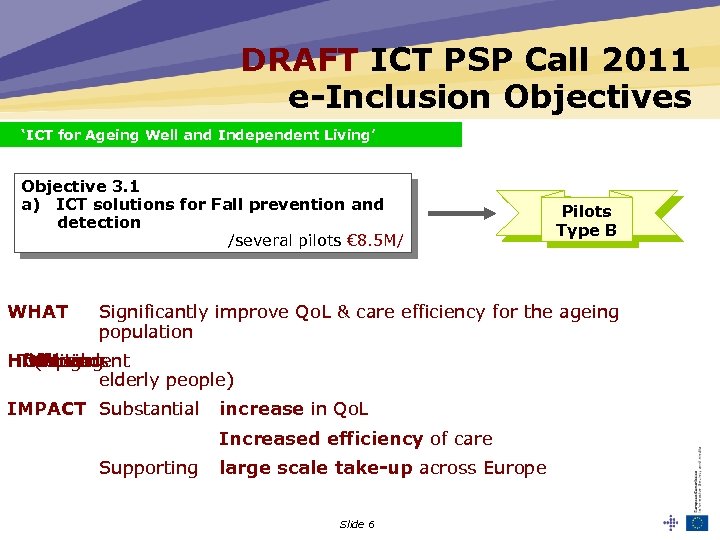 DRAFT ICT PSP Call 2011 e-Inclusion Objectives ‘ICT for Ageing Well and Independent Living’ Objective 3. 1 a) ICT solutions for Fall prevention and detection /several pilots € 8. 5 M/ WHAT Pilots Type B Significantly improve Qo. L & care efficiency for the ageing population HOWliving Through independent falls solutions (focus: elderly people) IMPACT Substantial increase in Qo. L Increased efficiency of care Supporting large scale take-up across Europe Slide 6
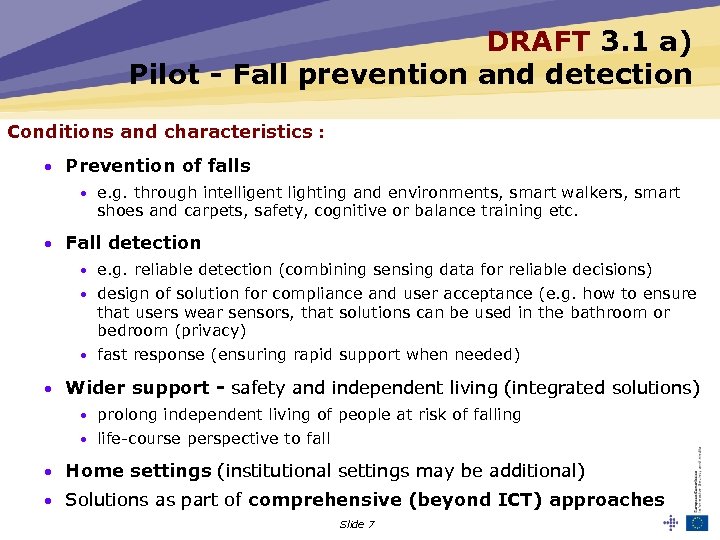 DRAFT 3. 1 a) Pilot - Fall prevention and detection Conditions and characteristics : • Prevention of falls • e. g. through intelligent lighting and environments, smart walkers, smart shoes and carpets, safety, cognitive or balance training etc. • Fall detection • e. g. reliable detection (combining sensing data for reliable decisions) • design of solution for compliance and user acceptance (e. g. how to ensure that users wear sensors, that solutions can be used in the bathroom or bedroom (privacy) • fast response (ensuring rapid support when needed) • Wider support - safety and independent living (integrated solutions) • prolong independent living of people at risk of falling • life-course perspective to fall • Home settings (institutional settings may be additional) • Solutions as part of comprehensive (beyond ICT) approaches Slide 7
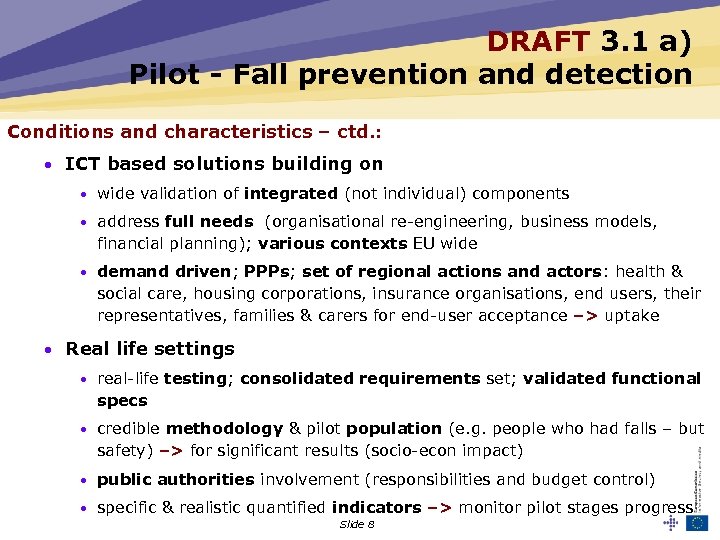 DRAFT 3. 1 a) Pilot - Fall prevention and detection Conditions and characteristics – ctd. : • ICT based solutions building on • wide validation of integrated (not individual) components • address full needs (organisational re-engineering, business models, financial planning); various contexts EU wide • demand driven; PPPs; set of regional actions and actors: health & social care, housing corporations, insurance organisations, end users, their representatives, families & carers for end-user acceptance –> uptake • Real life settings • real-life testing; consolidated requirements set; validated functional specs • credible methodology & pilot population (e. g. people who had falls – but safety) –> for significant results (socio-econ impact) • public authorities involvement (responsibilities and budget control) • specific & realistic quantified indicators –> monitor pilot stages progress Slide 8
 DRAFT 3. 1 a) Pilot - Fall prevention and detection Conditions and characteristics – ctd. : • Dissemination, visibility, enabling replication • socio-economic evidence base for ICT investments in the field (cost- benefit analysis and user satisfaction) –> sustainable business models • sustainable uptake and replication –> Complete set of common specifications for technology and services agreed along value chain • networking and coordination between the pilots –> visibility and impact • dissemination - guidelines, manuals, educational materials; various audiences & levels (experts, authorities, public) • interoperability, compliance with relevant standards, taking into account best practices and relevant standardisation efforts; ethics & privacy issues Slide 9
 DRAFT ICT PSP Call 2011 e-Inclusion Objectives ‘ICT for Ageing Well and Independent Living’ Objective 3. 1 b) ICT and Ageing Network /1 Th. N € 0. 5 M/ WHAT Themati c Network Develop guidelines for deployment of innovation in ICT & Ageing Well and share good practices across Europe HOW key of regional Network representatives national or innovation initiatives in the field of ICT for Ageing Well IMPACT Substantial increase in Qo. L and efficiency of care Accelerating large scale take-up across Europe Strengthening partnerships across innovators, industry players, public authorities and investors Slide 10
 Why is a network needed? • Many existing & emerging initiatives on Innovation in ICT and Ageing • National level, Regional level • Difficult to identify and contact • Little cooperation exist between them Þ Lacking sharing of information and good practice Þ Lacking critical mass Þ Reduced impact Slide 11
 DRAFT 3. 1 b) Thematic Network – Ageing Well Conditions and characteristics : • Build on the key national or regional stakeholder platforms associated with ICT & Ageing • Outreach to a wider set of national and international stakeholders from across Europe, • industry, users organisations, public authorities, investors, housing and insurance companies and service providers • Coordination with related EU level activities, notably • ageing well pilots under the ICT-PSP programme • relevant national pilots • Contribute to key events and activities Slide 12
 DRAFT 3. 1 b) Thematic Network – Ageing Well Conditions and characteristics – ctd. : • Regular workshops should be organised, e. g. on • Indicators and measurement methodologies for impact assessment • Emerging care standards and guidelines • Exchange of current results and experiences to a wider set of stakeholders: • consolidation of common specifications for successful solutions • Wider dissemination Slide 13
 DRAFT 3. 1 b) Thematic Network – Ageing Well Expected impact: • Evidence of substantial prolongation of time elderly people can live independently at home • Evidence of improvement of • Quality of Life of older people & their families • health and social care systems and services • Wide take-up of ICT-based fall prevention solutions across Europe • World leading position by European industry in innovative markets for ICT based solutions supporting independent living and the ageing population. Slide 14
 Impacts of a coherent investment • Proven functional specifications for ICT & Ageing solutions – validated across Europe, translatable into public procurement, • Substantial socio-economic evidence of impact from ICT solutions for key Ageing related problems • Cost-benefit • Quality of Life • Europe-wide replication using public procurement and Structural Funds – intermediate step to large scale deployment in European Innovation Partnership Slide 15
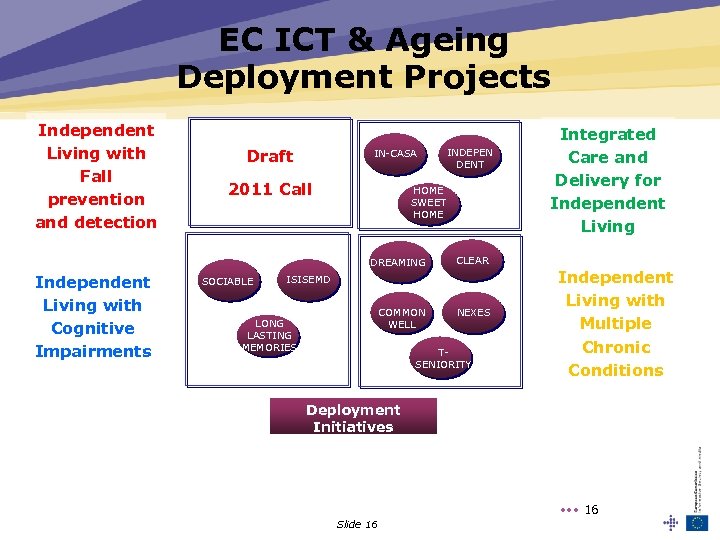 EC ICT & Ageing Deployment Projects Independent Living with Fall prevention and detection Draft IN-CASA 2011 Call INDEPEN DENT HOME SWEET HOME DREAMING Independent Living with Cognitive Impairments SOCIABLE CLEAR COMMON WELL NEXES Integrated Care and Delivery for Independent Living ISISEMD LONG LASTING MEMORIES TSENIORITY Independent Living with Multiple Chronic Conditions Deployment Initiatives Prototypes • • • 16 Slide 16
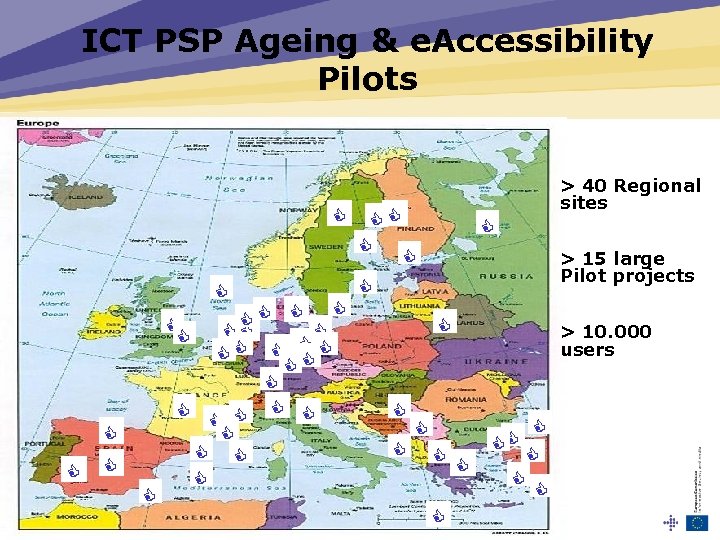 ICT PSP Ageing & e. Accessibility Pilots > 40 Regional sites > 15 large Pilot projects Slide 17 > 10. 000 users
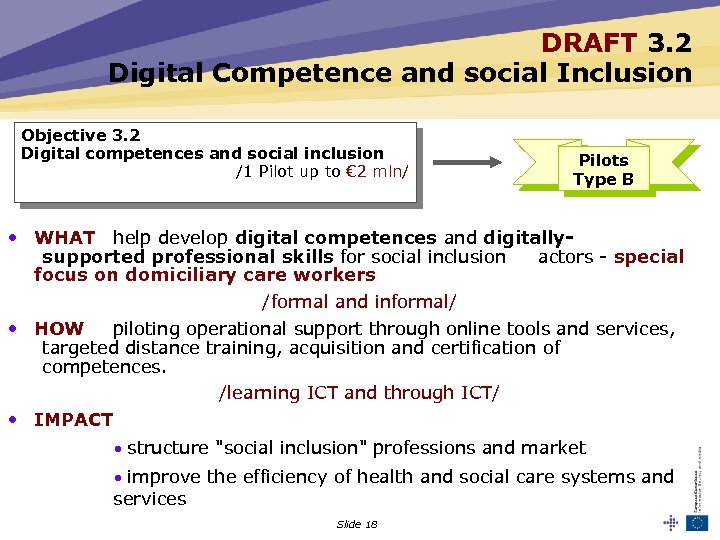 DRAFT 3. 2 Digital Competence and social Inclusion Objective 3. 2 Digital competences and social inclusion /1 Pilot up to € 2 mln/ Pilots Type B • WHAT help develop digital competences and digitallysupported professional skills for social inclusion actors - special focus on domiciliary care workers /formal and informal/ • HOW piloting operational support through online tools and services, targeted distance training, acquisition and certification of competences. /learning ICT and through ICT/ • IMPACT • structure "social inclusion" professions and market • improve the efficiency of health and social care systems and services Slide 18
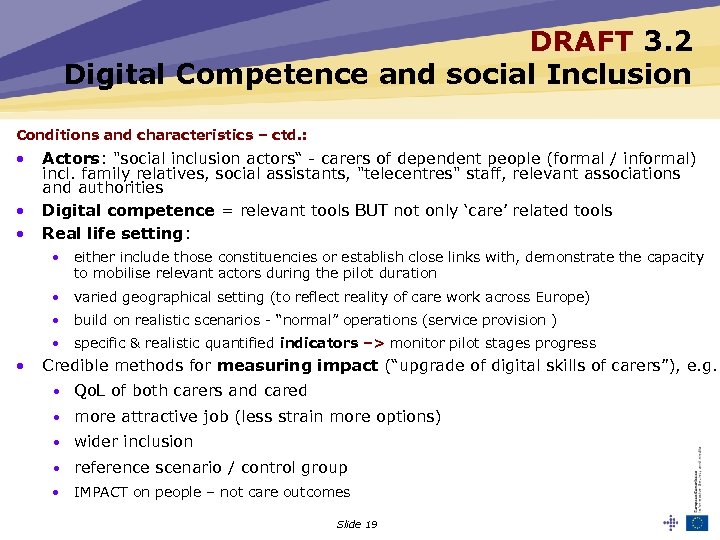 DRAFT 3. 2 Digital Competence and social Inclusion Conditions and characteristics – ctd. : • • • Actors: "social inclusion actors“ - carers of dependent people (formal / informal) incl. family relatives, social assistants, "telecentres" staff, relevant associations and authorities Digital competence = relevant tools BUT not only ‘care’ related tools Real life setting: • • varied geographical setting (to reflect reality of care work across Europe) • build on realistic scenarios - “normal” operations (service provision ) • • either include those constituencies or establish close links with, demonstrate the capacity to mobilise relevant actors during the pilot duration specific & realistic quantified indicators –> monitor pilot stages progress Credible methods for measuring impact (“upgrade of digital skills of carers”), e. g. • Qo. L of both carers and cared • more attractive job (less strain more options) • wider inclusion • reference scenario / control group • IMPACT on people – not care outcomes Slide 19
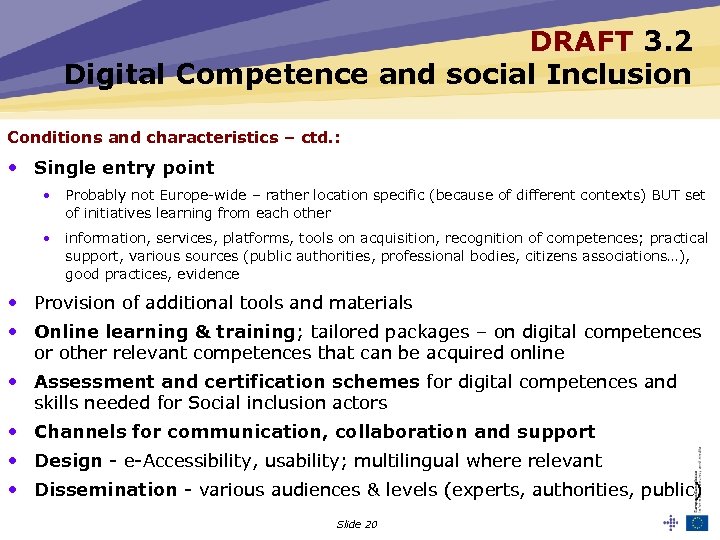 DRAFT 3. 2 Digital Competence and social Inclusion Conditions and characteristics – ctd. : • Single entry point • Probably not Europe-wide – rather location specific (because of different contexts) BUT set of initiatives learning from each other • information, services, platforms, tools on acquisition, recognition of competences; practical support, various sources (public authorities, professional bodies, citizens associations…), good practices, evidence • Provision of additional tools and materials • Online learning & training; tailored packages – on digital competences or other relevant competences that can be acquired online • Assessment and certification schemes for digital competences and skills needed for Social inclusion actors • Channels for communication, collaboration and support • Design - e-Accessibility, usability; multilingual where relevant • Dissemination - various audiences & levels (experts, authorities, public) Slide 20
 DRAFT 3. 2 Digital Competence and social Inclusion • Outcomes • best practice toolkits – how to teach and train people • which are the skills / competences • business models – who and how should invest in training • qualitative and quantitative evidence on benefits from investment in carers digital competences and skills Expected impact: • Strengthening the use of ICT solutions for delivering social support and care • Increasing digital competences and engagement of persons involved in this area • Raising the profile of social inclusion work Slide 21
 e-Accessibility – Background e-Accessibility: ensuring that people with disabilities and the elderly access and use ICTs on an equal basis with others; that the design, production and installation of ICTs take account of their specific needs. Setting up Policies and Actions • European i 2010 initiative on e-Inclusion: "to be part of the information society“ • Commission’s Communication "Towards an accessible information society“, 2008 (suggestions for improving Web accessibility) • Digital Agenda for Europe: Promote take-up of digital technologies by potentially disadvantaged groups, such as elderly, less-literate, low-income persons; Improving access for people with a disabilities • ICT Policy Support Programme - stimulate competitiveness and innovation while encouraging greater uptake of ICT across society • Framework Programmes for supporting R&D on e-Accessibility, Slide 22 including Assistive Technology and Design for All since > 15 years
 UN Convention and EU disability strategy 2020 • UN Convention on the Rights of People with Disabilities – new momentum for acting on e-accessibility: “to ensure access, on an equal basis with others, to ICT and systems, and to services provided to the public, including electronic services and emergency services” • International treaty on human rights • Many references to technology • Implementation UNC: • Implementation thematic level • Implementation at formal level: Coordination, focal point, independent mechanism • Monitoring; Statistics: Indicators and targets with dates, UNC report • Thematic Actions • 10 areas (including accessibility), various actors • European Commission actions • Possible common actions at National level • EU institutions • • • 23 • Civil society Slide 23
 DRAFT ICT PSP Call 2011 e-Inclusion Objectives ‘ICT for Ageing Well and Independent Living’ Objective 3. 3 – e-Accessibility /up to one pilot € 3 M/ Pilots Type B Focus and outcomes • to reinforce the e-accessibility implementation across Europe, • notably in the area of public services, • through the provision of common approaches • leading to the creation and the delivery of accessible services for people with disabilities • and the monitoring of accessibility through multiple platforms. Slide 24
 DRAFT 3. 3 Pilot – e-Accessibility Conditions and characteristics : Elements to deliver (1) • Technology guidance for generating, testing and validating accessible presentation and content on multiple platforms (web, digital TV, mobile, public digital terminals). In particular: • Tools, templates and specifications for accessible web page creation and design, content creation and management. • Automatic and manual testing • Quality control certification and conformance aspects. To build as appropriate on past and ongoing EU-funded projects (e. g. FP 6 WAB cluster, FP 7 ACCESSIBLE project, FP 7 VUMS cluster, CIP Pilots DTV 4 ALL, REACH 112, CIP Thematic-Network e. Access+, and a coming CIP Pilot on public digital terminal) To take into account existing specifications (widely acknowledged internationally) for web content, authoring tools, user agents, rich internet applications and other aspects relevant to e-accessibility. Slide 25
 DRAFT 3. 3 Pilot – e-Accessibility Conditions and characteristics : Elements to deliver (2) • Accessible online public services/ services of general interest, paying special attention to services with high social impact and to crossborder services. In relation to: • "European Interoperability Framework" for e-government (IDABC) • Inclusive e-government aspects beyond accessibility (e. g. usability, user centricity). • Accessibility requirements for public procurement of web-based services, on the basis of appropriate guidance and toolkits. • Multi-platform delivery (mobile, TV, public digital terminals, …) • "dynamic web"/ web 2. 0 applications • Interaction with users: • use of the service itself (access to information, forms, transactions, etc) • and user feedback & online assistance regarding e- accessibility issues. Slide 26
 DRAFT 3. 3 Pilot – e-Accessibility Conditions and characteristics : Elements to deliver (3) • Support packages and training for creators and managers of web sites and other on-line information, including: • reference curricula, • competence assessment and certification, • tutorials and good practices repository. • Public awareness • Monitoring and assessment schemes for e-accessibility status and impact, notably in terms of quality of service, costs and benefits. Slide 27
 DRAFT 3. 3 Pilot – e-Accessibility Conditions and characteristics : Elements to consider (4) • Coverage of a wide range of user profiles and user functionalities (using as appropriate the ICF from WHO) • International standards and specifications related to web- and e-accessibility. In particular, to build upon and liaise with activities undertaken under the European standardisation mandate 376. • Specific and realistic quantified indicators to monitor progress at all stages during the pilot. • Integrated dissemination and communication, addressing • not only experts, • but also public authorities and relevant stakeholders who could play a role for the future deployment or replication of the envisaged solution/service, • as well as the public at large. Slide 28
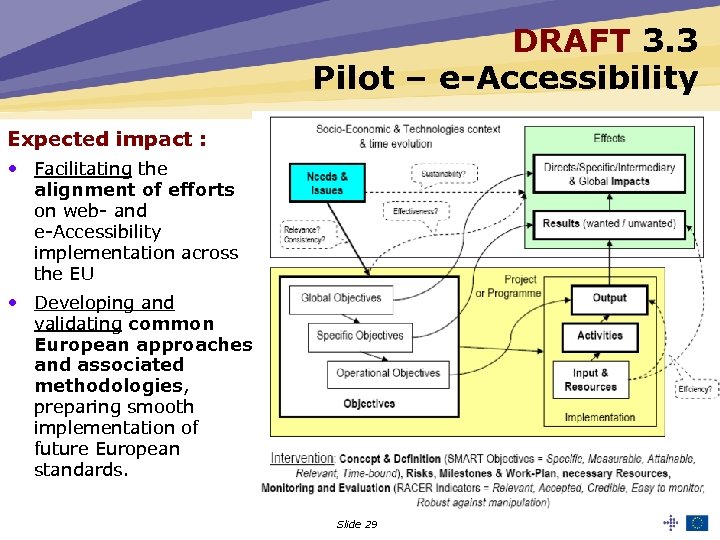 DRAFT 3. 3 Pilot – e-Accessibility Expected impact : • Facilitating the alignment of efforts on web- and e-Accessibility implementation across the EU • Developing and validating common European approaches and associated methodologies, preparing smooth implementation of future European standards. Slide 29
 Relevant on-going Standardisation • Mandate 376 to ESOs on European Accessibility requirements for the public procurement of ICT goods and services • Phase I: Inventory of existing functional requirements and stds/technical specs, Analysis on testing & conformity assessment • Phase II: Standardisation Activities: European standard, Technical report and support guidelines, On-line freely accessible toolkit • NEW Mandate 473 to ESOs to include Design for all in relevant standardization initiatives • Acceptance of the mandate expected by 8 March • Set up of a new CENELEC Technical Board working group (SAGA) • will monitor the revision of ISO/IEC Guide 71 • relevance of standardization deliverables for people with disabilities & olders • main areas for standardization • report on progress of work programme • Progress report by Autumn 2011 Slide 30
 Writing an e-Inclusion Pilot proposal • Clearly link approach, implementation and impacts (including means to achieve them) sections • Demonstrate a logical path from approch, challenges /risks, specific objectives, milestones and key deliverables • Explain the rationale of each pilot site (complementarity, etc) • Demonstrate the coverage of the full value chain of stakeholders • Include not only technical validation, but also validation of operational, legal, policy aspects Slide 31
 Further Information • CIP ICT PSP Info Day – February 28 th 2011 • CIP Programme details http: //ec. europa. eu/information_society/activities/ict_psp • e-Inclusion specific Info Day – February 11 th http: //ec. europa. eu/information_society/activities/einclusion/events/cip_ call 5/index_en. htm • e-Inclusion http: //ec. europa. eu/einclusion • Ambient Assisted Living Joint Programme http: //www. aal-europe. eu/ • EIP http: //ec. europa. eu/active-healthy-ageing • Best Practice Portal http: //www. epractice. eu • Contact: katarzyna. balucka (at) ec. europa. eu Slide 32
 ICT-PSP Call 5 2011 THEME 3: ICT FOR HEALTH, AGEING WELL AND INCLUSION Objective 3. 4 Anne Starkie-Alves DG INFSO ICT for Health anne. starkie-alves@ec. europa. eu
 e. Health in CIP ICT –PSP Policy Snapshot • “Telemedicine for the benefit of patients, healthcare systems and society” COM (2008) 689 final • Digital Agenda for Europe • European Innovation Partnership on Active and Healthy Ageing • e. Health Action Plan 2011 • Council conclusions on safe and efficient healthcare through e. Health –(Dec 2009) • Council conclusions on innovative approaches for chronic diseases - (Dec 2010) • e. Health Governance Initiative Empowerment and Telehealth ICT-PSP Call 5 Info Day, Brussels, 28 February 2010 Slide 34
 Overall Objective of 3. 4 Empowering patients and supporting widespread deployment of telemedicine services • Build on results of ongoing initiatives: • ep. SOS • Renewing Health • e. Health Governance Initiative • Work towards DAE goals (KA 13) • Undertake pilot actions to equip Europeans with secure online access to their medical health data by 2015 • Achieve by 2020 widespread deployment of telemedicine services ICT-PSP Call 5 Info Day, Brussels, 28 February 2010 Slide 35
 3. 4 a) empowering patients through secure online access by citizens to their medical / health records • The objective is to validate services based on secure and user friendly online access by patients to their health data (in real life settings), to evaluate the benefits and prepare for their wider deployment. • Who: • Minimum 4 independent legal entities from 4 different MS or Associated Countries • Key players involved in the provision of online e. Health services (incl. e- booking, referral tracking, chronic disease management support, repeat e -prescriptions…) • What : • Health and economic evaluation of services • Business model for long term sustainability • Recommendations for minimum set of services and their EU-wide implementation ICT-PSP Call 5 Info Day, Brussels, 28 February 2010 Slide 36
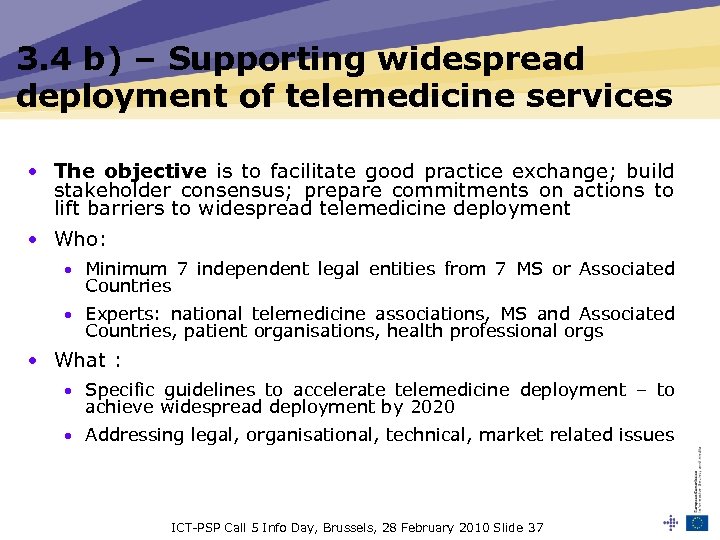 3. 4 b) – Supporting widespread deployment of telemedicine services • The objective is to facilitate good practice exchange; build stakeholder consensus; prepare commitments on actions to lift barriers to widespread telemedicine deployment • Who: • Minimum 7 independent legal entities from 7 MS or Associated Countries • Experts: national telemedicine associations, MS and Associated Countries, patient organisations, health professional orgs • What : • Specific guidelines to accelerate telemedicine deployment – to achieve widespread deployment by 2020 • Addressing legal, organisational, technical, market related issues ICT-PSP Call 5 Info Day, Brussels, 28 February 2010 Slide 37
 Thank you For more information: INFSO-EHEALTH-CIP-CALLS@ec. europa. eu Or anne. starkie-alves@ec. europa. eu ICT-PSP Call 5 Info Day, Brussels, 28 February 2010 Slide 38