


 Скачать презентацию Information Control and Games Shi-Chung Chang EE-II 245
58e3f59d210b098949c1ca98244cb25e.ppt
- Количество слайдов: 34
 Information, Control and Games Shi-Chung Chang EE-II 245, Tel: 2363 -5251 ext. 245 scchang@cc. ee. ntu. edu. tw, http: //recipe. ee. ntu. edu. tw/scc. htm Office Hours: Mon/Wed 1: 00 -2: 00 pm or by appointment Yi-Nung Yang (03 ) 2655205, yinyang@ms 17. hinet. net 1
 Moral Hazard, Incentives Theory (continued), and Incomplete Information 2
 Moral hazard • 道德風險 – A person who has insurance coverage will have less incentive to take proper care of an insured object than a person who does not • Two players are involved: – Insurer (manager of the insurance company) – Customer of the insurance company 3
 The essential question in incentive scheme design • The essential question: – What kind of insurance will the customer buy? – Coverage v. s. carefulness – Moral hazard problem, Adverse selection, and its cures • How to formulate the problem mathematically? 4
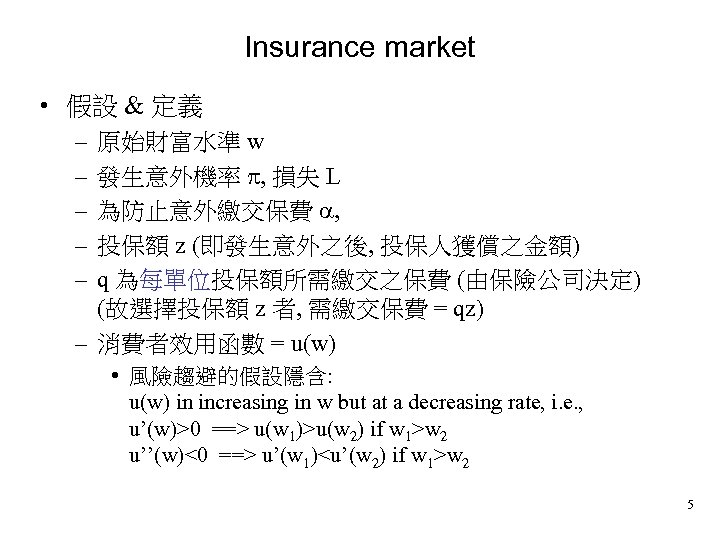 Insurance market • 假設 & 定義 – – – 原始財富水準 w 發生意外機率 , 損失 L 為防止意外繳交保費 , 投保額 z (即發生意外之後, 投保人獲償之金額) q 為每單位投保額所需繳交之保費 (由保險公司決定) (故選擇投保額 z 者, 需繳交保費 = qz) – 消費者效用函數 = u(w) • 風險趨避的假設隱含: u(w) in increasing in w but at a decreasing rate, i. e. , u’(w)>0 ==> u(w 1)>u(w 2) if w 1>w 2 u’’(w)<0 ==> u’(w 1)
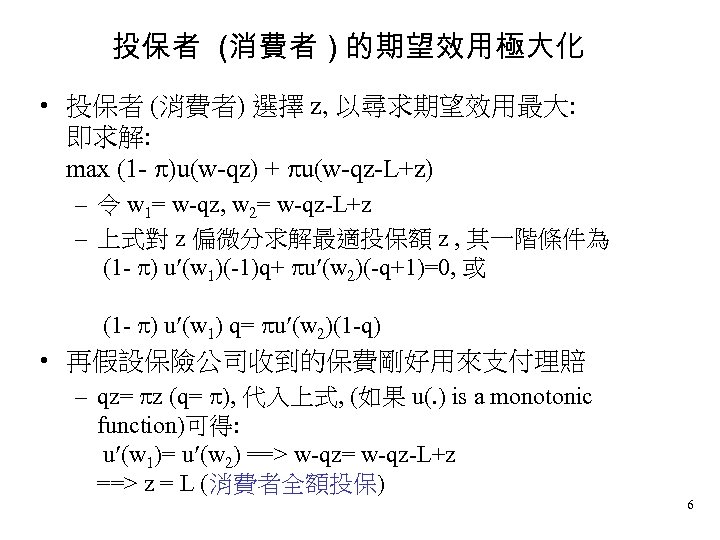 投保者 (消費者 ) 的期望效用極大化 • 投保者 (消費者) 選擇 z, 以尋求期望效用最大: 即求解: max (1 - )u(w-qz) + u(w-qz-L+z) – 令 w 1= w-qz, w 2= w-qz-L+z – 上式對 z 偏微分求解最適投保額 z , 其一階條件為 (1 - ) u (w 1)(-1)q+ u (w 2)(-q+1)=0, 或 (1 - ) u (w 1) q= u (w 2)(1 -q) • 再假設保險公司收到的保費剛好用來支付理賠 – qz= z (q= ), 代入上式, (如果 u(. ) is a monotonic function)可得: u (w 1)= u (w 2) ==> w-qz= w-qz-L+z ==> z = L (消費者全額投保) 6
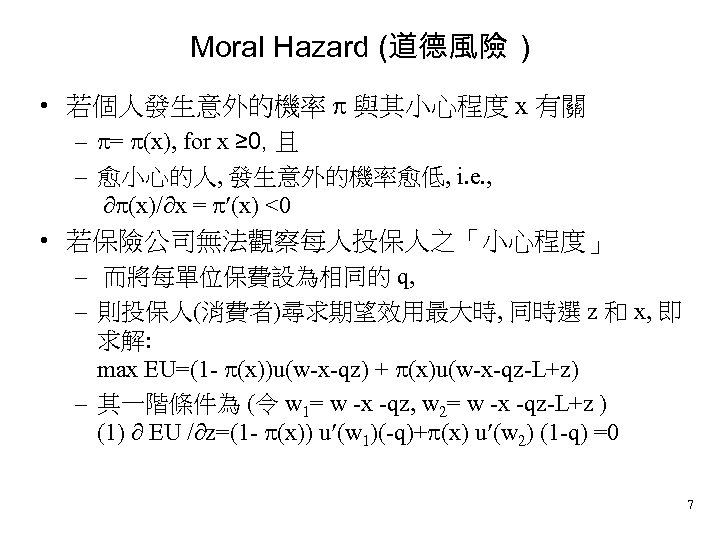 Moral Hazard (道德風險 ) • 若個人發生意外的機率 與其小心程度 x 有關 – = (x), for x ≥ 0, 且 – 愈小心的人, 發生意外的機率愈低, i. e. , (x)/ x = (x) <0 • 若保險公司無法觀察每人投保人之「小心程度」 – 而將每單位保費設為相同的 q, – 則投保人(消費者)尋求期望效用最大時, 同時選 z 和 x, 即 求解: max EU=(1 - (x))u(w-x-qz) + (x)u(w-x-qz-L+z) – 其一階條件為 (令 w 1= w -x -qz, w 2= w -x -qz-L+z ) (1) EU / z=(1 - (x)) u (w 1)(-q)+ (x) u (w 2) (1 -q) =0 7
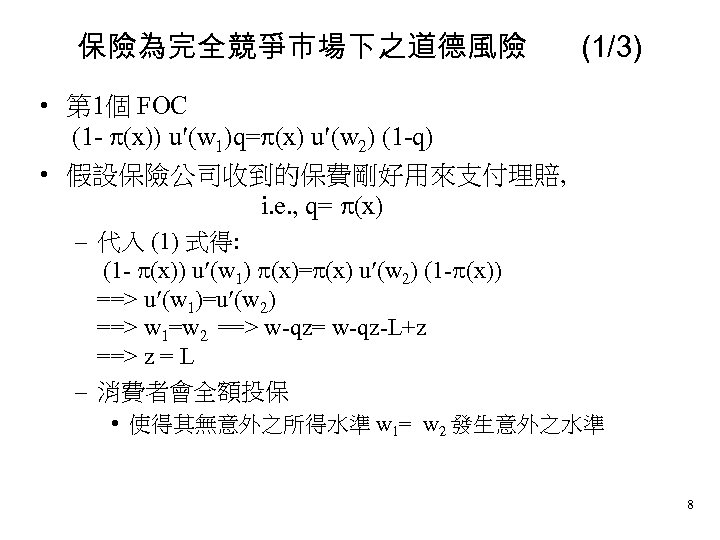 保險為完全競爭市場下之道德風險 (1/3) • 第 1個 FOC (1 - (x)) u (w 1)q= (x) u (w 2) (1 -q) • 假設保險公司收到的保費剛好用來支付理賠, i. e. , q= (x) – 代入 (1) 式得: (1 - (x)) u (w 1) (x)= (x) u (w 2) (1 - (x)) ==> u (w 1)=u (w 2) ==> w 1=w 2 ==> w-qz= w-qz-L+z ==> z = L – 消費者會全額投保 • 使得其無意外之所得水準 w 1= w 2 發生意外之水準 8
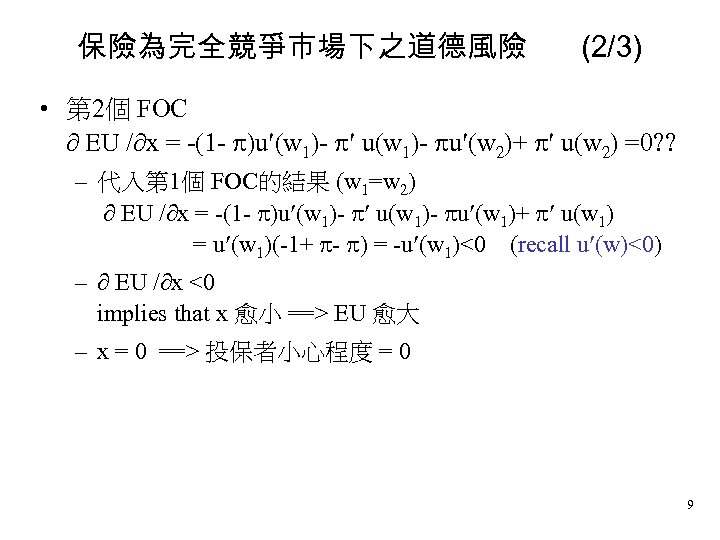 保險為完全競爭市場下之道德風險 (2/3) • 第 2個 FOC EU / x = -(1 - )u (w 1)- u(w 1)- u (w 2)+ u(w 2) =0? ? – 代入第 1個 FOC的結果 (w 1=w 2) EU / x = -(1 - )u (w 1)- u(w 1)- u (w 1)+ u(w 1) = u (w 1)(-1+ - ) = -u (w 1)<0 (recall u (w)<0) – EU / x <0 implies that x 愈小 ==> EU 愈大 – x = 0 ==> 投保者小心程度 = 0 9
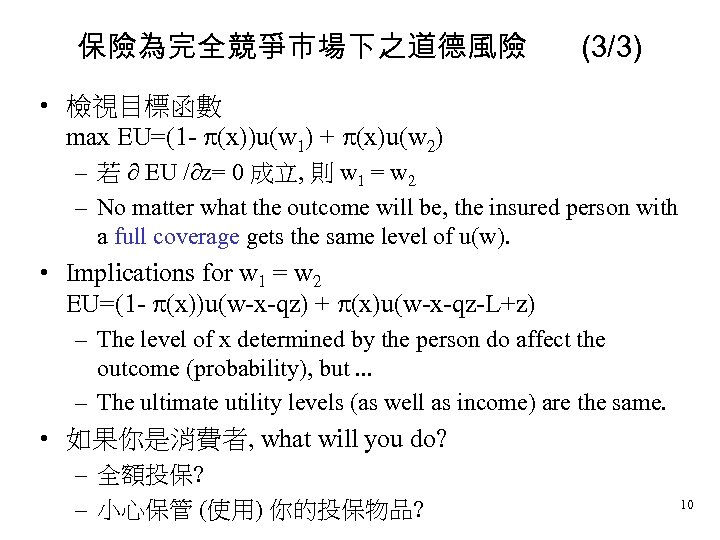 保險為完全競爭市場下之道德風險 (3/3) • 檢視目標函數 max EU=(1 - (x))u(w 1) + (x)u(w 2) – 若 EU / z= 0 成立, 則 w 1 = w 2 – No matter what the outcome will be, the insured person with a full coverage gets the same level of u(w). • Implications for w 1 = w 2 EU=(1 - (x))u(w-x-qz) + (x)u(w-x-qz-L+z) – The level of x determined by the person do affect the outcome (probability), but. . . – The ultimate utility levels (as well as income) are the same. • 如果你是消費者, what will you do? – 全額投保? – 小心保管 (使用) 你的投保物品? 10
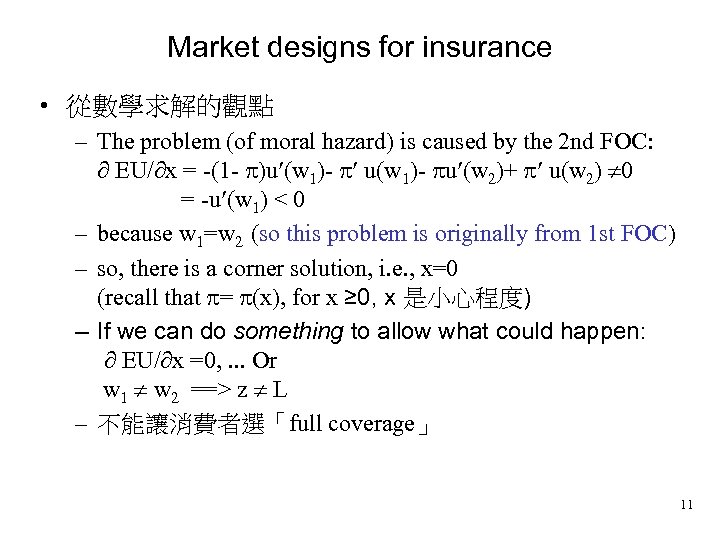 Market designs for insurance • 從數學求解的觀點 – The problem (of moral hazard) is caused by the 2 nd FOC: EU/ x = -(1 - )u (w 1)- u(w 1)- u (w 2)+ u(w 2) 0 = -u (w 1) < 0 – because w 1=w 2 (so this problem is originally from 1 st FOC) – so, there is a corner solution, i. e. , x=0 (recall that = (x), for x ≥ 0, x 是小心程度) – If we can do something to allow what could happen: EU/ x =0, . . . Or w 1 w 2 ==> z L – 不能讓消費者選「full coverage」 11
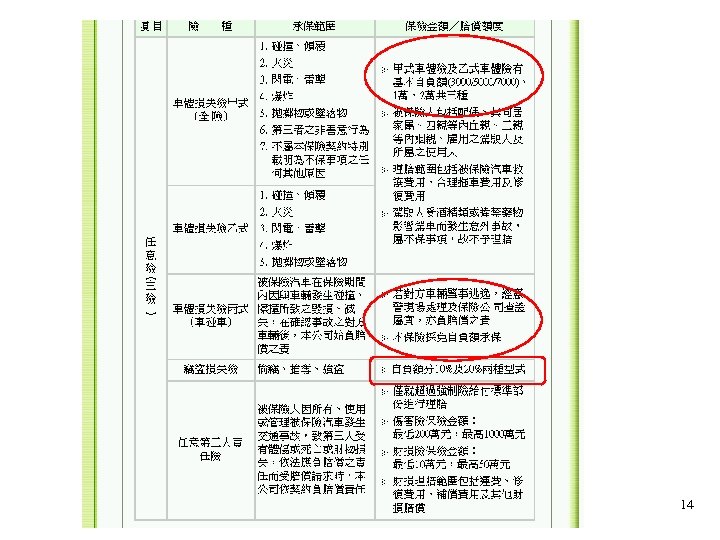
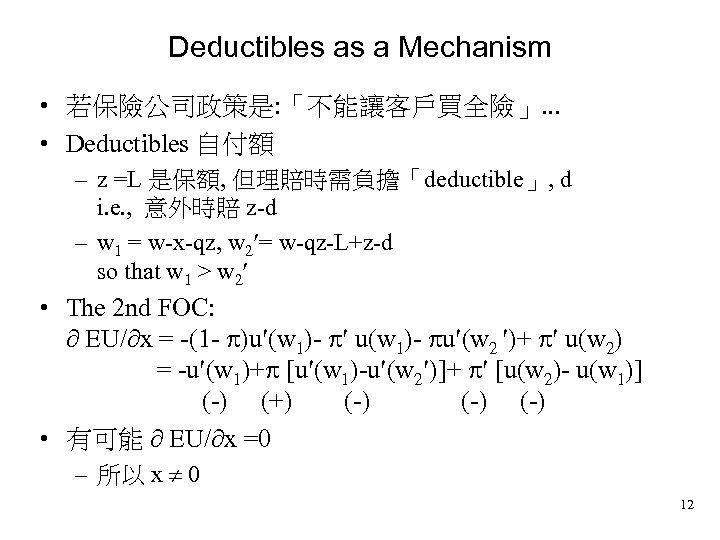 Deductibles as a Mechanism • 若保險公司政策是: 「不能讓客戶買全險」. . . • Deductibles 自付額 – z =L 是保額, 但理賠時需負擔「deductible」, d i. e. , 意外時賠 z-d – w 1 = w-x-qz, w 2 = w-qz-L+z-d so that w 1 > w 2 • The 2 nd FOC: EU/ x = -(1 - )u (w 1)- u(w 1)- u (w 2 )+ u(w 2) = -u (w 1)+ [u (w 1)-u (w 2 )]+ [u(w 2)- u(w 1)] (-) (+) (-) (-) • 有可能 EU/ x =0 – 所以 x 0 12
 Economic Insight of the Deductibles • 檢視目標函數 max EU=(1 - (x))u(w 1) + (x)u(w 2 ) • Incentive – w 1 > w 2 – if the consumer can increase x to reduce (x), – this gives more weights on (1 - ) u(w 1). So, he will be more careful (x↑) • Insurance policy – d 愈大, 則 w 2 愈小 ==> x↑ 防止汽車被偷, 記得鎖車門, 加買大鎖, 裝 GPS 防盜. . – 保費可能也不同 13
 14
14
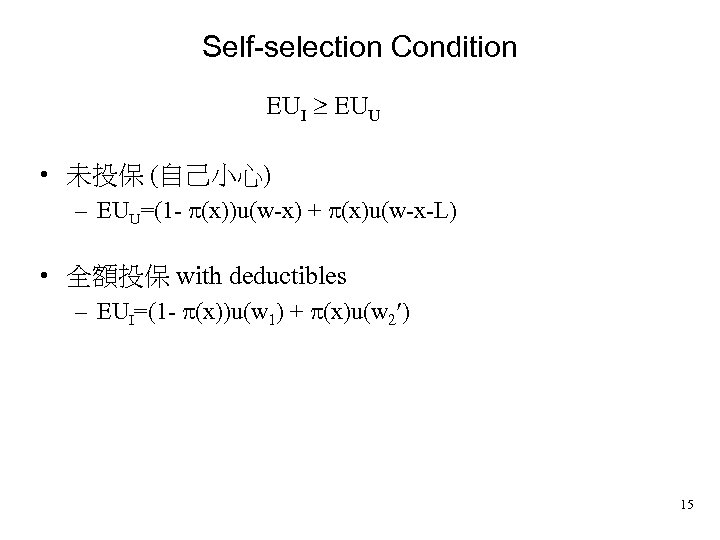 Self-selection Condition EUI EUU • 未投保 (自己小心) – EUU=(1 - (x))u(w-x) + (x)u(w-x-L) • 全額投保 with deductibles – EUI=(1 - (x))u(w 1) + (x)u(w 2 ) 15
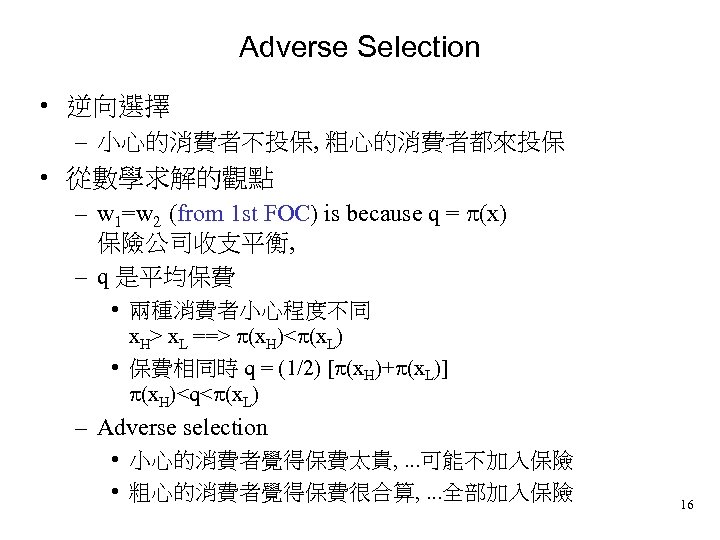 Adverse Selection • 逆向選擇 – 小心的消費者不投保, 粗心的消費者都來投保 • 從數學求解的觀點 – w 1=w 2 (from 1 st FOC) is because q = (x) 保險公司收支平衡, – q 是平均保費 • 兩種消費者小心程度不同 x. H> x. L ==> (x. H)< (x. L) • 保費相同時 q = (1/2) [ (x. H)+ (x. L)] (x. H)
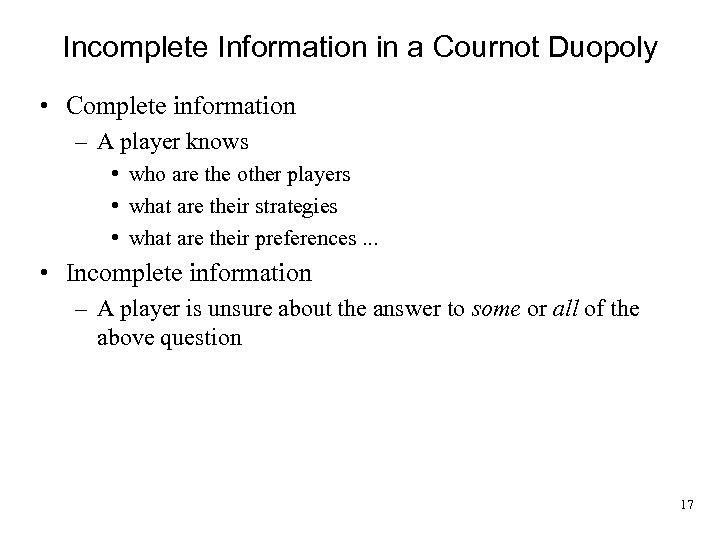 Incomplete Information in a Cournot Duopoly • Complete information – A player knows • who are the other players • what are their strategies • what are their preferences. . . • Incomplete information – A player is unsure about the answer to some or all of the above question 17
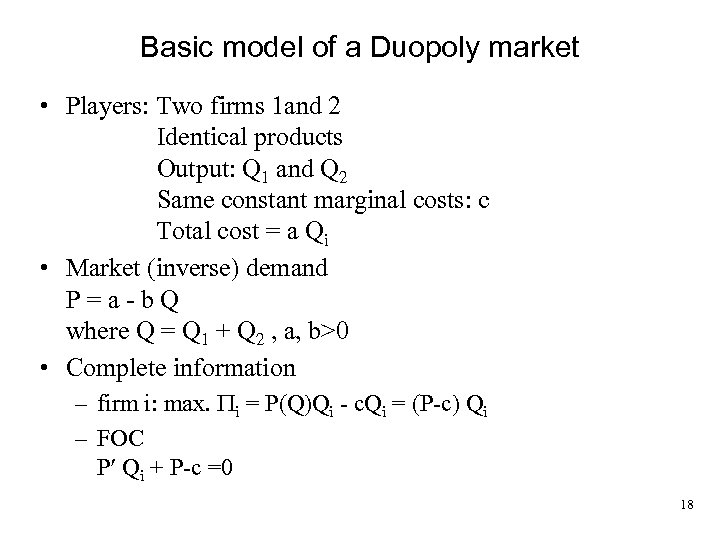 Basic model of a Duopoly market • Players: Two firms 1 and 2 Identical products Output: Q 1 and Q 2 Same constant marginal costs: c Total cost = a Qi • Market (inverse) demand P=a-b. Q where Q = Q 1 + Q 2 , a, b>0 • Complete information – firm i: max. i = P(Q)Qi - c. Qi = (P-c) Qi – FOC P Qi + P-c =0 18
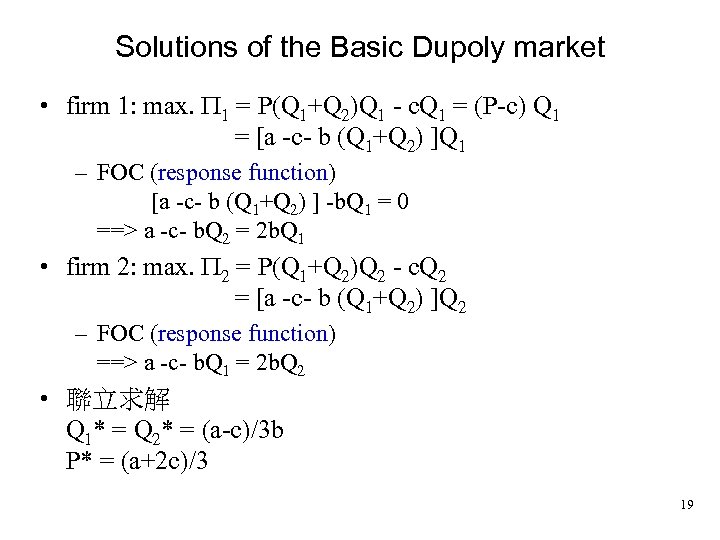 Solutions of the Basic Dupoly market • firm 1: max. 1 = P(Q 1+Q 2)Q 1 - c. Q 1 = (P-c) Q 1 = [a -c- b (Q 1+Q 2) ]Q 1 – FOC (response function) [a -c- b (Q 1+Q 2) ] -b. Q 1 = 0 ==> a -c- b. Q 2 = 2 b. Q 1 • firm 2: max. 2 = P(Q 1+Q 2)Q 2 - c. Q 2 = [a -c- b (Q 1+Q 2) ]Q 2 – FOC (response function) ==> a -c- b. Q 1 = 2 b. Q 2 • 聯立求解 Q 1* = Q 2* = (a-c)/3 b P* = (a+2 c)/3 19
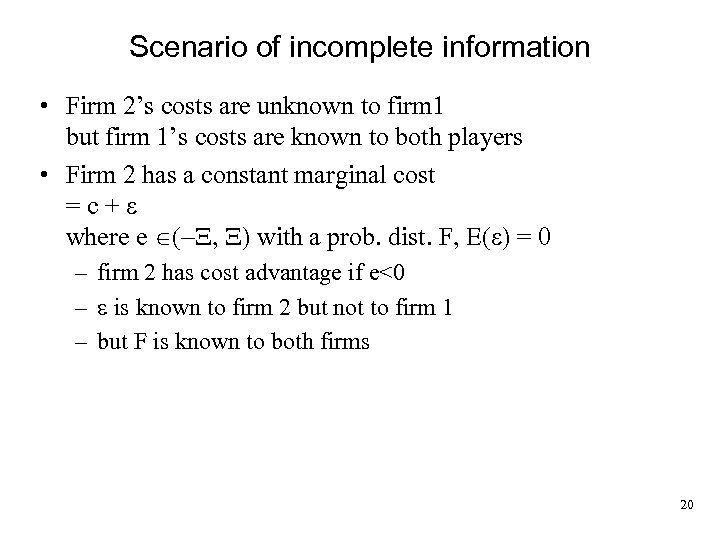 Scenario of incomplete information • Firm 2’s costs are unknown to firm 1 but firm 1’s costs are known to both players • Firm 2 has a constant marginal cost =c+ where e ( , ) with a prob. dist. F, E( ) = 0 – firm 2 has cost advantage if e<0 – is known to firm 2 but not to firm 1 – but F is known to both firms 20
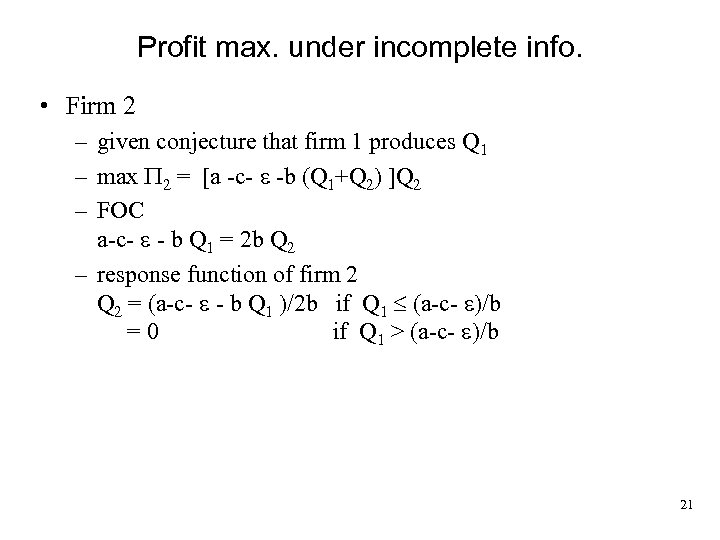 Profit max. under incomplete info. • Firm 2 – given conjecture that firm 1 produces Q 1 – max 2 = [a -c- -b (Q 1+Q 2) ]Q 2 – FOC a-c- - b Q 1 = 2 b Q 2 – response function of firm 2 Q 2 = (a-c- - b Q 1 )/2 b if Q 1 (a-c- )/b =0 if Q 1 > (a-c- )/b 21
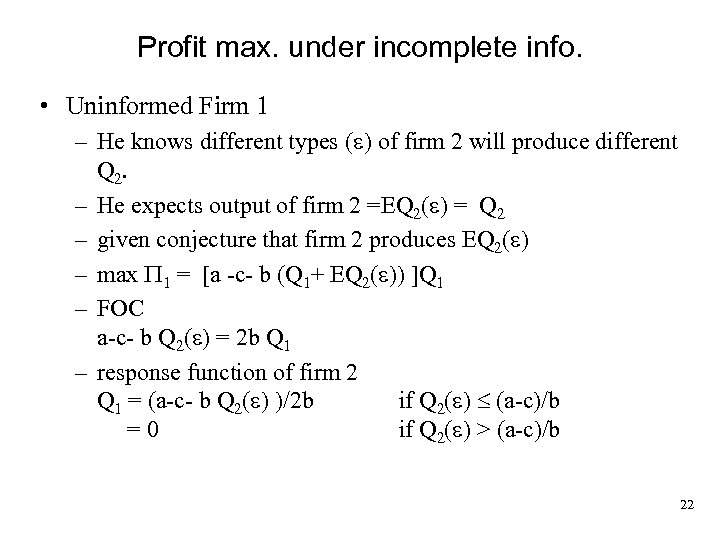 Profit max. under incomplete info. • Uninformed Firm 1 – He knows different types ( ) of firm 2 will produce different Q 2. – He expects output of firm 2 =EQ 2( ) = Q 2 – given conjecture that firm 2 produces EQ 2( ) – max 1 = [a -c- b (Q 1+ EQ 2( )) ]Q 1 – FOC a-c- b Q 2( ) = 2 b Q 1 – response function of firm 2 Q 1 = (a-c- b Q 2( ) )/2 b if Q 2( ) (a-c)/b =0 if Q 2( ) > (a-c)/b 22
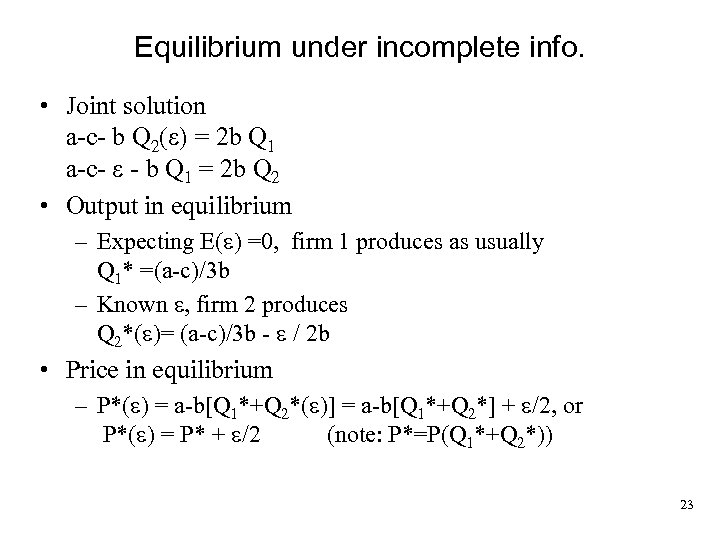 Equilibrium under incomplete info. • Joint solution a-c- b Q 2( ) = 2 b Q 1 a-c- - b Q 1 = 2 b Q 2 • Output in equilibrium – Expecting E( ) =0, firm 1 produces as usually Q 1* =(a-c)/3 b – Known , firm 2 produces Q 2*( )= (a-c)/3 b - / 2 b • Price in equilibrium – P*( ) = a-b[Q 1*+Q 2*( )] = a-b[Q 1*+Q 2*] + /2, or P*( ) = P* + /2 (note: P*=P(Q 1*+Q 2*)) 23
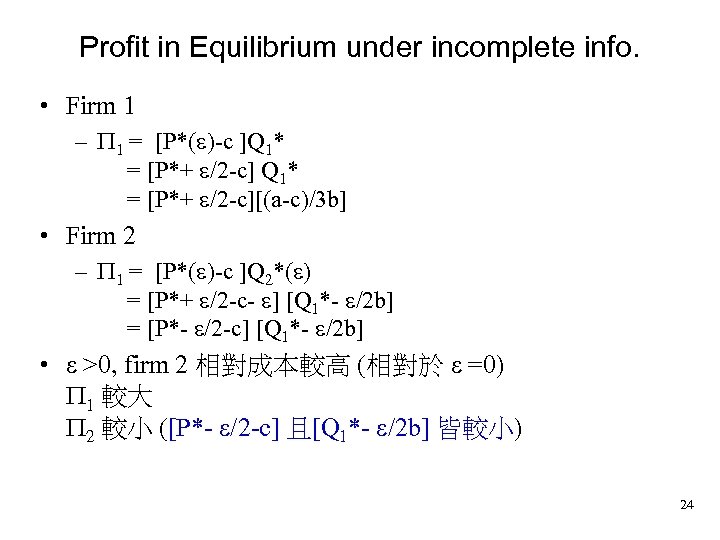 Profit in Equilibrium under incomplete info. • Firm 1 – 1 = [P*( )-c ]Q 1* = [P*+ /2 -c][(a-c)/3 b] • Firm 2 – 1 = [P*( )-c ]Q 2*( ) = [P*+ /2 -c- ] [Q 1*- /2 b] = [P*- /2 -c] [Q 1*- /2 b] • >0, firm 2 相對成本較高 (相對於 =0) 1 較大 2 較小 ([P*- /2 -c] 且[Q 1*- /2 b] 皆較小) 24
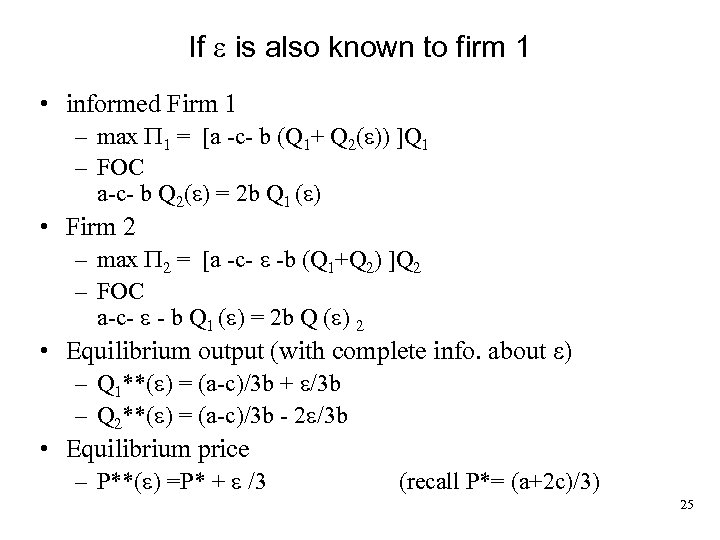 If is also known to firm 1 • informed Firm 1 – max 1 = [a -c- b (Q 1+ Q 2( )) ]Q 1 – FOC a-c- b Q 2( ) = 2 b Q 1 ( ) • Firm 2 – max 2 = [a -c- -b (Q 1+Q 2) ]Q 2 – FOC a-c- - b Q 1 ( ) = 2 b Q ( ) 2 • Equilibrium output (with complete info. about ) – Q 1**( ) = (a-c)/3 b + /3 b – Q 2**( ) = (a-c)/3 b - 2 /3 b • Equilibrium price – P**( ) =P* + /3 (recall P*= (a+2 c)/3) 25
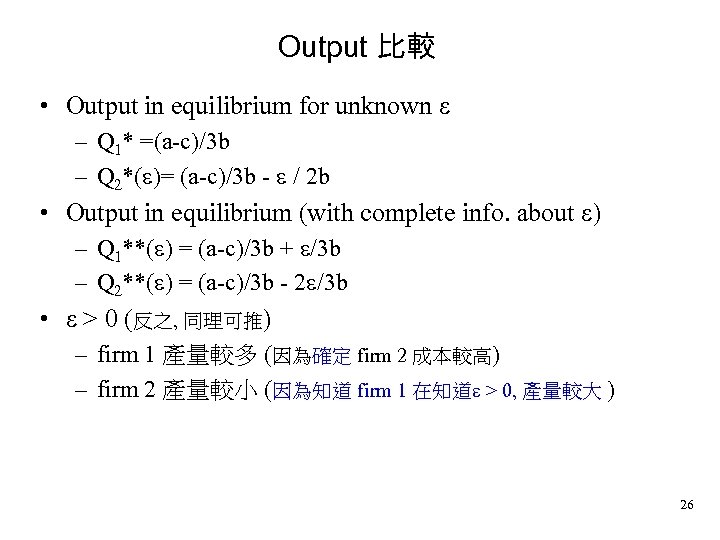 Output 比較 • Output in equilibrium for unknown – Q 1* =(a-c)/3 b – Q 2*( )= (a-c)/3 b - / 2 b • Output in equilibrium (with complete info. about ) – Q 1**( ) = (a-c)/3 b + /3 b – Q 2**( ) = (a-c)/3 b - 2 /3 b • > 0 (反之, 同理可推) – firm 1 產量較多 (因為確定 firm 2 成本較高) – firm 2 產量較小 (因為知道 firm 1 在知道 > 0, 產量較大 ) 26
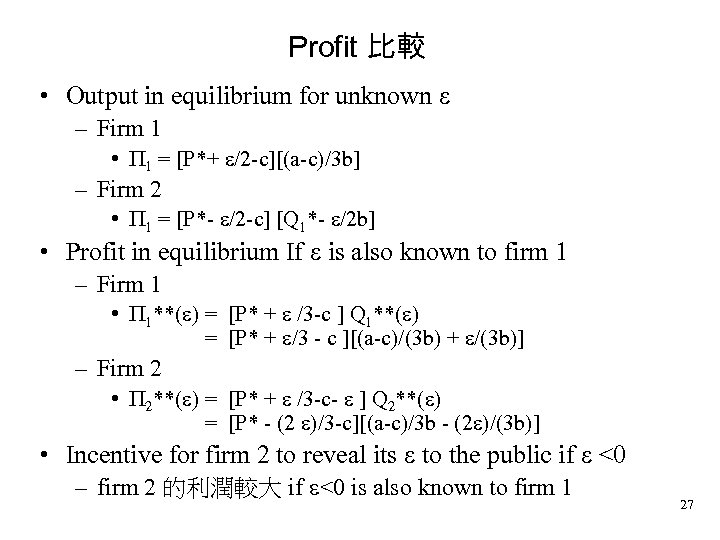 Profit 比較 • Output in equilibrium for unknown – Firm 1 • 1 = [P*+ /2 -c][(a-c)/3 b] – Firm 2 • 1 = [P*- /2 -c] [Q 1*- /2 b] • Profit in equilibrium If is also known to firm 1 – Firm 1 • 1**( ) = [P* + /3 -c ] Q 1**( ) = [P* + /3 - c ][(a-c)/(3 b) + /(3 b)] – Firm 2 • 2**( ) = [P* + /3 -c- ] Q 2**( ) = [P* - (2 )/3 -c][(a-c)/3 b - (2 )/(3 b)] • Incentive for firm 2 to reveal its to the public if <0 – firm 2 的利潤較大 if <0 is also known to firm 1 27
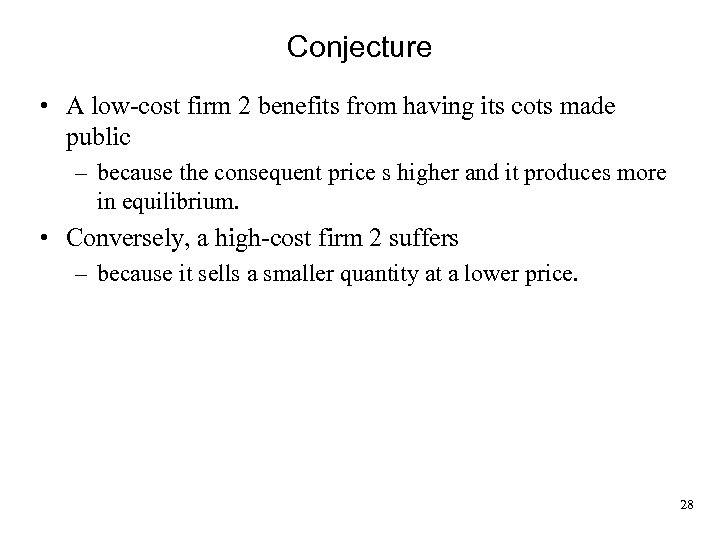 Conjecture • A low-cost firm 2 benefits from having its cots made public – because the consequent price s higher and it produces more in equilibrium. • Conversely, a high-cost firm 2 suffers – because it sells a smaller quantity at a lower price. 28
 Revealing Costs to a Rival • An efficient firm 2 ( <0) will make the information about its low costs public. • Q: How about an inefficient firm 2 with >0? • Reasoning – Efficient firms will reveal their costs to its rival. – But non-revelation is also informative: 不願透露成本訊息的廠商, 很有可能是高成本 ( >0) 29
 Informative no-information • In 1 st stage • Firm 2 can decide to reveal or not reveal – assumptions: information revealed by firm 2 is credible and costless. • In 2 nd stage • After revelation or lac thereof- the two firms compete on quantities • Focus on: – Firm 1 concludes from non-revelation that firm 2’s costs must be higher than some level – ( > > ^ >0 ) 30
 All type of the firm reveals their costs • Proposition – In equilibrium, = ^ , every type of firm 2 will reveal its costs • Thinking: – for any ^ < and non-revelation about firm 2’s costs – firm 1 可假定 firm 2’s type 介於 ( ^, ) 之間 進而猜測其產量為 Q~2 31
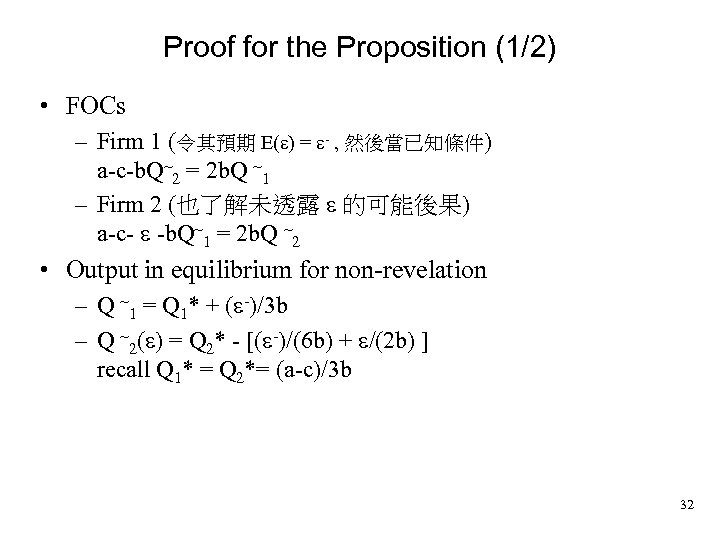 Proof for the Proposition (1/2) • FOCs – Firm 1 (令其預期 E( ) = - , 然後當已知條件) a-c-b. Q~2 = 2 b. Q ~1 – Firm 2 (也了解未透露 的可能後果) a-c- -b. Q~1 = 2 b. Q ~2 • Output in equilibrium for non-revelation – Q ~1 = Q 1* + ( -)/3 b – Q ~2( ) = Q 2* - [( -)/(6 b) + /(2 b) ] recall Q 1* = Q 2*= (a-c)/3 b 32
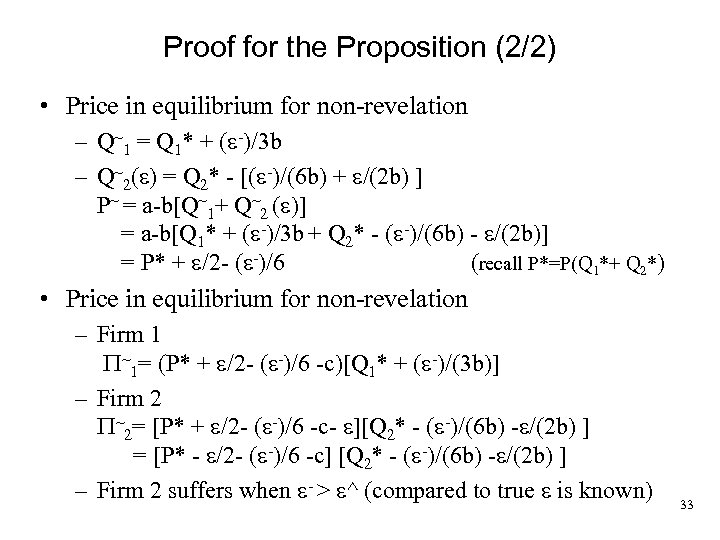 Proof for the Proposition (2/2) • Price in equilibrium for non-revelation – Q~1 = Q 1* + ( -)/3 b – Q~2( ) = Q 2* - [( -)/(6 b) + /(2 b) ] P~ = a-b[Q~1+ Q~2 ( )] = a-b[Q 1* + ( -)/3 b + Q 2* - ( -)/(6 b) - /(2 b)] = P* + /2 - ( -)/6 (recall P*=P(Q 1*+ Q 2*) • Price in equilibrium for non-revelation – Firm 1 ~1= (P* + /2 - ( -)/6 -c)[Q 1* + ( -)/(3 b)] – Firm 2 ~2= [P* + /2 - ( -)/6 -c- ][Q 2* - ( -)/(6 b) - /(2 b) ] = [P* - /2 - ( -)/6 -c] [Q 2* - ( -)/(6 b) - /(2 b) ] – Firm 2 suffers when - > ^ (compared to true is known) 33
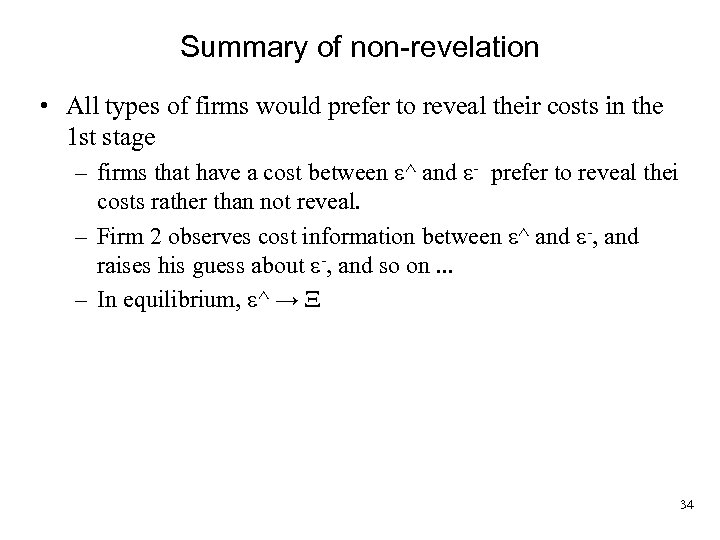 Summary of non-revelation • All types of firms would prefer to reveal their costs in the 1 st stage – firms that have a cost between ^ and - prefer to reveal thei costs rather than not reveal. – Firm 2 observes cost information between ^ and -, and raises his guess about -, and so on. . . – In equilibrium, ^ → 34