 Скачать презентацию Information Communication Technology ICT Enabled Total Quality
63c0c0ad84e38911bb35d79aa25e7c34.ppt
- Количество слайдов: 23



Information & Communication Technology (ICT) Enabled Total Quality Management (TQM) in Library and Information Services (LIS) Keynote Address Delivered in the Sixteenth National Convention on Knowledge, Library and Information Networking (NACLIN 2013) on ‘Emerging Technologies and Innovations in Library Practices’, organized by DELNET at MNIT, Jaipur Roshan Lal Raina Indian Institute of Management Lucknow December 11, 2013
Agenda • • • Context LIS Functions in Context Challenges for LIPs Opportunities for LICs & LIPs Way Forward
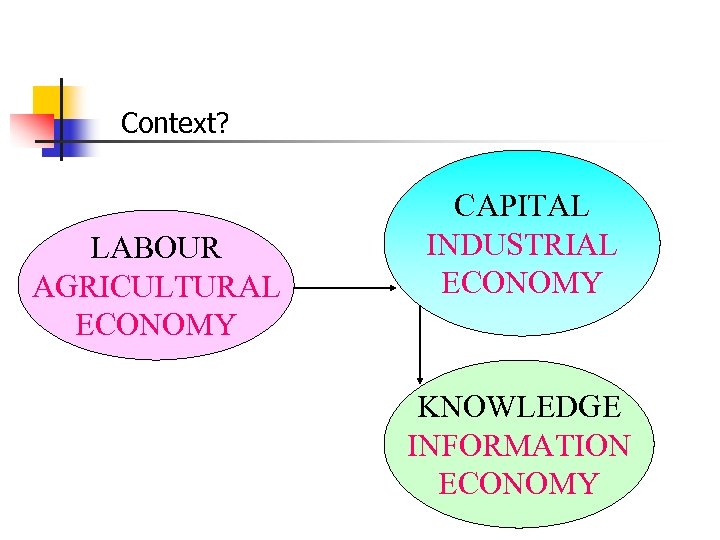
Context? LABOUR AGRICULTURAL ECONOMY CAPITAL INDUSTRIAL ECONOMY KNOWLEDGE INFORMATION ECONOMY
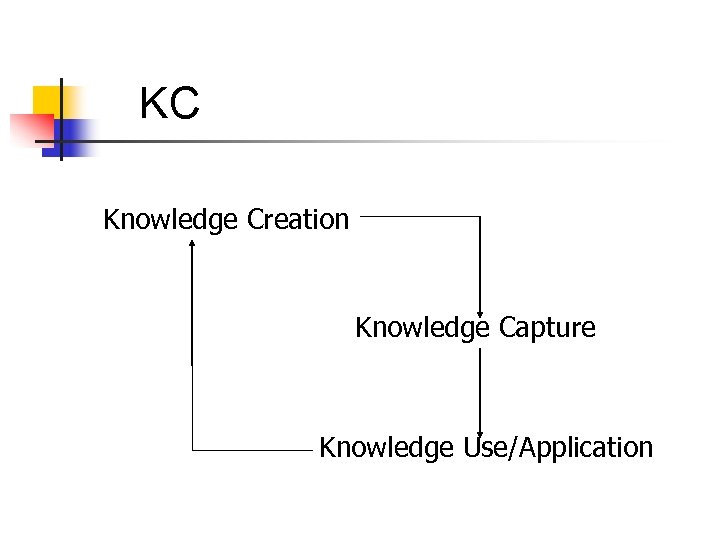
KC Knowledge Creation Knowledge Capture Knowledge Use/Application
LIPs in K/I C Not just Facilitators but Partners in all the three components
LIS Functions in Changed Context Procure Process Provide Not just Reading Materials but Essence
Challenges in Acquisitions • Evolve Policies with Customer as the Focus • No March Pressures • Move from traditional to modern IT enabled procurement methods • No vendor patronage --competitive • E-books
Consumer Attitudes Toward E-Book Reading Consumers are very interested in "bundling" print and digital versions of a book, with 48% of survey respondents willing to pay more for bundles. Just over half of survey respondents would pay more for an e‐book if it could be given away or re‐sold. Consumers do not distinguish between e‐books published by traditional houses and independently published options when making buying decisions. While the numbers are relatively small, there is an increase in the number of people who buy print and digital versions of a book interchangeably and a slow decline in the number of people who exclusively buy e‐books. Len Vlahos, BISG Executive Director, said "Four years of consumer data shows clearly that e‐ book consumption has reached mainstream readers and has expanded well beyond early adopter 'power readers, ' but that physical books remain a popular format for many consumers, especially in certain categories. This survey provides actionable information for companies across the industry to stay ahead of these trends. "
Challenges in Processing … no less Give it the treatment that it deserves and not overdue on this Again, keep your ‘USER’ in focus Use the facilities already available Accommodate your own (local) requirements
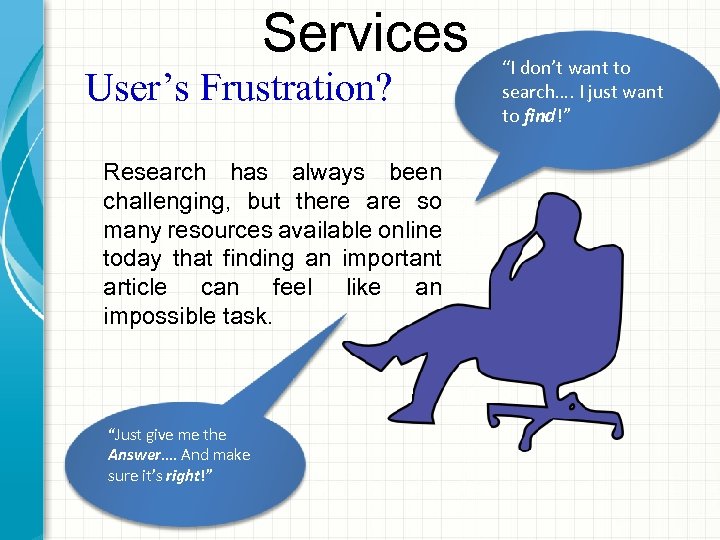
Services User’s Frustration? Research has always been challenging, but there are so many resources available online today that finding an important article can feel like an impossible task. “Just give me the Answer…. And make sure it’s right!” “I don’t want to search…. I just want to find!”
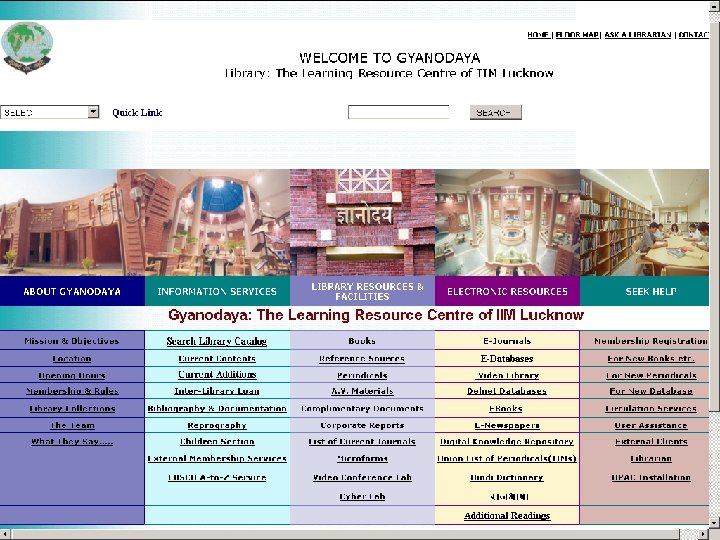
Disjointed approach to information searching and service delivery OPACs E-Journals Databases Digital Repositories Newspaper Articles E-Books Cited References Other Contents All searched separately
Alternatives Federated searches Web-scale discovery. A preharvested central index coupled with a richly featured discovery layer providing a single search across a library’s local, open access, and subscription collections Central index. The collection of preharvested and processed metadata and full text that comprises the searchable content. Discovery layer. The user interface and search system for discovering, displaying, and interacting with the content in library systems
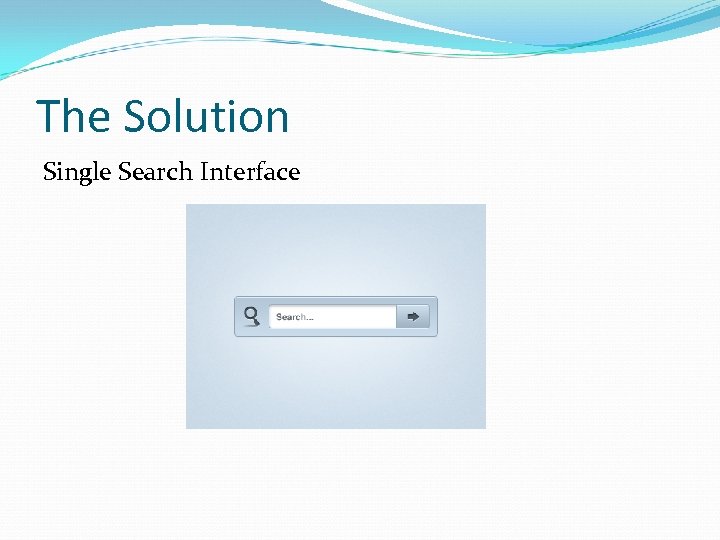
The Solution Single Search Interface
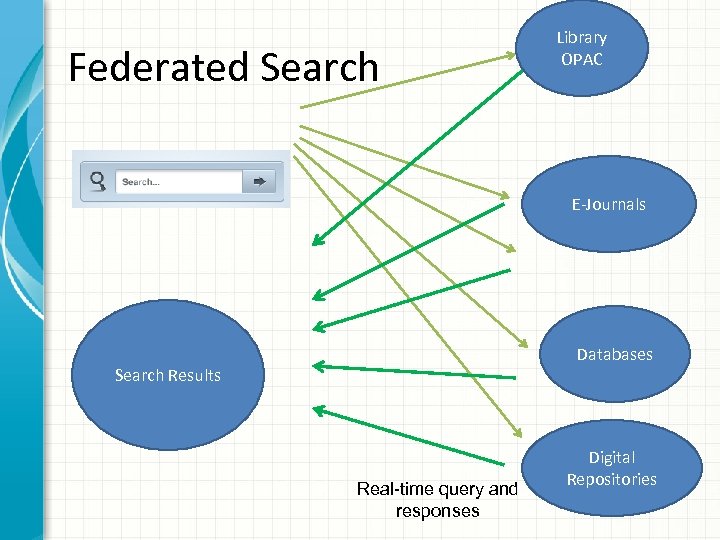
Federated Search Library OPAC E‐Journals Databases Search Results Real-time query and responses Digital Repositories
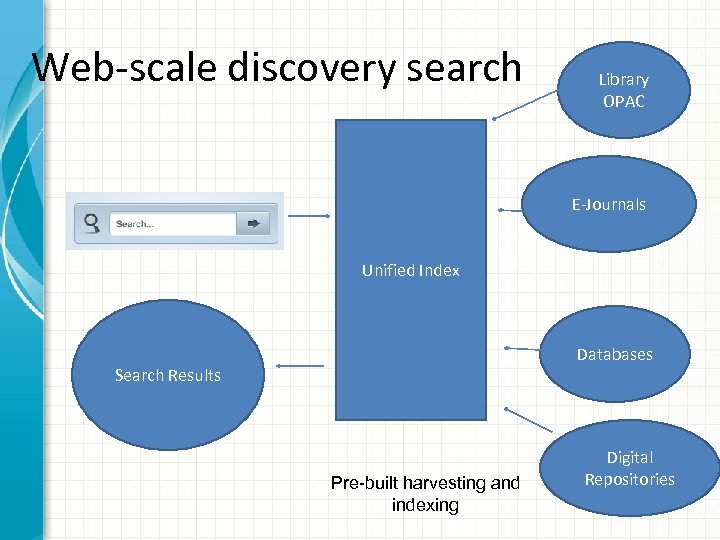
Web‐scale discovery search Library OPAC E‐Journals Unified Index Databases Search Results Pre-built harvesting and indexing Digital Repositories
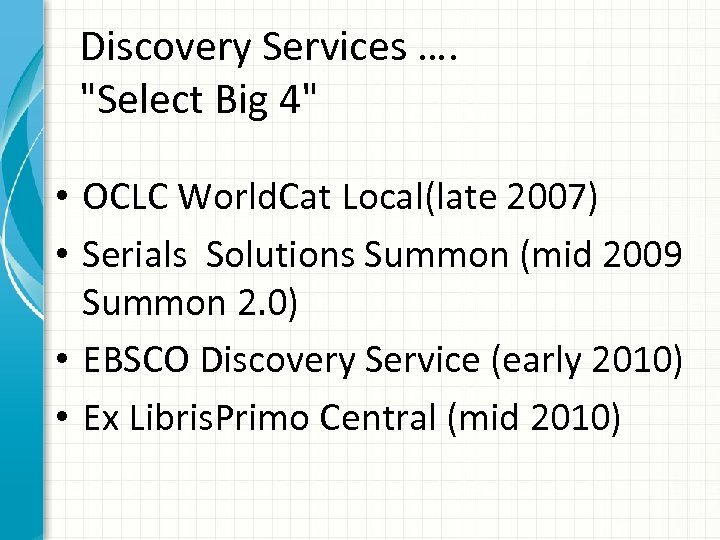
Discovery Services …. "Select Big 4" • OCLC World. Cat Local(late 2007) • Serials Solutions Summon (mid 2009 Summon 2. 0) • EBSCO Discovery Service (early 2010) • Ex Libris. Primo Central (mid 2010)
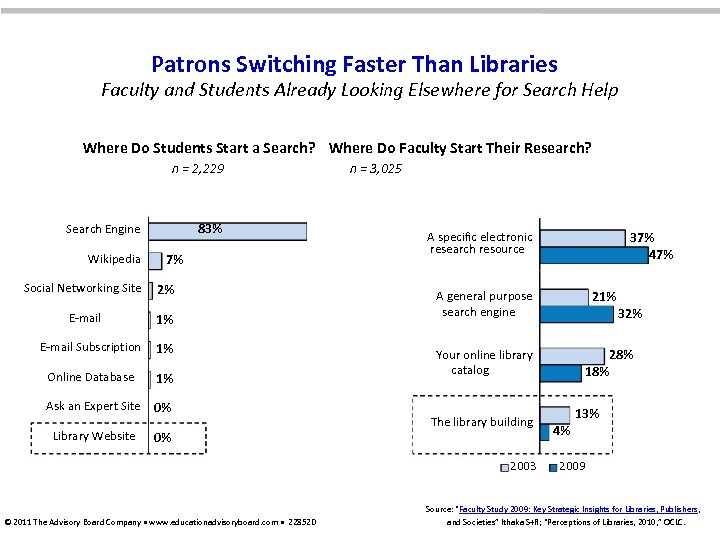
Patrons Switching Faster Than Libraries Faculty and Students Already Looking Elsewhere for Search Help Where Do Students Start a Search? Where Do Faculty Start Their Research? n = 2, 229 83% Search Engine Wikipedia 7% Social Networking Site 2% E‐mail 1% E‐mail Subscription 1% Online Database 1% Ask an Expert Site 0% Library Website 0% n = 3, 025 21% 32% A general purpose search engine 28% 18% Your online library catalog The library building 2003 © 2011 The Advisory Board Company • www. educationadvisoryboard. com • 22852 D 37% 47% A specific electronic research resource 4% 13% 2009 Source: “Faculty Study 2009: Key Strategic Insights for Libraries, Publishers, and Societies” Ithaka S+R; “Perceptions of Libraries, 2010, ” OCLC.
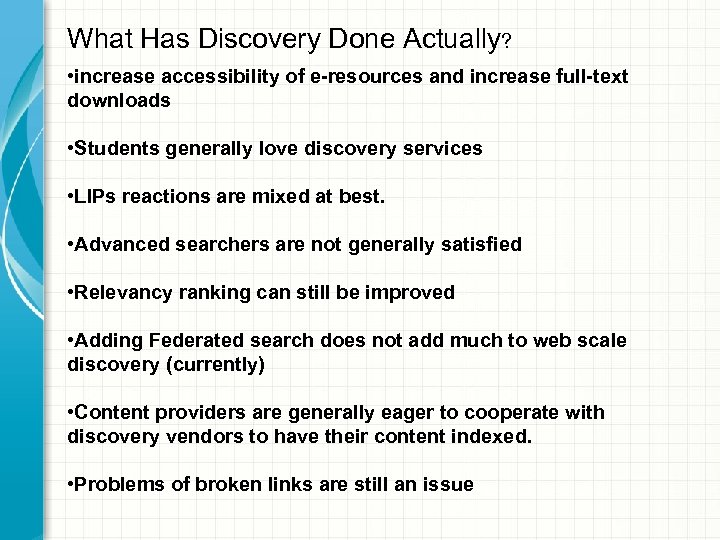
What Has Discovery Done Actually? • increase accessibility of e-resources and increase full-text downloads • Students generally love discovery services • LIPs reactions are mixed at best. • Advanced searchers are not generally satisfied • Relevancy ranking can still be improved • Adding Federated search does not add much to web scale discovery (currently) • Content providers are generally eager to cooperate with discovery vendors to have their content indexed. • Problems of broken links are still an issue
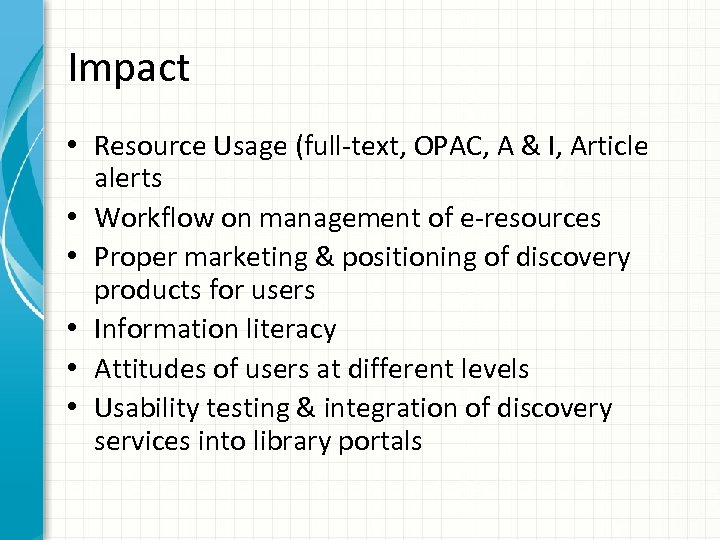
Impact • Resource Usage (full‐text, OPAC, A & I, Article alerts • Workflow on management of e‐resources • Proper marketing & positioning of discovery products for users • Information literacy • Attitudes of users at different levels • Usability testing & integration of discovery services into library portals
Challenges • • Relevance of the hits Subject coverage in terms of currency and content Precision ratio Are web scale discovery tools a good starting point for exhaustive subject searches or for exploring new topics? • Will such tools help a searcher to become competent information user in the work place and in later life? • Do we need to change our information literacy education to find the new discovery environment? • Can we augment our discovery services to support and deliver our information system.
![Way Ahead … • Recommendation services [Contextual] • Field navigation • Relevance ranked results](https://present5.com/presentation/63c0c0ad84e38911bb35d79aa25e7c34/image-22.jpg "Way Ahead … • Recommendation services [Contextual] • Field navigation • Relevance ranked results")
Way Ahead … • Recommendation services [Contextual] • Field navigation • Relevance ranked results • Enhanced visual displays • Multi‐media stuff
Searching & Retrieval Habits • Patron – the key • Producer • The Facilitator » Question Please • Thanks
Скачать презентацию Information Communication Technology ICT Enabled Total Quality
63c0c0ad84e38911bb35d79aa25e7c34.ppt