


 Скачать презентацию Information and Communicatio Technologies and Government Veneta Andonova
b3ed2c21bb6c0be192b05715dc21df73.ppt
- Количество слайдов: 19
 Information and Communicatio Technologies and Government Veneta Andonova Instituto Tecnologico Autonomo de Mexico (ITAM) ESNIE 2006 Workshop
 Introduction n Information and Communication Technologies (ICT), institutions and economic development u u n Andonova, V. (2006) Mobile phones, the Internet and the institutional environment, Telecommunications Policy 30, 29 -45 Andonova, V. and L. Diaz (2006) Can progress be resistant to bad institutions? The case of ICT, working paper Vo. IP, technology interactions and network effects u u Ladron de Guevarra, A. and V. Andonova (2006) Interacciones tecnologicas y efectos red: Claves para predecir el impacto del VOIP sobre la industria de las telecommunicaciones, Universia Business Review Ladron de Guevarra, A. and V. Andonova (2006) Technology interactions in the presence of network effects, UPF working paper
 Topics of Discussion n n Different ICT place different requirements on the receptive institutional environment. Changed technological parameters of ICT reduce requirement for government effectiveness.
 Why study ICT n n n ICT are a major determinant of economic growth as they reduce information asymmetry. ICT become fast the foundation of the knowledge economy. New technologies such as mobile phones and Internet are important demand drivers for the telecommunications sector.
 Digital Divide n n Digital divide is the difference between those with permanent, effective access to new ICT and those with none. If ICT are so important why aren’t they every government’s priority? u “productivity paradox” u limited resources u institutional environment (Henisz & Zelner, 2001, Levy & Spiller, 1996)
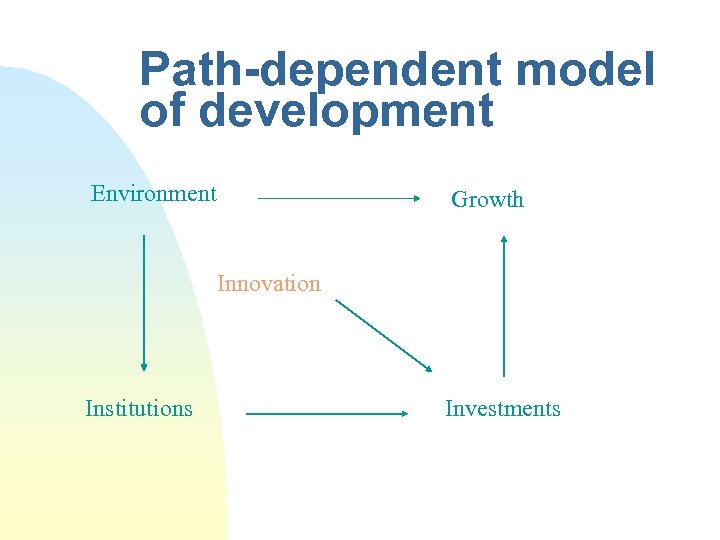 Path-dependent model of development Environment Growth Innovation Institutions Investments
 Can progress be resistant to bad institutions? n n n H 1: An investment friendly institutional environment, characterized by lower investor risks, correlates positively with the diffusion of ICT. H 2: An investment friendly institutional environment, characterized by lower investor risks, correlates more strongly with the diffusion of those ICT which rely most heavily on site-specific assets and require larger up-front investments. H 3: An investment friendly institutional environment, characterized by lower investor risks, correlates less strongly with the diffusion of those ICT which rely more heavily on easily transportable, re-deployable modules.
 Empirical Test n n n POLCON: a structurally derived and internationally comparable measure of the degree of constraints on policy change (Henisz, 2000). Political Rights and Civil Liberties (Freedom House) Control variables: price variables (connection charge and price per minute); GDP per capita, illiteracy, urban population, English as a second language, degree of competition and privatization in the sector, electric grid and other infrastructure indicators)
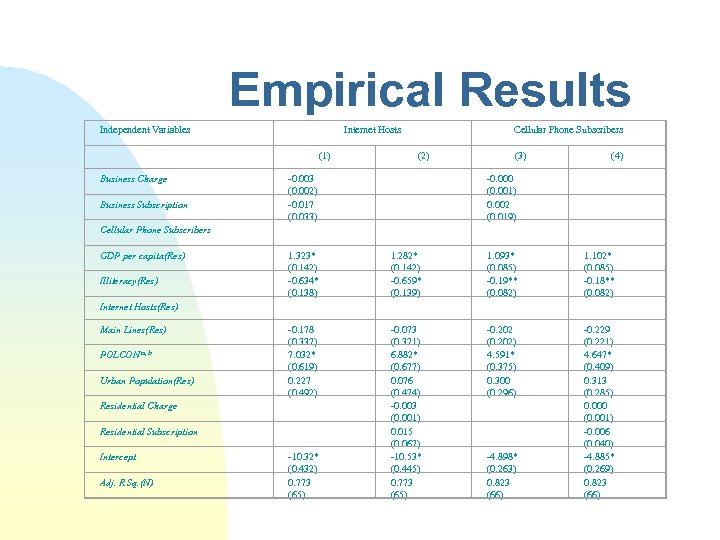 Empirical Results Independent Variables Internet Hosts Business Charge (1) Cellular Phone Subscribers (2) 1. 323* (0. 142) -0. 634* (0. 138) 1. 282* (0. 142) -0. 659* (0. 139) 1. 093* (0. 085) -0. 19** (0. 082) 1. 102* (0. 085) -0. 18** (0. 082) Residential Charge -0. 178 (0. 337) 7. 032* (0. 619) 0. 227 (0. 492) -0. 202 (0. 202) 4. 591* (0. 375) 0. 300 (0. 296) Residential Subscription Intercept -10. 32* (0. 432) 0. 773 (65) -0. 073 (0. 371) 6. 882* (0. 677) 0. 076 (0. 474) -0. 003 (0. 001) 0. 015 (0. 067) -10. 53* (0. 445) 0. 773 (65) -0. 229 (0. 221) 4. 647* (0. 409) 0. 313 (0. 285) 0. 000 (0. 001) -0. 006 (0. 040) -4. 885* (0. 269) 0. 823 (66) Cellular Phone Subscribers GDP per capita(Res) Illiteracy(Res) Internet Hosts(Res) Main Lines(Res) POLCON a, b Urban Population(Res) Adj. R Sq. (N) (4) -0. 000 (0. 001) 0. 002 (0. 019) Business Subscription -0. 003 (0. 002) -0. 017 (0. 033) (3) -4. 898* (0. 263) 0. 823 (66)
 Policy Implications n n n Differences observed in the use of ICT, frequently called the digital divide, stem from deeper differences in what might be called institutional divide. Human capital and the degree of urbanization are important determinants of ICT diffusion. Consider changing institutions indirectly by using technologies which are less sensitive to institutional underdevelopment and which, in tern, through market dynamics, will endogenously change institutions.
 Technology Interactions and Network Effects n n Three technologies: fixed telephony, mobile telephony and Internet These ICT have huge positive effects on TFP, but telecoms appropriated only a small part of the value they created. The next big thing is VOIP. Can we predict what is going to happen in this industry and what the role of the government will be?
 Real Life n n In September 2005 e. Bay purchased Skype for 4. 1 billion USD. How would VOIP affect other ICT? What are the interdependencies among ICT technologies? Would VOIP (innovation) change the role of government in the sector?
 Our Model Model 1 Model 2 Model 3 Functional form Equation Constante Ci = (1 - S) Exponencial Ci = 1 -S epd*(Ni/Si) Lineal Ci = 1 -S + d*(Ni/Si)
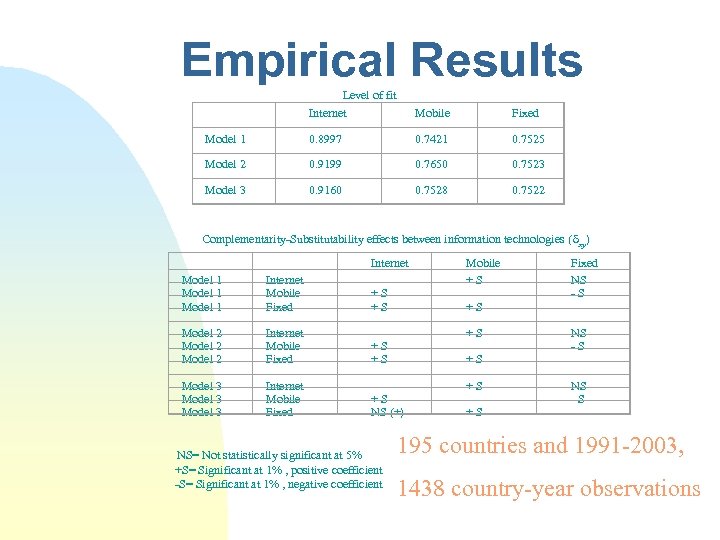 Empirical Results Level of fit Internet 0. 8997 0. 9199 0. 9160 Model 3 Model 2 Model 1 Mobile Fixed 0. 7421 0. 7650 0. 7528 0. 7525 0. 7523 0. 7522 Complementarity-Substitutability effects between information technologies ( xy) Internet Mobile Fixed Model 1 Internet + S NS Model 1 Mobile + S - S Model 1 Fixed + S Model 2 Internet + S NS Model 2 Mobile + S - S Model 2 Fixed + S Model 3 Internet + S NS Model 3 Mobile + S - S Model 3 Fixed NS (+) + S NS= Not statistically significant at 5% +S= Significant at 1% , positive coefficient -S= Significant at 1% , negative coefficient 195 countries and 1991 -2003, 1438 country-year observations
 Results n n n Mobile telephony and Internet are fully complementary. Fixed telephony fosters the diffusion of mobile telephony, which on its turn cannibalises the diffusion of fixed phones. Fixed telephony facilitates the diffusion of Internet but Internet diffusion does not have any significant effect on fixed telephony diffusion.
 Implications n n Total complementarity between mobile telephony and Internet implies that hybrid technologies would prevail over classic versions of Internet and mobile. e. Bay has moved in this direction. One-technology companies should look for strategic alliencies. Prices paid for 3 G licencies might not be that exaggerated? !
 Implications n n n In places where firxed telephony has already been deployed, mobile telephony works as a complement. In places with long waiting lines, mobile is a substitute for fixed telephony. Given that deployment of fixed telephony depends a lot on institutions, we claim that fixed and mobile telephony behave as complements or substitutes depending on the level of institutional development.
 Implications n n n Fixed telephony is the base for Internet diffusion, where more VOIP means less fixed lines. Countries with high Internet usage indices show a decline in fixed lines. Traditional telecoms should convert into Internet providers. The market of Internet connectivity is more competitive than fixed telephony (natural monopoly). VOIP reduces the need of high government effectiveness in the regulation of fixed telephony.
 Discussion