


 Скачать презентацию Informatics and standards for nanomedicine technology Dennis G
c24803a40ca3de1f5f841a0926b30888.ppt
- Количество слайдов: 51
 Informatics and standards for nanomedicine technology Dennis G. Thomas, Pacific Northwest National Lab Alan Chappell, Pacific Northwest National Lab Elaine Freund, 3 rd Millennium Sharon Gaheen, SAIC Stacey Harper, Oregon State University Juli D. Klemm, NIH/NCI David S. Paik, Stanford University Nathan A. Baker, Pacific Northwest National Lab, nathan. baker@pnnl. gov 1
 Outline Introduction to the ca. BIG® Nanotechnology Working Group Overview of nanotechnology informatics challenges Research projects Ontology development Pub. Nano resource Data exchange standards Structure-property-activity modeling 2
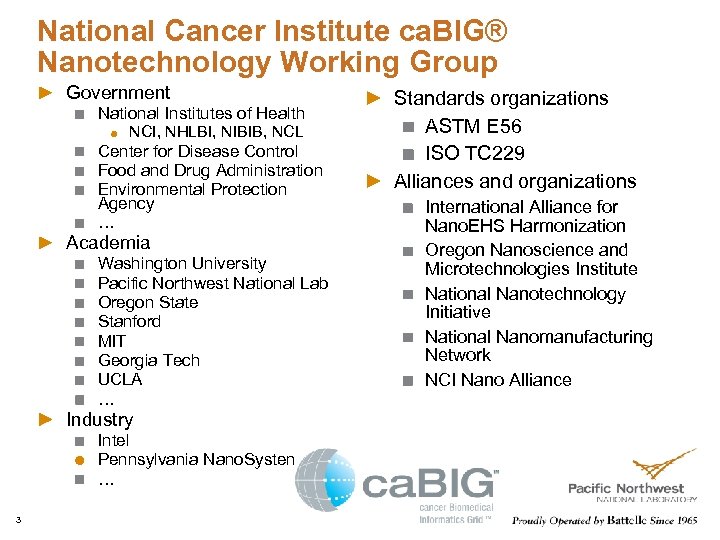 National Cancer Institute ca. BIG® Nanotechnology Working Group Government National Institutes of Health NCI, NHLBI, NIBIB, NCL Center for Disease Control Food and Drug Administration Environmental Protection Agency … Academia Washington University Pacific Northwest National Lab Oregon State Stanford MIT Georgia Tech UCLA … Industry Intel Pennsylvania Nano. Systems … 3 Standards organizations ASTM E 56 ISO TC 229 Alliances and organizations International Alliance for Nano. EHS Harmonization Oregon Nanoscience and Microtechnologies Institute National Nanotechnology Initiative National Nanomanufacturing Network NCI Nano Alliance
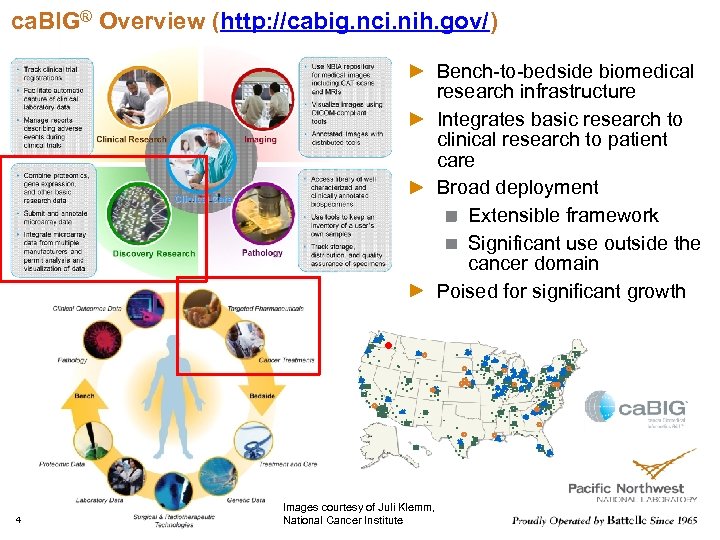 ca. BIG® Overview (http: //cabig. nci. nih. gov/) Bench-to-bedside biomedical research infrastructure Integrates basic research to clinical research to patient care Broad deployment Extensible framework Significant use outside the cancer domain Poised for significant growth • 4 Images courtesy of Juli Klemm, National Cancer Institute
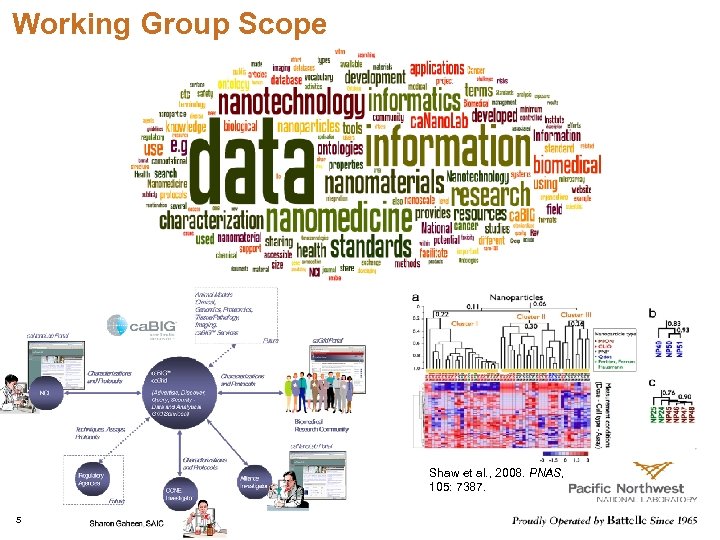 Working Group Scope Shaw et al. , 2008. PNAS, 105: 7387. 5
 Nano WG current areas of focus Nano-TAB development (enabling) Nanotechnology data sharing standards Working draft ready Community engaged Need to focus on applications and standards NPO support and expansion (enabling) Standard vocabulary and ontology for nanomedicine Foundation established Community engaged Need to focus on support for nano-TAB and other annotation projects Nano-QSAR (applying) Structure-activity relationships for nanomaterial-biological interactions Community engaged; participants identified Many potential areas of focus
 Outline Introduction to the ca. BIG® Nanotechnology Working Group Overview of nanotechnology informatics challenges Research projects Ontology development Pub. Nano resource Data exchange standards Structure-property-activity modeling 7
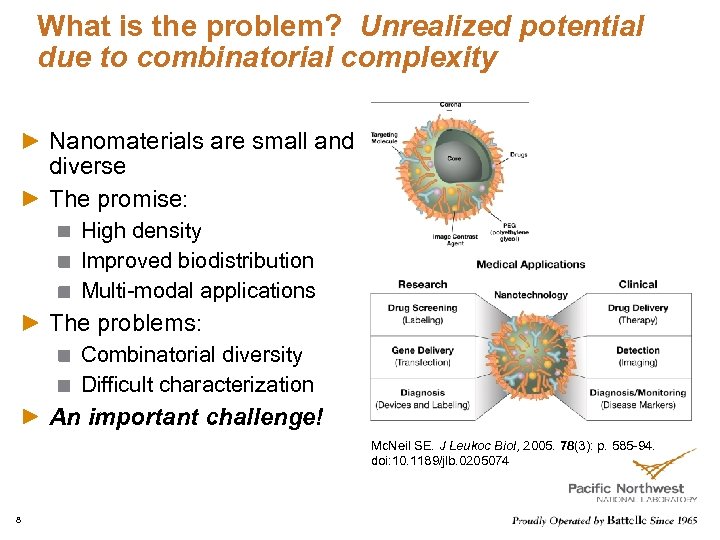 What is the problem? Unrealized potential due to combinatorial complexity Nanomaterials are small and diverse The promise: High density Improved biodistribution Multi-modal applications The problems: Combinatorial diversity Difficult characterization An important challenge! Mc. Neil SE. J Leukoc Biol, 2005. 78(3): p. 585 -94. doi: 10. 1189/jlb. 0205074 8
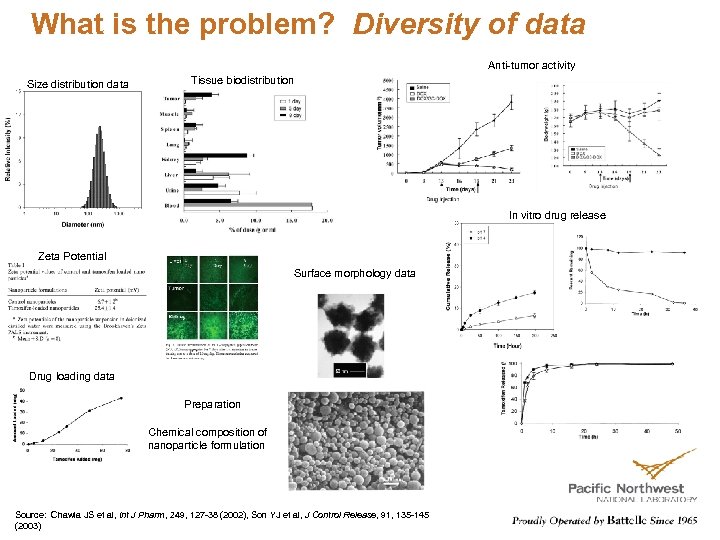 What is the problem? Diversity of data Anti-tumor activity Size distribution data Tissue biodistribution In vitro drug release Zeta Potential Surface morphology data Drug loading data Preparation Chemical composition of nanoparticle formulation Source: Chawla JS et al, Int J Pharm, 249, 127 -38 (2002), Son YJ et al, J Control Release, 91, 135 -145 (2003)
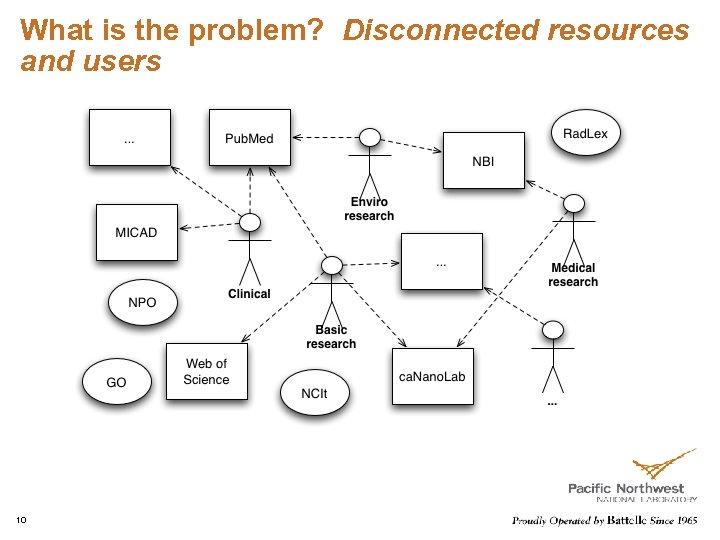 What is the problem? Disconnected resources and users 10
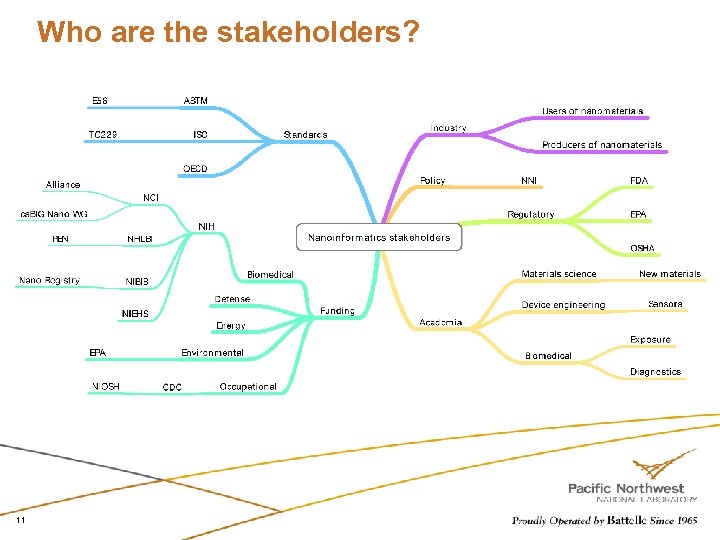 Who are the stakeholders? 11
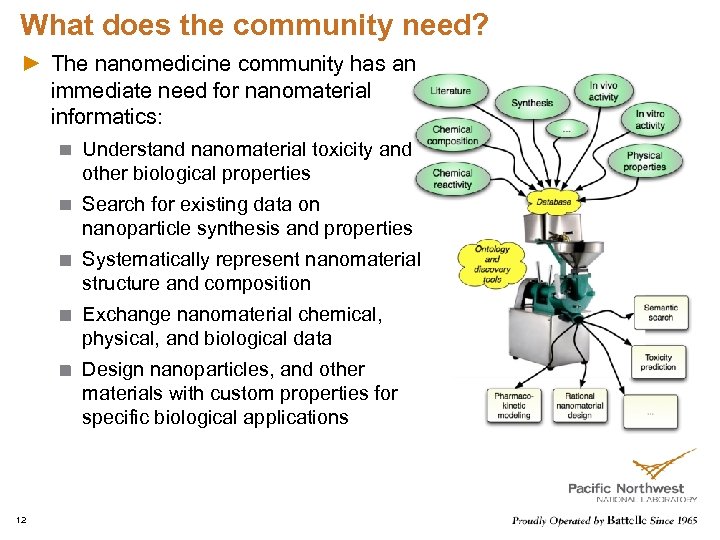 What does the community need? The nanomedicine community has an immediate need for nanomaterial informatics: Understand nanomaterial toxicity and other biological properties Search for existing data on nanoparticle synthesis and properties Systematically represent nanomaterial structure and composition Exchange nanomaterial chemical, physical, and biological data Design nanoparticles, and other materials with custom properties for specific biological applications 12
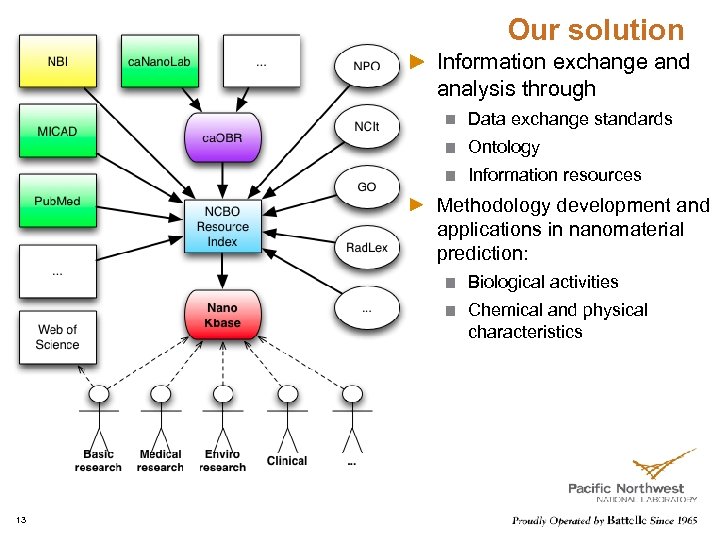 Our solution Information exchange and analysis through Data exchange standards Ontology Information resources Methodology development and applications in nanomaterial prediction: Biological activities Chemical and physical characteristics 13
 Outline Introduction to the ca. BIG® Nanotechnology Working Group Overview of nanotechnology informatics challenges Research projects Ontology development Pub. Nano resource Data exchange standards Structure-property-activity modeling 14
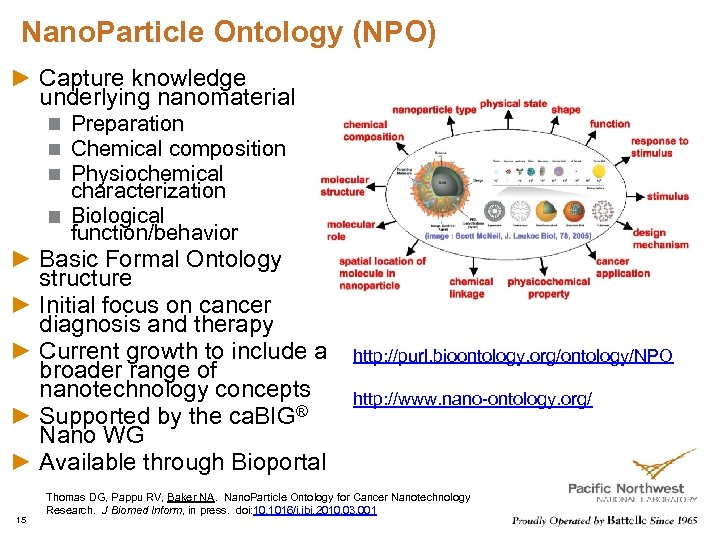 Nano. Particle Ontology (NPO) Capture knowledge underlying nanomaterial Preparation Chemical composition Physiochemical characterization Biological function/behavior Basic Formal Ontology structure Initial focus on cancer diagnosis and therapy Current growth to include a broader range of nanotechnology concepts Supported by the ca. BIG® Nano WG Available through Bioportal 15 http: //purl. bioontology. org/ontology/NPO http: //www. nano-ontology. org/ Thomas DG, Pappu RV, Baker NA. Nano. Particle Ontology for Cancer Nanotechnology Research. J Biomed Inform, in press. doi: 10. 1016/j. jbi. 2010. 03. 001
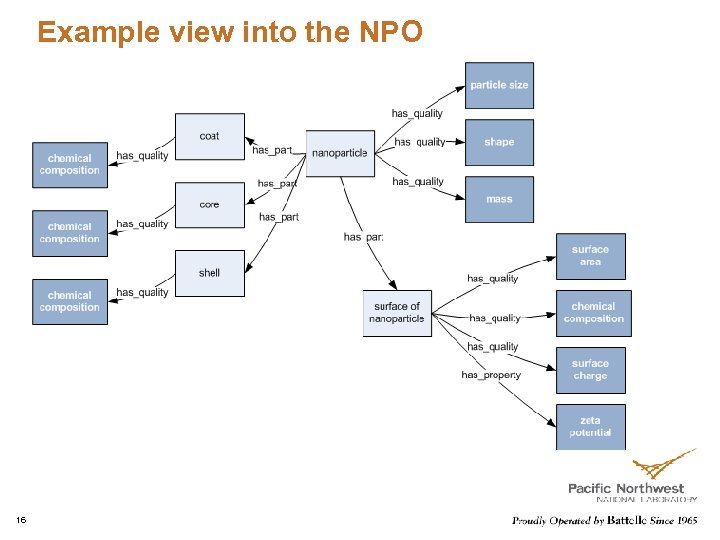 Example view into the NPO 16
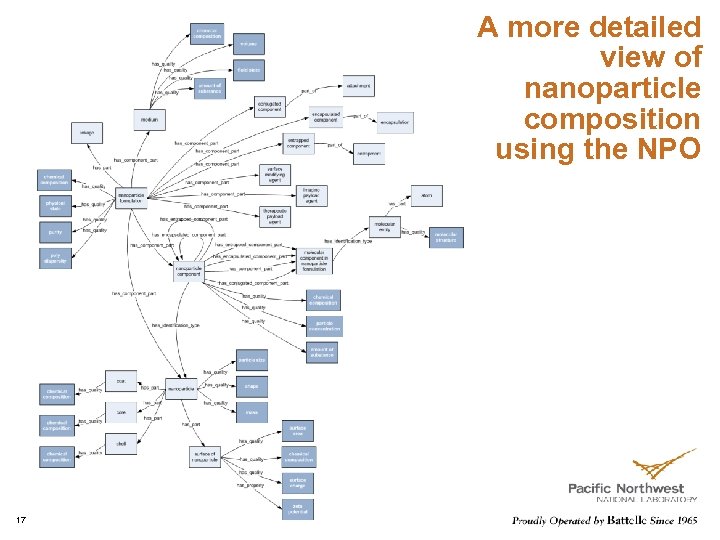 A more detailed view of nanoparticle composition using the NPO 17
 Outline Introduction to the ca. BIG® Nanotechnology Working Group Overview of nanotechnology informatics challenges Research projects Ontology development Pub. Nano resource Data exchange standards Structure-property-activity modeling 18
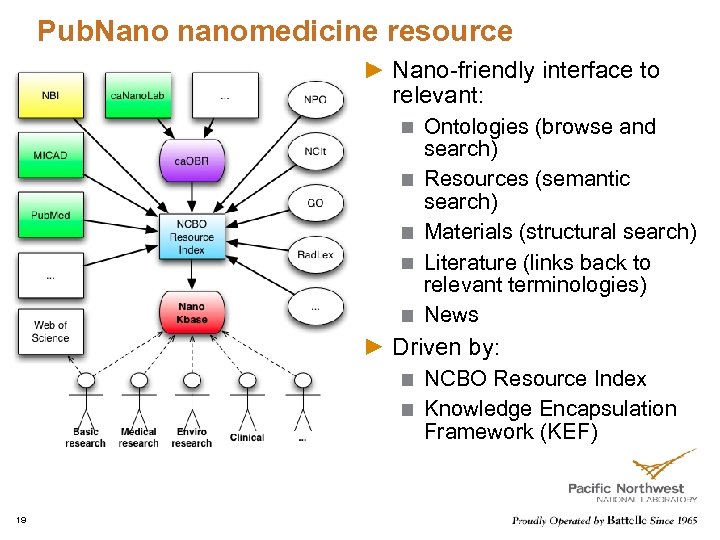 Pub. Nano nanomedicine resource Nano-friendly interface to relevant: Ontologies (browse and search) Resources (semantic search) Materials (structural search) Literature (links back to relevant terminologies) News Driven by: NCBO Resource Index Knowledge Encapsulation Framework (KEF) 19
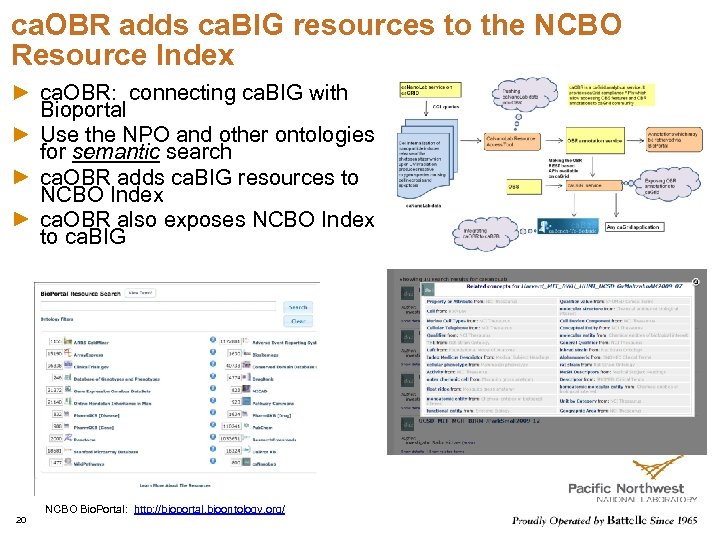 ca. OBR adds ca. BIG resources to the NCBO Resource Index ca. OBR: connecting ca. BIG with Bioportal Use the NPO and other ontologies for semantic search ca. OBR adds ca. BIG resources to NCBO Index ca. OBR also exposes NCBO Index to ca. BIG 20 NCBO Bio. Portal: http: //bioportal. bioontology. org/
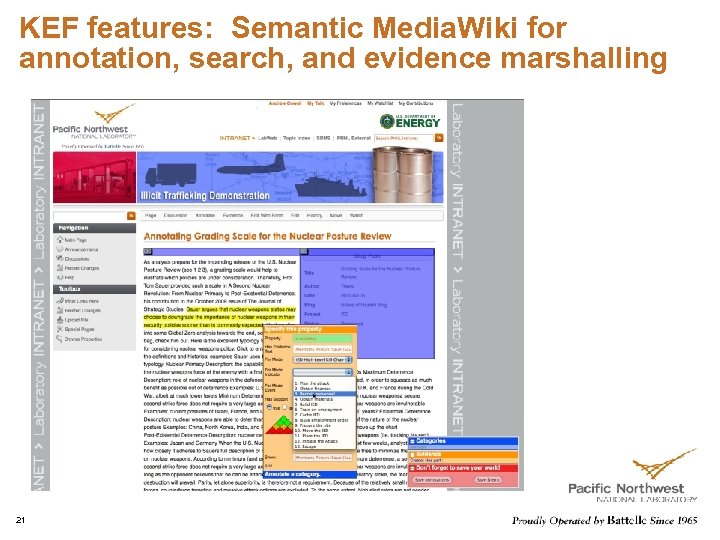 KEF features: Semantic Media. Wiki for annotation, search, and evidence marshalling 21
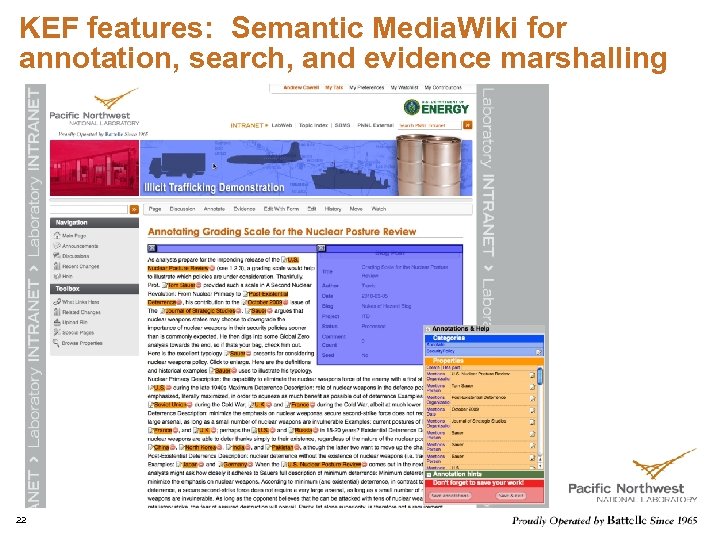 KEF features: Semantic Media. Wiki for annotation, search, and evidence marshalling 22
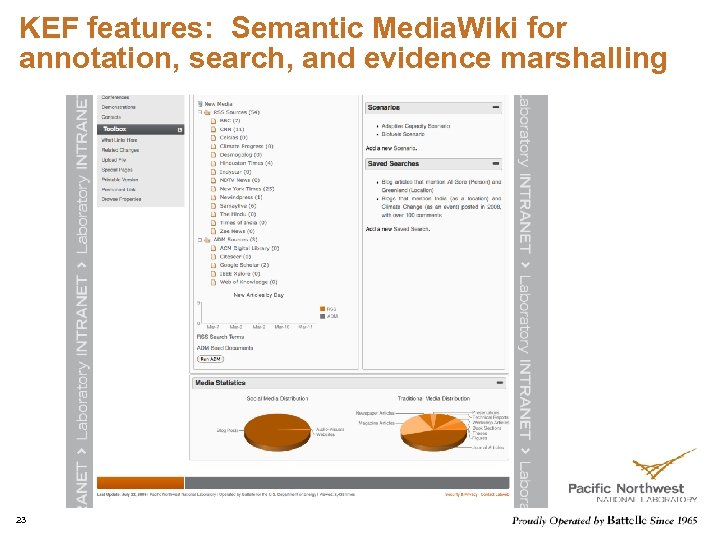 KEF features: Semantic Media. Wiki for annotation, search, and evidence marshalling 23
 Pub. Nano: coming soon! Integration of: Pub. Med ca. Nano. Lab MICAD GEO … Coming soon to http: //pubnano. bioontology. org ! 24
 Outline Introduction to the ca. BIG® Nanotechnology Working Group Overview of nanotechnology informatics challenges Research projects Ontology development Pub. Nano resource Data exchange standards Structure-property-activity modeling 25
 NANO-TAB FOR NANOMATERIAL DATA SHARING
 Target audiences and applications Audiences Biomedical researchers (Nano)-Materials scientists Toxicologists Regulatory scientists Industrial hygienists … Applications Synthesis Therapeutics, diagnostics, imaging Bionics and prosthetics Risk and exposure assessment Toxicity prediction and reduction Laboratory and occupational safety
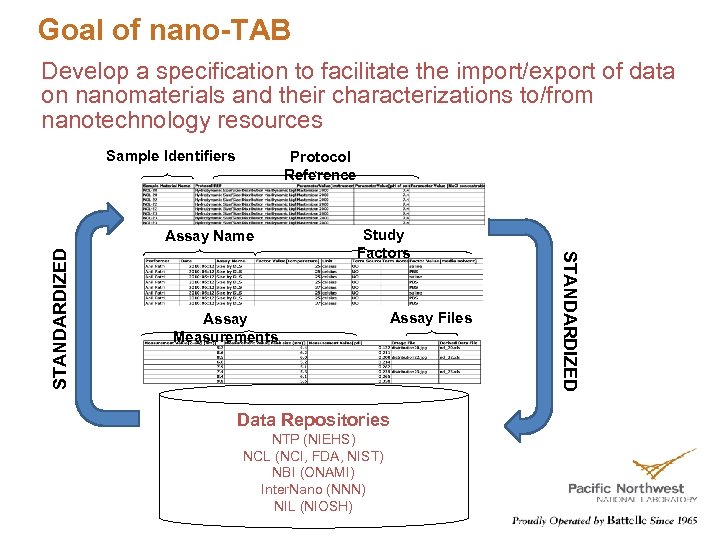 Goal of nano-TAB Develop a specification to facilitate the import/export of data on nanomaterials and their characterizations to/from nanotechnology resources Sample Identifiers Protocol Reference Study Factors Assay Measurements Assay Files Data Repositories NTP (NIEHS) NCL (NCI, FDA, NIST) NBI (ONAMI) Inter. Nano (NNN) NIL (NIOSH) STANDARDIZED Assay Name
 What is nano-TAB? A standard tab-delimited format for describing data related to Investigations Nanomaterials Specimens Assays Leverages and extends the Investigation/Study/Assay (ISA-TAB) format Standard tab-delimited file format Developed by the European Bioinformatics Institute (EBI) for representing a variety of assays and technology types Example: MAGE-TAB Nano-TAB supports ontology-based curation Nanomaterials and concepts from the Nano. Particle Ontology (NPO) as well as other ontologies
 Uses and benefits Address the data sharing challenges in nanomedicine Provide a standard means for identifying nanomaterials and characterizations Enable the submission and exchange of nanomaterial data to/from nanotechnology data resources ( e. g. , NBI, ca. Nano. Lab, etc. ) Empower organizations to adopt standards for representing data in nanotechnology publications Provide researchers with guidelines for representing nanomaterials and characterizations to achieve crossmaterial comparison
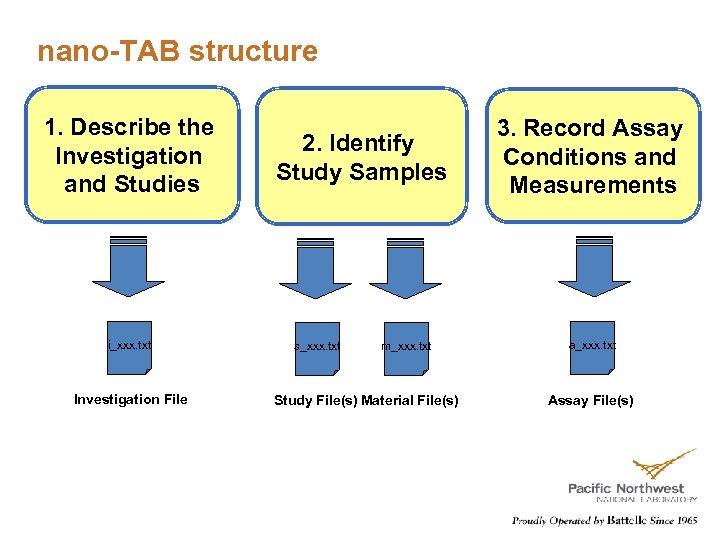
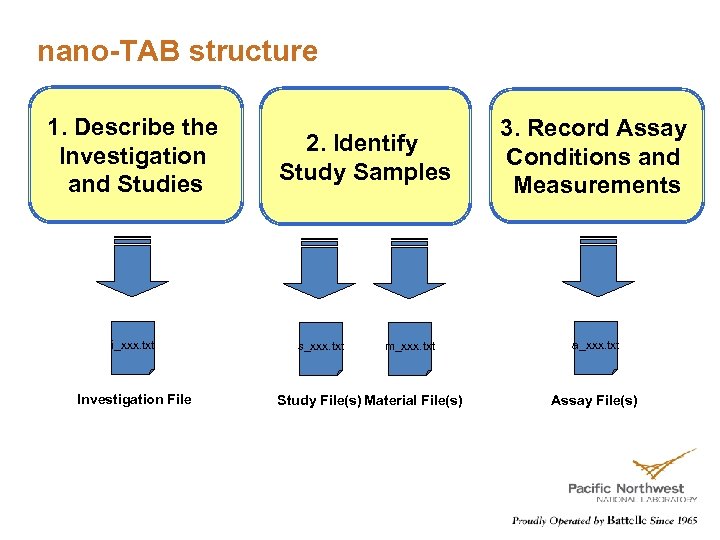
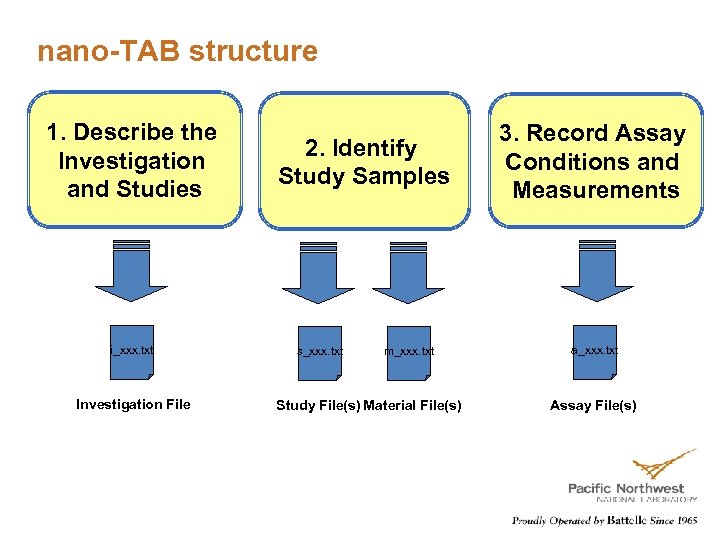 nano-TAB structure 1. Describe the Investigation and Studies i_xxx. txt Investigation File 2. Identify Study Samples s_xxx. txt m_xxx. txt Study File(s) Material File(s) 3. Record Assay Conditions and Measurements a_xxx. txt Assay File(s)
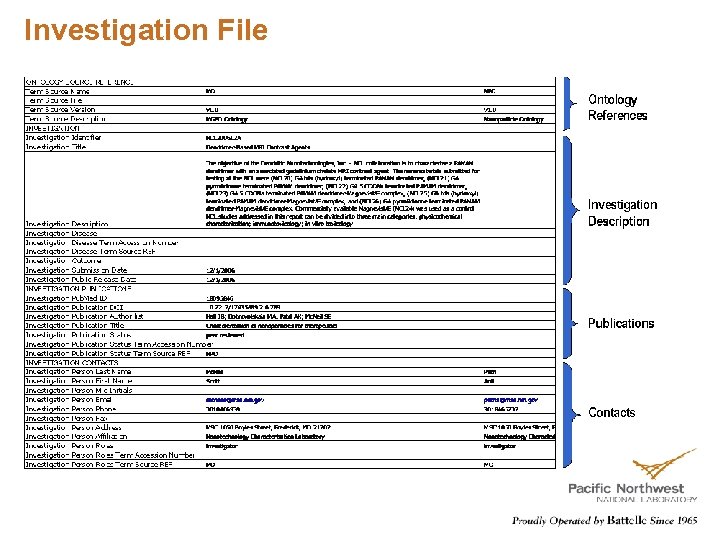
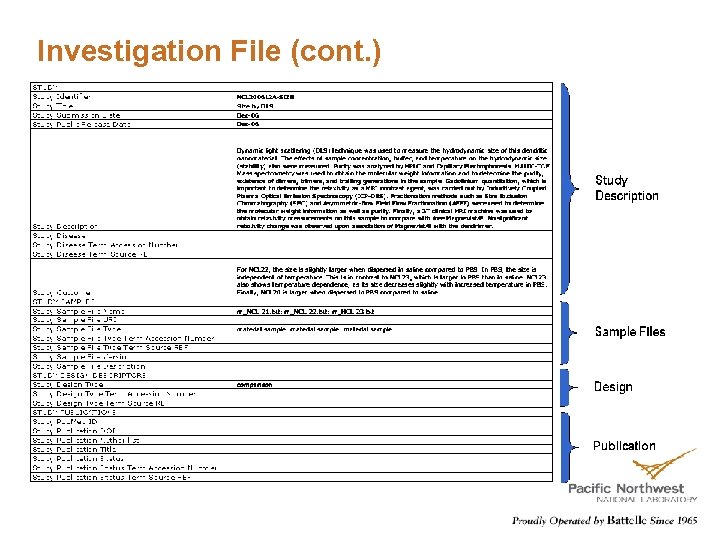
 nano-TAB Investigation File Describes Primary investigation Associated studies, assays, and protocols Descriptive information about the study includes Design descriptors and factors Publications Assays and protocols Contacts Vertical-based spreadsheet format with columns representing multiple values
 Investigation File
 Investigation File (cont. )
 nano-TAB structure 1. Describe the Investigation and Studies i_xxx. txt Investigation File 2. Identify Study Samples s_xxx. txt m_xxx. txt Study File(s) Material File(s) 3. Record Assay Conditions and Measurements a_xxx. txt Assay File(s)
 nano-TAB Study File Study files provide mappings between the samples, materials, and processing events associated with a study. Samples can be Biological materials Nanomaterials Small molecules For physical-chemical characterizations of nanomaterials, the sample is the nanomaterial. For in vitro and in vivo characterizations, the sample is the biological specimen (cell line, animal, etc. )
 nano-TAB Material File Primary file for describing Nanomaterial composition and formulation Physical properties Structure Allows for Comparison of nanomaterials across nanotechnology resources Association with optional files; e. g. , a Structure file for representing the 3 D structure of the nanomaterial Vertical-based spreadsheet with the following sections: MATERIAL SAMPLE MATERIAL COMPONENT MATERIAL LINKAGE
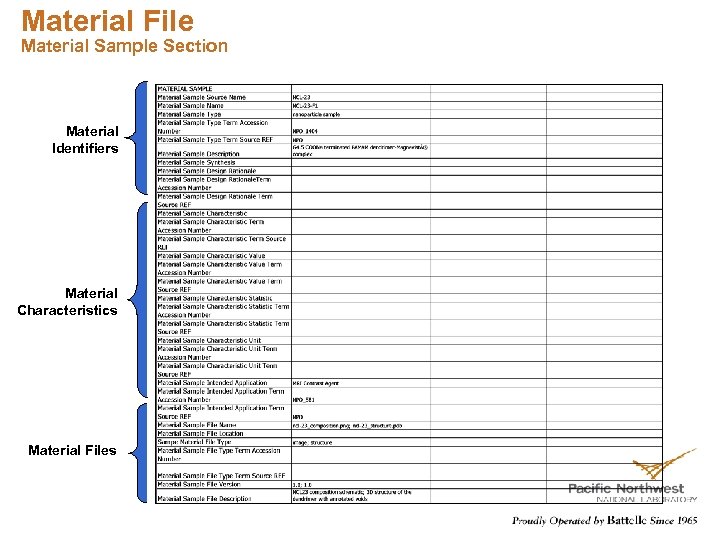 Material File Material Sample Section Material Identifiers Material Characteristics Material Files
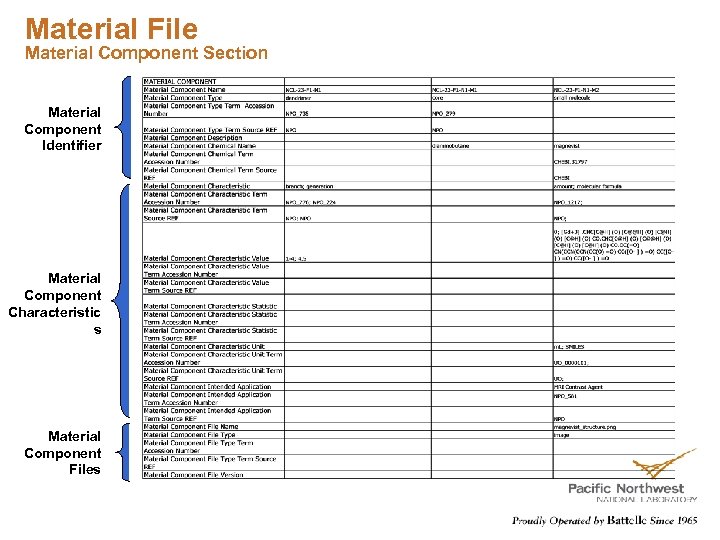 Material File Material Component Section Material Component Identifier Material Component Characteristic s Material Component Files
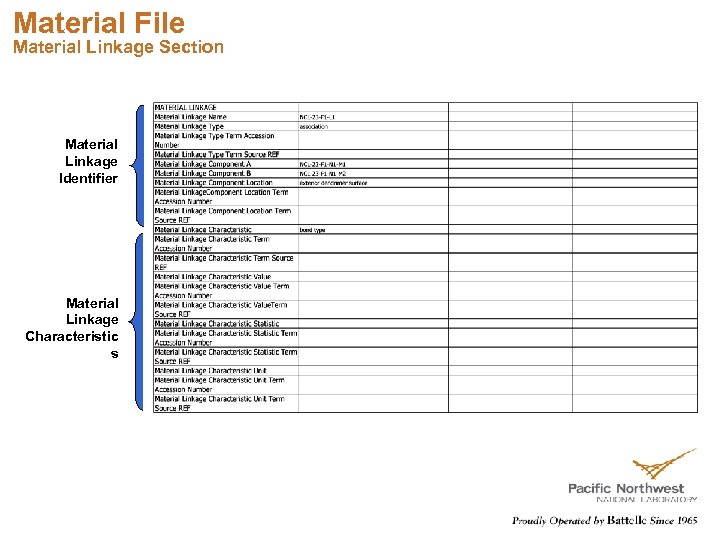 Material File Material Linkage Section Material Linkage Identifier Material Linkage Characteristic s
 nano-TAB structure 1. Describe the Investigation and Studies i_xxx. txt Investigation File 2. Identify Study Samples s_xxx. txt m_xxx. txt Study File(s) Material File(s) 3. Record Assay Conditions and Measurements a_xxx. txt Assay File(s)
 nano-TAB Assay File Describes the protocol parameters and factors, including: Temperature Media/solvent Concentration Provides references or links to assay results, including: Measurements Instrumentation Derived data files Templates available for the “top Nano WG assays” Size by DLS (Physico-Chemical) Zeta Potential (Physico-Chemical) Hemolysis (In Vitro) Hepatocarcinoma Cytoxicity (MTT and LDH) (In Vitro) Caspase 3 Apoptosis (In Vitro) Toxicity (ADME, Single/Repeat Dose) (In Vivo) Your assay here!
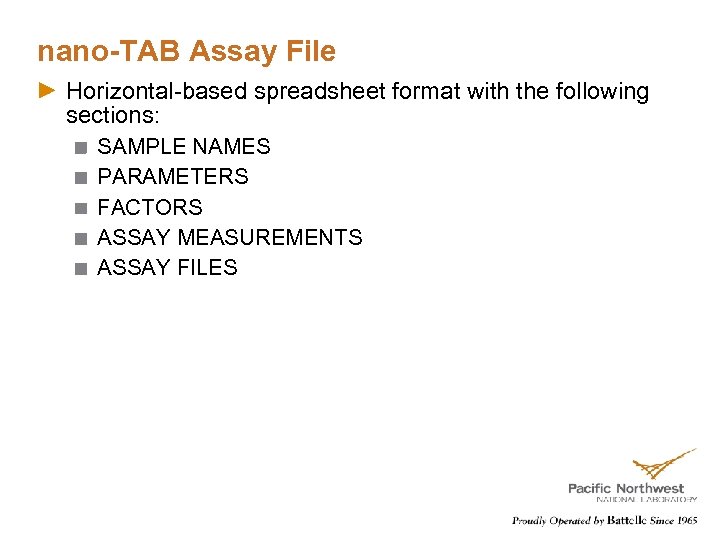 nano-TAB Assay File Horizontal-based spreadsheet format with the following sections: SAMPLE NAMES PARAMETERS FACTORS ASSAY MEASUREMENTS ASSAY FILES
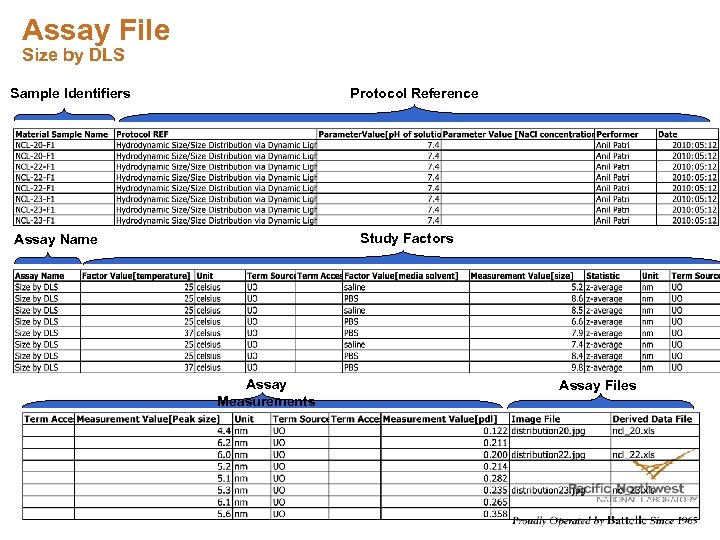 Assay File Size by DLS Protocol Reference Sample Identifiers Study Factors Assay Name Assay Measurements Assay Files
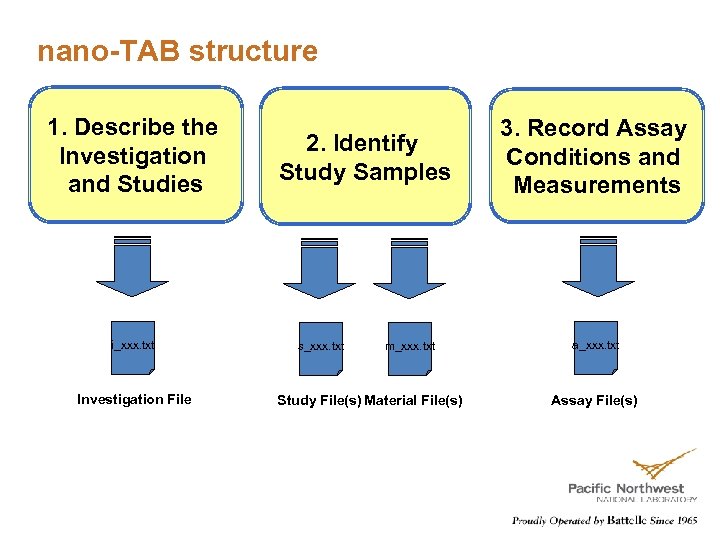 nano-TAB structure 1. Describe the Investigation and Studies i_xxx. txt Investigation File 2. Identify Study Samples s_xxx. txt m_xxx. txt Study File(s) Material File(s) 3. Record Assay Conditions and Measurements a_xxx. txt Assay File(s)
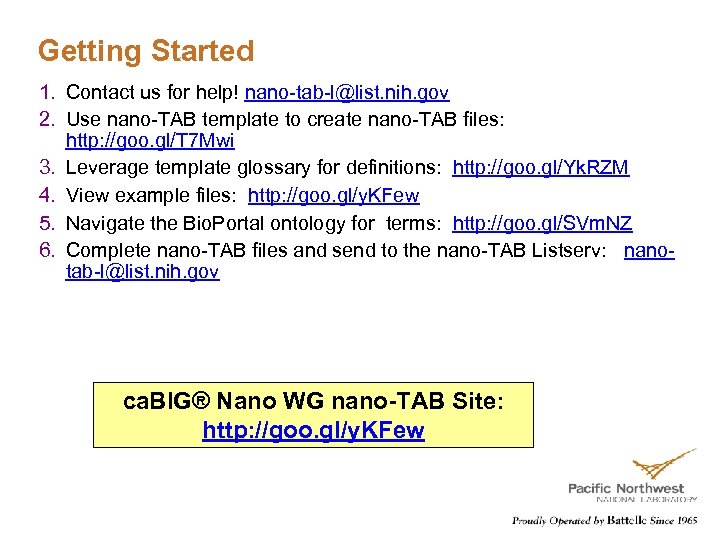 Getting Started 1. Contact us for help! nano-tab-l@list. nih. gov 2. Use nano-TAB template to create nano-TAB files: http: //goo. gl/T 7 Mwi 3. Leverage template glossary for definitions: http: //goo. gl/Yk. RZM 4. View example files: http: //goo. gl/y. KFew 5. Navigate the Bio. Portal ontology for terms: http: //goo. gl/SVm. NZ 6. Complete nano-TAB files and send to the nano-TAB Listserv: nanotab-l@list. nih. gov ca. BIG® Nano WG nano-TAB Site: http: //goo. gl/y. KFew
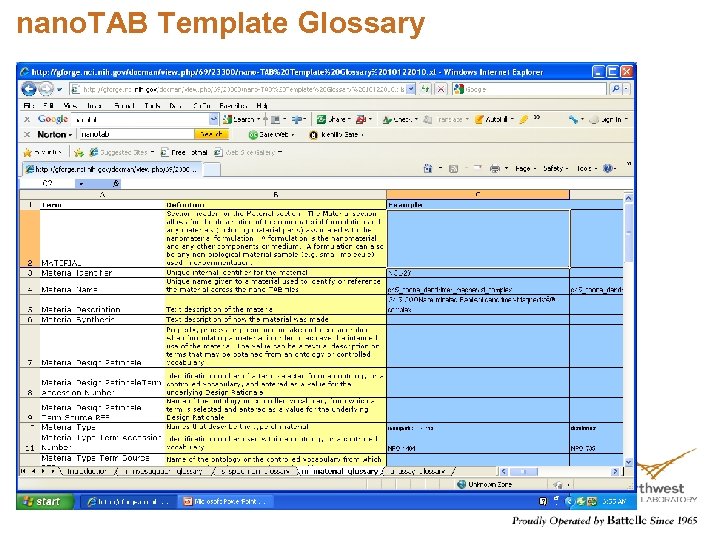 nano. TAB Template Glossary
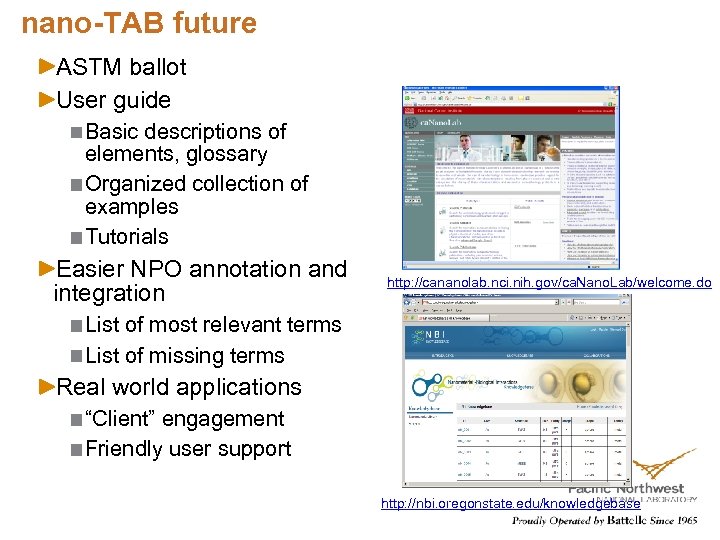 nano-TAB future ASTM ballot User guide Basic descriptions of elements, glossary Organized collection of examples Tutorials Easier NPO annotation and integration http: //cananolab. nci. nih. gov/ca. Nano. Lab/welcome. do List of most relevant terms List of missing terms Real world applications “Client” engagement Friendly user support http: //nbi. oregonstate. edu/knowledgebase
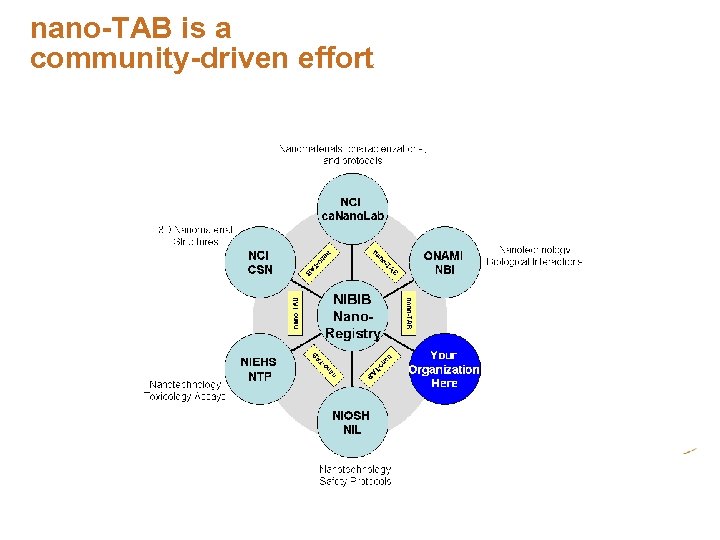 nano-TAB is a community-driven effort
 Additional nano-TAB reading and project team nano-TAB Project Site: http: //goo. gl/y. KFew ASTM nano-TAB Work Item WK 28974: http: //goo. gl/Oj. SOX ISA-TAB: http: //isatab. sourceforge. net ca. BIG ICR Nano WG Data Standards Document: http: //goo. gl/s. DEvp Nano. Particle Ontology (NPO): http: //www. nanoontology. org Nano-TAB project team Nathan Baker, PNNL Amy Bednar, ERDC Elaine Freund, 3 rd Millennium Marty Fritts, NCL Sharon Gaheen, SAIC Liz Hahn-Dantona, Lockheed Martin Stacey Harper, Oregon State University Mark Hoover, NIOSH Fred Klaessig, Pennsylvania Bio Nano Systems Juli Klemm, NCI CBIIT David Paik, Stanford University Sue Pan, SAIC Grace Stafford, The Jackson Laboratory Todd Stokes, Georgia Tech Dennis Thomas, PNNL
 Summary Introduction to the ca. BIG® Nanotechnology Working Group Overview of nanotechnology informatics challenges Research projects Ontology development Pub. Nano resource Data exchange standards Structure-property-activity modeling 51 Collaborators ca. BIG® ICR Workspace, NCBO staff, ASTM, Raul Cachau, Gilbert Fragoso, Elaine Freund, Marty Fritts, Sam Gambhir, Sharon Gaheen, Liz Hahn. Dantona, Stacey Harper, Mark Hoover, Fred Klaessig, Juli Klemm, Michal Lijowski, David Paik, Sue Pan, Rohit Pappu, Persistent Systems Ltd, Daniel Rubin, Stan Shaw, Dennis Thomas, Eddie Xu, Kilian Weinberger, Trish Whetzel, …and many more! Funding ca. BIG® ICR Workspace and the NIH NCI ca. BIG® Working Group, Pacific Northwest National Laboratory HHS sector LDRD funds, as well as NIH grants U 54 HG 004028 and U 01 NS 073457