


 Скачать презентацию Informal Meeting of African Institutions on Livestock Policy
df0ec0901ea63670251a1d3f08646b74.ppt
- Количество слайдов: 11
 Informal Meeting of African Institutions on Livestock Policy Making for Africa Presentation by: M. Z. BICABA and CHI L. TAWAH Rome, 8 -9 March, 2005 A Living from Livestock Pro-Poor Livestock Policy Initiative
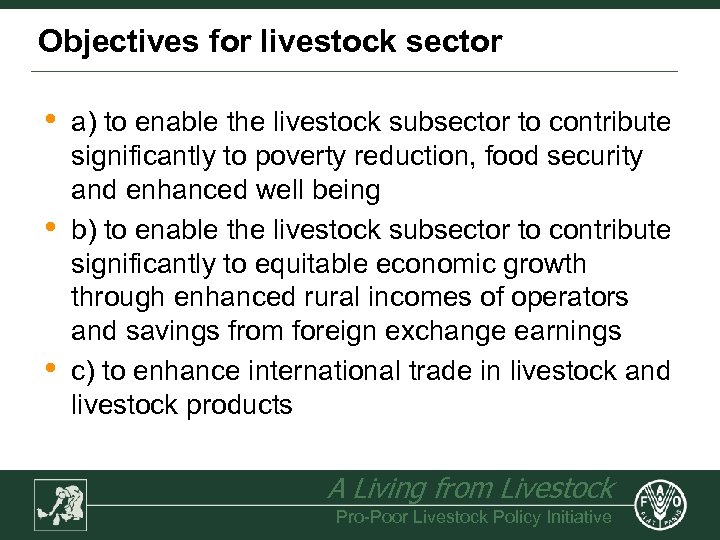 Objectives for livestock sector • • • a) to enable the livestock subsector to contribute significantly to poverty reduction, food security and enhanced well being b) to enable the livestock subsector to contribute significantly to equitable economic growth through enhanced rural incomes of operators and savings from foreign exchange earnings c) to enhance international trade in livestock and livestock products A Living from Livestock Pro-Poor Livestock Policy Initiative
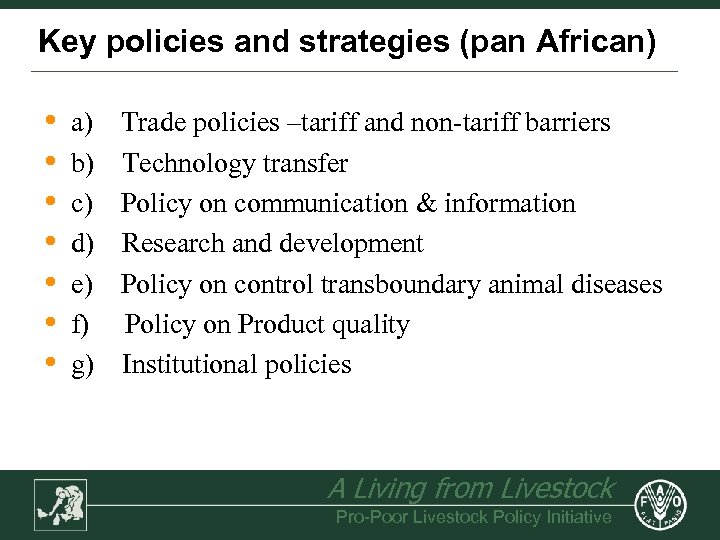 Key policies and strategies (pan African) • • a) Trade policies –tariff and non-tariff barriers b) Technology transfer c) Policy on communication & information d) Research and development e) Policy on control transboundary animal diseases f) Policy on Product quality g) Institutional policies A Living from Livestock Pro-Poor Livestock Policy Initiative
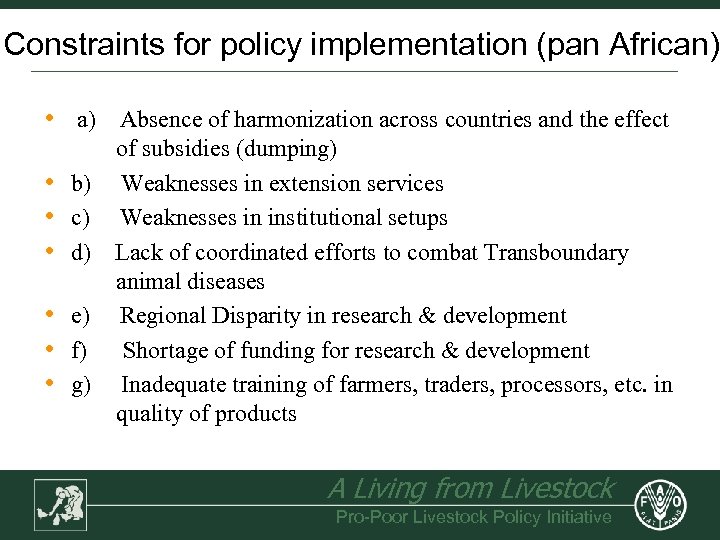 Constraints for policy implementation (pan African) • • a) Absence of harmonization across countries and the effect of subsidies (dumping) b) Weaknesses in extension services c) Weaknesses in institutional setups d) Lack of coordinated efforts to combat Transboundary animal diseases e) Regional Disparity in research & development f) Shortage of funding for research & development g) Inadequate training of farmers, traders, processors, etc. in quality of products A Living from Livestock Pro-Poor Livestock Policy Initiative
 Recommendations (pan African) • • • a) Harmonization of SPS standards b) Training of Staff in OIE/WTO negotiation skills c) Efforts need to be coordinated to address TADs in order to promote international livestock marketing d) Governments and donors should provide sufficient port to livestock activities such as research, policy formulation e) Pan-African Institutions need to be set up to handle quality of livestock products and address problems of technology transfer f) Training of operators should include business skills, leadership skills, technical skills, organizational skills A Living from Livestock Pro-Poor Livestock Policy Initiative
 Key policies and strategies (regional) • • a) Establishment of regional trade policies b) Strategic organization of livestock production chain (production, processing and marketing) c) Provision of transport and communication infrastructure within and across regions d) Support to regional research and development structures A Living from Livestock Pro-Poor Livestock Policy Initiative
 Constraints for policy implementation (regional) • • • a) Poor organization of regional markets b) Non exploitation of regional specificities (opportunities) for strategic livestock production c) Poor exchange of information between countries in the region due to poor transport and communication networks d) Poorly structured and poorly funded regional research and development e) Weak transport and communication infrastructure f) Absence of knowledge of supply and demand A Living from Livestock Pro-Poor Livestock Policy Initiative
 Recommendations (regional) • • • a) Development of appropriate policies that take care of tariff and non-tariff barriers b) Exploitation of comparative advantage of each region/zone, including livestock-environment interactions c) Strengthening of transport and communication in order to facilitate access to domestic and inter-regional markets d) Strengthening of the collection, processing and dissemination of market information e) Strengthening of regional research and development institutions (funding) A Living from Livestock Pro-Poor Livestock Policy Initiative
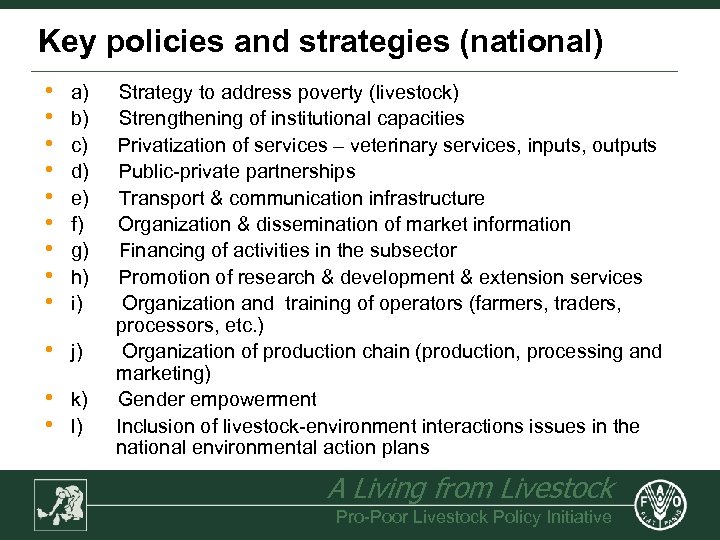 Key policies and strategies (national) • • • a) Strategy to address poverty (livestock) b) Strengthening of institutional capacities c) Privatization of services – veterinary services, inputs, outputs d) Public-private partnerships e) Transport & communication infrastructure f) Organization & dissemination of market information g) Financing of activities in the subsector h) Promotion of research & development & extension services i) Organization and training of operators (farmers, traders, processors, etc. ) j) Organization of production chain (production, processing and marketing) k) Gender empowerment l) Inclusion of livestock-environment interactions issues in the national environmental action plans A Living from Livestock Pro-Poor Livestock Policy Initiative
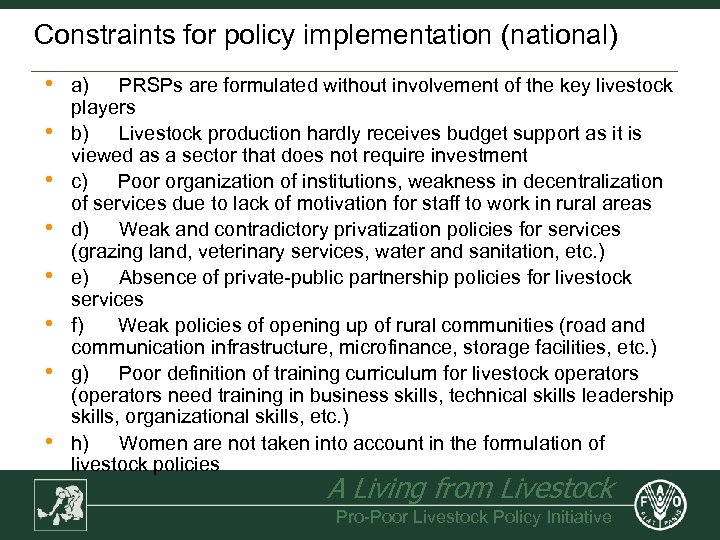 Constraints for policy implementation (national) • • a) PRSPs are formulated without involvement of the key livestock players b) Livestock production hardly receives budget support as it is viewed as a sector that does not require investment c) Poor organization of institutions, weakness in decentralization of services due to lack of motivation for staff to work in rural areas d) Weak and contradictory privatization policies for services (grazing land, veterinary services, water and sanitation, etc. ) e) Absence of private-public partnership policies for livestock services f) Weak policies of opening up of rural communities (road and communication infrastructure, microfinance, storage facilities, etc. ) g) Poor definition of training curriculum for livestock operators (operators need training in business skills, technical skills leadership skills, organizational skills, etc. ) h) Women are not taken into account in the formulation of livestock policies A Living from Livestock Pro-Poor Livestock Policy Initiative
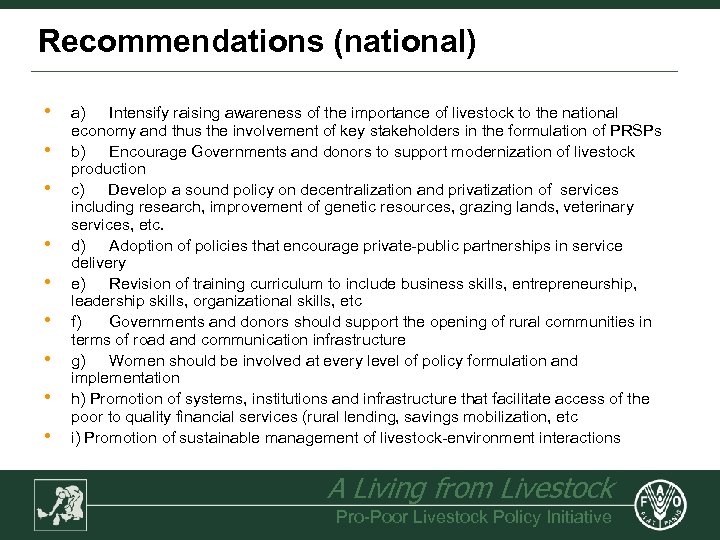 Recommendations (national) • • • a) Intensify raising awareness of the importance of livestock to the national economy and thus the involvement of key stakeholders in the formulation of PRSPs b) Encourage Governments and donors to support modernization of livestock production c) Develop a sound policy on decentralization and privatization of services including research, improvement of genetic resources, grazing lands, veterinary services, etc. d) Adoption of policies that encourage private-public partnerships in service delivery e) Revision of training curriculum to include business skills, entrepreneurship, leadership skills, organizational skills, etc f) Governments and donors should support the opening of rural communities in terms of road and communication infrastructure g) Women should be involved at every level of policy formulation and implementation h) Promotion of systems, institutions and infrastructure that facilitate access of the poor to quality financial services (rural lending, savings mobilization, etc i) Promotion of sustainable management of livestock-environment interactions A Living from Livestock Pro-Poor Livestock Policy Initiative