 Скачать презентацию Inform and Empower to Improve Public Services Initiative
1b6264f5cd5106e2dda8b51cb4abec3b.ppt
- Количество слайдов: 18



Inform and Empower to Improve Public Services Initiative Review 3. 31. 08 Juliette Gimon Salimah Samji Sonal Shah Meryl Stone Aleem Walji Alix Zwane Google Confidential and Proprietary 1
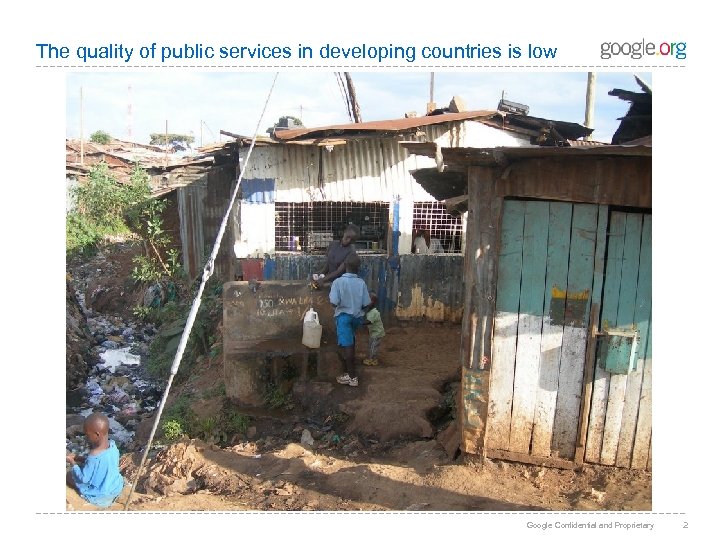
The quality of public services in developing countries is low Google Confidential and Proprietary 2
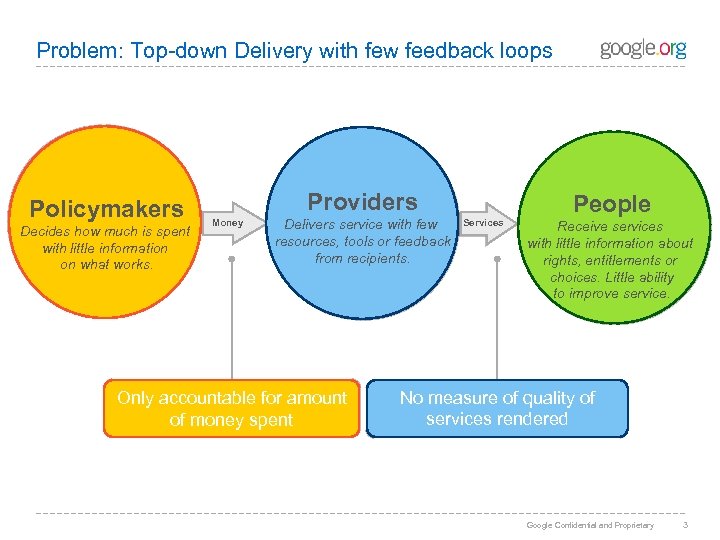
Problem: Top-down Delivery with few feedback loops Policymakers Decides how much is spent with little information on what works. Providers Money Delivers service with few resources, tools or feedback from recipients. Only accountable for amount of money spent People Services Receive services with little information about rights, entitlements or choices. Little ability to improve service. No measure of quality of services rendered Google Confidential and Proprietary 3
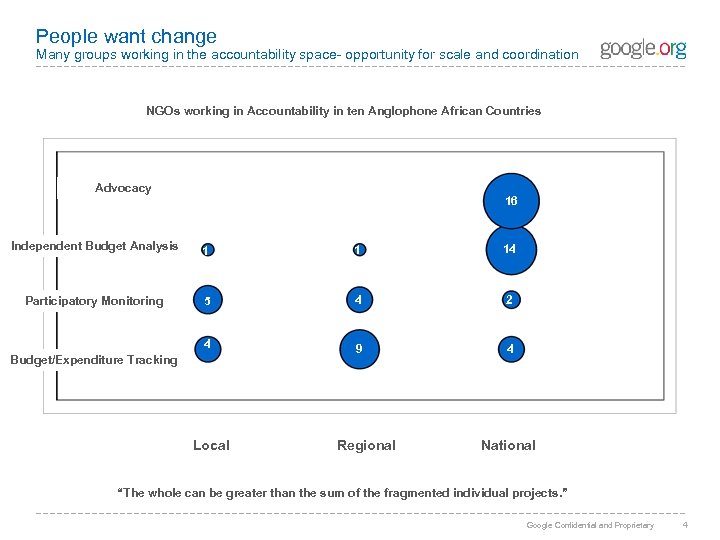
People want change Many groups working in the accountability space- opportunity for scale and coordination NGOs working in Accountability in ten Anglophone African Countries Advocacy 16 Independent Budget Analysis 1 1 14 Participatory Monitoring 5 4 2 4 9 4 Budget/Expenditure Tracking Local Regional National “The whole can be greater than the sum of the fragmented individual projects. ” Google Confidential and Proprietary 4
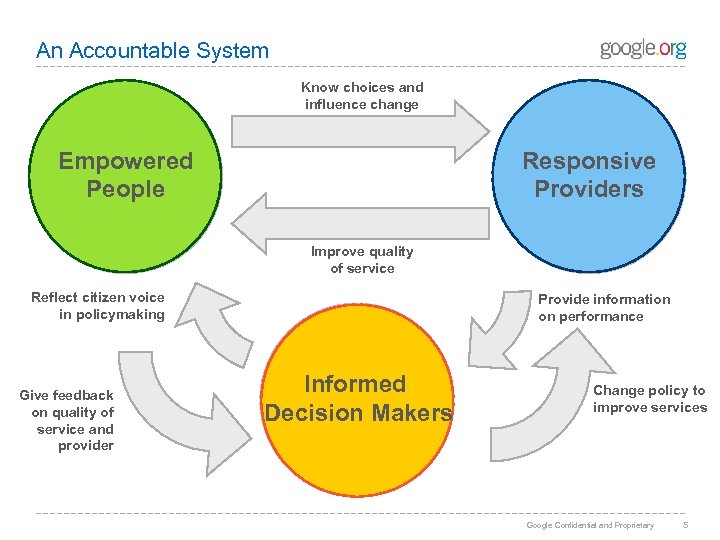
An Accountable System Know choices and influence change Empowered People Responsive Providers Improve quality of service Reflect citizen voice in policymaking Give feedback on quality of service and provider Provide information on performance Informed Decision Makers Change policy to improve services Google Confidential and Proprietary 5
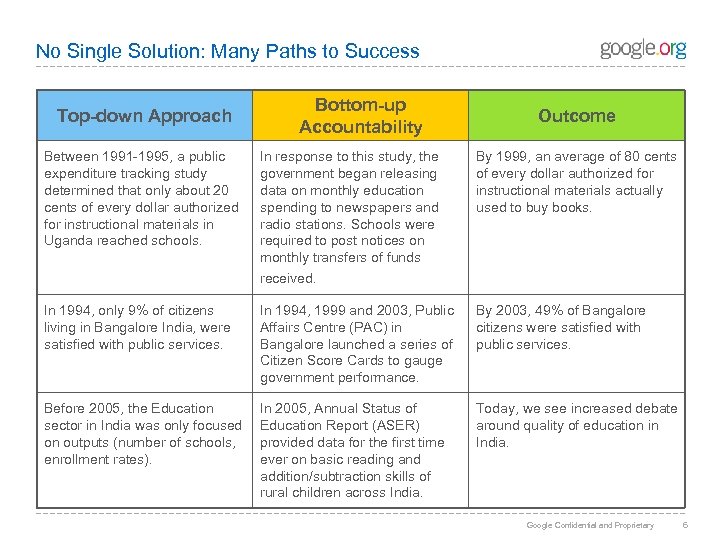
No Single Solution: Many Paths to Success Top-down Approach Bottom-up Accountability Outcome Between 1991 -1995, a public expenditure tracking study determined that only about 20 cents of every dollar authorized for instructional materials in Uganda reached schools. In response to this study, the government began releasing data on monthly education spending to newspapers and radio stations. Schools were required to post notices on monthly transfers of funds received. By 1999, an average of 80 cents of every dollar authorized for instructional materials actually used to buy books. In 1994, only 9% of citizens living in Bangalore India, were satisfied with public services. In 1994, 1999 and 2003, Public Affairs Centre (PAC) in Bangalore launched a series of Citizen Score Cards to gauge government performance. By 2003, 49% of Bangalore citizens were satisfied with public services. Before 2005, the Education sector in India was only focused on outputs (number of schools, enrollment rates). In 2005, Annual Status of Education Report (ASER) provided data for the first time ever on basic reading and addition/subtraction skills of rural children across India. Today, we see increased debate around quality of education in India. Google Confidential and Proprietary 6
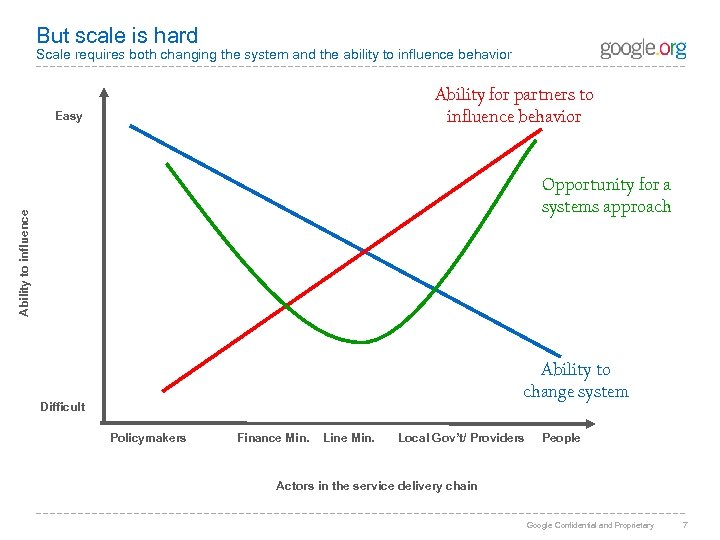
But scale is hard Scale requires both changing the system and the ability to influence behavior Ability for partners to influence behavior Easy Ability to influence Opportunity for a systems approach Ability to change system Difficult Policymakers Finance Min. Line Min. Local Gov’t/ Providers People Actors in the service delivery chain Google Confidential and Proprietary 7
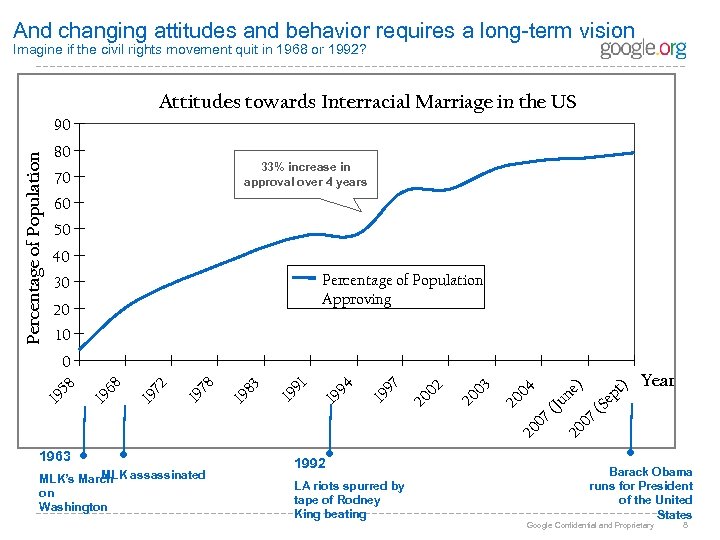
And changing attitudes and behavior requires a long-term vision Imagine if the civil rights movement quit in 1968 or 1992? Attitudes towards Interracial Marriage in the US Percentage of Population 90 80 33% increase in approval over 4 years 70 60 50 40 Percentage of Population Approving 30 20 10 1963 MLK’s March assassinated on Washington 1992 LA riots spurred by tape of Rodney King beating 07 (S e pt ) e) Year 20 20 07 (J un 04 20 03 20 02 20 19 97 19 94 91 19 19 83 19 78 72 19 19 68 19 58 0 Barack Obama runs for President of the United States Google Confidential and Proprietary 8
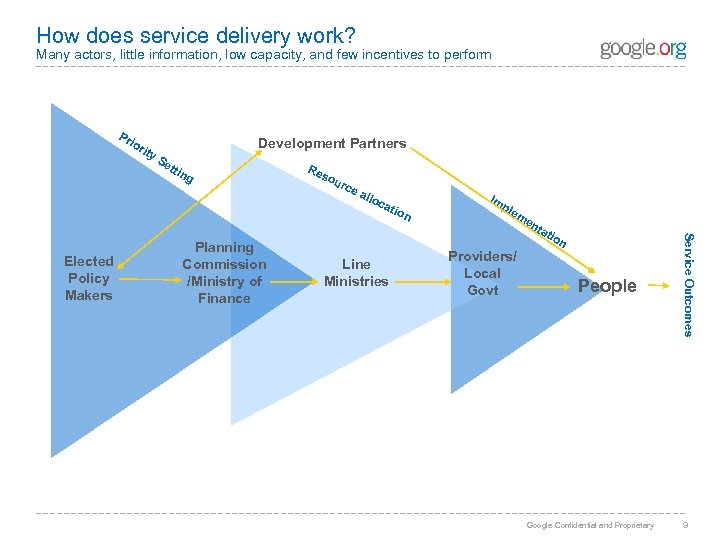
How does service delivery work? Many actors, little information, low capacity, and few incentives to perform Pr ior ity Development Partners Se ttin g Re so urc e allo cat ion Planning Commission /Ministry of Finance ple m en ta tio n Line Ministries Providers/ Local Govt People Google Confidential and Proprietary Service Outcomes Elected Policy Makers Im 9
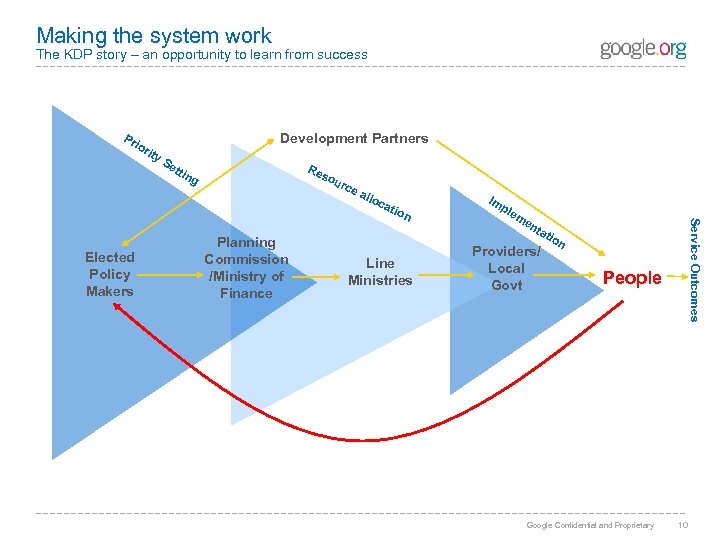
Making the system work The KDP story – an opportunity to learn from success Pr ior ity Development Partners Se Re ttin so urc e g allo Elected Policy Makers Planning Commission /Ministry of Finance Line Ministries Im ple me nta tio Providers/ Local Govt Service Outcomes cat ion n People Google Confidential and Proprietary 10
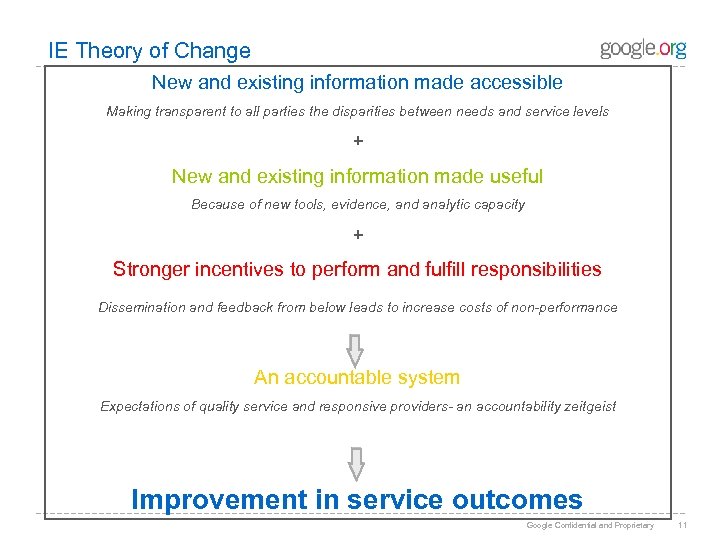
IE Theory of Change New and existing information made accessible Making transparent to all parties the disparities between needs and service levels + New and existing information made useful Because of new tools, evidence, and analytic capacity + Stronger incentives to perform and fulfill responsibilities Dissemination and feedback from below leads to increase costs of non-performance An accountable system Expectations of quality service and responsive providers- an accountability zeitgeist Improvement in service outcomes Google Confidential and Proprietary 11
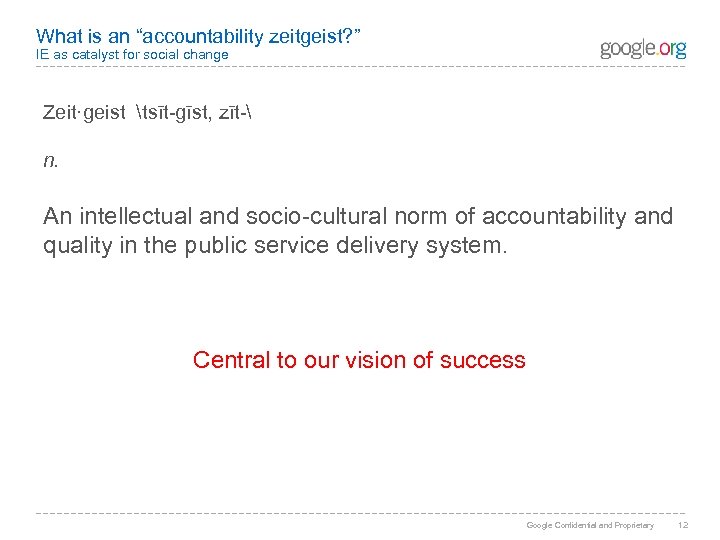
What is an “accountability zeitgeist? ” IE as catalyst for social change Zeit·geist tsīt-gīst, zīt- n. An intellectual and socio-cultural norm of accountability and quality in the public service delivery system. Central to our vision of success Google Confidential and Proprietary 12
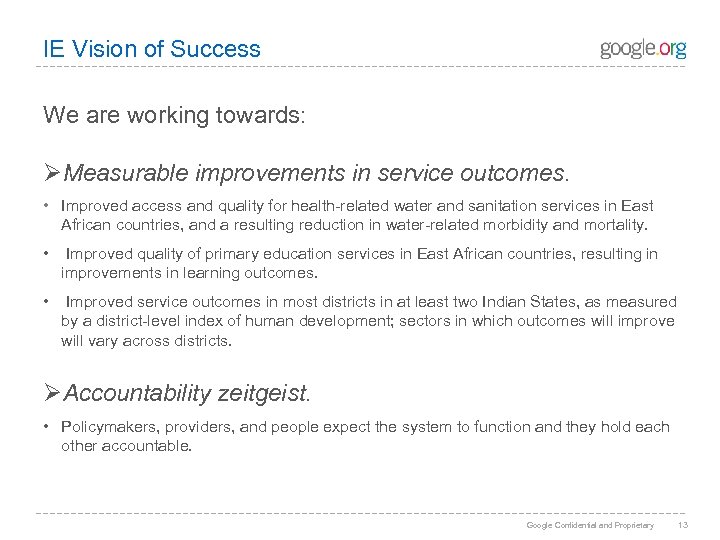
IE Vision of Success We are working towards: ØMeasurable improvements in service outcomes. • Improved access and quality for health-related water and sanitation services in East African countries, and a resulting reduction in water-related morbidity and mortality. • Improved quality of primary education services in East African countries, resulting in improvements in learning outcomes. • Improved service outcomes in most districts in at least two Indian States, as measured by a district-level index of human development; sectors in which outcomes will improve will vary across districts. ØAccountability zeitgeist. • Policymakers, providers, and people expect the system to function and they hold each other accountable. Google Confidential and Proprietary 13
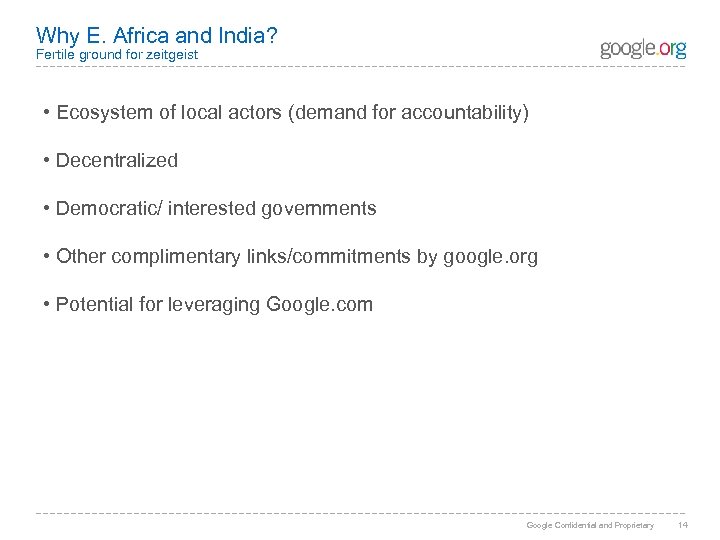
Why E. Africa and India? Fertile ground for zeitgeist • Ecosystem of local actors (demand for accountability) • Decentralized • Democratic/ interested governments • Other complimentary links/commitments by google. org • Potential for leveraging Google. com Google Confidential and Proprietary 14
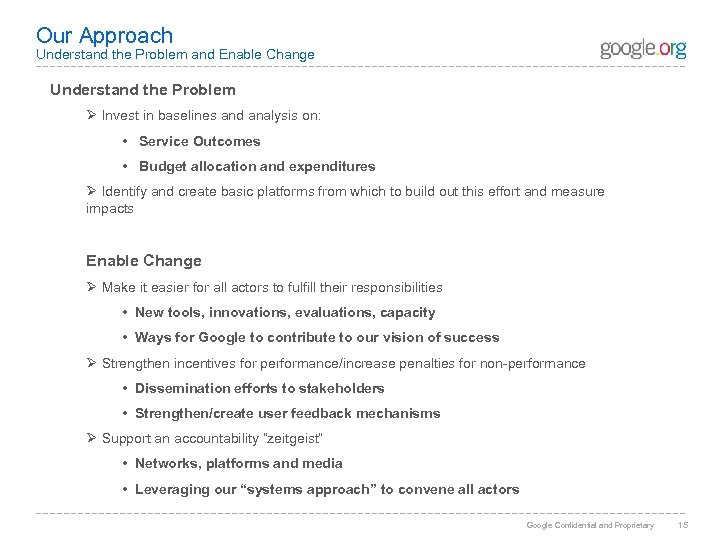
Our Approach Understand the Problem and Enable Change Understand the Problem Ø Invest in baselines and analysis on: • Service Outcomes • Budget allocation and expenditures Ø Identify and create basic platforms from which to build out this effort and measure impacts Enable Change Ø Make it easier for all actors to fulfill their responsibilities • New tools, innovations, evaluations, capacity • Ways for Google to contribute to our vision of success Ø Strengthen incentives for performance/increase penalties for non-performance • Dissemination efforts to stakeholders • Strengthen/create user feedback mechanisms Ø Support an accountability “zeitgeist” • Networks, platforms and media • Leveraging our “systems approach” to convene all actors Google Confidential and Proprietary 15
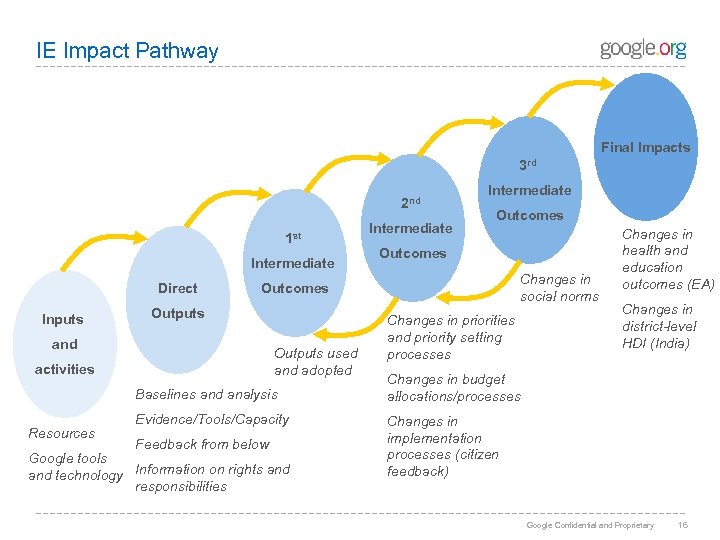
IE Impact Pathway Final Impacts 3 rd 2 nd 1 st Intermediate Direct Inputs and activities Outcomes Changes in social norms Outcomes Outputs used and adopted Baselines and analysis Resources Intermediate Evidence/Tools/Capacity Feedback from below Google tools and technology Information on rights and responsibilities Changes in priorities and priority setting processes Changes in health and education outcomes (EA) Changes in district-level HDI (India) Changes in budget allocations/processes Changes in implementation processes (citizen feedback) Google Confidential and Proprietary 16
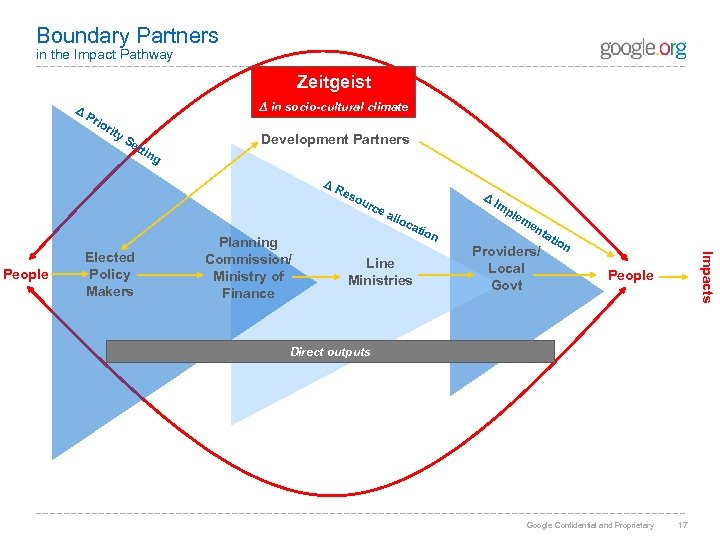
Boundary Partners in the Impact Pathway Zeitgeist Δ Δ in socio-cultural climate Pr ior ity Development Partners Se ttin g ΔR eso urc e allo cat Line Ministries ion Im p lem en tat i Providers/ Local Govt on Impacts People Elected Policy Makers Planning Commission/ Ministry of Finance Δ People Direct outputs Google Confidential and Proprietary 17
Zeitgeist = scale Social accountability movement ØScale means a “social accountability movement” in this context ØMake our plans for directly influencing boundary partners in such a way that this helps us support social change • Working with boundary partners throughout the chain • Google is a neutral player taking a system approach • Develop partnerships as an ecosystem • Regional networks • Broad-based information dissemination • Scalable approaches to partner and project selection, platforms ØAct as catalyst for social change; not big push ØThis strategy to be revised and refined ØPlan for testing To. C and tracking intermediate outputs is central to this Google Confidential and Proprietary 18
Скачать презентацию Inform and Empower to Improve Public Services Initiative
1b6264f5cd5106e2dda8b51cb4abec3b.ppt