 Скачать презентацию INFLUENCE OF THE SUBSTRATE METAL OVERLAYER AND LATTICE
29a83b7941eefd0a8684580a1aad49de.ppt
- Количество слайдов: 18



INFLUENCE OF THE SUBSTRATE, METAL OVERLAYER AND LATTICE NEIGHBORS ON THE FOCUSING PROPERTIES OF COLLOIDAL MICROSPHERES N. Arnold 1 Applied Physics, Johannes Kepler University A-4040, Linz, Austria 1 Current address: Experimental Physics, J. Kepler University, A-4040, Linz, Austria 18. 03. 2018 1 N. Arnold, Applied Physics, Linz
History and motivation • Experiments: • Substrate damage in Laser Cleaning and patterning with ML arrays (Konstanz, Singapore) • Arrays of microspheres on support used for processing (Linz) • Metal coated spheres: LIFT, spheres’ arrays with apertures, tailored transmission (Linz) • Theory • Mie theory – single sphere, complicated (Konstanz, Singapore) • “Particle on surface” – single sphere + substrate, even more complicated (Singapore, Manchester) • Dipoles, uniform asymptotics of geometrical optics – single sphere, either small or large (Linz, Konstanz) • Multi-sphere interference in Gaussian approximation (Linz) • Real life factors: multiple spheres (of intermediate size) + substrate + overlayers + capillary condensation, often simultaneously need FDTD and qualitative understanding 18. 03. 2018 2 N. Arnold, Applied Physics, Linz
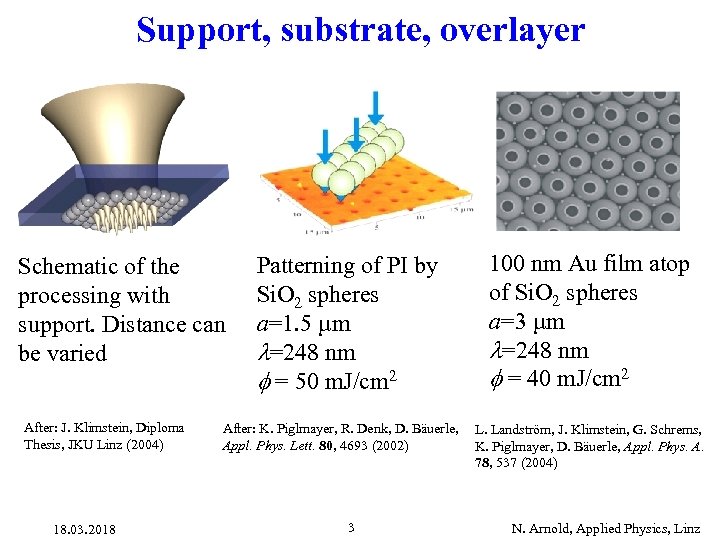
Support, substrate, overlayer Schematic of the processing with support. Distance can be varied After: J. Klimstein, Diploma Thesis, JKU Linz (2004) 18. 03. 2018 Patterning of PI by Si. O 2 spheres a=1. 5 µm =248 nm = 50 m. J/cm 2 After: K. Piglmayer, R. Denk, D. Bäuerle, Appl. Phys. Lett. 80, 4693 (2002) 3 100 nm Au film atop of Si. O 2 spheres a=3 µm =248 nm = 40 m. J/cm 2 L. Landström, J. Klimstein, G. Schrems, K. Piglmayer, D. Bäuerle, Appl. Phys. A. 78, 537 (2004) N. Arnold, Applied Physics, Linz
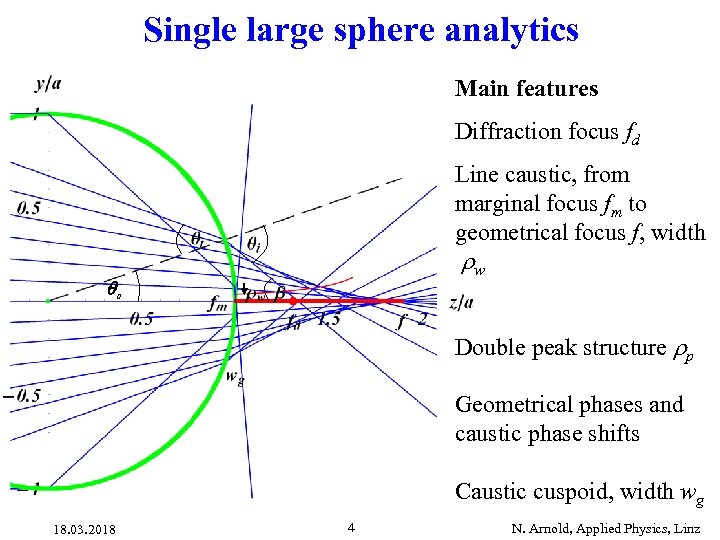
Single large sphere analytics Main features Diffraction focus fd Line caustic, from marginal focus fm to geometrical focus f, width w o Double peak structure p Geometrical phases and caustic phase shifts Caustic cuspoid, width wg 18. 03. 2018 4 N. Arnold, Applied Physics, Linz
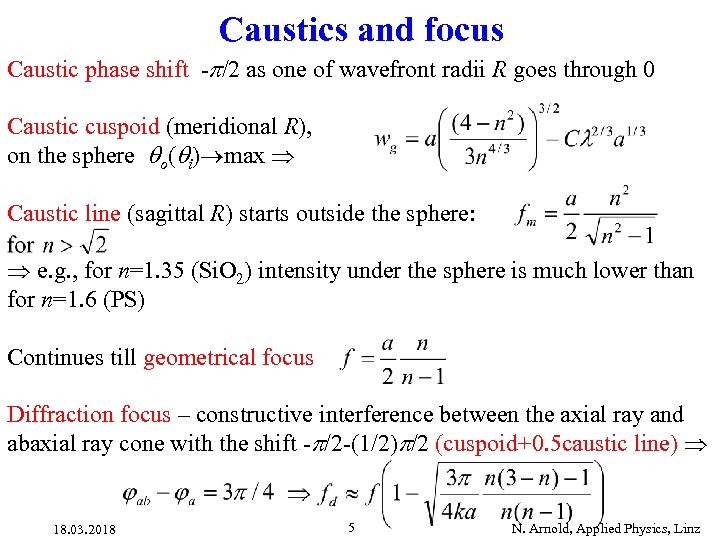
Caustics and focus Caustic phase shift - /2 as one of wavefront radii R goes through 0 Caustic cuspoid (meridional R), on the sphere o( i) max Caustic line (sagittal R) starts outside the sphere: e. g. , for n=1. 35 (Si. O 2) intensity under the sphere is much lower than for n=1. 6 (PS) Continues till geometrical focus Diffraction focus – constructive interference between the axial ray and abaxial ray cone with the shift - /2 -(1/2) /2 (cuspoid+0. 5 caustic line) 18. 03. 2018 5 N. Arnold, Applied Physics, Linz
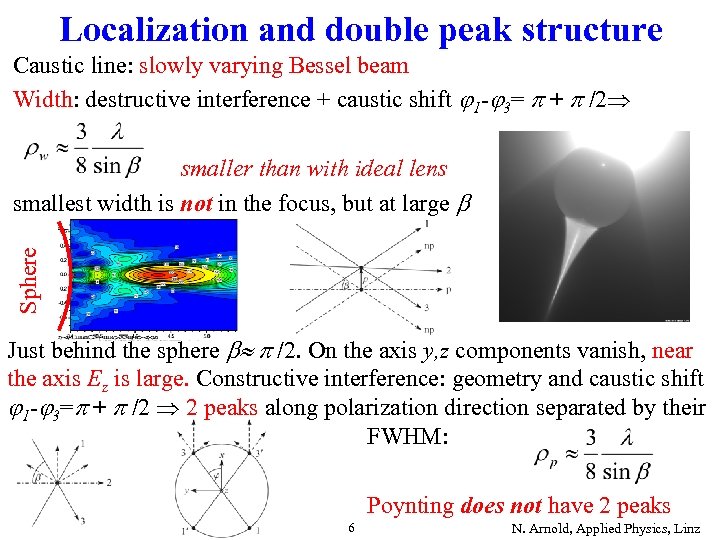
Localization and double peak structure Caustic line: slowly varying Bessel beam Width: destructive interference + caustic shift 1 - 3= + /2 Sphere smaller than with ideal lens smallest width is not in the focus, but at large Just behind the sphere /2. On the axis y, z components vanish, near the axis Ez is large. Constructive interference: geometry and caustic shift 1 - 3= + /2 2 peaks along polarization direction separated by their FWHM: Poynting does not have 2 peaks 18. 03. 2018 6 N. Arnold, Applied Physics, Linz
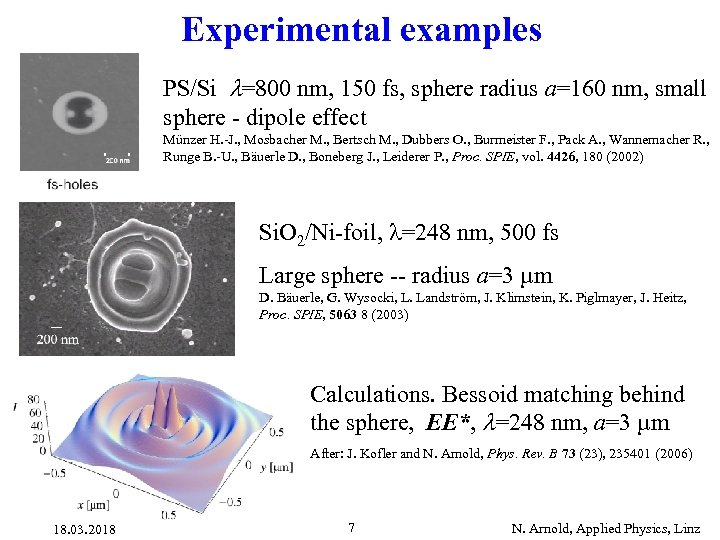
Experimental examples PS/Si =800 nm, 150 fs, sphere radius a=160 nm, small sphere - dipole effect Münzer H. -J. , Mosbacher M. , Bertsch M. , Dubbers O. , Burmeister F. , Pack A. , Wannemacher R. , Runge B. -U. , Bäuerle D. , Boneberg J. , Leiderer P. , Proc. SPIE, vol. 4426, 180 (2002) Si. O 2/Ni-foil, =248 nm, 500 fs Large sphere -- radius a=3 µm D. Bäuerle, G. Wysocki, L. Landström, J. Klimstein, K. Piglmayer, J. Heitz, Proc. SPIE, 5063 8 (2003) Calculations. Bessoid matching behind the sphere, EE*, =248 nm, a=3 µm After: J. Kofler and N. Arnold, Phys. Rev. B 73 (23), 235401 (2006) 18. 03. 2018 7 N. Arnold, Applied Physics, Linz
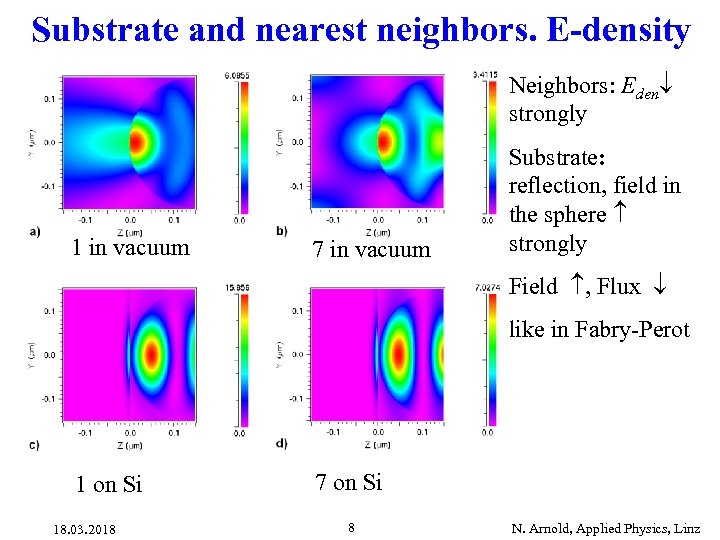
Substrate and nearest neighbors. E-density Neighbors: Eden strongly 1 in vacuum 7 in vacuum Substrate: reflection, field in the sphere strongly Field , Flux like in Fabry-Perot 1 on Si 18. 03. 2018 7 on Si 8 N. Arnold, Applied Physics, Linz
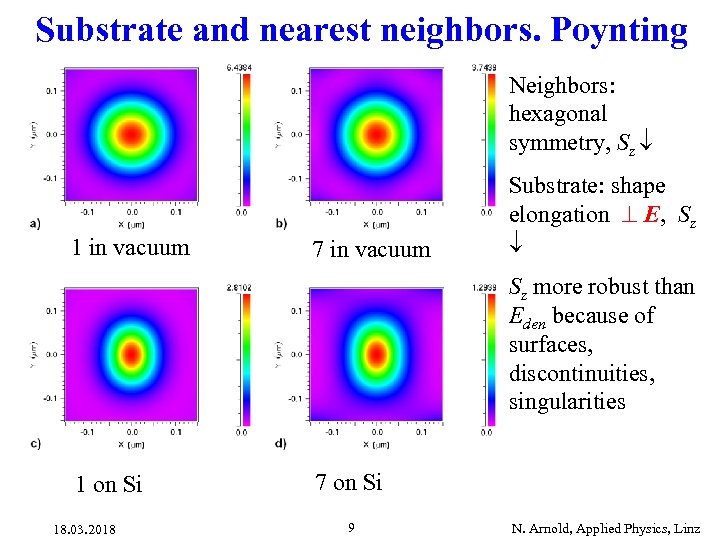
Substrate and nearest neighbors. Poynting Neighbors: hexagonal symmetry, Sz 1 in vacuum 7 in vacuum Substrate: shape elongation E, Sz more robust than Eden because of surfaces, discontinuities, singularities 1 on Si 18. 03. 2018 7 on Si 9 N. Arnold, Applied Physics, Linz
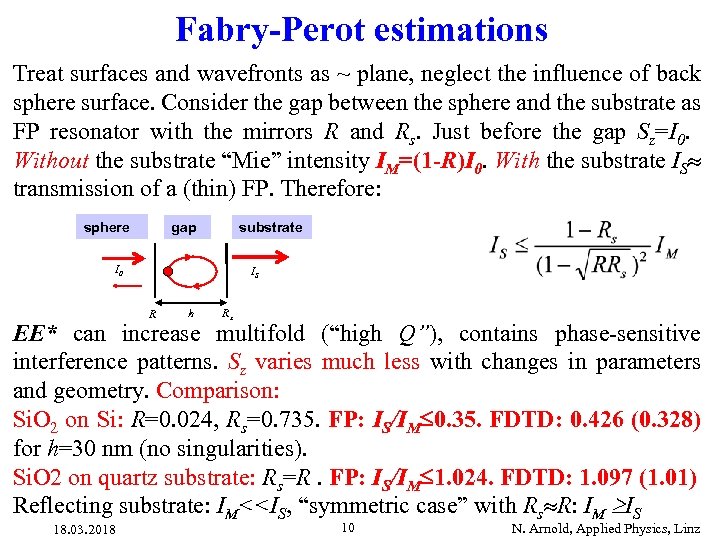
Fabry-Perot estimations Treat surfaces and wavefronts as ~ plane, neglect the influence of back sphere surface. Consider the gap between the sphere and the substrate as FP resonator with the mirrors R and Rs. Just before the gap Sz=I 0. Without the substrate “Mie” intensity IM=(1 -R)I 0. With the substrate IS transmission of a (thin) FP. Therefore: sphere gap substrate I 0 IS R h Rs EE* can increase multifold (“high Q”), contains phase-sensitive interference patterns. Sz varies much less with changes in parameters and geometry. Comparison: Si. O 2 on Si: R=0. 024, Rs=0. 735. FP: IS/IM 0. 35. FDTD: 0. 426 (0. 328) for h=30 nm (no singularities). Si. O 2 on quartz substrate: Rs=R. FP: IS/IM 1. 024. FDTD: 1. 097 (1. 01) Reflecting substrate: IM<<IS, “symmetric case” with Rs R: IM IS 18. 03. 2018 10 N. Arnold, Applied Physics, Linz
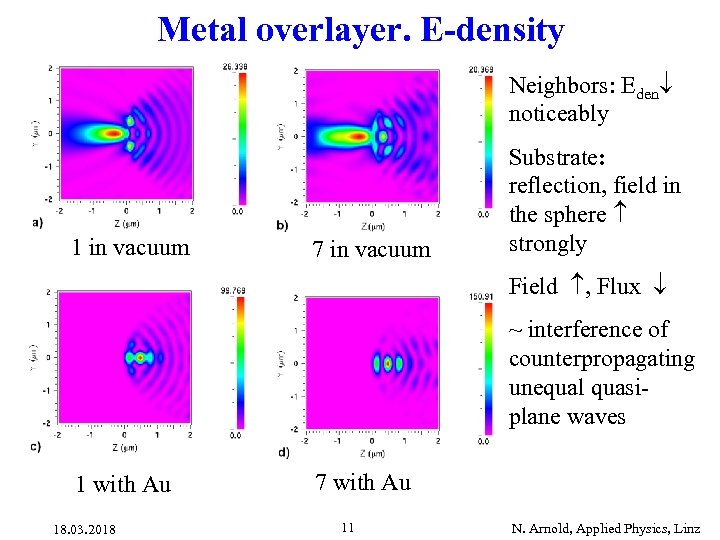
Metal overlayer. E-density Neighbors: Eden noticeably 1 in vacuum 7 in vacuum Substrate: reflection, field in the sphere strongly Field , Flux ~ interference of counterpropagating unequal quasiplane waves 1 with Au 18. 03. 2018 7 with Au 11 N. Arnold, Applied Physics, Linz
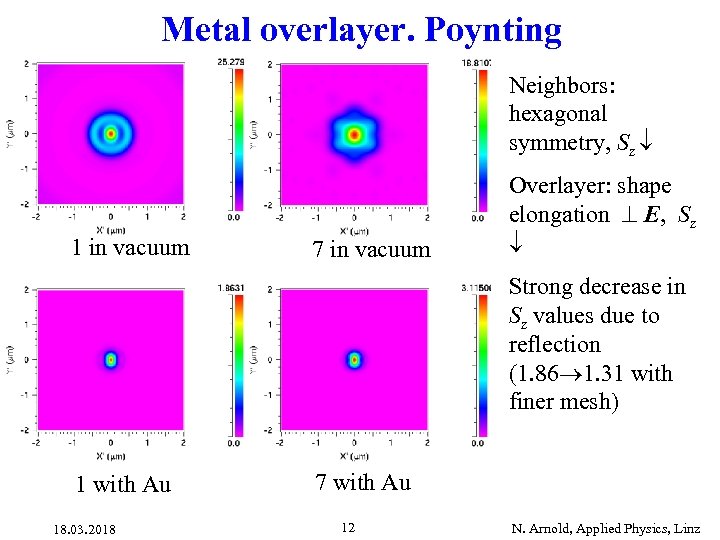
Metal overlayer. Poynting Neighbors: hexagonal symmetry, Sz 1 in vacuum 7 in vacuum Overlayer: shape elongation E, Sz Strong decrease in Sz values due to reflection (1. 86 1. 31 with finer mesh) 1 with Au 18. 03. 2018 7 with Au 12 N. Arnold, Applied Physics, Linz
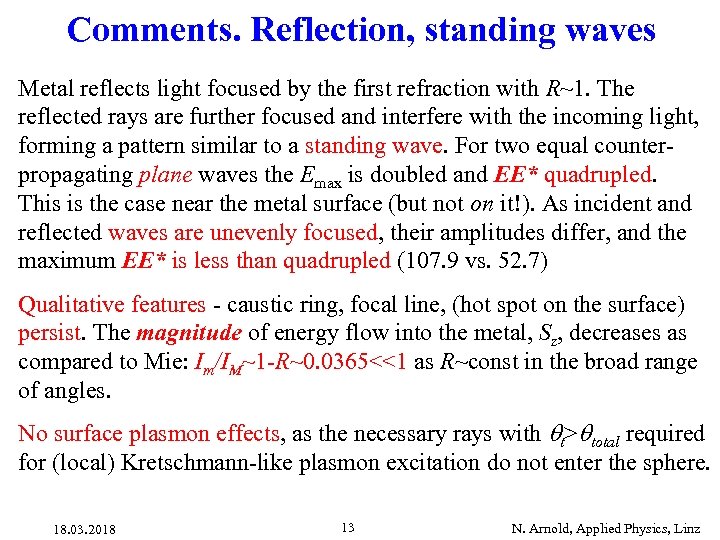
Comments. Reflection, standing waves Metal reflects light focused by the first refraction with R~1. The reflected rays are further focused and interfere with the incoming light, forming a pattern similar to a standing wave. For two equal counterpropagating plane waves the Emax is doubled and EE* quadrupled. This is the case near the metal surface (but not on it!). As incident and reflected waves are unevenly focused, their amplitudes differ, and the maximum EE* is less than quadrupled (107. 9 vs. 52. 7) Qualitative features - caustic ring, focal line, (hot spot on the surface) persist. The magnitude of energy flow into the metal, Sz, decreases as compared to Mie: Im/IM~1 -R~0. 0365<<1 as R~const in the broad range of angles. No surface plasmon effects, as the necessary rays with t> total required for (local) Kretschmann-like plasmon excitation do not enter the sphere. 18. 03. 2018 13 N. Arnold, Applied Physics, Linz
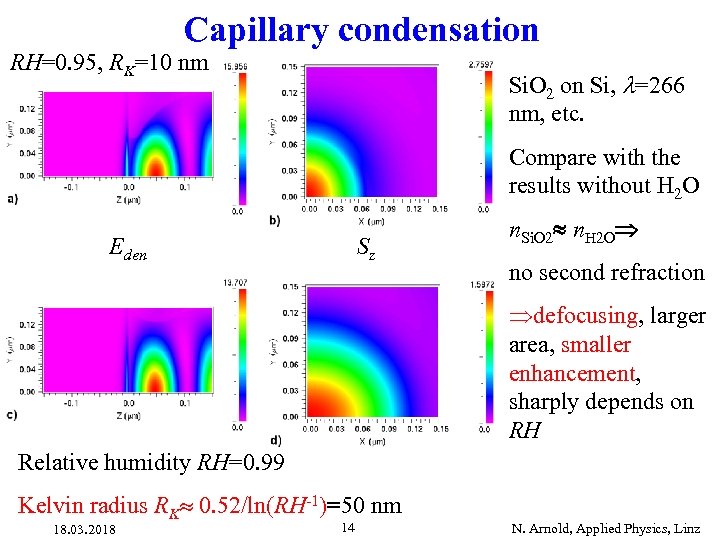
Capillary condensation RH=0. 95, RK=10 nm Si. O 2 on Si, =266 nm, etc. Compare with the results without H 2 O Eden Sz n. Si. O 2 n. H 2 O no second refraction defocusing, larger area, smaller enhancement, sharply depends on RH Relative humidity RH=0. 99 Kelvin radius RK 0. 52/ln(RH-1)=50 nm 18. 03. 2018 14 N. Arnold, Applied Physics, Linz
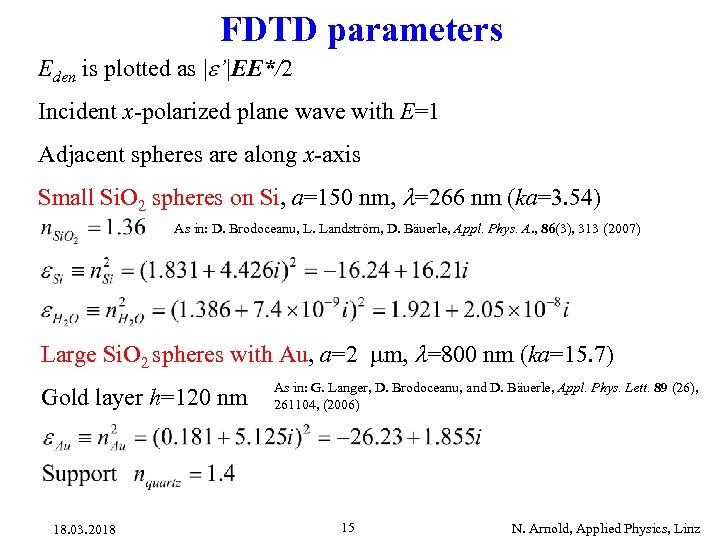
FDTD parameters Eden is plotted as | ’|EE*/2 Incident x-polarized plane wave with E=1 Adjacent spheres are along x-axis Small Si. O 2 spheres on Si, a=150 nm, =266 nm (ka=3. 54) As in: D. Brodoceanu, L. Landström, D. Bäuerle, Appl. Phys. A. , 86(3), 313 (2007) Large Si. O 2 spheres with Au, a=2 m, =800 nm (ka=15. 7) Gold layer h=120 nm 18. 03. 2018 As in: G. Langer, D. Brodoceanu, and D. Bäuerle, Appl. Phys. Lett. 89 (26), 261104, (2006) 15 N. Arnold, Applied Physics, Linz
Conclusions • Focusing by large spheres -- uniform asymptotics of geometrical optics, caustic phase shifts. Line caustic, lateral localization better than for the ideal lens, double peak structure near the sphere due to Ez. • Substrate strongly modifies the intensity under the sphere. This can be understood using Fabry-Perot model. Energy flowing into a reflecting substrate is significantly lower than expected from Mie. • Metallic overlayer acts as a reflecting mirror. It increases the peak intensity inside the sphere, but decreases the flow of energy into the metal as compared to Mie. This may lead to sphere damage and is important for the analysis of LIFT process and aperture formation. • Nearest lattice neighbors modify the field distribution in the planes parallel to the ML and noticeably change the intensity in the focal area. • Capillary condensation decreases the peak enhancement, delocalizes high-field region. • Field enhancement estimations based on Mie or even more advanced semi-analytical models can be way off and should be applied cautiously to a quantitative analysis of real experiments. 18. 03. 2018 16 N. Arnold, Applied Physics, Linz
Acknowledgements Discussions: Prof. B. Luk’yanchuk (Singapore) Dr. Z. Wang (Manchester) Dr. L. Landström (Uppsala) DI. J. Kofler (Vienna) Prof. D. Bäuerle (Linz) FDTD help: CD Laboratory for Surface Optics (Linz) Univ. Doz. Dr. K. Hingerl MSc. V. Lavchiev 18. 03. 2018 17 N. Arnold, Applied Physics, Linz
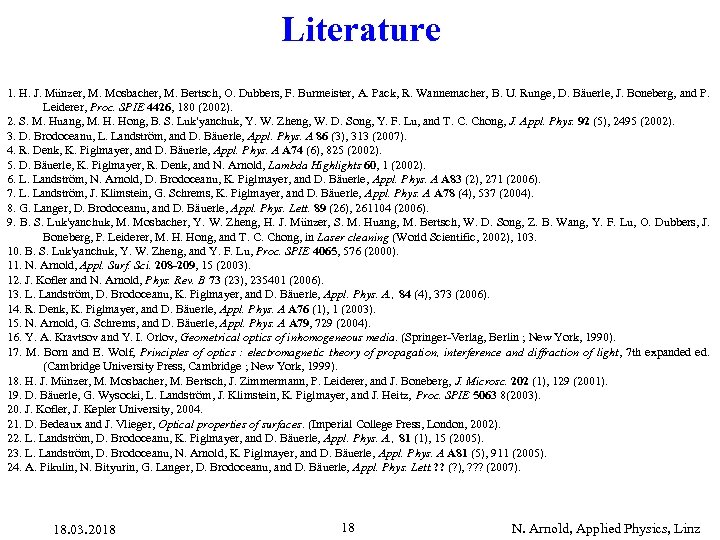
Literature 1. H. J. Münzer, M. Mosbacher, M. Bertsch, O. Dubbers, F. Burmeister, A. Pack, R. Wannemacher, B. U. Runge, D. Bäuerle, J. Boneberg, and P. Leiderer, Proc. SPIE 4426, 180 (2002). 2. S. M. Huang, M. H. Hong, B. S. Luk'yanchuk, Y. W. Zheng, W. D. Song, Y. F. Lu, and T. C. Chong, J. Appl. Phys. 92 (5), 2495 (2002). 3. D. Brodoceanu, L. Landström, and D. Bäuerle, Appl. Phys. A 86 (3), 313 (2007). 4. R. Denk, K. Piglmayer, and D. Bäuerle, Appl. Phys. A A 74 (6), 825 (2002). 5. D. Bäuerle, K. Piglmayer, R. Denk, and N. Arnold, Lambda Highlights 60, 1 (2002). 6. L. Landström, N. Arnold, D. Brodoceanu, K. Piglmayer, and D. Bäuerle, Appl. Phys. A A 83 (2), 271 (2006). 7. L. Landström, J. Klimstein, G. Schrems, K. Piglmayer, and D. Bäuerle, Appl. Phys. A A 78 (4), 537 (2004). 8. G. Langer, D. Brodoceanu, and D. Bäuerle, Appl. Phys. Lett. 89 (26), 261104 (2006). 9. B. S. Luk'yanchuk, M. Mosbacher, Y. W. Zheng, H. J. Münzer, S. M. Huang, M. Bertsch, W. D. Song, Z. B. Wang, Y. F. Lu, O. Dubbers, J. Boneberg, P. Leiderer, M. H. Hong, and T. C. Chong, in Laser cleaning (World Scientific, 2002), 103. 10. B. S. Luk'yanchuk, Y. W. Zheng, and Y. F. Lu, Proc. SPIE 4065, 576 (2000). 11. N. Arnold, Appl. Surf. Sci. 208 -209, 15 (2003). 12. J. Kofler and N. Arnold, Phys. Rev. B 73 (23), 235401 (2006). 13. L. Landström, D. Brodoceanu, K. Piglmayer, and D. Bäuerle, Appl. Phys. A. , 84 (4), 373 (2006). 14. R. Denk, K. Piglmayer, and D. Bäuerle, Appl. Phys. A A 76 (1), 1 (2003). 15. N. Arnold, G. Schrems, and D. Bäuerle, Appl. Phys. A A 79, 729 (2004). 16. Y. A. Kravtsov and Y. I. Orlov, Geometrical optics of inhomogeneous media. (Springer-Verlag, Berlin ; New York, 1990). 17. M. Born and E. Wolf, Principles of optics : electromagnetic theory of propagation, interference and diffraction of light, 7 th expanded ed. (Cambridge University Press, Cambridge ; New York, 1999). 18. H. J. Münzer, M. Mosbacher, M. Bertsch, J. Zimmermann, P. Leiderer, and J. Boneberg, J. Microsc. 202 (1), 129 (2001). 19. D. Bäuerle, G. Wysocki, L. Landström, J. Klimstein, K. Piglmayer, and J. Heitz, Proc. SPIE 5063 8(2003). 20. J. Kofler, J. Kepler University, 2004. 21. D. Bedeaux and J. Vlieger, Optical properties of surfaces. (Imperial College Press, London, 2002). 22. L. Landström, D. Brodoceanu, K. Piglmayer, and D. Bäuerle, Appl. Phys. A. , 81 (1), 15 (2005). 23. L. Landström, D. Brodoceanu, N. Arnold, K. Piglmayer, and D. Bäuerle, Appl. Phys. A A 81 (5), 911 (2005). 24. A. Pikulin, N. Bityurin, G. Langer, D. Brodoceanu, and D. Bäuerle, Appl. Phys. Lett. ? ? (? ), ? ? ? (2007). 18. 03. 2018 18 N. Arnold, Applied Physics, Linz
Скачать презентацию INFLUENCE OF THE SUBSTRATE METAL OVERLAYER AND LATTICE
29a83b7941eefd0a8684580a1aad49de.ppt