


 Скачать презентацию INFERTILITY ROLE OF FAMILY PHYSICIAN SUSHIL JAIN 3
6cbd3e461c0e1a378f3c4ff2176c1a55.ppt
- Количество слайдов: 31
 INFERTILITY: ROLE OF FAMILY PHYSICIAN SUSHIL JAIN 3 RD YEAR B. H. M. S
 Definitions Infertility = Inability of a couple practicing frequent intercourse and not using contraception to fail to conceive a child within one year. n Infertility affects 15 -20% of couples, or 11 million reproductive age people in the U. S. n
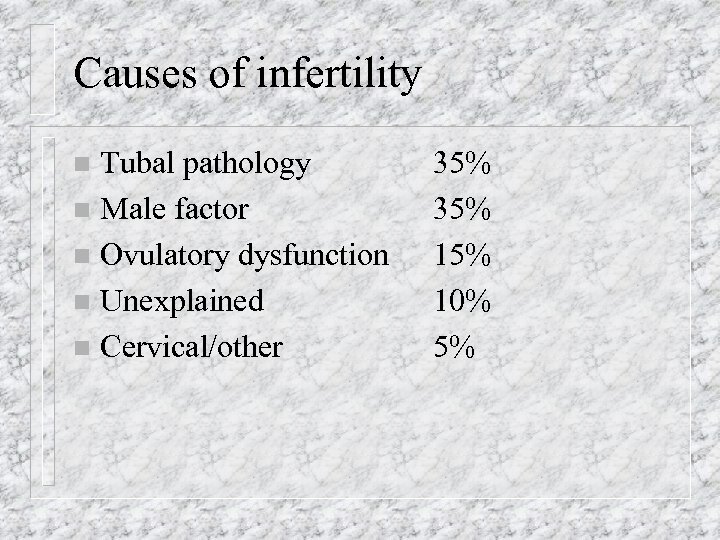 Causes of infertility Tubal pathology n Male factor n Ovulatory dysfunction n Unexplained n Cervical/other n 35% 15% 10% 5%
 Counsel patience! n In normal young couples: – – – n 25% conceive after one month 70% conceive after six months 95% conceive by one year Only an additional 5% will conceive in an additional 6 -12 months
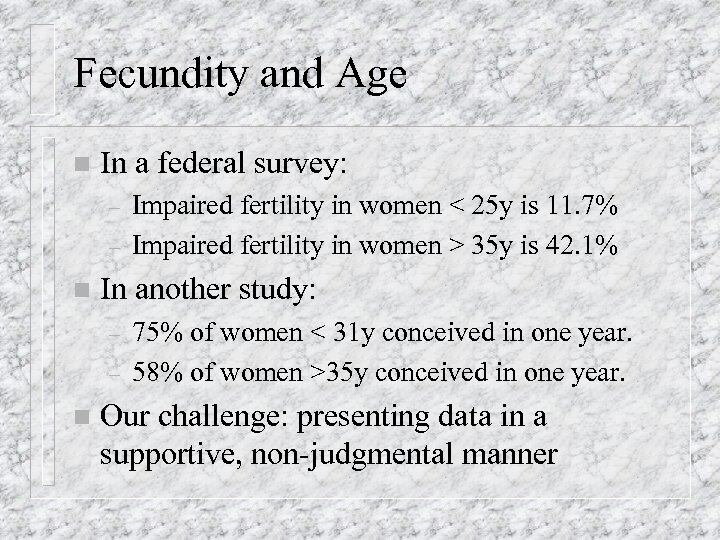 Fecundity and Age n In a federal survey: – – n In another study: – – n Impaired fertility in women < 25 y is 11. 7% Impaired fertility in women > 35 y is 42. 1% 75% of women < 31 y conceived in one year. 58% of women >35 y conceived in one year. Our challenge: presenting data in a supportive, non-judgmental manner
 Tubal/ Pelvic pathology n n n Congenital anomalies Tubal occlusion Evaluated by: – – – hysterosalpingogram laparoscopy hysteroscopy n May occur as sequelae of – – PID endometriosis abdominal/pelvic surgery peritonitis
 Male factor Male partner should be evaluated simultaneously with female n Causes of male infertility: n – – – reversible conditions (varicocele, obstructive azoospermia) not reversible, but viable sperm available (ejaculatorydysfunction, inoperative obstructive azoospermia) not reversible, no viable sperm (hypogonadism) genetic abnormalities testicular or pituitary cancer
 Ovulatory dysfunction Causes 15% of infertility n Diagnosed by menstrual irregularities, basal body temperature charting, ovulation prediction kits, serum progesterone levels. n
 Ovulatory Dysfunction - 2 n Causes of ovulatory dysfunction: – – – polycystic ovary syndrome hypothalamic anovulation hyperprolactinemia premature and age-related ovarian failure luteal phase defect (theoretical)
 Polycystic Ovarian Syndrome n n n Oligomenorrhea/amenorrhea and hyperandrogenism Prevalence: 5%. Among women with O. D. , 70% have PCOS. Clinical evidence: hirsutism, acne, obesity Lab evidence: elevated testosterone, elevated DHEA-S. “Polycystic ovaries” supportive, not diagnostic
 PCOS: Treatment Approach Weight loss if BMI>30 n Clomiphene to induce ovulation n If DHEA-S >2, clomiphene + glucocorticoid (dexamethasone) n If clomiphene alone unsuccessful, try metformin + clomiphene. n – SOURCE- MIMS 2012
 Hypothalamic Anovulation Low levels of Gn. RH, low of normal levels of FSH/ LH, low levels of endogenous estrogen. n Associated factors: low BMI (< 20), highintensity exercise, extreme diets, stress. n Treatment: lifestyle modification. n
 Hyperprolactinemia Causes: pituitary adenoma, psych meds. n Test for: pregnancy, thyroid disease. n Imaging: MRI for macro vs microadenoma n Treament: Bromocriptine (dopamine agonist). After correction, 80% of women will ovulate, 80% will get pregnant. n Discontinue treatment once pregnancy established. n
 What Can I Do? Infertility Evaluation for the Family Doctor
 History and Physical - Female n History – – – – menarche, puberty menstrual hx preganancies, abortions, birth control dysparenunia, dysmenorrhea STD’s, abdominal surg, galactorrhea Weight loss/gain Stress, exercise, drugs, alcohol, psychological n Physical – – – weight/BMI thyroid skin (striae? Acanthosis nigracans? ) pelvic (vaginal mucosa, masses, pain) rectal (uterosacral nodularity)
 History and Physical - Male n History – – – – prior fertility medications h/o diabetes, mumps, undescended testes genital surgery, trauma, infections ED drug/alcohol use, stress underwear, hot tubs, frequent coitus n Physical – – – habitus, gynecomastia sexual development testicular volume (5 x 3 cm) epididymis, vas, prostate by palpation check for varicocele
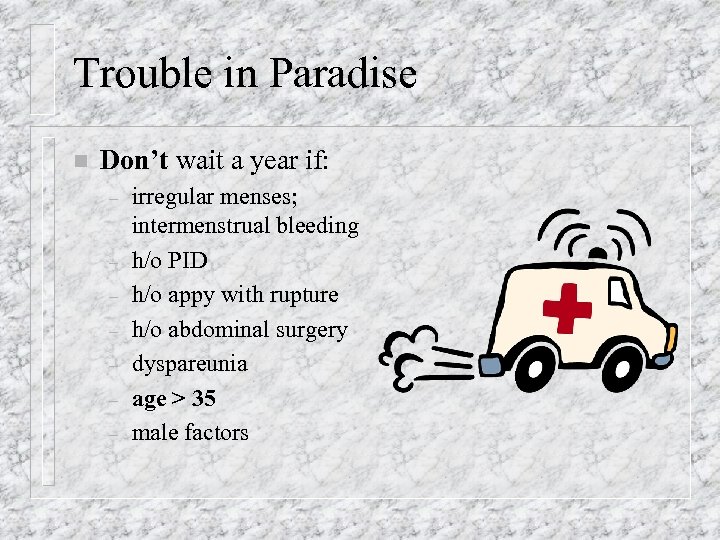 Trouble in Paradise n Don’t wait a year if: – – – – irregular menses; intermenstrual bleeding h/o PID h/o appy with rupture h/o abdominal surgery dyspareunia age > 35 male factors
 On your first visit: Semen analysis n Confirm ovulation n – – – n basal body temperature charting ovulation predictor kits (detect LH surge) consider serum progesterone on day 21 Labs: – – – TSH and prolactin. DHEA-S if concern for PCOS. FSH & estradiol on cycle day 3 if >35 y. Cervical cultures prn.
 Three months later n Hysterosalpingogram – – evaluates tubal patency and uterine cavity shape noninvasive but involves a tenaculum performed by radiology with gynecology supervision diagnostic and therapeutic
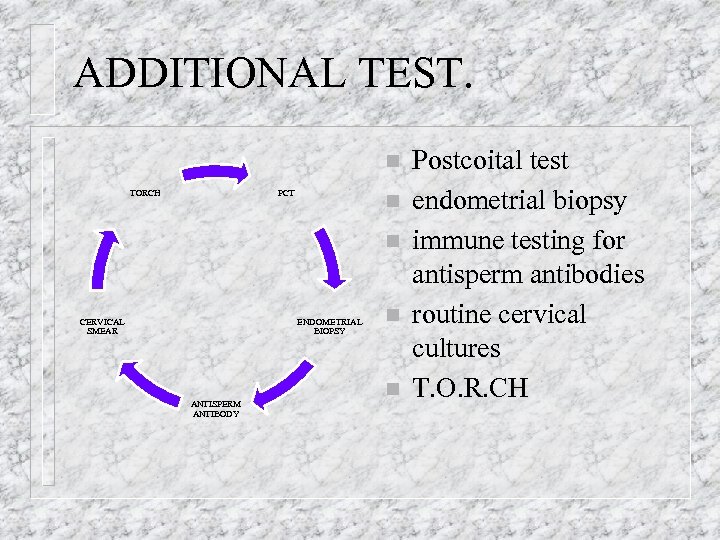 ADDITIONAL TEST. n TORCH PCT n n CERVICAL SMEAR ENDOMETRIAL BIOPSY ANTISPERM ANTIBODY n n Postcoital test endometrial biopsy immune testing for antisperm antibodies routine cervical cultures T. O. R. CH
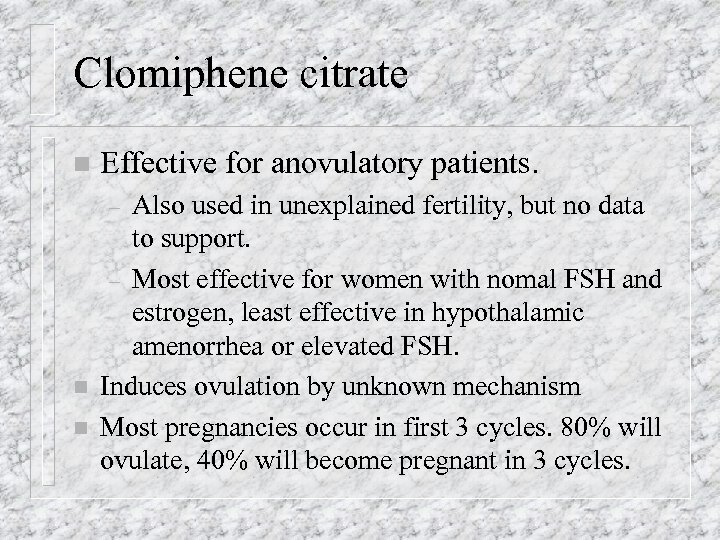 Clomiphene citrate n Effective for anovulatory patients. Also used in unexplained fertility, but no data to support. – Most effective for women with nomal FSH and estrogen, least effective in hypothalamic amenorrhea or elevated FSH. Induces ovulation by unknown mechanism Most pregnancies occur in first 3 cycles. 80% will ovulate, 40% will become pregnant in 3 cycles. – n n
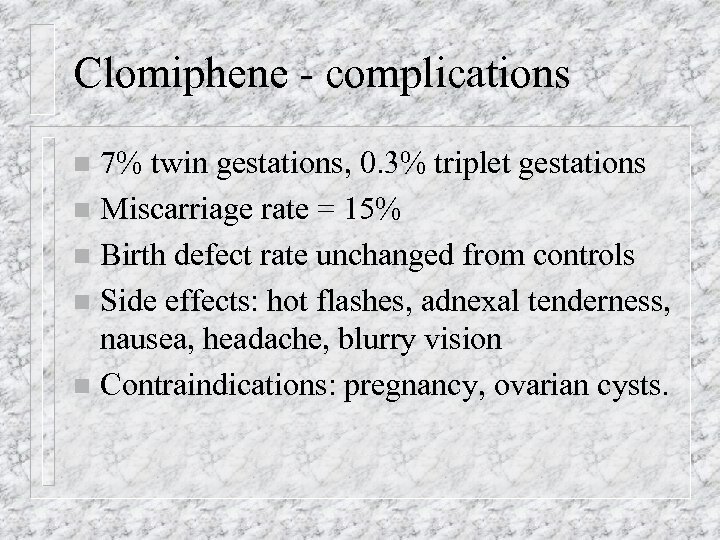 Clomiphene - complications 7% twin gestations, 0. 3% triplet gestations n Miscarriage rate = 15% n Birth defect rate unchanged from controls n Side effects: hot flashes, adnexal tenderness, nausea, headache, blurry vision n Contraindications: pregnancy, ovarian cysts. n
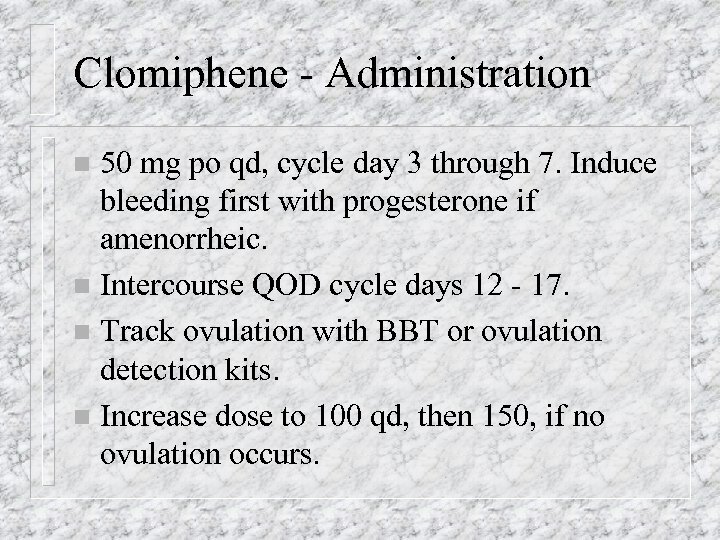 Clomiphene - Administration 50 mg po qd, cycle day 3 through 7. Induce bleeding first with progesterone if amenorrheic. n Intercourse QOD cycle days 12 - 17. n Track ovulation with BBT or ovulation detection kits. n Increase dose to 100 qd, then 150, if no ovulation occurs. n
 Bibliography n Bradshaw, Karen. Evaluation and Management of the Infertile Couple. Ob/Gyn vol 5, chapter 50, 1998. n Penzias, Alan. Infertility: Contemporary office-based evaluation and treatment. Obstet& Gynecol Clinics, vol 27, no 3, Sept 2000. n ACOG Practice Bulletin. Management of Infertility Caused by Ovulatory Dysfunction. Number 34, February 2002. n Royal College of Obstetricians and Gynecologists, The Management of Infertility in Secondary Care: National Evidence-Based Clinical Guidelines. www. rcog. org. uk.
 Case 1 n A 24 year old couple comes to see you. They have been trying to get pregnant for 8 months. – What questions do you ask?
 Case 1 n The woman tells you she has never been pregnant. She has a regular 28 day cycle and bleeds for 4 days each month. Her medical history is unremarkable except she “got really sick” when she was 16 and had “nasty stuff coming from down there” – what do you do next?
 Case 2 n A 35 year old woman and her 31 year old male partner come to see you. They have been trying to get pregnant for 6 months. – What do you ask?
 Case 2 n She says her periods have been irregular since she went off the pill a year ago. She has never been pregnant. He has fathered a child by another woman several years ago. – – – What do you look for on exam? What lab tests do you order today? Do you give them homework?
 Case 2 n They come back 3 months later with BBT charts showing no discernable pattern. Lab tests, including semen analysis, were all normal. – – What is the diagnosis? What do you do next?
 Case 2 n You begin discussion of clomiphene. They want to know the side effects, and if this means they’ll have sextuplets and get a free house like the folks on TV. – – What do you tell them? How do you administer the clomiphene?
 Case 2 n They come back in one month. She feels “like a total bitch - excuse me, doctor” on the clomiphene. She is not pregnant. BBT charting shows a mid-cycle temperature rise. – What happens next?