


 Скачать презентацию Infection Control in Day Care Centres A Teleconference
89aba82f19731c317ac3ebb5f3a70d0b.ppt
- Количество слайдов: 41
 Infection Control in Day Care Centres A Teleconference September 16, 2003 Jim Gauthier, MLT, CIC jgauthier 2@sympatico. ca 1
 Your Host! 2
 Our Goals • Understand why our population is at risk • Understand the transmission of nemesis to population • Understand ways of stopping or preventing this transmission • Have a bit of fun! 3
 In a Nut Shell • Keep it clean • Understand our nemesis - the bugs – The environment – Our hands • which leads to: • Don’t eat it! – Clean eating areas and high touch surfaces – Clean hands before and after eating – Clean hands regularly 4
 5
5
 Feces Facts • 70% of passed feces is water • 70% dried weight of feces is bacteria • 1 gram of dried feces contains up to 1 x 10¹² bacteria (1, 000, 000) • 1 microgram contains 1 x 10⁶ bacteria • Most of these bacteria are anaerobic, nonpathogenic organisms 6
 Saliva • 1 m. L of saliva can contain 1 x 10⁸ organisms • Predominantly anaerobic • Whole spectrum of organisms – aerobic – anaerobic – viruses 7
 The Children - Our Host- The Risk • Infants and toddlers require assistance with toileting • Explore the environment with their mouths • Drool • Developing immunity • Hands-on contact with care providers • Contact with other children 8
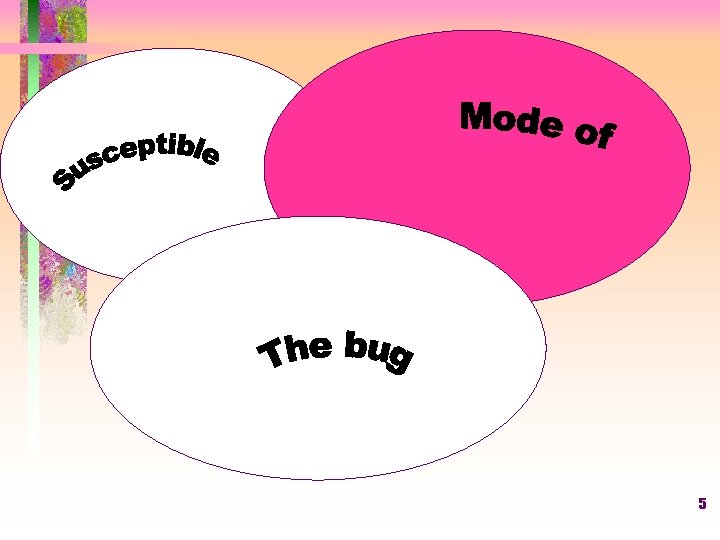
 Risk Factors for Transmission • Organism Characteristics – mode of spread – infective dose – environmental survival • Presence of carrier state, or asymptomatic infection • Immunity 9
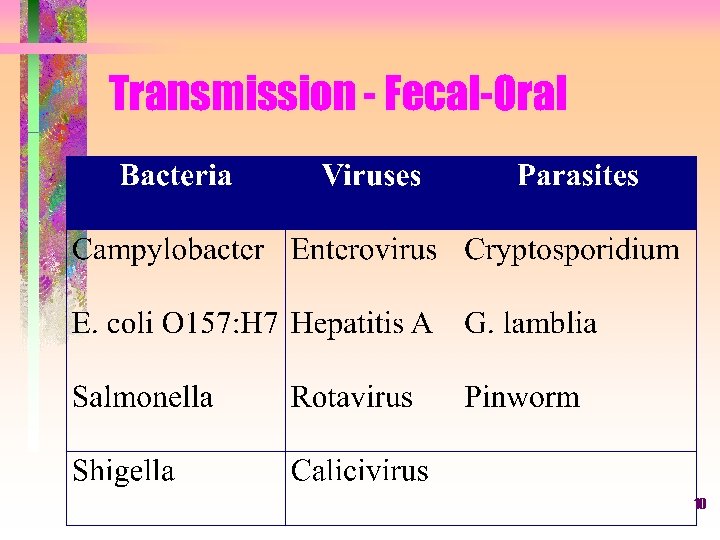 Transmission - Fecal-Oral 10
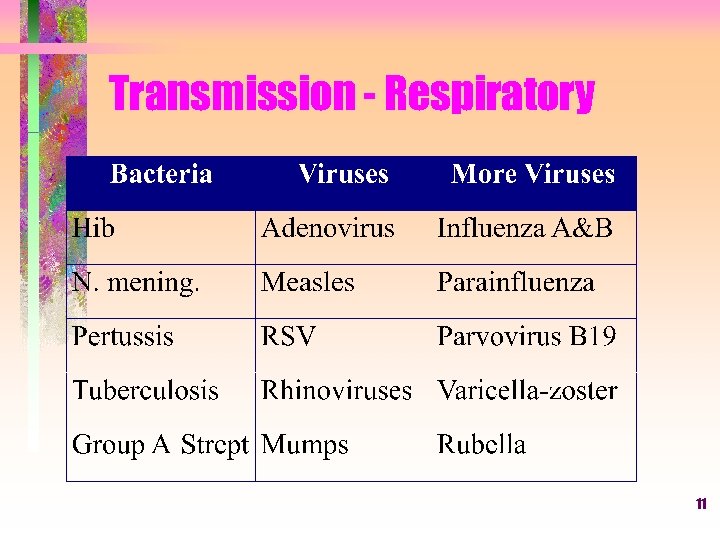 Transmission - Respiratory 11
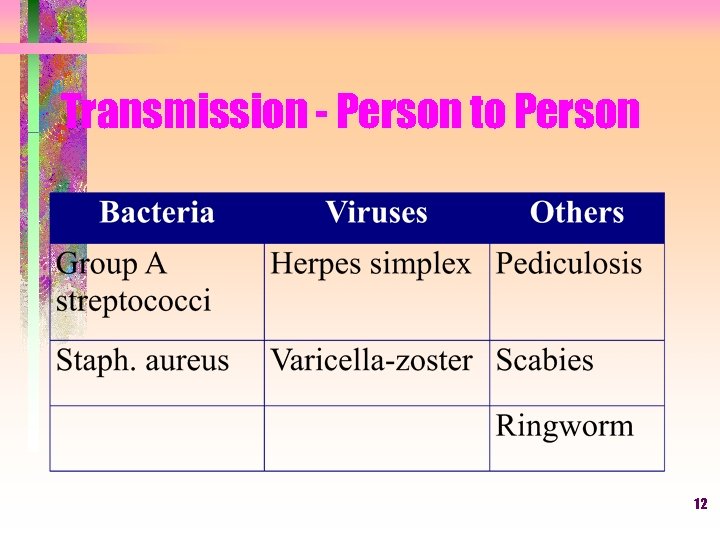 Transmission - Person to Person 12
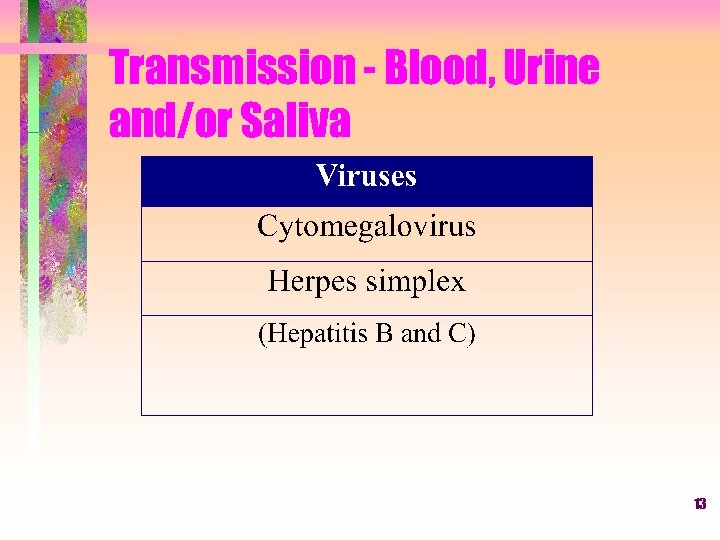 Transmission - Blood, Urine and/or Saliva 13
 Standard or Routine Precautions • Treat all body fluids, excretions, secretions as potentially infectious • Wash hands well after any inadvertent contact with such fluids • Have immunizations up to date • Wear gloves if contact is anticipated – this could be controversial for diapering 14
 Standard or Routine Precautions • Gloves – can cause more problems especially if not used properly – must be changed or removed immediately after use • don’t use same gloves to change a child, then sanitize change area 15
 Are These Bad Places to Be? • Extensive contact with other children in a day care setting is associated with a reduced risk of acute lymphoblastic leukemia. • Ma, X et al. Daycare attendance and risk of childhood acute lymphoblastic leukemia. Br J Cancer 2002: 86(9): 1419 -24 • Attending a daycare centre is the most important risk factor for respiratory tract infections in children aged 2 -5 years. • Forssell, G et al. Risk factors for respiratory tract infections in children aged 216 5 years. Scand J Prim Health Care 2001; 19(2): 122 -5
 Are These Bad Places to Be? • Young children in child care have averaged 96 days of illness per year. – 60 -70% are respiratory illnesses 17
 Do We Really Need to Know This? • 100 soils and samples from 10 daycare sandboxes yielded Toxocara, Ascaris, and hookworm ova • Only 3 sandboxes were actually positive • Gyorkos, TW et al. Parasite contamination of sand soil from daycare sandboxes and play areas. Can J Infect Dis 1994; (5(1): 17 -20 18
 Exclusion of Children • American Academy of Pediatrics - Red Book – Cannot participate comfortably – Care greater than what can be provided by the centre – Any of: fever, lethargy, irritability, persistent crying, difficult breathing, etc. – Diarrhea or stools with blood or mucus – Shigella infection or E. coli O 157: H 7 19
 Exclusion of Children – Vomiting 2 or more times in previous 24 hours, unless non-communicable – Mouth sores associated with excessive drooling – Rash with fever or behavioral changes – Purulent conjunctivitis • pink or red conjunctiva with white or yellow discharge – Impetigo, Streptococcal pharyngitis 20
 Exclusion of Children – Head lice, scabies – Varicella – Pertussis, mumps, measles – Hepatitis A infection 21
 Inclusion of Children • Non purulent conjunctivitis – pink conjunctiva with clear, watery eye discharge without fever, eye pain, or eyelid redness • Rash without fever and without behavioral change • Parvovirus B 19 infection in immunocompetent host 22 • CMV infection
 Sick Children • Never assume a child has no illness because they appear healthy! • Cohorting of ill children with same symptoms – requires cohorting of care worker • Separate area for ill and well children 23
 Staff • All staff will be screened as outlined by the Act, or the Ministry of Community and Social Services – both criminally and medically • Need clear guidelines for staff for recognizing illness in themselves • Food preparation staff separate from “toileting” staff • Eat same meals as children! 24
 Disinfection • CLEAN before DISINFECTING! – Soap and water for general cleaning – dilute bleach solutions – accelerated or stabilized hydrogen peroxide – Household disinfectants 25
 Disinfectants • Bleach – 800 ppm - effective against rotavirus – 1/64 dilution • 1/4 cup in 1 gallon (approx. 50 m. L in 4 L) • bathrooms, diapering areas (CDC) – 1/1000 dilution • (1 m. L in 1 L water)- water table – 1/10 dilution - body fluid spills – 1 Tbsp in 1 gallon (approx. 15 m. L in 4 L) • toys, clean eating utensils, etc. 26
 Disinfectants • Stabilized Hydrogen peroxide – Virox, Hydrox, Accel – Very effective against non-enveloped and enveloped viruses, and vegetative bacteria with a 5 minute contact time – Also works as a cleaner. – Can buy concentrate or ready-to-use 27
 Disinfectants • Virox – high level disinfectant with prolonged contact – No rinsing in food preparation areas - no residue – non toxic • www. viroxtech. com 28
 Disinfectants • Lysol spray – o-phenylphenol 0. 1% (quat) and ethanol 79% – Disinfectant effective against poliovirus (small, hydrophobic virus) with 30 second exposure - >3 log reduction – >99. 9% of rotavirus was inactivated in 10 minutes (1 and 3 minutes were almost as effective – 4 log or better reduction of common bacteria 29
 Disinfectants • Lysol references – Rutala WA, et al. Antimicrobial activity of home disinfectants and natural products against potential human pathogens. ICHE 2000; 21: 3338 – Sattar SA, et al. Interruption of rotavirus spread through chemical disinfection. ICHE 1994; 15: 751 -756 30
 Hand Hygiene • Recognized as the best way of stopping the spread of organisms in this setting • Soap and water – No indication for antimicrobial soap – 10 -15 seconds of lathering • Alcohol – more research into concentration required to kill all viruses 31
 Hand Hygiene • Towelettes – Must be alcohol based if used for hand hygiene • Children – after toileting – before and after eating – after pets, sand, dirt, art, ……. . – Education on sneezing and coughing • never too early to start! 32
 Toilet Areas • Handwashing must be observed • Outbreak of E coli O 157: H 7 possibly linked to contaminated surfaces and fomites from poor handwashing by symptomatic children OR shedders. • Need records of attendance, and changes in children, even if mild symptoms. • CCDR 29 -03 1 Feb 2003 33
 Water Tables • Add bleach to water (1 m. L per litre) • Have children wash hands before and after use • Disinfect all toys to be used in the table with dilute bleach solution • Avoid sponge toys • Watch straws and bubble pipes 34
 Toys • No soft or plush toys if “mouthers” are present • Dishwasher offers good level of sanitation on hard toys if hot water cycle is used– must be aware of water temperature • Establish a bin for used, mouthed toys for cleaning in soap and water, then disinfectant rinse 35
 Pregnant Workers • CMV – Highest concentration in urine and saliva – High seroconversion rate seen in child care workers working with children under 3 years of age, compared to general population – Best protection is Standard or Routine Precautions! – Avoid kissing, or eating saliva! 36
 Parent Education • Hygiene • Management of minor illness – inclusion, exclusion • Beyond my scope: – Child development – Appropriate nutrition 37
 Outbreak Management • • This is your area! Have decision flow chart readily available Thresholds - what is acceptable Day Care staff need to recognize potential outbreaks developing, and also infectious disease exposure that could lead to outbreak. 38
 In Summary: • Keep it clean – The environment – Our hands • which leads to: • Don’t eat it! – Clean eating and high touch surfaces, especially where fecal contamination may be – Clean hands before and after eating – Clean hands regularly 39
 Useful References • American Academy of Pediatrics- Red Book – 2003 • Canadian Pediatric Society – http: //www. cps. ca – http: //www. caringforkids. cps. ca • APIC Text of Infection Control and Epidemiology. 2000 40
 The End! • Any Questions? ? 41