 Скачать презентацию INF 5120 UML 2 and Sys ML Objecteering
4e5ce5ba8d153b892debc92c5878b6d2.ppt
- Количество слайдов: 59



INF 5120 UML 2 and Sys. ML, Objecteering SOA support ”Modelbased System development” Lecture 3: 02. 2009 Arne-Jørgen Berre Telecom and Informatics 1
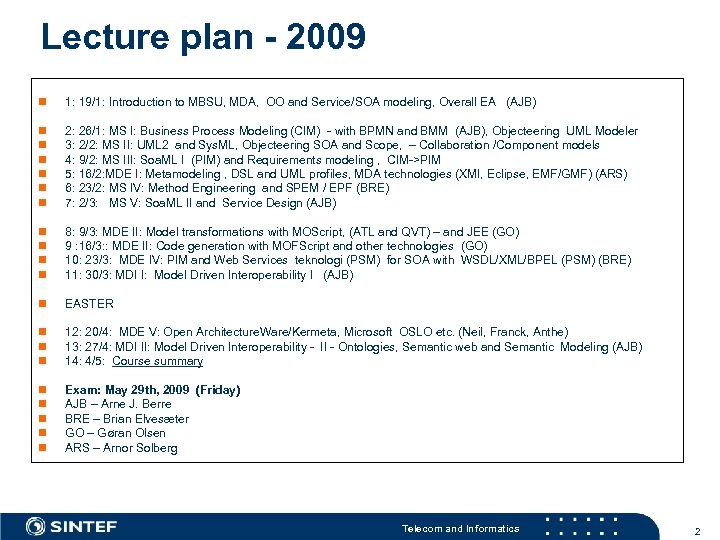
Lecture plan - 2009 n 1: 19/1: Introduction to MBSU, MDA, OO and Service/SOA modeling, Overall EA (AJB) n n n 2: 26/1: MS I: Business Process Modeling (CIM) - with BPMN and BMM (AJB), Objecteering UML Modeler 3: 2/2: MS II: UML 2 and Sys. ML, Objecteering SOA and Scope, – Collaboration /Component models 4: 9/2: MS III: Soa. ML I (PIM) and Requirements modeling , CIM->PIM 5: 16/2: MDE I: Metamodeling , DSL and UML profiles, MDA technologies (XMI, Eclipse, EMF/GMF) (ARS) 6: 23/2: MS IV: Method Engineering and SPEM / EPF (BRE) 7: 2/3: MS V: Soa. ML II and Service Design (AJB) n n 8: 9/3: MDE II: Model transformations with MOScript, (ATL and QVT) – and JEE (GO) 9 : 16/3: : MDE II: Code generation with MOFScript and other technologies (GO) 10: 23/3: MDE IV: PIM and Web Services teknologi (PSM) for SOA with WSDL/XML/BPEL (PSM) (BRE) 11: 30/3: MDI I: Model Driven Interoperability I (AJB) n EASTER n n n 12: 20/4: MDE V: Open Architecture. Ware/Kermeta, Microsoft OSLO etc. (Neil, Franck, Anthe) 13: 27/4: MDI II: Model Driven Interoperability - II - Ontologies, Semantic web and Semantic Modeling (AJB) 14: 4/5: Course summary n n n Exam: May 29 th, 2009 (Friday) AJB – Arne J. Berre BRE – Brian Elvesæter GO – Gøran Olsen ARS – Arnor Solberg Telecom and Informatics 2
Next Lecture – February 9 th, 2009 n MS III: (Modeling Services III) n Soa. ML I - Service oriented architecture Modeling Language – from a modeler’s perspective (PIM) n Requirements modeling n CIM->PIM mappings and transformations Telecom and Informatics 3
OOram – Role modeling n Methodology from UIO/SINTEF from 1996 n Book: Working with Objects, n Prof. Trygve Reenskaug & al Telecom and Informatics 4
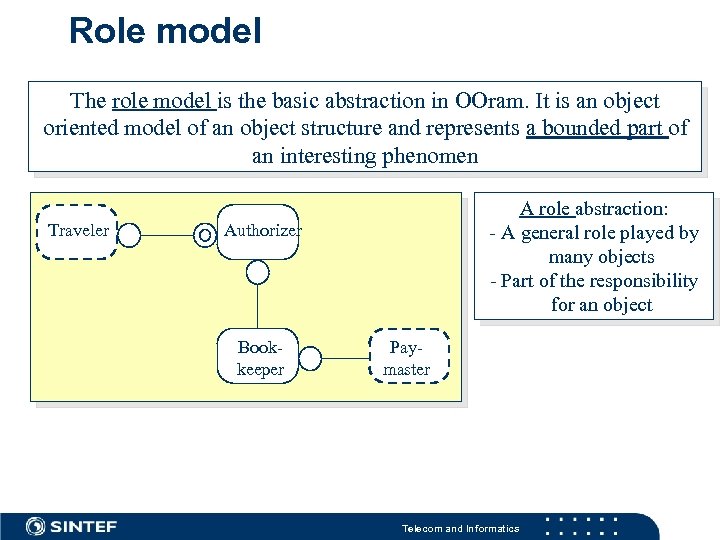
Role model The role model is the basic abstraction in OOram. It is an object oriented model of an object structure and represents a bounded part of an interesting phenomen Traveler A role abstraction: - A general role played by many objects - Part of the responsibility for an object Authorizer Bookkeeper Paymaster Telecom and Informatics
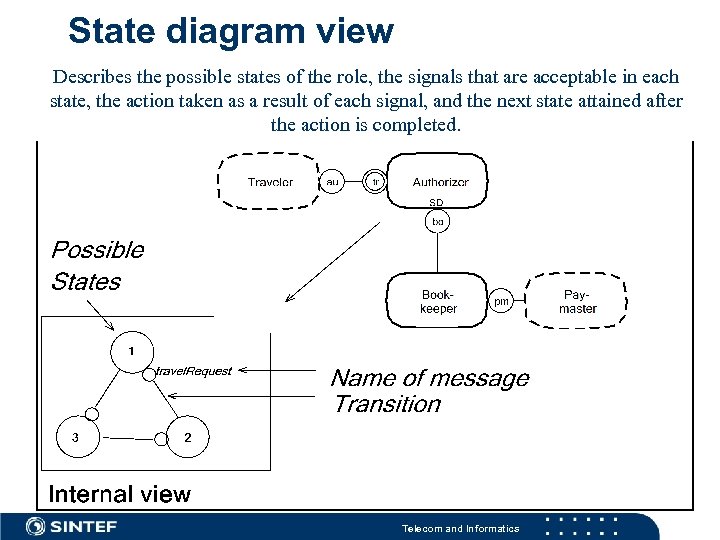
State diagram view Describes the possible states of the role, the signals that are acceptable in each state, the action taken as a result of each signal, and the next state attained after the action is completed. Telecom and Informatics
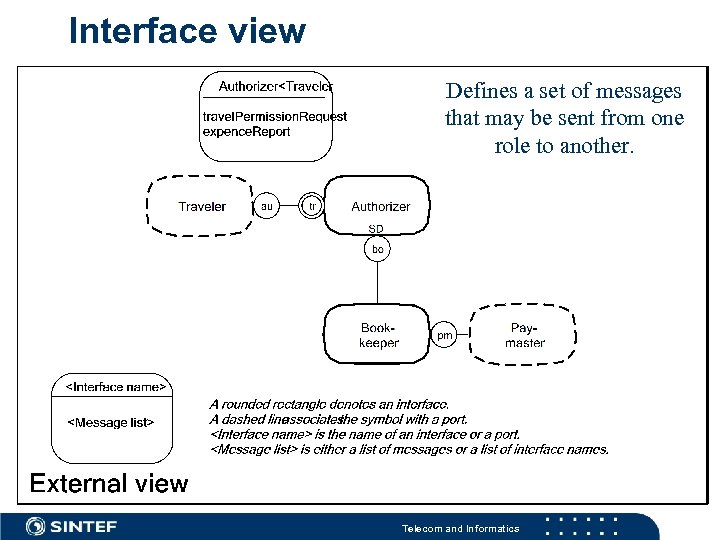
Interface view Defines a set of messages that may be sent from one role to another. Telecom and Informatics
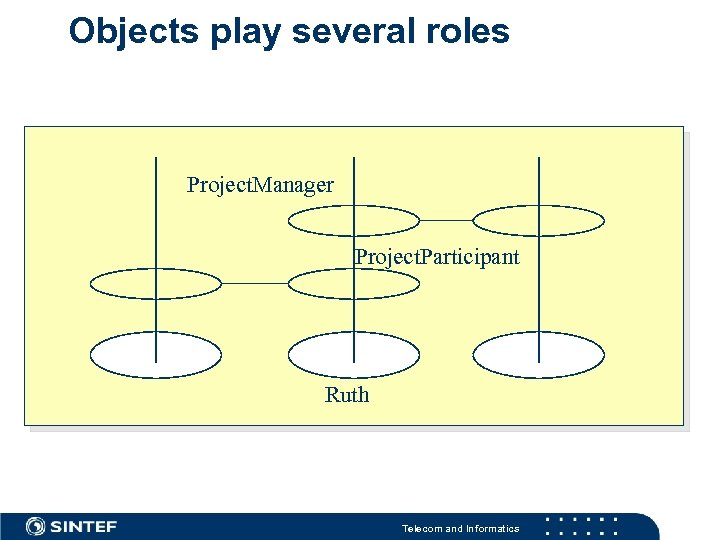
Objects play several roles Project. Manager Project. Participant Ruth Telecom and Informatics
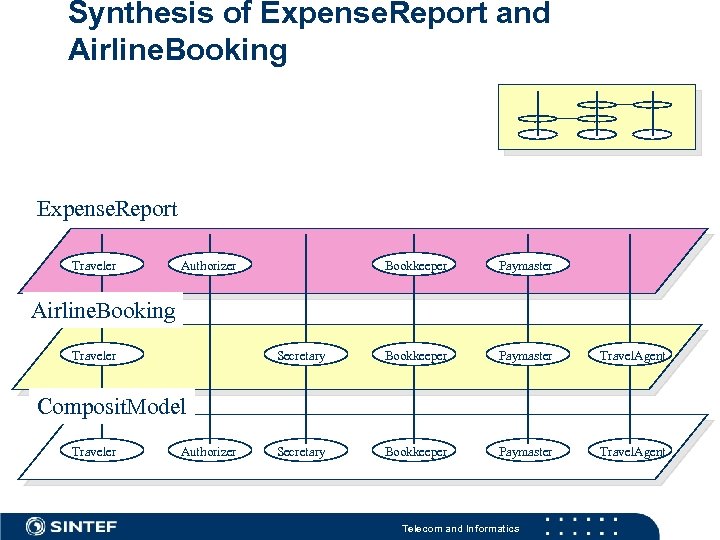
Synthesis of Expense. Report and Airline. Booking Expense. Report Traveler Authorizer Bookkeeper Paymaster Secretary Bookkeeper Paymaster Travel. Agent Airline. Booking Traveler Composit. Model Traveler Authorizer Telecom and Informatics
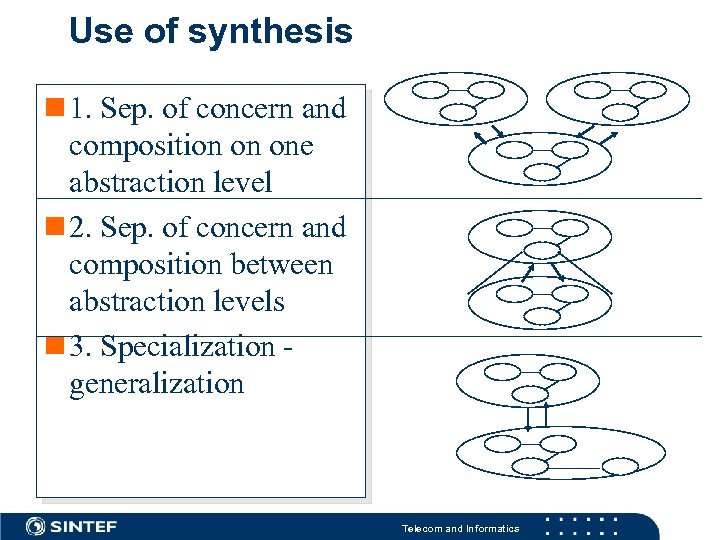
Use of synthesis n 1. Sep. of concern and composition on one abstraction level n 2. Sep. of concern and composition between abstraction levels n 3. Specialization generalization Telecom and Informatics
UML 2. 0 With contributions from Øystein Haugen, SINTEF & Birger Møller-Pedersen, Ui. O Telecom and Informatics 11
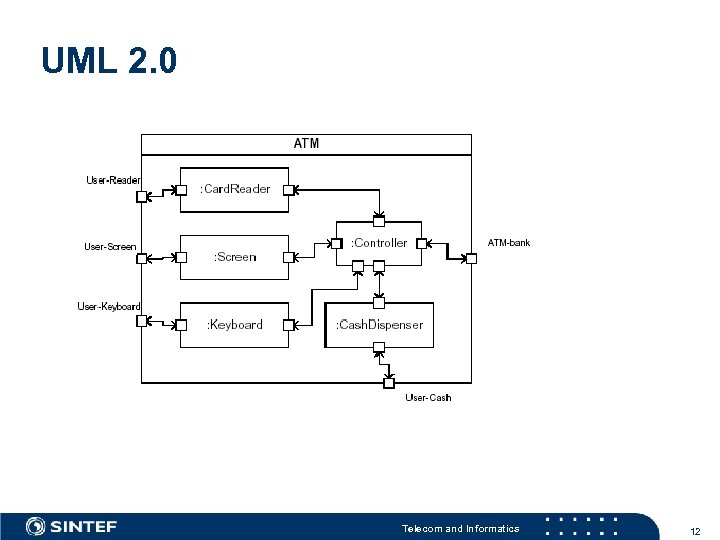
UML 2. 0 Telecom and Informatics 12
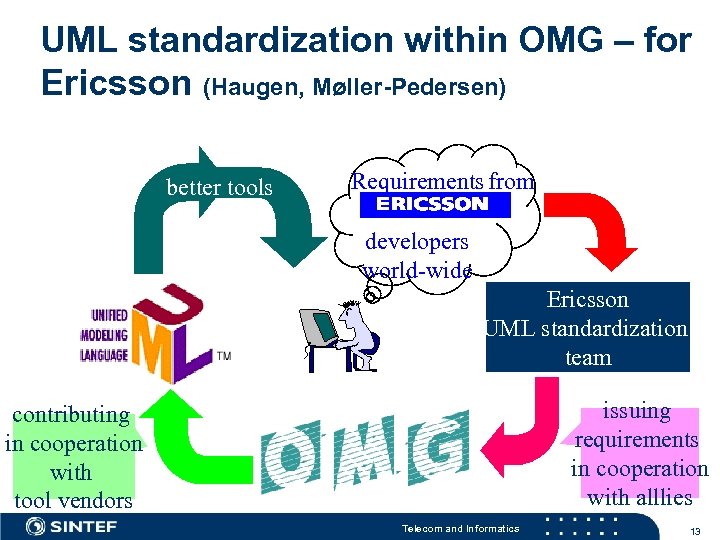
UML standardization within OMG – for Ericsson (Haugen, Møller-Pedersen) better tools improved Requirements from developers world-wide Ericsson UML standardization team issuing requirements in cooperation with alllies contributing in cooperation with tool vendors Telecom and Informatics 13
U 2 Partners 2 P n Submitters n Alcatel, CA, Ericsson, Fujitsu, HP, IBM, I-Logix, IONA, Kabira, Motorola, Oracle, Rational, SOFTEAM, Telelogic, Unisys n Supporters n Advanced Concepts Center LLC, Ceira Technologies, Commissariat à L'Energie Atomique, Compuware, Daimler. Chrysler, Embarcadero Technologies, Enea Data, France Telecom, Fraunhofer FOKUS, Gentleware, Intellicorp, Jaczone, Kennedy Carter, Klasse Objecten, KLOCwork, Lockheed Martin, Mercury Computer, MSC. Software, Northeastern University, Popkin Software, Proforma, Sims Associates, Syntropy Ltd. , Sun Microsystems, University of Kaiserslautern, University of Kent, VERIMAG, Web. Gain, and 88 solutions Telecom and Informatics 14
Why UML 2. 0? n for Ericsson, Motorola, Alcatel, Nokia (telecom, realtime) n SDL/MSC n UML/ROOM (as by Rose. RT) only one vendor n UML 2. 0 combining features from these n for others n Scalability, modeling of large, complex systems n Improvement of existing concepts: activities, components, n Completeness: action semantics, formal/precise definition n in general n Experiences with UML 1. x required an improvement n Model Based Development requires a good modeling language Telecom and Informatics 15
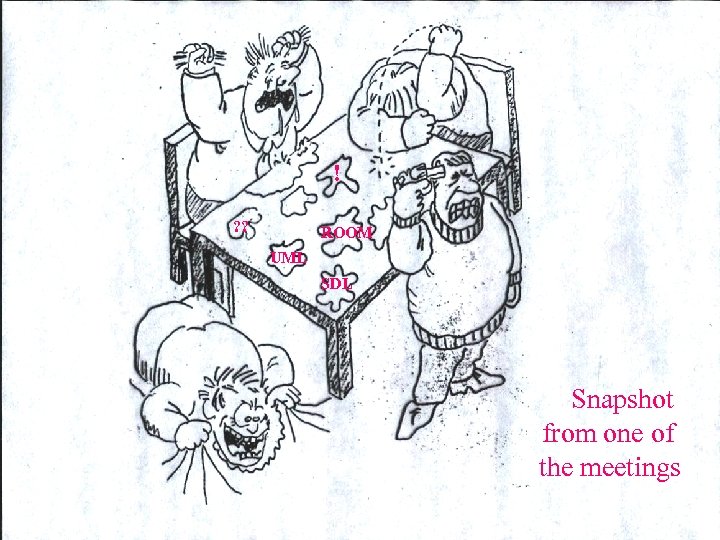
! ? ? ROOM UML SDL Snapshot from one of the meetings Telecom and Informatics 17
Example - ATM n Domain statement n An Automatic Teller Machine (ATM) is a system with mechanical as n n well as electronic parts. Its purpose is to provide a bank user with cash provided that the user can authenticate herself and she has adequate funds in her bank account. She authenticates herself by presenting a card to the ATM cardreader, and a personal identification number (PIN) through the ATM keyboard. The ATM is connected electronically and possibly through some kind of network to the bank such that the account status may be checked online. The ATM is refilled with cash notes regularly or when the number of specific notes is below some limit. The ATM may also provide foreign currency to the customer Telecom and Informatics 18
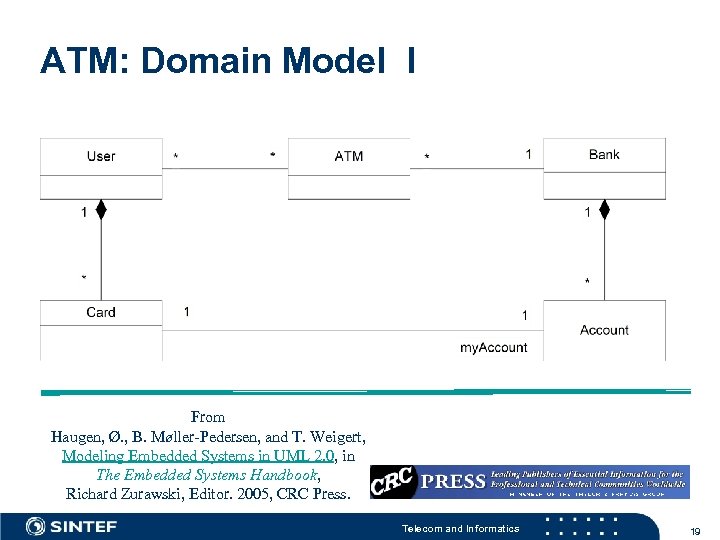
ATM: Domain Model I From Haugen, Ø. , B. Møller-Pedersen, and T. Weigert, Modeling Embedded Systems in UML 2. 0, in The Embedded Systems Handbook, Richard Zurawski, Editor. 2005, CRC Press. Telecom and Informatics 19
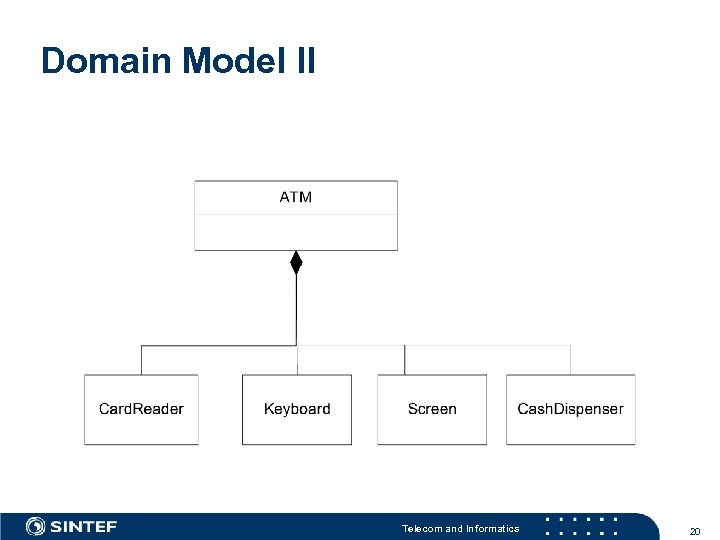
Domain Model II Telecom and Informatics 20
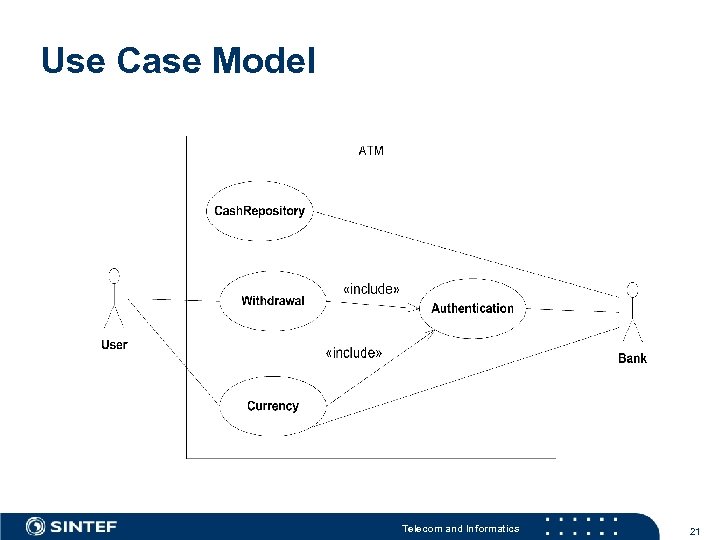
Use Case Model Telecom and Informatics 21
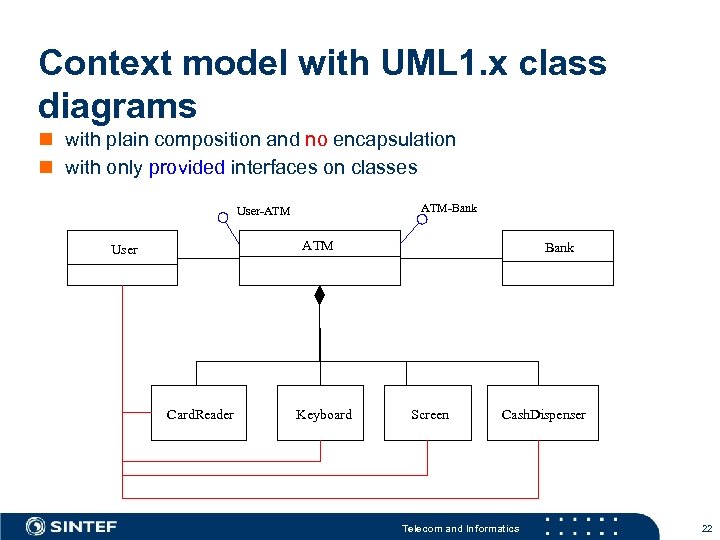
Context model with UML 1. x class diagrams n with plain composition and no encapsulation n with only provided interfaces on classes ATM-Bank User-ATM User Card. Reader Keyboard Bank Screen Cash. Dispenser Telecom and Informatics 22
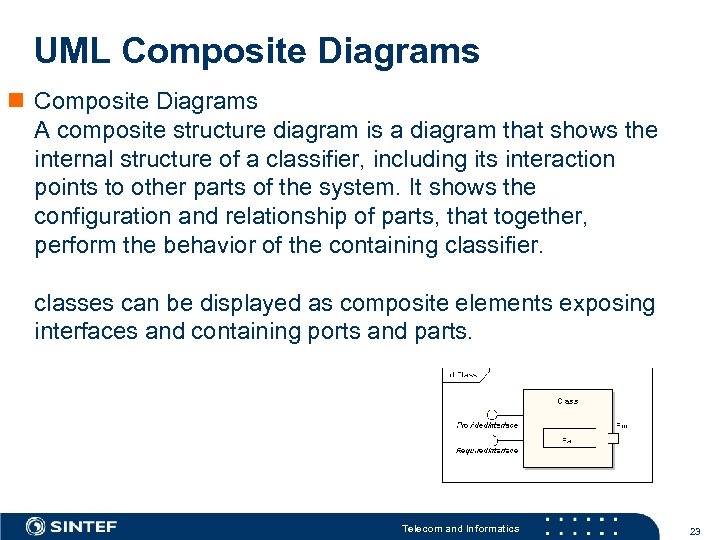
UML Composite Diagrams n Composite Diagrams A composite structure diagram is a diagram that shows the internal structure of a classifier, including its interaction points to other parts of the system. It shows the configuration and relationship of parts, that together, perform the behavior of the containing classifier. classes can be displayed as composite elements exposing interfaces and containing ports and parts. Telecom and Informatics 23
Part n A part is an element that represents a set of one or more instances which are owned by a containing classifier instance. So for example, if a diagram instance owned a set of graphical elements, then the graphical elements could be represented as parts; if it were useful to do so, to model some kind of relationship between them. Note that a part can be removed from its parent before the parent is deleted, so that the part isn't deleted at the same time. A part is shown as an unadorned rectangle contained within the body of a class or component element. Telecom and Informatics 24
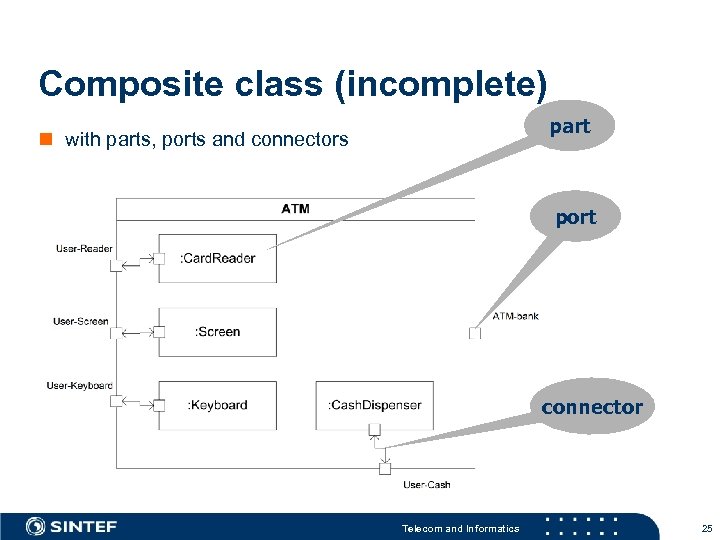
Composite class (incomplete) part n with parts, ports and connectors port connector Telecom and Informatics 25
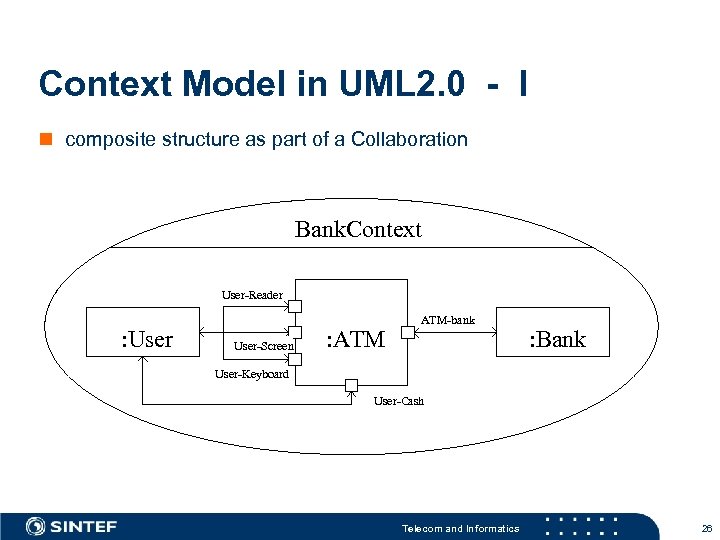
Context Model in UML 2. 0 - I n composite structure as part of a Collaboration Bank. Context User-Reader : User-Screen : ATM-bank : Bank User-Keyboard User-Cash Telecom and Informatics 26
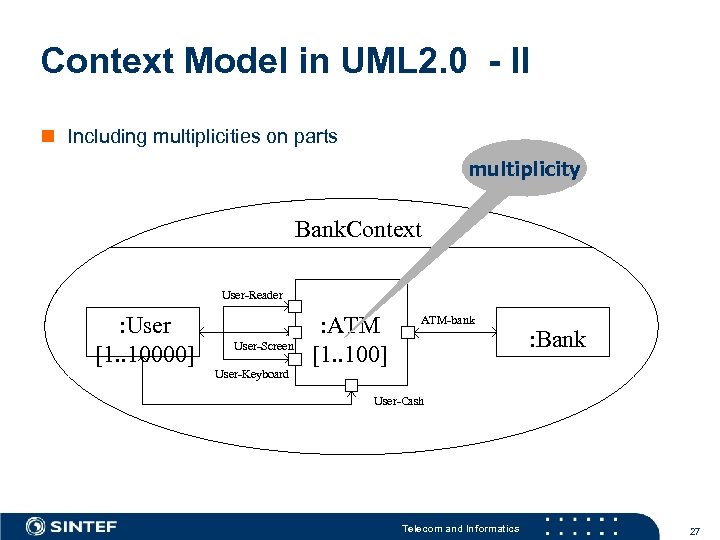
Context Model in UML 2. 0 - II n Including multiplicities on parts multiplicity Bank. Context User-Reader : User [1. . 10000] User-Screen : ATM [1. . 100] ATM-bank : Bank User-Keyboard User-Cash Telecom and Informatics 27
![… as part of Packages? No Bank. Context User-Reader : User [1. . 10000]](https://present5.com/presentation/4e5ce5ba8d153b892debc92c5878b6d2/image-27.jpg "… as part of Packages? No Bank. Context User-Reader : User [1. . 10000]")
… as part of Packages? No Bank. Context User-Reader : User [1. . 10000] User-Screen : ATM [1. . 100] ATM-bank : Bank User-Keyboard User-Cash Telecom and Informatics 28
Sequence Diagrams (Interactions) n Sequence Diagrams are n simple n powerful n readable n used to describe interaction sequences n History n Has been used for a number of years informally n Standardized 1992 in Z. 120 (Message Sequence Charts - MSC) n Last major revision of MSC is from 1999 (called MSC-2000) n Formal semantics of MSC-96 is given in Z. 120 Annex B n Included in UML from 1999, but in a rather simple variant Telecom and Informatics 29
Purpose n Emphasizes the interaction between objects indicating that the interplay is the most important aspect n Often only a small portion of the total variety of behavior is described improve the individual understanding of an interaction problem n Sequence Diagrams are used to. . . n document protocol situations, n illustrate behavior situations, n verify interaction properties relative to a specification, n describe test cases, n document simulation traces. Telecom and Informatics 30
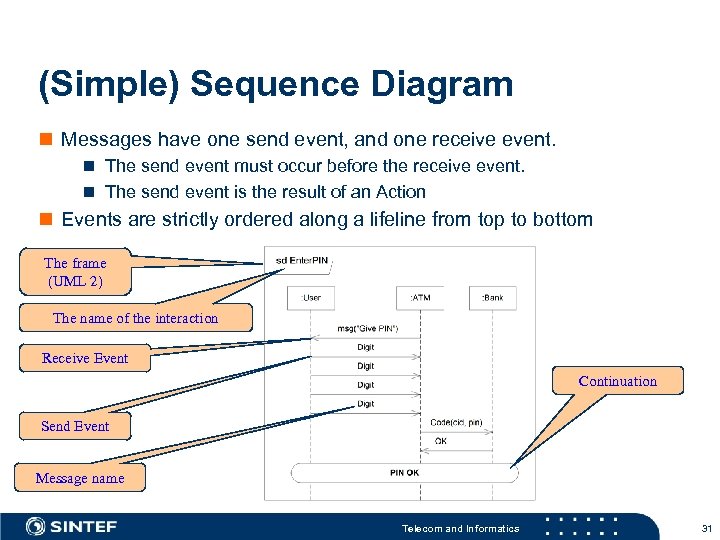
(Simple) Sequence Diagram n Messages have one send event, and one receive event. n The send event must occur before the receive event. n The send event is the result of an Action n Events are strictly ordered along a lifeline from top to bottom The frame (UML 2) The name of the interaction Receive Event Continuation Send Event Message name Telecom and Informatics 31
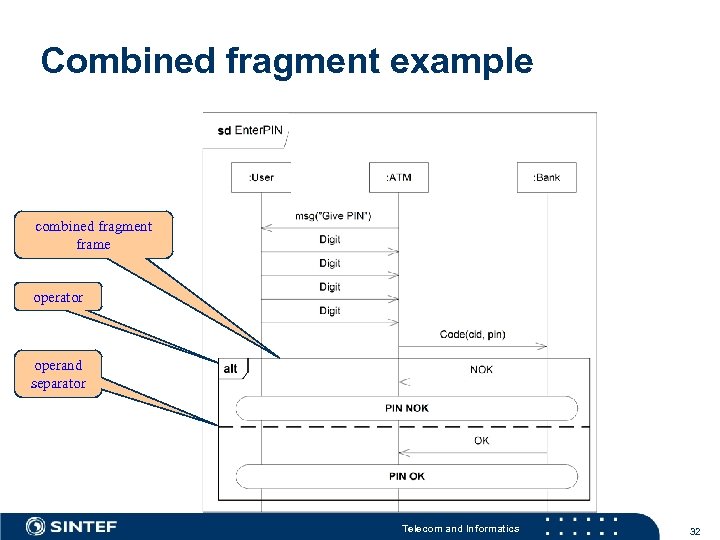
Combined fragment example combined fragment frame operator operand separator Telecom and Informatics 32
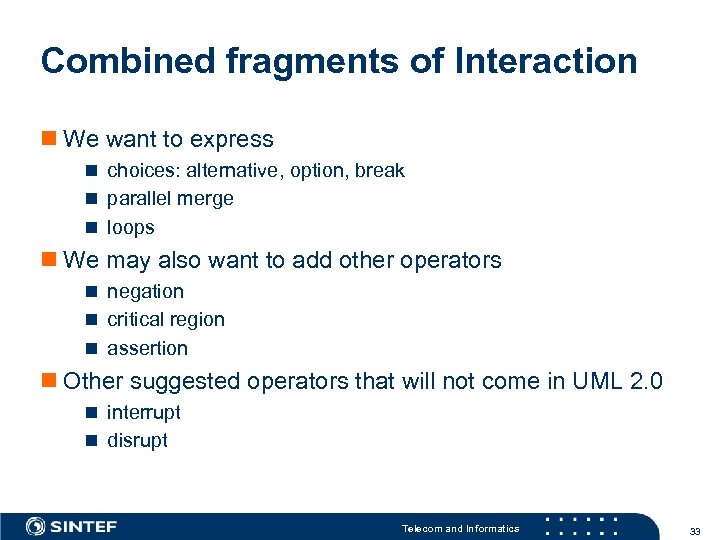
Combined fragments of Interaction n We want to express n choices: alternative, option, break n parallel merge n loops n We may also want to add other operators n negation n critical region n assertion n Other suggested operators that will not come in UML 2. 0 n interrupt n disrupt Telecom and Informatics 33
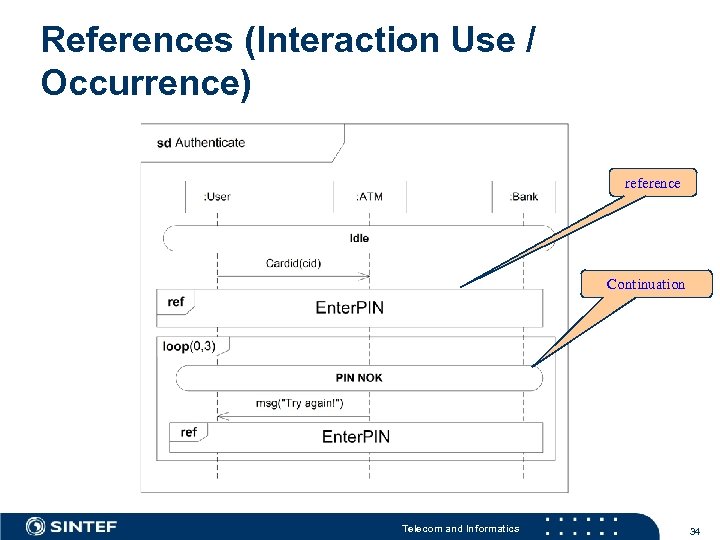
References (Interaction Use / Occurrence) reference Continuation Telecom and Informatics 34
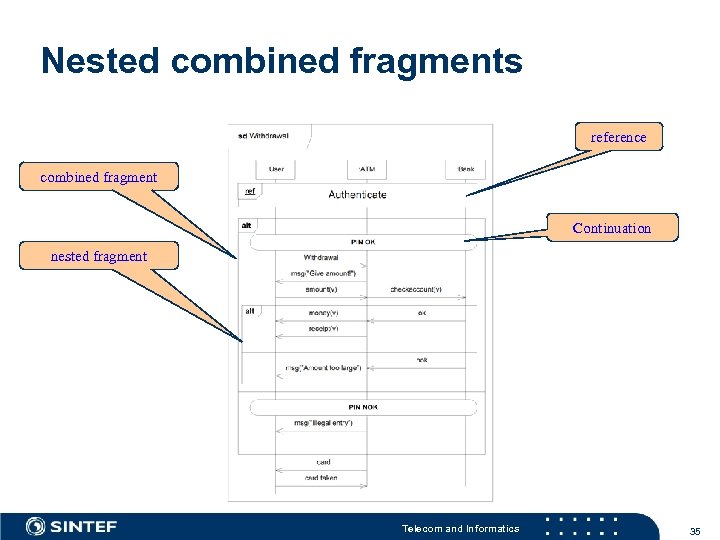
Nested combined fragments reference combined fragment Continuation nested fragment Telecom and Informatics 35
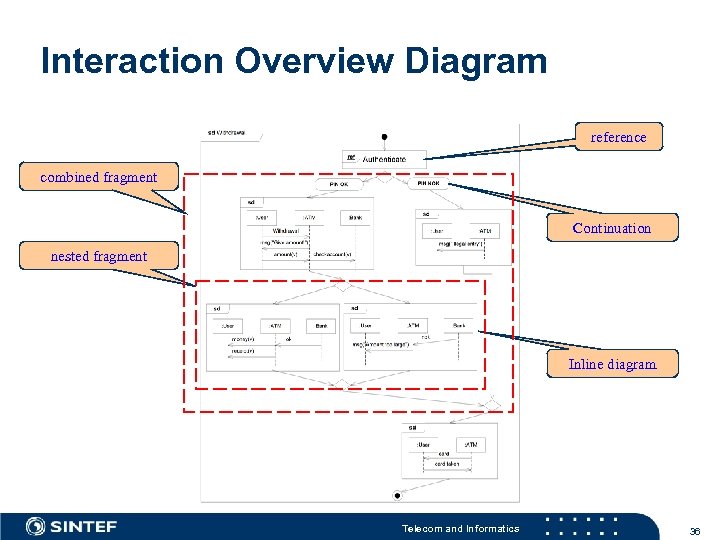
Interaction Overview Diagram reference combined fragment Continuation nested fragment Inline diagram Telecom and Informatics 36
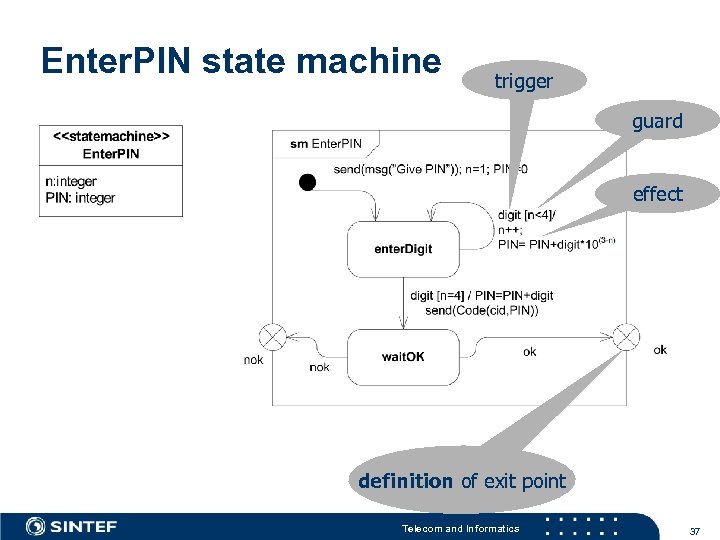
Enter. PIN state machine trigger guard effect definition of exit point Telecom and Informatics 37
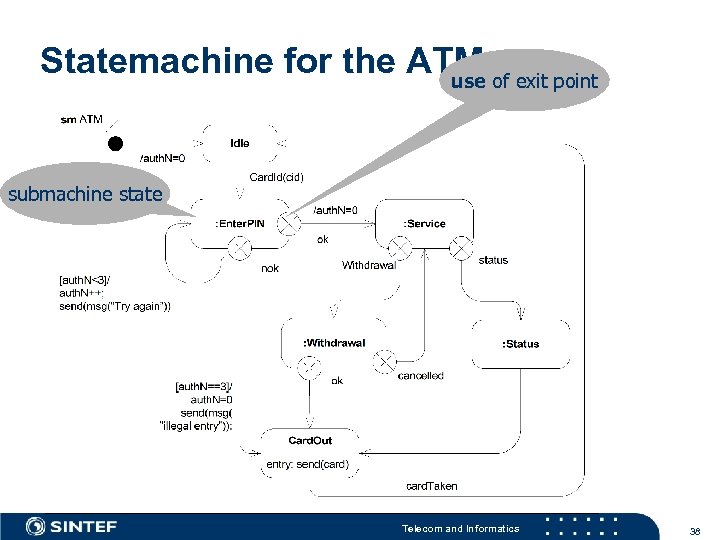
Statemachine for the ATM of exit point use submachine state Telecom and Informatics 38
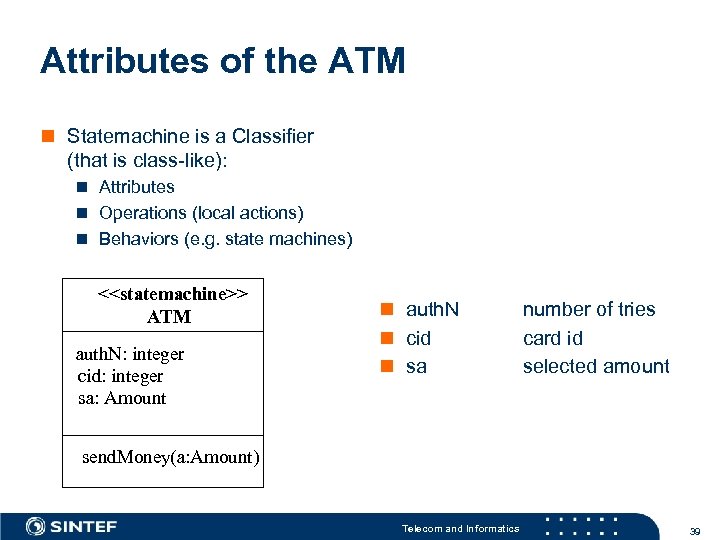
Attributes of the ATM n Statemachine is a Classifier (that is class-like): n Attributes n Operations (local actions) n Behaviors (e. g. state machines) <<statemachine>> ATM auth. N: integer cid: integer sa: Amount n auth. N n cid n sa number of tries card id selected amount send. Money(a: Amount) Telecom and Informatics 39
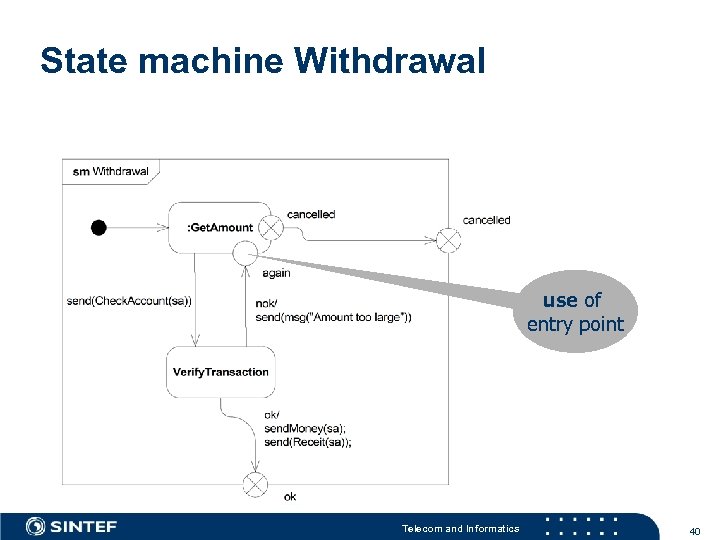
State machine Withdrawal use of entry point Telecom and Informatics 40
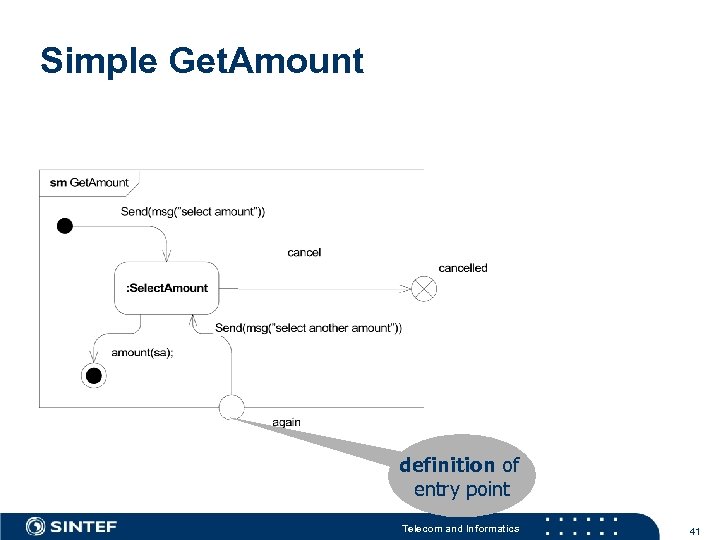
Simple Get. Amount definition of entry point Telecom and Informatics 41
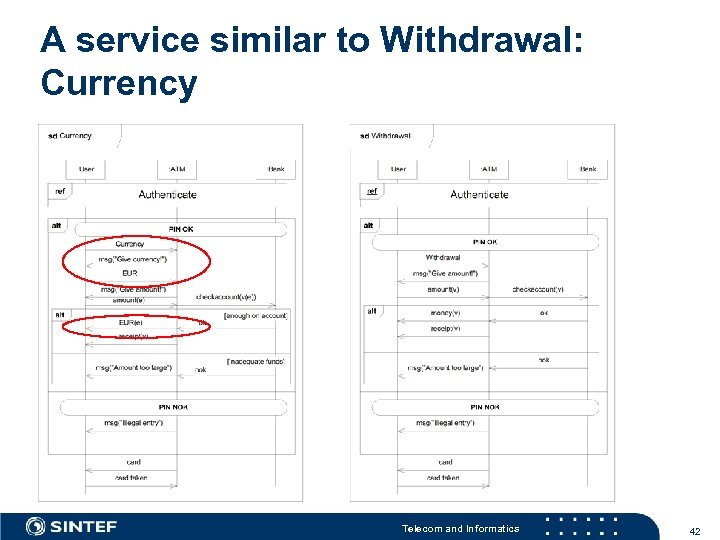
A service similar to Withdrawal: Currency Telecom and Informatics 42
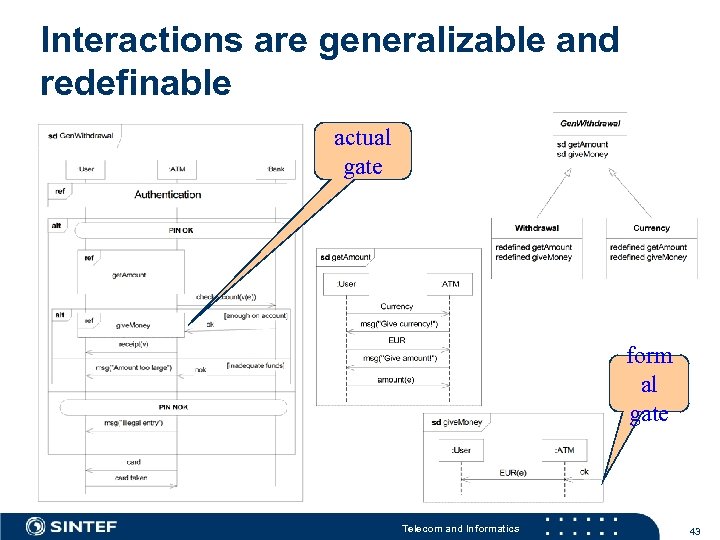
Interactions are generalizable and redefinable actual gate form al gate Telecom and Informatics 43
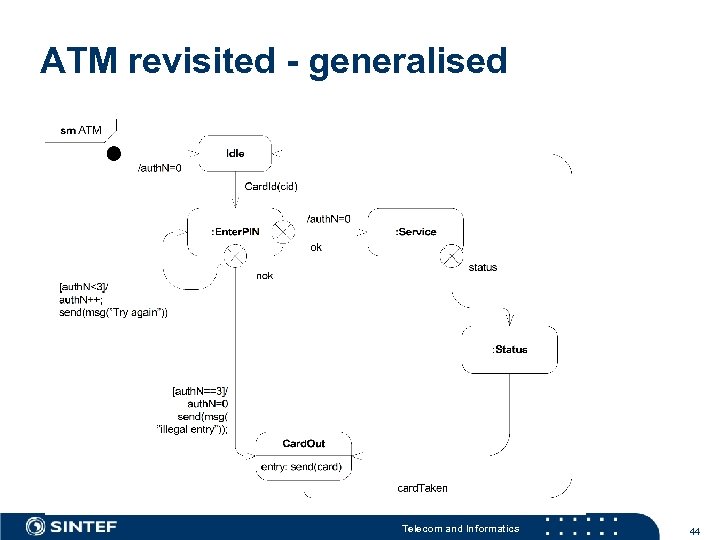
ATM revisited - generalised Telecom and Informatics 44
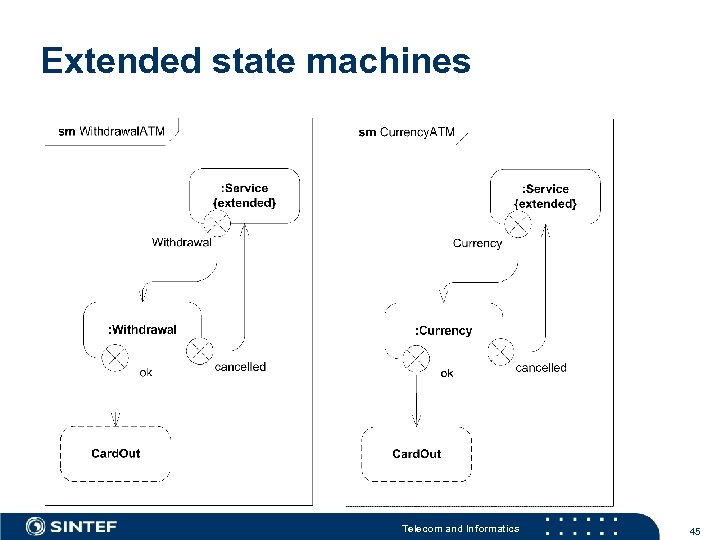
Extended state machines Telecom and Informatics 45
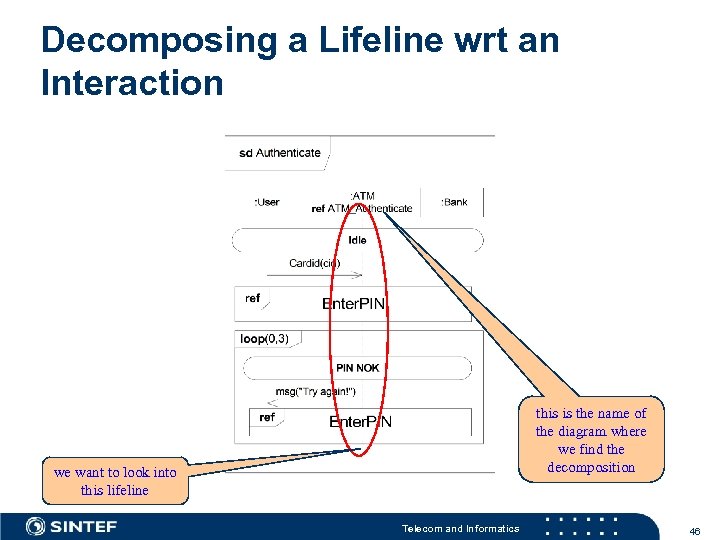
Decomposing a Lifeline wrt an Interaction this is the name of the diagram where we find the decomposition we want to look into this lifeline Telecom and Informatics 46
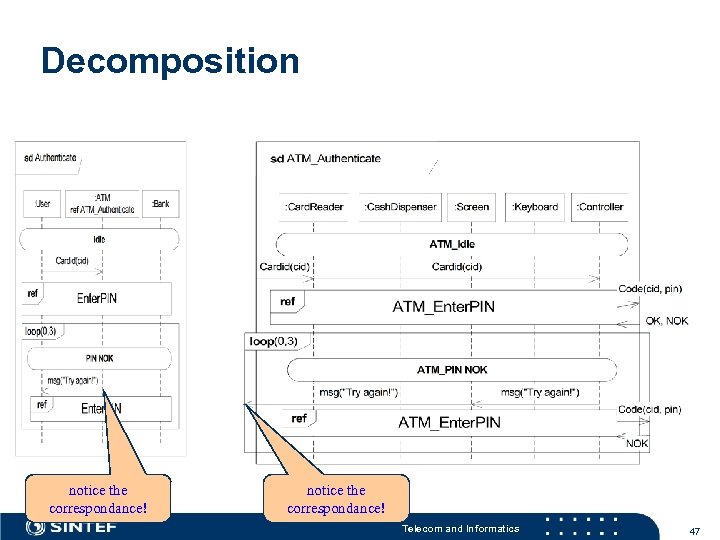
Decomposition notice the correspondance! Telecom and Informatics 47
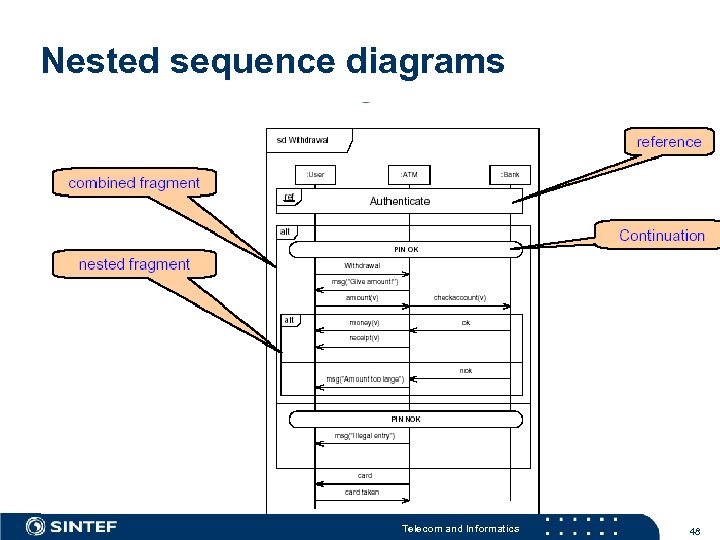
Nested sequence diagrams Telecom and Informatics 48
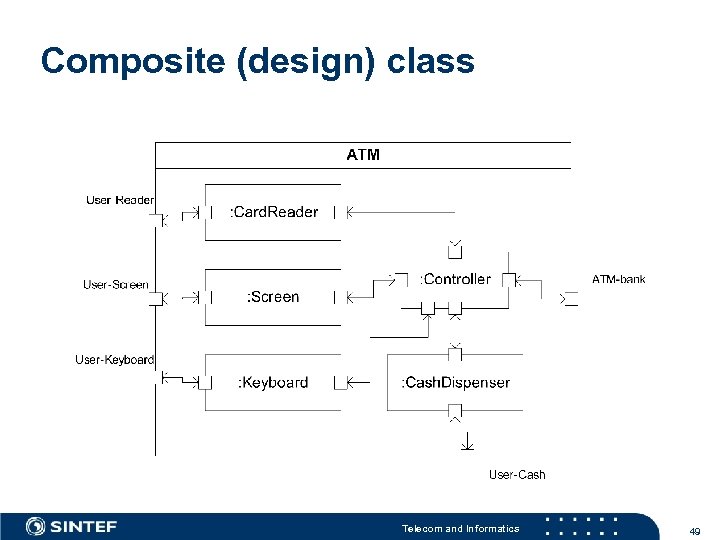
Composite (design) class Telecom and Informatics 49
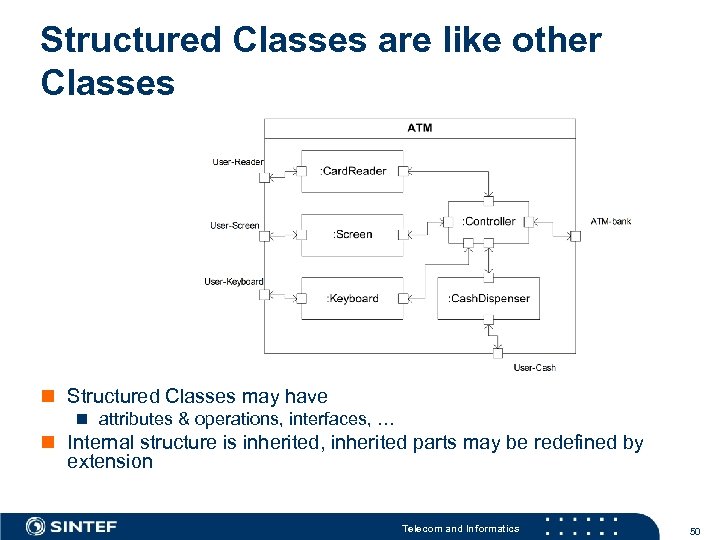
Structured Classes are like other Classes n Structured Classes may have n attributes & operations, interfaces, … n Internal structure is inherited, inherited parts may be redefined by extension Telecom and Informatics 50
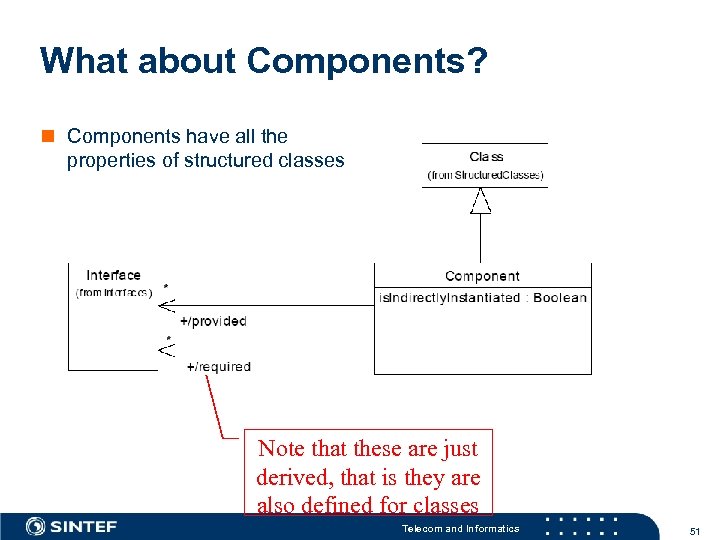
What about Components? n Components have all the properties of structured classes Note that these are just derived, that is they are also defined for classes Telecom and Informatics 51
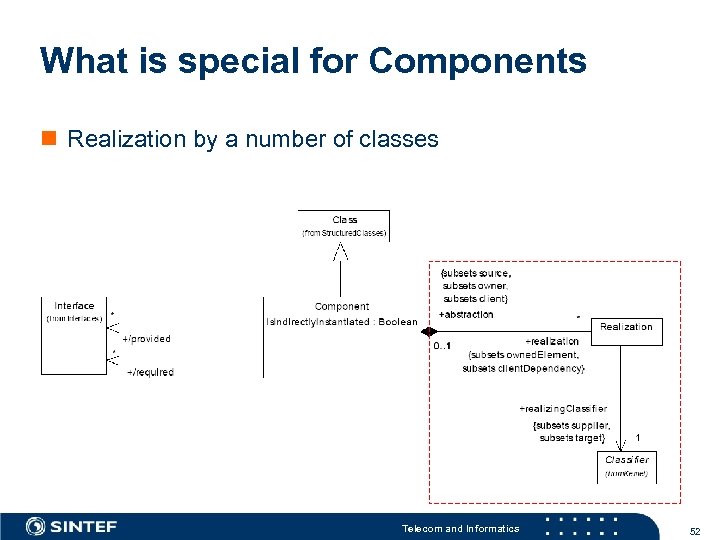
What is special for Components n Realization by a number of classes Telecom and Informatics 52
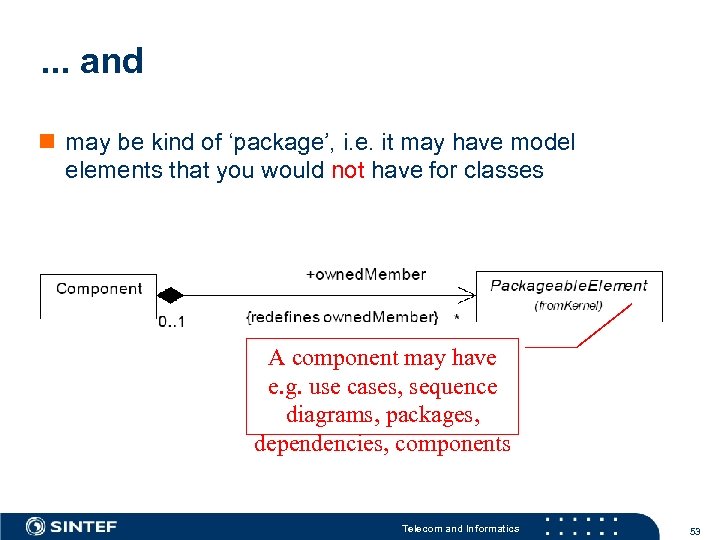
. . . and n may be kind of ‘package’, i. e. it may have model elements that you would not have for classes A component may have e. g. use cases, sequence diagrams, packages, dependencies, components Telecom and Informatics 53
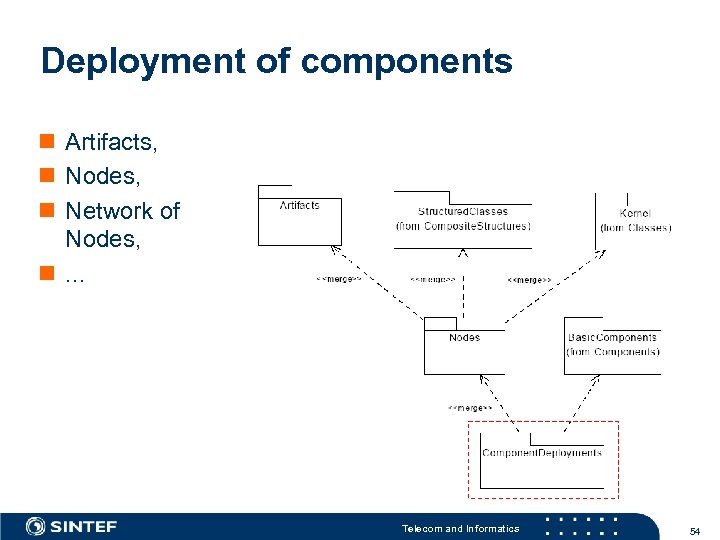
Deployment of components n Artifacts, n Nodes, n Network of Nodes, n. . . Telecom and Informatics 54
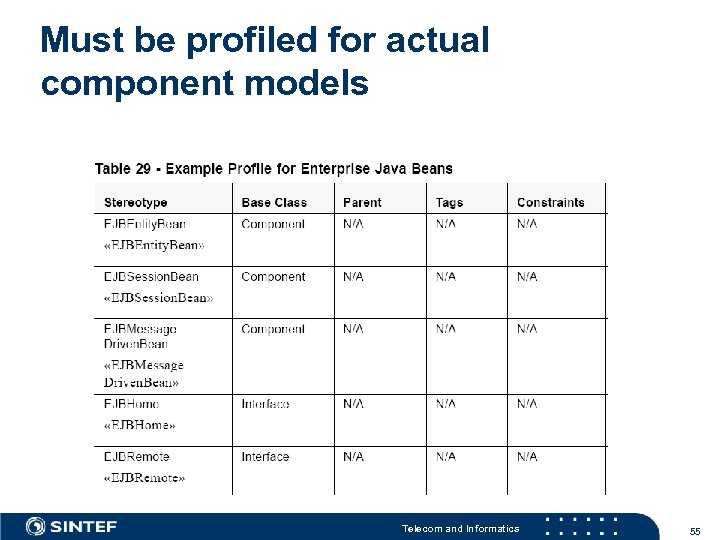
Must be profiled for actual component models Telecom and Informatics 55
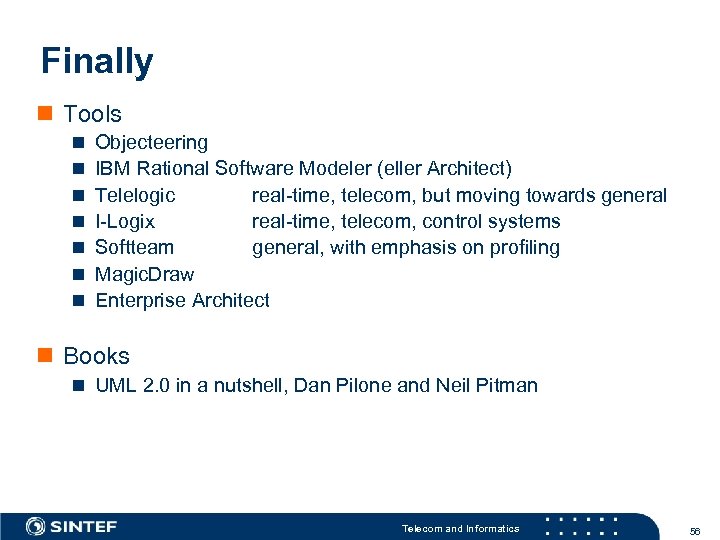
Finally n Tools n n n n Objecteering IBM Rational Software Modeler (eller Architect) Telelogic real-time, telecom, but moving towards general I-Logix real-time, telecom, control systems Softteam general, with emphasis on profiling Magic. Draw Enterprise Architect n Books n UML 2. 0 in a nutshell, Dan Pilone and Neil Pitman Telecom and Informatics 56
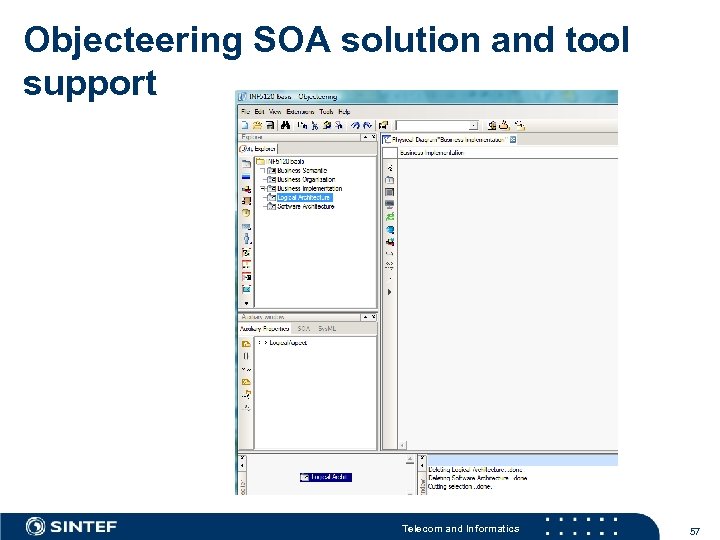
Objecteering SOA solution and tool support Telecom and Informatics 57
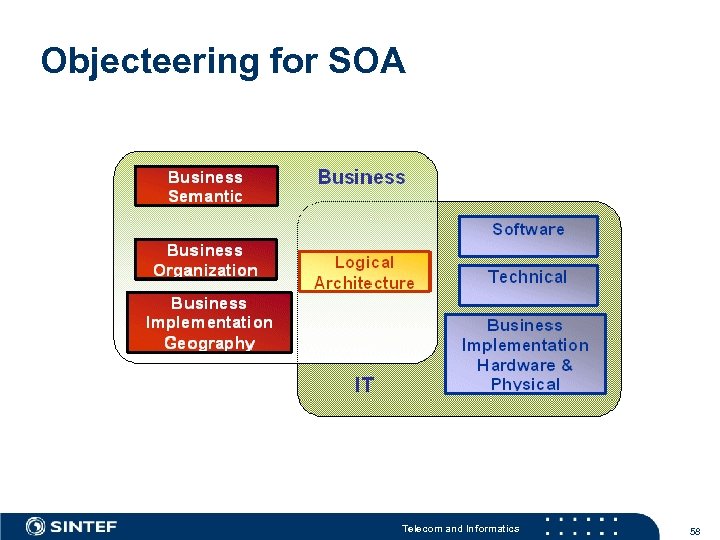
Objecteering for SOA Telecom and Informatics 58
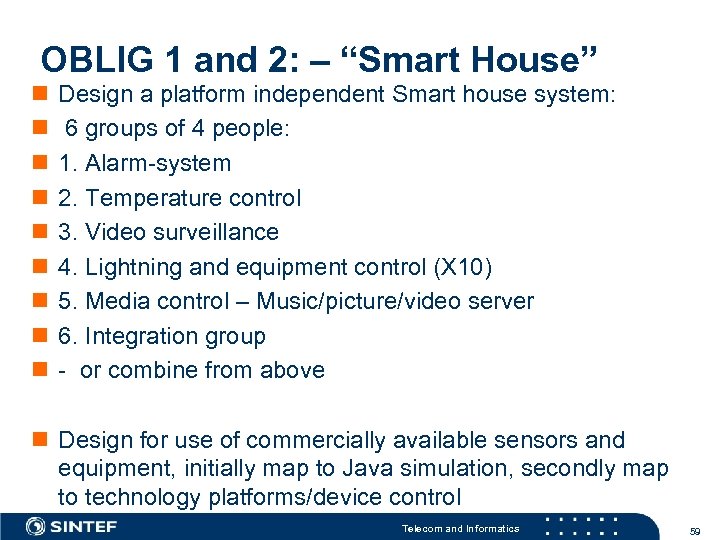
OBLIG 1 and 2: – “Smart House” n n n n n Design a platform independent Smart house system: 6 groups of 4 people: 1. Alarm-system 2. Temperature control 3. Video surveillance 4. Lightning and equipment control (X 10) 5. Media control – Music/picture/video server 6. Integration group - or combine from above n Design for use of commercially available sensors and equipment, initially map to Java simulation, secondly map to technology platforms/device control Telecom and Informatics 59
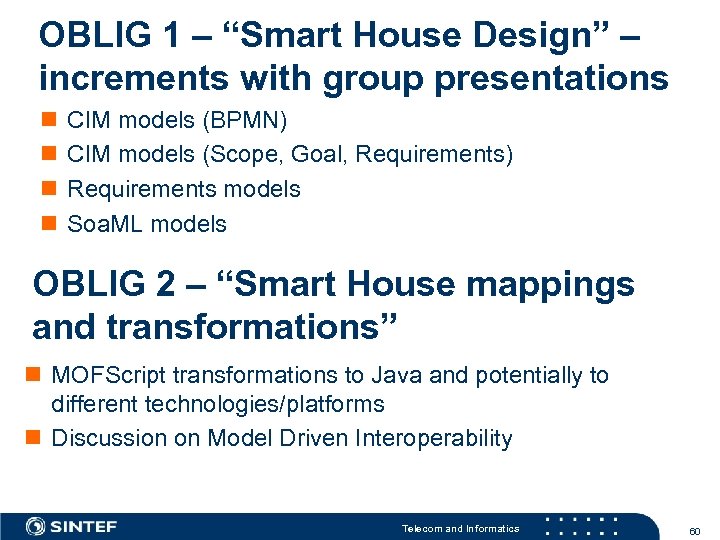
OBLIG 1 – “Smart House Design” – increments with group presentations n n CIM models (BPMN) CIM models (Scope, Goal, Requirements) Requirements models Soa. ML models OBLIG 2 – “Smart House mappings and transformations” n MOFScript transformations to Java and potentially to different technologies/platforms n Discussion on Model Driven Interoperability Telecom and Informatics 60
Скачать презентацию INF 5120 UML 2 and Sys ML Objecteering
4e5ce5ba8d153b892debc92c5878b6d2.ppt