 Скачать презентацию INF 5120 Modellbasert Systemutvikling Modelbased System development Lecture
c69883033864dbb6442536643605971d.ppt
- Количество слайдов: 72



INF 5120 ”Modellbasert Systemutvikling” ”Modelbased System development” Lecture 1: 25. 01. 2010 Arne-Jørgen Berre Telecom and Informatics 1
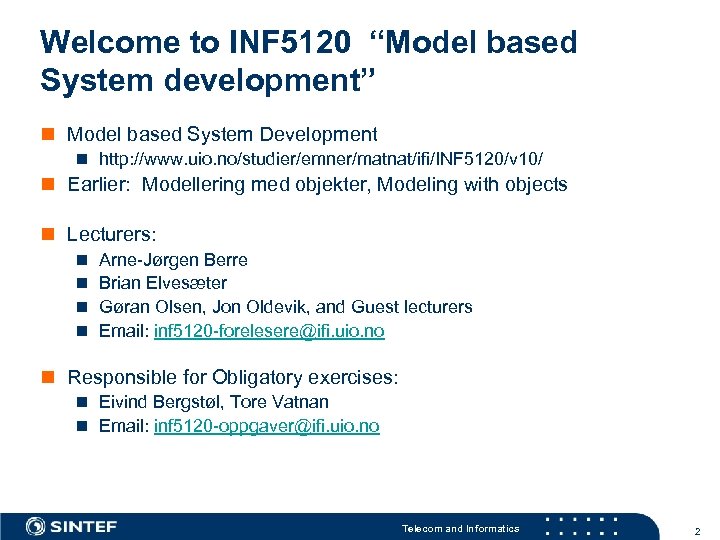
Welcome to INF 5120 “Model based System development” n Model based System Development n http: //www. uio. no/studier/emner/matnat/ifi/INF 5120/v 10/ n Earlier: Modellering med objekter, Modeling with objects n Lecturers: n n Arne-Jørgen Berre Brian Elvesæter Gøran Olsen, Jon Oldevik, and Guest lecturers Email: inf 5120 -forelesere@ifi. uio. no n Responsible for Obligatory exercises: n Eivind Bergstøl, Tore Vatnan n Email: inf 5120 -oppgaver@ifi. uio. no Telecom and Informatics 2
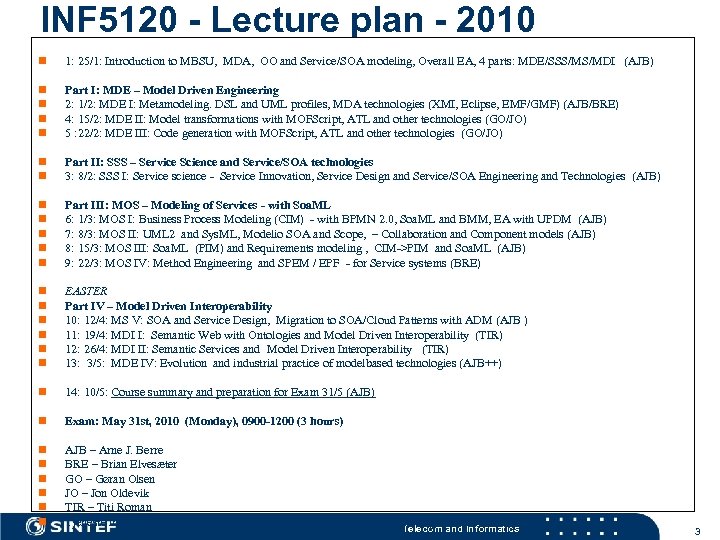
INF 5120 - Lecture plan - 2010 n 1: 25/1: Introduction to MBSU, MDA, OO and Service/SOA modeling, Overall EA, 4 parts: MDE/SSS/MS/MDI (AJB) n n Part I: MDE – Model Driven Engineering 2: 1/2: MDE I: Metamodeling. DSL and UML profiles, MDA technologies (XMI, Eclipse, EMF/GMF) (AJB/BRE) 4: 15/2: MDE II: Model transformations with MOFScript, ATL and other technologies (GO/JO) 5 : 22/2: MDE III: Code generation with MOFScript, ATL and other technologies (GO/JO) n n Part II: SSS – Service Science and Service/SOA technologies 3: 8/2: SSS I: Service science - Service Innovation, Service Design and Service/SOA Engineering and Technologies (AJB) n n n Part III: MOS – Modeling of Services - with Soa. ML 6: 1/3: MOS I: Business Process Modeling (CIM) - with BPMN 2. 0, Soa. ML and BMM, EA with UPDM (AJB) 7: 8/3: MOS II: UML 2 and Sys. ML, Modelio SOA and Scope, – Collaboration and Component models (AJB) 8: 15/3: MOS III: Soa. ML (PIM) and Requirements modeling , CIM->PIM and Soa. ML (AJB) 9: 22/3: MOS IV: Method Engineering and SPEM / EPF - for Service systems (BRE) n n n EASTER Part IV – Model Driven Interoperability 10: 12/4: MS V: SOA and Service Design, Migration to SOA/Cloud Patterns with ADM (AJB ) 11: 19/4: MDI I: Semantic Web with Ontologies and Model Driven Interoperability (TIR) 12: 26/4: MDI II: Semantic Services and Model Driven Interoperability (TIR) 13: 3/5: MDE IV: Evolution and industrial practice of modelbased technologies (AJB++) n 14: 10/5: Course summary and preparation for Exam 31/5 (AJB) n Exam: May 31 st, 2010 (Monday), 0900 -1200 (3 hours) n n n AJB – Arne J. Berre BRE – Brian Elvesæter GO – Gøran Olsen JO – Jon Oldevik TIR – Titi Roman Tjeneste innovasjon: BI/NHH, Tjeneste Design: OAH, Tjeneste Engineering: (INF 5210 -MS) Telecom and Informatics 3
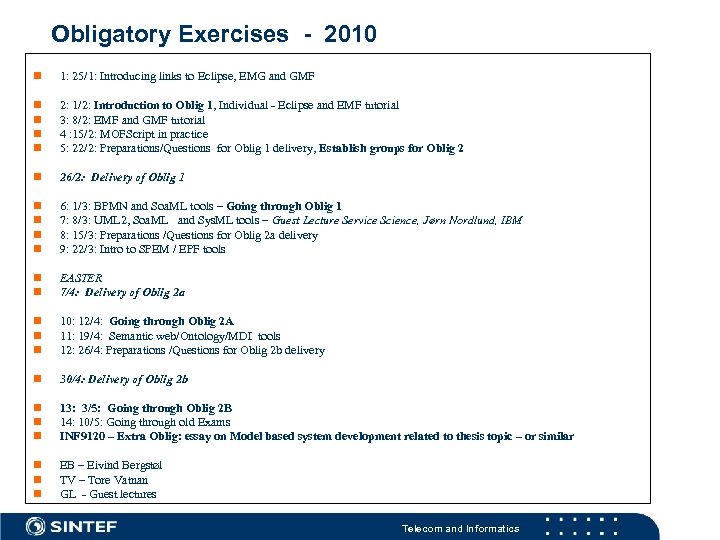
Obligatory Exercises - 2010 n 1: 25/1: Introducing links to Eclipse, EMG and GMF n n 2: 1/2: Introduction to Oblig 1, Individual - Eclipse and EMF tutorial 3: 8/2: EMF and GMF tutorial 4 : 15/2: MOFScript in practice 5: 22/2: Preparations/Questions for Oblig 1 delivery, Establish groups for Oblig 2 n 26/2: Delivery of Oblig 1 n n 6: 1/3: BPMN and Soa. ML tools – Going through Oblig 1 7: 8/3: UML 2, Soa. ML and Sys. ML tools – Guest Lecture Service Science, Jørn Nordlund, IBM 8: 15/3: Preparations /Questions for Oblig 2 a delivery 9: 22/3: Intro to SPEM / EPF tools n n EASTER 7/4: Delivery of Oblig 2 a n n n 10: 12/4: Going through Oblig 2 A 11: 19/4: Semantic web/Ontology/MDI tools 12: 26/4: Preparations /Questions for Oblig 2 b delivery n 30/4: Delivery of Oblig 2 b n n n 13: 3/5: Going through Oblig 2 B 14: 10/5: Going through old Exams INF 9120 – Extra Oblig: essay on Model based system development related to thesis topic – or similar n n n EB – Eivind Bergstøl TV – Tore Vatnan GL - Guest lectures Telecom and Informatics
4 parts of the course n MDE I-V (Model Driven Engineering) n SSS (Service Science and Service technologies) n MOS I-V (Model Driven Service Systems) n MDI I-II (Model Driven Interoperability) n Each part will have a separate handbook Telecom and Informatics 5
Objectives n n n Model based System Development - through ”modeling with objects and services” 2 roles: 1) Tool developer (Software Factory) 2) Application developer, (user of Software Factory). n Object-oriented -> Componentbased -> Service oriented n Reuse n Learn techniques n n n MDA – Model driven architecture Meta Modeling and modelltransformation * SOA – Service oriented architecture Unified Modeling Language (UML 2. 0) – for architecture MDI – Model Driven Interoperability Telecom and Informatics 6
Change in sequence from 2009 n We will change back to the sequence from 2008 with a bottom up approach (rather than top down as we had in 2009) – with first learning the principles and technologies for MDE in February. We will also give a short introduction to the focus area of Service Science and Service Engineering, and related SOA technologies. n In March we will focus on how to practice a model driven approach to Services (MOS), and in April we will introduce the topic of Semantic Web/services and Model Driven Interoperability (MDI) – before a final conclusion of the course Telecom and Informatics 7
New since last year n Initial focus on Eclipse with EMF and GMF and transformation tools n Use of Modelio commercial modeling tool – for UML 2 and BPMN 2. 0 (This is a new version of Objecteering) n New focus on “Service Science” – with Service Innovation (with BI/NHH), Service Design (OAH) and Service Engineering (UIO) n New standards: Focus on OMG MDA standards, and on Soa. ML with links to BPMN 2. 0, Sys. ML and UPDM. Telecom and Informatics 8
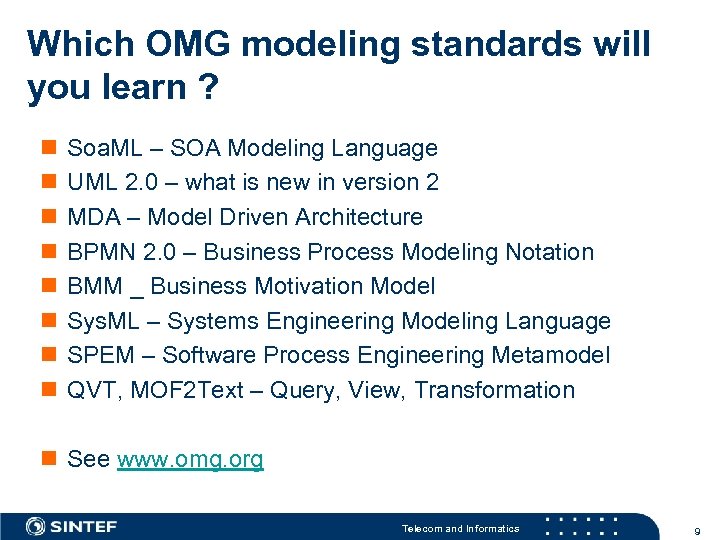
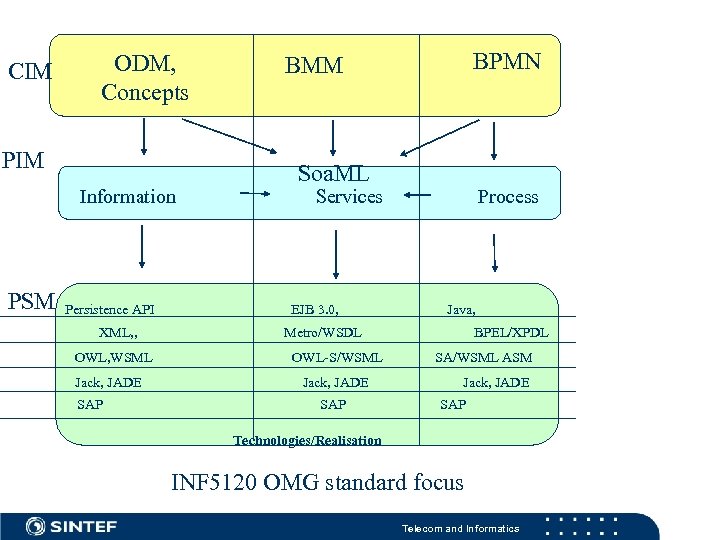
Which OMG modeling standards will you learn ? n n n n Soa. ML – SOA Modeling Language UML 2. 0 – what is new in version 2 MDA – Model Driven Architecture BPMN 2. 0 – Business Process Modeling Notation BMM _ Business Motivation Model Sys. ML – Systems Engineering Modeling Language SPEM – Software Process Engineering Metamodel QVT, MOF 2 Text – Query, View, Transformation n See www. omg. org Telecom and Informatics 9
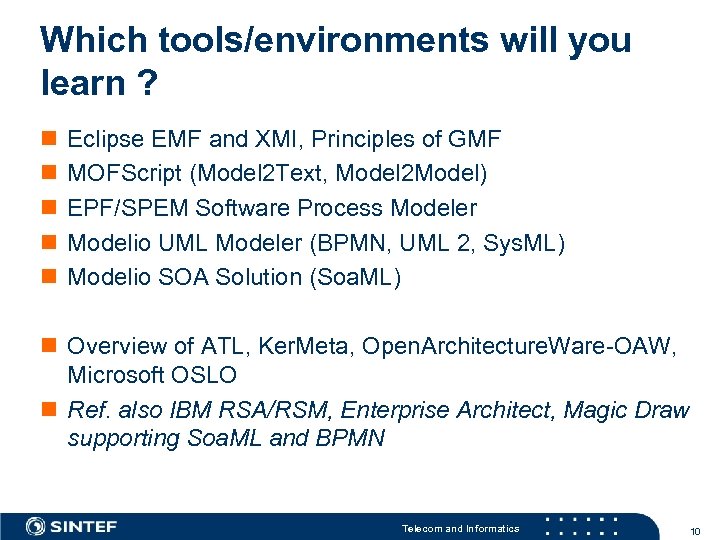
Which tools/environments will you learn ? n n n Eclipse EMF and XMI, Principles of GMF MOFScript (Model 2 Text, Model 2 Model) EPF/SPEM Software Process Modeler Modelio UML Modeler (BPMN, UML 2, Sys. ML) Modelio SOA Solution (Soa. ML) n Overview of ATL, Ker. Meta, Open. Architecture. Ware-OAW, Microsoft OSLO n Ref. also IBM RSA/RSM, Enterprise Architect, Magic Draw supporting Soa. ML and BPMN Telecom and Informatics 10
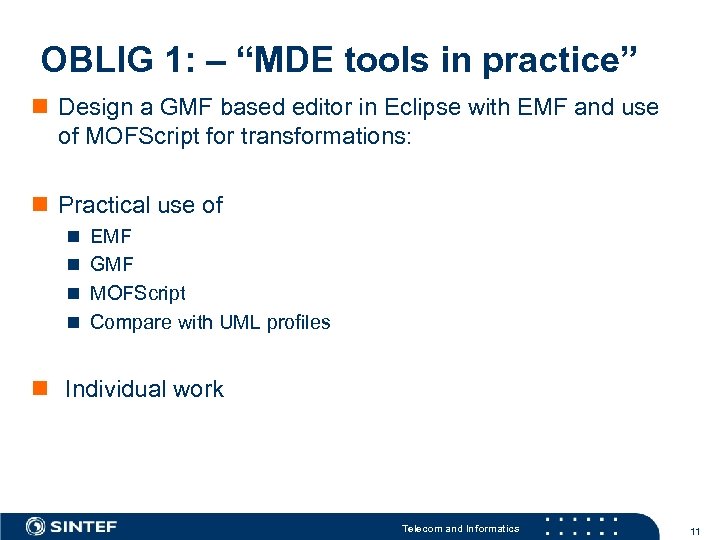
OBLIG 1: – “MDE tools in practice” n Design a GMF based editor in Eclipse with EMF and use of MOFScript for transformations: n Practical use of n EMF n GMF n MOFScript n Compare with UML profiles n Individual work Telecom and Informatics 11
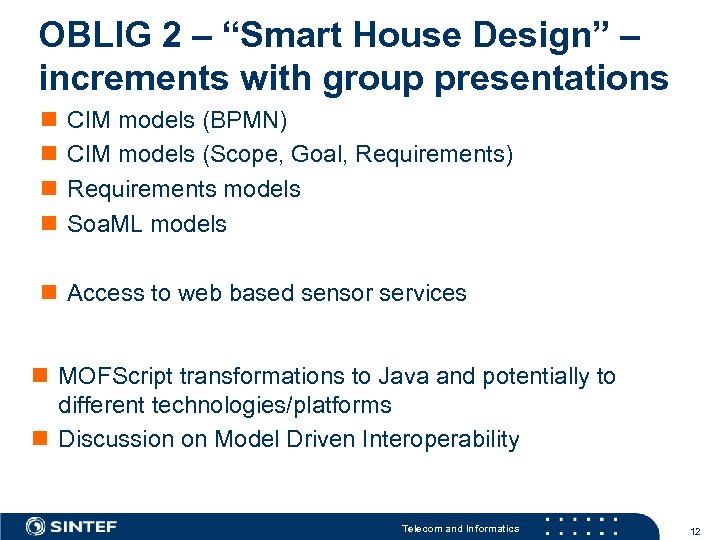
OBLIG 2 – “Smart House Design” – increments with group presentations n n CIM models (BPMN) CIM models (Scope, Goal, Requirements) Requirements models Soa. ML models n Access to web based sensor services n MOFScript transformations to Java and potentially to different technologies/platforms n Discussion on Model Driven Interoperability Telecom and Informatics 12
Requirements for the course n Student at UIO n Only assumption is basic knowledge of UML and Java (but not UML 2. 0) Telecom and Informatics 13
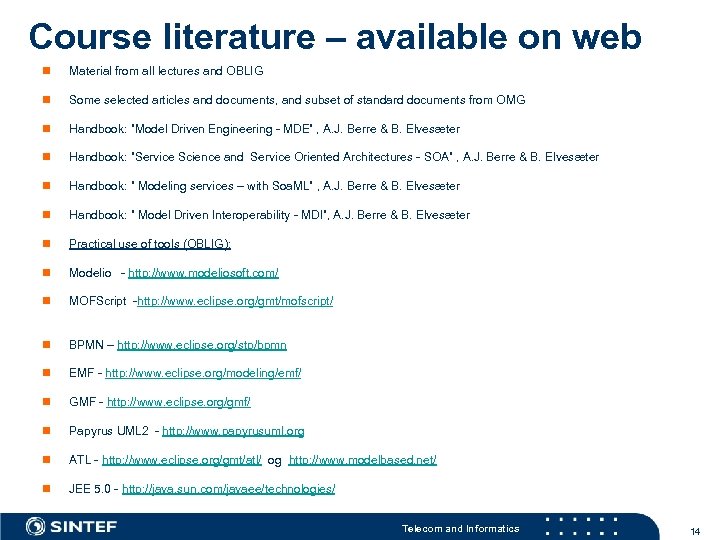
Course literature – available on web n Material from all lectures and OBLIG n Some selected articles and documents, and subset of standard documents from OMG n Handbook: ”Model Driven Engineering - MDE” , A. J. Berre & B. Elvesæter n Handbook: ”Service Science and Service Oriented Architectures - SOA” , A. J. Berre & B. Elvesæter n Handbook: ” Modeling services – with Soa. ML” , A. J. Berre & B. Elvesæter n Handbook: ” Model Driven Interoperability - MDI”, A. J. Berre & B. Elvesæter n Practical use of tools (OBLIG): n Modelio - http: //www. modeliosoft. com/ n MOFScript -http: //www. eclipse. org/gmt/mofscript/ n BPMN – http: //www. eclipse. org/stp/bpmn n EMF - http: //www. eclipse. org/modeling/emf/ n GMF - http: //www. eclipse. org/gmf/ n Papyrus UML 2 - http: //www. papyrusuml. org n ATL - http: //www. eclipse. org/gmt/atl/ og http: //www. modelbased. net/ n JEE 5. 0 - http: //java. sun. com/javaee/technologies/ Telecom and Informatics 14
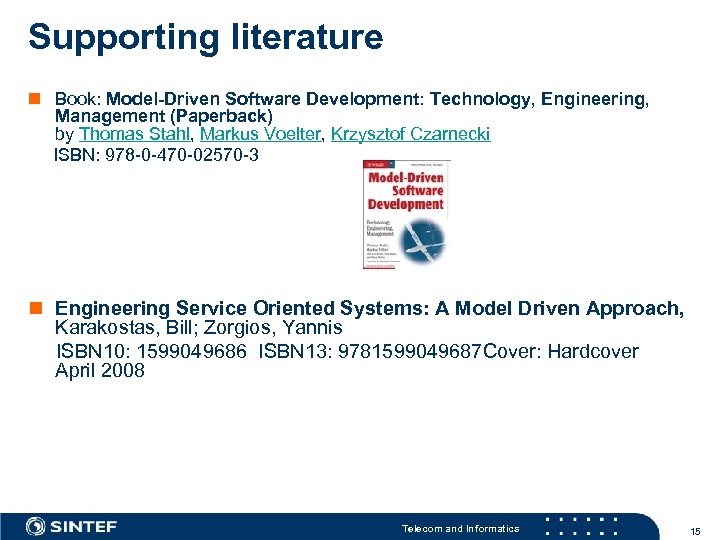
Supporting literature n Book: Model-Driven Software Development: Technology, Engineering, Management (Paperback) by Thomas Stahl, Markus Voelter, Krzysztof Czarnecki ISBN: 978 -0 -470 -02570 -3 n Engineering Service Oriented Systems: A Model Driven Approach, Karakostas, Bill; Zorgios, Yannis ISBN 10: 1599049686 ISBN 13: 9781599049687 Cover: Hardcover April 2008 Telecom and Informatics 15
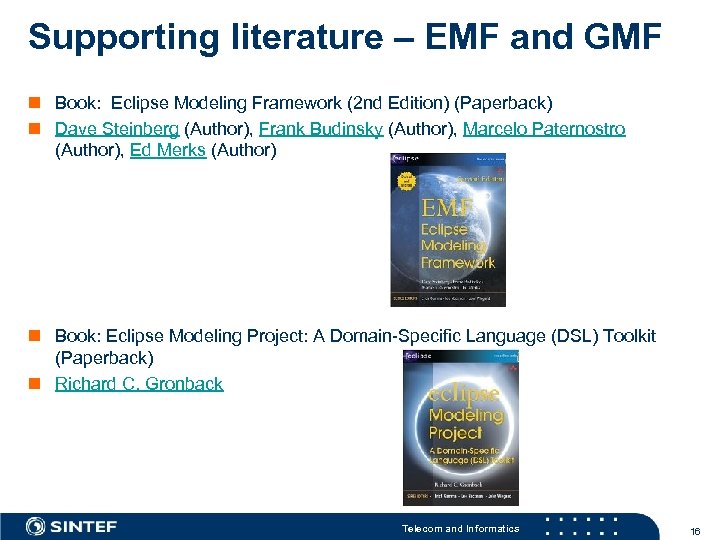
Supporting literature – EMF and GMF n Book: Eclipse Modeling Framework (2 nd Edition) (Paperback) n Dave Steinberg (Author), Frank Budinsky (Author), Marcelo Paternostro (Author), Ed Merks (Author) n Book: Eclipse Modeling Project: A Domain-Specific Language (DSL) Toolkit (Paperback) n Richard C. Gronback Telecom and Informatics 16

UML 2. 0 n UML 2. 0 and Sys. ML Background and Reference material n See www. uml-forum. com/specs. htm n n Også hos OMG: http: //www. omg. org/uml/ (UML) http: //www. omg. org/mda/ (MDA) http: //www. omg. org/cwm/ (MOF, XMI, CWM) Telecom and Informatics 17
UML 2. 0 recommend books: UML 2. 0 in a Nutshell by Dan Pilone (Author), Neil Pitman (Author) The Unified Modeling Language User Guide Second edition (ISBN 0 -321 -26797 -4) (G, Booch, J. Rumbaugh, Jacobsson) Telecom and Informatics 18
Exam n Case-based (ref. earlier exams) n All written material can be used n 09 -12 (3 hours) – Monday 31. May 2010 Telecom and Informatics 19
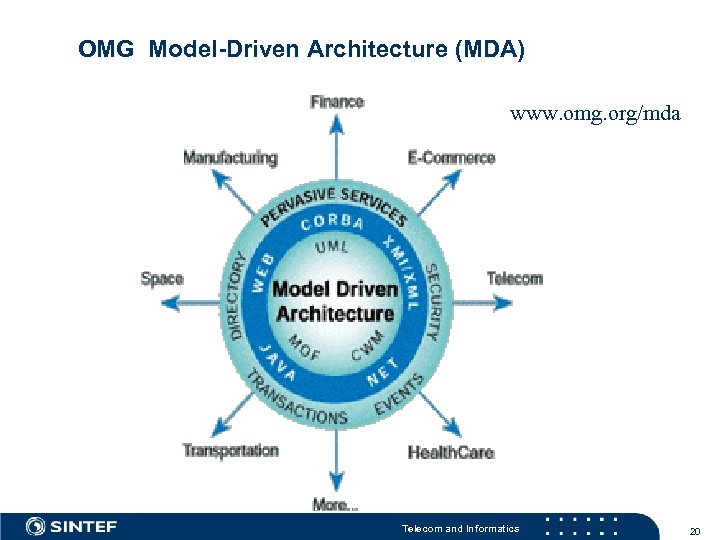
OMG Model-Driven Architecture (MDA) www. omg. org/mda Telecom and Informatics 20
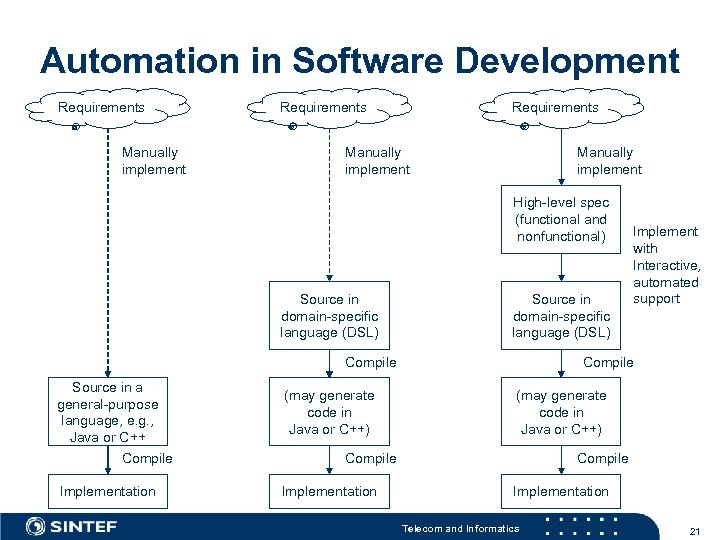
Automation in Software Development Requirements Manually implement High-level spec (functional and nonfunctional) Source in domain-specific language (DSL) Compile Source in a general-purpose language, e. g. , Java or C++ Compile Implementation (may generate code in Java or C++) Compile Implementation Implement with Interactive, automated support Compile Implementation Telecom and Informatics 21
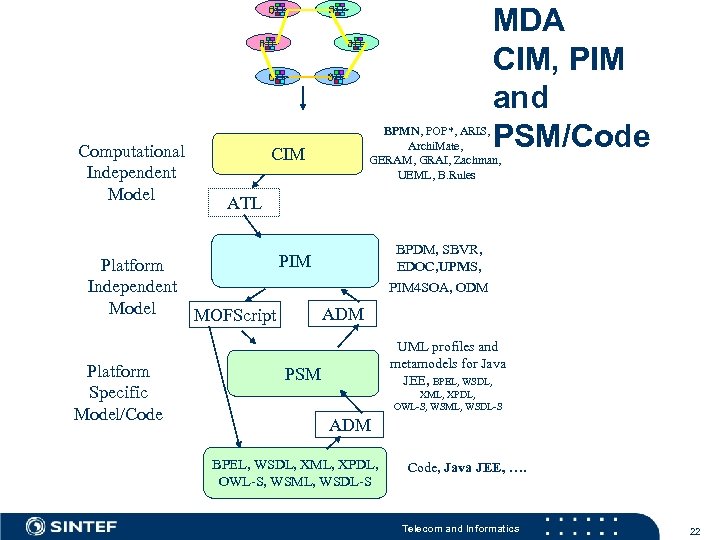
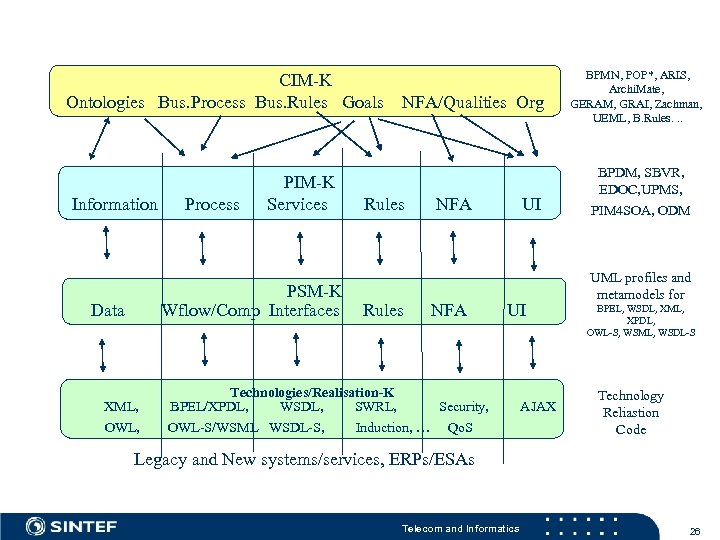
Computational Independent Model BPMN, POP*, ARIS, Archi. Mate, GERAM, GRAI, Zachman, UEML, B. Rules CIM ATL Platform Independent Model MOFScript Platform Specific Model/Code MDA CIM, PIM and PSM/Code BPDM, SBVR, EDOC, UPMS, PIM 4 SOA, ODM PIM ADM UML profiles and metamodels for Java JEE, BPEL, WSDL, PSM XML, XPDL, OWL-S, WSML, WSDL-S ADM BPEL, WSDL, XML, XPDL, OWL-S, WSML, WSDL-S Code, Java JEE, …. Telecom and Informatics 22
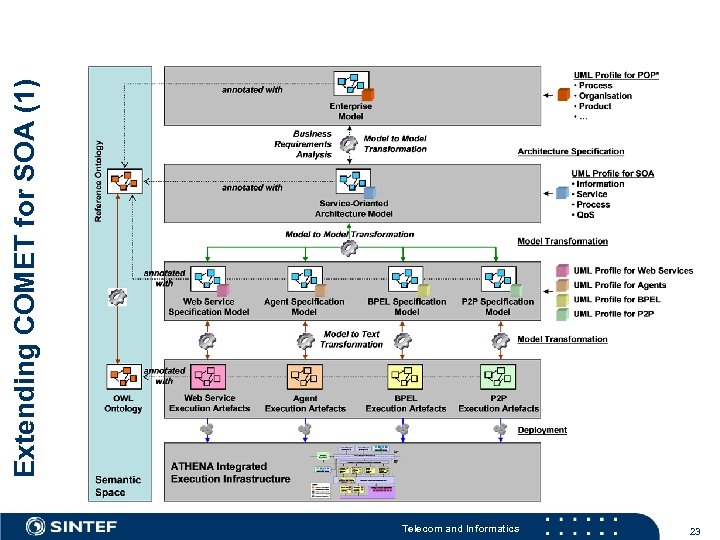
Telecom and Informatics 23 Extending COMET for SOA (1)
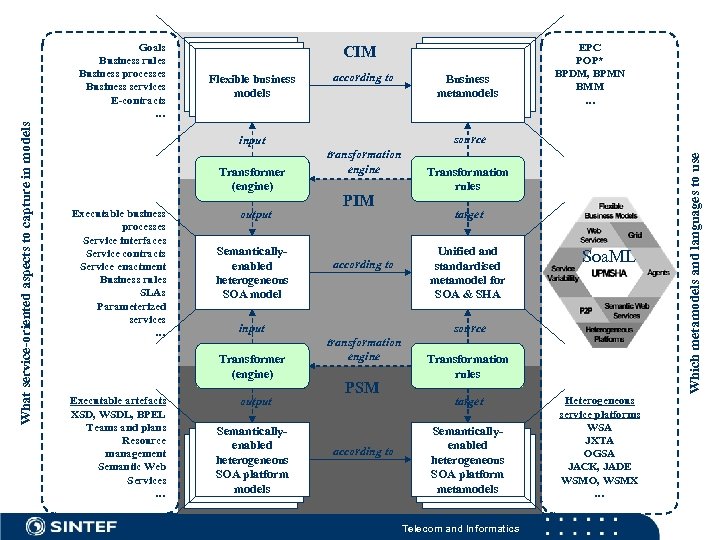
CIM Flexible business models according to source input Transformer (engine) Executable business processes Service interfaces Service contracts Service enactment Business rules SLAs Parameterized services … output Semanticallyenabled heterogeneous SOA model Executable artefacts XSD, WSDL, BPEL Teams and plans Resource management Semantic Web Services … transformation engine PIM according to input Transformer (engine) output Semantically. Interconnected enabled Interconnected heterogeneous SOA platform models Business metamodels EPC POP* BPDM, BPMN BMM … Transformation rules target Unified and standardised metamodel for SOA & SHA Soa. ML source transformation engine PSM according to Transformation rules target Semanticallyenabled Heterogeneous heterogeneous SOA platforms SOA platform metamodels Telecom and Informatics Heterogeneous service platforms WSA JXTA OGSA JACK, JADE WSMO, WSMX … Which metamodels and languages to use What service-oriented aspects to capture in models Goals Business rules Business processes Business services E-contracts …
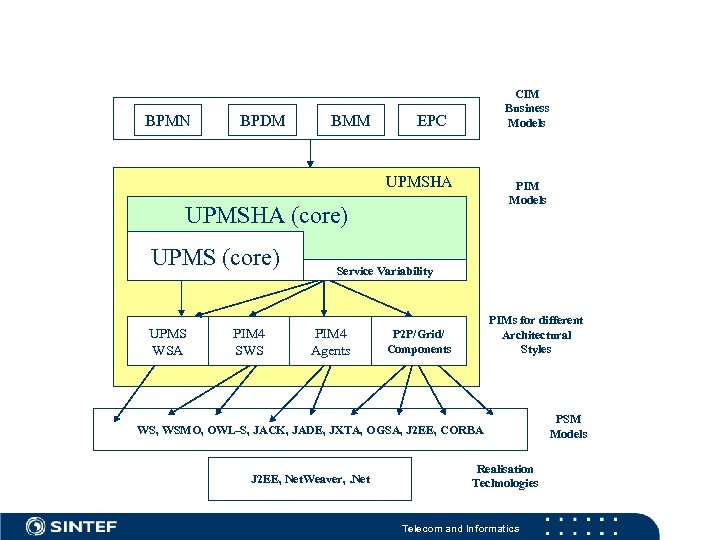
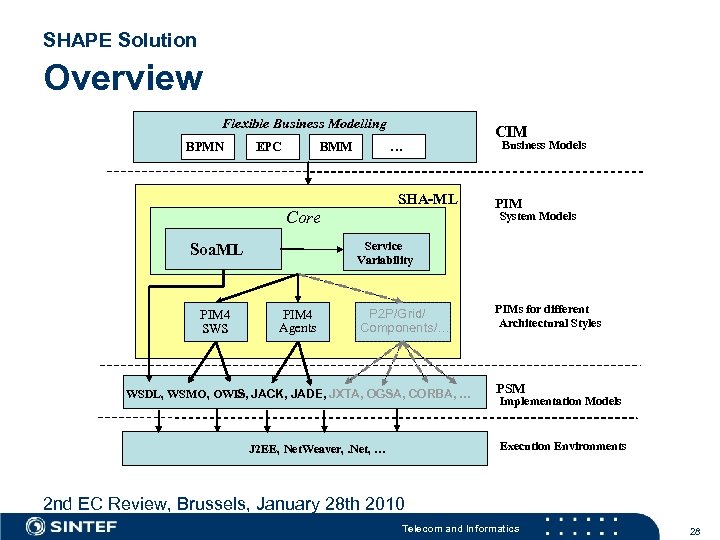
BPMN BPDM BMM CIM Business Models EPC UPMSHA PIM Models UPMSHA (core) UPMS WSA PIM 4 SWS Service Variability PIM 4 Agents PIMs for different Architectural Styles P 2 P/Grid/ Components WS, WSMO, OWL-S, JACK, JADE, JXTA, OGSA, J 2 EE, CORBA J 2 EE, Net. Weaver, . Net Realisation Technologies Telecom and Informatics PSM Models
CIM-K Ontologies Bus. Process Bus. Rules Goals Information Process PIM-K Services PSM-K Wflow/Comp Interfaces Data XML, OWL, NFA/Qualities Org Rules NFA UI UI Technologies/Realisation-K BPEL/XPDL, WSDL, SWRL, Security, OWL-S/WSML WSDL-S, Induction, … Qo. S AJAX BPMN, POP*, ARIS, Archi. Mate, GERAM, GRAI, Zachman, UEML, B. Rules. . . BPDM, SBVR, EDOC, UPMS, PIM 4 SOA, ODM UML profiles and metamodels for BPEL, WSDL, XML, XPDL, OWL-S, WSML, WSDL-S Technology Reliastion Code Legacy and New systems/services, ERPs/ESAs Telecom and Informatics 26
CIM ODM, Concepts PIM Information PSM Persistence API XML, , OWL, WSML Jack, JADE SAP BPMN BMM Soa. ML Services EJB 3. 0, Process Java, Metro/WSDL OWL-S/WSML Jack, JADE SAP BPEL/XPDL SA/WSML ASM Jack, JADE SAP Technologies/Realisation INF 5120 OMG standard focus Telecom and Informatics
SHAPE Solution Overview Flexible Business Modelling BPMN EPC … BMM SHA-ML Core Business Models PIM System Models Service Variability Soa. ML PIM 4 SWS CIM PIM 4 Agents P 2 P/Grid/ Components/… WSDL, WSMO, OWL JACK, JADE, JXTA, OGSA, CORBA, … S, PIMs for different Architectural Styles PSM Implementation Models Execution Environments J 2 EE, Net. Weaver, . Net, … 2 nd EC Review, Brussels, January 28 th 2010 Telecom and Informatics 28
SHAPE Solution MDE Technologies Purpose / Benefit Problem / State-of-Art Solution developed Future Plans Integrated & guided business modelling • Business-IT-Gap • Bus. Modeling techniques not integrated • Business-IT-Gap • Existing techn. not integrated • BPMN 2. 0 support • Cont. integration of bus. modelling • Backward analysis Enable MDE for services & SOA • MDE for SOA highly desired • UML does not support this • Soa. ML metamodel & profile • Modelling tools • Methodology • Disseminate Soa. ML • Commercialization • Soa. ML Extensions 3 Integration of Agent Technology Automated planning on top of services • Services are only passive infrastruc. • problem solving / planning on top • Framework & Tools for integration with Soa. ML • Enhance AOSE • Standardiz. (AMP) • Enhanced problem solving using services 4 Integration of SWS Technologies Handling Heterogeneity + automate service usage • Hetero. & dynamics in larger systems • SWS not aligned with classic SE MDE for SWS: Framework, Tool, Methodology • Standardization (OMG, W 3 C, OASIS) • MDE for Semantic Technologies Customization & personalization of services • Complex services vs. indiv. user req. • adequate techniques not existing • New approach based on SPEL • Metamodel, Tool, Methodology • Standardiz. (CVL) • Continue towards comprehensive serv. customization 1 Flexible Business Modelling 2 Service & SOA Modelling 5 Service Customization Telecom and Informatics 29
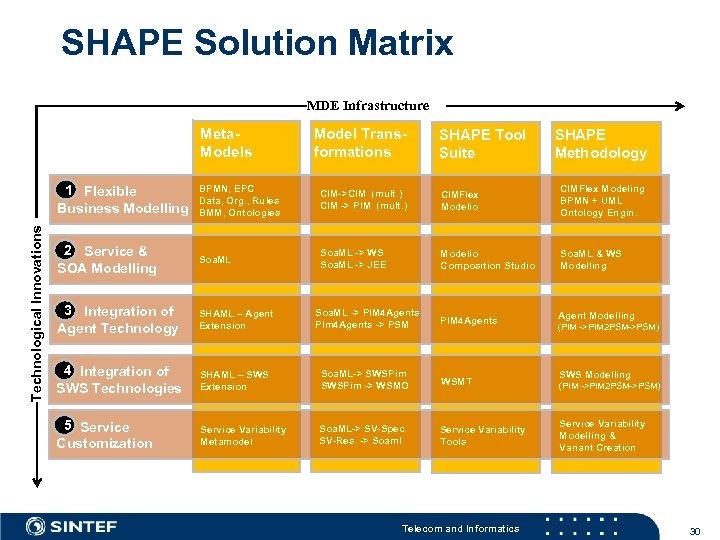
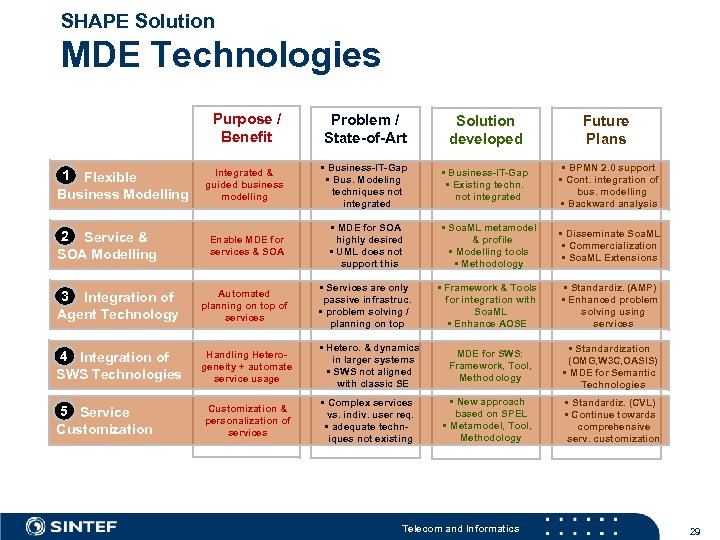
SHAPE Solution Matrix MDE Infrastructure Meta. Models Model Transformations SHAPE Tool Suite SHAPE Methodology Technological Innovations 1 Flexible Business Modelling BPMN, EPC Data, Org. , Rules BMM, Ontologies CIM->CIM (mult. ) CIM -> PIM (mult. ) CIMFlex Modelio CIMFlex Modeling BPMN + UML Ontology Engin. 2 Service & SOA Modelling Soa. ML -> WS Soa. ML -> JEE Modelio Composition Studio Soa. ML & WS Modelling 3 Integration of Agent Technology SHAML – Agent Extension Soa. ML -> PIM 4 Agents PIm 4 Agents -> PSM 4 Integration of SWS Technologies SHAML – SWS Extension Soa. ML-> SWSPim -> WSMO WSMT 5 Service Customization Service Variability Metamodel Soa. ML-> SV-Spec. SV-Res. -> Soaml Service Variability Tools PIM 4 Agents Telecom and Informatics Agent Modelling (PIM ->PIM 2 PSM->PSM) SWS Modelling (PIM ->PIM 2 PSM->PSM) Service Variability Modelling & Variant Creation 30
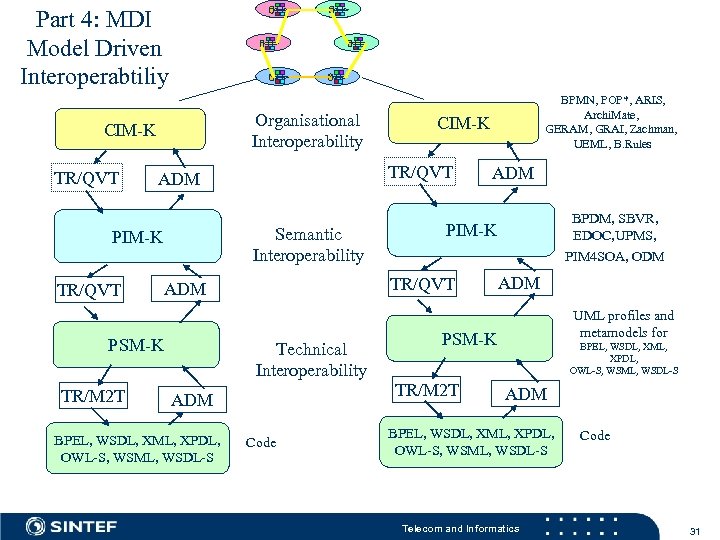
Part 4: MDI Model Driven Interoperabtiliy Organisational Interoperability CIM-K TR/QVT Semantic Interoperability PIM-K TR/QVT TR/M 2 T Technical Interoperability ADM BPEL, WSDL, XML, XPDL, OWL-S, WSML, WSDL-S ADM Code BPDM, SBVR, EDOC, UPMS, PIM 4 SOA, ODM PIM-K TR/QVT ADM PSM-K CIM-K TR/QVT ADM BPMN, POP*, ARIS, Archi. Mate, GERAM, GRAI, Zachman, UEML, B. Rules ADM UML profiles and metamodels for PSM-K TR/M 2 T BPEL, WSDL, XML, XPDL, OWL-S, WSML, WSDL-S ADM BPEL, WSDL, XML, XPDL, OWL-S, WSML, WSDL-S Telecom and Informatics Code 31
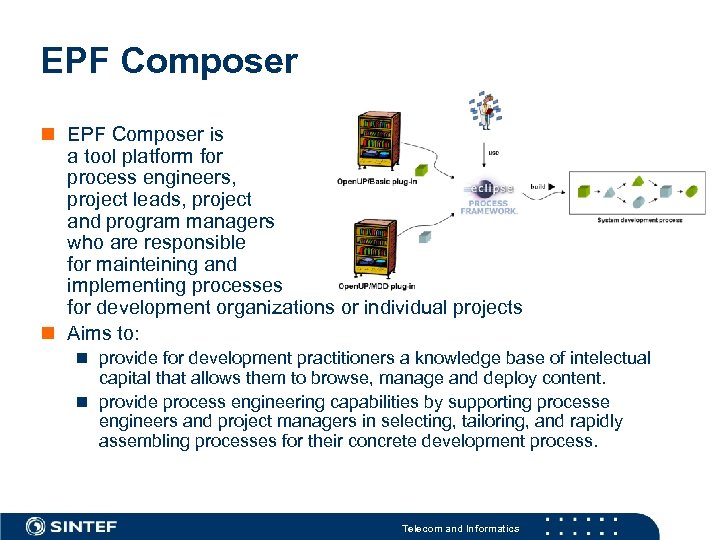
EPF Composer n EPF Composer is a tool platform for process engineers, project leads, project and program managers who are responsible for mainteining and implementing processes for development organizations or individual projects n Aims to: n provide for development practitioners a knowledge base of intelectual capital that allows them to browse, manage and deploy content. n provide process engineering capabilities by supporting processe engineers and project managers in selecting, tailoring, and rapidly assembling processes for their concrete development process. Telecom and Informatics
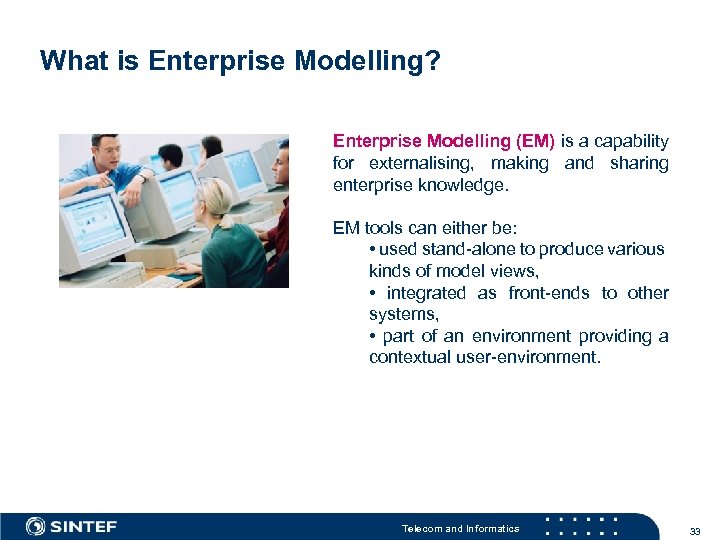
What is Enterprise Modelling? Enterprise Modelling (EM) is a capability for externalising, making and sharing enterprise knowledge. EM tools can either be: • used stand-alone to produce various kinds of model views, • integrated as front-ends to other systems, • part of an environment providing a contextual user-environment. Telecom and Informatics 33
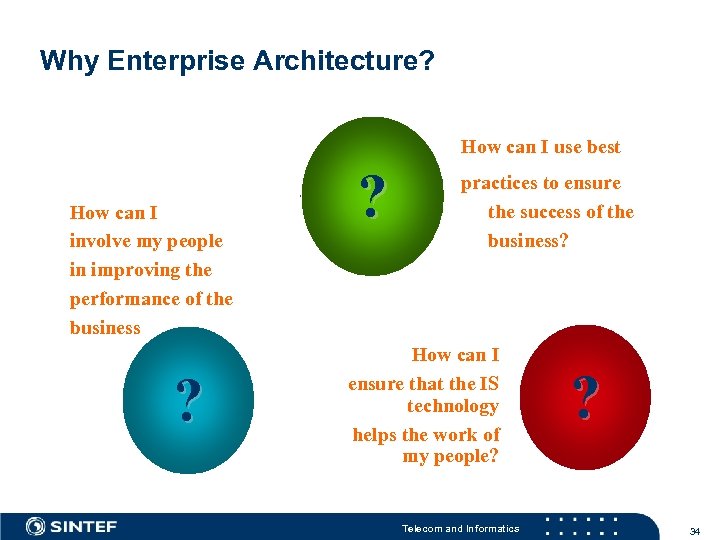
Why Enterprise Architecture? How can I use best How can I involve my people in improving the performance of the business ? ? practices to ensure the success of the business? How can I ensure that the IS technology helps the work of my people? Telecom and Informatics ? 34
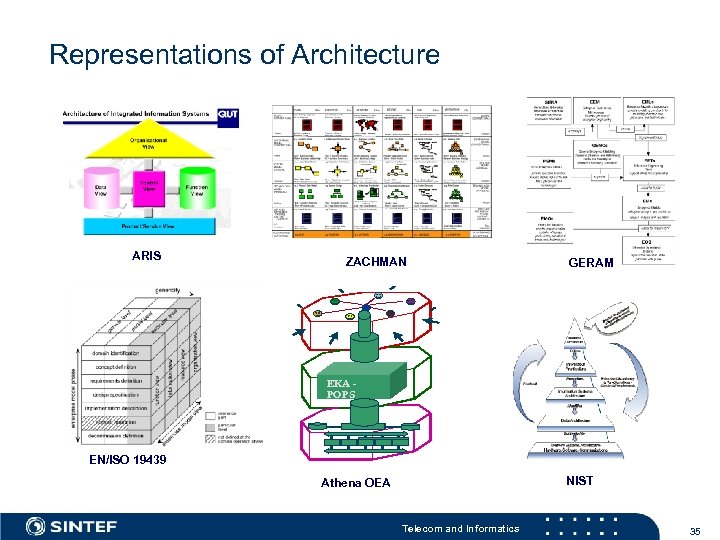
Representations of Architecture ARIS ZACHMAN GERAM EKA POPS EN/ISO 19439 NIST Athena OEA Telecom and Informatics 35
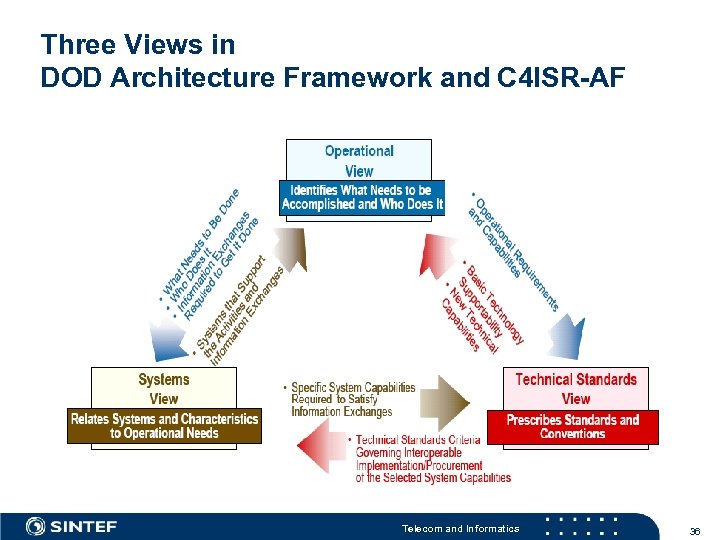
Three Views in DOD Architecture Framework and C 4 ISR-AF Telecom and Informatics 36
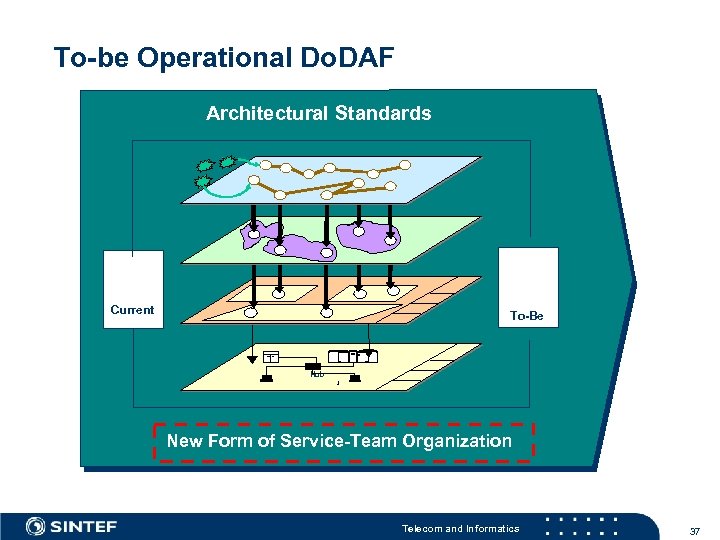
To-be Operational Do. DAF Architectural Standards Current architecture To be As is Target architecture To-Be Architectural models supported Hub by the necessary tools. New Form of Service-Team Organization Organisation Telecom and Informatics 37
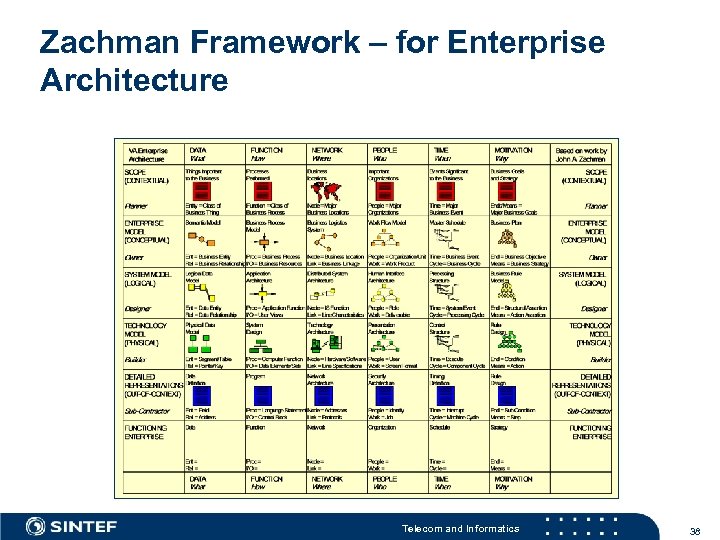
Zachman Framework – for Enterprise Architecture Telecom and Informatics 38
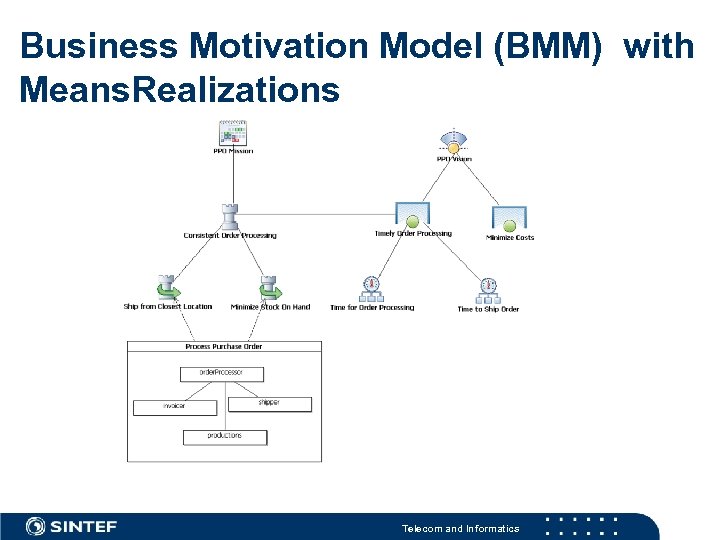
Business Motivation Model (BMM) with Means. Realizations Telecom and Informatics
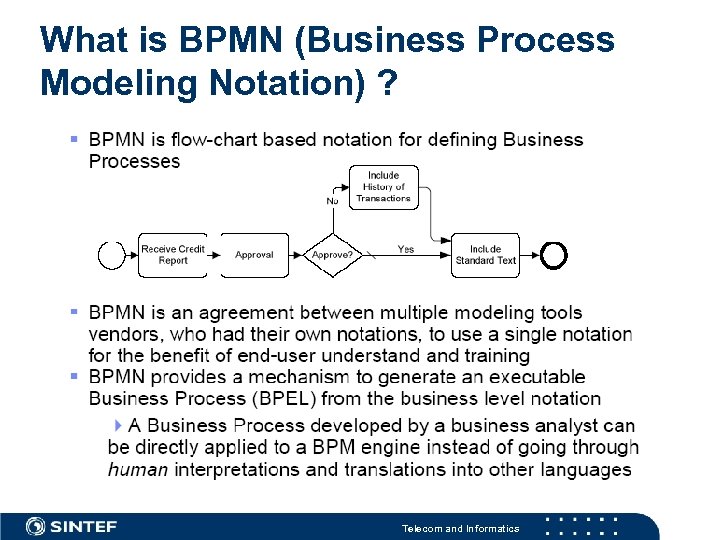
What is BPMN (Business Process Modeling Notation) ? Telecom and Informatics
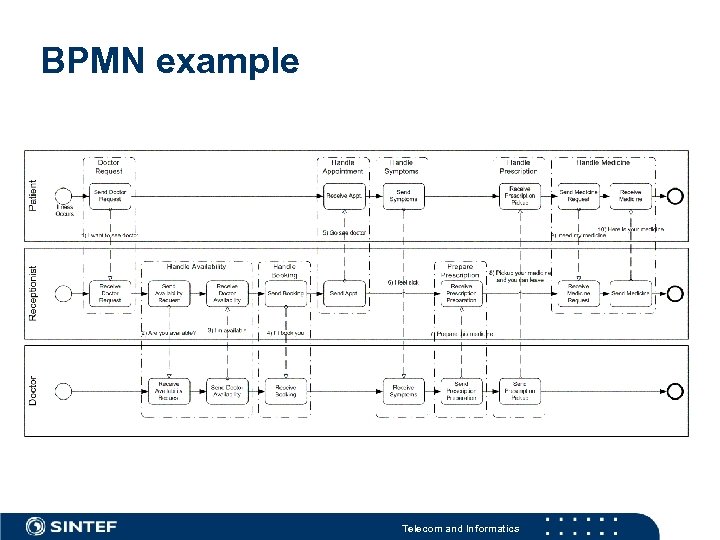
BPMN example Telecom and Informatics
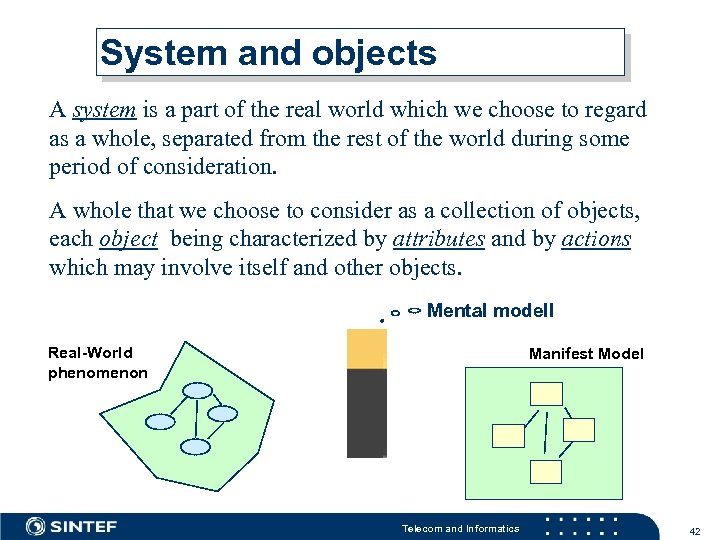
System and objects A system is a part of the real world which we choose to regard as a whole, separated from the rest of the world during some period of consideration. A whole that we choose to consider as a collection of objects, each object being characterized by attributes and by actions which may involve itself and other objects. Mental modell Real-World phenomenon Manifest Model Telecom and Informatics 42
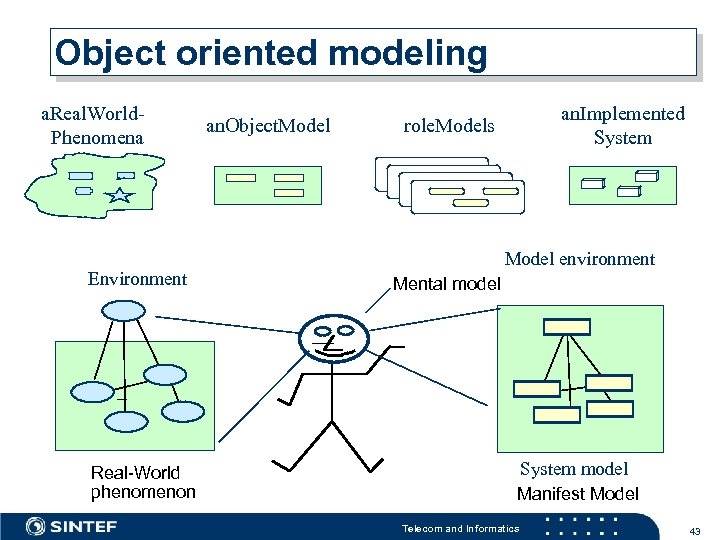
Object oriented modeling a. Real. World. Phenomena Environment Real-World phenomenon an. Object. Model an. Implemented System role. Models Model environment Mental model System model Manifest Model Telecom and Informatics 43
OO Programming Terminology n n n n n Encapsulation Object Message Method Class Instance Inheritance Polymorphism Dynamic (Late) Binding Telecom and Informatics 44
CRC Method, class, responsibilities, and collaborators n Method to learn the most basic OO concepts plus OO “thinking” n “The most effective way of teaching the idiomatic way of thinking with objects is to immerse the learner in the "object-ness" of the material. To do this we must remove as much familiar material as possible, expecting that details such as syntax and programming environment operation will be picked up quickly enough once the fundamentals have been thoroughly understood. ” n Technique also very useful during informal and creative analysis and design n Created by Kent Beck and Ward Cunningham, Textronix, 1989 Telecom and Informatics 45
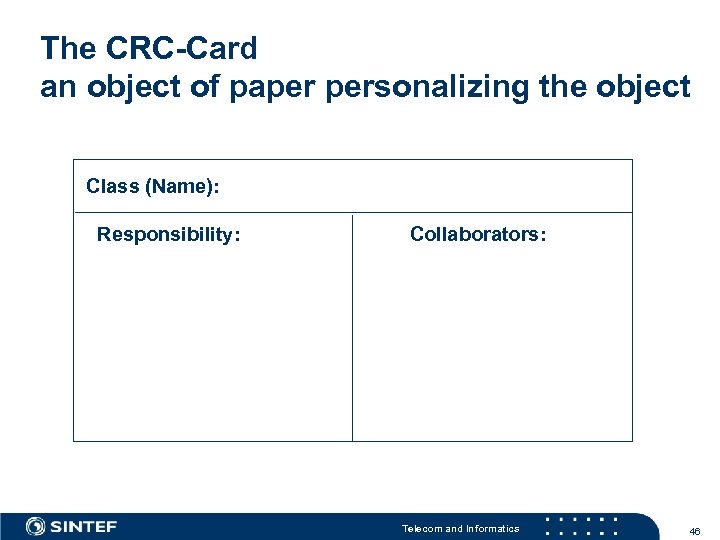
The CRC-Card an object of paper personalizing the object Class (Name): Responsibility: Collaborators: Telecom and Informatics 46
Class, responsibilities, and collaborators n Class The class name of an object creates a vocabulary for discussing a design. Indeed, many people have remarked that object design has more in common with language design than with procedural program design. We urge learners (and spend considerable time ourselves while designing) to find just the right set of words to describe our objects, a set that is internally consistent and evocative in the context of the larger design environment. n Responsibilities identify problems to be solved. The solutions will exist in many versions and refinements. A responsibility serves as a handle for discussing potential solutions. The responsibilities of an object are expressed by a handful of short verb phrases, each containing an active verb. The more that can be expressed by these phrases, the more powerful and concise the design. Again, searching for just the right words is a valuable use of time while designing. n Collaborators Objects which will send or be sent messages in the course of satisfying responsibilities. Collaboration is not necessarily a symmetric relation. For example in Smalltalk, View and Controller operate as near equals while Ordered. Collection offers a service with little regard or even awareness of its client. Telecom and Informatics 47
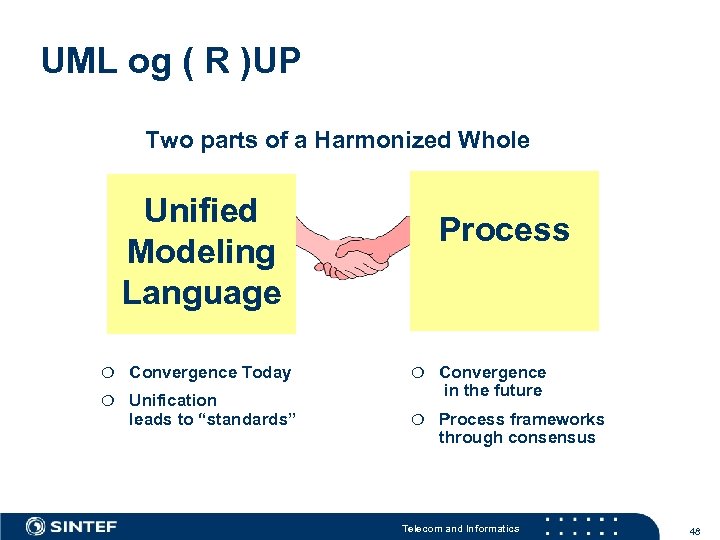
UML og ( R )UP Two parts of a Harmonized Whole Unified Modeling Language ¦ Convergence Today ¦ Unification leads to “standards” Process ¦ Convergence in the future ¦ Process frameworks through consensus Telecom and Informatics 48
UML Structural Modeling n n n Class Diagram Object Diagram Component Diagram (new in UML 2. 0) Package Diagram Deployment diagram Telecom and Informatics 49
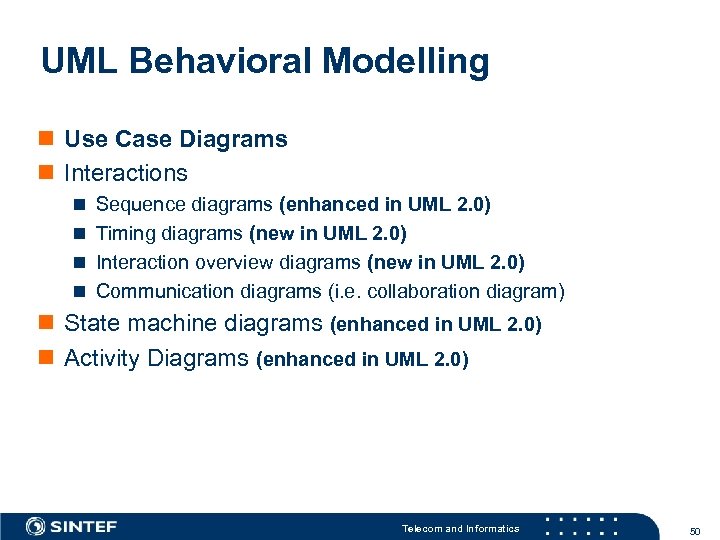
UML Behavioral Modelling n Use Case Diagrams n Interactions n Sequence diagrams (enhanced in UML 2. 0) n Timing diagrams (new in UML 2. 0) n Interaction overview diagrams (new in UML 2. 0) n Communication diagrams (i. e. collaboration diagram) n State machine diagrams (enhanced in UML 2. 0) n Activity Diagrams (enhanced in UML 2. 0) Telecom and Informatics 50
Different kind of models n Conceptual models n Specification models n Implementation models Telecom and Informatics 51
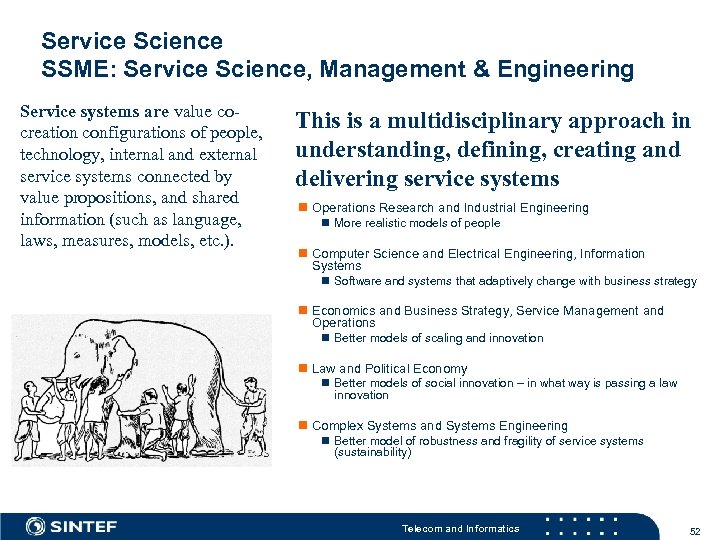
Service Science SSME: Service Science, Management & Engineering Service systems are value cocreation configurations of people, technology, internal and external service systems connected by value propositions, and shared information (such as language, laws, measures, models, etc. ). This is a multidisciplinary approach in understanding, defining, creating and delivering service systems n Operations Research and Industrial Engineering n More realistic models of people n Computer Science and Electrical Engineering, Information Systems n Software and systems that adaptively change with business strategy n Economics and Business Strategy, Service Management and Operations n Better models of scaling and innovation n Law and Political Economy n Better models of social innovation – in what way is passing a law innovation n Complex Systems and Systems Engineering n Better model of robustness and fragility of service systems (sustainability) Telecom and Informatics 52
Service Science n New academic cross discipline n Definition of Service: A service is value delivered to another through a well-defined interface and available to a community (which may be the general public). A service results in work provided to one by another. (Soa. ML) n Service Innovation n Service Design n Service Engineering Telecom and Informatics 53
SOA – Service oriented architecture n From Objects (1967 – 1995+) n To Components (1990 -2000+) n To Services (2000 - 2010+) Telecom and Informatics 54
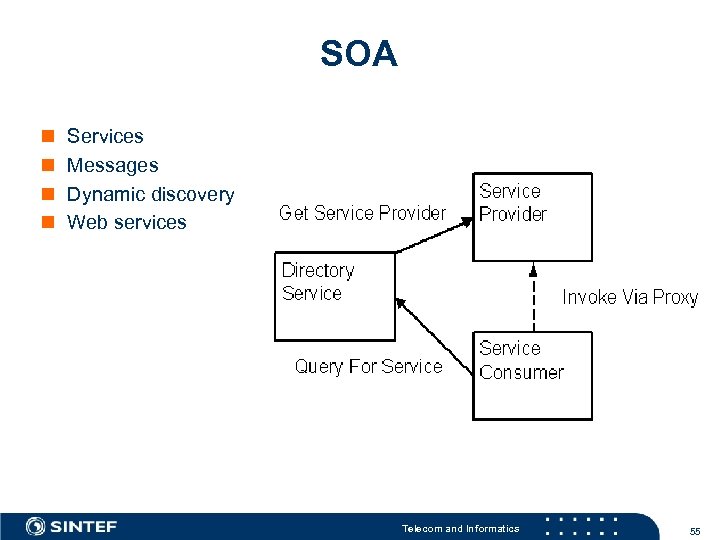
SOA n n Services Messages Dynamic discovery Web services Telecom and Informatics 55
Service Oriented Architecture (SOA) definition n A set of components which can be invoked, and whose interface descriptions can be published and discovered (W 3 C). n The policies, practices, frameworks that enable application functionality to be provided and consumed as sets of services published at a granularity relevant to the service consumer. Services can be invoked, published and discovered, and are abstracted away from the implementation using a single, standards-based form of interface. (CBDI) (www. cbdiforum. com) Telecom and Informatics 56
Extended service-oriented architecture Papazoglou and Georgakopoulos CACM, Oct. 2003 Telecom and Informatics 57
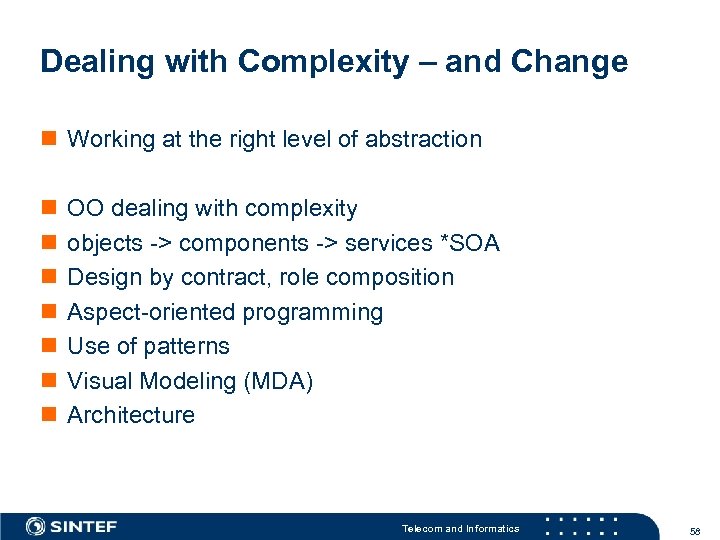
Dealing with Complexity – and Change n Working at the right level of abstraction n n n OO dealing with complexity objects -> components -> services *SOA Design by contract, role composition Aspect-oriented programming Use of patterns Visual Modeling (MDA) Architecture Telecom and Informatics 58
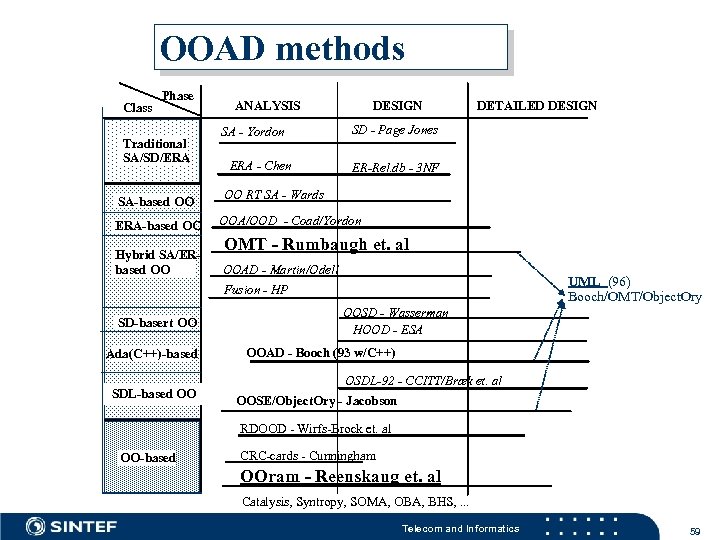
OOAD methods Class Phase Traditional SA/SD/ERA SA-based OO ERA-based OO Hybrid SA/ERbased OO ANALYSIS SA - Yordon ERA - Chen DESIGN DETAILED DESIGN SD - Page Jones ER-Rel. db - 3 NF OO RT SA - Wards OOA/OOD - Coad/Yordon OMT - Rumbaugh et. al OOAD - Martin/Odell UML (96) Booch/OMT/Object. Ory Fusion - HP SD-basert OO Ada(C++)-based SDL-based OO OOSD - Wasserman HOOD - ESA OOAD - Booch (93 w/C++) OSDL-92 - CCITT/Bræk et. al OOSE/Object. Ory - Jacobson RDOOD - Wirfs-Brock et. al OO-based CRC-cards - Cunningham OOram - Reenskaug et. al Catalysis, Syntropy, SOMA, OBA, BHS, . . . Telecom and Informatics 59
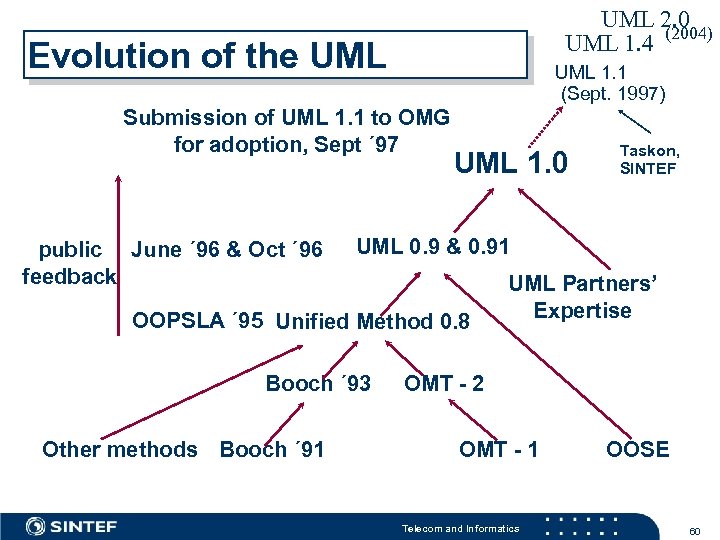
UML 2. 0 UML 1. 4 (2004) Evolution of the UML 1. 1 (Sept. 1997) Submission of UML 1. 1 to OMG for adoption, Sept ´ 97 public June ´ 96 & Oct ´ 96 feedback UML 1. 0 UML 0. 9 & 0. 91 OOPSLA ´ 95 Unified Method 0. 8 Booch ´ 93 Other methods Booch ´ 91 Taskon, SINTEF UML Partners’ Expertise OMT - 2 OMT - 1 Telecom and Informatics OOSE 60
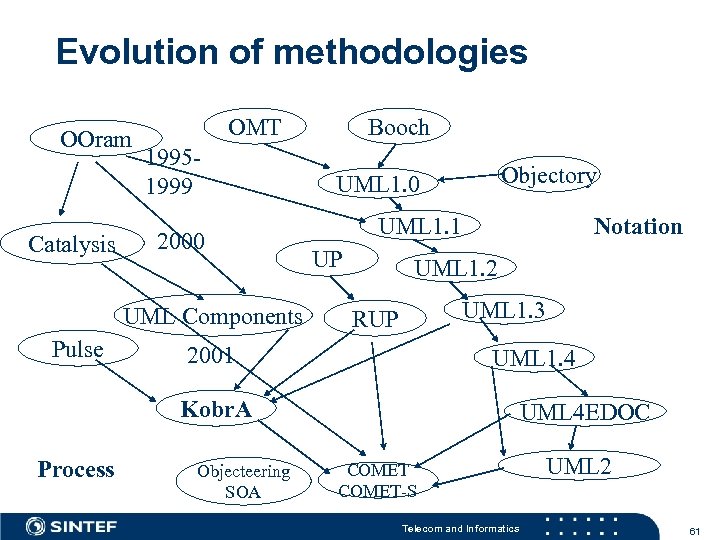
Evolution of methodologies OOram Catalysis OMT 19951999 2000 UML Components Pulse Booch Objectory UML 1. 0 UML 1. 1 UP Notation UML 1. 2 UML 1. 3 RUP 2001 UML 1. 4 Kobr. A Process Objecteering SOA UML 4 EDOC COMET-S Telecom and Informatics UML 2 61
See also: www. soaml. org Final version of Soa. ML per March , 2010 Telecom and Informatics 62
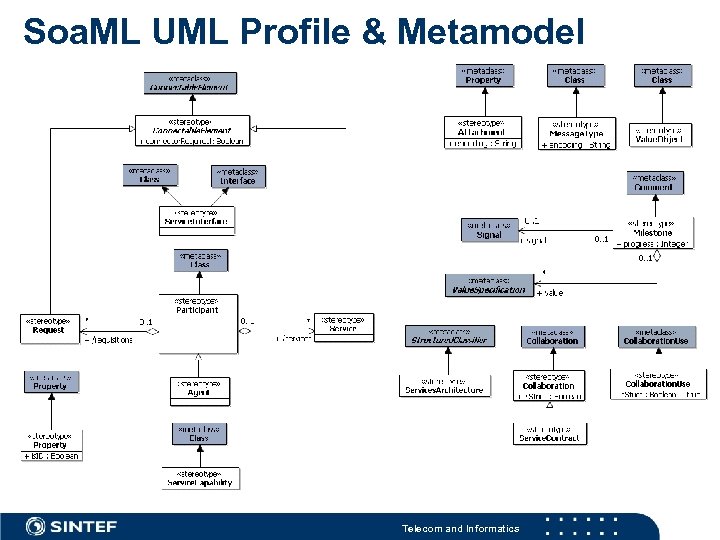
Soa. ML UML Profile & Metamodel Telecom and Informatics
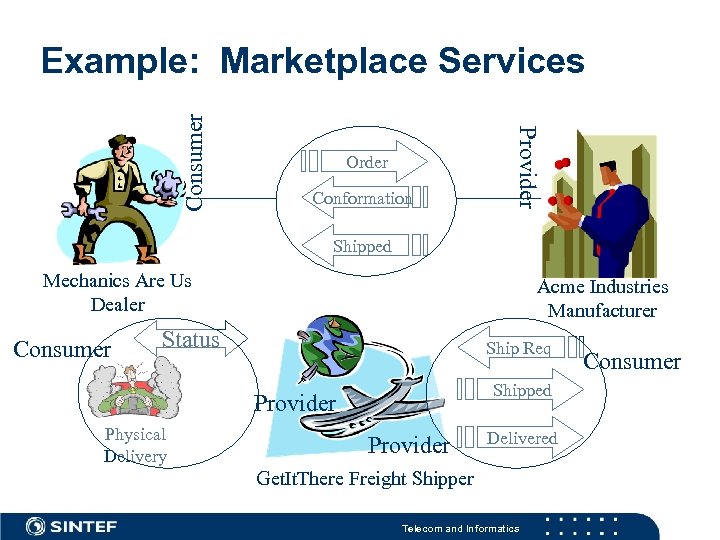
Order Conformation Provider Consumer Example: Marketplace Services Shipped Mechanics Are Us Dealer Consumer Acme Industries Manufacturer Status Ship Req Shipped Provider Physical Delivery Provider Delivered Get. It. There Freight Shipper Telecom and Informatics Consumer
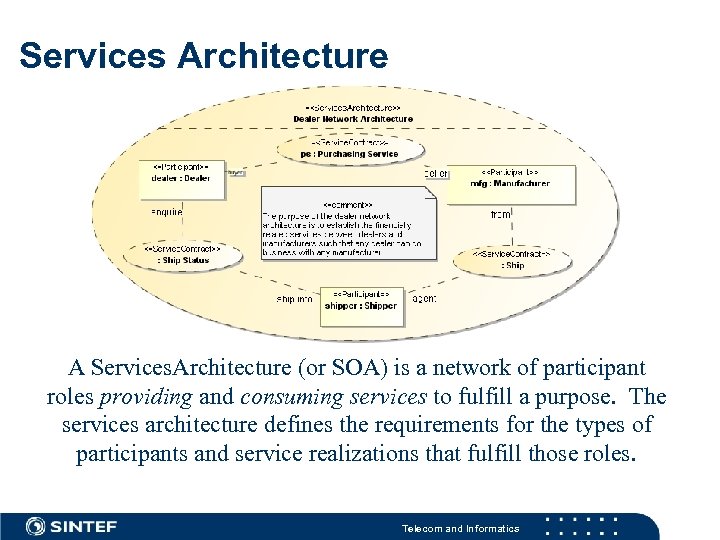
Services Architecture A Services. Architecture (or SOA) is a network of participant roles providing and consuming services to fulfill a purpose. The services architecture defines the requirements for the types of participants and service realizations that fulfill those roles. Telecom and Informatics
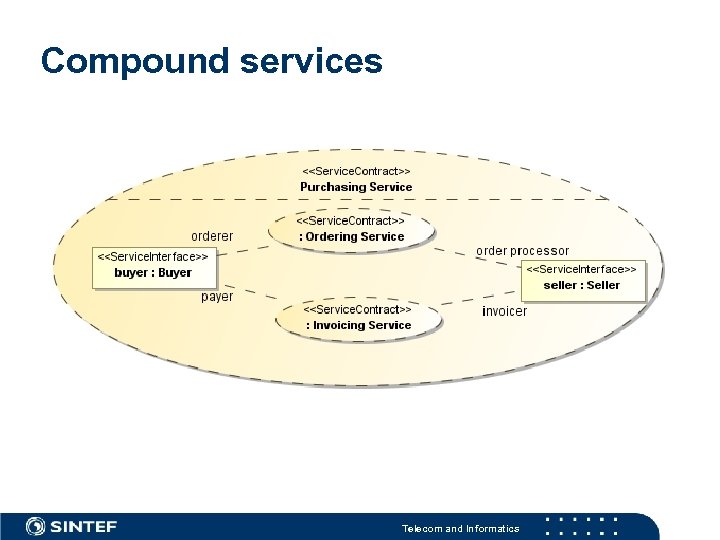
Compound services Telecom and Informatics
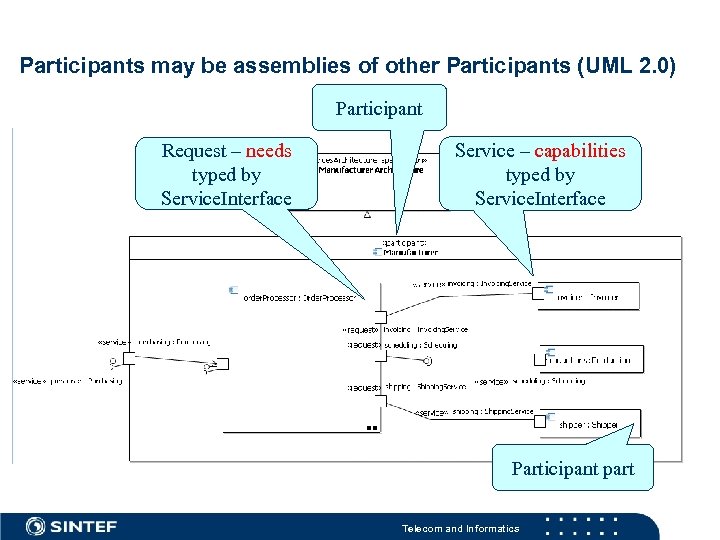
Participants may be assemblies of other Participants (UML 2. 0) Participant Request – needs typed by Service. Interface Service – capabilities typed by Service. Interface Participant part Telecom and Informatics
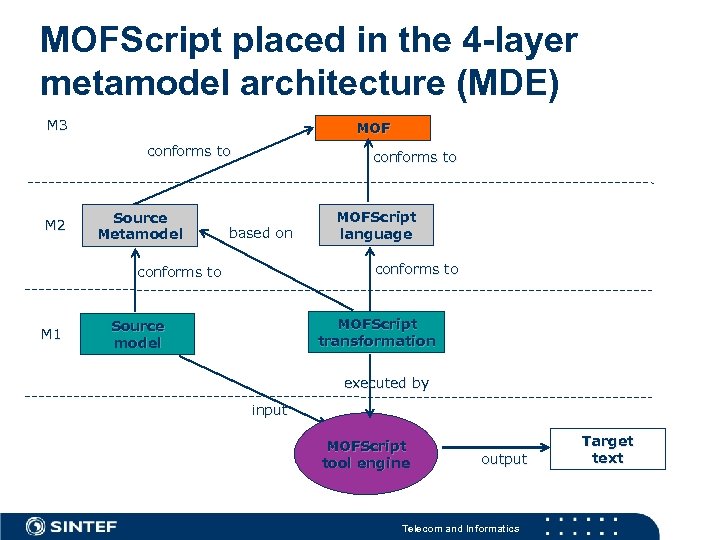
MOFScript placed in the 4 -layer metamodel architecture (MDE) M 3 MOF conforms to M 2 Source Metamodel conforms to based on conforms to M 1 MOFScript language MOFScript transformation Source model executed by input MOFScript tool engine output Telecom and Informatics Target text
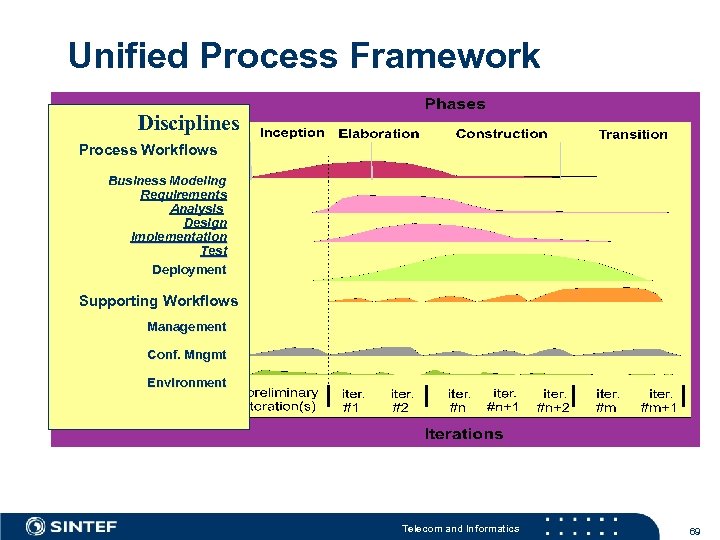
Unified Process Framework Disciplines Process Workflows Business Modeling Requirements Analysis Design Implementation Test Deployment Supporting Workflows Management Conf. Mngmt Environment Telecom and Informatics 69
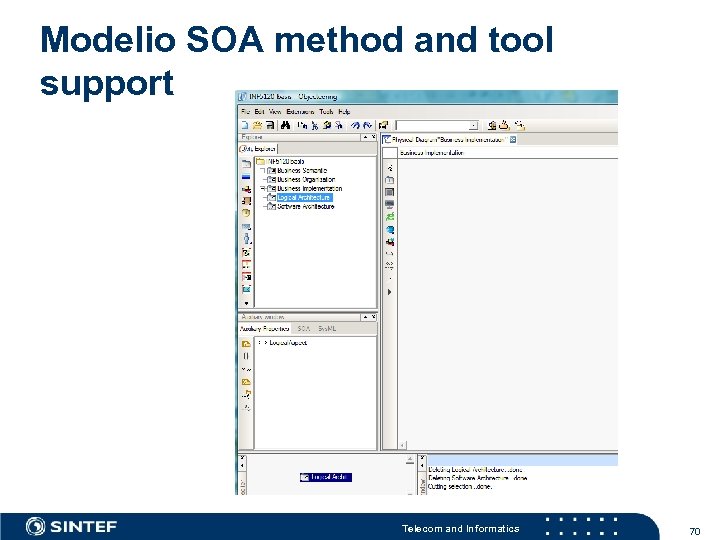
Modelio SOA method and tool support Telecom and Informatics 70
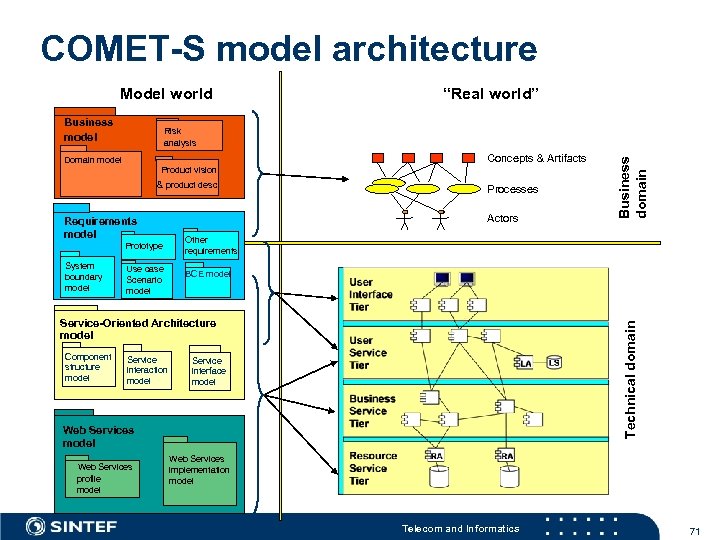
COMET-S model architecture Model world Business model “Real world” Concepts & Artifacts Domain model Product vision & product desc. Requirements model Prototype System boundary model Use case Scenario model Processes Actors Other requirements BCE model Service interaction model Technical domain Service-Oriented Architecture model Component structure model Service interface model. Web Services model Web Services profile model Business domain Risk analysis Web Services implementation model Telecom and Informatics 71
Next Lecture – MDE I February 1 st, 2010 n Metamodeling n Domain specific languages n Eclipse EMF and GMF n UML profiles n Draft handbook for MDE will be provided at the INF 5120 webpages n Oblig 1 intro: See Eclipse EMF/GMF tutorials n http: //www. eclipse. org/modeling/ Telecom and Informatics 72
Скачать презентацию INF 5120 Modellbasert Systemutvikling Modelbased System development Lecture
c69883033864dbb6442536643605971d.ppt