 Скачать презентацию INF 5070 Media Storage and Distribution Systems
07814646a22d000abc72c25637132649.ppt
- Количество слайдов: 61



INF 5070 – Media Storage and Distribution Systems: Introduction and Architectures 29/8 - 2005
Overview ü Intro Ø about the course Ø multimedia applications and challenges ü Architectures Ø Media (Video) on Demand Ø Machine internals Ø Video server structures Ø Examples INF 5070 – media storage and distribution systems 2005 Carsten Griwodz & Pål Halvorsen
INF 5070: The Course
Lecturers ü Carsten Griwodz Ø email: griff @ ifi Ø office: 3343 ü Pål Halvorsen Ø email: paalh @ ifi Ø office: 3345 INF 5070 – media storage and distribution systems 2005 Carsten Griwodz & Pål Halvorsen
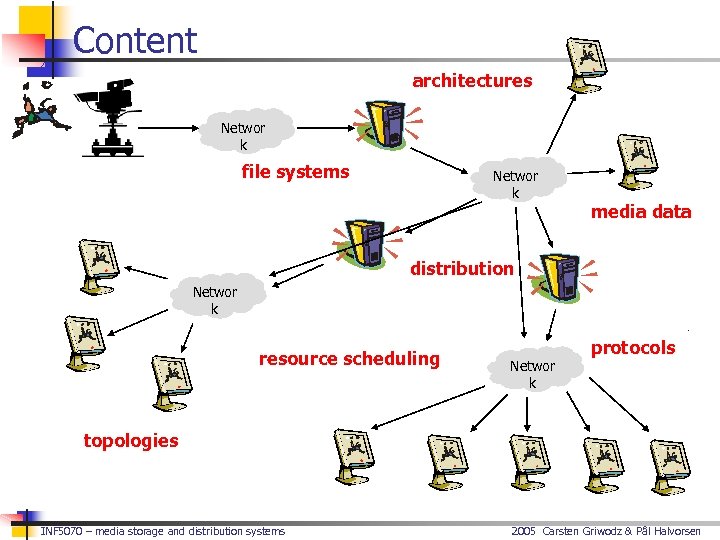
Content architectures Networ k file systems Networ k media data distribution Networ k resource scheduling Networ k protocols topologies INF 5070 – media storage and distribution systems 2005 Carsten Griwodz & Pål Halvorsen
Content - lectures ü System architectures (server and system designs) ü Media and user behavior (wire and file formats, codecs, processing multimedia data, user interactivity) ü Resource management (CPU and memory management) ü Protocols with and without Quality of Service (Qo. S) (specific and generic Qo. S approaches) INF 5070 – media storage and distribution systems 2005 Carsten Griwodz & Pål Halvorsen
Content - lectures ü Storage systems (management of multimedia files, retrieval) ü Distribution (use of caches and proxy servers) ü Peer-to-Peer (various clients, different amount of resources) ü Guest lecture 7/11: The FAST searching system (architecture: resource utilization and performance, storage and distribution of data, parallelism, etc. ) INF 5070 – media storage and distribution systems 2005 Carsten Griwodz & Pål Halvorsen
Content - student assignment ü Mandatory student assignment (will be presented more in-depth later): Ø write a project plan describing your assignment (3/10) write a report describing the test and its results, and give a presentation to the class at the end of the course (28/11) Ø for example (examples from earlier): Ø n n n n TCP friendliness variations New TCP implementations Network emulators Comparison of Linux schedulers File system benchmarking (different OSes and file systems) Comparison of open source video servers (Helix vs. Darwin) Comparison of methods for network performance monitoring … INF 5070 – media storage and distribution systems 2005 Carsten Griwodz & Pål Halvorsen
Goals ü Media servers and distribution system Ø media characteristics Ø architectures Ø system support Ø protocols Ø distribution mechanisms Ø … ü Be able to evaluate any combination of these mechanisms, e. g. , Ø Ø Ø data placement on disk and memory caching algorithm video popularity and proxy caching algorithm … INF 5070 – media storage and distribution systems 2005 Carsten Griwodz & Pål Halvorsen
Exam ü Prerequisite: approved presentation of student assignment ü Oral exam (? ? /12 -2005): Ø all transparencies from lectures Ø content of your own student assignment INF 5070 – media storage and distribution systems 2005 Carsten Griwodz & Pål Halvorsen
Applications and Challenges
Applications ü Multimedia enriches the user interface giving new applications ü Broadcast – server is only VCR substitute (e. g. , MTV Europe) ü Media-on-Demand (Mo. D) Ø Network-based, user controlled distribution of media content, e. g. : n n n Video-on-Demand (Vo. D) (e. g. , Bell Atlantic (‘ 93) ~1000 users, 700 choices) News-on-Demand (No. D) (e. g. , CNN, BBC web today, BAD quality) Learning-on-Demand (Lo. D) (e. g. , the OMODIS project) ü Virtual worlds (typically live, not on-Demand) Ø video conferencing (e. g. , USIT’s electronic classroom) Ø games (e. g. , Anarchy online, Quake, …) INF 5070 – media storage and distribution systems 2005 Carsten Griwodz & Pål Halvorsen
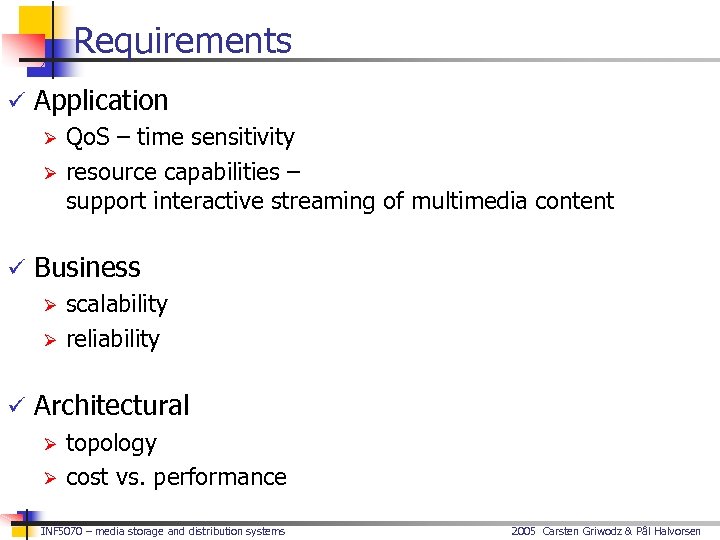
Requirements ü Application Ø Qo. S – time sensitivity Ø resource capabilities – support interactive streaming of multimedia content ü Business Ø scalability Ø reliability ü Architectural Ø topology Ø cost vs. performance INF 5070 – media storage and distribution systems 2005 Carsten Griwodz & Pål Halvorsen
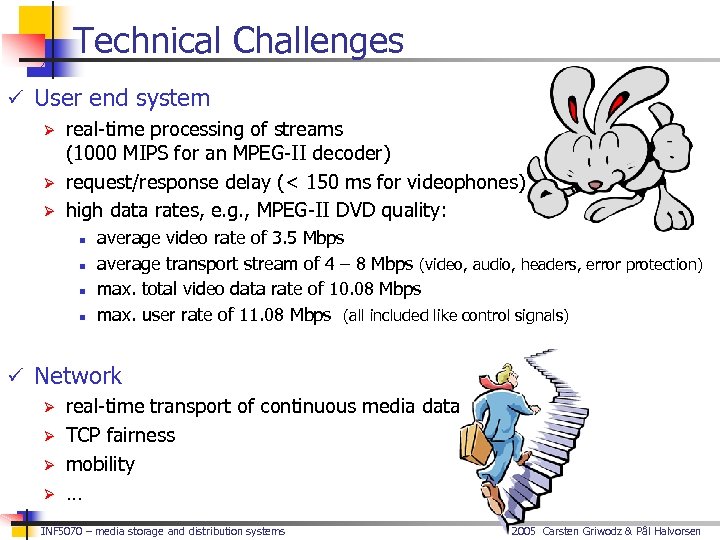
Technical Challenges ü User end system Ø real-time processing of streams (1000 MIPS for an MPEG-II decoder) Ø request/response delay (< 150 ms for videophones) Ø high data rates, e. g. , MPEG-II DVD quality: n n average video rate of 3. 5 Mbps average transport stream of 4 – 8 Mbps (video, audio, headers, error protection) max. total video data rate of 10. 08 Mbps max. user rate of 11. 08 Mbps (all included like control signals) ü Network Ø real-time transport of continuous media data Ø TCP fairness Ø mobility Ø … INF 5070 – media storage and distribution systems 2005 Carsten Griwodz & Pål Halvorsen
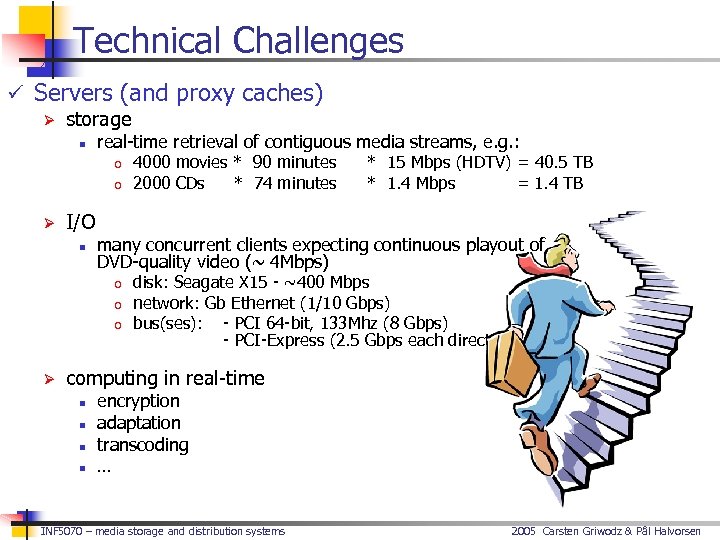
Technical Challenges ü Servers (and proxy caches) Ø storage n real-time retrieval of contiguous media streams, e. g. : o o Ø I/O n * 15 Mbps (HDTV) = 40. 5 TB * 1. 4 Mbps = 1. 4 TB many concurrent clients expecting continuous playout of DVD-quality video (~ 4 Mbps) o o o Ø 4000 movies * 90 minutes 2000 CDs * 74 minutes disk: Seagate X 15 - ~400 Mbps network: Gb Ethernet (1/10 Gbps) bus(ses): - PCI 64 -bit, 133 Mhz (8 Gbps) - PCI-Express (2. 5 Gbps each direction/lane) computing in real-time n n encryption adaptation transcoding … INF 5070 – media storage and distribution systems 2005 Carsten Griwodz & Pål Halvorsen
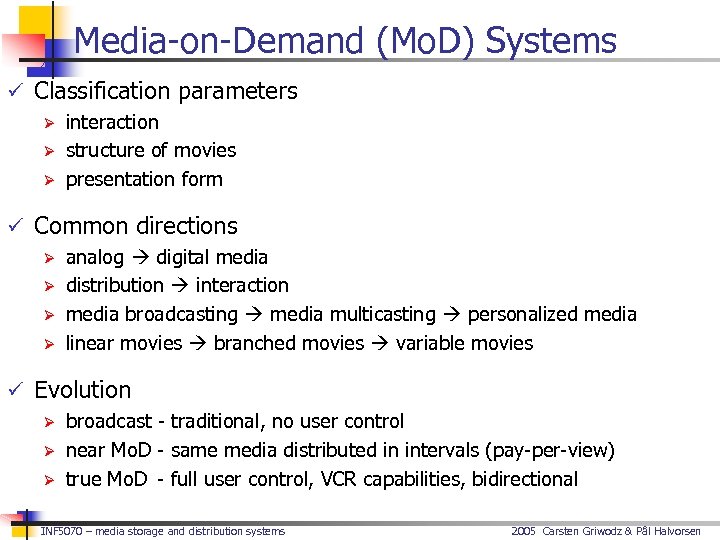
Media-on-Demand (Mo. D) Systems ü Classification parameters Ø interaction Ø structure of movies Ø presentation form ü Common directions Ø analog digital media Ø distribution interaction Ø media broadcasting media multicasting personalized media Ø linear movies branched movies variable movies ü Evolution Ø broadcast - traditional, no user control Ø near Mo. D - same media distributed in intervals (pay-per-view) Ø true Mo. D - full user control, VCR capabilities, bidirectional INF 5070 – media storage and distribution systems 2005 Carsten Griwodz & Pål Halvorsen
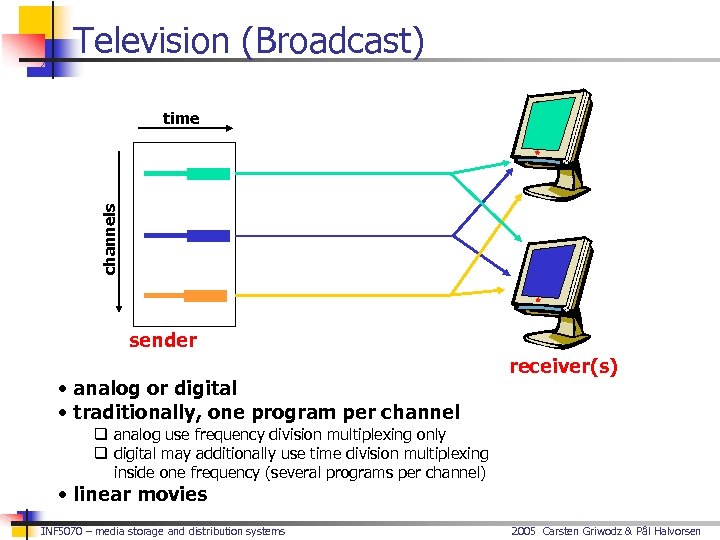
Television (Broadcast) channels time sender • analog or digital • traditionally, one program per channel receiver(s) q analog use frequency division multiplexing only q digital may additionally use time division multiplexing inside one frequency (several programs per channel) • linear movies INF 5070 – media storage and distribution systems 2005 Carsten Griwodz & Pål Halvorsen
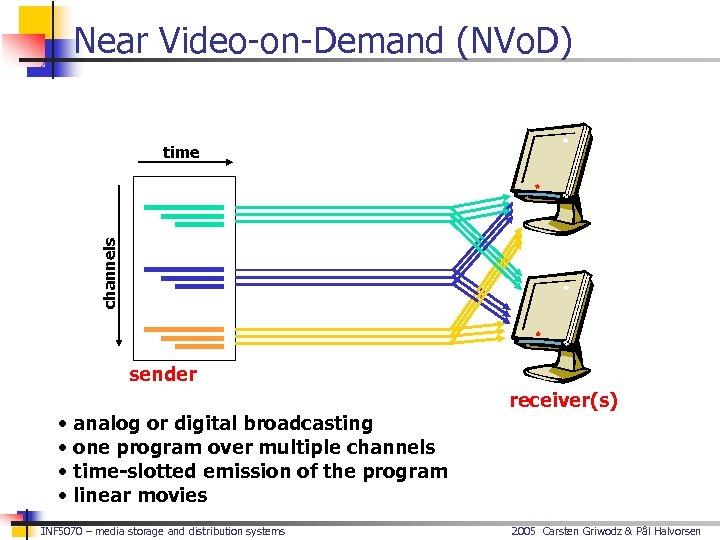
Near Video-on-Demand (NVo. D) channels time sender • analog or digital broadcasting • one program over multiple channels • time-slotted emission of the program • linear movies INF 5070 – media storage and distribution systems receiver(s) 2005 Carsten Griwodz & Pål Halvorsen
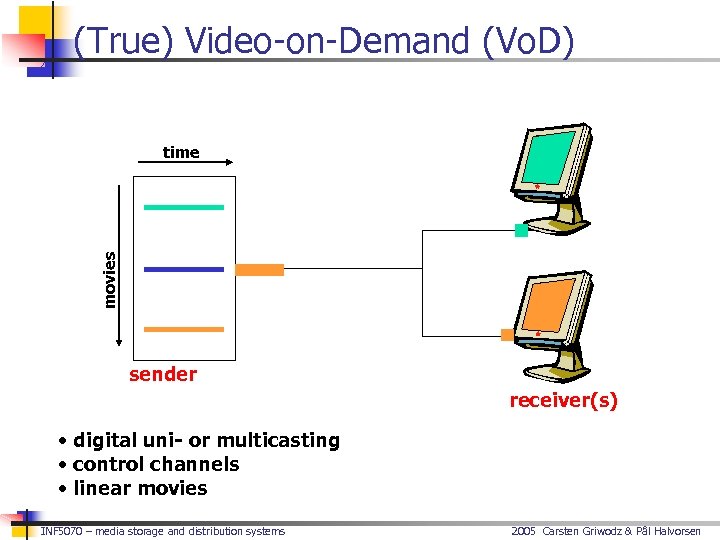
(True) Video-on-Demand (Vo. D) movies time sender receiver(s) • digital uni- or multicasting • control channels • linear movies INF 5070 – media storage and distribution systems 2005 Carsten Griwodz & Pål Halvorsen
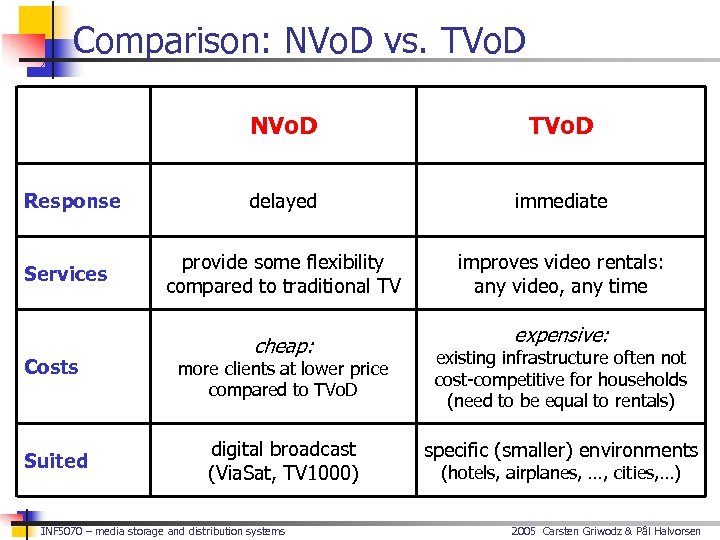
Comparison: NVo. D vs. TVo. D NVo. D Response Services Costs Suited TVo. D delayed immediate provide some flexibility compared to traditional TV improves video rentals: any video, any time cheap: more clients at lower price compared to TVo. D digital broadcast (Via. Sat, TV 1000) INF 5070 – media storage and distribution systems expensive: existing infrastructure often not cost-competitive for households (need to be equal to rentals) specific (smaller) environments (hotels, airplanes, …, cities, …) 2005 Carsten Griwodz & Pål Halvorsen
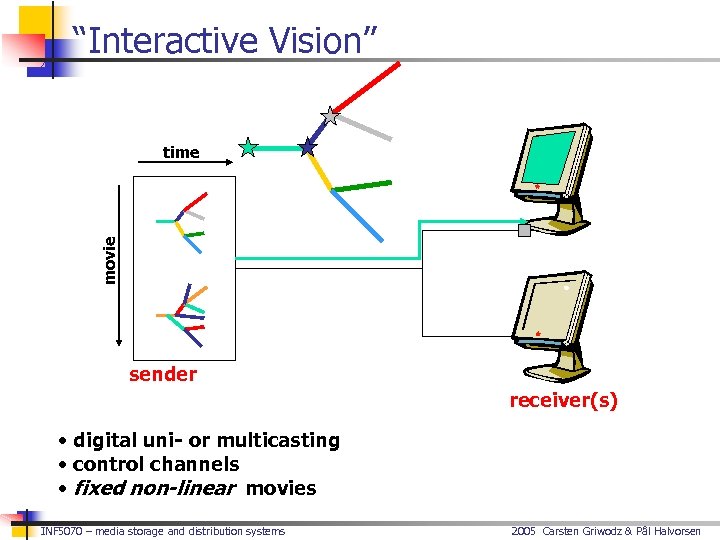
“Interactive Vision” movie time sender receiver(s) • digital uni- or multicasting • control channels • fixed non-linear movies INF 5070 – media storage and distribution systems 2005 Carsten Griwodz & Pål Halvorsen
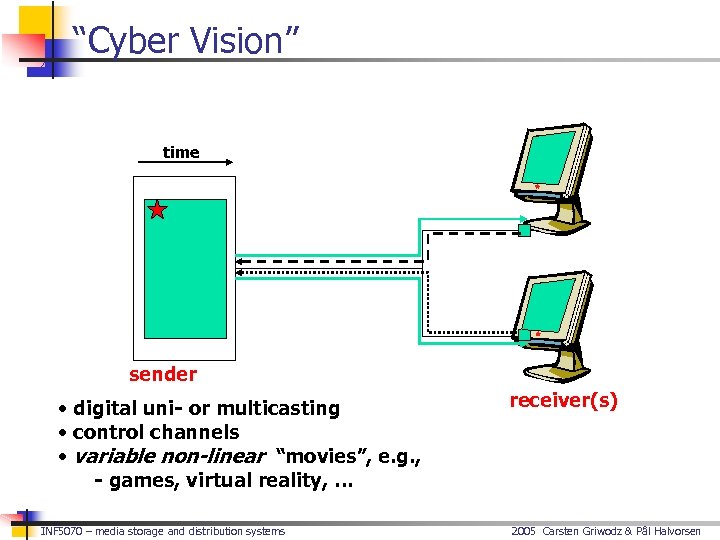
“Cyber Vision” time sender • digital uni- or multicasting • control channels • variable non-linear “movies”, e. g. , - games, virtual reality, … INF 5070 – media storage and distribution systems receiver(s) 2005 Carsten Griwodz & Pål Halvorsen
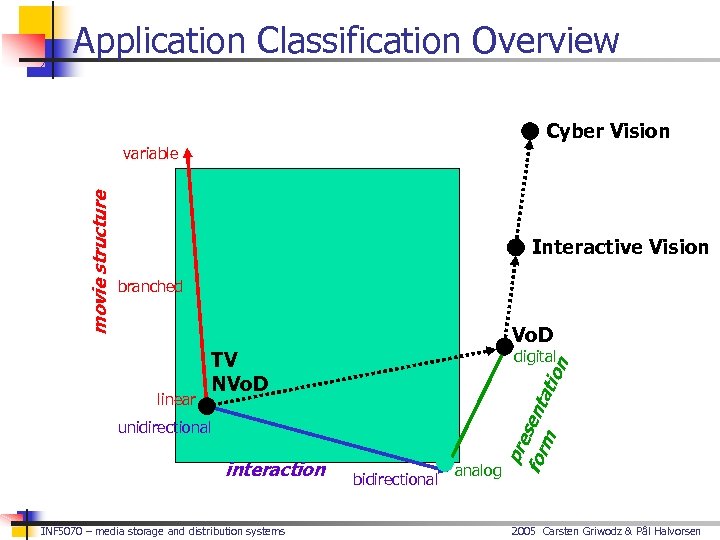
Application Classification Overview Cyber Vision Interactive Vision branched HDTV Vo. D linear digital unidirectional ion TV NVo. D VIDEO interaction INF 5070 – media storage and distribution systems bidirectional pre for sent at m movie structure variable analog 2005 Carsten Griwodz & Pål Halvorsen
Media (Video) on Demand
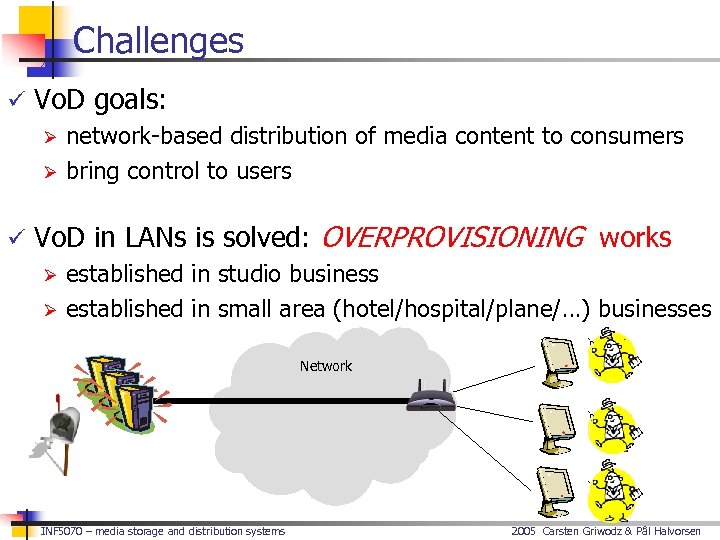
Challenges ü Vo. D goals: Ø network-based distribution of media content to consumers Ø bring control to users ü Vo. D in LANs is solved: OVERPROVISIONING works Ø established in studio business Ø established in small area (hotel/hospital/plane/…) businesses Network INF 5070 – media storage and distribution systems 2005 Carsten Griwodz & Pål Halvorsen
Challenges ü Vo. D in WANs Ø assumptions: n n Ø programs: n n Ø need for interoperability – not from a single source need for co-operative distribution systems amount of data: n n Ø overprovisioning of resources will NOT work no central control of delivery system estimated 65000 movies made in 1995 260 TB MPEG-2 data additionally, data from TV-series, sport clips, news, … historically: n n n much attention as “interactive TV (ITV)” some years ago many (not successful) field trials now: interest turned to Internet-based systems INF 5070 – media storage and distribution systems 2005 Carsten Griwodz & Pål Halvorsen
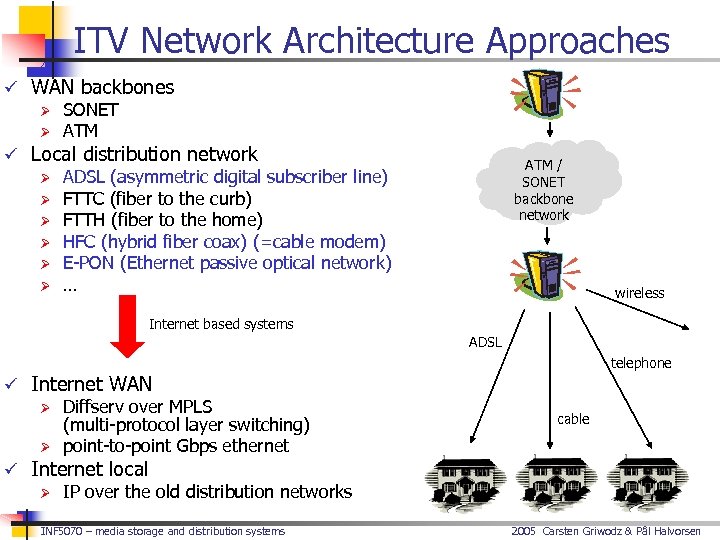
ITV Network Architecture Approaches ü WAN backbones Ø SONET Ø ATM ü Local distribution network Ø ADSL (asymmetric digital subscriber line) Ø FTTC (fiber to the curb) Ø FTTH (fiber to the home) Ø HFC (hybrid fiber coax) (=cable modem) Ø E-PON (Ethernet passive optical network) Ø … ATM / SONET backbone network wireless Internet based systems ADSL telephone ü Internet WAN Ø Diffserv over MPLS (multi-protocol layer switching) Ø point-to-point Gbps ethernet ü Internet local Ø IP over the old distribution networks INF 5070 – media storage and distribution systems cable 2005 Carsten Griwodz & Pål Halvorsen
Concerns: Internet-Based Vo. D Systems ü Can technical problems be mastered? Ø broadband communication to every home Ø user-friendly end systems Ø server technology ü Market success? Ø what prices will consumers accept? n n Ø will it be competitive? n n Ø high equipment (HW & SW) costs data costs to existing TV programs to video rentals what is the consequence of ITV field trials in USA and Europe? n no big success only a few private consumers willing to participate trials were cancelled or switched from TV-based to PC-based platforms INF 5070 – media storage and distribution systems 2005 Carsten Griwodz & Pål Halvorsen
Driving Forces ü Hardware/software (IT) companies Ø computer (e. g. , IBM, HP, Sun, Microsoft, …) Ø consumer electronics (e. g. , Sony, Philips, …) ü Network companies Ø telephone (e. g. , Telenor, Telia, BT, AT&T, …) Ø cable TV (e. g. , UPC, Time-Warner Cable, …) ü Content companies Ø media n n n Ø Ø movies (e. g. , Time-Warner, Disney, …) TV programs (e. g. , NRK, TV 2, TV 3, …) hyper media information bases (e. g. , Springer, Bertelsmann, …) home-shopping (e. g. , Amazon, Ebay, …) video games (e. g. , Nintendo, Sega, Microsoft, …) INF 5070 – media storage and distribution systems 2005 Carsten Griwodz & Pål Halvorsen
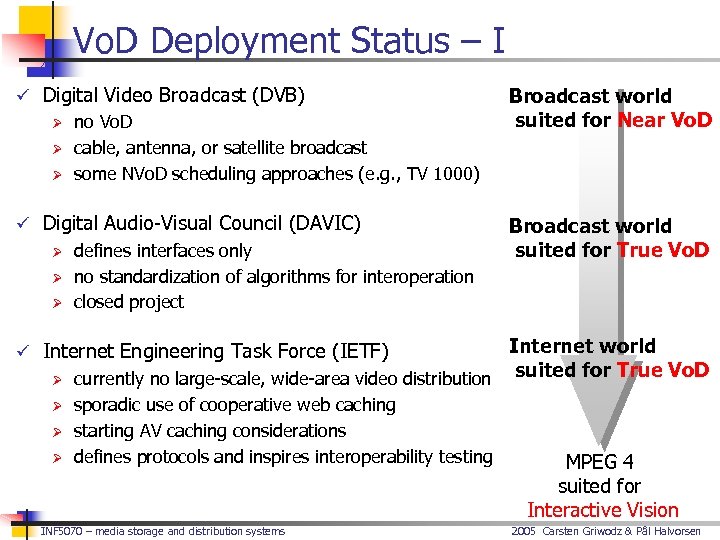
Vo. D Deployment Status – I ü Digital Video Broadcast (DVB) Ø Ø Ø no Vo. D cable, antenna, or satellite broadcast some NVo. D scheduling approaches (e. g. , TV 1000) ü Digital Audio-Visual Council (DAVIC) Ø Ø Ø defines interfaces only no standardization of algorithms for interoperation closed project Broadcast world suited for Near Vo. D Broadcast world suited for True Vo. D Internet world currently no large-scale, wide-area video distribution suited for True Vo. D ü Internet Engineering Task Force (IETF) Ø Ø sporadic use of cooperative web caching starting AV caching considerations defines protocols and inspires interoperability testing INF 5070 – media storage and distribution systems MPEG 4 suited for Interactive Vision 2005 Carsten Griwodz & Pål Halvorsen
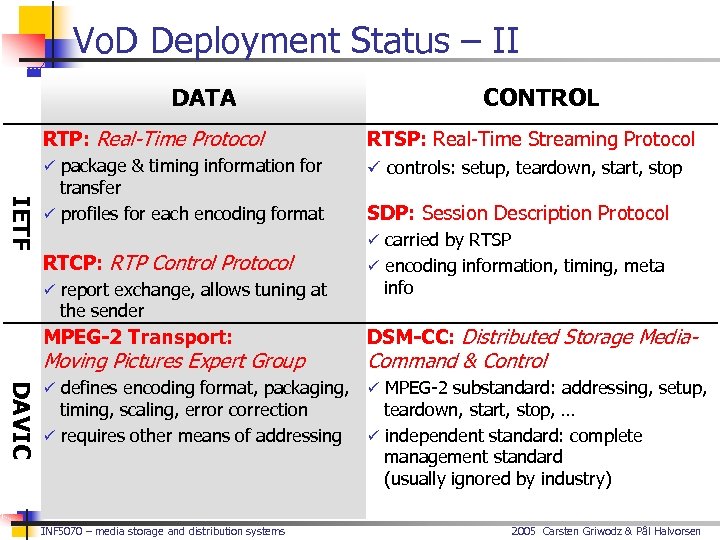
Vo. D Deployment Status – II DATA CONTROL RTP: Real-Time Protocol RTSP: Real-Time Streaming Protocol ü package & timing information for ü controls: setup, teardown, start, stop IETF transfer ü profiles for each encoding format RTCP: RTP Control Protocol ü report exchange, allows tuning at SDP: Session Description Protocol ü carried by RTSP ü encoding information, timing, meta info the sender MPEG-2 Transport: DSM-CC: Distributed Storage Media- ü defines encoding format, packaging, ü MPEG-2 substandard: addressing, setup, Moving Pictures Expert Group DAVIC timing, scaling, error correction ü requires other means of addressing INF 5070 – media storage and distribution systems Command & Control teardown, start, stop, … ü independent standard: complete management standard (usually ignored by industry) 2005 Carsten Griwodz & Pål Halvorsen
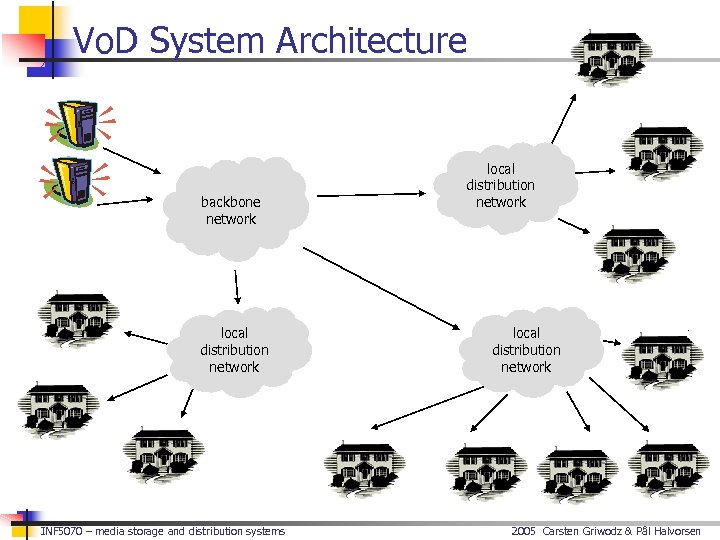
Vo. D System Architecture backbone network local distribution network INF 5070 – media storage and distribution systems local distribution network 2005 Carsten Griwodz & Pål Halvorsen
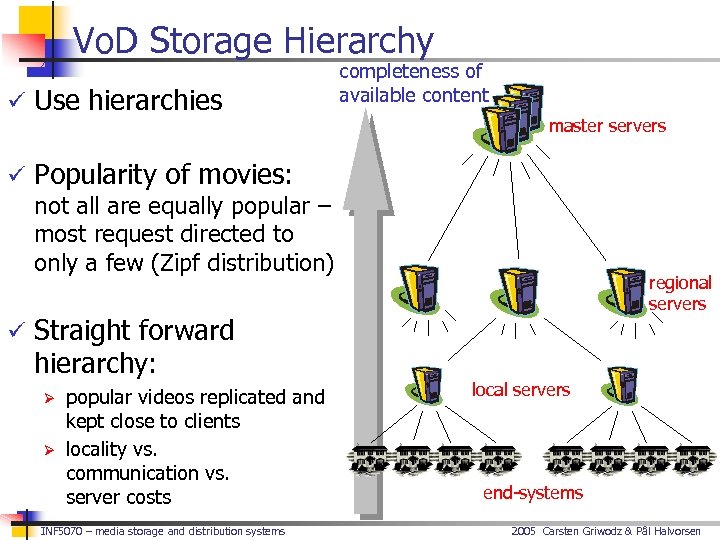
Vo. D Storage Hierarchy ü Use hierarchies completeness of available content master servers ü Popularity of movies: not all are equally popular – most request directed to only a few (Zipf distribution) regional servers ü Straight forward hierarchy: Ø Ø popular videos replicated and kept close to clients locality vs. communication vs. server costs INF 5070 – media storage and distribution systems local servers end-systems 2005 Carsten Griwodz & Pål Halvorsen
Vo. D Components ü Servers ü Networks Ø backbone Ø local networks ü Intermediate nodes Ø routers Ø proxy cache servers ü End-systems Ø PCs Ø TV sets with set-top boxes INF 5070 – media storage and distribution systems 2005 Carsten Griwodz & Pål Halvorsen
Traditional Server Machine Internals
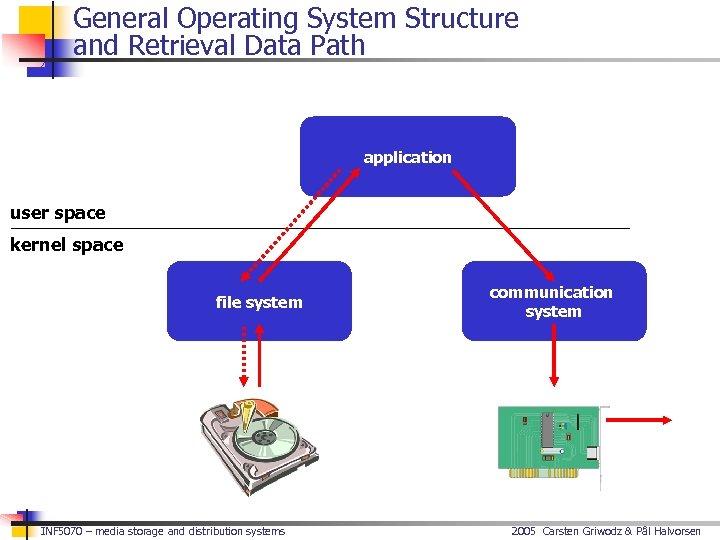
General Operating System Structure and Retrieval Data Path application user space kernel space file system INF 5070 – media storage and distribution systems communication system 2005 Carsten Griwodz & Pål Halvorsen
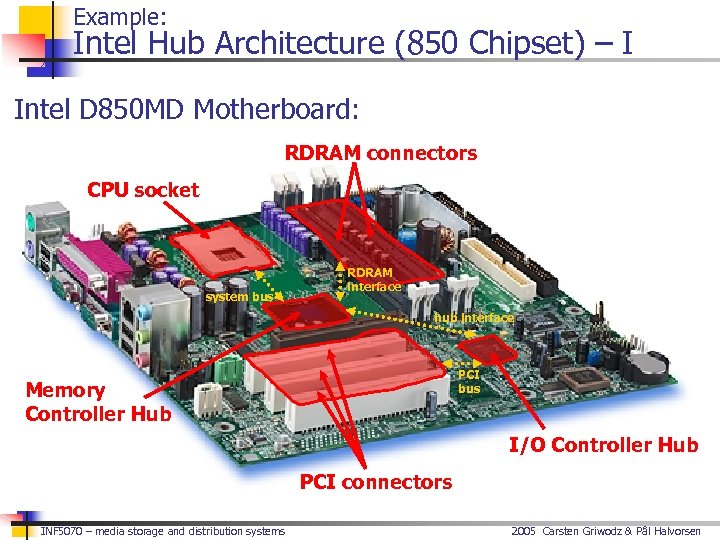
Example: Intel Hub Architecture (850 Chipset) – I Intel D 850 MD Motherboard: RDRAM connectors CPU socket system bus RDRAM interface hub interface PCI bus Memory Controller Hub I/O Controller Hub PCI connectors INF 5070 – media storage and distribution systems 2005 Carsten Griwodz & Pål Halvorsen
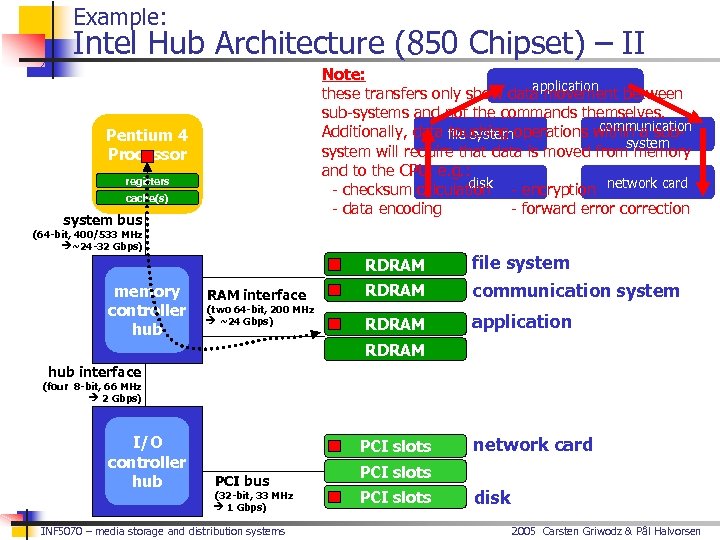
Example: Intel Hub Architecture (850 Chipset) – II Note: application these transfers only show data movement between sub-systems and not the commands themselves. communication Additionally, data file system operations within a subtouching system will require that data is moved from memory and to the CPU, e. g. : disk - checksum calculation - encryption network card - data encoding - forward error correction Pentium 4 Processor registers cache(s) system bus (64 -bit, 400/533 MHz ~24 -32 Gbps) RDRAM memory controller hub RAM interface (two 64 -bit, 200 MHz ~24 Gbps) file system RDRAM communication system RDRAM application RDRAM hub interface (four 8 -bit, 66 MHz 2 Gbps) I/O controller hub PCI slots PCI bus (32 -bit, 33 MHz 1 Gbps) INF 5070 – media storage and distribution systems network card PCI slots disk 2005 Carsten Griwodz & Pål Halvorsen
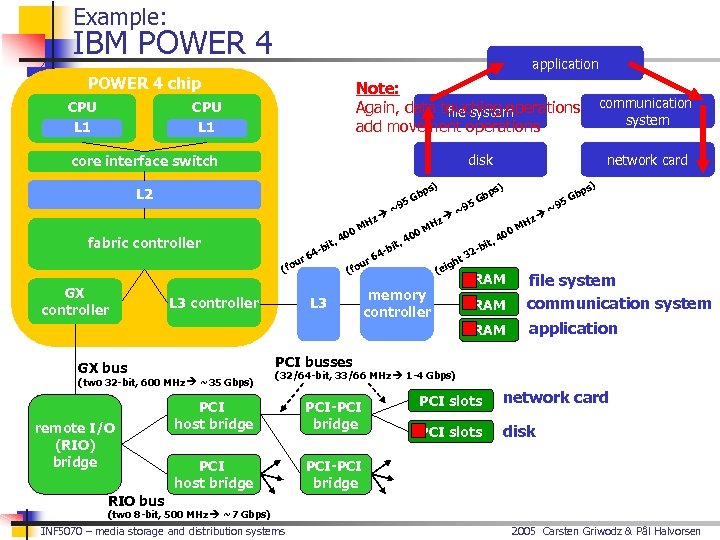
Example: IBM POWER 4 application POWER 4 chip CPU L 1 Note: Again, data touching operations file system add movement operations CPU L 1 communication system disk core interface switch ) ps L 2 0 M fabric controller 0 , 4 bit 4 - 6 ur (fo ~9 H 0 M 0 , 4 bit z ~9 (e 3 ht ig Hz ~9 0 M 0 t, 4 bi 2 - u (fo b 5 G - 4 r 6 ) ps b 5 G Hz network card RAM application RAM PCI busses GX bus (two 32 -bit, 600 MHz ~35 Gbps) remote I/O (RIO) bridge L 3 controller memory controller file system communication system RAM GX controller (32/64 -bit, 33/66 MHz 1 -4 Gbps) PCI host bridge PCI-PCI bridge PCI host bridge PCI slots network card PCI slots disk PCI-PCI bridge RIO bus (two 8 -bit, 500 MHz ~7 Gbps) INF 5070 – media storage and distribution systems 2005 Carsten Griwodz & Pål Halvorsen
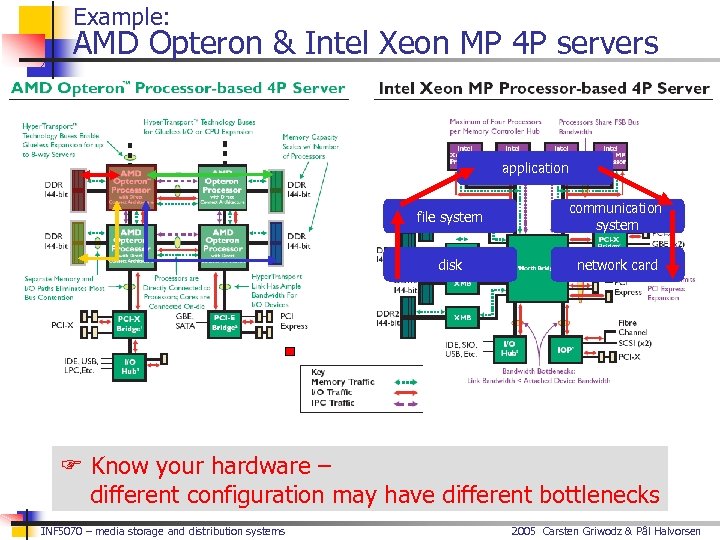
Example: AMD Opteron & Intel Xeon MP 4 P servers application file system communication system disk network card F Know your hardware – different configuration may have different bottlenecks INF 5070 – media storage and distribution systems 2005 Carsten Griwodz & Pål Halvorsen
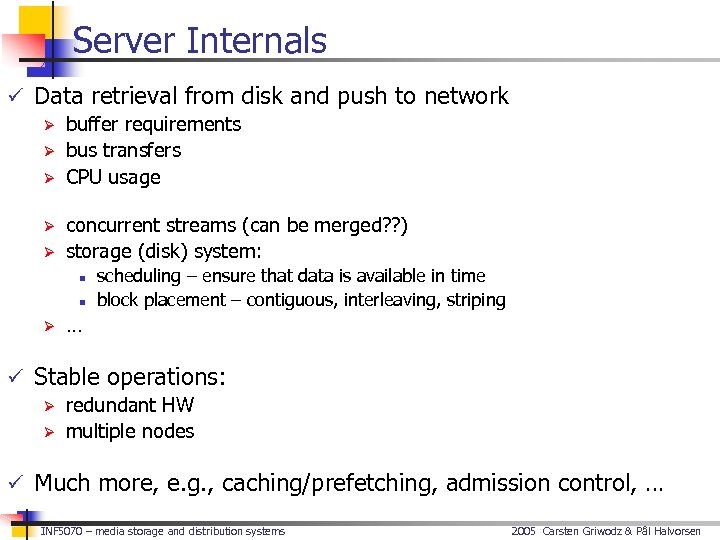
Server Internals ü Data retrieval from disk and push to network Ø buffer requirements Ø bus transfers Ø CPU usage Ø Ø concurrent streams (can be merged? ? ) storage (disk) system: n n Ø scheduling – ensure that data is available in time block placement – contiguous, interleaving, striping … ü Stable operations: Ø redundant HW Ø multiple nodes ü Much more, e. g. , caching/prefetching, admission control, … INF 5070 – media storage and distribution systems 2005 Carsten Griwodz & Pål Halvorsen
Video Server Structure
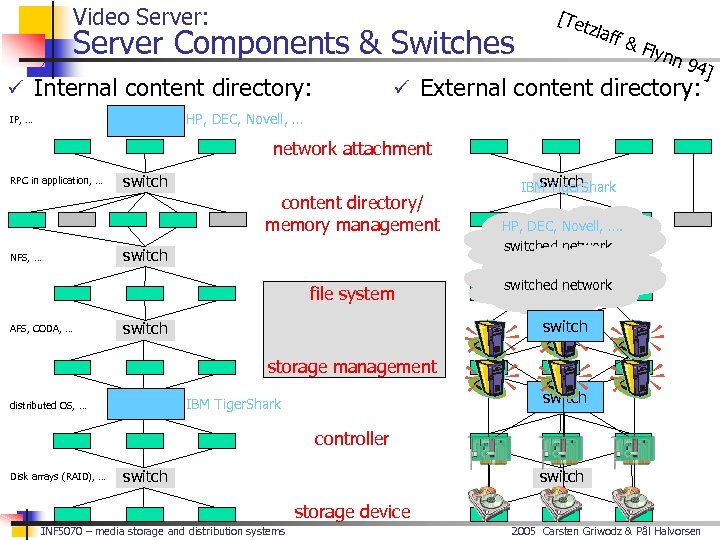
Video Server: Server Components & Switches ü Internal content directory: [Te tzla ff & Flyn n 94 ü External content directory: HP, DEC, Novell, … IP, … network attachment RPC in application, … switch content directory/ memory management NFS, … switch HP, DEC, Novell, …. switched network switch file system AFS, CODA, … switch IBM Tiger. Shark switched network switch storage management distributed OS, … switch IBM Tiger. Shark controller Disk arrays (RAID), … switch storage device INF 5070 – media storage and distribution systems 2005 Carsten Griwodz & Pål Halvorsen ]
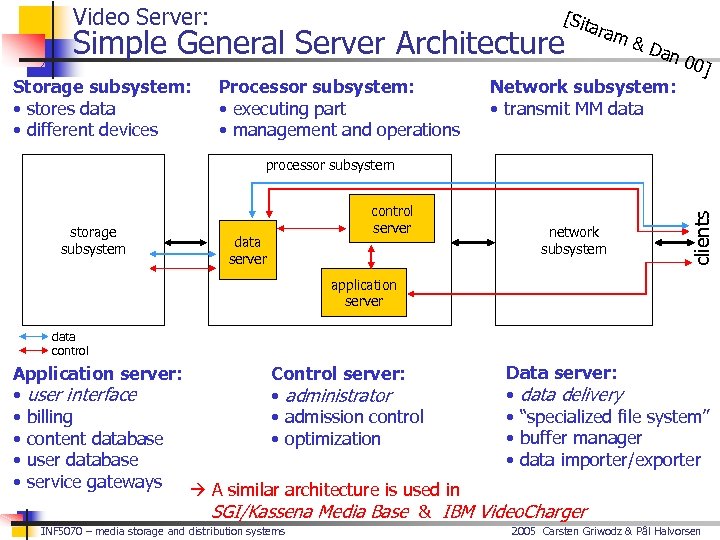
Video Server: [Sit Simple General Server Architecture Storage subsystem: • stores data • different devices Processor subsystem: • executing part • management and operations aram &D an 0 Network subsystem: • transmit MM data 0] storage subsystem data server control server network subsystem clients processor subsystem application server data control Data server: Application server: Control server: • data delivery • user interface • administrator • “specialized file system” • billing • admission control • buffer manager • content database • optimization • data importer/exporter • user database • service gateways A similar architecture is used in SGI/Kassena Media Base & IBM Video. Charger INF 5070 – media storage and distribution systems 2005 Carsten Griwodz & Pål Halvorsen
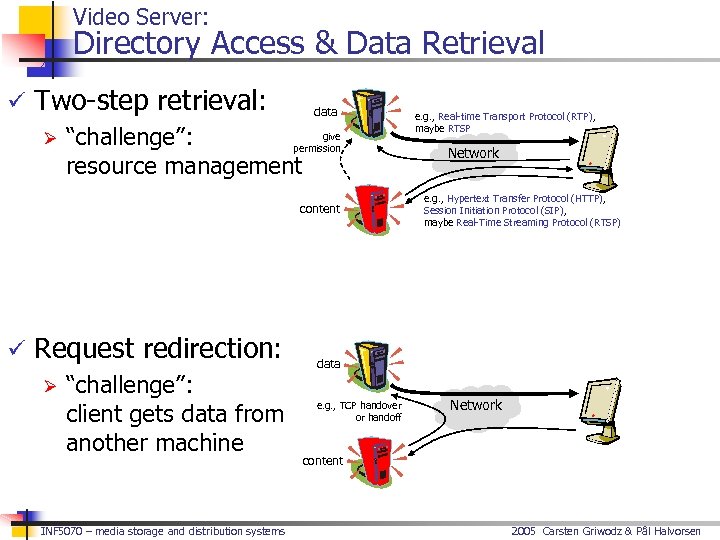
Video Server: Directory Access & Data Retrieval ü Two-step retrieval: data give Ø “challenge”: permission resource management content ü Request redirection: Ø “challenge”: client gets data from another machine INF 5070 – media storage and distribution systems e. g. , Real-time Transport Protocol (RTP), maybe RTSP Network e. g. , Hypertext Transfer Protocol (HTTP), Session Initiation Protocol (SIP), maybe Real-Time Streaming Protocol (RTSP) data e. g. , TCP handover or handoff Network content 2005 Carsten Griwodz & Pål Halvorsen
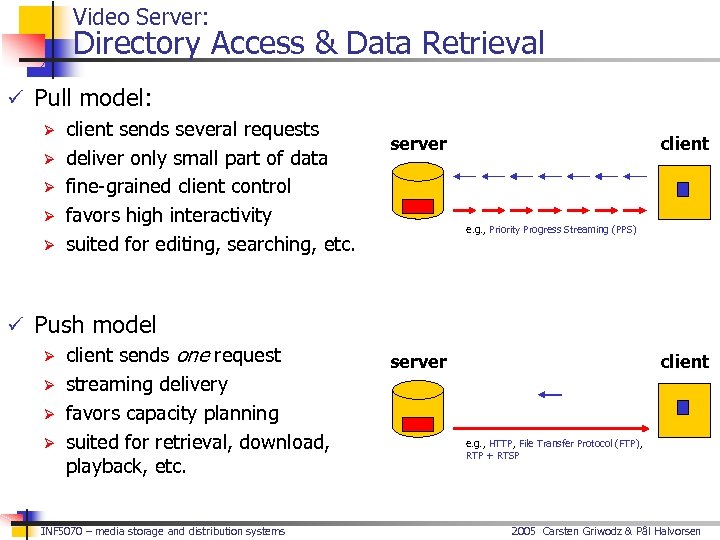
Video Server: Directory Access & Data Retrieval ü Pull model: Ø client sends several requests Ø deliver only small part of data Ø fine-grained client control Ø favors high interactivity Ø suited for editing, searching, etc. ü Push model Ø client sends one request Ø streaming delivery Ø favors capacity planning Ø suited for retrieval, download, playback, etc. INF 5070 – media storage and distribution systems server client e. g. , Priority Progress Streaming (PPS) server client e. g. , HTTP, File Transfer Protocol (FTP), RTP + RTSP 2005 Carsten Griwodz & Pål Halvorsen
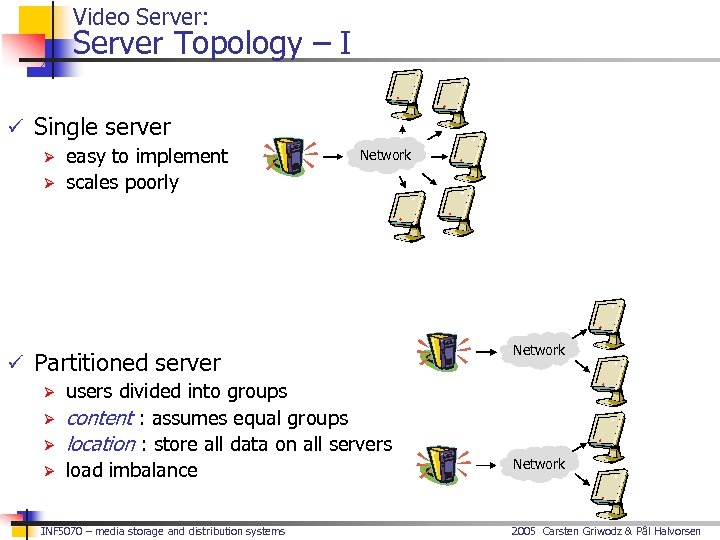
Video Server: Server Topology – I ü Single server Ø easy to implement Ø scales poorly Network ü Partitioned server Ø users divided into groups Ø content : assumes equal groups Ø location : store all data on all servers Ø load imbalance INF 5070 – media storage and distribution systems Network 2005 Carsten Griwodz & Pål Halvorsen
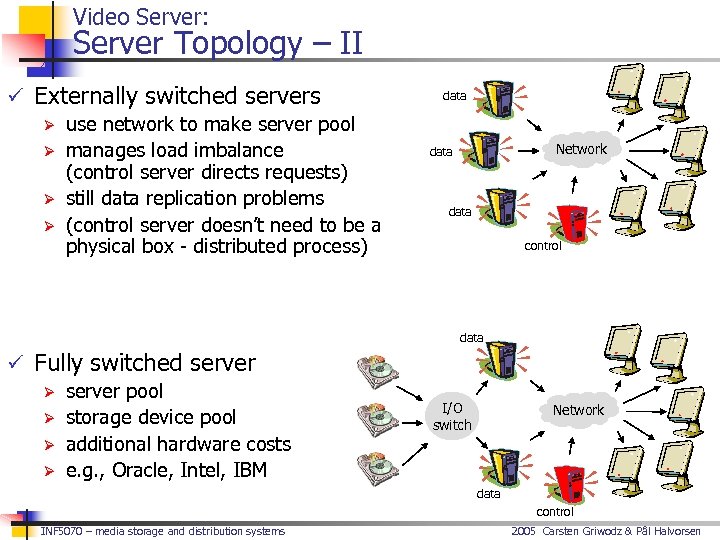
Video Server: Server Topology – II ü Externally switched servers Ø use network to make server pool Ø manages load imbalance (control server directs requests) Ø still data replication problems Ø (control server doesn’t need to be a physical box - distributed process) data Network data control data ü Fully switched server Ø server pool Ø storage device pool Ø additional hardware costs Ø e. g. , Oracle, Intel, IBM I/O switch Network data control INF 5070 – media storage and distribution systems 2005 Carsten Griwodz & Pål Halvorsen
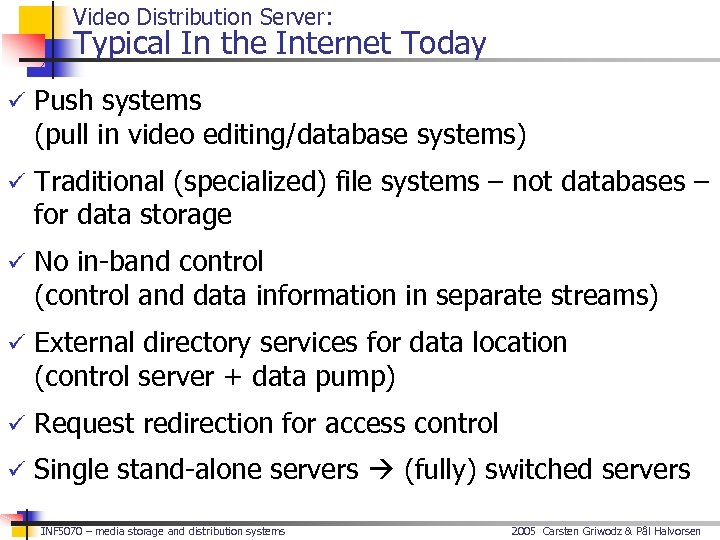
Video Distribution Server: Typical In the Internet Today ü Push systems (pull in video editing/database systems) ü Traditional (specialized) file systems – not databases – for data storage ü No in-band control (control and data information in separate streams) ü External directory services for data location (control server + data pump) ü Request redirection for access control ü Single stand-alone servers (fully) switched servers INF 5070 – media storage and distribution systems 2005 Carsten Griwodz & Pål Halvorsen
Server Examples
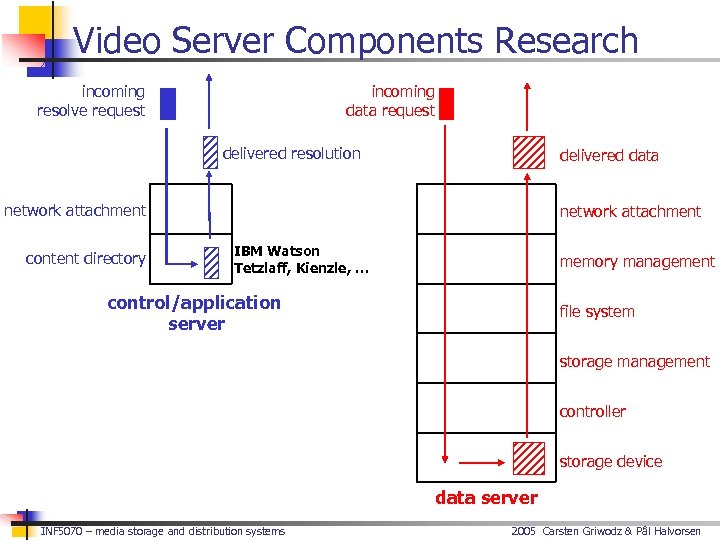
Video Server Components Research incoming resolve request incoming data request delivered resolution delivered data network attachment content directory network attachment IBM Watson Tetzlaff, Kienzle, … memory management control/application server file system storage management controller storage device data server INF 5070 – media storage and distribution systems 2005 Carsten Griwodz & Pål Halvorsen
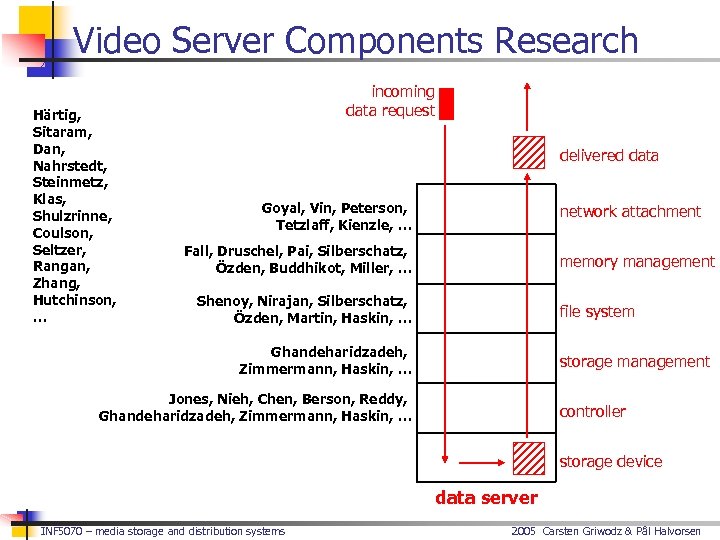
Video Server Components Research Härtig, Sitaram, Dan, Nahrstedt, Steinmetz, Klas, Shulzrinne, Coulson, Seltzer, Rangan, Zhang, Hutchinson, … incoming data request delivered data Goyal, Vin, Peterson, Tetzlaff, Kienzle, … network attachment Fall, Druschel, Pai, Silberschatz, Özden, Buddhikot, Miller, … memory management Shenoy, Nirajan, Silberschatz, Özden, Martin, Haskin, … file system Ghandeharidzadeh, Zimmermann, Haskin, … storage management Jones, Nieh, Chen, Berson, Reddy, Ghandeharidzadeh, Zimmermann, Haskin, … controller storage device data server INF 5070 – media storage and distribution systems 2005 Carsten Griwodz & Pål Halvorsen
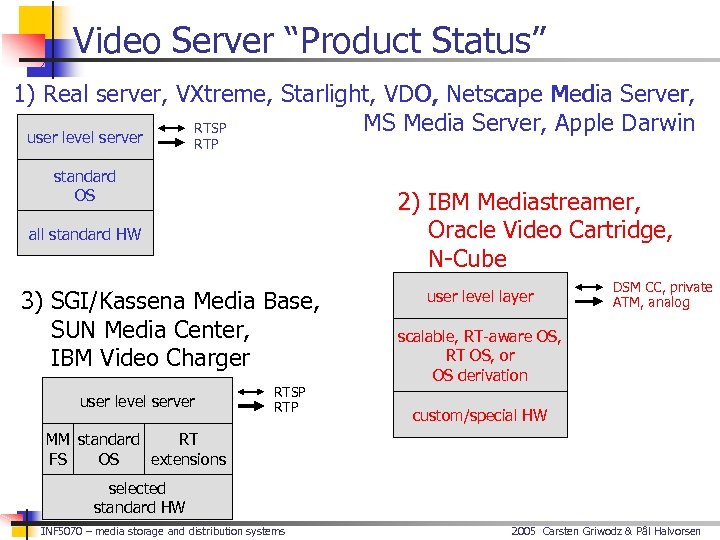
Video Server “Product Status” 1) Real server, VXtreme, Starlight, VDO, Netscape Media Server, MS Media Server, Apple Darwin RTSP user level server RTP standard OS 2) IBM Mediastreamer, Oracle Video Cartridge, N-Cube all standard HW 3) SGI/Kassena Media Base, SUN Media Center, IBM Video Charger user level server RTSP RTP user level layer DSM CC, private ATM, analog scalable, RT-aware OS, RT OS, or OS derivation custom/special HW MM standard RT FS OS extensions selected standard HW INF 5070 – media storage and distribution systems 2005 Carsten Griwodz & Pål Halvorsen
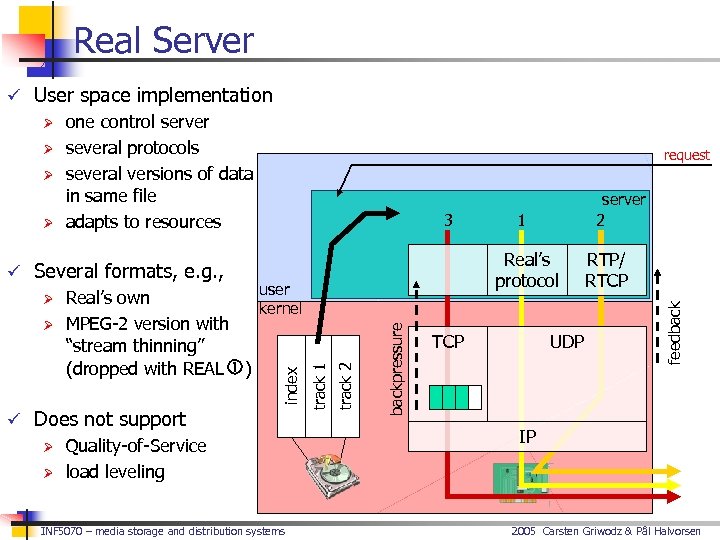
Real Server ü User space implementation Ø Ø Ø one control server several protocols several versions of data in same file adapts to resources request 3 Ø Ø Quality-of-Service load leveling INF 5070 – media storage and distribution systems backpressure track 2 ü Does not support track 1 index Ø user Real’s own kernel MPEG-2 version with “stream thinning” (dropped with REAL ) 1 Real’s protocol ü Several formats, e. g. , Ø server 2 TCP UDP RTP/ RTCP feedback Ø IP 2005 Carsten Griwodz & Pål Halvorsen
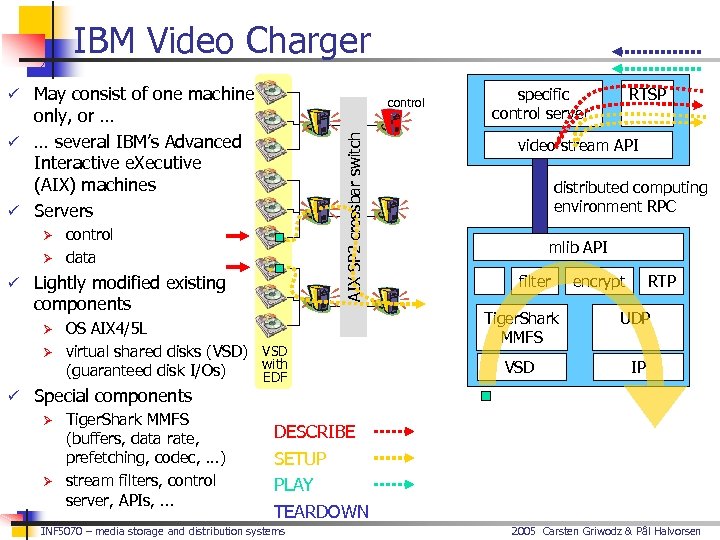
IBM Video Charger ü May consist of one machine control Ø Ø AIX SP 2 crossbar switch only, or … ü … several IBM’s Advanced Interactive e. Xecutive (AIX) machines ü Servers control data ü Lightly modified existing components Ø Ø OS AIX 4/5 L virtual shared disks (VSD) VSD with (guaranteed disk I/Os) EDF ü Special components Ø Tiger. Shark MMFS (buffers, data rate, prefetching, codec, . . . ) Ø stream filters, control server, APIs, . . . specific control server RTSP video stream API distributed computing environment RPC mlib API filter encrypt RTP Tiger. Shark MMFS UDP VSD IP DESCRIBE SETUP PLAY TEARDOWN INF 5070 – media storage and distribution systems 2005 Carsten Griwodz & Pål Halvorsen
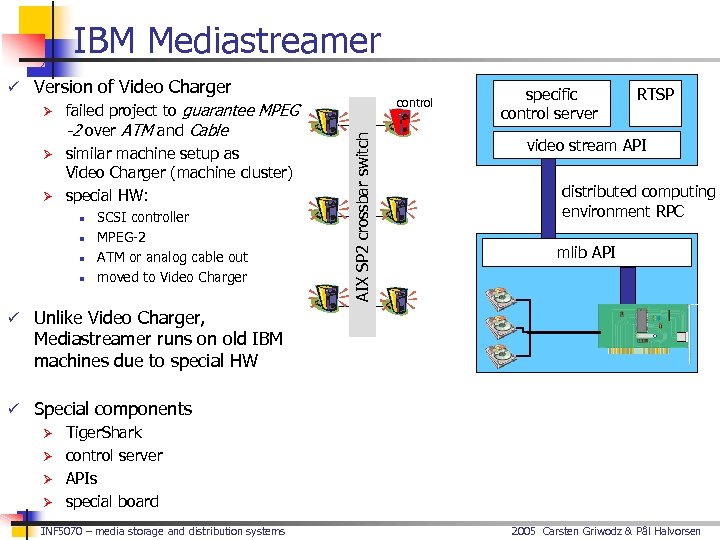
IBM Mediastreamer n n SCSI controller MPEG-2 ATM or analog cable out moved to Video Charger control AIX SP 2 crossbar switch ü Version of Video Charger Ø failed project to guarantee MPEG -2 over ATM and Cable Ø similar machine setup as Video Charger (machine cluster) Ø special HW: specific control server RTSP video stream API distributed computing environment RPC mlib API ü Unlike Video Charger, Mediastreamer runs on old IBM machines due to special HW ü Special components Ø Tiger. Shark Ø control server Ø APIs Ø special board INF 5070 – media storage and distribution systems 2005 Carsten Griwodz & Pål Halvorsen
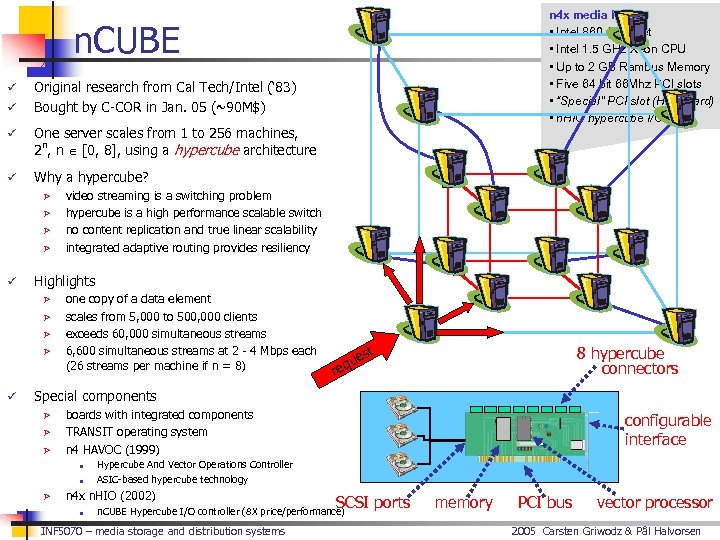
n 4 x media hubs: • Intel 860 Chip Set • Intel 1. 5 GHz Xeon CPU • Up to 2 GB Rambus Memory • Five 64 bit 66 Mhz PCI slots • “Special” PCI slot (HIB board) • n. HIO hypercube I/O n. CUBE ü ü Original research from Cal Tech/Intel (‘ 83) Bought by C-COR in Jan. 05 (~90 M$) ü One server scales from 1 to 256 machines, 2 n, n [0, 8], using a hypercube architecture ü Why a hypercube? Ø Ø ü Highlights Ø Ø ü video streaming is a switching problem hypercube is a high performance scalable switch no content replication and true linear scalability integrated adaptive routing provides resiliency one copy of a data element scales from 5, 000 to 500, 000 clients exceeds 60, 000 simultaneous streams 6, 600 simultaneous streams at 2 - 4 Mbps each (26 streams per machine if n = 8) st ue q 8 hypercube connectors re Special components Ø Ø Ø boards with integrated components TRANSIT operating system n 4 HAVOC (1999) n n Ø Hypercube And Vector Operations Controller ASIC-based hypercube technology n 4 x n. HIO (2002) n configurable interface SCSI ports n. CUBE Hypercube I/O controller (8 X price/performance) INF 5070 – media storage and distribution systems memory PCI bus vector processor 2005 Carsten Griwodz & Pål Halvorsen
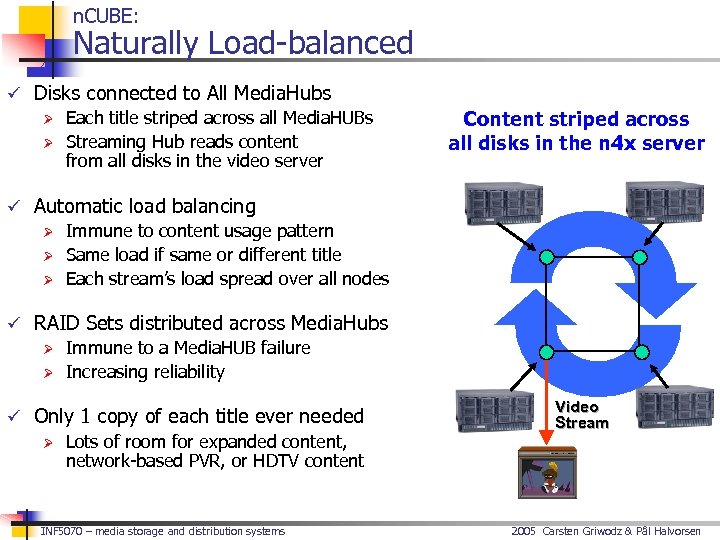
n. CUBE: Naturally Load-balanced ü Disks connected to All Media. Hubs Ø Each title striped across all Media. HUBs Ø Streaming Hub reads content from all disks in the video server Content striped across all disks in the n 4 x server ü Automatic load balancing Ø Immune to content usage pattern Ø Same load if same or different title Ø Each stream’s load spread over all nodes ü RAID Sets distributed across Media. Hubs Ø Immune to a Media. HUB failure Ø Increasing reliability ü Only 1 copy of each title ever needed Ø Lots of room for expanded content, network-based PVR, or HDTV content INF 5070 – media storage and distribution systems Video Stream 2005 Carsten Griwodz & Pål Halvorsen
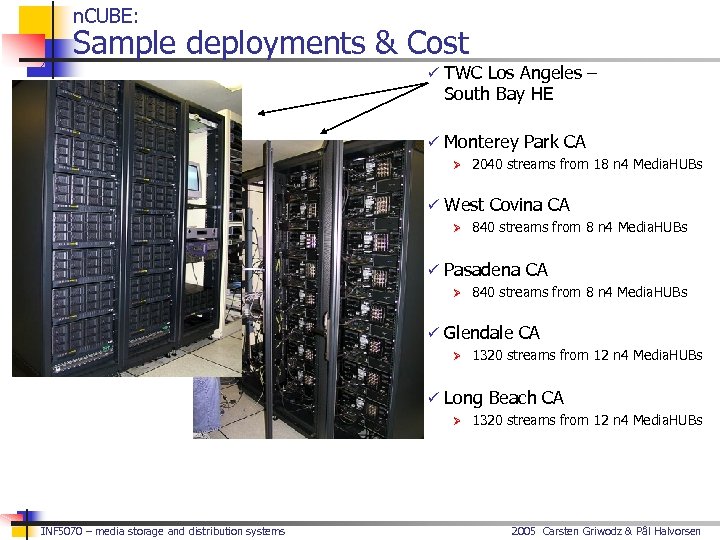
n. CUBE: Sample deployments & Cost ü TWC Los Angeles – South Bay HE ü Monterey Park CA Ø 2040 streams from 18 n 4 Media. HUBs ü West Covina CA Ø 840 streams from 8 n 4 Media. HUBs ü Pasadena CA Ø 840 streams from 8 n 4 Media. HUBs ü Glendale CA Ø 1320 streams from 12 n 4 Media. HUBs ü Long Beach CA Ø INF 5070 – media storage and distribution systems 1320 streams from 12 n 4 Media. HUBs 2005 Carsten Griwodz & Pål Halvorsen
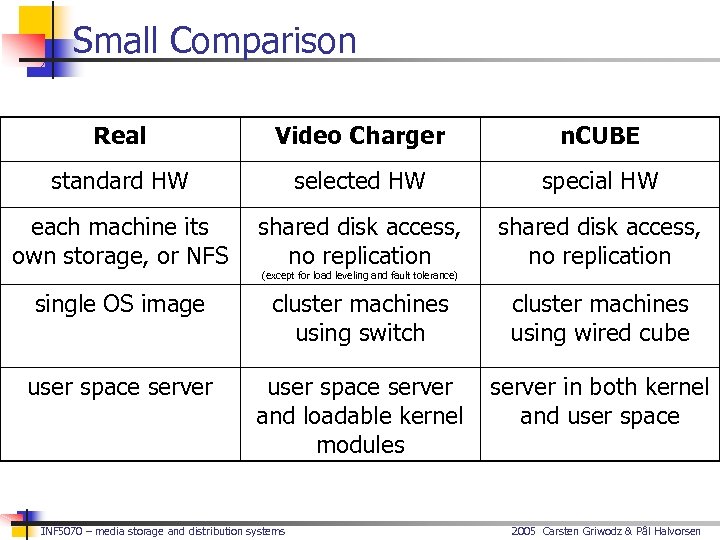
Small Comparison Real Video Charger n. CUBE standard HW selected HW special HW each machine its own storage, or NFS shared disk access, no replication single OS image cluster machines using switch cluster machines using wired cube user space server and loadable kernel modules server in both kernel and user space (except for load leveling and fault tolerance) INF 5070 – media storage and distribution systems 2005 Carsten Griwodz & Pål Halvorsen
Summary ü Multimedia applications and challenges ü Media (Video) on Demand ü Machine internals ü Video server structures ü Video server examples INF 5070 – media storage and distribution systems 2005 Carsten Griwodz & Pål Halvorsen
Скачать презентацию INF 5070 Media Storage and Distribution Systems
07814646a22d000abc72c25637132649.ppt