


 Скачать презентацию Inequality and Institutions in 20 th Century America
625df4f9c507c721a2d1796603bb9c09.ppt
- Количество слайдов: 34
 Inequality and Institutions in 20 th Century America Frank Levy and Peter Temin
 Economic growth raises living standard • But a rising tide does not necessarily lift all boats – A rising GDP does not raise everyone’s income • Median real annual earning of male BAs did not rise, 1989 -2004. – Real GDP per hour rose 44%
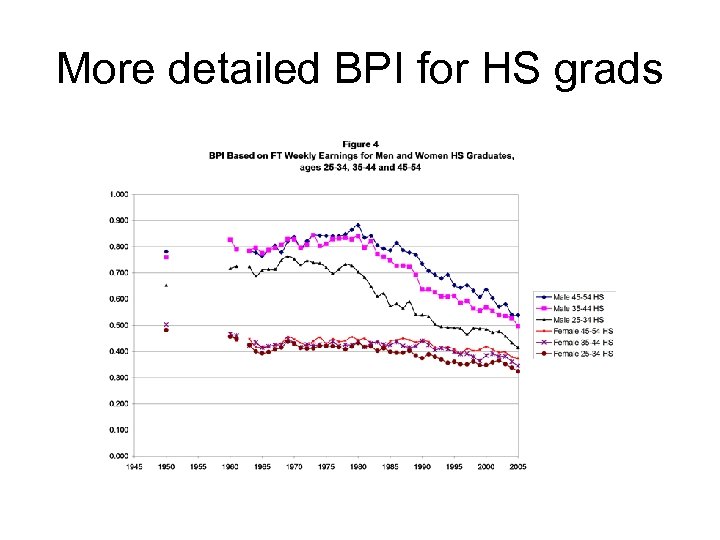
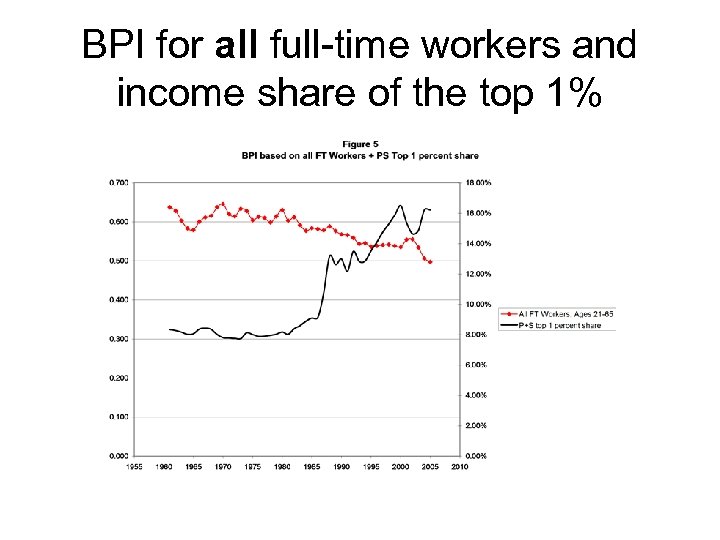
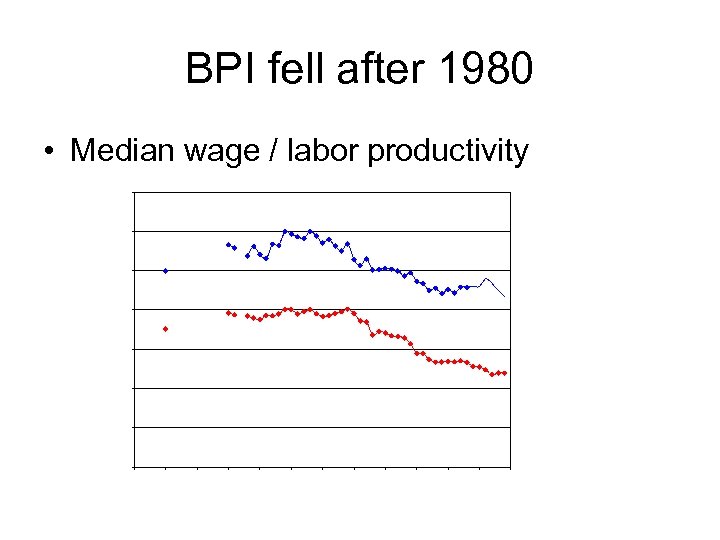 BPI fell after 1980 • Median wage / labor productivity
 Where did the rest of GDP Go? • Piketty and Saez (2003) found that the income share of the top 1% rose dramatically • Half of income growth since 1980 went to top 1% • The rest appears to have gone to rich workers below the top 1% – Capital share did not rise
 Previous research on wages • Mostly focused on the benefits of education • Both HS and college graduate wages fell relative to productivity • Although the gap between them widened
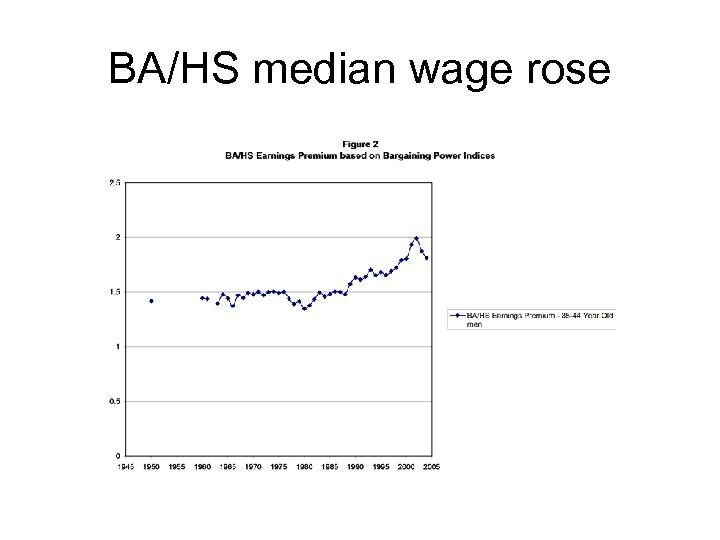 BA/HS median wage rose
 Education is only part of the story • We argue the declining BPI is due to a change in institutions • From the Treaty of Detroit • To the Washington Consensus • Specific stories (education, trade, technology) are set within this overall change
 Plan of presentation • Data analysis • The Treaty of Detroit • The end of the Treaty – Reducing workers’ BPI • Connecting our data and story • Conclusions
 BPI numerator • Nominal median wages • Multiplied by the ratio of supplements to wages – Only available for all workers – May underestimate gaps between workers – But will not affect trends
 BPI denominator • Nominal GDP • Divided by persons engaged in production • NB: capital share of GDP has no trend, 1960 -2000 – Reallocation is within wages – P&S report that high incomes are now in earnings, not returns to capital
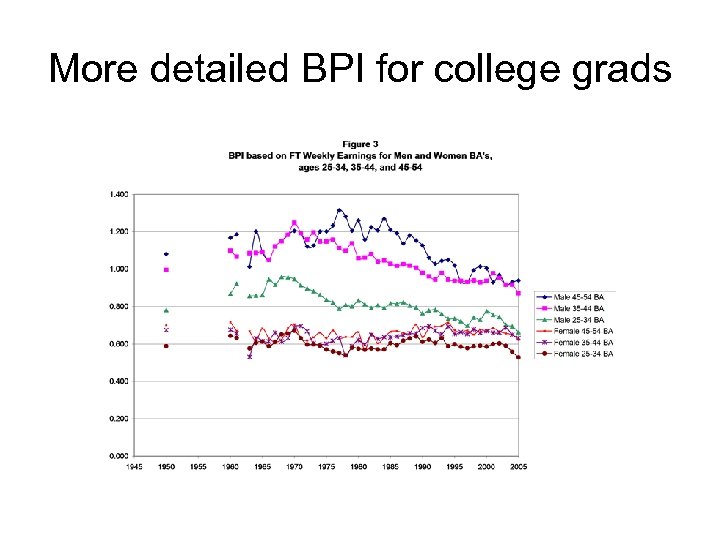 More detailed BPI for college grads
 More detailed BPI for HS grads
 BPI for all full-time workers and income share of the top 1%
 Institutions • FDR did not know macroeconomics • Made many changes in micro-economic institutions • NIRA (1933), replaced by NLRA (1935) – Supreme Court rejected NIRA in 1935; accepted NLRA in 1937 • Promoted unions and collective bargaining • As did worker demands in the Depression
 Top income taxes also rose
 Wartime changes • Emphasis changed from wages to production • NWLB (1942) mediated • Frozen wages, no strikes or lock-outs • Benefits were not included as wages • Exempted from taxes • Legacy: procedures and people
 Truman’s 1945 conference • Invited only 36 business and labor leaders • Signaled that government would be involved – “third man in the ring” • Statement by Chairman of the US C. of C. – “Labor unions are woven into our economic pattern of American life, and collective bargaining is a part of the democratic process. I say recognize this fact not only with our lips but with our hearts. ”
 Taft-Hartley Act, 1947 • Demonstrated business opposition to unions – Restricted some union practices • But still kept most previous agreements • Government began to edge out of the ring • Unions turned to private bargains
 Reuther and Wilson, 1948 • Wilson, CEO of GM, wanted labor peace – Reuther recently had survived an attempted assassination • GM proposed a two-year contract with: – COLA: cost of living adjustment – AIF: annual improvement factor • UAW would give GM control of production – And labor assignment
 Reuther’s attitude • Reuther agreed to the plan and wage formulas “only because most of those in control of government and industry show no signs of acting in the public interest. They are enforcing a system of private planning for private profit at public expense” (Lichtenstein, 1995).
 Renewal for 5 years • • Ford agreed, added pensions GM signed on readily Chrysler agreed only after a long strike Fortune called the UAW-GM contract the Treaty of Detroit
 Life under the Treaty of Detroit • • • Pattern bargaining Relative wages moved together Far more widely than the auto industry Contract issues also moved together But there was still some labormanagement conflict
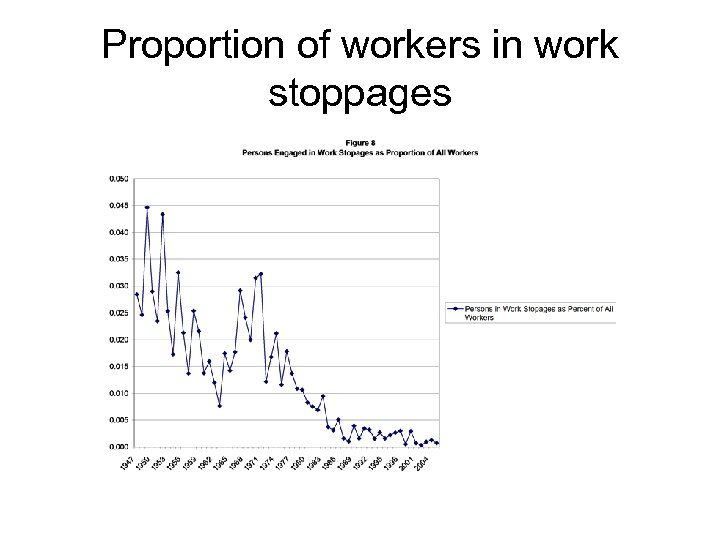 Proportion of workers in work stoppages
 Benefits of the Treaty of Detroit • Expanding middle class – People could afford single homes, cars • Enhanced upward mobility – People lived better than their parents • A safety net for industrial change – Workers taking a pay cut from a lost job could get back to original pay quickly
 Stagflation • The Vietnam War produced stagflation • Not understood with 1970 s macro – Similar to FDR in the Depression • Treated as microeconomics by Carter – Appointed Fred Kahn (IO) as inflation czar – Supported deregulation to fight inflation
 Changing labor law • AFL-CIO proposed minor changes to labor law in 1978 – Reaffirming the Treaty of Detroit system • Passed in the House by 257 to 163 • But filibustered in the Senate – It would have passed a vote • Employers were dead set against the bill
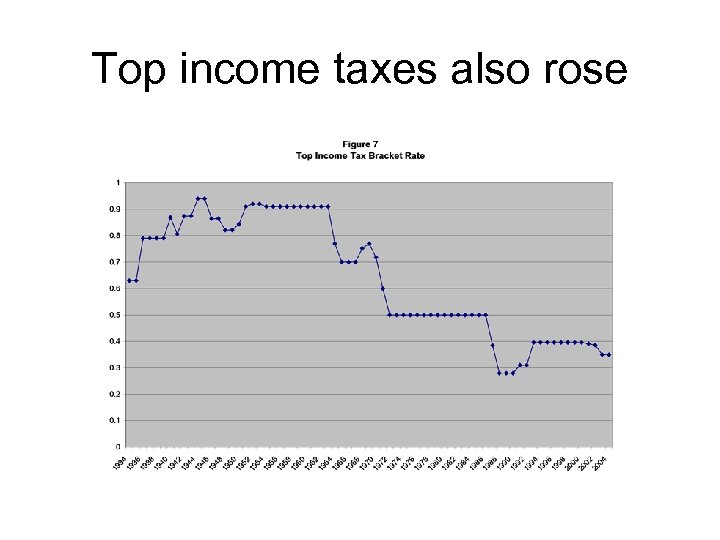
 Reagan’s changes • Supported Volcker (appointed by Carter) – Accepted unemployment to stop inflation • Reduced tax rates on top incomes • Broke the strike of air controllers – Even though they had supported him
 Industrial fluctuations • Declining dollar in the 1970 s had helped wages – Rural Renaissance • Rising dollar in the 1980 s hurt workers – Rust Belt • Loss of postwar industries put unions under siege – Fluctuations made for rapid transitions
 Washington Consensus • Theory followed practice • Argued that deregulation promoted progress – Everyone would benefit • Inequality was the price of progress – Could be offset by ex-post redistribution
 But redistribution was never done • Reagan allowed the minimum wage to fall – A cause of inequality • NLRB had been politicized by Eisenhower – Reagan appointed a management consultant – Decisions favored companies • Work stoppages fell (shown earlier) – Discouragement rather than conflict
 Clinton continued the Washington Consensus • • Favored deregulation Promoted globalization International competition for jobs Norms of equal wage gains faded, hurting college graduates • NB: Clinton did some ex-post redistribution – Expanded the EITC
 Connecting the Dots, I • Domestic tests • Treaty of Detroit affected NE conditions – Its demise reduced North-South wage differences • Fewer strikes – Days lost to work stoppages declined – Not explicable by skill-biased tech. change
 Connecting the Dots, II • International tests • US has low real-wage stability – Stability of US real wages has been falling • Countries with large unions grew as fast – Wash. Consensus may be more “efficient” – But it does not affect the rate of growth • Country variation in inequality – Inequality did not grow since 1980 in Germany, France, Japan, etc.
 Conclusions • Institutions changed during times of stress – But stress did not dictate the nature of institutions • Washington Consensus not inevitable – Deregulation, low minimum wages, low taxes for high incomes, and destruction of unions • Could be changed if the will was there – Will it take another disaster?