 Скачать презентацию Inequalities in Access to Health Care in Brazil
d5ec811dce8ed77b65dda27d235b4a74.ppt
- Количество слайдов: 22



Inequalities in Access to Health Care in Brazil and India Closing the Gap for the Poorest-poor ESRC Collaborative Analysis of Micro Data Resources: BRAZIL-INDIA PATHFINDER Research Project Sabu Padmadas (ssp@soton. ac. uk) 4 th ESRC Research Methods Festival, St. Catherine’s College, University of Oxford, 5 -8 July, 2010
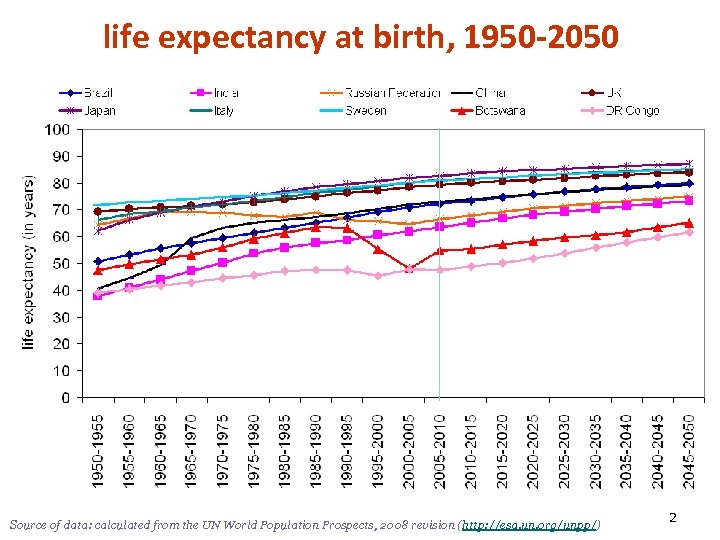
life expectancy at birth, 1950 -2050 Source of data: calculated from the UN World Population Prospects, 2008 revision (http: //esa. un. org/unpp/) 2
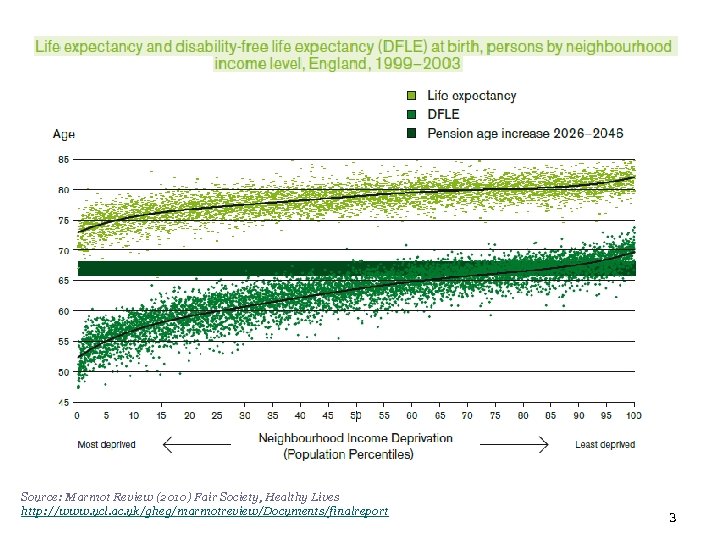
Source: Marmot Review (2010) Fair Society, Healthy Lives http: //www. ucl. ac. uk/gheg/marmotreview/Documents/finalreport 3
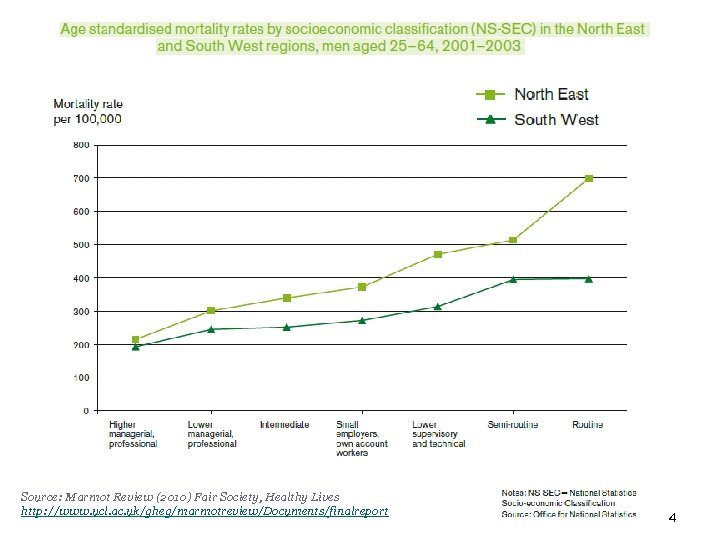
Source: Marmot Review (2010) Fair Society, Healthy Lives http: //www. ucl. ac. uk/gheg/marmotreview/Documents/finalreport 4
objectives of the project Facilitate international research partnerships and networking of social scientists from Brazil, India and the UK § Analyse large-scale national survey data to address policyoriented research problems in the area related to social inequalities and population health § Share research experiences and build capacity in quantitative analysis of health and demographic data from household surveys § Produce joint academic research outputs and disseminate findings at international conferences § Identify priority research areas and strengthen the research consortium by developing joint research proposals. § 5
research Team: UK partners Sabu Padmadas, Andrew Channon, Fiifi Amoako Johnson, Zoe Matthews, Maria Evandrou, Jane Falkingham Saseendran Pallikadavath Tiziana Leone Expertise: Reproductive and child health, Family planning, Health care systems, Health inequalities, Epidemiology, Poverty, Ageing, Spatial analysis, Survey data analysis, Demographic & Health Surveys 6
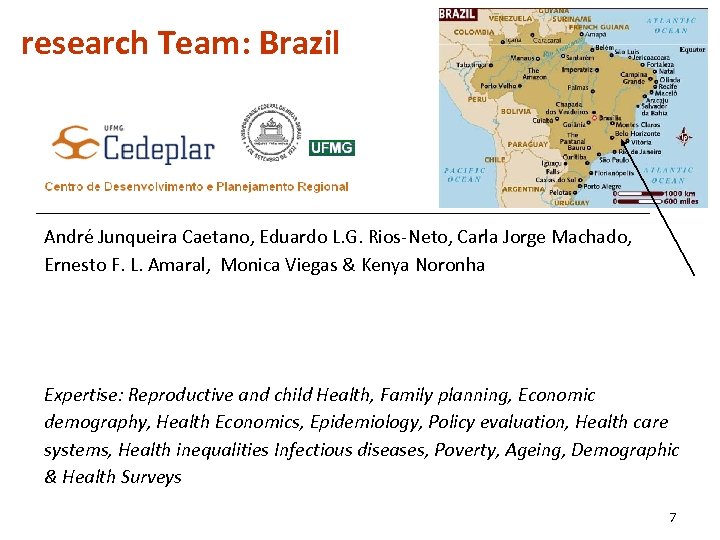
research Team: Brazil André Junqueira Caetano, Eduardo L. G. Rios-Neto, Carla Jorge Machado, Ernesto F. L. Amaral, Monica Viegas & Kenya Noronha Expertise: Reproductive and child Health, Family planning, Economic demography, Health Economics, Epidemiology, Policy evaluation, Health care systems, Health inequalities Infectious diseases, Poverty, Ageing, Demographic & Health Surveys 7
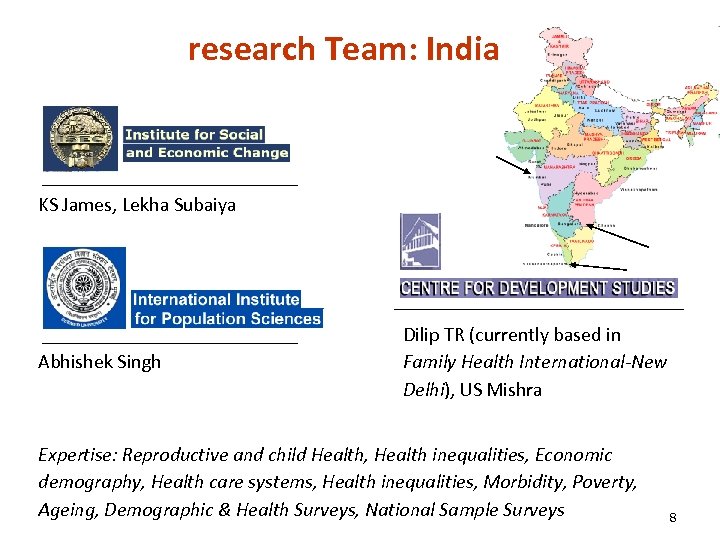
research Team: India KS James, Lekha Subaiya Abhishek Singh Dilip TR (currently based in Family Health International-New Delhi), US Mishra Expertise: Reproductive and child Health, Health inequalities, Economic demography, Health care systems, Health inequalities, Morbidity, Poverty, Ageing, Demographic & Health Surveys, National Sample Surveys 8
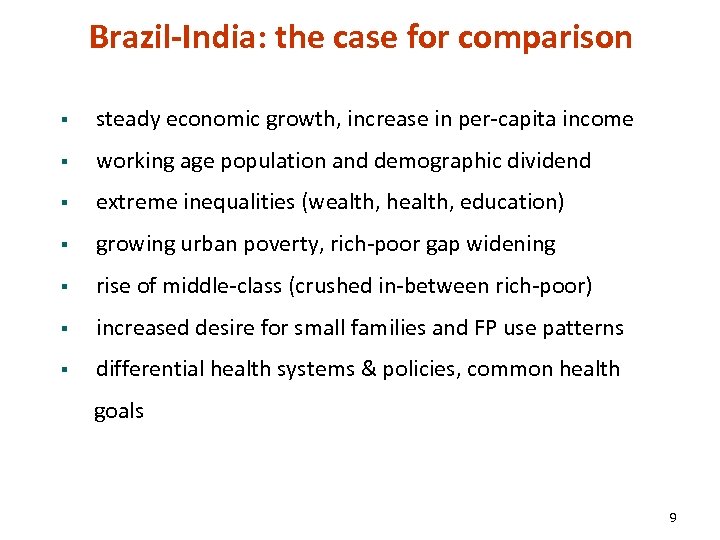
Brazil-India: the case for comparison § steady economic growth, increase in per-capita income § working age population and demographic dividend § extreme inequalities (wealth, health, education) § growing urban poverty, rich-poor gap widening § rise of middle-class (crushed in-between rich-poor) § increased desire for small families and FP use patterns § differential health systems & policies, common health goals 9
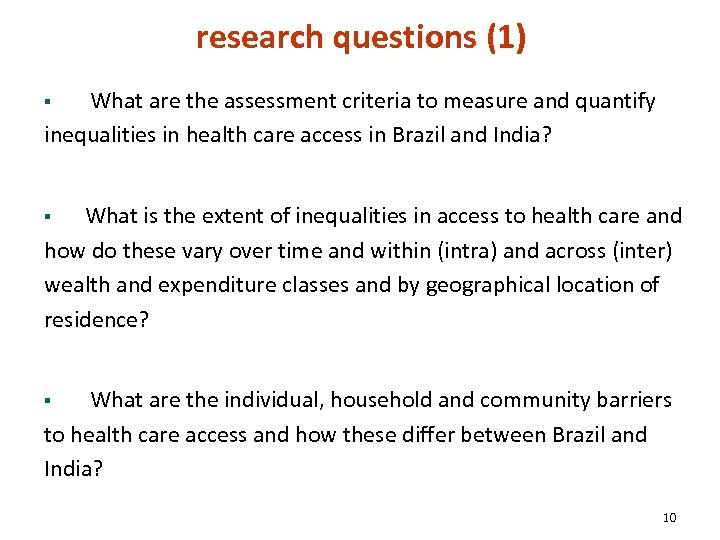
research questions (1) What are the assessment criteria to measure and quantify inequalities in health care access in Brazil and India? § What is the extent of inequalities in access to health care and how do these vary over time and within (intra) and across (inter) wealth and expenditure classes and by geographical location of residence? § What are the individual, household and community barriers to health care access and how these differ between Brazil and India? § 10
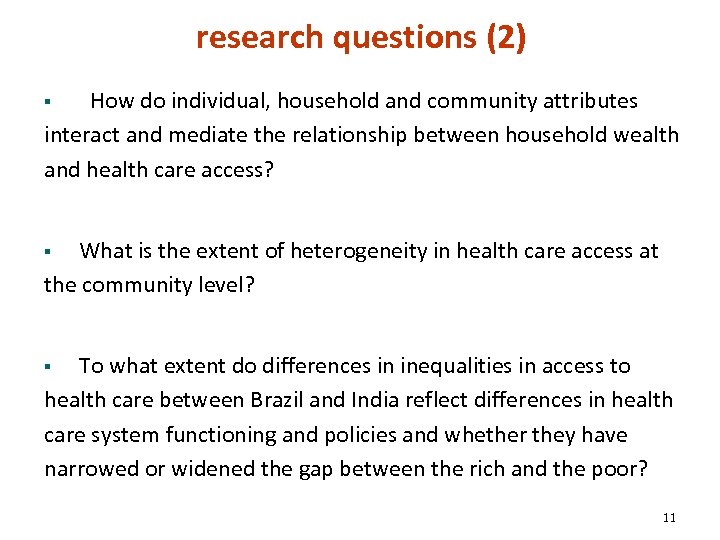
research questions (2) How do individual, household and community attributes interact and mediate the relationship between household wealth and health care access? § What is the extent of heterogeneity in health care access at the community level? § To what extent do differences in inequalities in access to health care between Brazil and India reflect differences in health care system functioning and policies and whether they have narrowed or widened the gap between the rich and the poor? § 11
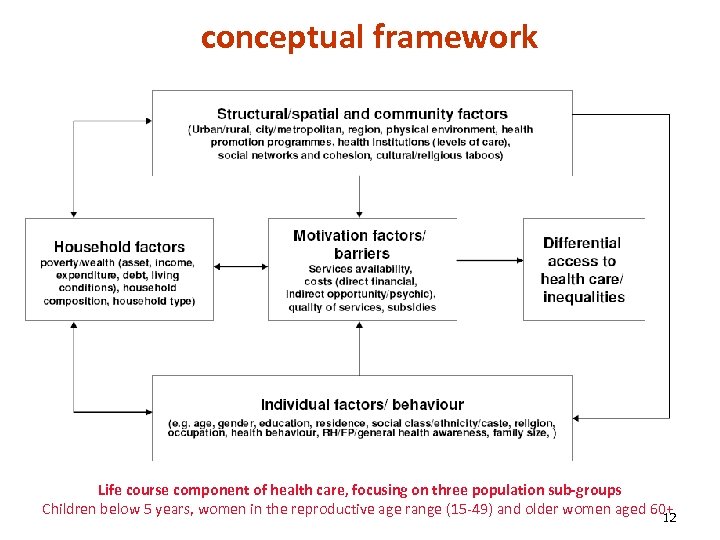
conceptual framework Life course component of health care, focusing on three population sub-groups Children below 5 years, women in the reproductive age range (15 -49) and older women aged 60+ 12
Timeline & Outputs 12 months (April 2010 – March 2011) Three sets of research workshops with specific research agenda incl academic papers (under progress), research proposals and capacity building activities: June 2010 (Belo Horizonte), Jan 2011 (Bangalore) & Mar 2011 (Southampton). Dissemination: national and international conferences, project website, fact sheets, peer-reviewed joint publications 13
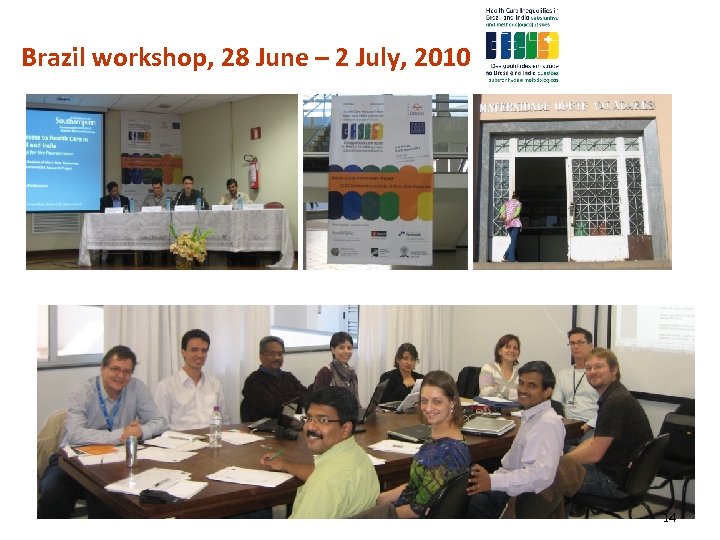
Brazil workshop, 28 June – 2 July, 2010 14
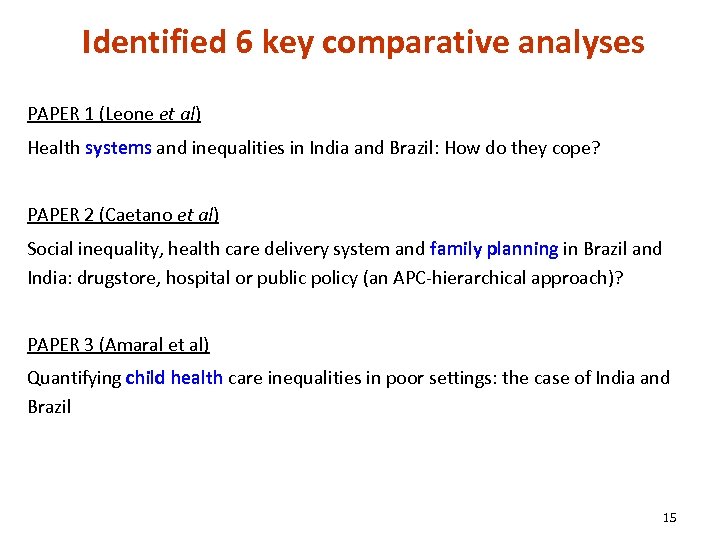
Identified 6 key comparative analyses PAPER 1 (Leone et al) Health systems and inequalities in India and Brazil: How do they cope? PAPER 2 (Caetano et al) Social inequality, health care delivery system and family planning in Brazil and India: drugstore, hospital or public policy (an APC-hierarchical approach)? PAPER 3 (Amaral et al) Quantifying child health care inequalities in poor settings: the case of India and Brazil 15
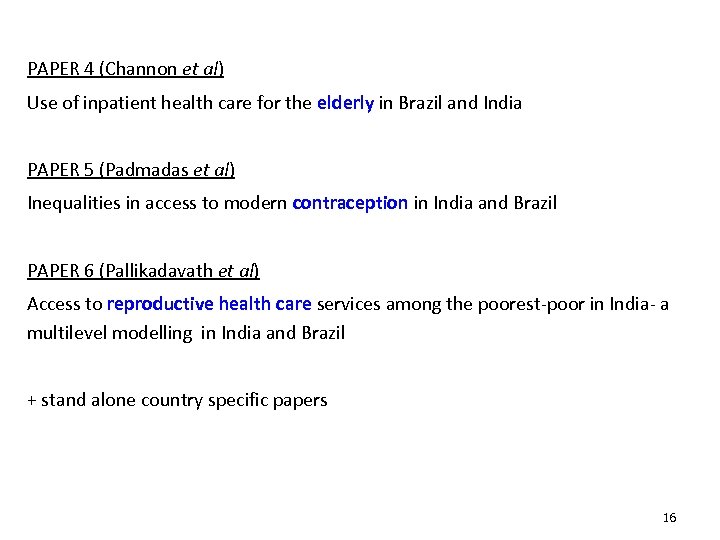
PAPER 4 (Channon et al) Use of inpatient health care for the elderly in Brazil and India PAPER 5 (Padmadas et al) Inequalities in access to modern contraception in India and Brazil PAPER 6 (Pallikadavath et al) Access to reproductive health care services among the poorest-poor in India- a multilevel modelling in India and Brazil + stand alone country specific papers 16
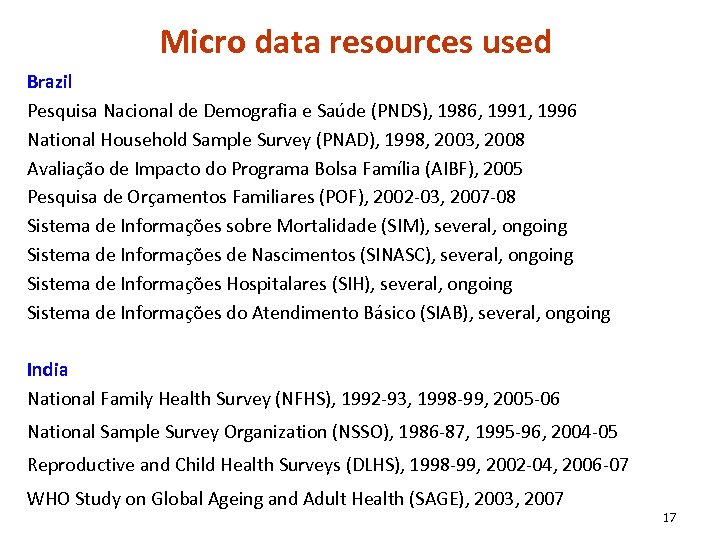
Micro data resources used Brazil Pesquisa Nacional de Demografia e Saúde (PNDS), 1986, 1991, 1996 National Household Sample Survey (PNAD), 1998, 2003, 2008 Avaliação de Impacto do Programa Bolsa Família (AIBF), 2005 Pesquisa de Orçamentos Familiares (POF), 2002 -03, 2007 -08 Sistema de Informações sobre Mortalidade (SIM), several, ongoing Sistema de Informações de Nascimentos (SINASC), several, ongoing Sistema de Informações Hospitalares (SIH), several, ongoing Sistema de Informações do Atendimento Básico (SIAB), several, ongoing India National Family Health Survey (NFHS), 1992 -93, 1998 -99, 2005 -06 National Sample Survey Organization (NSSO), 1986 -87, 1995 -96, 2004 -05 Reproductive and Child Health Surveys (DLHS), 1998 -99, 2002 -04, 2006 -07 WHO Study on Global Ageing and Adult Health (SAGE), 2003, 2007 17
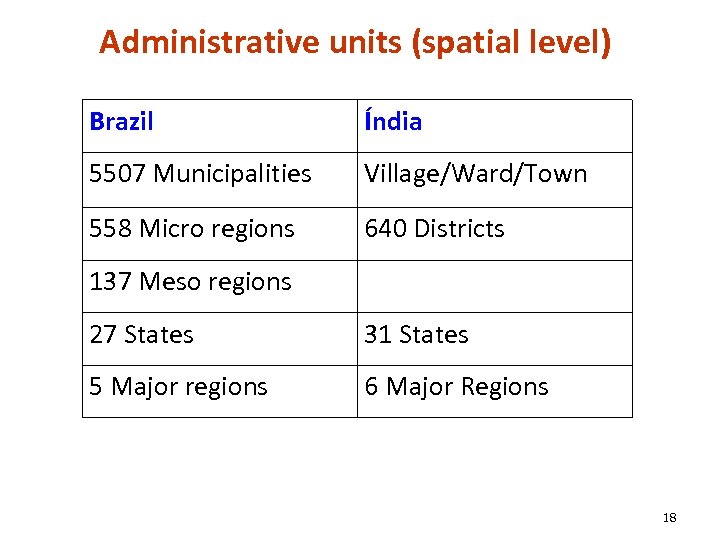
Administrative units (spatial level) Brazil Índia 5507 Municipalities Village/Ward/Town 558 Micro regions 640 Districts 137 Meso regions 27 States 31 States 5 Major regions 6 Major Regions 18
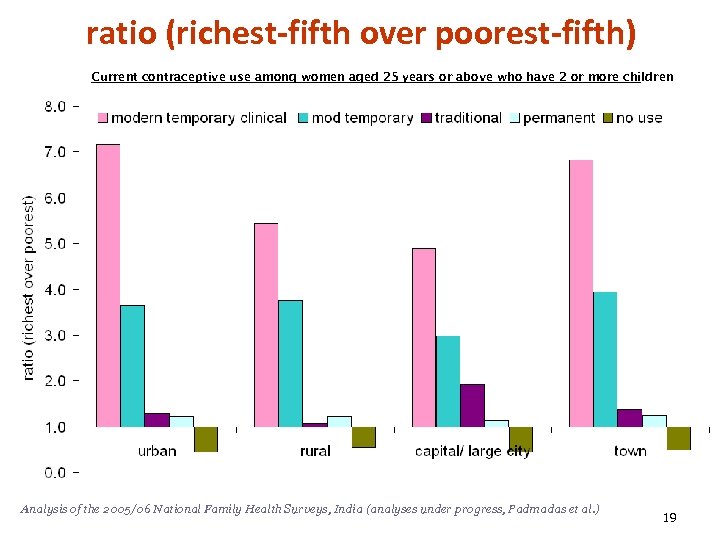
ratio (richest-fifth over poorest-fifth) Current contraceptive use among women aged 25 years or above who have 2 or more children Analysis of the 2005/06 National Family Health Surveys, India (analyses under progress, Padmadas et al. ) 19
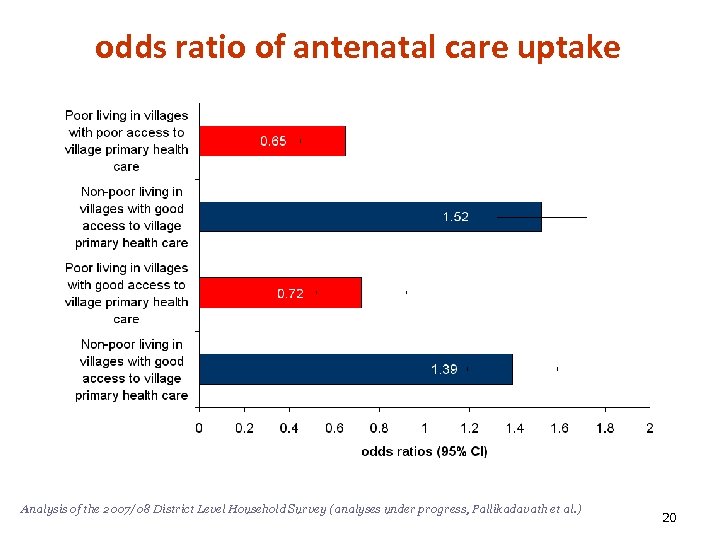
odds ratio of antenatal care uptake Analysis of the 2007/08 District Level Household Survey (analyses under progress, Pallikadavath et al. ) 20
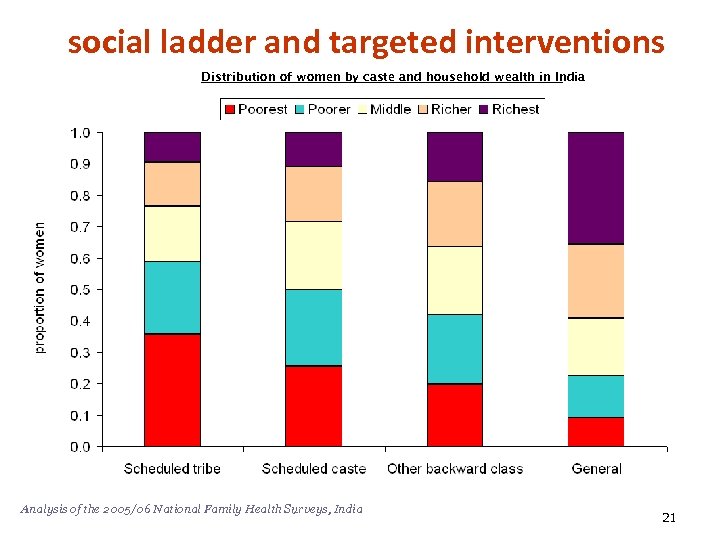
social ladder and targeted interventions Distribution of women by caste and household wealth in India Analysis of the 2005/06 National Family Health Surveys, India 21
acknowledgments § ESRC/Pathfinder Scheme (Grant Reference: RES-238 -25 -0009) § Project team members from Brazil, India & the UK Thank you very much 22
Скачать презентацию Inequalities in Access to Health Care in Brazil
d5ec811dce8ed77b65dda27d235b4a74.ppt