 Скачать презентацию INEFFABILITY Plan of the unit Present examples of
f2931e32296fe970ab58a501fa9b9337.ppt
- Количество слайдов: 71



INEFFABILITY Plan of the unit: Present examples of „ineffability“ Discuss various solutions for the problem Concentrate on two solutions 3/18/2018 1
An architectural prediction Recall : For each input, a set of candidates is generated, out of which Eval picks an optimal one --> For every input, there must be at least one grammatical output. This prediction of OT seems not fulfilled. . . 3/18/2018 2
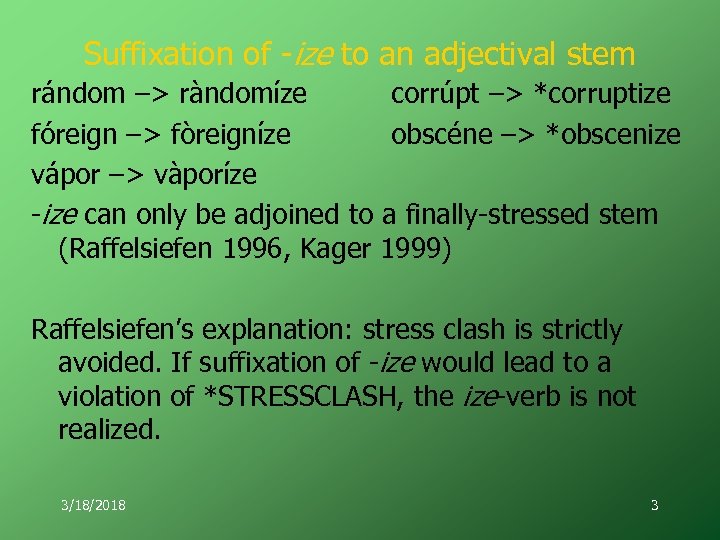
Suffixation of -ize to an adjectival stem rándom –> ràndomíze corrúpt –> *corruptize fóreign –> fòreigníze obscéne –> *obscenize vápor –> vàporíze -ize can only be adjoined to a finally-stressed stem (Raffelsiefen 1996, Kager 1999) Raffelsiefen’s explanation: stress clash is strictly avoided. If suffixation of -ize would lead to a violation of *STRESSCLASH, the ize-verb is not realized. 3/18/2018 3
Suffixation of -ize to an adjectival stem The only viable solution is to block the output because of non-wellformedness of the output. Since the output cannot be wellformed (because stress is at the wrong place and because it cannot be moved), no optimal output arises. 3/18/2018 4
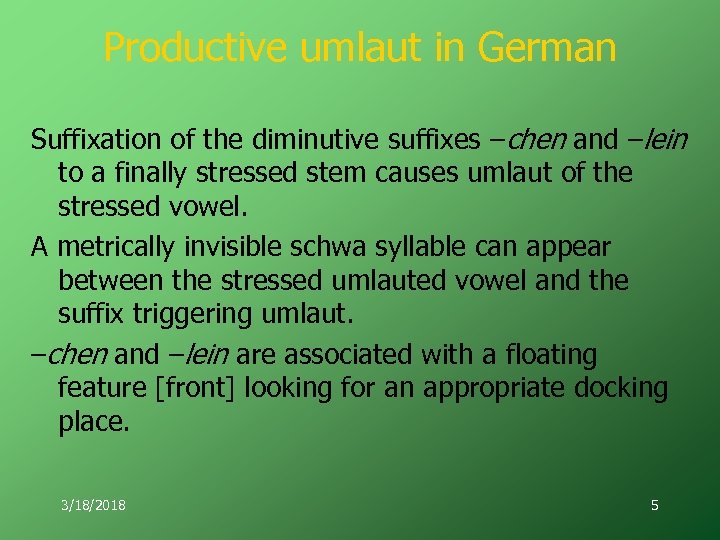
Productive umlaut in German Suffixation of the diminutive suffixes –chen and –lein to a finally stressed stem causes umlaut of the stressed vowel. A metrically invisible schwa syllable can appear between the stressed umlauted vowel and the suffix triggering umlaut. –chen and –lein are associated with a floating feature [front] looking for an appropriate docking place. 3/18/2018 5
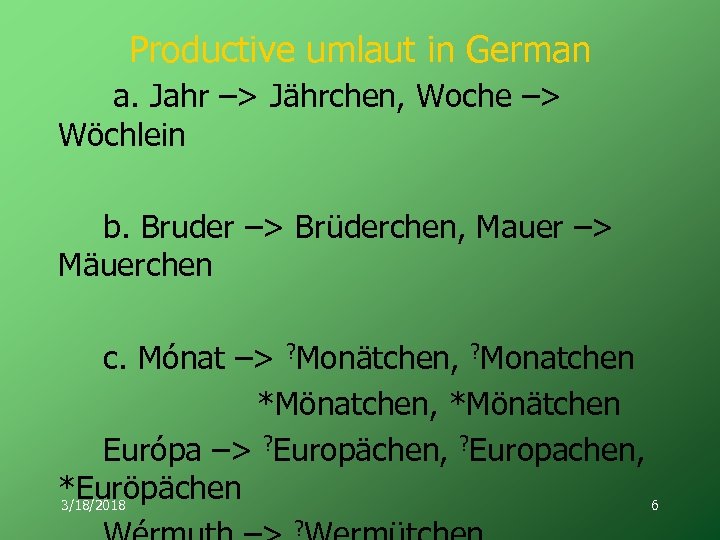
Productive umlaut in German a. Jahr –> Jährchen, Woche –> Wöchlein b. Bruder –> Brüderchen, Mauer –> Mäuerchen c. Mónat –> ? Monätchen, ? Monatchen *Mönatchen, *Mönätchen Európa –> ? Europächen, ? Europachen, *Euröpächen 3/18/2018 6 ?
Productive umlaut in German Partly unsolvable conflict in (c). Most German speakers prefer not to diminutivize the stem, when stress is not final. An input consisting of Monat + chen is usually just not realized. Wermüthchen with stress on ü is sometimes accepted. Notice that speakers are unsure about their judgement of such data. They usually do not feel competent or motivate their reluctance 3/18/2018 7 with (irrelevant) semantic arguments
Productive umlaut in German Similar problem as before. Stress is at the wrong place and it cannot be moved. No output is well-formed. This is not expected in the OT framework. The optimal candidate should be one which fulfills best the constraints. That’s it. 3/18/2018 8
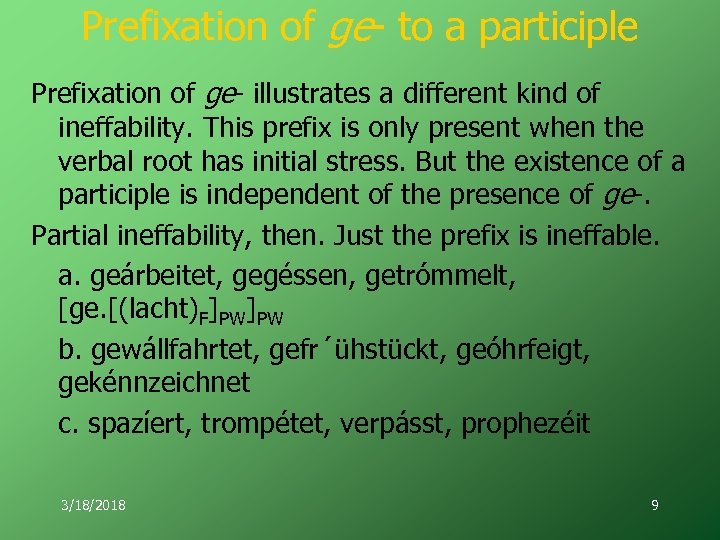
Prefixation of ge- to a participle Prefixation of ge- illustrates a different kind of ineffability. This prefix is only present when the verbal root has initial stress. But the existence of a participle is independent of the presence of ge-. Partial ineffability, then. Just the prefix is ineffable. a. geárbeitet, gegéssen, getrómmelt, [ge. [(lacht)F]PW]PW b. gewállfahrtet, gefr´ühstückt, geóhrfeigt, gekénnzeichnet c. spazíert, trompétet, verpásst, prophezéit 3/18/2018 9
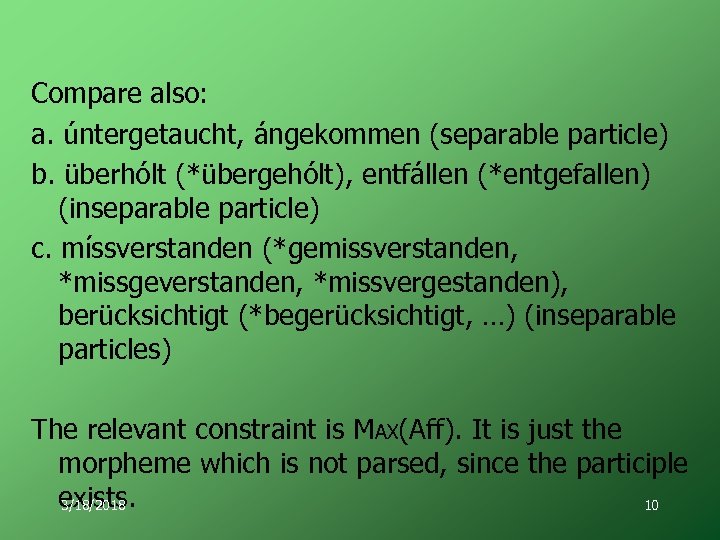
Compare also: a. úntergetaucht, ángekommen (separable particle) b. überhólt (*übergehólt), entfállen (*entgefallen) (inseparable particle) c. míssverstanden (*gemissverstanden, *missgeverstanden, *missvergestanden), berücksichtigt (*begerücksichtigt, …) (inseparable particles) The relevant constraint is MAX(Aff). It is just the morpheme which is not parsed, since the participle exists. 3/18/2018 10
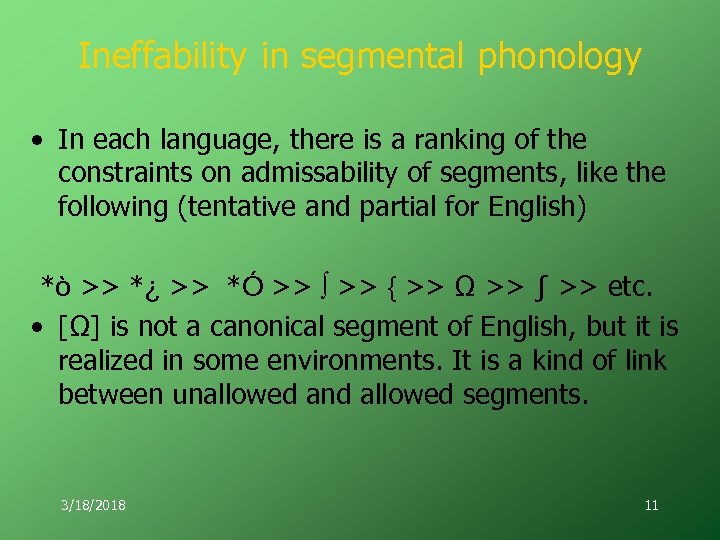
Ineffability in segmental phonology • In each language, there is a ranking of the constraints on admissability of segments, like the following (tentative and partial for English) *ò >> *¿ >> *Ó >> ∫ >> { >> Ω >> ∫ >> etc. • [Ω] is not a canonical segment of English, but it is realized in some environments. It is a kind of link between unallowed and allowed segments. 3/18/2018 11
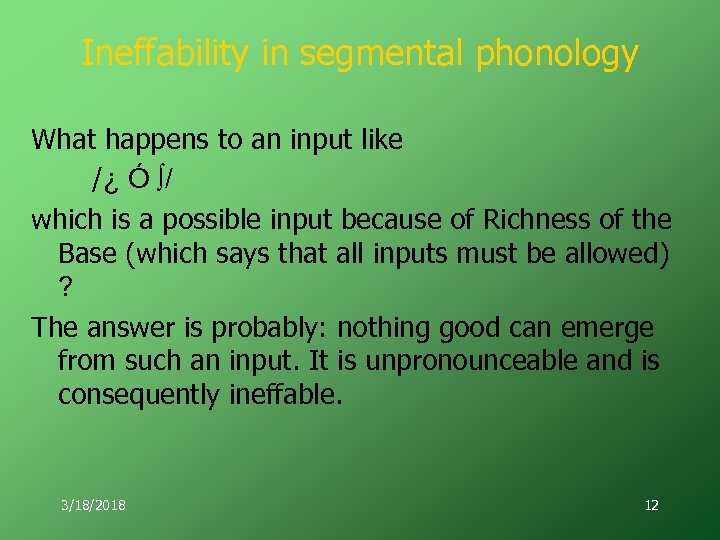
Ineffability in segmental phonology What happens to an input like /¿ Ó ∫/ which is a possible input because of Richness of the Base (which says that all inputs must be allowed) ? The answer is probably: nothing good can emerge from such an input. It is unpronounceable and is consequently ineffable. 3/18/2018 12
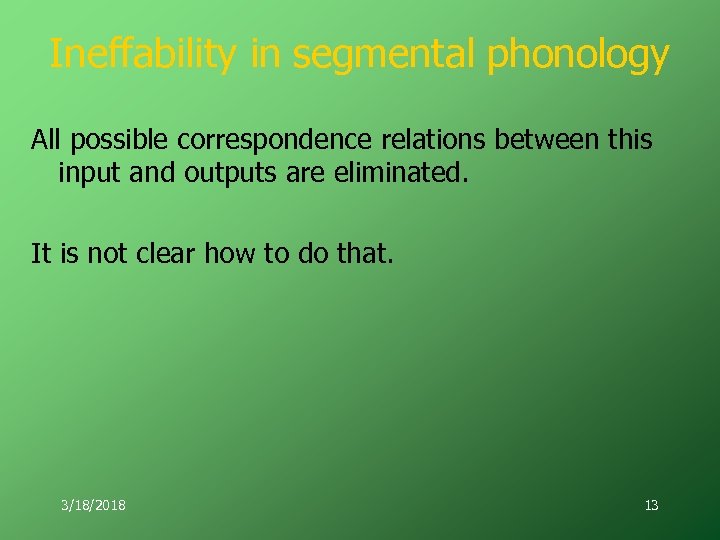
Ineffability in segmental phonology All possible correspondence relations between this input and outputs are eliminated. It is not clear how to do that. 3/18/2018 13
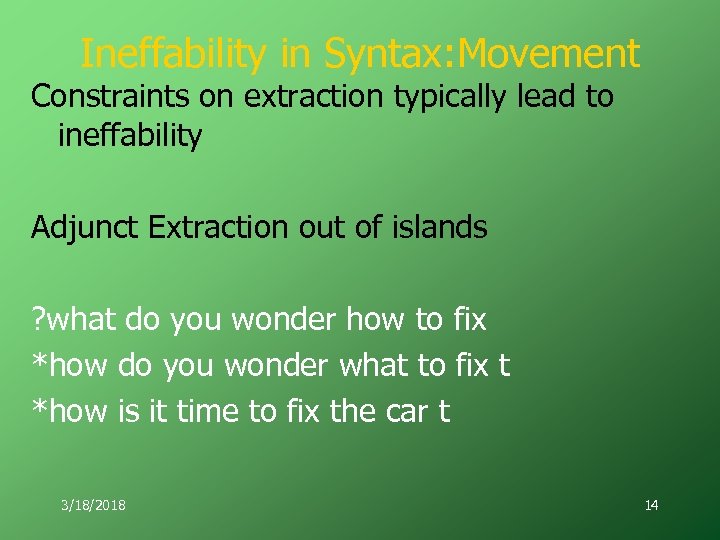
Ineffability in Syntax: Movement Constraints on extraction typically lead to ineffability Adjunct Extraction out of islands ? what do you wonder how to fix *how do you wonder what to fix t *how is it time to fix the car t 3/18/2018 14
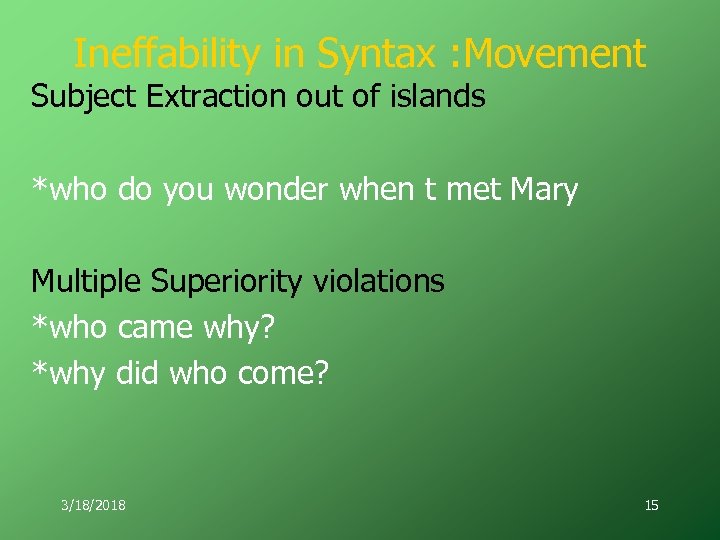
Ineffability in Syntax : Movement Subject Extraction out of islands *who do you wonder when t met Mary Multiple Superiority violations *who came why? *why did who come? 3/18/2018 15
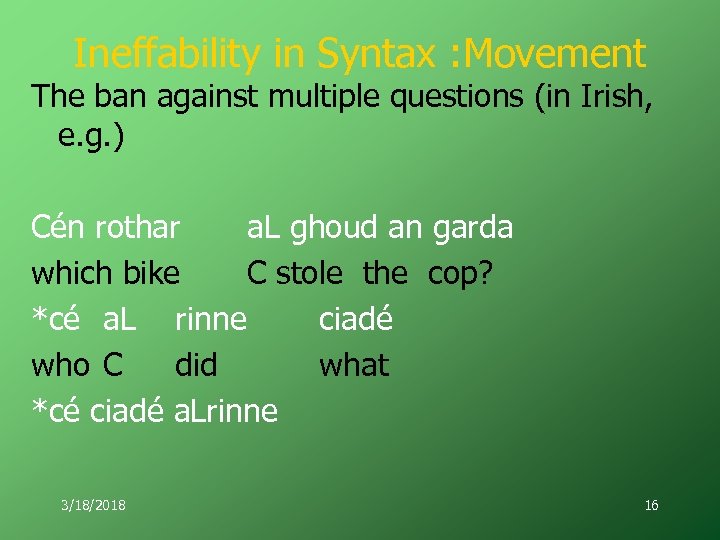
Ineffability in Syntax : Movement The ban against multiple questions (in Irish, e. g. ) Cén rothar a. L ghoud an garda which bike C stole the cop? *cé a. L rinne ciadé who C did what *cé ciadé a. Lrinne 3/18/2018 16
Ineffability in Syntax: Interfaces Ineffability also arises quite often at the “interface” between syntax and morphology. The syntactically derived forms can not be spelt out by the available morphological means. 3/18/2018 17
Deletion in full relatives Der Mann der wo ihn liebt the-nom man who-nom that loves him Der Mann ---- wo ihn liebt Der Mann den --- ihn liebt In certain dialects of German, either the relative pronoun or Comp can be deleted (cp. Pesetsky‘s account of English and French) 3/18/2018 18
Deletion in full relatives But Case must be recoverable der Mann den wo er liebt the man who-acc that he loves *der Mann --- wo er liebt 3/18/2018 19
Deletion in full relatives When two Cases fall together morphologically, deletion is fine die Frau wo er mag schläft the women C he likes sleeps die = nom (as required by matrix) = acc (as required by complement) 3/18/2018 20
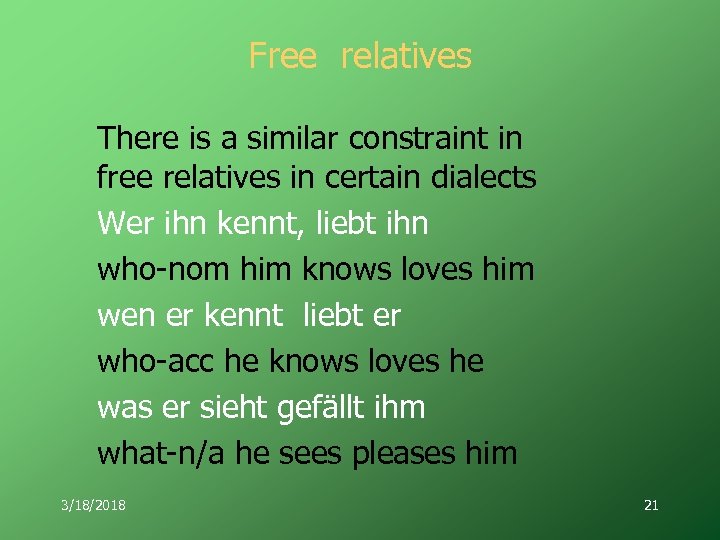
Free relatives There is a similar constraint in free relatives in certain dialects Wer ihn kennt, liebt ihn who-nom him knows loves him wen er kennt liebt er who-acc he knows loves he was er sieht gefällt ihm what-n/a he sees pleases him 3/18/2018 21
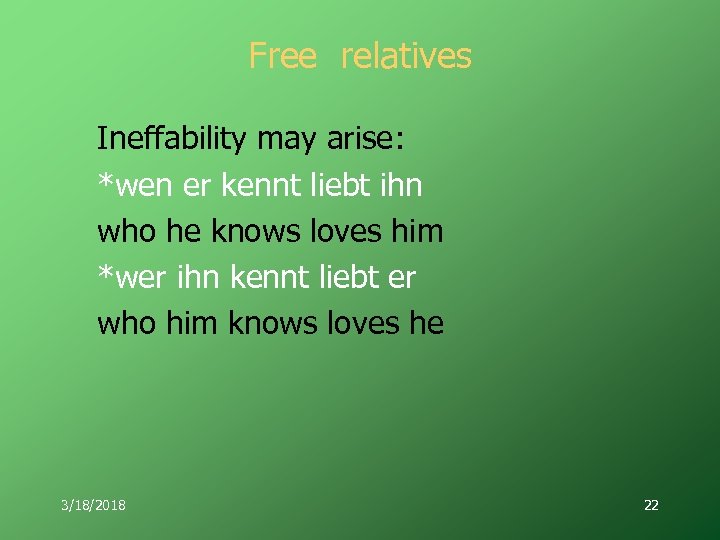
Free relatives Ineffability may arise: *wen er kennt liebt ihn who he knows loves him *wer ihn kennt liebt er who him knows loves he 3/18/2018 22
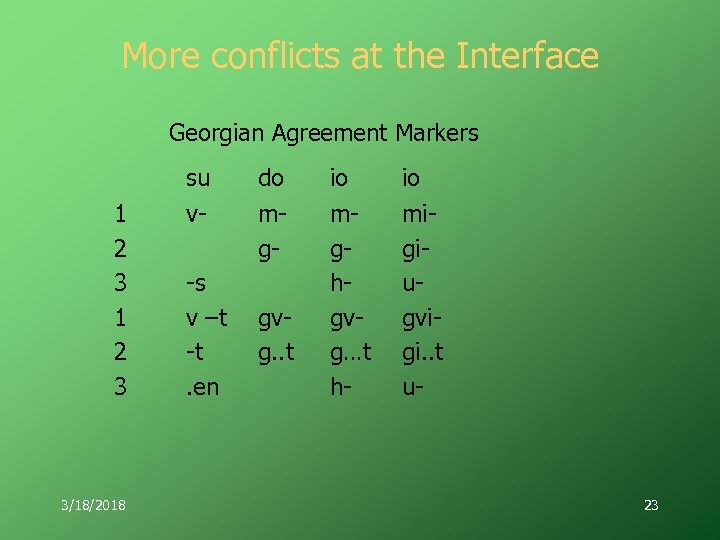
More conflicts at the Interface Georgian Agreement Markers su 1 2 3 3/18/2018 do io io v- mghgvg…t h- migiugvigi. . t u- -s v –t -t. en gvg. . t 23
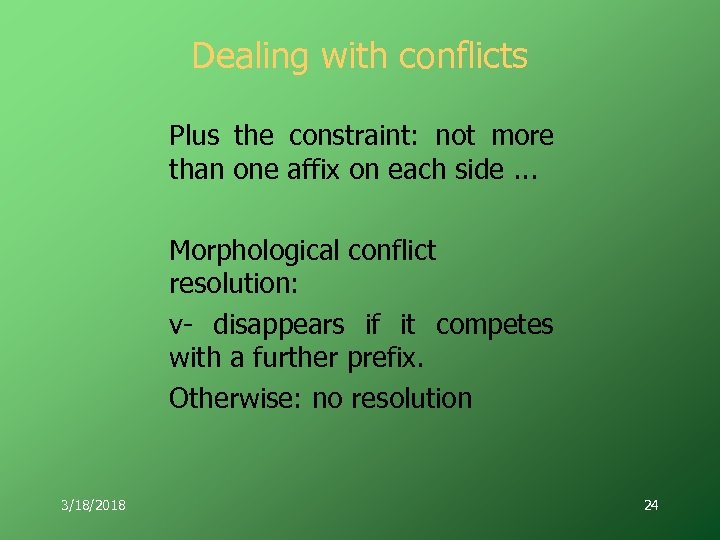
Dealing with conflicts Plus the constraint: not more than one affix on each side. . . Morphological conflict resolution: v- disappears if it competes with a further prefix. Otherwise: no resolution 3/18/2018 24
Ineffability is thus a reality. It is an ubiquituous phenomenon of language, but morphology seems to play a special role. If OT cannot deal with it, ineffability would constitute a serious problem (cp. Pesetsky assessment of OT syntax). 3/18/2018 25
Solutions Input-related solution: 1. One disallows certain inputs GEN-related solutions: 2. Constraining GEN 3. Making GEN more liberal 3/18/2018 26
Solutions EVAL-related solution: 4. Making certain constraints unviolable The PARSE family of solutions 5. Different degrees of Parse violations 3/18/2018 27
Solutions Architectural changes 6. Comparing Inputs 7. Bidirectional Optimizations Restricting the Scope of OT 8. Pesetsky 9. Interface solutions 3/18/2018 28
Input related solutions 1. Certain inputs are not allowed This is not a good solution: Inputs should be free (Richness of the base). It is the task of the constraint hierarchy to eliminate bad outputs (and inputs). 3/18/2018 29
Input related solutions The solution would have to introduce a new language specific grammar component for certain (most? ) cases: An English-German contrast *who came why wer kam warum 3/18/2018 30
Input related solutions Manipulating Inputs Often, ineffability arises because the form that expresses the meaning „intuitively“ does not participate in the competitions. Changes in the input concept might help 3/18/2018 31
Input related solutions brotherhood, happiness *brotherity *happity --> Abstract Inputs? *Who do you think that t came? Who do you think came If that is in the input, an ineffability problem might arise 3/18/2018 32
Input related solutions Likewise: Extractions in Tagalog or Kwakwala: Only the subject can be questioned. . . Are the passive morphemes part of the input? ? 3/18/2018 33
Input related solutions It seems obvious that a decision needs to be taken w. r. t. what is an input -- proper decisions might solve certain apparent ineffability problems. . . but not all There is no competitor to *obsenize /¿ Ó ∫/ 3/18/2018 or 34
Input related solutions Likewise: how do you weep because she fixed the car t (but see below!) 3/18/2018 35
GEN related solutions Solution 2: Constraining GEN The constraints on movement might be part of GEN (Chomsky: MLC is part of the definition of movement. . . ) *who do you weep because t came 3/18/2018 36
GEN related solutions BUT: Movement contraints are rarely truly universal. . . (GEN should be universal, though) What happens to the input? ? *I don‘t care you weep because who came 3/18/2018 37
GEN related solutions We could also allow GEN to do more things than one would normally expect (solution 3): Making a structure biclausal *who came why? who came, and why? 3/18/2018 38
GEN related solutions Relating free and bound relative clauses: *wen er kennt liebt ihn who he knows loves him may be blocked if jeder, den er kennt, liebt ihn everyone who he knows loves him is included in the candidate set. 3/18/2018 39
GEN related solutions The solution does not work in all cases (e. g. perhaps adjunct island constraints) and makes it likely that grammar gets out of control 3/18/2018 40
EVAL related solutions (sol 4) Some constraints must be obligatorily fulfilled by optimal candidates: candidates which do not fulfill them cannot be optimal. In some cases, all candidates are eliminated (usual solution). Recall: Stress clash is strictly avoided. If suffixation of -ize would lead to a violation of *STRESSCLASH, the ize-verb is not realized. 3/18/2018 41
EVAL-related solution • There is a filter called Control between Gen and Eval, consisting of unviolable constraints and blocking the formation of some words (Orgun & Sprouse 1997). • However, *STRESSCLASH is not unviolable (compare Chìnése in English, `süßsáuer, tòt´müde in German), neither are NOUNSTRESSED ü/ö/ä (compare möblíeren) or UMLAUT (compare Frauchen). 3/18/2018 42
EVAL-related solution • So, Control cannot be the solution for ineffability in the case of -ize. • Blocking is probably a property of the lexicon (rather than of the grammar). 3/18/2018 43
EVAL related solutions Are there truly universal constraints (In syntax, perhaps: Theta-Criterion, ccommand condition on binding - but these look like interface things. . . ) One leaves OT thereby. . . 3/18/2018 44
PARSE-related solutions (5) Solution of Mcarthy & Prince (for Latinate suffixes), Raffelsiefen (for -ize) and many others: a candidate which violates a constraint requiring phonetic realization of morphemes is optimal. M-PARSE: ‘Morphemes are phonetically realized. ’ 3/18/2018 45
PARSE-related solutions M-PARSE is ranked below the constraints requiring umlaut to occur in the right prosodic conditions. If the constraints on prosodic structure cannot be fulfilled, the morphemes are not realized and M-PARSE is violated. 3/18/2018 46
M-PARSE in ineffability 3/18/2018 47

M-PARSE in ineffability 3/18/2018 48
Problems (Kager) 1. Many suffixes influence the stress pattern of the stem they adjoin to. Why do -ize or -chen don’t do that? (Not a real problem) 2. Stress clash is tolerated in English in some cases. Why not here? The same tolerance is found in German for unstressed umlauted vowels, as well as for stems suffixed with -chen and without umlaut: Frauchen, Blondchen, …. Why not Wodkachen or Wodkächen? (Not a problem either: OT alone cannot account for the different behavior of -ize and, say, -ic (remember titánic) 3/18/2018 49
Summary so far There seems to be basically two origins of ineffabillity. First, what can be called grammatical ill-formedness. No output of a certain input can emerge as optimal, because the result always violates some high-ranking constraint which must be fulfilled in the language. This was illustrated with *obsenize. 3/18/2018 50
Summary so far The other cause of ineffability is explained by the comparative power of OT. Some output is not optimal because there is another one which is. Ineffability is just apparent. Lexical blocking Bidirectional optimization in syntax 3/18/2018 51
Lexical blocking • Some words which are perfect from the point of view of morphology and phonology are nevertheless non-existent. First there is the phenomenon of blocking. Data from Aronoff: various * variety curious * curiousity glorious glory *gloriosity spacious space *spaciosity 3/18/2018 52
• The non-existence of *gloriosity and *spaciosity is explained by the fact that a non-derived form with approximately the same meaning already exists, thus glory and space. • The fact that variety and curiosity exist is explained by the absence of a non-derived nominal with the same meaning. 3/18/2018 53
Bidirectional optimization • This kind of blocking is explained by a bidirectional optimization between input and output, as well as between output and input. If there is a better input for some output, the output cannot be optimal. Instead it is the output corresponding to the input which is chosen as optimal (it violates less faithfulness constraints). • An output like *gloriosity sees the input 3/18/2018 glory and, since glory as output is better 54
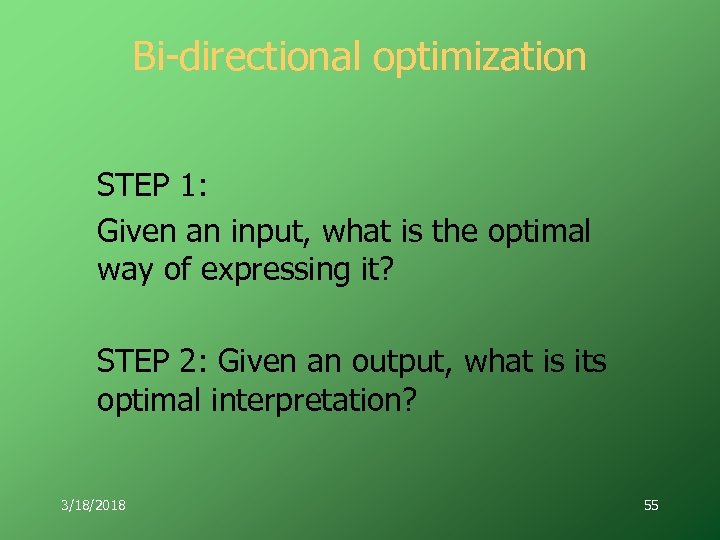
Bi-directional optimization STEP 1: Given an input, what is the optimal way of expressing it? STEP 2: Given an output, what is its optimal interpretation? 3/18/2018 55
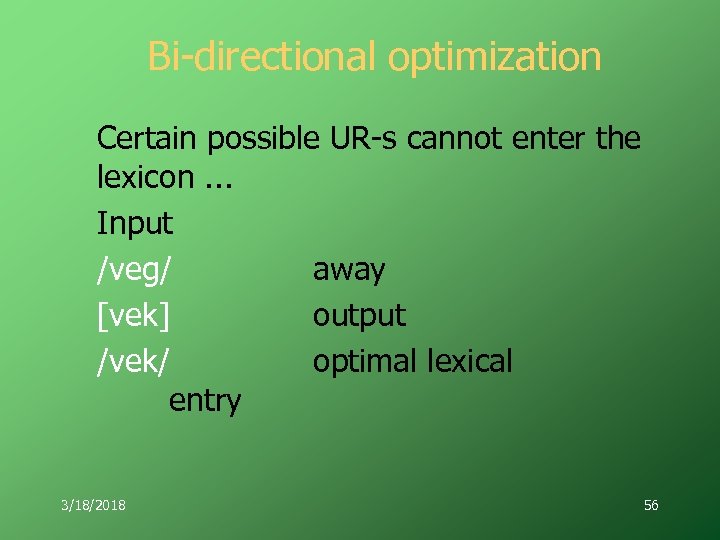
Bi-directional optimization Certain possible UR-s cannot enter the lexicon. . . Input /veg/ away [vek] output /vek/ optimal lexical entry 3/18/2018 56
Bi-directional optimization An interpretation is ineffable if its optimal expression has a different optimal interpretation! To conclude, let’s turn to a detailed syntactic example 3/18/2018 57
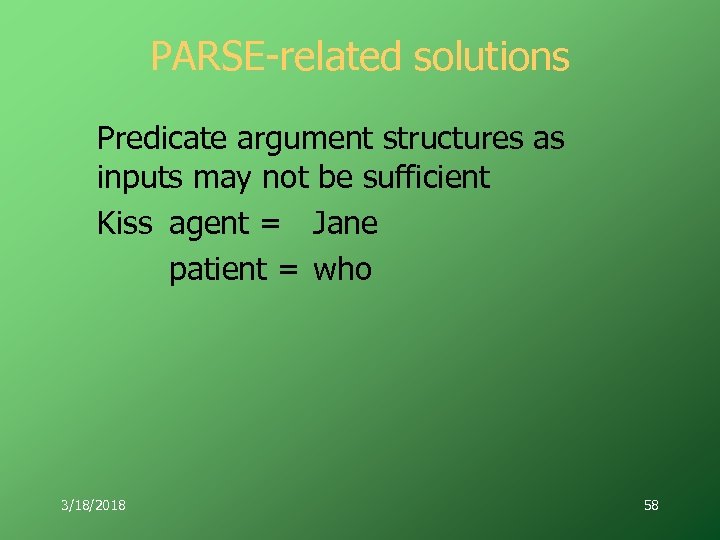
PARSE-related solutions Predicate argument structures as inputs may not be sufficient Kiss agent = Jane patient = who 3/18/2018 58
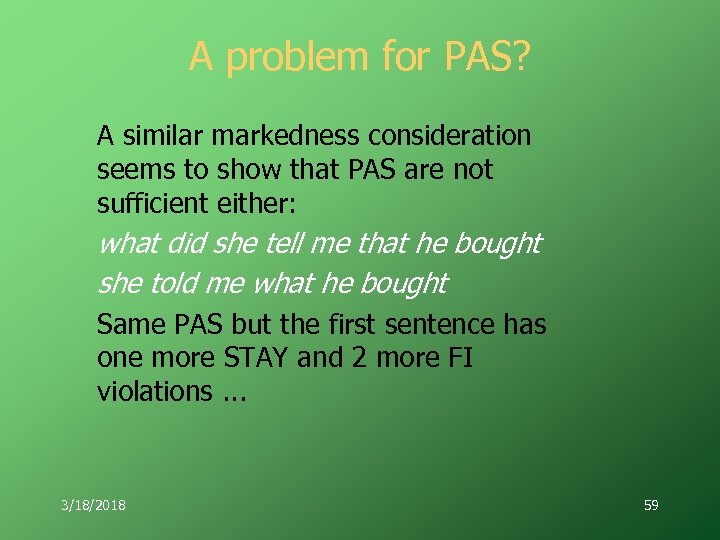
A problem for PAS? A similar markedness consideration seems to show that PAS are not sufficient either: what did she tell me that he bought she told me what he bought Same PAS but the first sentence has one more STAY and 2 more FI violations. . . 3/18/2018 59
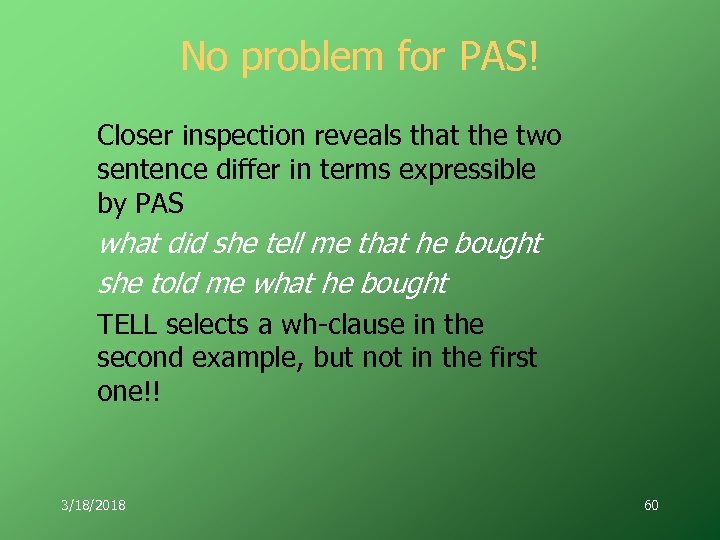
No problem for PAS! Closer inspection reveals that the two sentence differ in terms expressible by PAS what did she tell me that he bought she told me what he bought TELL selects a wh-clause in the second example, but not in the first one!! 3/18/2018 60
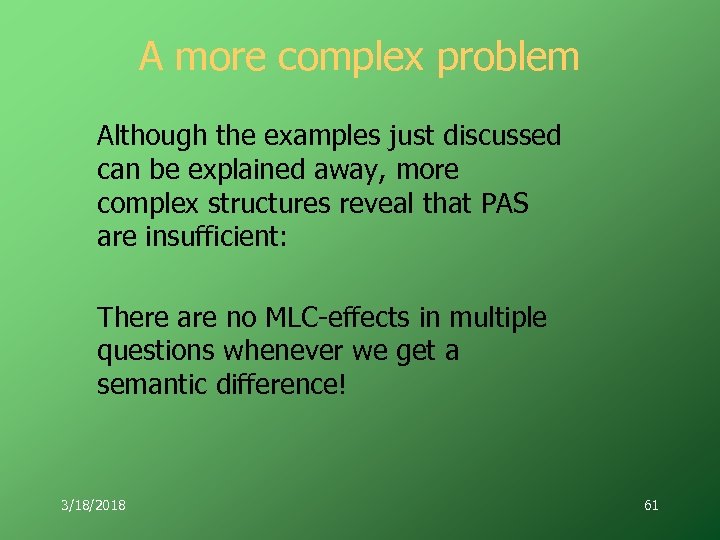
A more complex problem Although the examples just discussed can be explained away, more complex structures reveal that PAS are insufficient: There are no MLC-effects in multiple questions whenever we get a semantic difference! 3/18/2018 61
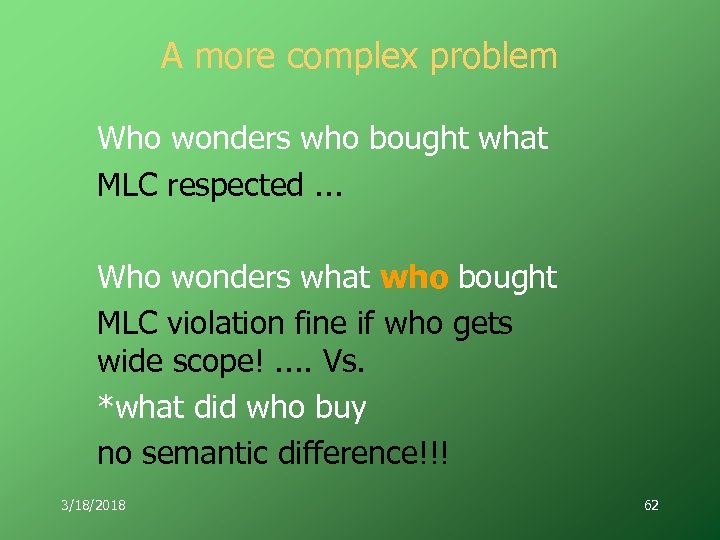
A more complex problem Who wonders who bought what MLC respected. . . Who wonders what who bought MLC violation fine if who gets wide scope!. . Vs. *what did who buy no semantic difference!!! 3/18/2018 62
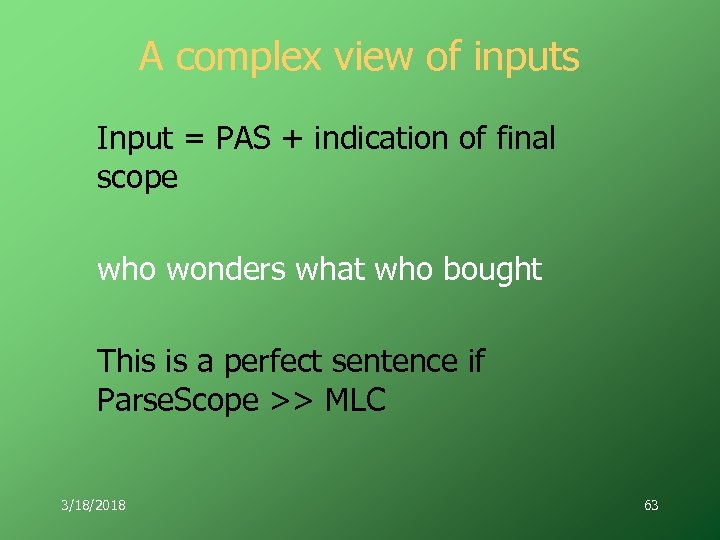
A complex view of inputs Input = PAS + indication of final scope who wonders what who bought This is a perfect sentence if Parse. Scope >> MLC 3/18/2018 63
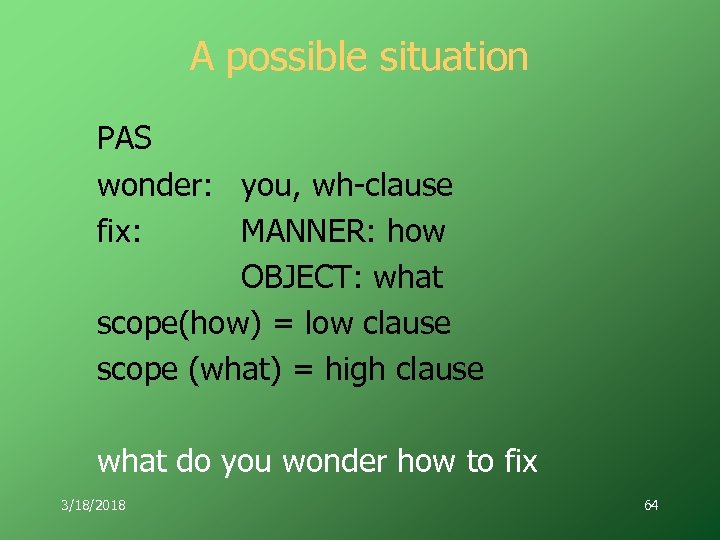
A possible situation PAS wonder: you, wh-clause fix: MANNER: how OBJECT: what scope(how) = low clause scope (what) = high clause what do you wonder how to fix 3/18/2018 64
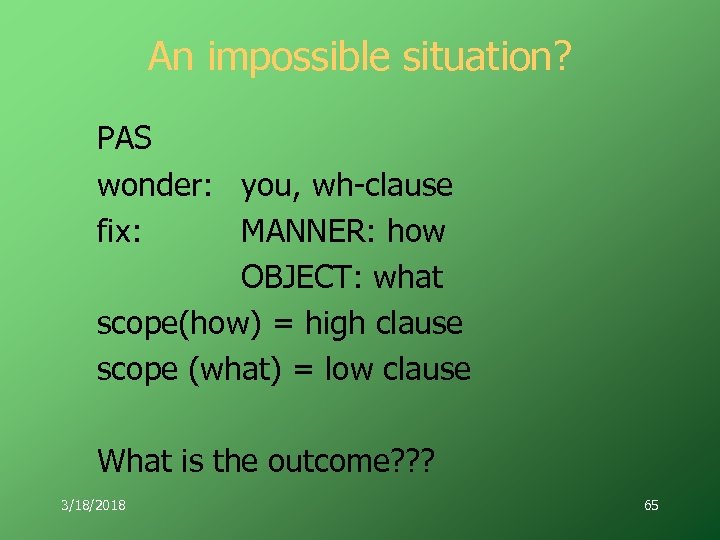
An impossible situation? PAS wonder: you, wh-clause fix: MANNER: how OBJECT: what scope(how) = high clause scope (what) = low clause What is the outcome? ? ? 3/18/2018 65
An impossible situation? It would seem that we get *how do you wonder what to fix an ungrammatical sentence. Thus we seem to have run into the ineffability problem: there is just no way of expressing the PAS+scope. . . 3/18/2018 66
An overlooked possibility But what if the ban on long adjunct movement (the displacement of how) has a higher rank than Parse(Scope). Then you wonder how what to fix has a better profile than how do you wonder what to fix 3/18/2018 67
An overlooked possibility And the ban against multiple wh -phrases/the need to fill the matrix wh-position also has a higher rank than Parse(Scope), then what do you wonder how to fix has the best profile! 3/18/2018 68
A PARSE solution Thus, ineffability appears to have a simple solution. . . there are many aspects of the input to which the output need not be faithful. . . and if scope can be among these aspects, a certain meaning cannot be expressed. 3/18/2018 69
Architectural Solutions (6) The picture is not complete, however! what do you wonder how to fix may be the optimal way of dealing with an input in which how has wide scope. . . but the sentence does not have that interpretation! 3/18/2018 70
Bi-directional optimization An interpretation is ineffable if its optimal expression has a different optimal interpretation! what do you wonder how to fix Interpretation 1: respects Parse. Scope Interpretation 2: violates Parse. Scope 3/18/2018 71
Скачать презентацию INEFFABILITY Plan of the unit Present examples of
f2931e32296fe970ab58a501fa9b9337.ppt