


 Скачать презентацию Industry Comes Of Age Chapter 24 1865 -1900
98200f88a9f91eb3dea6aba7f4cd914b.ppt
- Количество слайдов: 65
 Industry Comes Of Age Chapter 24 1865 -1900
 Railroads n 1865 – only 35, 000 miles of rail, with most of the track lying east of the Mississippi River n 1900 – 192, 556 miles of rail, with most of the track lying west of the Mississippi River n Congress began to advance loans to 2 companies to build a transcontinental railroad n Frontier villages became cities if a railroad was placed nearby
 Union Pacific Railroad n Commissioned by Congress to push westward from Omaha, Nebraska
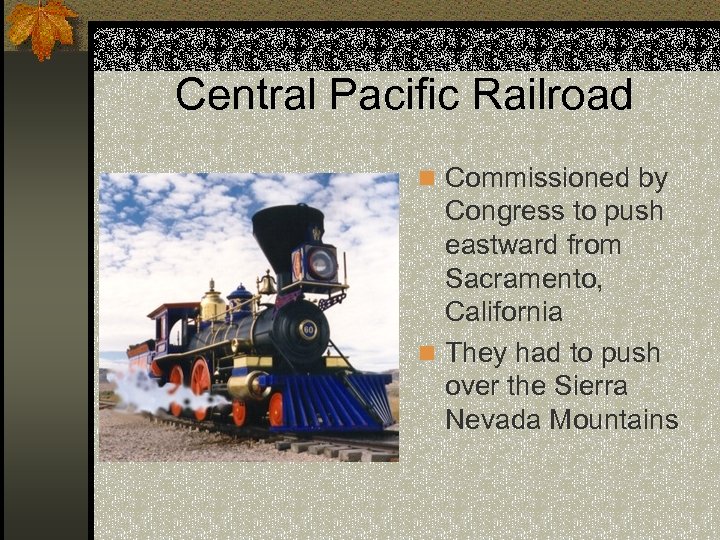 Central Pacific Railroad n Commissioned by Congress to push eastward from Sacramento, California n They had to push over the Sierra Nevada Mountains
 Big Four n There were four chief financial brokers of the transcontinental railroad n Two included: n Leland Stanford of California – had huge political connections n Collis P. Huntington – an adept lobbyist n Railroads made a profit of $105 million
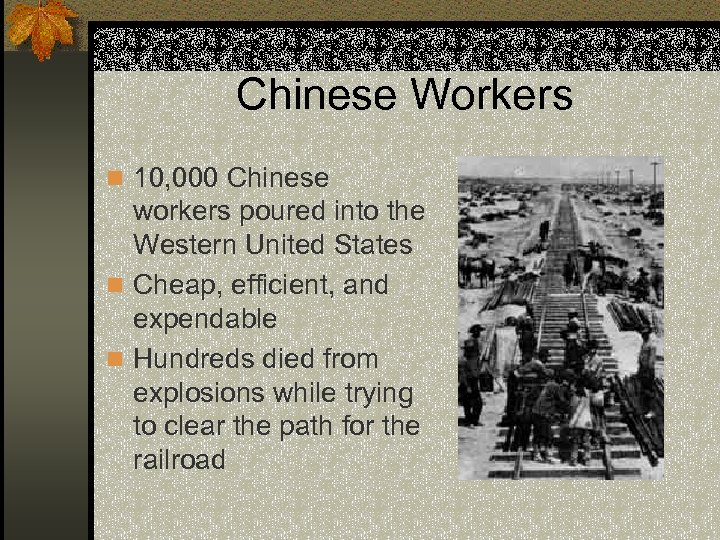 Chinese Workers n 10, 000 Chinese workers poured into the Western United States n Cheap, efficient, and expendable n Hundreds died from explosions while trying to clear the path for the railroad
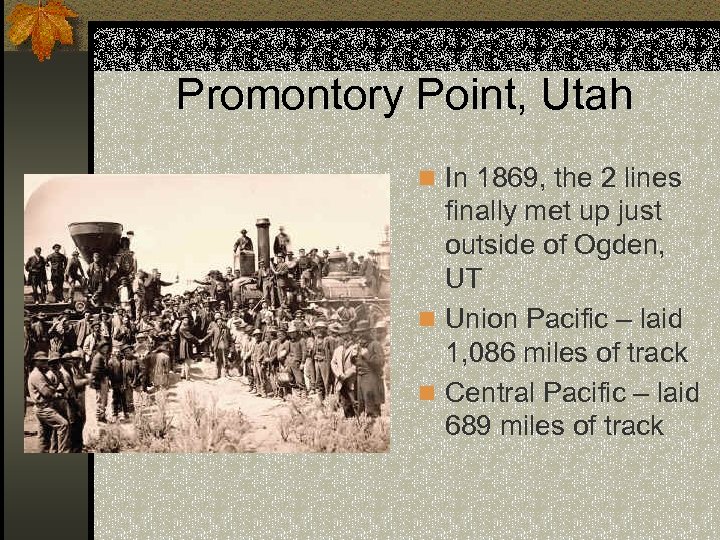 Promontory Point, Utah n In 1869, the 2 lines finally met up just outside of Ogden, UT n Union Pacific – laid 1, 086 miles of track n Central Pacific – laid 689 miles of track
 Steel n The need for this metal increased because it was safer for railroads to travel on steel tracks n It was more economical and steel could carry a heavier load n Bessemer Process – 1850 s – making cheaper steel by blowing cold air on red -hot iron, making the metal white-hot igniting the carbon and eliminating impurities
 RR Improvements n Standard gauge – universal width of railroad tracks came about after Civil War n Westinghouse air brake – 1870 s more efficient and much safer n Pullman Palace Cars – advertised as “gorgeous traveling hotels”
 Corruption n This is still the Gilded Age, and corruption lingers in all aspects of life. n If you can make money at it, it was probably corrupt n $ = corruption n Credit Mobilier & Jay Gould n Stock watering – RR stocks were grossly inflated, and then stocks were sold
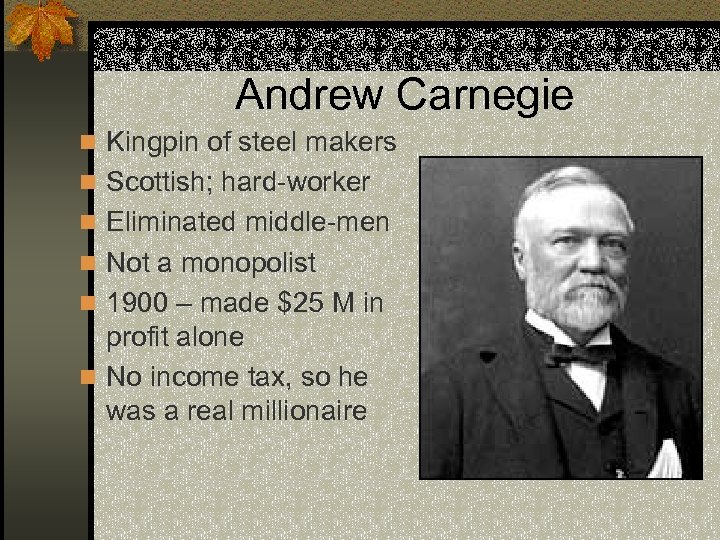 Andrew Carnegie n Kingpin of steel makers n Scottish; hard-worker n Eliminated middle-men n Not a monopolist n 1900 – made $25 M in profit alone n No income tax, so he was a real millionaire
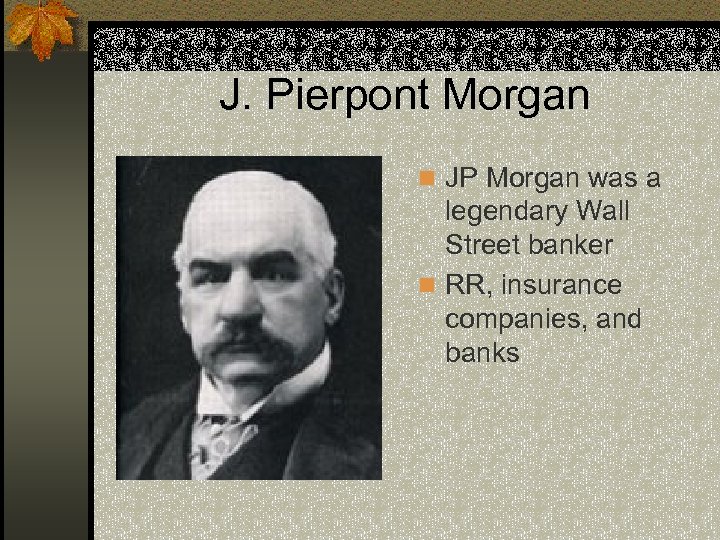 J. Pierpont Morgan n JP Morgan was a legendary Wall Street banker n RR, insurance companies, and banks
 Morgan and Carnegie n By 1900, Carnegie was eager to sell his holdings in steel n Morgan invested into steel pipe production, and wanted to own more steel n Morgan agreed to buy Carnegie out for $400 million n Carnegie spent the rest of his life giving away money to libraries, universities, and philanthropies
 JP Morgan n Controlled United States Steel Corporation n Capitalized at $1. 4 Billion n US Steel was the United States’ first billion dollar corporation
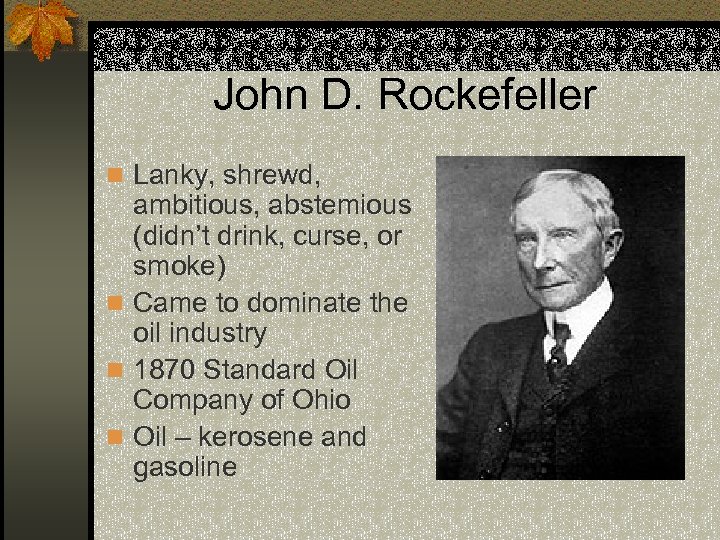 John D. Rockefeller n Lanky, shrewd, ambitious, abstemious (didn’t drink, curse, or smoke) n Came to dominate the oil industry n 1870 Standard Oil Company of Ohio n Oil – kerosene and gasoline
 Rockefeller and Standard Oil n Controlled 95% of all oil refineries in the United States n Eliminated middle-men, and created an oil monopoly n Became one of the richest “robberbarons” in US history
 America Moves to the City Chapter 25 1865 -1900
 Population n 1870 – 40 million people in US n 1900 – 80 million people in US n The lure of industrial jobs brought people to the city n Rural people began to move to Urban areas in search of a better job, and better way of life
 Urban Frontier n 1860 – no city with 1, 000 people n 1890 – NYC, Chicago, and Philadelphia all had 1, 000 people n 1900 – NYC had over 3. 5 million people n NYC became the 2 nd largest city in the world to London, England
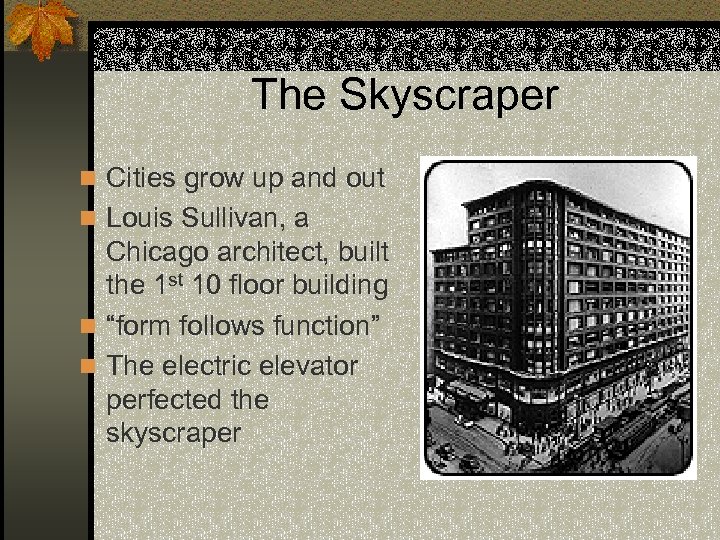 The Skyscraper n Cities grow up and out n Louis Sullivan, a Chicago architect, built the 1 st 10 floor building n “form follows function” n The electric elevator perfected the skyscraper
 Commuting n Americans became commuter to and from work n Electric trolleys expanded the reach of the average citizen n Different districts for business, industry, and residences emerged n Residential districts were segregated by race and class
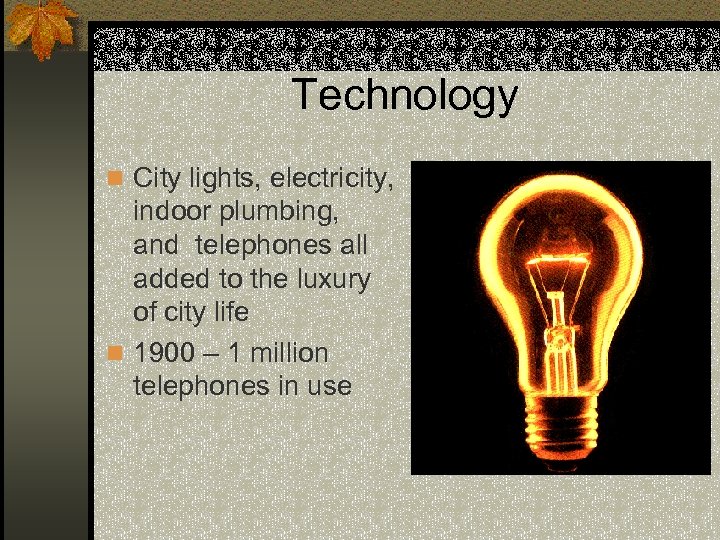 Technology n City lights, electricity, indoor plumbing, and telephones all added to the luxury of city life n 1900 – 1 million telephones in use
 Waste n Country – very little waste n City – produced much more trash n Waste disposal – new issue to the urban age n Criminals flourished in the city n Impure water, uncollected garbage, unwashed bodies, droppings from animals, HORRIBLE STENCH n “the best and the worst combined”
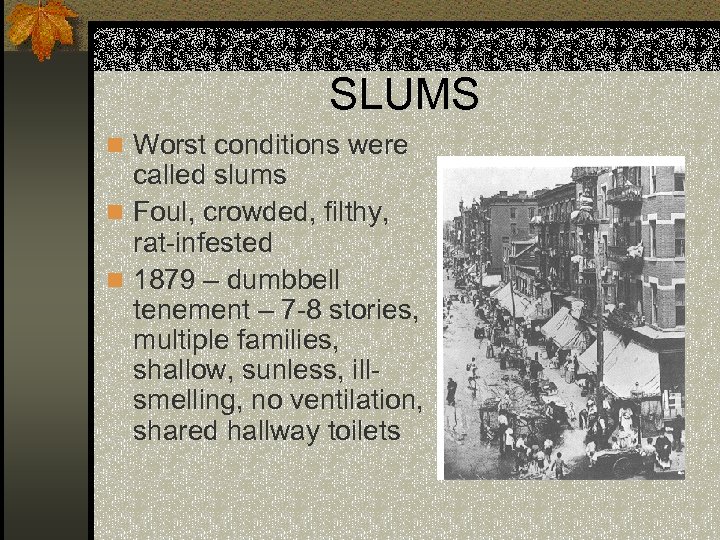 SLUMS n Worst conditions were called slums n Foul, crowded, filthy, rat-infested n 1879 – dumbbell tenement – 7 -8 stories, multiple families, shallow, sunless, illsmelling, no ventilation, shared hallway toilets
 Slums n Flophouse – poor could stay on poor mattresses for a few cents a night n The wealthy left the city altogether, and moved to the suburb
 New Immigration n 1880 s – over 5 million immigrants came to the US (avg. 2, 100/day) n Before, most had been from British Isles, W. Europe, Germany, and Scandinavia n They were Anglo-Saxon, some Irish. Catholic, Catholic Germans n 1880 s – immigrant stream changed
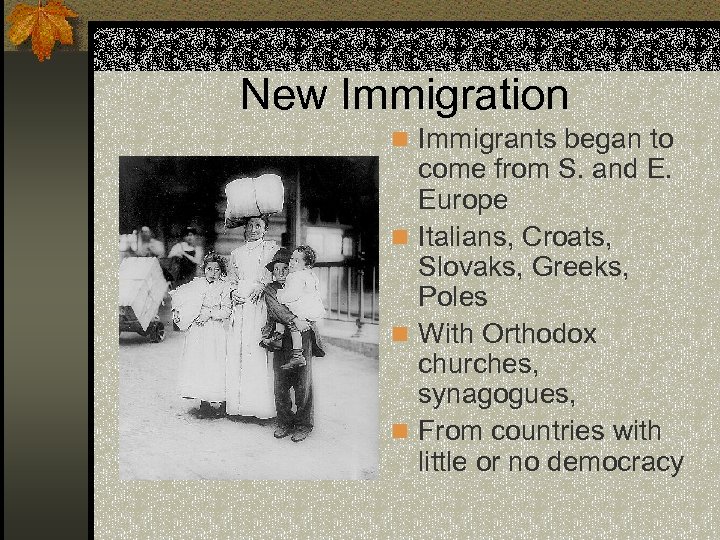 New Immigration n Immigrants began to come from S. and E. Europe n Italians, Croats, Slovaks, Greeks, Poles n With Orthodox churches, synagogues, n From countries with little or no democracy
 Europe n Had no room for its people because: n Old World was growing vigorously n Fish and grain from New World helped Old World population n Potato changed Europe n Created an Army of unemployed in Europe
 “America Fever” n USA was painted as a land of fabulous opportunity, freedom from conscription, and no religious persecution n Industry needed people to work for low wages n States needed people for #s n Steamships needed paying freight n 1880 s – Russians turned violently on their Jews
 Birds Of Passage n Many were migrant workers who came to the US to work for months for American $$$ and returned home to Europe with their earnings
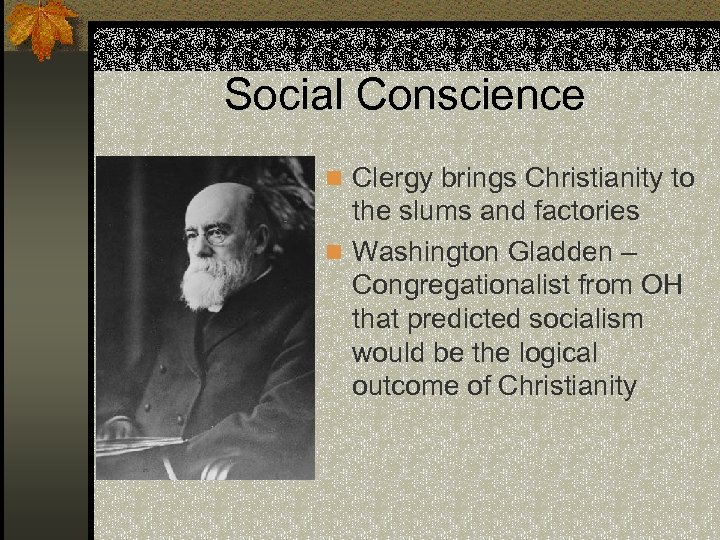 Social Conscience n Clergy brings Christianity to the slums and factories n Washington Gladden – Congregationalist from OH that predicted socialism would be the logical outcome of Christianity
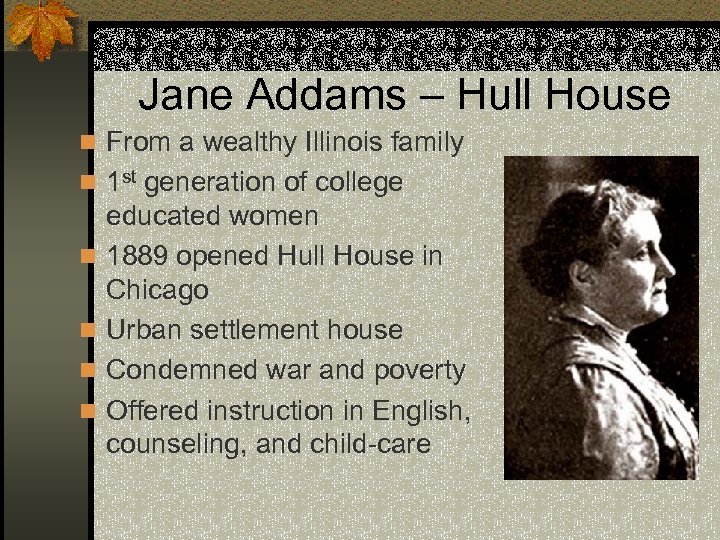 Jane Addams – Hull House n From a wealthy Illinois family n 1 st generation of college n n educated women 1889 opened Hull House in Chicago Urban settlement house Condemned war and poverty Offered instruction in English, counseling, and child-care
 Nativism n Viewed the Eastern and Southern Europeans as inferior n Blamed them for degradation of govt. , working for low wages, importing socialism, communism, and anarchy n Anglo-Saxons worried they would be outbred and outvoted
 American Protective Association (APA) n 1887 n 1 million members n Urged voting against Catholic candidates n Very anti-Catholic n Organized labor was nativist because of the language barrier
 Chinese Exclusion Act - 1882 n 1 st restrictive immigration laws keeping a race totally out of the US n This law barred all Chinese from entering the US for 10 years
 Undesirables n People who were forbidden grew to include: the insane, polygamists, prostitutes, alcoholics, anarchists, and diseased people n 1886 – Statue of Liberty was given by France to celebrate America’s open arms to immigrants n Nativists hated the idea
 Religion n Urban cities posed challenges for American churches n Protestants, in particular, had many doctrines and teachings that were irrelevant in urban cities n Church became a sacred diversion, or amusement for some
 Religion n John D. Rockefeller – pillar of Baptist Church n J. P. Morgan – pillar of the Episcopal Church n Materialism prevailed – worshipped money as achievement n “God causes the righteous to prosper”
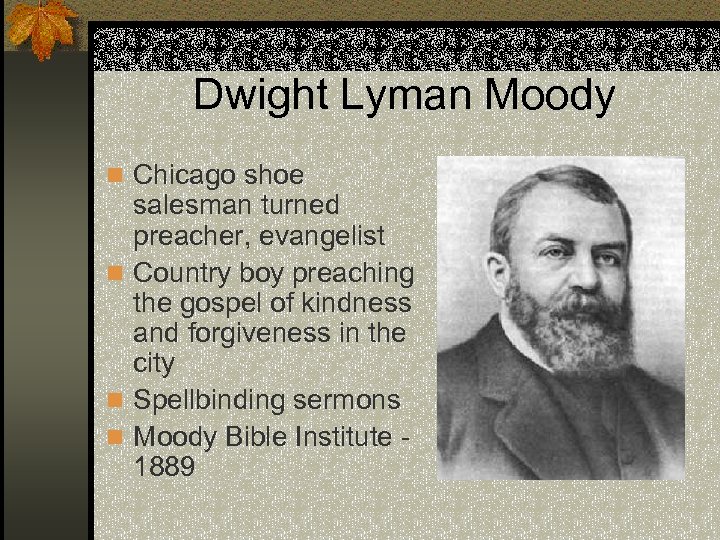 Dwight Lyman Moody n Chicago shoe salesman turned preacher, evangelist n Country boy preaching the gospel of kindness and forgiveness in the city n Spellbinding sermons n Moody Bible Institute 1889
 Religion n Roman Catholic and Jewish faith was growing in the city n Strength came from New Immigrants n 1900 – Catholics largest single denomination in the US
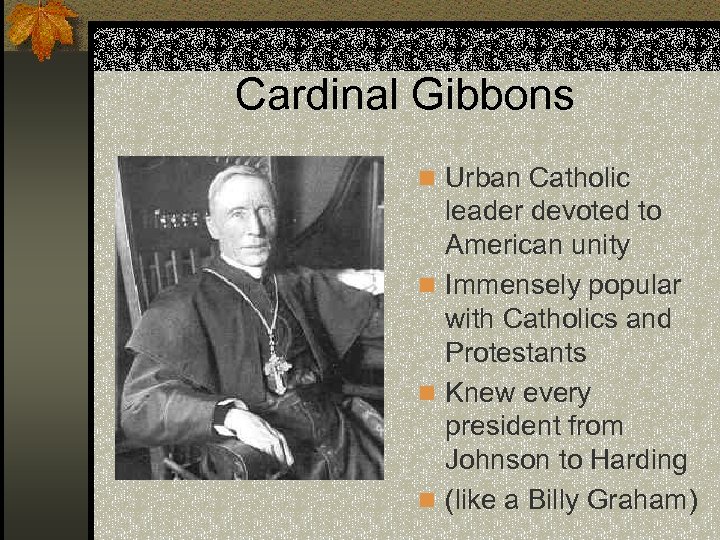 Cardinal Gibbons n Urban Catholic leader devoted to American unity n Immensely popular with Catholics and Protestants n Knew every president from Johnson to Harding n (like a Billy Graham)
 Religion n 1890 – 150 different religious denominations n Salvation Army – soldiers without swords – est. in England in 1879
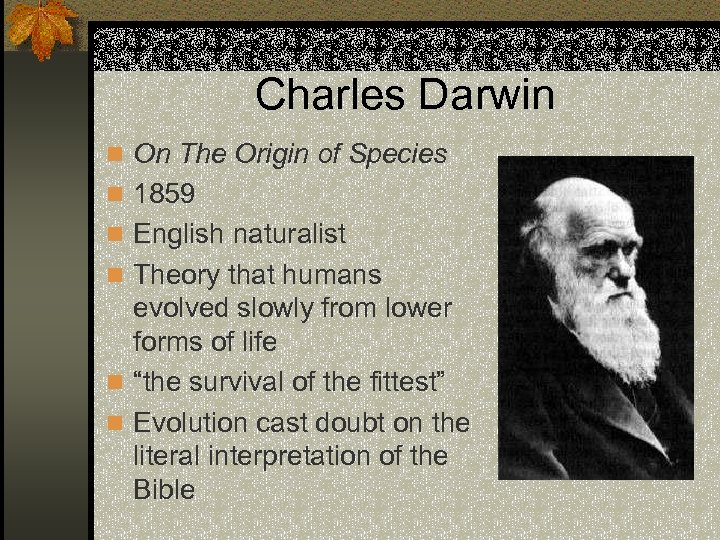 Charles Darwin n On The Origin of Species n 1859 n English naturalist n Theory that humans evolved slowly from lower forms of life n “the survival of the fittest” n Evolution cast doubt on the literal interpretation of the Bible
 Evolution n Fundamentalists – believed in God’s creation of the earth in 6 days n Modernists – flatly refused to accept Bible as science or history n Teachers of biology who embraced evolution were removed from their post
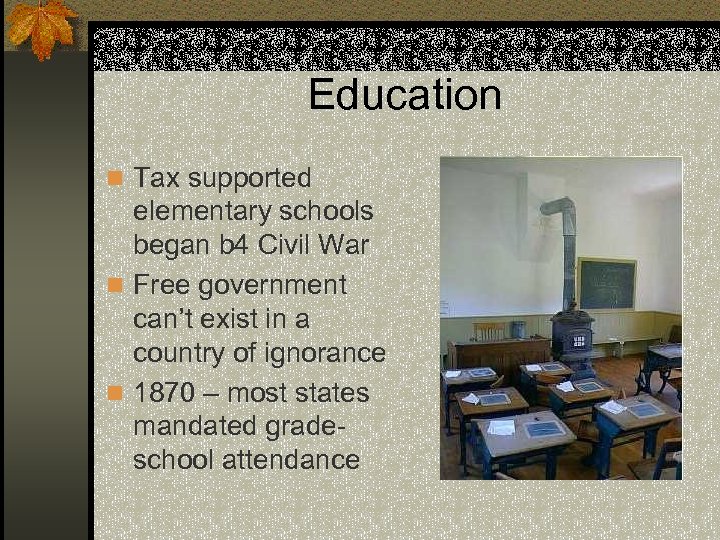 Education n Tax supported elementary schools began b 4 Civil War n Free government can’t exist in a country of ignorance n 1870 – most states mandated gradeschool attendance
 High Schools n High Schools began to spread in the 1880 s and 1890 s n Before the war, private academies were the only high schools n Tax supported high schools were rare n 1900 – 6, 000 HS w/ free texts supported by tax $
 Normal College n Teacher training expanded in the late 19 th century n 1910 – 300 Normal Schools n Southwest Texas State started as a normal school
 Education n Kindergartens – borrowed from Germany n Strength of Catholic parochial schools grew n 1870 – 20% of US was illiterate n 1900 – 10. 7% of US was illiterate
 African Americans n Suffered most because of lack of education opportunity n 44% of non-whites were illiterate in 1900
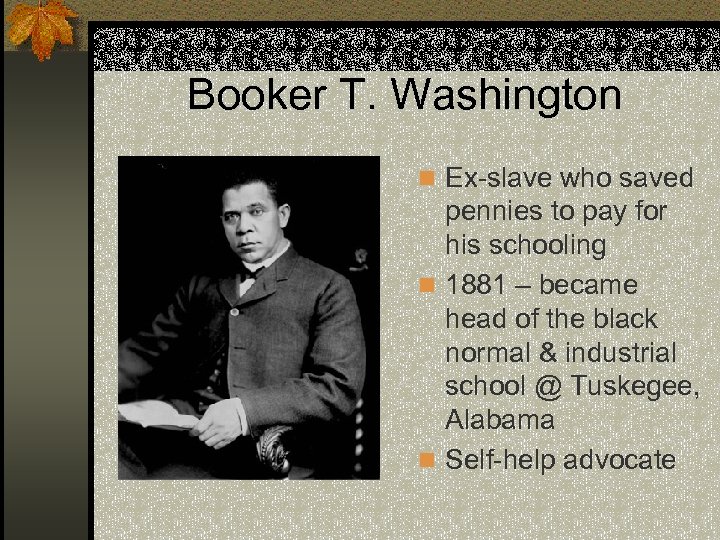 Booker T. Washington n Ex-slave who saved pennies to pay for his schooling n 1881 – became head of the black normal & industrial school @ Tuskegee, Alabama n Self-help advocate
 Booker T. Washington n “accomodationist” – Washington stopped just short of challenging white supremacy n B. T. W. – avoided the issue of social equality – focused on development of education n Economic independence would lead to political and civil rights, he believed
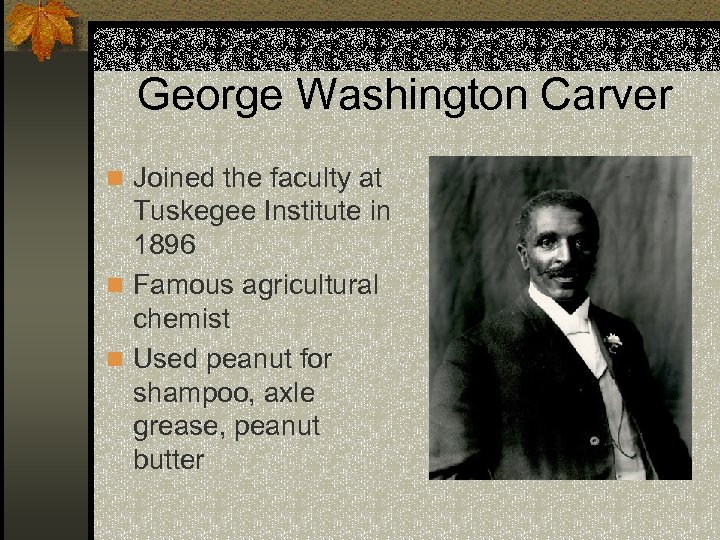 George Washington Carver n Joined the faculty at Tuskegee Institute in 1896 n Famous agricultural chemist n Used peanut for shampoo, axle grease, peanut butter
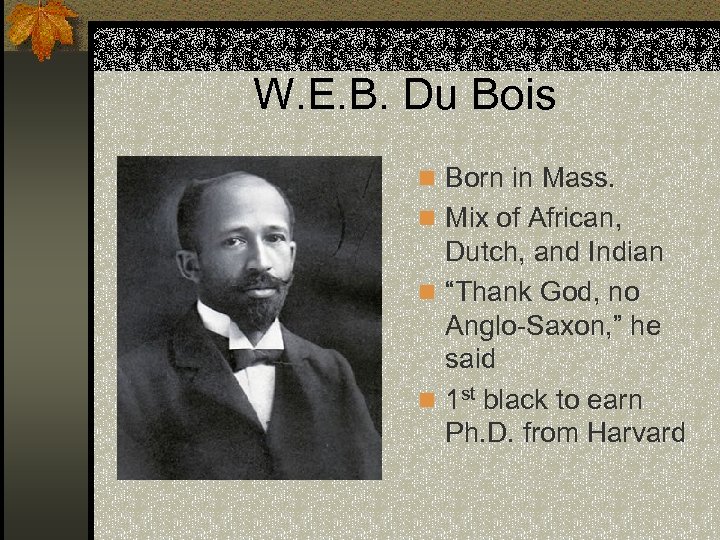 W. E. B. Du Bois n Born in Mass. n Mix of African, Dutch, and Indian n “Thank God, no Anglo-Saxon, ” he said n 1 st black to earn Ph. D. from Harvard
 Du Bois n Very arrogant (“The honor, I assure you, was n n n all Harvard’s”) Demanded complete equality for blacks, social and economic Du Bois called Washington and “Uncle Tom” Helped to found the NAACP in 1910 Historian, sociologist, and poet Died in exile in Africa at age 95 in 1963
 Black Colleges n Howard University in D. C n Hampton Institute in Virginia n Atlanta University n Made college possible for blacks
 Morrill Act (1862) n Provided generous grant of public land to the states for support of education n “Land grant colleges” n Most became state universities
 Hatch Act (1887) n Provided federal funds for the establishment of agricultural experiment stations in connection with land grant universities
 Private Endowments n Private philanthropies also richly supplemented federal funds n Industrial millionaires gave tremendous amounts of money n 1878 -1898 – money barons gave away $150 million to schools alone n Private schools – Cornell (1865) Leland Stanford Junior (1891) Univ. of Chicago (1892)
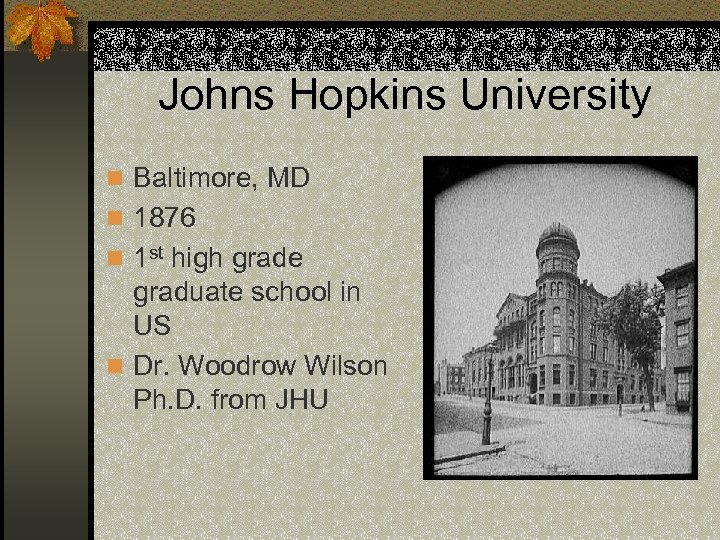 Johns Hopkins University n Baltimore, MD n 1876 n 1 st high grade graduate school in US n Dr. Woodrow Wilson Ph. D. from JHU
 Health n Louis Pasteur – pasteurization process n Joseph Lister – word Listerine, bacteria killing formula n Popularity of heavy beards end – “germ traps” n Campaigns against public spitting n Life expectancy went up
 Press n Linotype – 1885 n Sensationalism – sex, scandal, human interest n Joseph Pulitzer n William Randolph Hearst n Yellow journalism – prostituted the press in lies and exaggeration to increase circulation
 Literature n Dime Novels – Harlan F. Halsey wrote 650 n n novels Walt Whitman and Emily Dickinson – famous American poets Mark Twain – Samuel Longhorne Clemens “two fathoms” 1907 – Twain receives honorary Ph. D. from Oxford Wrote using common western language
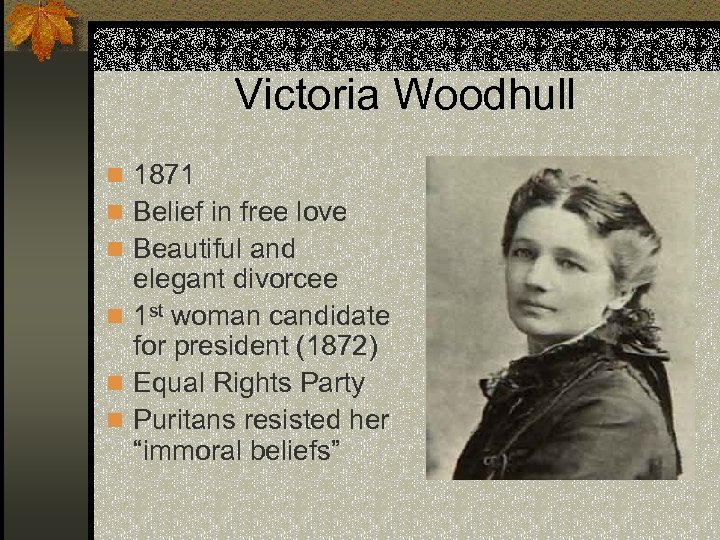 Victoria Woodhull n 1871 n Belief in free love n Beautiful and elegant divorcee n 1 st woman candidate for president (1872) n Equal Rights Party n Puritans resisted her “immoral beliefs”
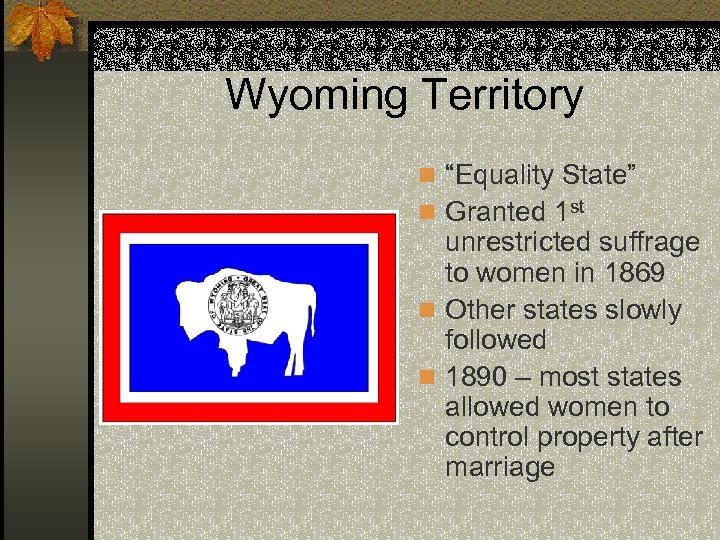 Wyoming Territory n “Equality State” n Granted 1 st unrestricted suffrage to women in 1869 n Other states slowly followed n 1890 – most states allowed women to control property after marriage
 Amusement n Vaudeville – course jokes and graceful n n acrobats (1880 s-1890 s) Circus – Phineas T. Barnum and James A. Bailey open “The Greatest Show on Earth” Wild West Shows – Buffalo Bill Cody with Indians, buffalo, and gunmen Baseball – 1 st pro team 1869 (Cincinnati Red Stockings) emerges as national pastime 1888 – all-star team tours the world