 Скачать презентацию INDUSTRY AND COMPETITIVE ANALYSIS Basis of crafting
lec5=industry_analysis.ppt
- Количество слайдов: 25



INDUSTRY AND COMPETITIVE ANALYSIS
Basis of crafting strategy process is analysis • Crafting strategy is an analysis-driven exercise, not a task where managers can get by with opinions, good instincts, and creative thinking. Judgments about what strategy to pursue need to flow directly from solid analysis of a company's external environment and internal situation. The two biggest considerations are – (1) industry and competitive conditions – (2) a company's competitive capabilities, resources, internal strengths and weaknesses, and market position.
Importance of the analysis • Accurate diagnosis of the company's situation is necessary managerial preparation for deciding on a sound long-term direction, setting appropriate objectives, and crafting a winning strategy. • Without perceptive understanding of the strategic aspects of a company's macro- and microenvironments, the chances are greatly increased that managers will make a strategic game plan that doesn't fit the situation well, that holds little prospect for building competitive advantage, and that is unlikely to boost company performance.
The methods of industry and competitive analysis • Industries differ widely in their economic characteristics, competitive situations, and future profit prospects. • The economic and competitive traits of the fast-food business have little in common with those of providing Internet-related products or services. The cable-TV business is shaped by industry and competitive conditions radically different from those in the soft-drink business.
Characteristics of an industry • The economic character of industries varies according to a number of factors: the overall size and market growth rate, the pace of technological change, the geographic, boundaries of the market (which can extend from local to worldwide), the number and sizes of buyers and sellers, whether sellers' products are virtually identical or highly differentiated, the extent to which costs are affected by economies of scale, and the types of distribution channels used to access buyers.
Competitive advantage of an industry • Competitive forces can be moderate in one industry and fierce, even cutthroat, in another. • Moreover, industries differ widely in the degree of competitive emphasis put on price, product quality, performance features, service, advertising and promotion, and new product innovation. In some industries, price competition dominates the marketplace while in others the competitive emphasis is centered on quality or product performance or customer service or brand image/reputation. In other industries, the challenge is for companies to work cooperatively with suppliers, customers.
Profitability of an industry • An industry's economic traits and competitive conditions and how they are expected to change determine whether its future profit prospects will be poor, average, or excellent. Industry and competitive conditions differ so much that leading companies in unattractive industries can find it hard to earn respectable profits, while even weak companies in attractive industries can turn in good performances.
What is Industry and competitive analysis • Industry and competitive analysis aims fit developing probing, insightful answers to seven questions: • 1. What are the industry's dominant economic features? • 2. What competitive forces are at work in the industry and how strong are they? • 3. What are the drivers of change in the industry and what impact will they have? • 4. Which companies are in the strongest/weakest competitive positions? • 5. Who's likely to make what competitive moves next? • 6. What key factors will determine competitive success or failure? • 7. How attractive is the industry in terms of its prospects for above-average profitability? The answers to these questions build understanding of a firm's surrounding environment and, collectively, form the basis for matching its strategy to changing industry conditions and competitive realities.
What Are the Industry's Dominant Economic Features? • Because industries differ significantly in their character and structure, industry and competitive analysis begins with an overview of the industry's dominant economic features. As a working definition, we use the word industry to mean a group of firms whose products have so many of the same attributes that they compete for the same buyers.
The factors to consider in profiling an industry: Market size. • Small markets don't tend to attract big/new competitors; large markets often draw the interest of companies looking to acquire competitors with established positions in attractive industries • Sulfuric Acid Industry • $400 -$500 million annual revenues; 4 million tons total volume
The factor…: Scope of competitive rivalry • The scope can be local, regional, national, or global. • Sulfuric Acid Industry • Primarily regional; producers rarely sell outside a 250 -mile radius of plant due to high cost of shipping long distances.
The factor…: Market growth rate and where the industry is in the growth cycle • An industry can be at the stage of early development, rapid growth and takeoff, early maturity, mature, saturated and stagnant, declining. • Fast growth breeds new entry; growth slowdowns spawn increased rivalry and a shake-out of weak competitors • Sulfuric Acid Industry • 2 -3 percent annually. Stage in Life Cycle: Mature
The factor…: Number of rivals and their relative sizes • Is the industry fragmented with many small companies or concentrated and dominated by a few large companies? • Sulfuric Acid Industry • About 30 companies with 110 plant locations and capacity of 4. 5 million tons. Market shares range from a low of 3 percent to a high of 21 percent.
The factor…: The number of buyers and their relative sizes. • Are the customers big or small? • Sulfuric Acid Industry • Customers: About 2, 000 buyers; most are industrial chemical firms.
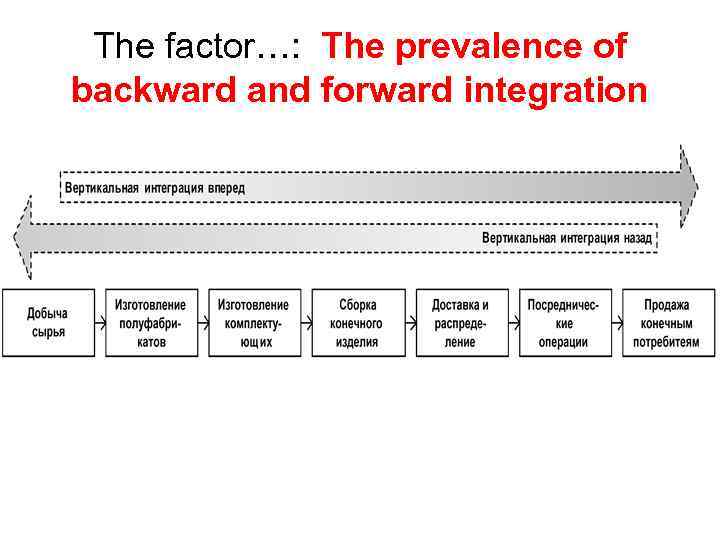
The factor…: The prevalence of backward and forward integration
The factor…: The prevalence of backward and forward integration • The integration raises capital requirements; often creates competitive differences and cost differences among fully versus partially versus nonintegrated firms. • Sulfuric Acid Industry • Degree of Vertical Integration: Mixed; 5 of the 10 largest companies are integrated backward into mining operations and also forward in that sister industrial chemical divisions buy over 50 percent of the output of their plants; all other companies are engaged solely in the production of sulfuric acid.
The factor…: The types of distribution channels used to access buyers • The quantity of intermediaries. • Sulfuric Acid Industry • No intermediaries between Sulfuric Acid factories and consumers of Sulfuric Acid
The factor…: The pace of technological change in both production process innovation and new product introductions • Shortens product life cycle; increases risk because of opportunities for leapfrogging. • Sulfuric Acid Industry • Production technology is standard and changes have been slow; biggest changes are occurring in products— 1 -2 newly formulated specialty chemicals products are being introduced annually, accounting for nearly all of industry growth.
The factor…: Whether the product(s)/service(s) of rival firms are highly differentiated, weakly differentiated, or essentially identical. • Standardized products: Buyers have more power because it is easier to switch from seller to seller. • Sulfuric Acid Industry • Highly standardized; the brands of different producers are essentially identical (buyers perceive little real difference from seller to seller).
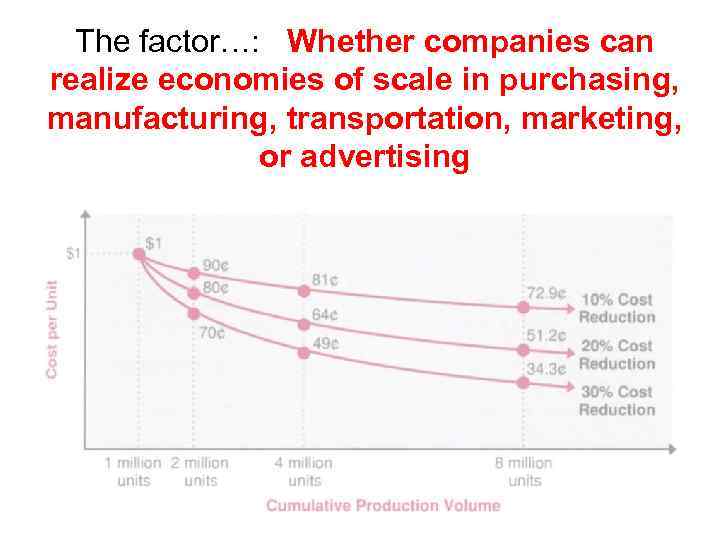
The factor…: Whether companies can realize economies of scale in purchasing, manufacturing, transportation, marketing, or advertising
The factor…: Whether companies can realize economies of scale in purchasing, manufacturing, transportation, marketing, or advertising • Economy of scale increases volume and market share needed to be cost competitive • Sulfuric Acid Industry • Scale Economies: Moderate; all companies have virtually equal manufacturing costs but scale economies exist in shipping in multiple carloads to same customer and in purchasing large quantities of raw materials.
The factor…: Whether high rates of capacity utilization are crucial to achieving low-cost production efficiency • Sulfuric Acid Industry • Capacity Utilization: Manufacturing efficiency is highest between 90 -100 percent of rated capacity; below 90 percent utilization, unit costs run significantly higher.
The factor…: Resource requirements and the ease of entry and exit • High barriers protect positions and profits of existing firms; low barriers make existing firms vulnerable to entry • Sulfuric Acid Industry • Ease of Entry/Exit: Moderate entry barriers exist in the form of capital requirements to construct a new plant of minimum efficient size (cost equals $10 million) and ability to build a customer base inside a 250 -mile radius of plant.
The factor…: Whether industry profitability is above/below par • High-profit industries attract new entrants; depressed conditions encourage exit. • Sulfuric Acid Industry • Subpar to average; the commodity nature of the industry's product results in intense price-cutting when demand slackens, but prices firm up during periods of strong demand. Profits track the strength of demand for the industry's products.
Importance of industry's economic features analysis • An industry's economic features are important because of the implications they have for strategy. For example, in capital-intensive industries where investment in a single plant can run several hundred million dollars, a firm can spread the burden of high fixed costs by pursuing a strategy that promotes high utilization of fixed assets and generates more revenue per dollar of fixed-asset investment. Thus commercial airlines try to boost the revenue productivity of their multimillion-dollar jets by cutting ground time at airport gates (to get in more flights per day with the same plane) and by using multi-tiered price discounts to fill up otherwise empty seats.
Скачать презентацию INDUSTRY AND COMPETITIVE ANALYSIS Basis of crafting
lec5=industry_analysis.ppt