


 Скачать презентацию INDUSTRIAL PLASTICS Venera Dyunyasheva Roman Gagan Determination
Gagan_Dyunyasheva_Plastics.pptx
- Количество слайдов: 9
 INDUSTRIAL PLASTICS Venera Dyunyasheva Roman Gagan
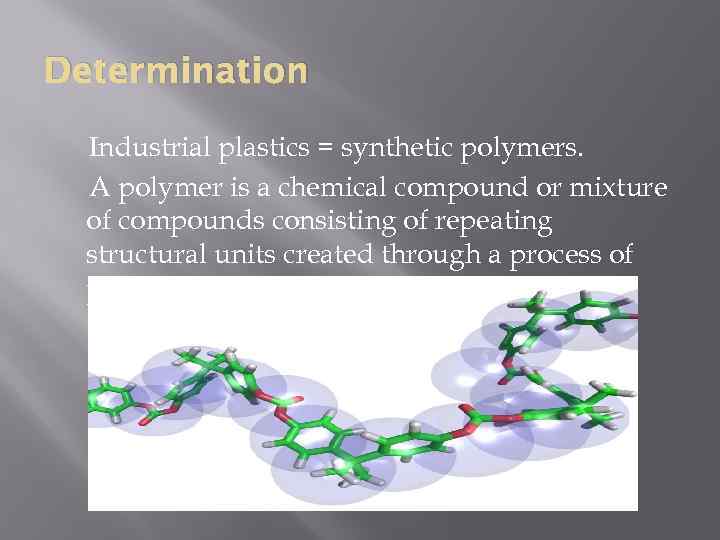 Determination Industrial plastics = synthetic polymers. A polymer is a chemical compound or mixture of compounds consisting of repeating structural units created through a process of polymerization.
 Examples The list of synthetic polymers includes synthetic rubber, Bakelite, neoprene, nylon, PVC, polystyrene, polyethylene, polypropylene, polyacrylonitrile, PVB, silicone, and many more.
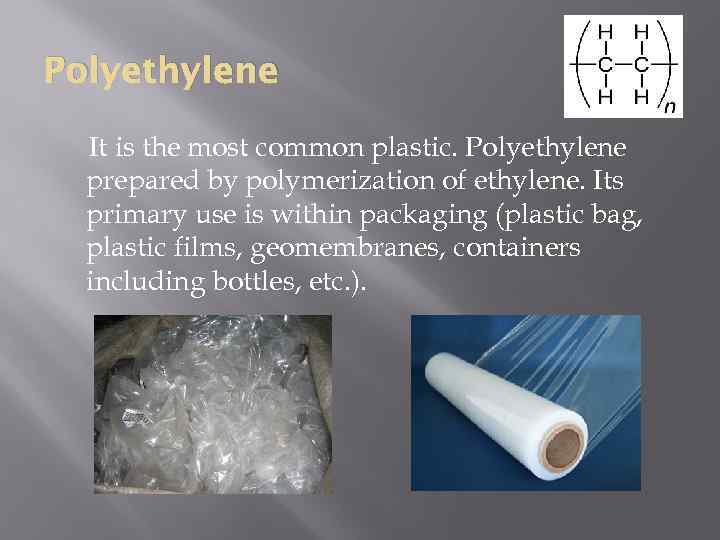 Polyethylene It is the most common plastic. Polyethylene prepared by polymerization of ethylene. Its primary use is within packaging (plastic bag, plastic films, geomembranes, containers including bottles, etc. ).
 Properties Polyethylene is a thermoplastic polymer consisting of long hydrocarbon chains. Depending on the crystallinity and molecular weight, a melting point and glass transition may or may not be observable. The temperature at which these occur varies strongly with the type of polyethylene. For common commercial grades of medium- and high-density polyethylene the melting point is typically in the range 120 to 130 °C. The melting point for average, commercial, lowdensity polyethylene is typically 105 to 115 °C. It is resistant to gentle oxidants and reducing agents. Polyethylene burns slowly with a blue flame having a yellow tip and gives off an odour of paraffin. The material continues burning on removal of the flame source and produces a drip. Crystalline samples do not dissolve at room temperature.
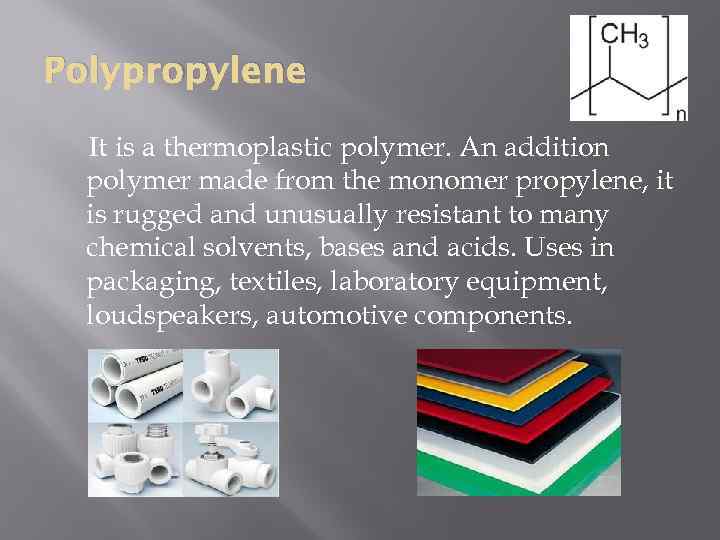 Polypropylene It is a thermoplastic polymer. An addition polymer made from the monomer propylene, it is rugged and unusually resistant to many chemical solvents, bases and acids. Uses in packaging, textiles, laboratory equipment, loudspeakers, automotive components.
 Properties Most commercial polypropylene is isotactic and has an intermediate level of crystallinity between that of lowdensity polyethylene and high-density polyethylene. Polypropylene is normally tough and flexible, especially when copolymerized with ethylene. This allows polypropylene to be used as an engineering plastic. Perfectly isotactic polypropylene has a melting point of 171 °C. The melt flow rate is a measure of molecular weight of polypropylene. The measure helps to determine how easily the molten raw material will flow during processing. Polypropylene with higher melting flow rate will fill the plastic mold more easily during the injection or blowmolding production process. As the melt flow increases, however, some physical properties, like impact strength, will decrease.
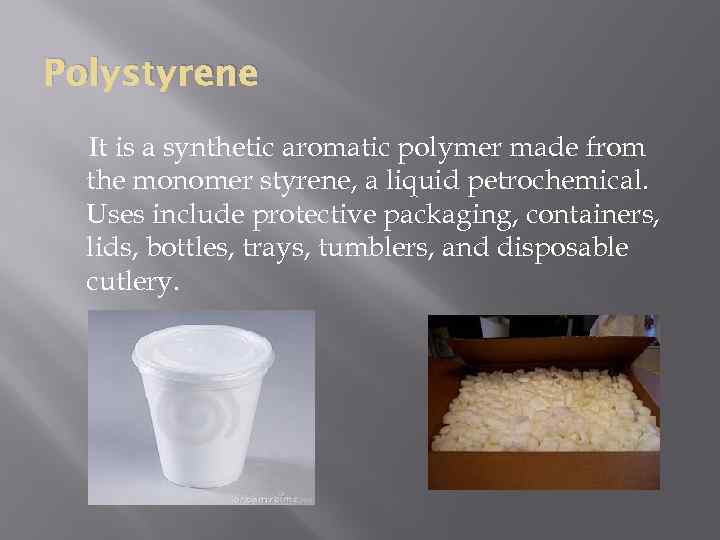 Polystyrene It is a synthetic aromatic polymer made from the monomer styrene, a liquid petrochemical. Uses include protective packaging, containers, lids, bottles, trays, tumblers, and disposable cutlery.
 Properties As a thermoplastic polymer, polystyrene is in a solid (glassy) state at room temperature but flows if heated above about 100 °C, its glass transition temperature. It becomes rigid again when cooled. This temperature behaviour is exploited for molding and extrusion, since it can be cast into molds with fine detail. Since the molecules are long hydrocarbon chains that consist of thousands of atoms, the total attractive force between the molecules is large. When heated the chains are able to take on a higher degree of conformation and slide past each other. This intermolecular weakness confers flexibility and elasticity. The ability of the system to be readily deformed above its glass transition temperature allows polystyrene to be readily softened and molded upon heating.