


 Скачать презентацию Inductors A coil of wire can create a
9c7d7ac80d0fa7e4c14bd49d273cb60c.ppt
- Количество слайдов: 65
 Inductors A coil of wire can create a magnetic field if a current is run through it. If that current changes (as in the AC case), the magnetic field created by the coil will change. Will this changing magnetic field through the coil cause a voltage to be created across the coil? YES! This is called self-inductance and is the basis behind the circuit element called the inductor.
![Inductors Recall Faraday’s Law: V = d/dt [ B d. A ]. Since the](https://present5.com/presentation/9c7d7ac80d0fa7e4c14bd49d273cb60c/image-2.jpg "Inductors Recall Faraday’s Law: V = d/dt [ B d. A ]. Since the") Inductors Recall Faraday’s Law: V = d/dt [ B d. A ]. Since the voltage created depends in this case on the changing magnetic field, and the field depends on the changing current, and since the angle (dot product) and the area don’t change, we have: Vinductor = -L d. I /dt where the L (called the inductance) depends on the shape and material (just like capacitance and resistance).
Inductors Recall Faraday’s Law: V = d/dt [ B d. A ]. Since the voltage created depends in this case on the changing magnetic field, and the field depends on the changing current, and since the angle (dot product) and the area don’t change, we have: Vinductor = -L d. I /dt where the L (called the inductance) depends on the shape and material (just like capacitance and resistance).
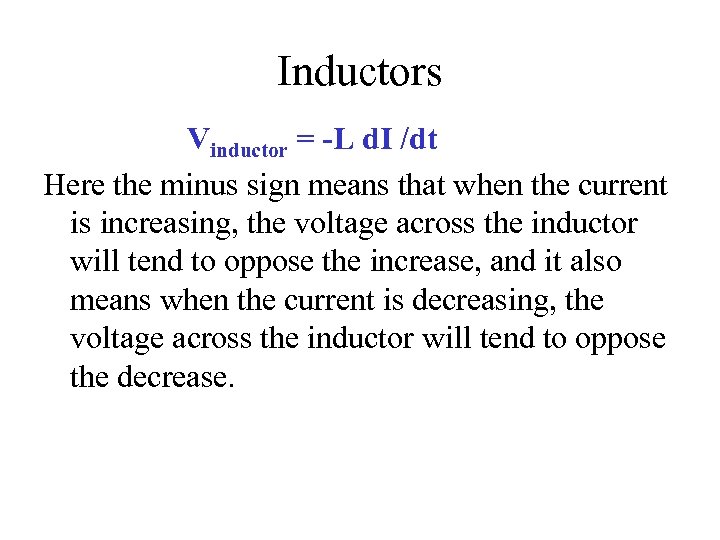 Inductors Vinductor = -L d. I /dt Here the minus sign means that when the current is increasing, the voltage across the inductor will tend to oppose the increase, and it also means when the current is decreasing, the voltage across the inductor will tend to oppose the decrease.
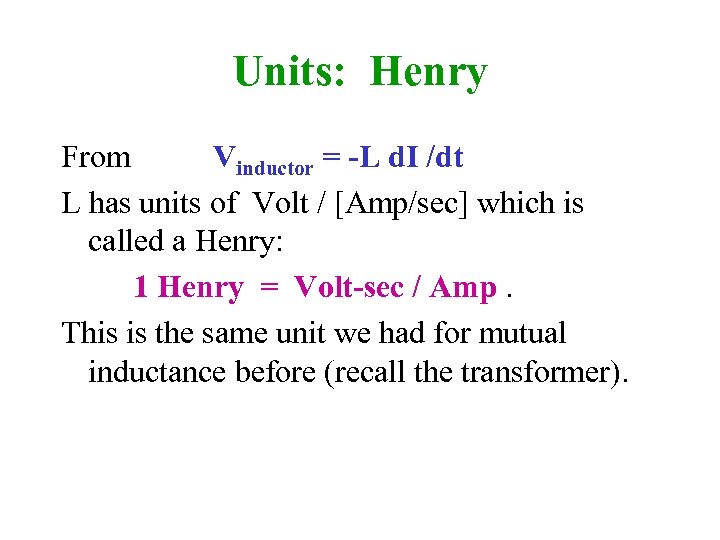 Units: Henry From Vinductor = -L d. I /dt L has units of Volt / [Amp/sec] which is called a Henry: 1 Henry = Volt-sec / Amp. This is the same unit we had for mutual inductance before (recall the transformer).
 Solenoid type inductor For a capacitor, we started with a parallel plate configuration since the parallel plates provided a uniform electric field between the plates. In the same way, we will start with a device that provides a uniform magnetic field inside the device: a solenoid.
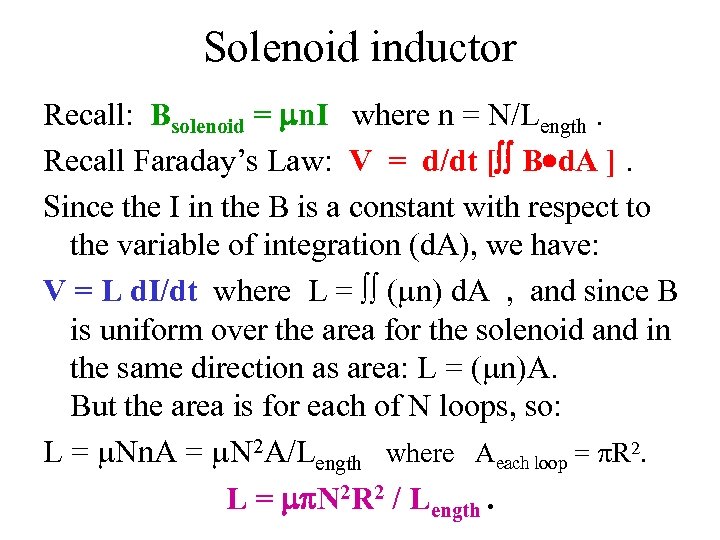 Solenoid inductor Recall: Bsolenoid = mn. I where n = N/Length. Recall Faraday’s Law: V = d/dt [ B d. A ]. Since the I in the B is a constant with respect to the variable of integration (d. A), we have: V = L d. I/dt where L = ( n) d. A , and since B is uniform over the area for the solenoid and in the same direction as area: L = ( n)A. But the area is for each of N loops, so: L = Nn. A = N 2 A/Length where Aeach loop = p. R 2. L = mp. N 2 R 2 / Length.
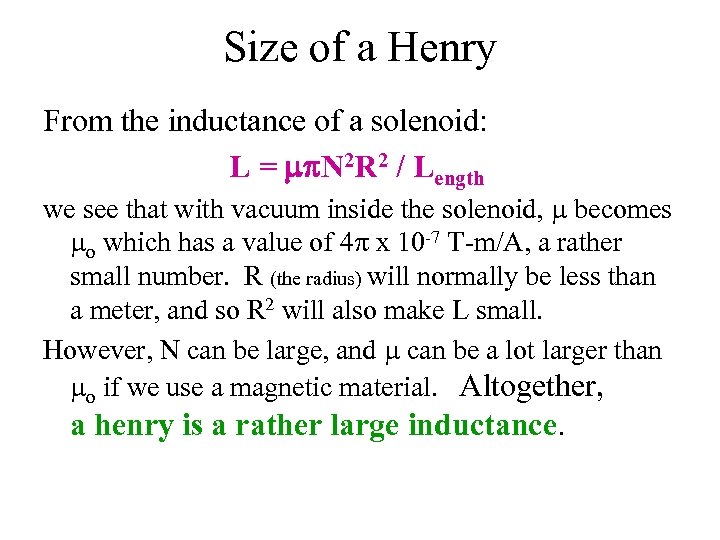 Size of a Henry From the inductance of a solenoid: L = mp. N 2 R 2 / Length we see that with vacuum inside the solenoid, becomes o which has a value of 4 p x 10 -7 T-m/A, a rather small number. R (the radius) will normally be less than a meter, and so R 2 will also make L small. However, N can be large, and can be a lot larger than o if we use a magnetic material. Altogether, a henry is a rather large inductance.
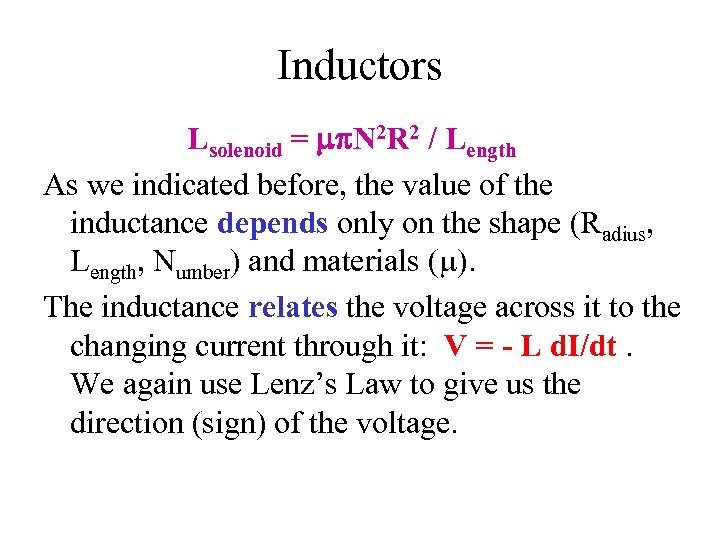 Inductors Lsolenoid = mp. N 2 R 2 / Length As we indicated before, the value of the inductance depends only on the shape (Radius, Length, Number) and materials ( ). The inductance relates the voltage across it to the changing current through it: V = - L d. I/dt. We again use Lenz’s Law to give us the direction (sign) of the voltage.
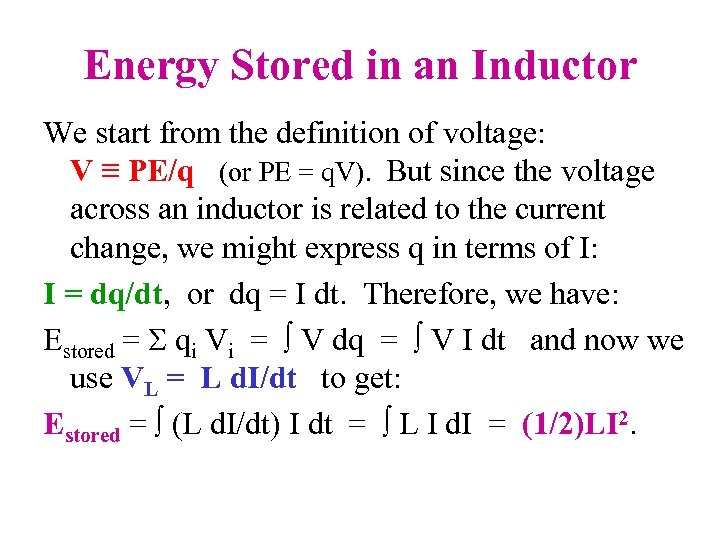 Energy Stored in an Inductor We start from the definition of voltage: V ≡ PE/q (or PE = q. V). But since the voltage across an inductor is related to the current change, we might express q in terms of I: I = dq/dt, or dq = I dt. Therefore, we have: Estored = S qi Vi = V dq = V I dt and now we use VL = L d. I/dt to get: Estored = (L d. I/dt) I dt = L I d. I = (1/2)LI 2.
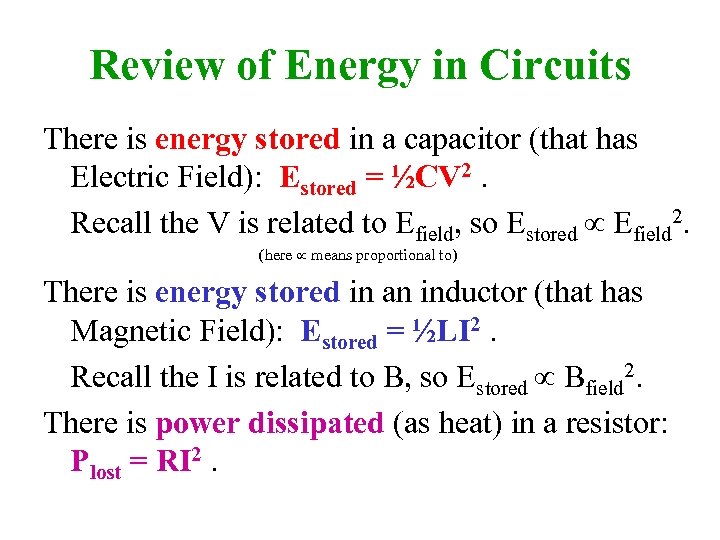 Review of Energy in Circuits There is energy stored in a capacitor (that has Electric Field): Estored = ½CV 2. Recall the V is related to Efield, so Estored Efield 2. (here means proportional to) There is energy stored in an inductor (that has Magnetic Field): Estored = ½LI 2. Recall the I is related to B, so Estored Bfield 2. There is power dissipated (as heat) in a resistor: Plost = RI 2.
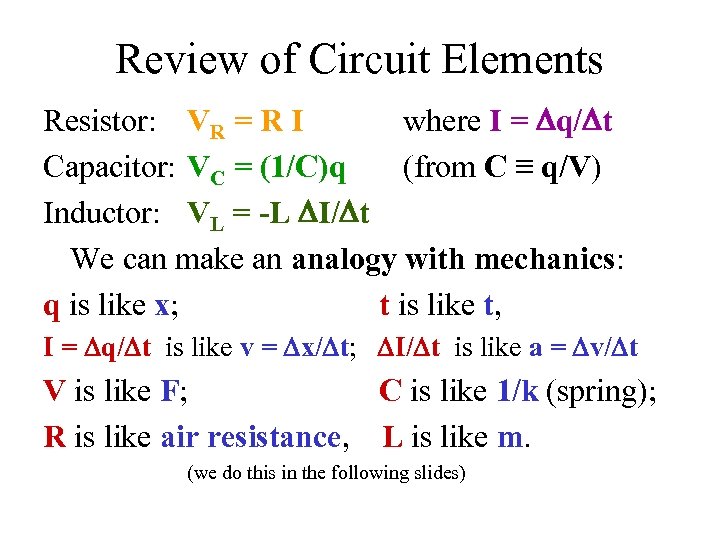 Review of Circuit Elements Resistor: VR = R I where I = Dq/Dt Capacitor: VC = (1/C)q (from C ≡ q/V) Inductor: VL = -L DI/Dt We can make an analogy with mechanics: q is like x; t is like t, I = Dq/Dt is like v = Dx/Dt; DI/Dt is like a = Dv/Dt V is like F; C is like 1/k (spring); R is like air resistance, L is like m. (we do this in the following slides)
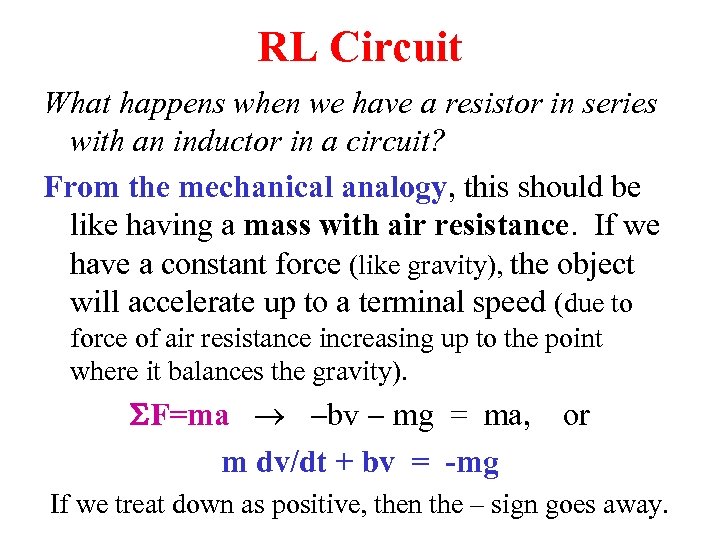 RL Circuit What happens when we have a resistor in series with an inductor in a circuit? From the mechanical analogy, this should be like having a mass with air resistance. If we have a constant force (like gravity), the object will accelerate up to a terminal speed (due to force of air resistance increasing up to the point where it balances the gravity). SF=ma -bv - mg = ma, m dv/dt + bv = -mg or If we treat down as positive, then the – sign goes away.
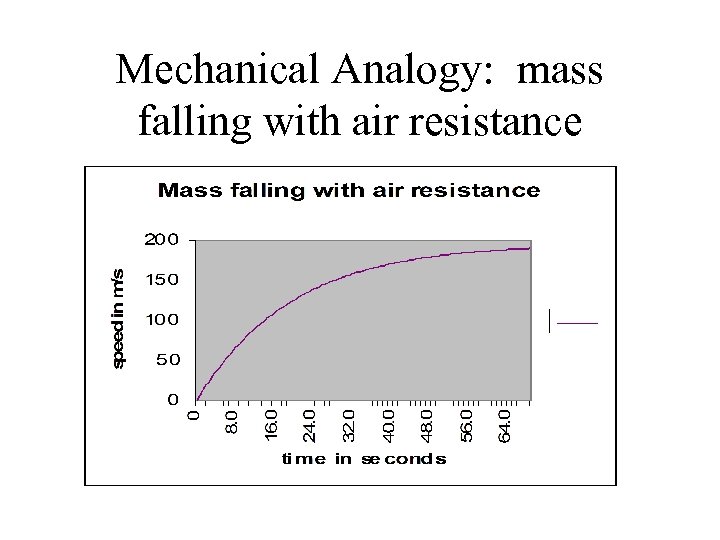 Mechanical Analogy: mass falling with air resistance
 RL Circuit (cont. ) If we connect the resistor and the inductor to a battery and then turn the switch on, from the mechanical analogy we would expect the current (which is like velocity) to begin to increase until it reaches a constant amount.
 LR Circuit - qualitative look From the circuit point of view, initially we have zero current so there is no VR (voltage drop across the resistor). Thus the full voltage of the battery is trying to change the current, hence VL = Vbattery, and so d. I/dt = Vbattery /L. This is like the falling mass: initially there is no speed so there is no air resistance and the mass falls with the full acceleration due to gravity.
 LR Circuit - qualitative look However, as the current increases, there is more voltage drop across the resistor, VR, which reduces the voltage across the inductor (VL = Vbattery - VR), and hence the smaller VL reduces the rate of change of the current! This is like the mass with gravity and air resistance: as the mass falls and picks up speed there is more and more air resistance opposing gravity so there is less and less acceleration and so the speed levels out.
 RL Circuit: Differential Equation To see this behavior quantitatively, we need to get an equation. We can get a differential equation by using the Conservation of Energy (SVi = 0): Vbattery - Vresistor - Vinductor = 0. This looks like an ordinary algebraic equation. But all the V’s are not constants: we have relations for Vresistor and Vinductor.
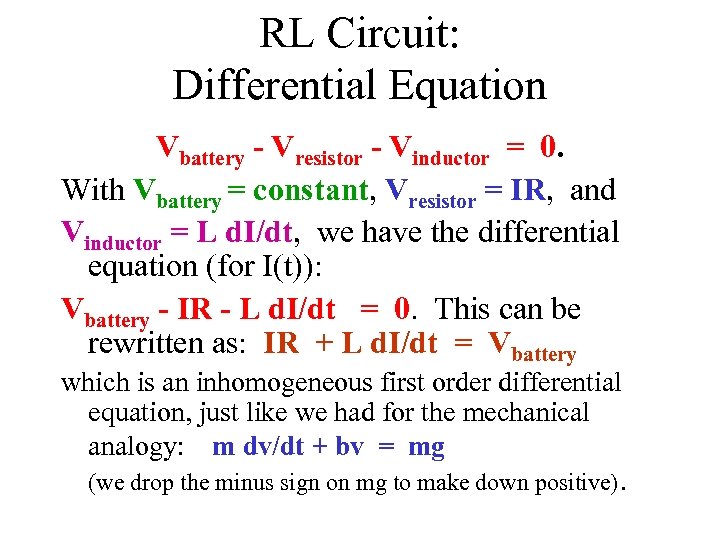 RL Circuit: Differential Equation Vbattery - Vresistor - Vinductor = 0. With Vbattery = constant, Vresistor = IR, and Vinductor = L d. I/dt, we have the differential equation (for I(t)): Vbattery - IR - L d. I/dt = 0. This can be rewritten as: IR + L d. I/dt = Vbattery which is an inhomogeneous first order differential equation, just like we had for the mechanical analogy: m dv/dt + bv = mg (we drop the minus sign on mg to make down positive).
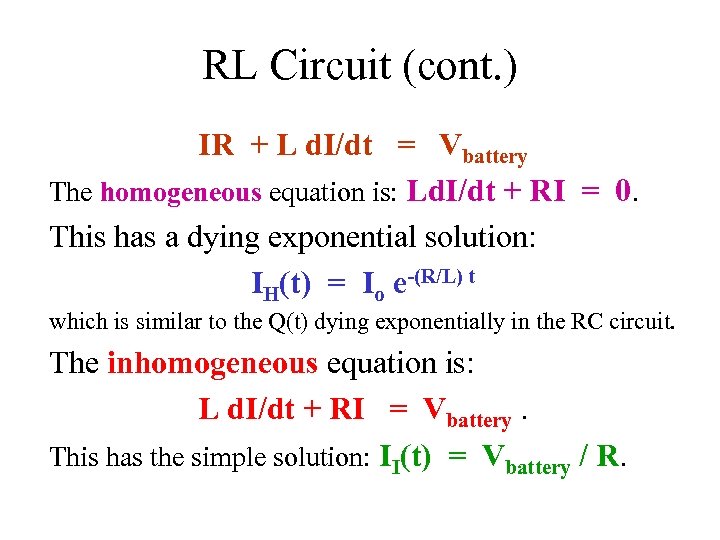 RL Circuit (cont. ) IR + L d. I/dt = Vbattery The homogeneous equation is: Ld. I/dt + RI = 0. This has a dying exponential solution: IH(t) = Io e-(R/L) t which is similar to the Q(t) dying exponentially in the RC circuit. The inhomogeneous equation is: L d. I/dt + RI = Vbattery. This has the simple solution: II(t) = Vbattery / R.
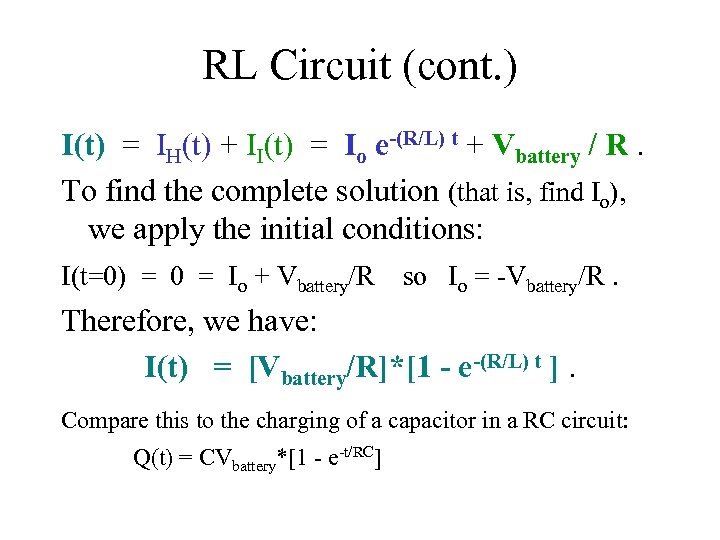 RL Circuit (cont. ) I(t) = IH(t) + II(t) = Io e-(R/L) t + Vbattery / R. To find the complete solution (that is, find Io), we apply the initial conditions: I(t=0) = 0 = Io + Vbattery/R so Io = -Vbattery/R. Therefore, we have: I(t) = [Vbattery/R]*[1 - e-(R/L) t ]. Compare this to the charging of a capacitor in a RC circuit: Q(t) = CVbattery*[1 - e-t/RC]
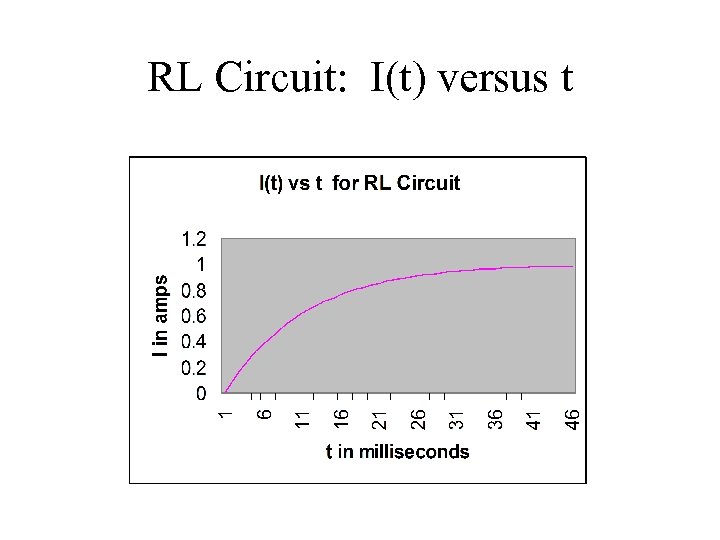
![RL Circuit I(t) = [Vbattery/R]*[1 - e-(R/L)t ]. At t=0, I(0) = 0. As](https://present5.com/presentation/9c7d7ac80d0fa7e4c14bd49d273cb60c/image-21.jpg "RL Circuit I(t) = [Vbattery/R]*[1 - e-(R/L)t ]. At t=0, I(0) = 0. As") RL Circuit I(t) = [Vbattery/R]*[1 - e-(R/L)t ]. At t=0, I(0) = 0. As time goes on, the current, I(t), does increase and finally (when t is large and e-(R/L)t is tiny) reaches the value Vbattery /R which is what it would be without the inductor present. The graph on the next slide shows this function when Vbattery = 24 volts; R = 24 W, and L = 1 H. Note that the max current is 1 Amp, and the time scale is in milliseconds.
RL Circuit I(t) = [Vbattery/R]*[1 - e-(R/L)t ]. At t=0, I(0) = 0. As time goes on, the current, I(t), does increase and finally (when t is large and e-(R/L)t is tiny) reaches the value Vbattery /R which is what it would be without the inductor present. The graph on the next slide shows this function when Vbattery = 24 volts; R = 24 W, and L = 1 H. Note that the max current is 1 Amp, and the time scale is in milliseconds.
 RL Circuit: I(t) versus t
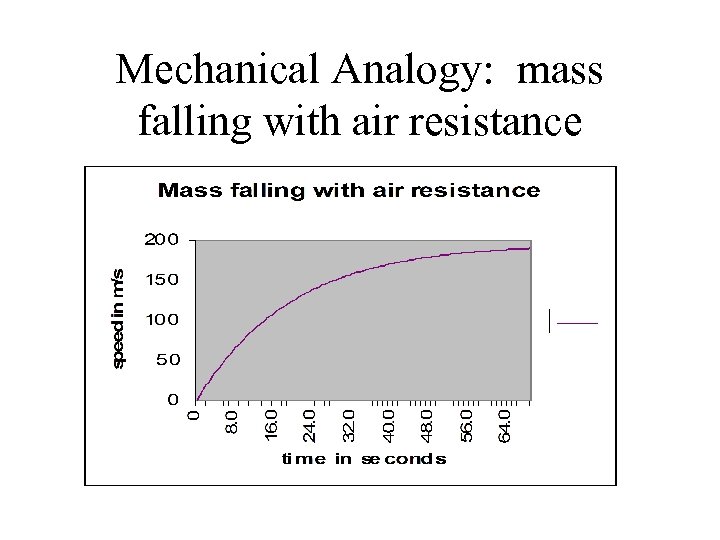 Mechanical Analogy: mass falling with air resistance
 RL Circuit Note that this graph of I(t) versus t looks qualitatively just like v(t) versus t for the mass falling under constant gravity with air resistance. According to the analogy, the inductance acts like the mass, and the resistance acts like the coefficient for air resistance.
 RL Circuits – cont. If you have an inductor in a DC circuit, it only comes into play when you turn on the DC voltage or turn it off (with a switch). When you turn the switch on, we saw that it takes a little time for the current to build up. What happens when you turn the switch off?
 RL Circuits – cont. What happens when you turn the switch off? When you turn the switch off, there is a large change in the current in a short time, which means there is a large voltage across the inductor. There is also a lot of energy stored in the inductor in the form of the magnetic field in the inductor. What will this large voltage with energy behind it do?
 RL Circuits – cont. What will this large voltage in the inductor with energy behind it do? If you don’t have a path to dissipate that energy, it will cause a spark to occur at the switch! What circuits have a large inductance? Anything with a large magnetic field, especially electromagnets!
 DC Circuits with C and L Because of the energy stored in the inductor, it is good practice in lab to turn the voltage down before you turn a power switch off - as we just saw. What about the energy in a capacitor when the DC power switch is turned off? Unless we give the capacitor a path to discharge, it may keep its charge until the air discharges it, and so may give someone a jolt if touched soon after the switch is turned off!
 R, L and C in a circuit We have already considered an RC circuit (in Part 2) and an RL circuit (just now). We looked at these cases for a circuit in which we had a battery and then threw the switch. Other than when turning a DC circuit on and off, the L has no effect and the C acts as a break in the circuit. However, the main reason these circuit elements are important is in AC circuits. We look next at the case of the three elements in a series circuit with an AC voltage applied.
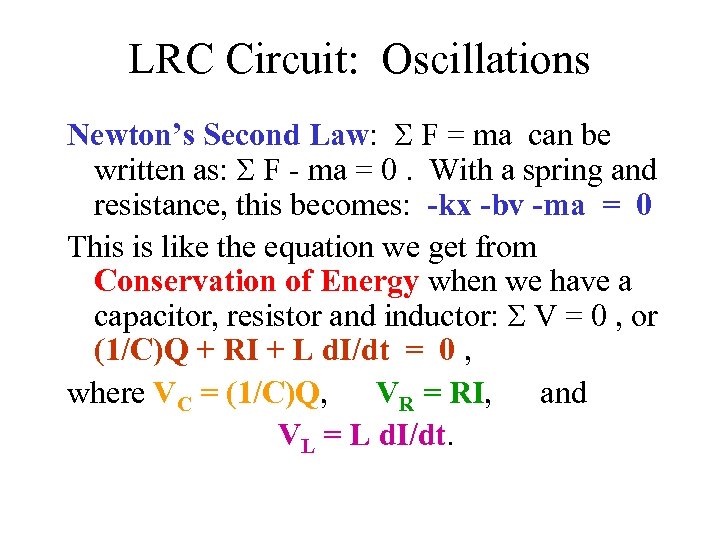 LRC Circuit: Oscillations Newton’s Second Law: S F = ma can be written as: S F - ma = 0. With a spring and resistance, this becomes: -kx -bv -ma = 0 This is like the equation we get from Conservation of Energy when we have a capacitor, resistor and inductor: S V = 0 , or (1/C)Q + RI + L d. I/dt = 0 , where VC = (1/C)Q, VR = RI, and VL = L d. I/dt.
 Resonance If we put an inductor and a capacitor with an AC voltage, we have the analogy with a mass connected to a spring that has an oscillating applied force. In both of these cases (mechanical and electrical), we get resonance. We’ll demonstrate this in class with a mass and spring. This, it turns out, is the basis of tuning a radio! The system will “resonate’ at some frequency. What does the resonant frequency for the system (mechanical or electrical) depend on?
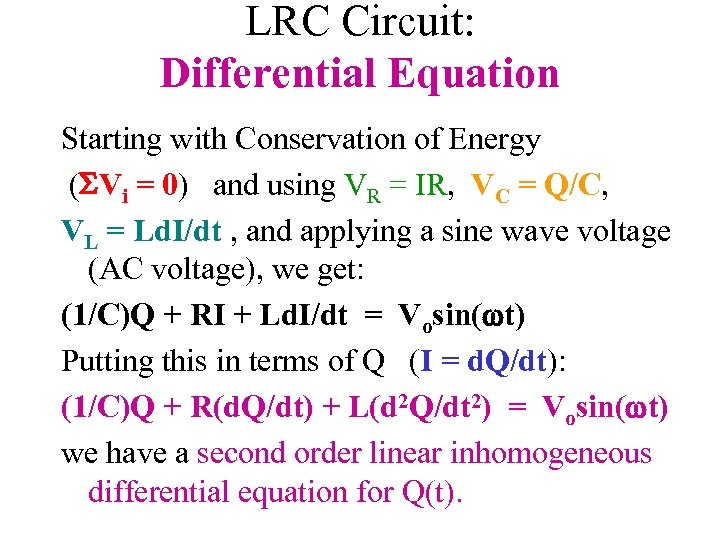 LRC Circuit: Differential Equation Starting with Conservation of Energy (SVi = 0) and using VR = IR, VC = Q/C, VL = Ld. I/dt , and applying a sine wave voltage (AC voltage), we get: (1/C)Q + RI + Ld. I/dt = Vosin( t) Putting this in terms of Q (I = d. Q/dt): (1/C)Q + R(d. Q/dt) + L(d 2 Q/dt 2) = Vosin( t) we have a second order linear inhomogeneous differential equation for Q(t).
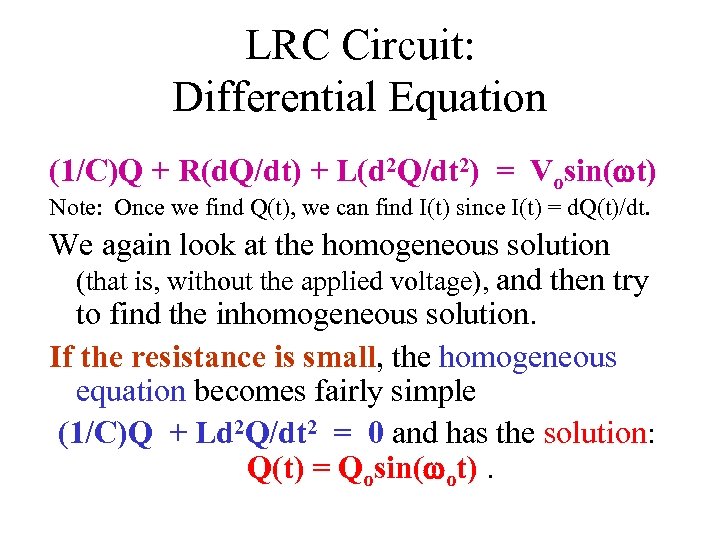 LRC Circuit: Differential Equation (1/C)Q + R(d. Q/dt) + L(d 2 Q/dt 2) = Vosin( t) Note: Once we find Q(t), we can find I(t) since I(t) = d. Q(t)/dt. We again look at the homogeneous solution (that is, without the applied voltage), and then try to find the inhomogeneous solution. If the resistance is small, the homogeneous equation becomes fairly simple (1/C)Q + Ld 2 Q/dt 2 = 0 and has the solution: Q(t) = Qosin( ot).
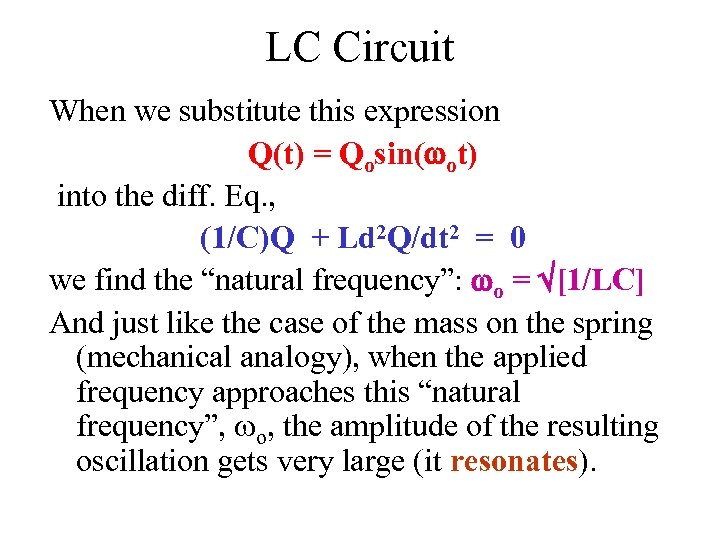 LC Circuit When we substitute this expression Q(t) = Qosin( ot) into the diff. Eq. , (1/C)Q + Ld 2 Q/dt 2 = 0 we find the “natural frequency”: o = [1/LC] And just like the case of the mass on the spring (mechanical analogy), when the applied frequency approaches this “natural frequency”, o, the amplitude of the resulting oscillation gets very large (it resonates).
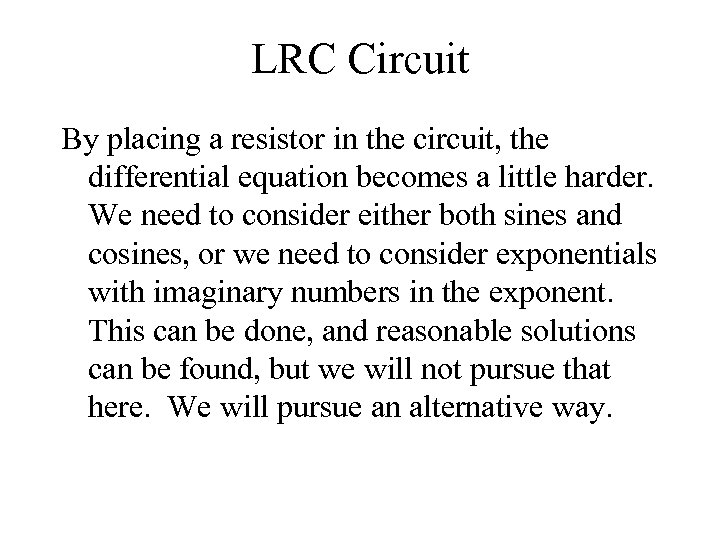 LRC Circuit By placing a resistor in the circuit, the differential equation becomes a little harder. We need to consider either both sines and cosines, or we need to consider exponentials with imaginary numbers in the exponent. This can be done, and reasonable solutions can be found, but we will not pursue that here. We will pursue an alternative way.
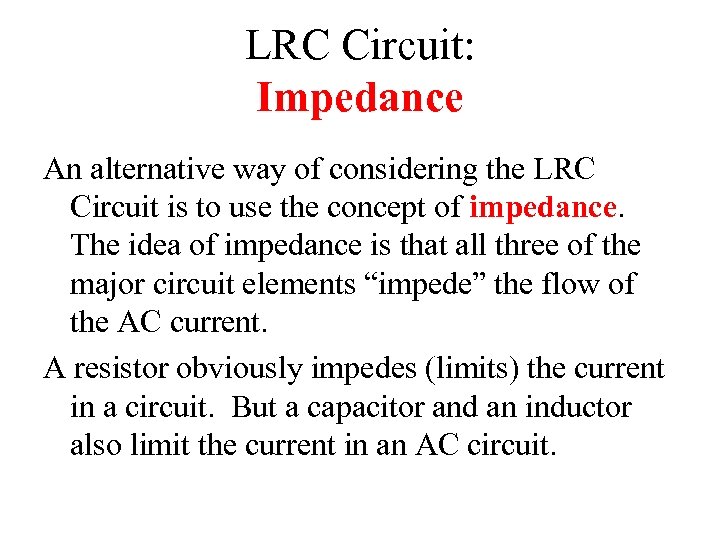 LRC Circuit: Impedance An alternative way of considering the LRC Circuit is to use the concept of impedance. The idea of impedance is that all three of the major circuit elements “impede” the flow of the AC current. A resistor obviously impedes (limits) the current in a circuit. But a capacitor and an inductor also limit the current in an AC circuit.
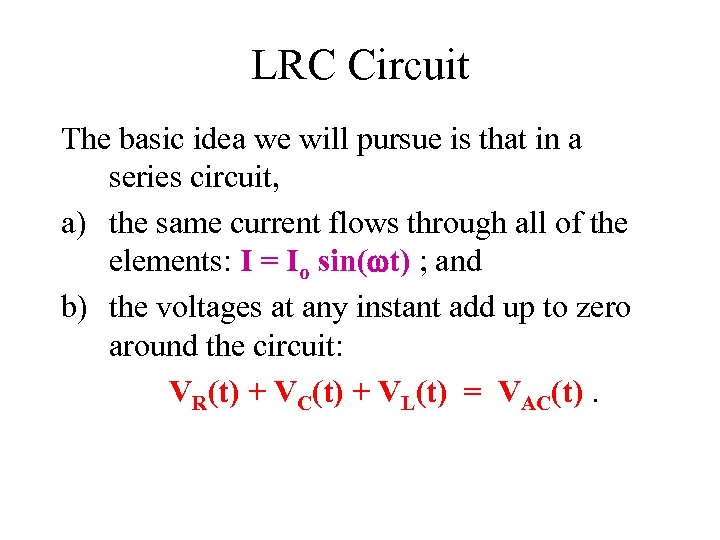 LRC Circuit The basic idea we will pursue is that in a series circuit, a) the same current flows through all of the elements: I = Io sin( t) ; and b) the voltages at any instant add up to zero around the circuit: VR(t) + VC(t) + VL(t) = VAC(t).
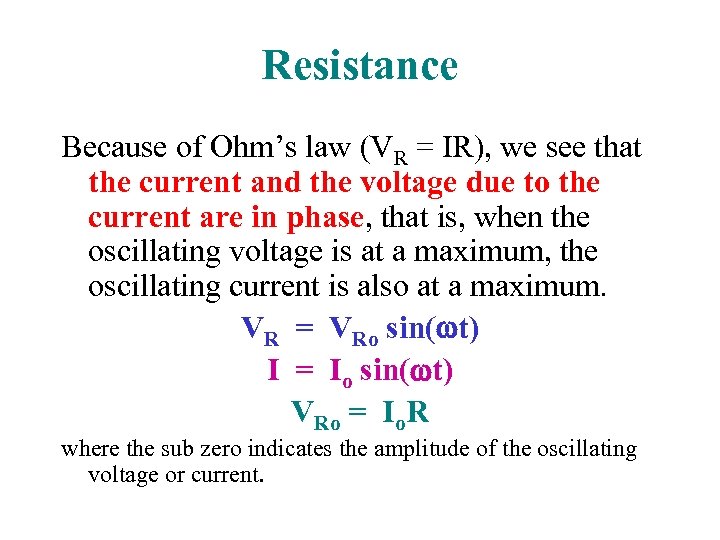 Resistance Because of Ohm’s law (VR = IR), we see that the current and the voltage due to the current are in phase, that is, when the oscillating voltage is at a maximum, the oscillating current is also at a maximum. VR = VRo sin( t) I = Io sin( t) VRo = Io. R where the sub zero indicates the amplitude of the oscillating voltage or current.
![Capacitive Reactance For a capacitor: VC = (1/C)Q, [from C=Q/V] and with I =](https://present5.com/presentation/9c7d7ac80d0fa7e4c14bd49d273cb60c/image-39.jpg "Capacitive Reactance For a capacitor: VC = (1/C)Q, [from C=Q/V] and with I =") Capacitive Reactance For a capacitor: VC = (1/C)Q, [from C=Q/V] and with I = d. Q/dt, or Q = I dt, if I = Iosin( t), then Q = I dt = Iosin( t) dt = (-Io/ ) cos( t), so VC = -(1/ C)Iocos( t). Note that cosine is 90 o different than sine - we say it is 90 o out of phase. This means that VC is 90 o out of phase with the current! Note that the constant (1/ C) acts just like R in that it relates V and I. We call this the capacitive reactance, XC = (1/ C) so VCo=XCIo.
Capacitive Reactance For a capacitor: VC = (1/C)Q, [from C=Q/V] and with I = d. Q/dt, or Q = I dt, if I = Iosin( t), then Q = I dt = Iosin( t) dt = (-Io/ ) cos( t), so VC = -(1/ C)Iocos( t). Note that cosine is 90 o different than sine - we say it is 90 o out of phase. This means that VC is 90 o out of phase with the current! Note that the constant (1/ C) acts just like R in that it relates V and I. We call this the capacitive reactance, XC = (1/ C) so VCo=XCIo.
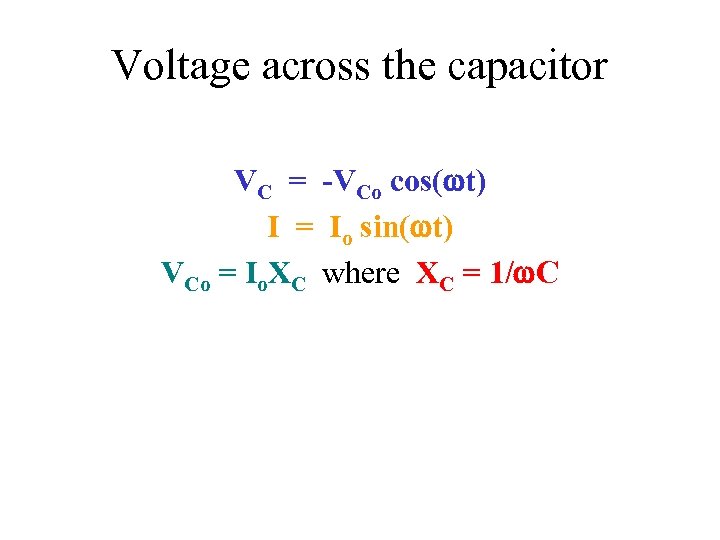 Voltage across the capacitor VC = -VCo cos( t) I = Io sin( t) VCo = Io. XC where XC = 1/ C
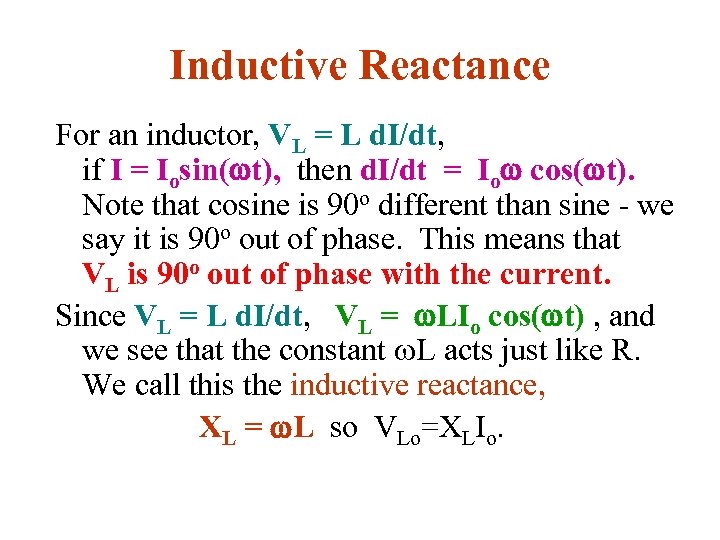 Inductive Reactance For an inductor, VL = L d. I/dt, if I = Iosin( t), then d. I/dt = Io cos( t). Note that cosine is 90 o different than sine - we say it is 90 o out of phase. This means that VL is 90 o out of phase with the current. Since VL = L d. I/dt, VL = LIo cos( t) , and we see that the constant L acts just like R. We call this the inductive reactance, XL = L so VLo=XLIo.
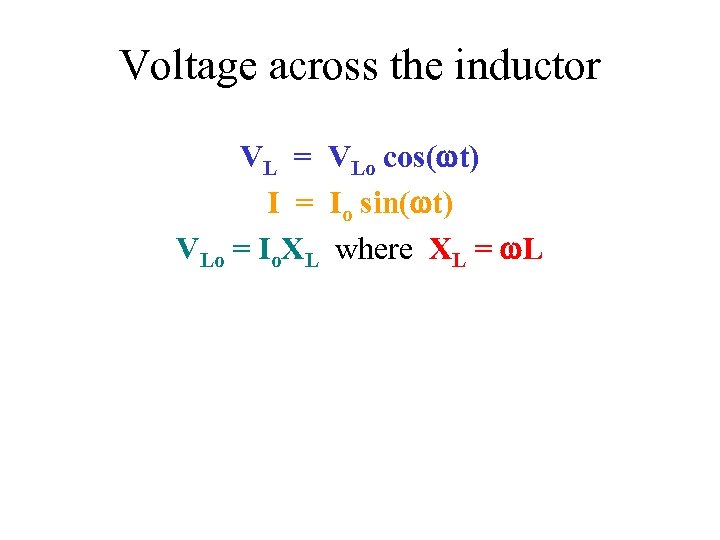 Voltage across the inductor VL = VLo cos( t) I = Io sin( t) VLo = Io. XL where XL = L
 LRC in series Note that in a series combination, the current must be the same in all the elements, while the voltage adds. However, the voltage must add to zero across a complete circuit at every instant of time. But since the voltages are out of phase with each other, the amplitudes of the voltages (and hence the rms voltages) will not add up to zero!
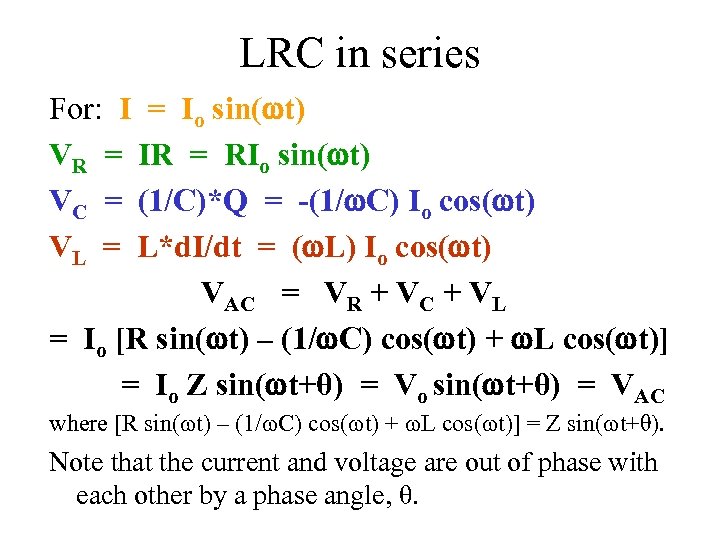 LRC in series For: I = Io sin( t) VR = IR = RIo sin( t) VC = (1/C)*Q = -(1/ C) Io cos( t) VL = L*d. I/dt = ( L) Io cos( t) VAC = VR + VC + VL = Io [R sin( t) – (1/ C) cos( t) + L cos( t)] = Io Z sin( t+θ) = Vo sin( t+θ) = VAC where [R sin( t) – (1/ C) cos( t) + L cos( t)] = Z sin( t+θ). Note that the current and voltage are out of phase with each other by a phase angle, θ.
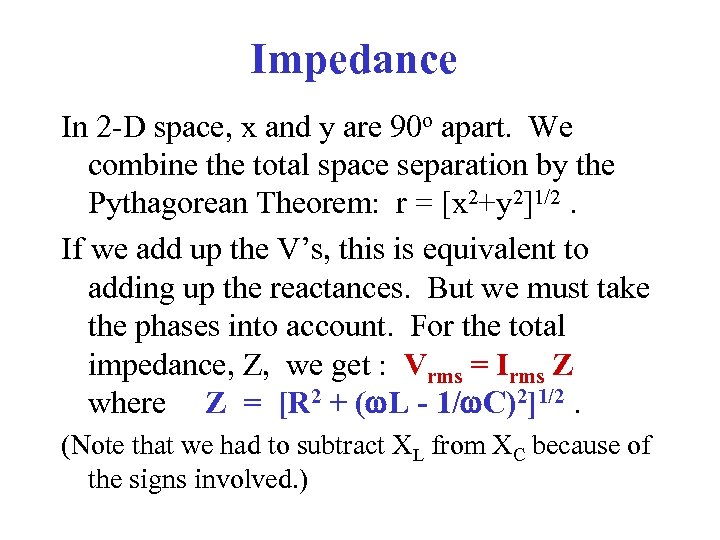 Impedance In 2 -D space, x and y are 90 o apart. We combine the total space separation by the Pythagorean Theorem: r = [x 2+y 2]1/2. If we add up the V’s, this is equivalent to adding up the reactances. But we must take the phases into account. For the total impedance, Z, we get : Vrms = Irms Z where Z = [R 2 + ( L - 1/ C)2]1/2. (Note that we had to subtract XL from XC because of the signs involved. )
![Resonance Vrms = Irms. Z where Z = [R 2 + ( L-1/ C)2]1/2](https://present5.com/presentation/9c7d7ac80d0fa7e4c14bd49d273cb60c/image-46.jpg "Resonance Vrms = Irms. Z where Z = [R 2 + ( L-1/ C)2]1/2") Resonance Vrms = Irms. Z where Z = [R 2 + ( L-1/ C)2]1/2 Note that when ( L - 1/ C) = 0, Z is smallest and so I is biggest! This is the condition for resonance. Thus when = [1/LC]1/2, we have resonance. This is the same result we would get using the differential equation route. Note that this is equivalent to the resonance of a spring when = [k/m]1/2 , since k is like 1/C and L is like m.
Resonance Vrms = Irms. Z where Z = [R 2 + ( L-1/ C)2]1/2 Note that when ( L - 1/ C) = 0, Z is smallest and so I is biggest! This is the condition for resonance. Thus when = [1/LC]1/2, we have resonance. This is the same result we would get using the differential equation route. Note that this is equivalent to the resonance of a spring when = [k/m]1/2 , since k is like 1/C and L is like m.
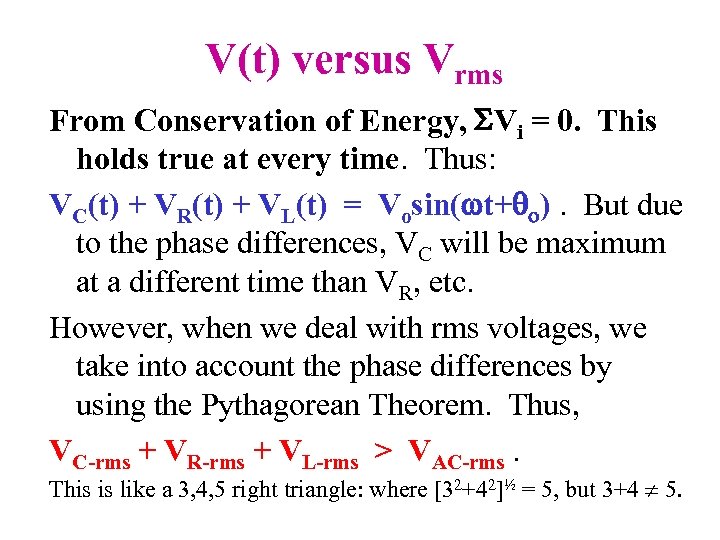 V(t) versus Vrms From Conservation of Energy, SVi = 0. This holds true at every time. Thus: VC(t) + VR(t) + VL(t) = Vosin( t+qo). But due to the phase differences, VC will be maximum at a different time than VR, etc. However, when we deal with rms voltages, we take into account the phase differences by using the Pythagorean Theorem. Thus, VC-rms + VR-rms + VL-rms > VAC-rms. This is like a 3, 4, 5 right triangle: where [32+42]½ = 5, but 3+4 5.
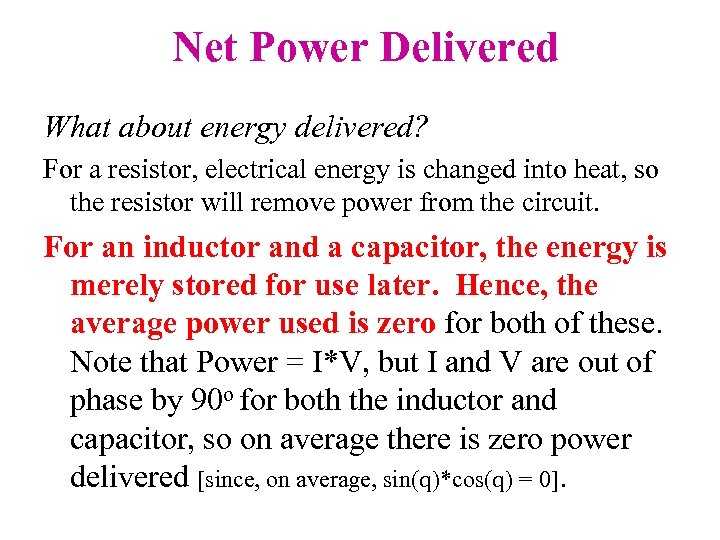 Net Power Delivered What about energy delivered? For a resistor, electrical energy is changed into heat, so the resistor will remove power from the circuit. For an inductor and a capacitor, the energy is merely stored for use later. Hence, the average power used is zero for both of these. Note that Power = I*V, but I and V are out of phase by 90 o for both the inductor and capacitor, so on average there is zero power delivered [since, on average, sin(q)*cos(q) = 0].
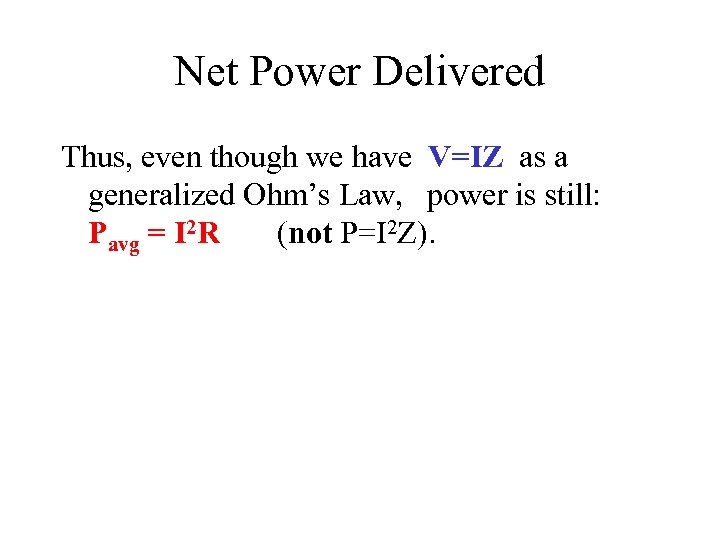 Net Power Delivered Thus, even though we have V=IZ as a generalized Ohm’s Law, power is still: Pavg = I 2 R (not P=I 2 Z).
 Computer Homework There is a computer homework program on Inductance on Vol. 4, #4, that gives you practice on DC and AC behaviors of inductors.
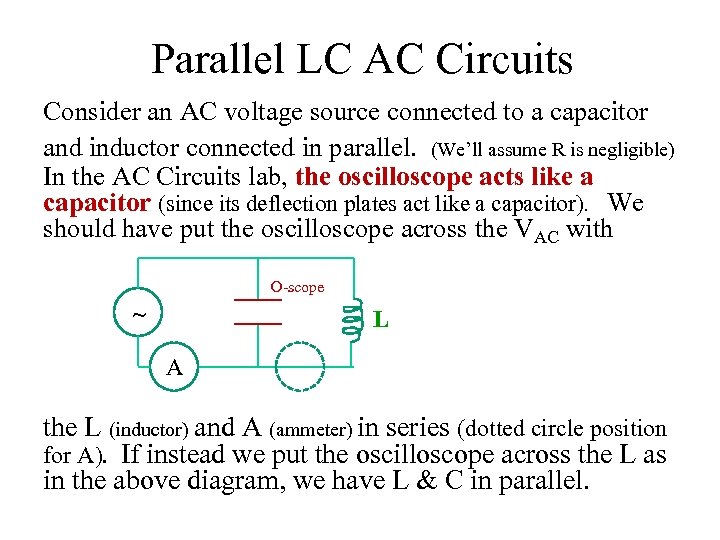 Parallel LC AC Circuits Consider an AC voltage source connected to a capacitor and inductor connected in parallel. (We’ll assume R is negligible) In the AC Circuits lab, the oscilloscope acts like a capacitor (since its deflection plates act like a capacitor). We should have put the oscilloscope across the VAC with O-scope ~ L A the L (inductor) and A (ammeter) in series (dotted circle position for A). If instead we put the oscilloscope across the L as in the above diagram, we have L & C in parallel.
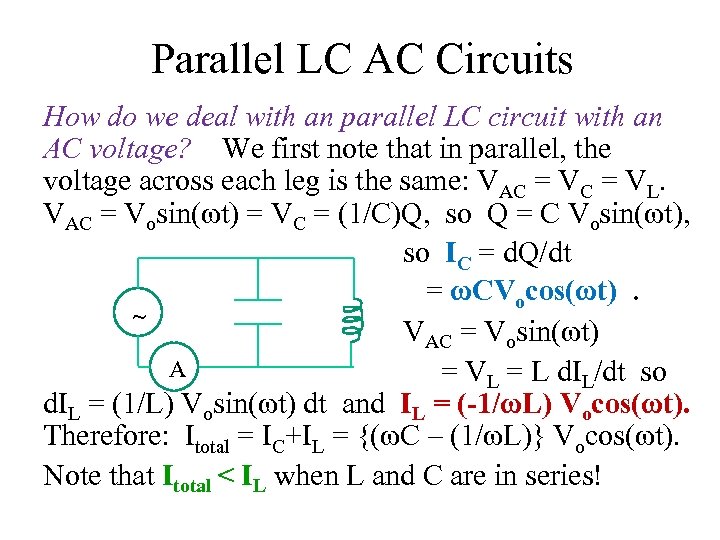 Parallel LC AC Circuits How do we deal with an parallel LC circuit with an AC voltage? We first note that in parallel, the voltage across each leg is the same: VAC = VL. VAC = Vosin(ωt) = VC = (1/C)Q, so Q = C Vosin(ωt), so IC = d. Q/dt = ωCVocos(ωt). ~ VAC = Vosin(ωt) A = VL = L d. IL/dt so d. IL = (1/L) Vosin(ωt) dt and IL = (-1/ωL) Vocos(ωt). Therefore: Itotal = IC+IL = {(ωC – (1/ωL)} Vocos(ωt). Note that Itotal < IL when L and C are in series!
 Magnetism in Matter Just as materials affect the electric fields in space, so do materials affect the magnetic fields in space. Recall that we described the effect of materials on the electric fields with the dielectric constant, K. This measured the “stretchability” of the electric charges in the materials. This stretching due to applied electric fields caused electric fields itself.
 Two main effects Atoms have electrons that “orbit” the positive nuclei. These “orbiting” electrons act like little current loops and can create small magnets. Effect 1: A diamagnetic effect is similar to the dielectric effect which reduces the field inside the material – a result of Lenz’s Law. Effect 2: An aligning effect among the atoms’ individual fields tends to increase the field inside the material.
 1. Diamagnetic Effect 1: By Lenz’s law, when the applied magnetic field changes, there is a tendency in the circuit to resist or oppose the change. This effect tends to create an induced magnetic field opposing the change in the external field. In this effect, the material acts to reduce any applied external magnetic field. This is similar to the dielectric effect that leads to the dielectric constant for electric fields.
 Diamagnetic Effect – cont. In certain materials at (usually) very low temperatures, these materials can exhibit superconductivity in which the resistance is not just small but zero! In these cases, the diamagnetic effect makes the B field inside the material zero. Usually, though, the diamagnetic effect is very small.
 2. Aligning Effect 2: Since the normal “currents” due to the “orbiting” electrons act like tiny magnets, these magnets will tend to align with an external magnetic field. This tendency to align will tend to add to any external applied magnetic field.
 2. Aligning Effect – cont. In ferromagnetic materials (Fe, Ni, Co, and some alloys), this aligning effect causes areas of the material to align. These areas of aligned atoms are called domains. Within the domains the alignment is strong, but the domains themselves are usually randomly oriented. A strong magnetic field will tend to align these domains. A strong magnetic field when the metal is hot and then cooled will tend to “freeze” the alignment of the domains. Heat or shock can cause these domains to become randomly oriented.
 Net Result When both of these effects (Lenz’s law and aligning) are combined, we find three different types of results: 1. Diamagnetic: Magnetic field is slightly reduced in some materials 2. Paramagnetic: Magnetic field is slightly increased in some materials 3. Ferromagnetic: Magnetic field is greatly increased in a few materials
 B, M and H We are already familiar with B. It is called the magnetic field or the magnetic flux density (from its use in V = -d/dt [ B d. A] ). This is the total field in space or in the material. We have H, called the magnetic field strength or magnetic intensity. This is the field due to external currents only. We have M, called the magnetization. It is the field due to the material only.
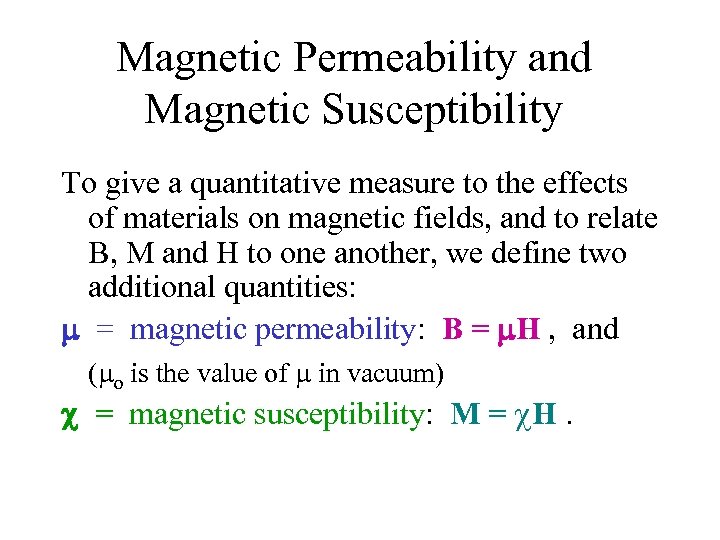 Magnetic Permeability and Magnetic Susceptibility To give a quantitative measure to the effects of materials on magnetic fields, and to relate B, M and H to one another, we define two additional quantities: m = magnetic permeability: B = m. H , and ( o is the value of in vacuum) = magnetic susceptibility: M = H.
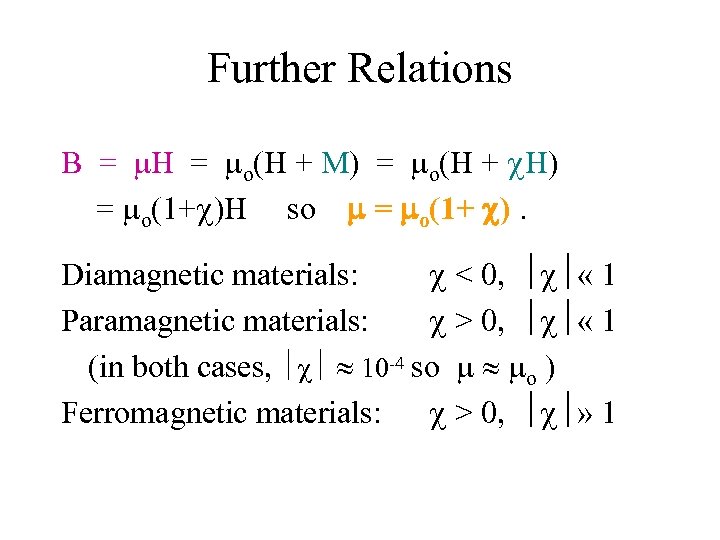 Further Relations B = H = o(H + M) = o(H + H) = o(1+ )H so m = mo(1+ ). Diamagnetic materials: < 0, « 1 Paramagnetic materials: > 0, « 1 (in both cases, 10 -4 so o ) Ferromagnetic materials: > 0, » 1
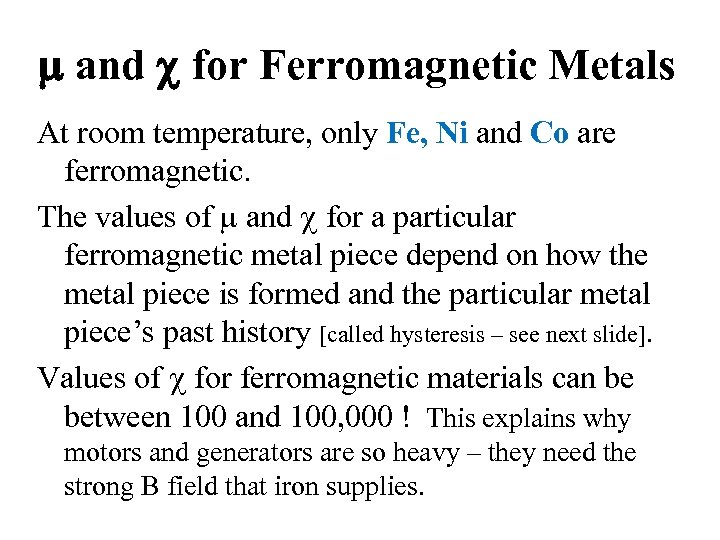 m and for Ferromagnetic Metals At room temperature, only Fe, Ni and Co are ferromagnetic. The values of and for a particular ferromagnetic metal piece depend on how the metal piece is formed and the particular metal piece’s past history [called hysteresis – see next slide]. Values of for ferromagnetic materials can be between 100 and 100, 000 ! This explains why motors and generators are so heavy – they need the strong B field that iron supplies.
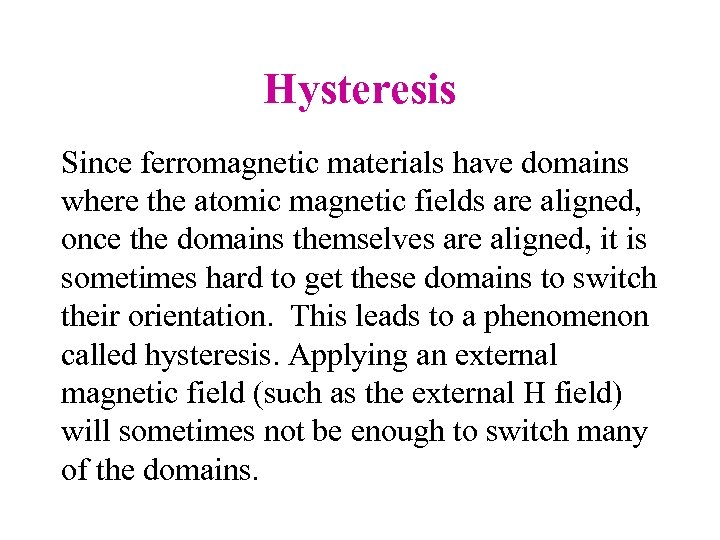 Hysteresis Since ferromagnetic materials have domains where the atomic magnetic fields are aligned, once the domains themselves are aligned, it is sometimes hard to get these domains to switch their orientation. This leads to a phenomenon called hysteresis. Applying an external magnetic field (such as the external H field) will sometimes not be enough to switch many of the domains.
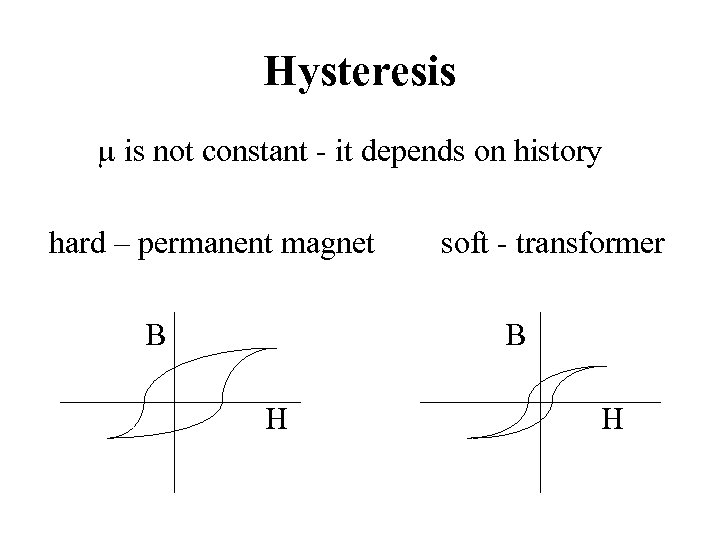 Hysteresis is not constant - it depends on history hard – permanent magnet B soft - transformer B H H