


 Скачать презентацию Indoor Radon Risk What do we know and
c02972237b6cdd95fb3b66def385b5f8.ppt
- Количество слайдов: 22
 Indoor Radon Risk What do we know and how do we know it? HPS Annual Meeting July 14, 2009 Jan Johnson, Ph. D, CHP Tetra Tech
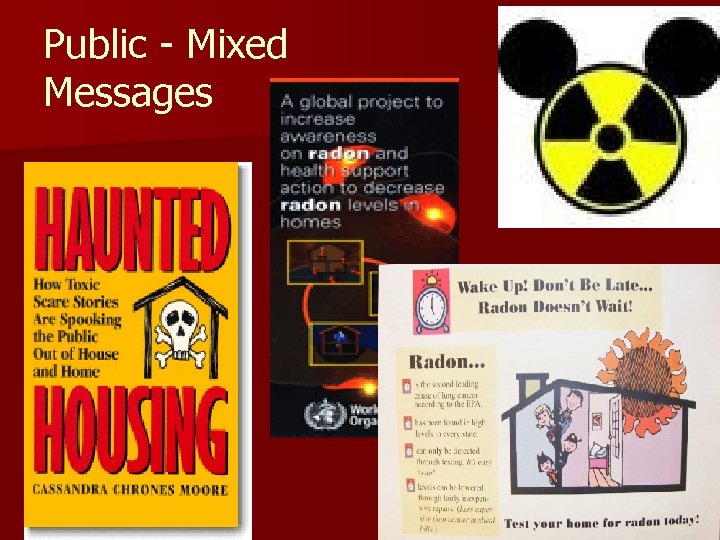 Public - Mixed Messages
 What do we know: Real problem or unnecessary concern? Underground miner studies n Indoor radon epidemiological studies (1972 – present) n – – Europe US and Canada 1984: Watras House – Public Awareness – EPA Action n National Academy of Sciences/National Research Council Reports (BEIR IV and BEIR VI) n Recent results of pooled epidemiologic studies n Dosimetry n
 BEIR VI Reprise - 1999 n What did BEIR VI tell us? n How does that relate to information available since BEIR VI was written? n Does new information support or contradict BEIR VI?
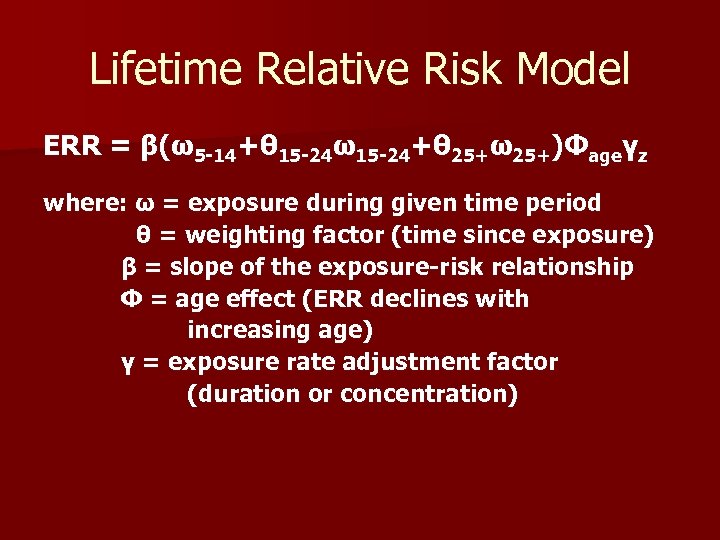 Lifetime Relative Risk Model ERR = β(ω5 -14+θ 15 -24ω15 -24+θ 25+ω25+)Φageγz where: ω = exposure during given time period θ = weighting factor (time since exposure) β = slope of the exposure-risk relationship Φ = age effect (ERR declines with increasing age) γ = exposure rate adjustment factor (duration or concentration)
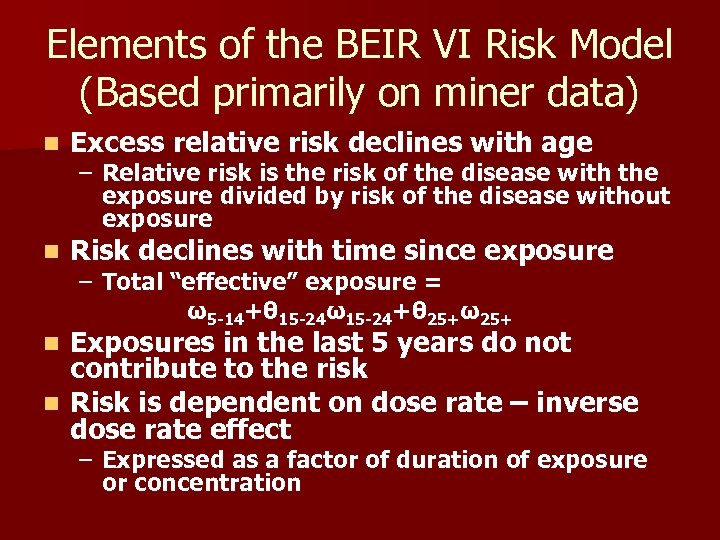 Elements of the BEIR VI Risk Model (Based primarily on miner data) n Excess relative risk declines with age n Risk declines with time since exposure – Relative risk is the risk of the disease with the exposure divided by risk of the disease without exposure – Total “effective” exposure = ω5 -14+θ 15 -24ω15 -24+θ 25+ω25+ Exposures in the last 5 years do not contribute to the risk n Risk is dependent on dose rate – inverse dose rate effect n – Expressed as a factor of duration of exposure or concentration
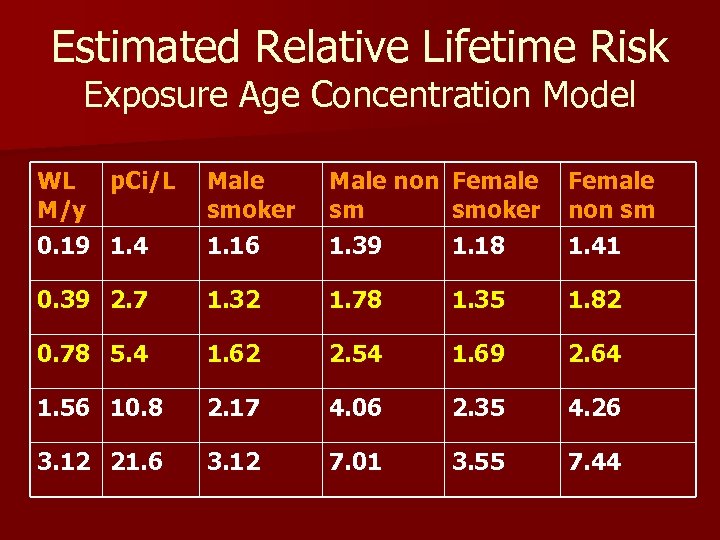 Estimated Relative Lifetime Risk Exposure Age Concentration Model WL p. Ci/L M/y 0. 19 1. 4 Male smoker 1. 16 Male non Female sm smoker 1. 39 1. 18 Female non sm 1. 41 0. 39 2. 7 1. 32 1. 78 1. 35 1. 82 0. 78 5. 4 1. 62 2. 54 1. 69 2. 64 1. 56 10. 8 2. 17 4. 06 2. 35 4. 26 3. 12 21. 6 3. 12 7. 01 3. 55 7. 44
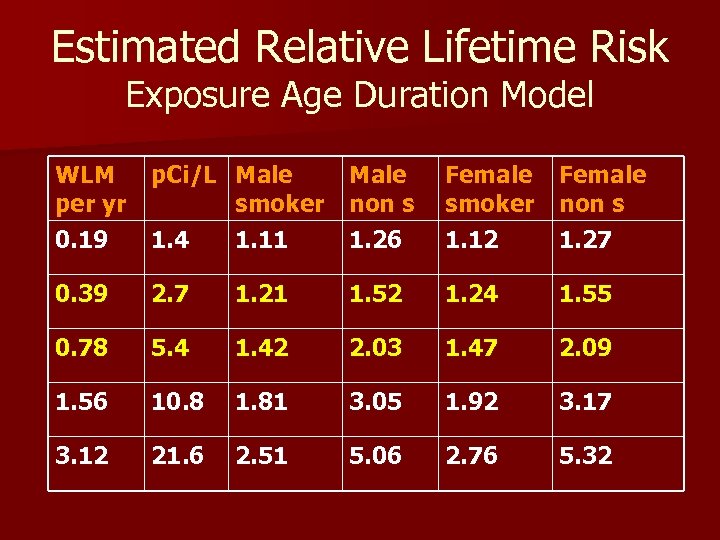 Estimated Relative Lifetime Risk Exposure Age Duration Model WLM per yr 0. 19 p. Ci/L Male smoker non s 1. 4 1. 11 1. 26 Female smoker non s 1. 12 1. 27 0. 39 2. 7 1. 21 1. 52 1. 24 1. 55 0. 78 5. 4 1. 42 2. 03 1. 47 2. 09 1. 56 10. 8 1. 81 3. 05 1. 92 3. 17 3. 12 21. 6 2. 51 5. 06 2. 76 5. 32
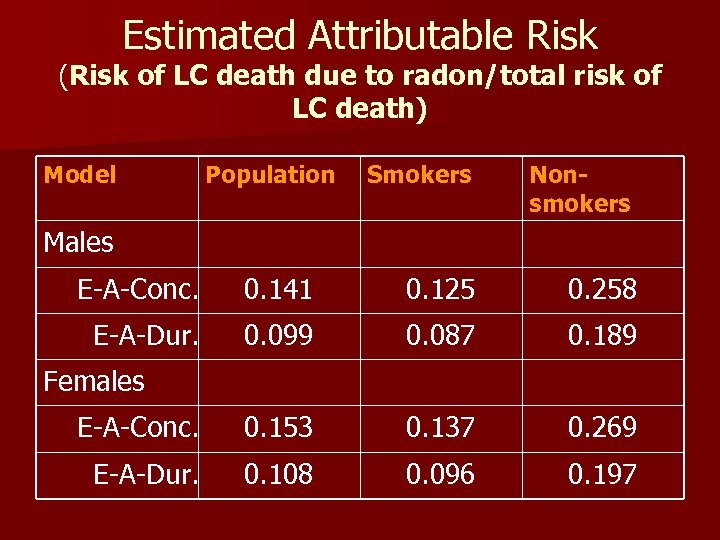 Estimated Attributable Risk (Risk of LC death due to radon/total risk of LC death) Model Population Smokers Nonsmokers Males E-A-Conc. 0. 141 0. 125 0. 258 E-A-Dur. 0. 099 0. 087 0. 189 E-A-Conc. 0. 153 0. 137 0. 269 E-A-Dur. 0. 108 0. 096 0. 197 Females
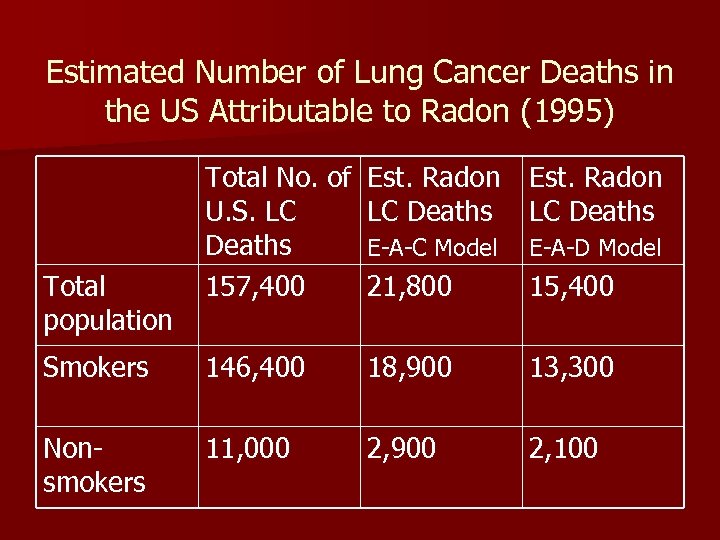 Estimated Number of Lung Cancer Deaths in the US Attributable to Radon (1995) Total No. of U. S. LC Deaths 157, 400 Est. Radon LC Deaths Smokers Nonsmokers Total population E-A-C Model E-A-D Model 21, 800 15, 400 146, 400 18, 900 13, 300 11, 000 2, 900 2, 100
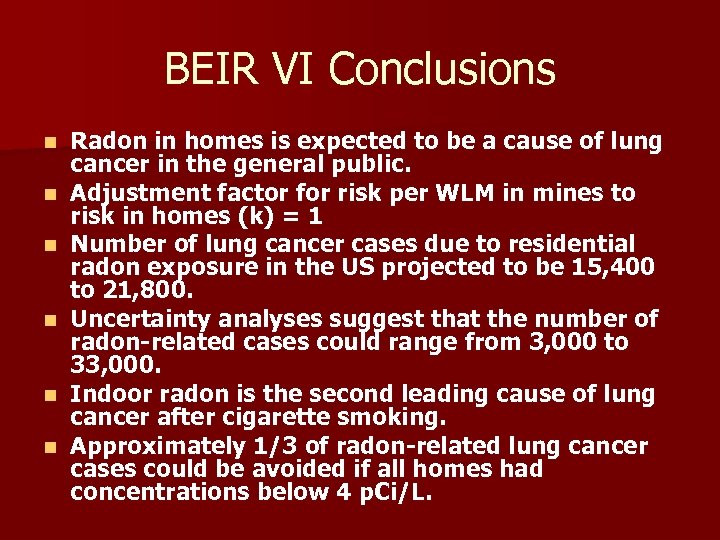 BEIR VI Conclusions n n n Radon in homes is expected to be a cause of lung cancer in the general public. Adjustment factor for risk per WLM in mines to risk in homes (k) = 1 Number of lung cancer cases due to residential radon exposure in the US projected to be 15, 400 to 21, 800. Uncertainty analyses suggest that the number of radon-related cases could range from 3, 000 to 33, 000. Indoor radon is the second leading cause of lung cancer after cigarette smoking. Approximately 1/3 of radon-related lung cancer cases could be avoided if all homes had concentrations below 4 p. Ci/L.
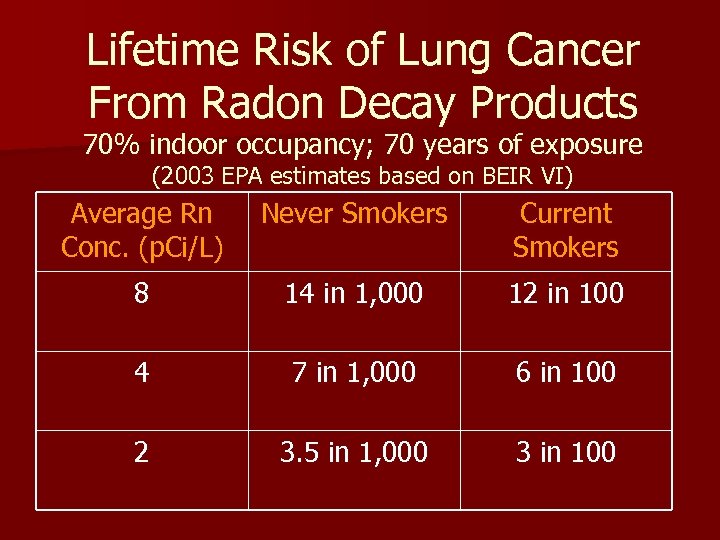 Lifetime Risk of Lung Cancer From Radon Decay Products 70% indoor occupancy; 70 years of exposure (2003 EPA estimates based on BEIR VI) Average Rn Conc. (p. Ci/L) Never Smokers Current Smokers 8 14 in 1, 000 12 in 100 4 7 in 1, 000 6 in 100 2 3. 5 in 1, 000 3 in 100
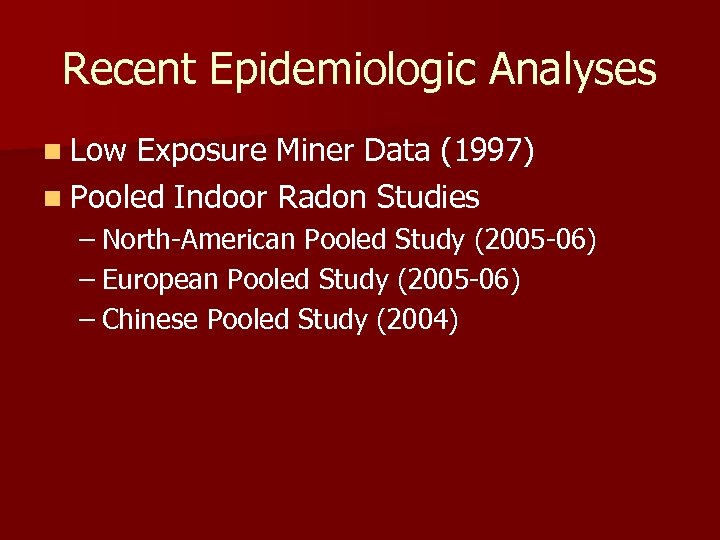 Recent Epidemiologic Analyses n Low Exposure Miner Data (1997) n Pooled Indoor Radon Studies – North-American Pooled Study (2005 -06) – European Pooled Study (2005 -06) – Chinese Pooled Study (2004)
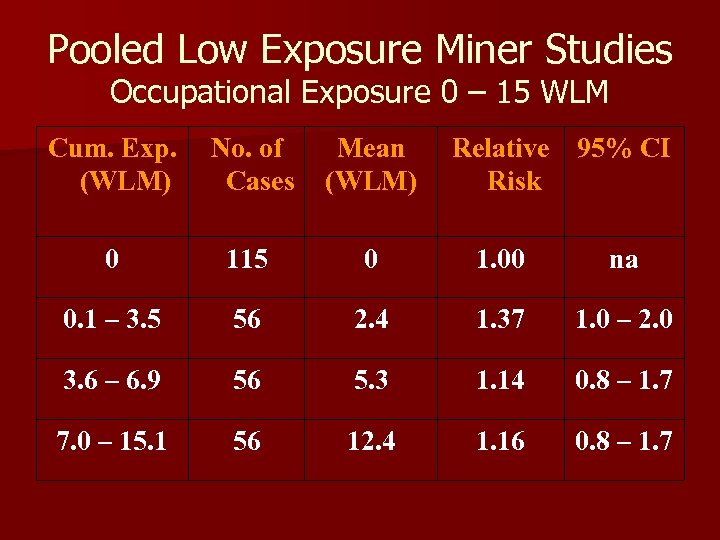 Pooled Low Exposure Miner Studies Occupational Exposure 0 – 15 WLM Cum. Exp. (WLM) No. of Cases Mean (WLM) Relative 95% CI Risk 0 115 0 1. 00 na 0. 1 – 3. 5 56 2. 4 1. 37 1. 0 – 2. 0 3. 6 – 6. 9 56 5. 3 1. 14 0. 8 – 1. 7 7. 0 – 15. 1 56 12. 4 1. 16 0. 8 – 1. 7
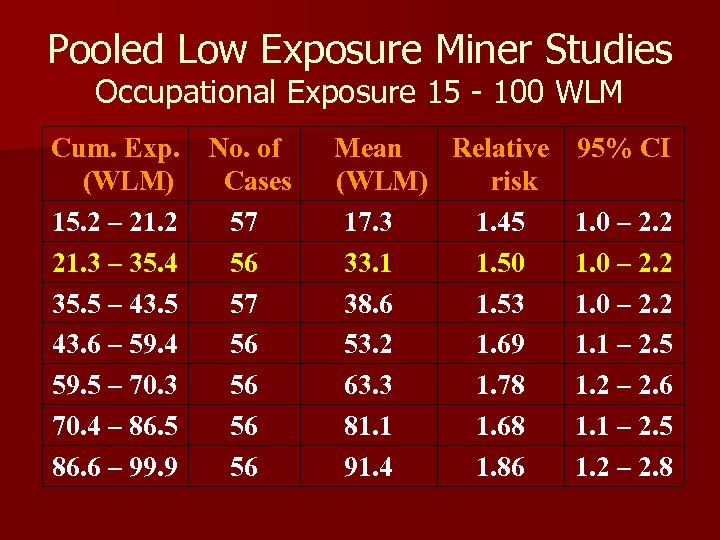 Pooled Low Exposure Miner Studies Occupational Exposure 15 - 100 WLM Cum. Exp. No. of (WLM) Cases 15. 2 – 21. 2 57 21. 3 – 35. 4 56 35. 5 – 43. 5 57 43. 6 – 59. 4 56 59. 5 – 70. 3 56 70. 4 – 86. 5 56 86. 6 – 99. 9 56 Mean Relative 95% CI (WLM) risk 17. 3 1. 45 1. 0 – 2. 2 33. 1 1. 50 1. 0 – 2. 2 38. 6 1. 53 1. 0 – 2. 2 53. 2 1. 69 1. 1 – 2. 5 63. 3 1. 78 1. 2 – 2. 6 81. 1 1. 68 1. 1 – 2. 5 91. 4 1. 86 1. 2 – 2. 8
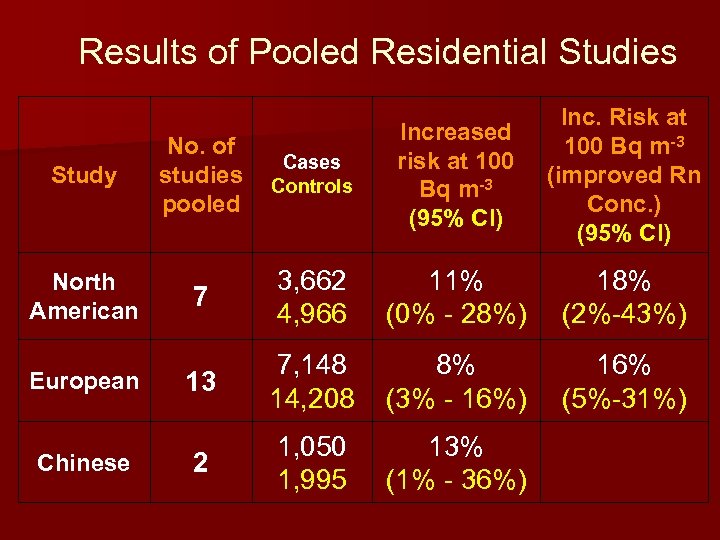 Results of Pooled Residential Studies Study North American European Chinese Inc. Risk at 100 Bq m-3 (improved Rn Conc. ) (95% CI) No. of studies pooled Cases Controls Increased risk at 100 Bq m-3 (95% CI) 7 3, 662 4, 966 11% (0% - 28%) 18% (2%-43%) 13 7, 148 14, 208 8% (3% - 16%) 16% (5%-31%) 2 1, 050 1, 995 13% (1% - 36%)
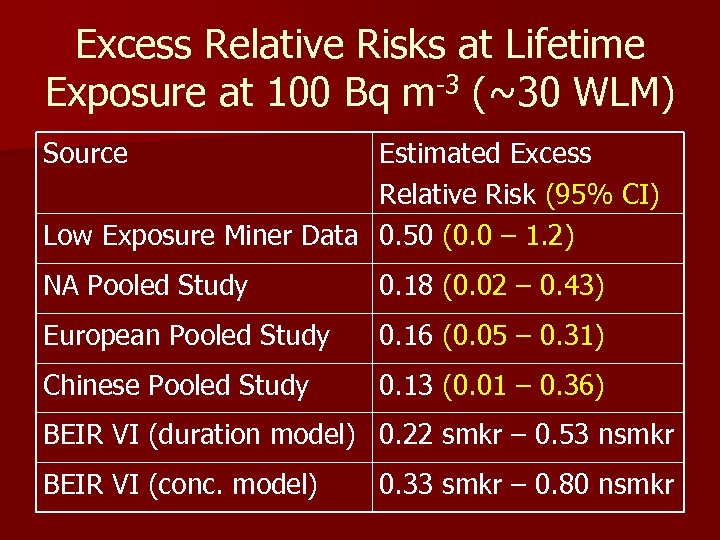 Excess Relative Risks at Lifetime Exposure at 100 Bq m-3 (~30 WLM) Source Estimated Excess Relative Risk (95% CI) Low Exposure Miner Data 0. 50 (0. 0 – 1. 2) NA Pooled Study 0. 18 (0. 02 – 0. 43) European Pooled Study 0. 16 (0. 05 – 0. 31) Chinese Pooled Study 0. 13 (0. 01 – 0. 36) BEIR VI (duration model) 0. 22 smkr – 0. 53 nsmkr BEIR VI (conc. model) 0. 33 smkr – 0. 80 nsmkr
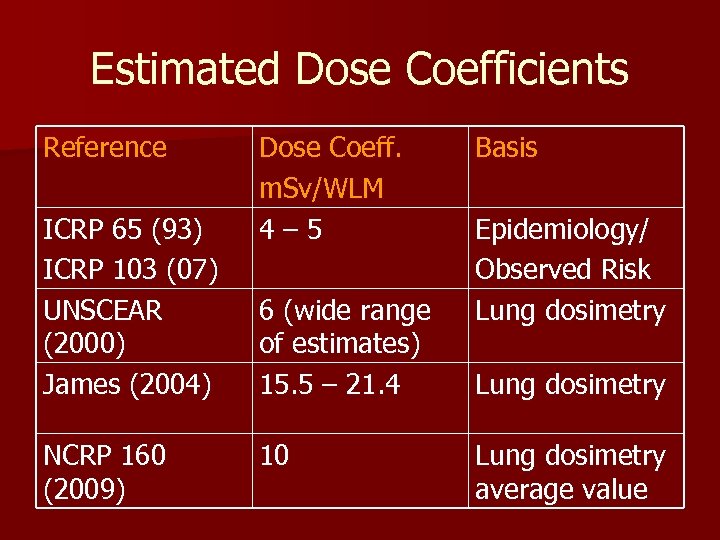 Estimated Dose Coefficients Reference ICRP 65 (93) ICRP 103 (07) UNSCEAR (2000) James (2004) NCRP 160 (2009) Dose Coeff. m. Sv/WLM 4– 5 6 (wide range of estimates) 15. 5 – 21. 4 10 Basis Epidemiology/ Observed Risk Lung dosimetry average value
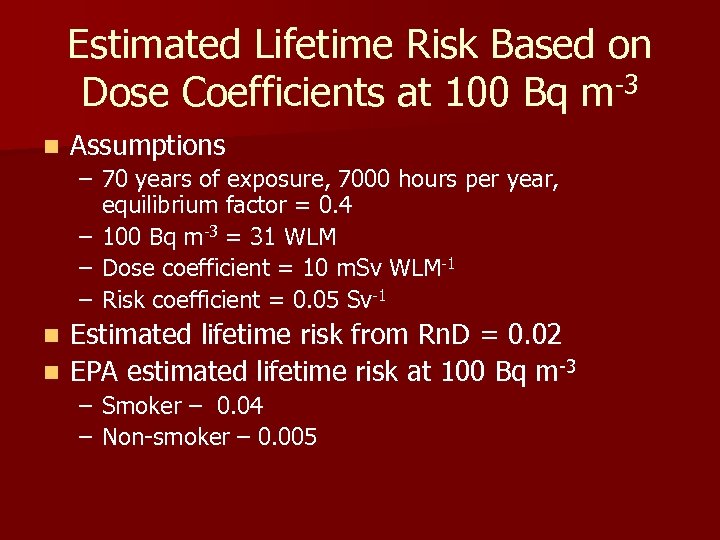 Estimated Lifetime Risk Based on Dose Coefficients at 100 Bq m-3 n Assumptions – 70 years of exposure, 7000 hours per year, equilibrium factor = 0. 4 – 100 Bq m-3 = 31 WLM – Dose coefficient = 10 m. Sv WLM-1 – Risk coefficient = 0. 05 Sv-1 Estimated lifetime risk from Rn. D = 0. 02 n EPA estimated lifetime risk at 100 Bq m-3 n – Smoker – 0. 04 – Non-smoker – 0. 005
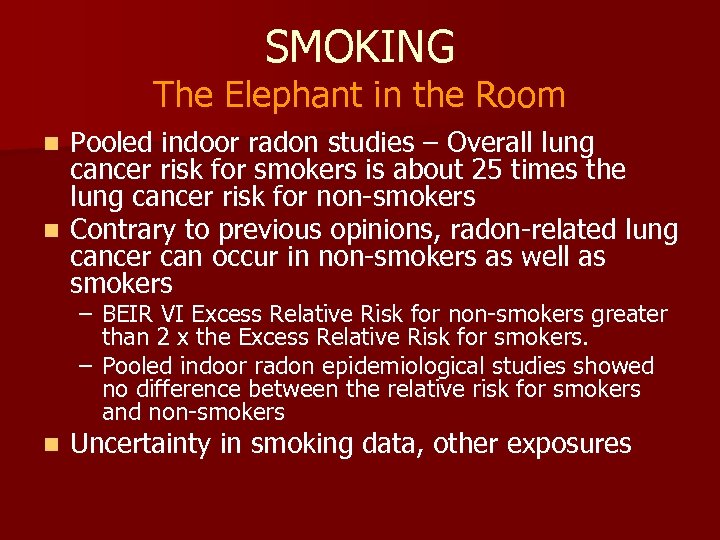 SMOKING The Elephant in the Room Pooled indoor radon studies – Overall lung cancer risk for smokers is about 25 times the lung cancer risk for non-smokers n Contrary to previous opinions, radon-related lung cancer can occur in non-smokers as well as smokers n – BEIR VI Excess Relative Risk for non-smokers greater than 2 x the Excess Relative Risk for smokers. – Pooled indoor radon epidemiological studies showed no difference between the relative risk for smokers and non-smokers n Uncertainty in smoking data, other exposures
 What does it all mean for public policy?
 HPS Revised Position Paper n In 2007 Health Physics Society Board appointed an Ad Hoc Committee to update the 1990 Indoor Radon Position Statement – Committee composed of health physicists, epidemiologists, EPA representatives, American Lung Association, State Health Department – Draft Position Statement approved with minor editorial changes by the Scientific and Public Issues Committee in February 2009 – Draft background document completed in May 2009 – Position Statement to be presented to the Board in July?