 Скачать презентацию Indonesia s Wi Fi Access Innovation Usable Knowledge for
1ac50be89d0e9a7665466240a5612362.ppt
- Количество слайдов: 22



Indonesia’s Wi. Fi Access Innovation Usable Knowledge for Growing the Telecom Sector Park Hotel, New Delhi, March 6, 2006 Divakar Goswami & Onno Purbo
Research Objectives 1. 2. 3. Why does Indonesia have more Wi-Fi deployed to connect to the Internet than most developing countries? What lessons can we learn from Wi. Fi innovations in Indonesia for other developing countries? What steps must be addressed for hastening Internet growth in Indonesia?
What is Wi. Fi? n Wi-Fi is based on a family of standards that allow data to be transmitted at high speeds wirelessly up to 15 kilometres away. ¨ n n 802. 11 (2 Mbps); 802. 11 b (11 Mbps); 802. 11 a (54 Mbps); 802. 11 g (54 Mbps). Where wired infrastructure is poorly developed (rural regions) wireless technologies like Wi-Fi, can be a viable solution to bridge digital divide. Many countries, including USA, EU, India, Indonesia etc. have unlicensed portion of 2. 4 Ghz band necessary for Wi-fi. Advantages: Quick deployment time, low-cost, minimal rights of way needed, “free” bandwidth. Disadvantages: Prone to interference, weather conditions, steep range/bandwidth tradeoff, doesn’t offer carrier class reliability.
Why Wi. Fi? n Has Wi. Fi deployment in Indonesia led to higher Internet access compared to other developing countries?
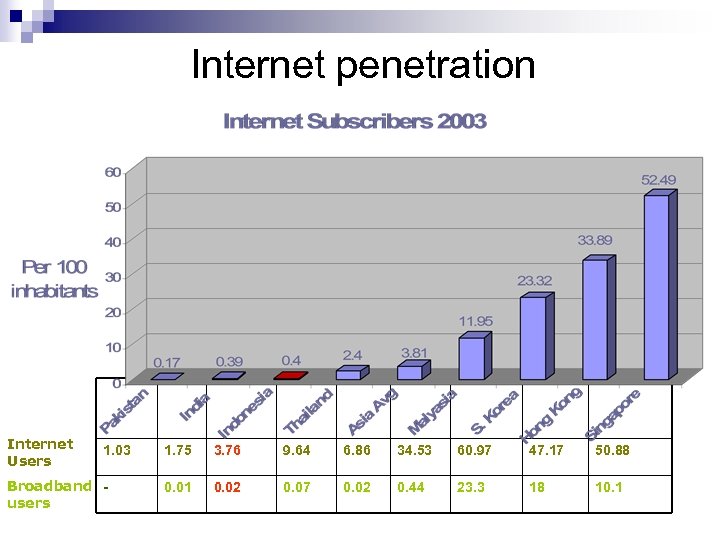
Internet penetration Internet Users 1. 03 Broadband users 1. 75 3. 76 9. 64 6. 86 34. 53 60. 97 47. 17 50. 88 0. 01 0. 02 0. 07 0. 02 0. 44 23. 3 18 10. 1
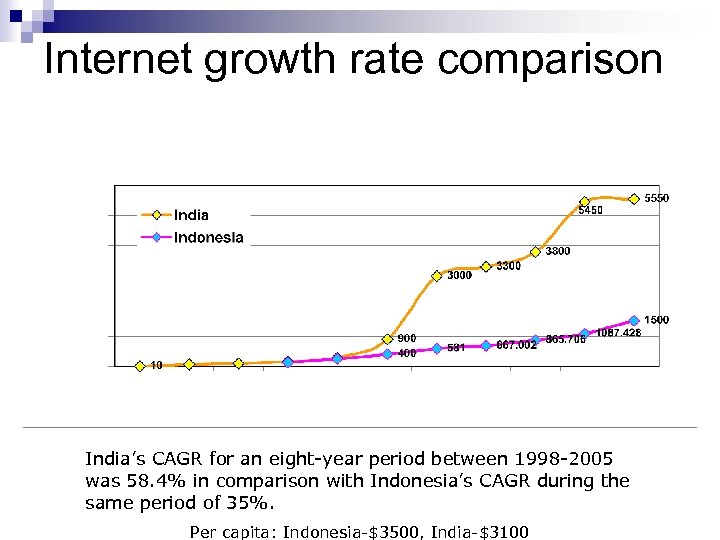
Internet growth rate comparison India’s CAGR for an eight-year period between 1998 -2005 was 58. 4% in comparison with Indonesia’s CAGR during the same period of 35%. Per capita: Indonesia-$3500, India-$3100
Why Study Wi. Fi in Indonesia? n There is more Wi. Fi deployment in Indonesia than most developing countries: ¨ 40 towns and cities in different islands have Wi. Fi deployed by entrepreneurs n n Wi. Fi deployment in other developing countries (Cambodia, Costa Rica, India, Bhutan etc. ) small -scale, experimental basis, non-commercial. Compared to developed countries, Wi. Fi uniquely deployed in Indonesia
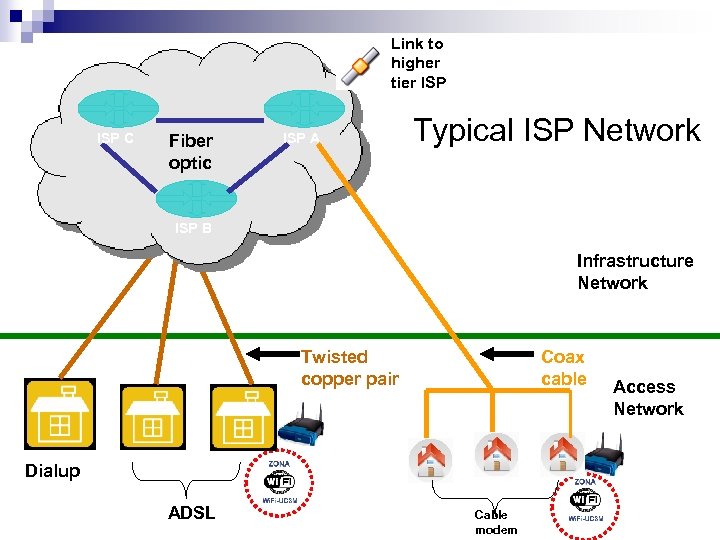
Link to higher tier ISP C Fiber optic ISP A Typical ISP Network ISP B Infrastructure Network Twisted copper pair Coax cable Dialup ADSL Cable modem Access Network
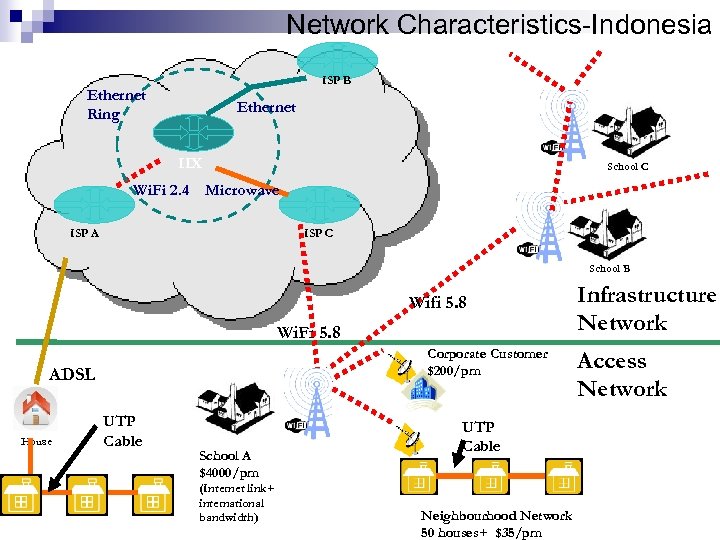
Network Characteristics-Indonesia ISP B Ethernet Ring Ethernet IIX School C Wi. Fi 2. 4 Microwave ISP A ISP C School B Wifi 5. 8 Wi. Fi 5. 8 Corporate Customer $200/pm ADSL House UTP Cable School A $4000/pm (Internet link+ international bandwidth) UTP Cable Neighbourhood Network 50 houses+ $35/pm Infrastructure Network Access Network
Uniqueness of Indonesian Wi. Fi deployed in Indonesia in unique manner: ¨Not inside home; not available for free. ¨Blurring of access and infrastructure network; used as low-bandwidth backhaul; up to curb Wi. Fi, last mile aerial cable. ¨Many tiered retailing of Internet service.
Innovations Around Constraints n Inadequate supply of network infrastructure-”backbone” & leased lines ¨ n High price of last mile infrastructure, i. e. , domestic leased lines ¨ n Wi. Fi provides service at substantially lower costs High price of international bandwidth ¨ n Wi. Fi fills “missing link” “Unlegal” use of satellite for international link High retail price of Internet Service ¨ Unlicensed reseller-ISPs using Wi. Fi to recoup high price
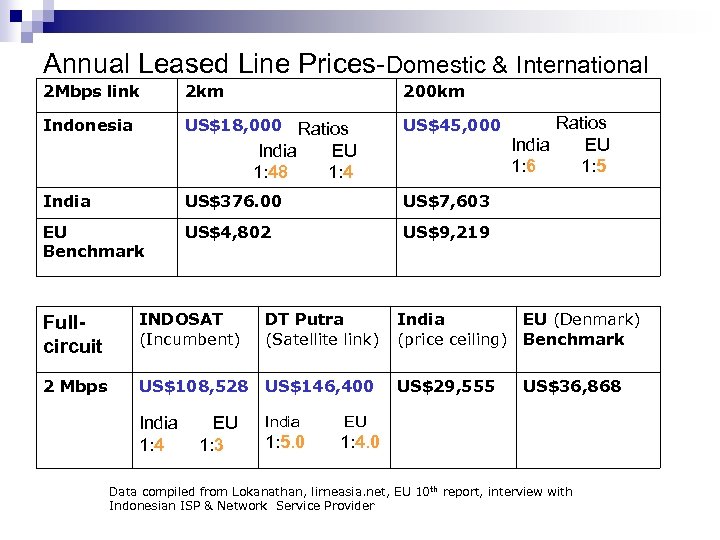
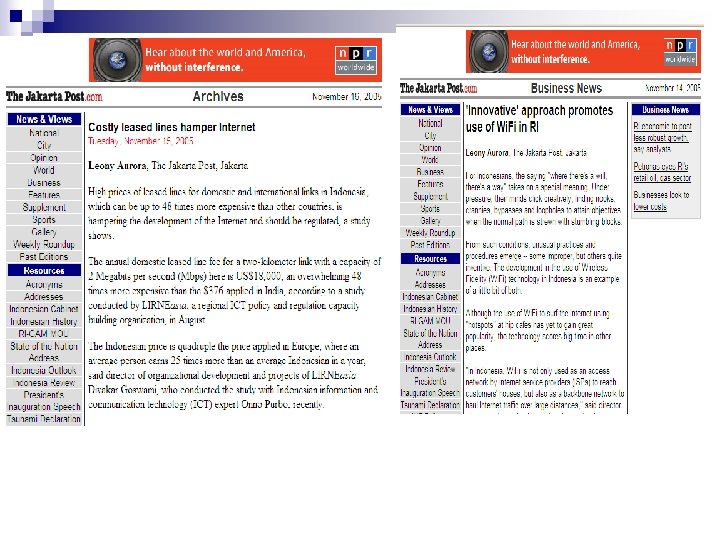
Annual Leased Line Prices-Domestic & International 2 Mbps link 2 km 200 km Indonesia US$18, 000 Ratios US$45, 000 Ratios India EU 1: 6 1: 5 India EU 1: 48 1: 4 India US$376. 00 US$7, 603 EU Benchmark US$4, 802 US$9, 219 Fullcircuit INDOSAT (Incumbent) DT Putra (Satellite link) India EU (Denmark) (price ceiling) Benchmark 2 Mbps US$108, 528 US$146, 400 US$29, 555 India EU 1: 4 1: 3 India EU US$36, 868 1: 5. 0 1: 4. 0 Data compiled from Lokanathan, lirneasia. net, EU 10 th report, interview with Indonesian ISP & Network Service Provider
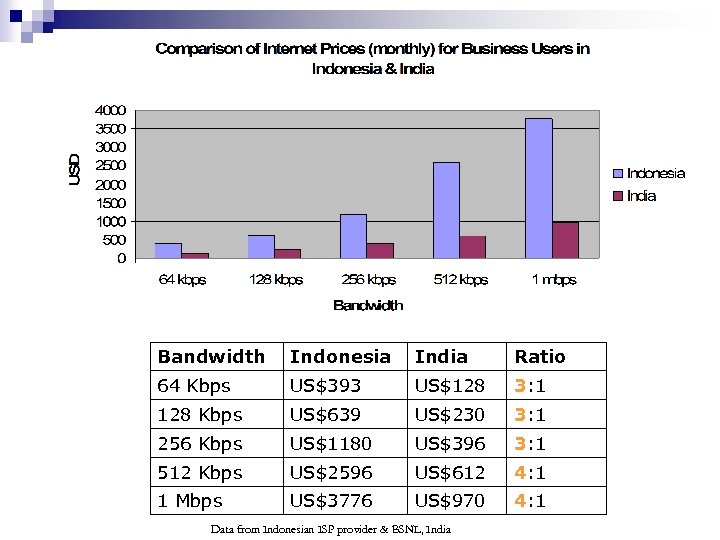
Bandwidth Indonesia India Ratio 64 Kbps US$393 US$128 3: 1 128 Kbps US$639 US$230 3: 1 256 Kbps US$1180 US$396 3: 1 512 Kbps US$2596 US$612 4: 1 1 Mbps US$3776 US$970 4: 1 Data from Indonesian ISP provider & BSNL, India
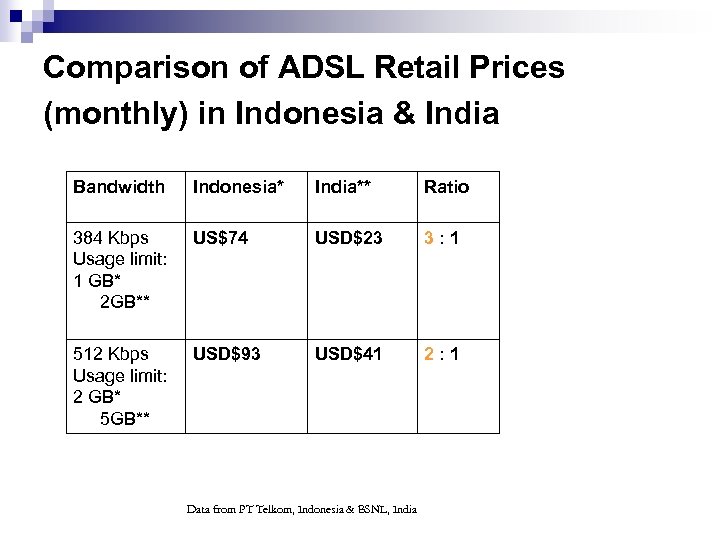
Comparison of ADSL Retail Prices (monthly) in Indonesia & India Bandwidth Indonesia* India** Ratio 384 Kbps Usage limit: 1 GB* 2 GB** US$74 USD$23 3 : 1 512 Kbps Usage limit: 2 GB* 5 GB** USD$93 USD$41 2 : 1 Data from PT Telkom, Indonesia & BSNL, India
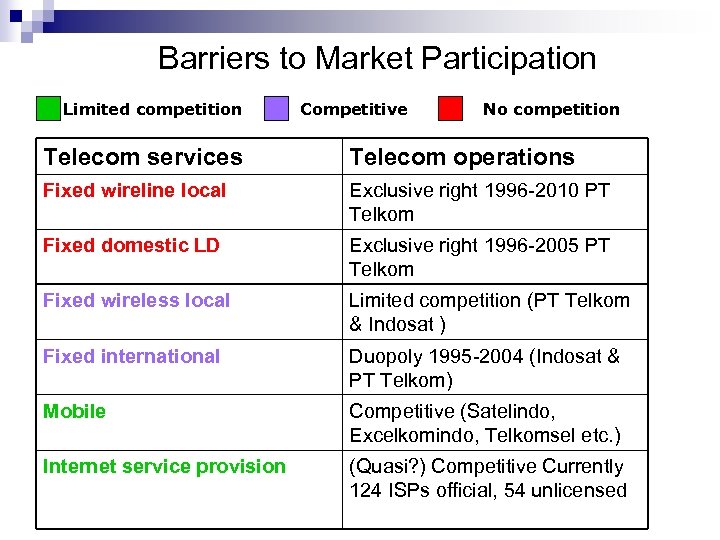
Barriers to Market Participation Limited competition Competitive No competition Telecom services Telecom operations Fixed wireline local Exclusive right 1996 -2010 PT Telkom Fixed domestic LD Exclusive right 1996 -2005 PT Telkom Fixed wireless local Limited competition (PT Telkom & Indosat ) Fixed international Duopoly 1995 -2004 (Indosat & PT Telkom) Mobile Competitive (Satelindo, Excelkomindo, Telkomsel etc. ) Internet service provision (Quasi? ) Competitive Currently 124 ISPs official, 54 unlicensed
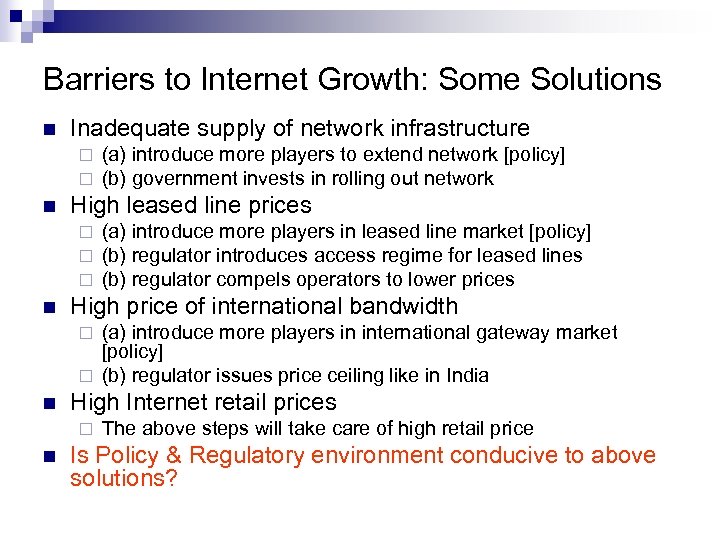
Barriers to Internet Growth: Some Solutions n Inadequate supply of network infrastructure ¨ ¨ n High leased line prices ¨ ¨ ¨ n (a) introduce more players to extend network [policy] (b) government invests in rolling out network (a) introduce more players in leased line market [policy] (b) regulator introduces access regime for leased lines (b) regulator compels operators to lower prices High price of international bandwidth (a) introduce more players in international gateway market [policy] ¨ (b) regulator issues price ceiling like in India ¨ n High Internet retail prices ¨ n The above steps will take care of high retail price Is Policy & Regulatory environment conducive to above solutions?
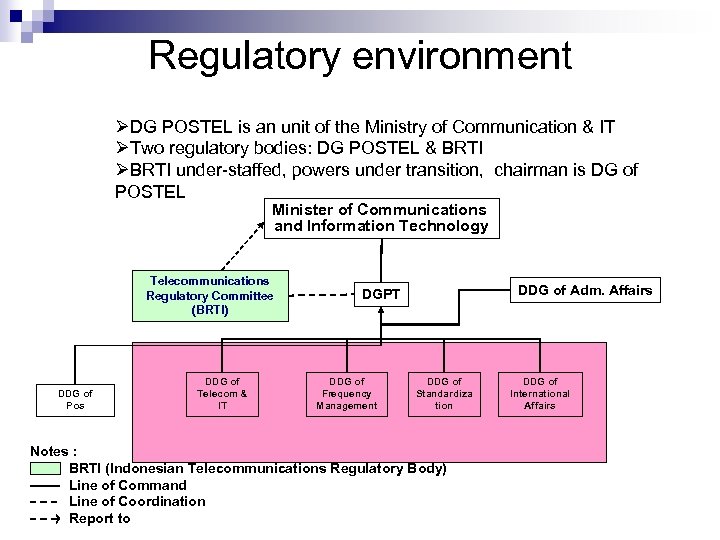
Regulatory environment ØDG POSTEL is an unit of the Ministry of Communication & IT ØTwo regulatory bodies: DG POSTEL & BRTI ØBRTI under-staffed, powers under transition, chairman is DG of POSTEL Minister of Communications and Information Technology Telecommunications Regulatory Committee (BRTI) DDG of Pos DDG of Telecom & IT DDG of Adm. Affairs DGPT DDG of Frequency Management DDG of Standardiza tion Notes : BRTI (Indonesian Telecommunications Regulatory Body) Line of Command Line of Coordination Report to DDG of International Affairs
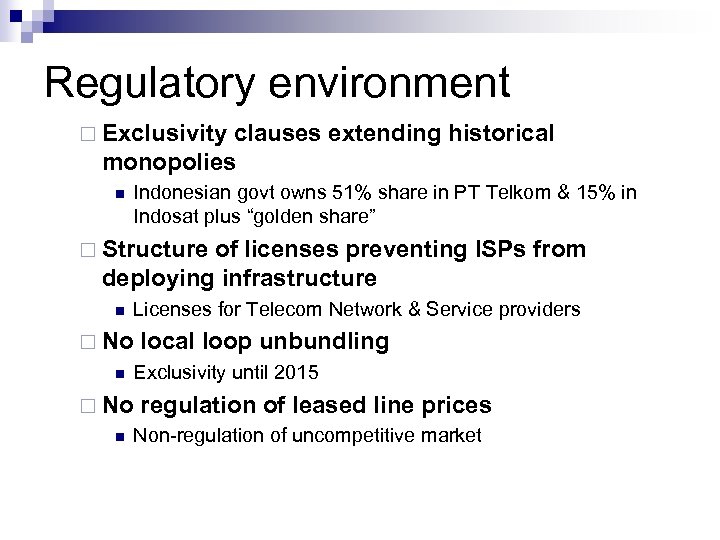
Regulatory environment ¨ Exclusivity clauses extending historical monopolies n Indonesian govt owns 51% share in PT Telkom & 15% in Indosat plus “golden share” ¨ Structure of licenses preventing ISPs from deploying infrastructure n Licenses for Telecom Network & Service providers ¨ No local loop unbundling n Exclusivity until 2015 ¨ No regulation of leased line prices n Non-regulation of uncompetitive market
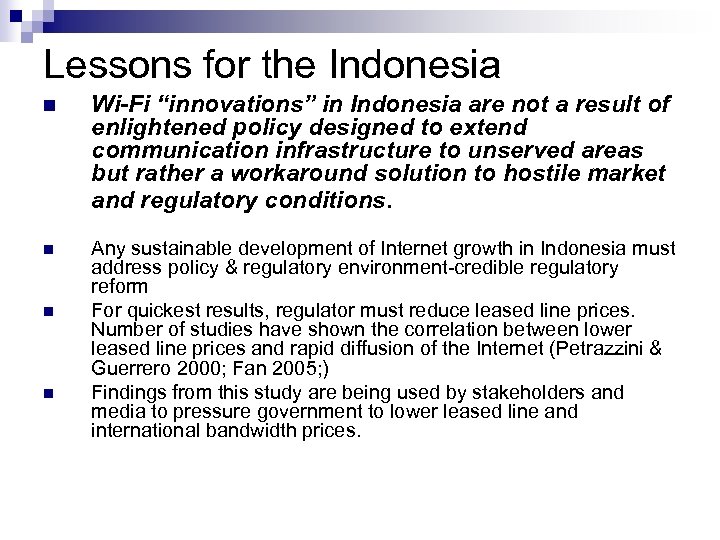
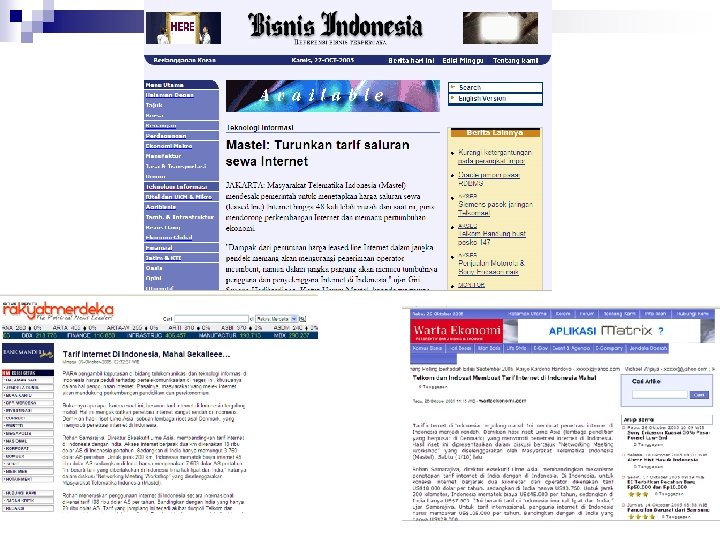
Lessons for the Indonesia n Wi-Fi “innovations” in Indonesia are not a result of enlightened policy designed to extend communication infrastructure to unserved areas but rather a workaround solution to hostile market and regulatory conditions. n Any sustainable development of Internet growth in Indonesia must address policy & regulatory environment-credible regulatory reform For quickest results, regulator must reduce leased line prices. Number of studies have shown the correlation between lower leased line prices and rapid diffusion of the Internet (Petrazzini & Guerrero 2000; Fan 2005; ) Findings from this study are being used by stakeholders and media to pressure government to lower leased line and international bandwidth prices. n n
Lessons for India & developing countries n n n Hastening of broadband Internet deployment in India & developing countries if ISPs can use Wi -Fi in the access network to bypass incumbent’s local loop. Wi-Fi can bridge digital divide by providing Internet connectivity leap-frogging difficult terrain and lack of wired infrastructure in rural areas. Wi-Fi deployment can be commercially viable.
Скачать презентацию Indonesia s Wi Fi Access Innovation Usable Knowledge for
1ac50be89d0e9a7665466240a5612362.ppt