 Скачать презентацию Indo-U S Science Technology Collaboration — Opportunities
5ae78e907573099822526f2732f929d8.ppt
- Количество слайдов: 29



Indo-U. S. Science & Technology Collaboration - Opportunities and Challenges presented at Fermi National Accelerator Laboratory Colloquium October 6, 2010 by Satish V. Kulkarni
This presentation will cover the following topics • India: then to now • India’s economic growth – Role of government and public enterprise – Role of private enterprise • US-India relations – President Obama’s visit to India, November 2010 • US-India collaborations – Higher education – S&T – Energy and climate change • Fermilab/Department of Atomic Energy partnership
India: then to now • India has a unique position in world history--- • In earlier times, it was a developed nation; downgraded to a developing nation during the past 300 years, and is now striving to regain its original status • With a population of 1. 2 B, it is the largest functioning democracy, a nation of contrasts with a pluralistic, secular society and the most diverse mixture of races, religions and languages • In the past, India was a egalitarian society but over the millennia, under foreign occupation, became a highly fragmented, feudal one with a compartmentalized caste system. Today, the caste system is slowly getting dismantled but feudalism persists it
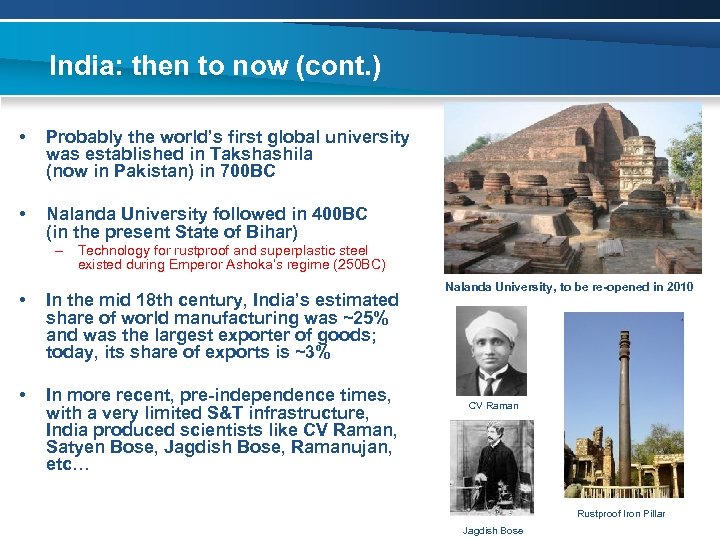
India: then to now (cont. ) • Probably the world’s first global university was established in Takshashila (now in Pakistan) in 700 BC • Nalanda University followed in 400 BC (in the present State of Bihar) – Technology for rustproof and superplastic steel existed during Emperor Ashoka’s regime (250 BC) • In the mid 18 th century, India’s estimated share of world manufacturing was ~25% and was the largest exporter of goods; today, its share of exports is ~3% • In more recent, pre-independence times, with a very limited S&T infrastructure, India produced scientists like CV Raman, Satyen Bose, Jagdish Bose, Ramanujan, etc… Nalanda University, to be re-opened in 2010 CV Raman Rustproof Iron Pillar Jagdish Bose
India: then to now (cont. ) • Rate of population growth is decreasing, but finite resources are beginning to adversely impact per capita availability – Much talk about ‘demographic dividend’ but there is a flip side to it • Literacy/education levels are rising and so are expectations— unemployment/underemployment is perhaps ~30% • Large middle class (~300 M) fuels the growth engine and attracts MNCs • India has become the largest milk producing nation (>100 M MT in 2007) • India has 69 billionaires with 4 among the world’s top 10 – Mukesh Ambani is the ‘Rockefeller’ of India; LN Mittal, ‘Carnegie’ (Ambani is building a $2 B residence in Mumbai) • ~800 M still at or below the poverty line (<$2/day); 1% of the people are crossing that line/year inflation of >10% is negating those gains – There is no evidence of large-scale extreme poverty in the past • ‘Inclusive Growth’ is the mantra estimated but recent
India’s economic growth • • Recently, Indian economy has grown at an annual rate of ~8% Reasons for this growth – Liberalization of economic policies in 1991 and move away from a stagnant socialist system – Many attribute it to ‘Jugaad’: Entrepreneurship + grassroots innovative approaches to overcome local constraints and obstacles; propensity to improvise • Example: Diesel irrigation pump on a steel frame with wheels becomes an ‘ultra-cheap’ vehicle that does not conform to safety standards • There is a downside to this mindset – ‘Jugaad’ often leads to employing means outside the regulatory framework (at times, illegal) to get the job done – ‘Sustainable’ innovation and ‘Scientific’ invention suffers • For the long-run, need a balanced approach
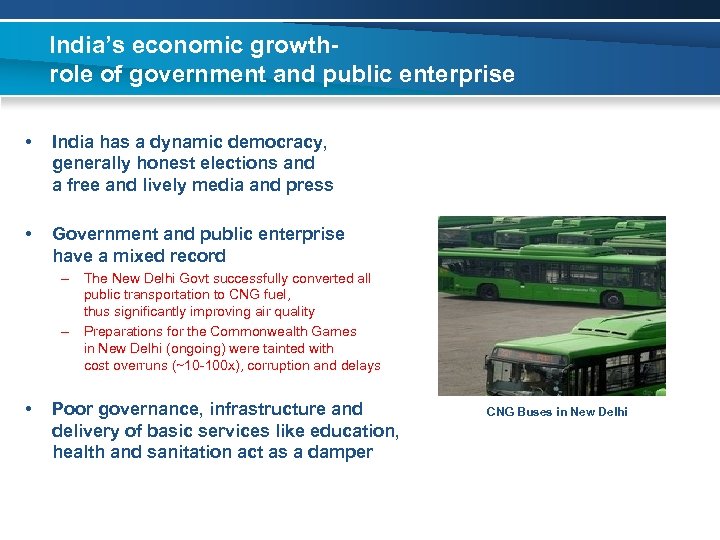
India’s economic growthrole of government and public enterprise • India has a dynamic democracy, generally honest elections and a free and lively media and press • Government and public enterprise have a mixed record – The New Delhi Govt successfully converted all public transportation to CNG fuel, thus significantly improving air quality – Preparations for the Commonwealth Games in New Delhi (ongoing) were tainted with cost overruns (~10 -100 x), corruption and delays • Poor governance, infrastructure and delivery of basic services like education, health and sanitation act as a damper CNG Buses in New Delhi
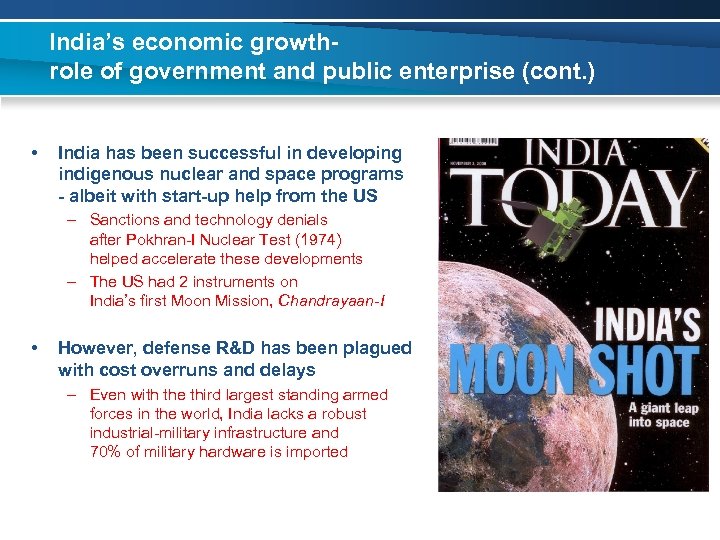
India’s economic growthrole of government and public enterprise (cont. ) • India has been successful in developing indigenous nuclear and space programs - albeit with start-up help from the US – Sanctions and technology denials after Pokhran-I Nuclear Test (1974) helped accelerate these developments – The US had 2 instruments on India’s first Moon Mission, Chandrayaan-I • However, defense R&D has been plagued with cost overruns and delays – Even with the third largest standing armed forces in the world, India lacks a robust industrial-military infrastructure and 70% of military hardware is imported
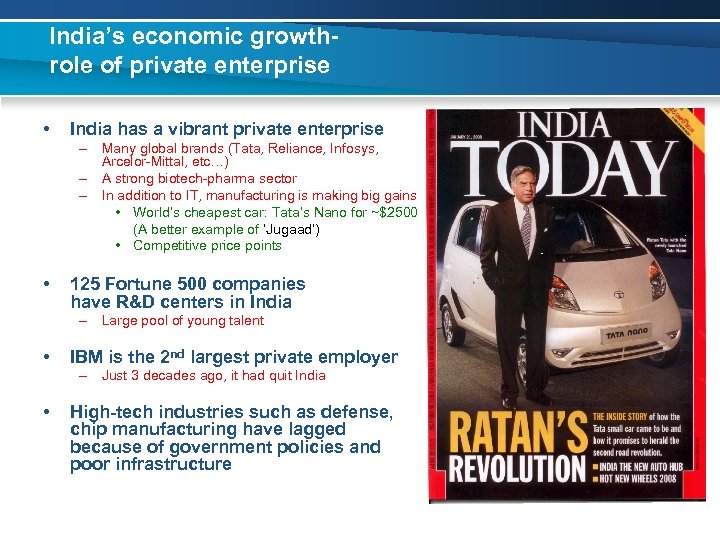
India’s economic growthrole of private enterprise • India has a vibrant private enterprise – Many global brands (Tata, Reliance, Infosys, Arcelor-Mittal, etc…) – A strong biotech-pharma sector – In addition to IT, manufacturing is making big gains • World’s cheapest car: Tata’s Nano for ~$2500 (A better example of ‘Jugaad’) • Competitive price points • 125 Fortune 500 companies have R&D centers in India – Large pool of young talent • IBM is the 2 nd largest private employer – Just 3 decades ago, it had quit India • High-tech industries such as defense, chip manufacturing have lagged because of government policies and poor infrastructure
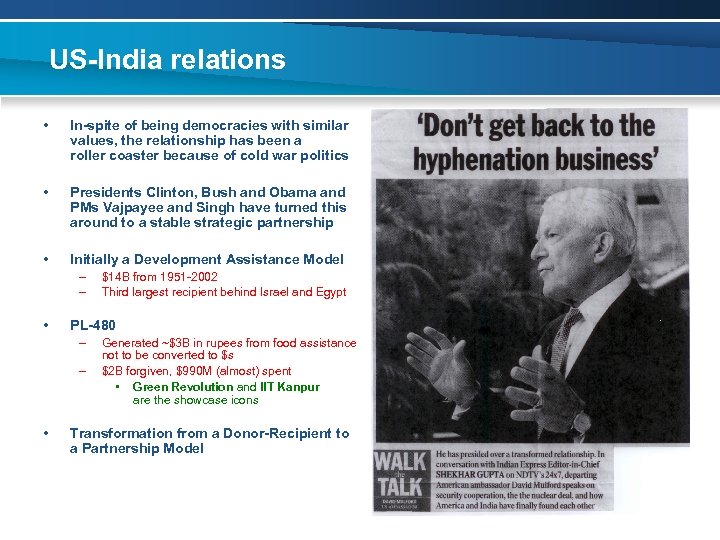
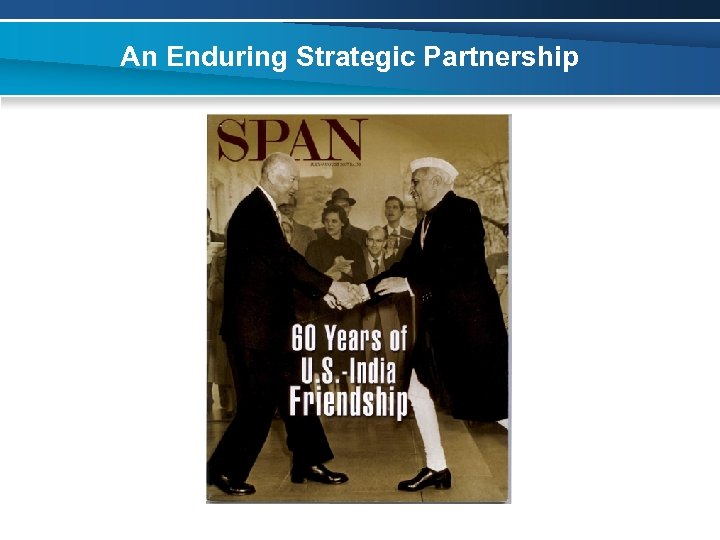
US-India relations • In-spite of being democracies with similar values, the relationship has been a roller coaster because of cold war politics • Presidents Clinton, Bush and Obama and PMs Vajpayee and Singh have turned this around to a stable strategic partnership • Initially a Development Assistance Model – – • PL-480 – – • $14 B from 1951 -2002 Third largest recipient behind Israel and Egypt Generated ~$3 B in rupees from food assistance not to be converted to $s $2 B forgiven, $990 M (almost) spent • Green Revolution and IIT Kanpur are the showcase icons Transformation from a Donor-Recipient to a Partnership Model
Five principal pillars of US-India relations • Strategic Cooperation • Energy and Climate Change • • Education and Development • Economics, Trade and Agriculture • Science, Technology, Health and Innovation President Obama visiting India in early November 2010
India’s Eleventh Five Year Plan (2007 -2012) • Investment – Overall increase of 400% from 10 th to 11 th Plan – Nine-fold increase in higher education outlays – Increase R&D expenditures from 0. 8% to 1. 3% of GDP – Funding for basic science to triple from current level of ~$500 M
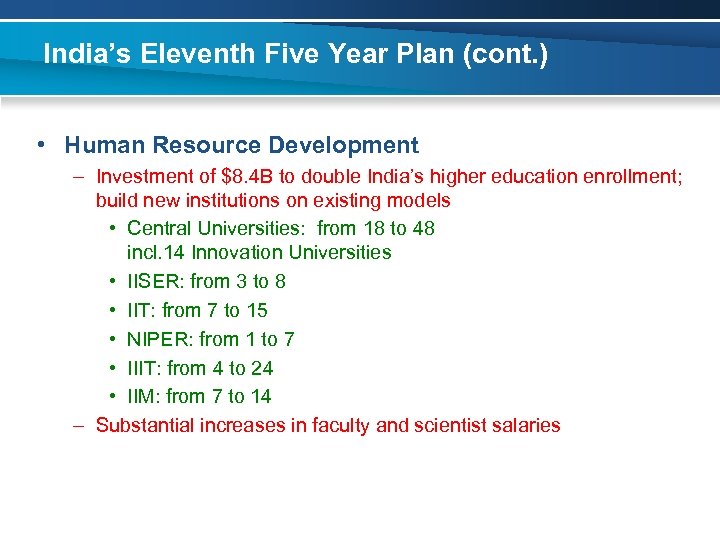
India’s Eleventh Five Year Plan (cont. ) • Human Resource Development – Investment of $8. 4 B to double India’s higher education enrollment; build new institutions on existing models • Central Universities: from 18 to 48 incl. 14 Innovation Universities • IISER: from 3 to 8 • IIT: from 7 to 15 • NIPER: from 1 to 7 • IIIT: from 4 to 24 • IIM: from 7 to 14 – Substantial increases in faculty and scientist salaries
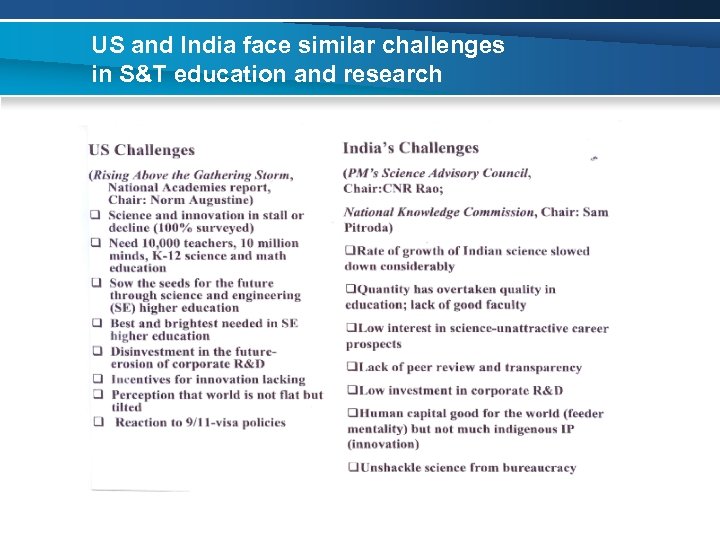
US and India face similar challenges in S&T education and research
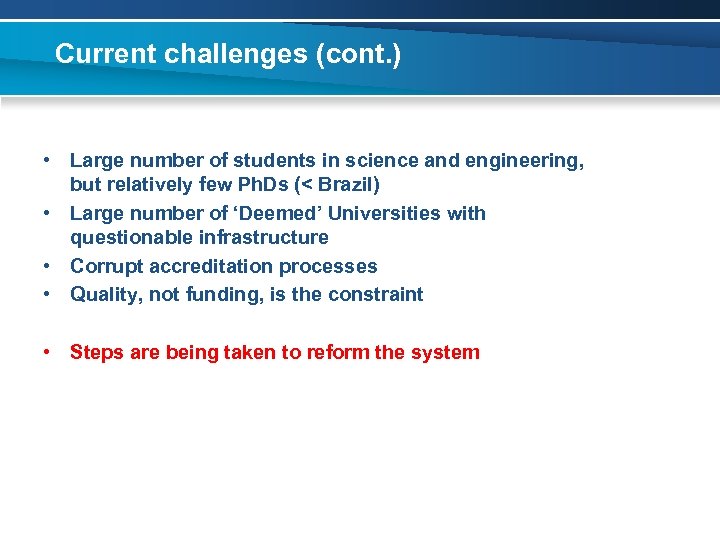
Current challenges (cont. ) • Large number of students in science and engineering, but relatively few Ph. Ds (< Brazil) • Large number of ‘Deemed’ Universities with questionable infrastructure • Corrupt accreditation processes • Quality, not funding, is the constraint • Steps are being taken to reform the system
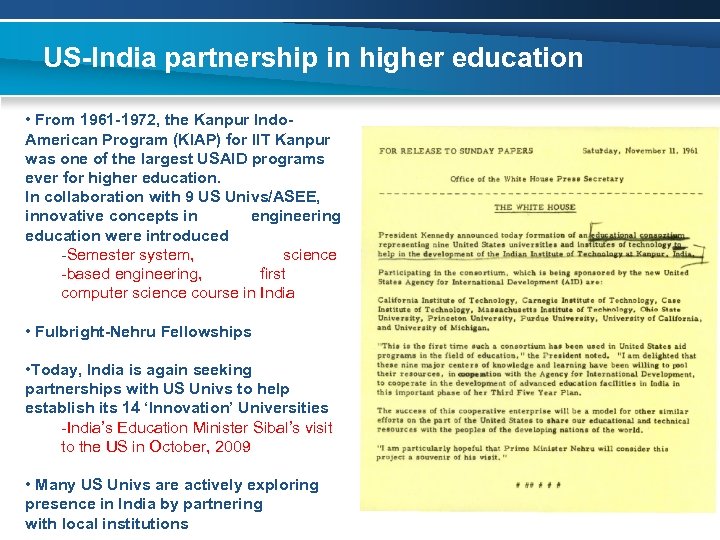
US-India partnership in higher education • From 1961 -1972, the Kanpur Indo. American Program (KIAP) for IIT Kanpur was one of the largest USAID programs ever for higher education. In collaboration with 9 US Univs/ASEE, innovative concepts in engineering education were introduced -Semester system, science -based engineering, first computer science course in India • Fulbright-Nehru Fellowships • Today, India is again seeking partnerships with US Univs to help establish its 14 ‘Innovation’ Universities -India’s Education Minister Sibal’s visit to the US in October, 2009 • Many US Univs are actively exploring presence in India by partnering with local institutions
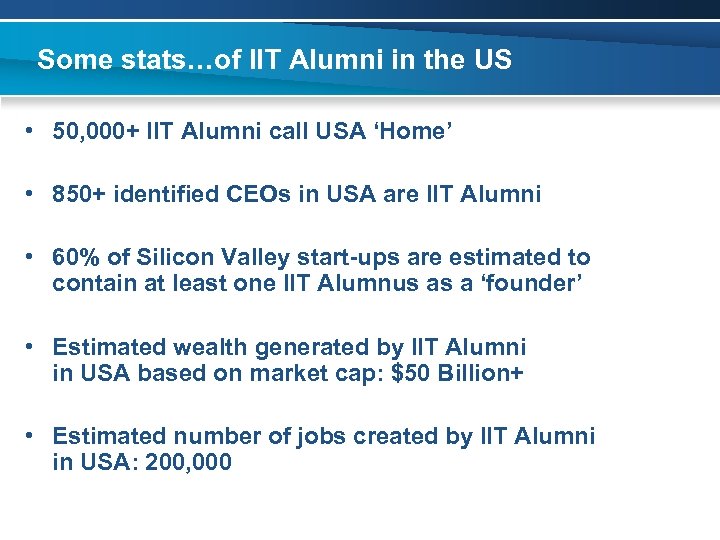
Some stats…of IIT Alumni in the US • 50, 000+ IIT Alumni call USA ‘Home’ • 850+ identified CEOs in USA are IIT Alumni • 60% of Silicon Valley start-ups are estimated to contain at least one IIT Alumnus as a ‘founder’ • Estimated wealth generated by IIT Alumni in USA based on market cap: $50 Billion+ • Estimated number of jobs created by IIT Alumni in USA: 200, 000
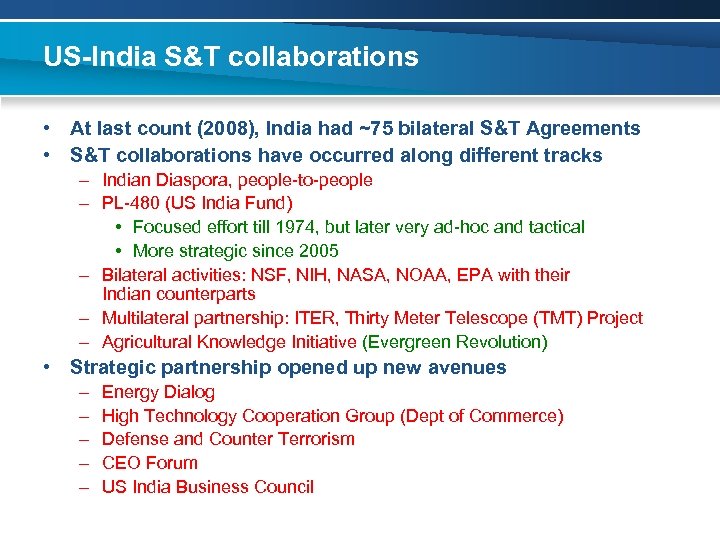
US-India S&T collaborations • At last count (2008), India had ~75 bilateral S&T Agreements • S&T collaborations have occurred along different tracks – Indian Diaspora, people-to-people – PL-480 (US India Fund) • Focused effort till 1974, but later very ad-hoc and tactical • More strategic since 2005 – Bilateral activities: NSF, NIH, NASA, NOAA, EPA with their Indian counterparts – Multilateral partnership: ITER, Thirty Meter Telescope (TMT) Project – Agricultural Knowledge Initiative (Evergreen Revolution) • Strategic partnership opened up new avenues – – – Energy Dialog High Technology Cooperation Group (Dept of Commerce) Defense and Counter Terrorism CEO Forum US India Business Council
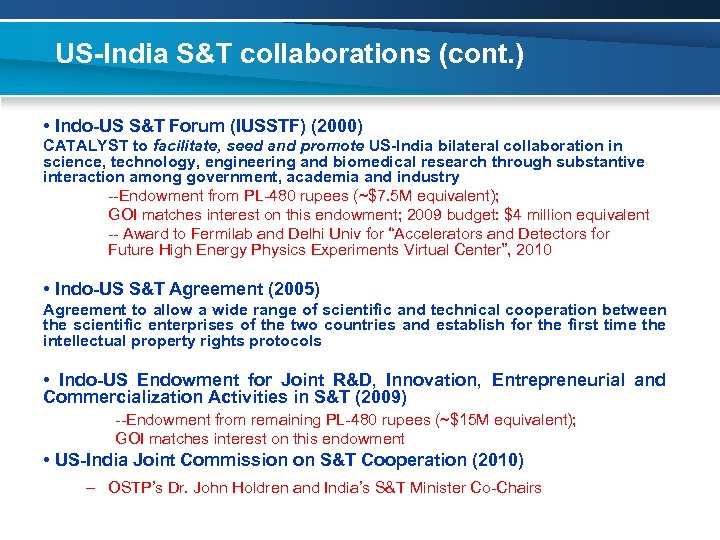
US-India S&T collaborations (cont. ) • Indo-US S&T Forum (IUSSTF) (2000) CATALYST to facilitate, seed and promote US-India bilateral collaboration in science, technology, engineering and biomedical research through substantive interaction among government, academia and industry --Endowment from PL-480 rupees (~$7. 5 M equivalent); GOI matches interest on this endowment; 2009 budget: $4 million equivalent -- Award to Fermilab and Delhi Univ for “Accelerators and Detectors for Future High Energy Physics Experiments Virtual Center”, 2010 • Indo-US S&T Agreement (2005) Agreement to allow a wide range of scientific and technical cooperation between the scientific enterprises of the two countries and establish for the first time the intellectual property rights protocols • Indo-US Endowment for Joint R&D, Innovation, Entrepreneurial and Commercialization Activities in S&T (2009) --Endowment from remaining PL-480 rupees (~$15 M equivalent); GOI matches interest on this endowment • US-India Joint Commission on S&T Cooperation (2010) – OSTP’s Dr. John Holdren and India’s S&T Minister Co-Chairs
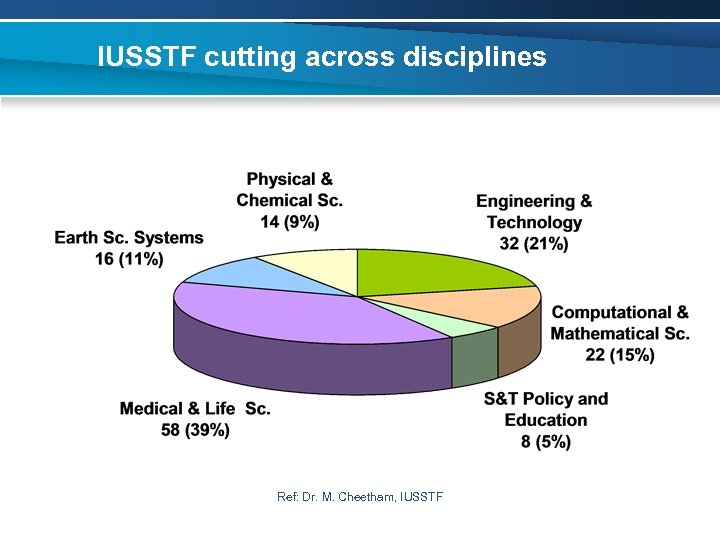
IUSSTF cutting across disciplines Ref: Dr. M. Cheetham, IUSSTF
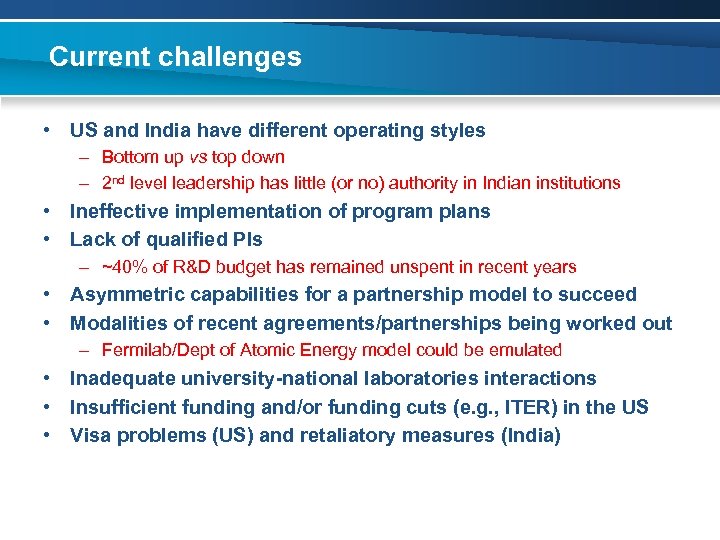
Current challenges • US and India have different operating styles – Bottom up vs top down – 2 nd level leadership has little (or no) authority in Indian institutions • Ineffective implementation of program plans • Lack of qualified PIs – ~40% of R&D budget has remained unspent in recent years • Asymmetric capabilities for a partnership model to succeed • Modalities of recent agreements/partnerships being worked out – Fermilab/Dept of Atomic Energy model could be emulated • Inadequate university-national laboratories interactions • Insufficient funding and/or funding cuts (e. g. , ITER) in the US • Visa problems (US) and retaliatory measures (India)
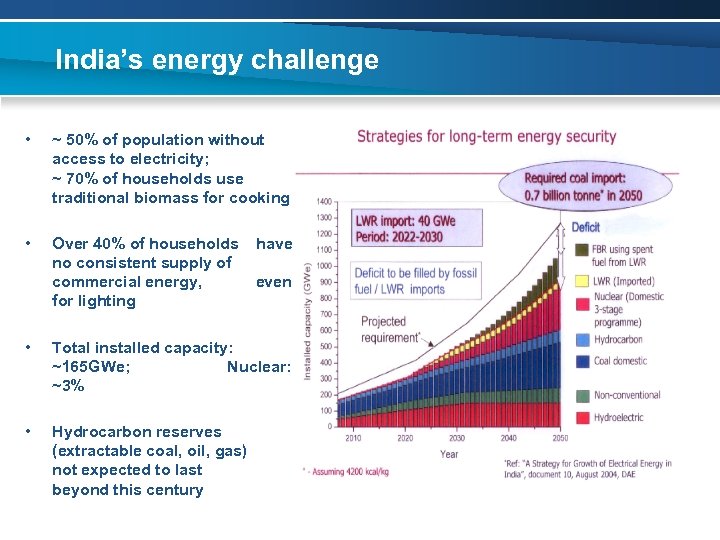
India’s energy challenge • ~ 50% of population without access to electricity; ~ 70% of households use traditional biomass for cooking • Over 40% of households no consistent supply of commercial energy, for lighting have even • Total installed capacity: ~165 GWe; Nuclear: ~3% • Hydrocarbon reserves (extractable coal, oil, gas) not expected to last beyond this century
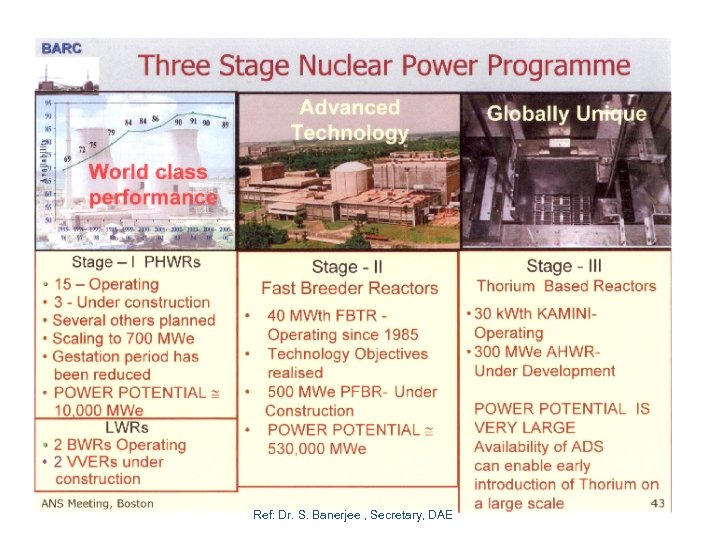
India’s 3 -Stage nuclear program Ref: Dr. S. Banerjee , Secretary, DAE
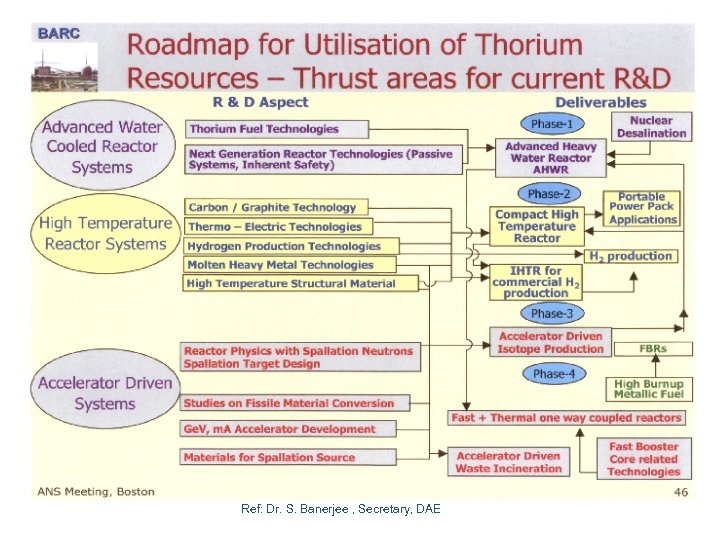
Ref: Dr. S. Banerjee , Secretary, DAE
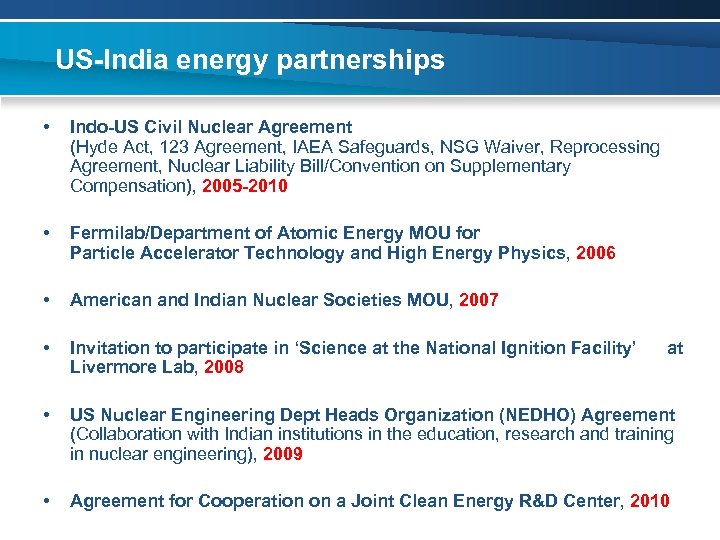
US-India energy partnerships • Indo-US Civil Nuclear Agreement (Hyde Act, 123 Agreement, IAEA Safeguards, NSG Waiver, Reprocessing Agreement, Nuclear Liability Bill/Convention on Supplementary Compensation), 2005 -2010 • Fermilab/Department of Atomic Energy MOU for Particle Accelerator Technology and High Energy Physics, 2006 • American and Indian Nuclear Societies MOU, 2007 • Invitation to participate in ‘Science at the National Ignition Facility’ Livermore Lab, 2008 • US Nuclear Engineering Dept Heads Organization (NEDHO) Agreement (Collaboration with Indian institutions in the education, research and training in nuclear engineering), 2009 • Agreement for Cooperation on a Joint Clean Energy R&D Center, 2010 at
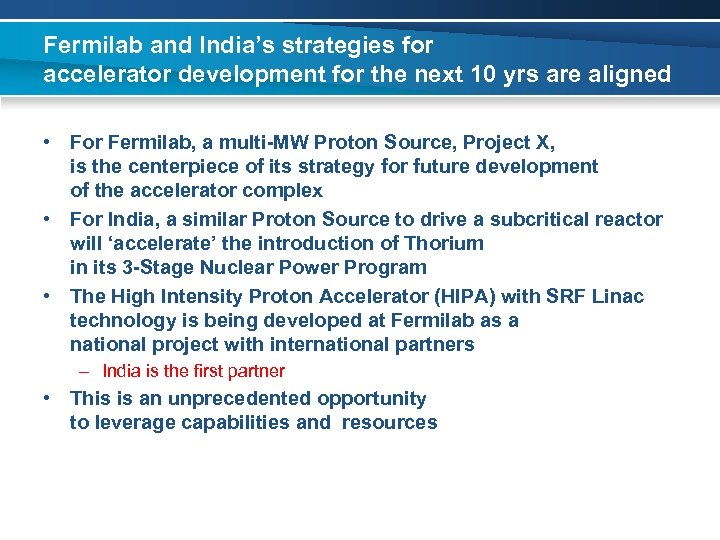
Fermilab and India’s strategies for accelerator development for the next 10 yrs are aligned • For Fermilab, a multi-MW Proton Source, Project X, is the centerpiece of its strategy for future development of the accelerator complex • For India, a similar Proton Source to drive a subcritical reactor will ‘accelerate’ the introduction of Thorium in its 3 -Stage Nuclear Power Program • The High Intensity Proton Accelerator (HIPA) with SRF Linac technology is being developed at Fermilab as a national project with international partners – India is the first partner • This is an unprecedented opportunity to leverage capabilities and resources
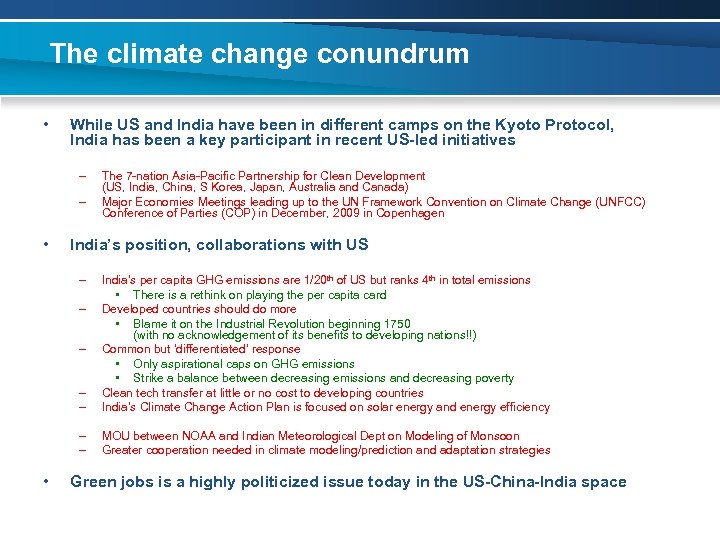
The climate change conundrum • While US and India have been in different camps on the Kyoto Protocol, India has been a key participant in recent US-led initiatives – – • The 7 -nation Asia-Pacific Partnership for Clean Development (US, India, China, S Korea, Japan, Australia and Canada) Major Economies Meetings leading up to the UN Framework Convention on Climate Change (UNFCC) Conference of Parties (COP) in December, 2009 in Copenhagen India’s position, collaborations with US – – – India’s per capita GHG emissions are 1/20 th of US but ranks 4 th in total emissions • There is a rethink on playing the per capita card Developed countries should do more • Blame it on the Industrial Revolution beginning 1750 (with no acknowledgement of its benefits to developing nations!!) Common but ‘differentiated’ response • Only aspirational caps on GHG emissions • Strike a balance between decreasing emissions and decreasing poverty Clean tech transfer at little or no cost to developing countries India’s Climate Change Action Plan is focused on solar energy and energy efficiency – – MOU between NOAA and Indian Meteorological Dept on Modeling of Monsoon Greater cooperation needed in climate modeling/prediction and adaptation strategies – – • Green jobs is a highly politicized issue today in the US-China-India space
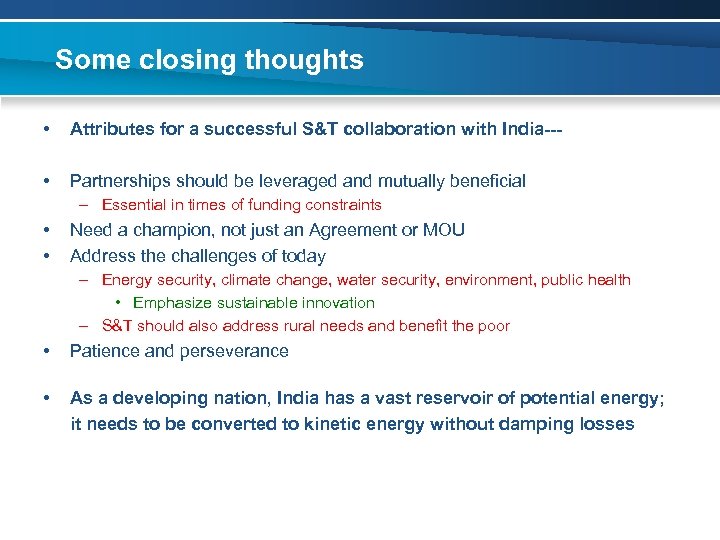
Some closing thoughts • Attributes for a successful S&T collaboration with India--- • Partnerships should be leveraged and mutually beneficial – Essential in times of funding constraints • • Need a champion, not just an Agreement or MOU Address the challenges of today – Energy security, climate change, water security, environment, public health • Emphasize sustainable innovation – S&T should also address rural needs and benefit the poor • Patience and perseverance • As a developing nation, India has a vast reservoir of potential energy; it needs to be converted to kinetic energy without damping losses
An Enduring Strategic Partnership
Скачать презентацию Indo-U S Science Technology Collaboration — Opportunities
5ae78e907573099822526f2732f929d8.ppt