


 Скачать презентацию Indo Rama Synthetics India Ltd Analyst Meet Quarter
f0e773b475234bd169192fb6bca594c0.ppt
- Количество слайдов: 35
 Indo Rama Synthetics (India) Ltd. Analyst Meet Quarter 2 & H 1 2006 -07 Results and The opportunities ahead Mumbai 18 October, 2006
 Agenda 1. Crude & Raw Material 2. Comparative Fibre scenario & Polyester 3. Factors influencing the performance of Indo Rama and the way forward 4. Indo Rama’s Expansion Project 5. Indo Rama Performance 2 2
 Crude & Raw Material 3 3
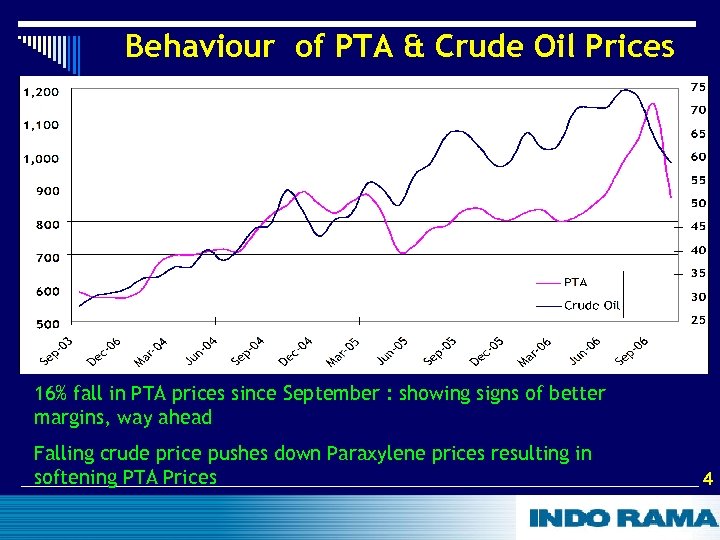 Behaviour of PTA & Crude Oil Prices 16% fall in PTA prices since September : showing signs of better margins, way ahead Falling crude price pushes down Paraxylene prices resulting in softening PTA Prices 4 4
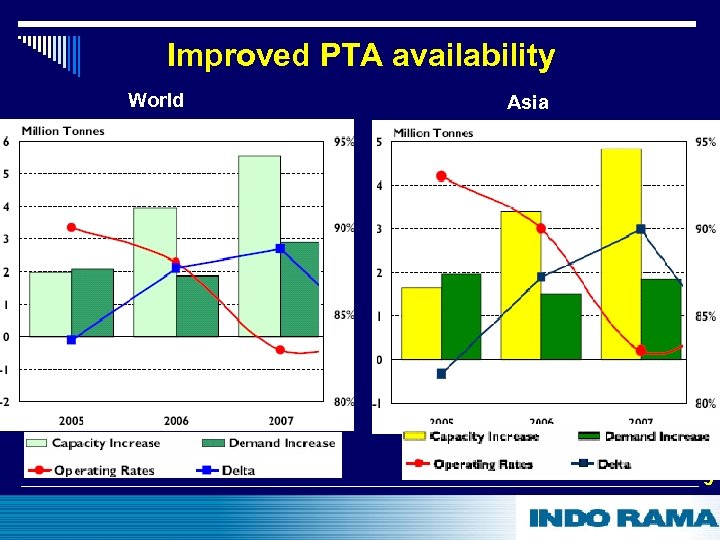 Improved PTA availability World Asia 5 5
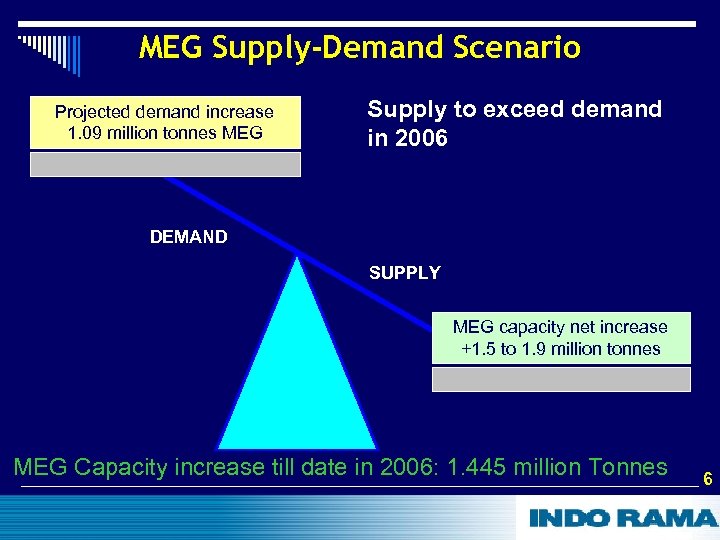 MEG Supply-Demand Scenario Projected demand increase 1. 09 million tonnes MEG Supply to exceed demand in 2006 DEMAND SUPPLY MEG capacity net increase +1. 5 to 1. 9 million tonnes MEG Capacity increase till date in 2006: 1. 445 million Tonnes 6 6
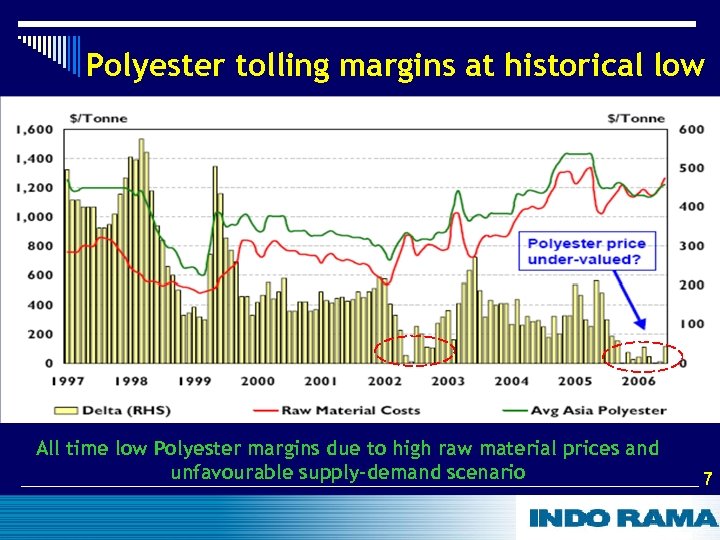 Polyester tolling margins at historical low All time low Polyester margins due to high raw material prices and unfavourable supply-demand scenario 7 7
 Comparative Fibre Scenario & Polyester 8 8
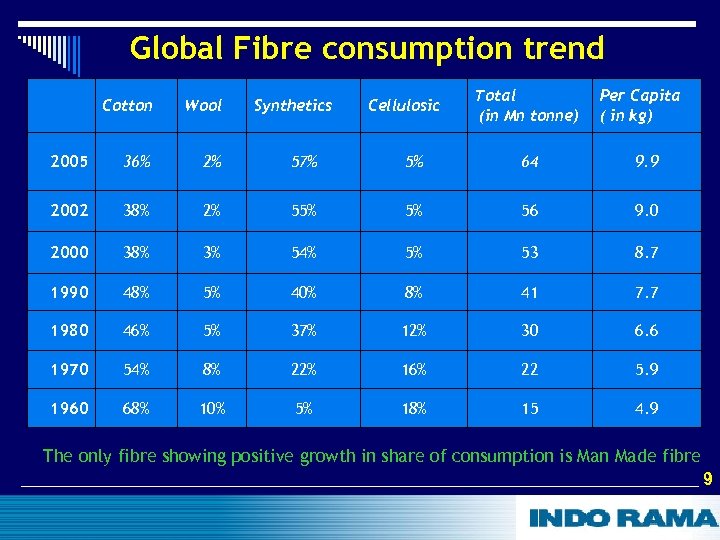 Global Fibre consumption trend Synthetics Cellulosic Total (in Mn tonne) Per Capita ( in kg) Cotton Wool 2005 36% 2% 57% 5% 64 9. 9 2002 38% 2% 55% 5% 56 9. 0 2000 38% 3% 54% 5% 53 8. 7 1990 48% 5% 40% 8% 41 7. 7 1980 46% 5% 37% 12% 30 6. 6 1970 54% 8% 22% 16% 22 5. 9 1960 68% 10% 5% 18% 15 4. 9 The only fibre showing positive growth in share of consumption is Man Made fibre 9 9
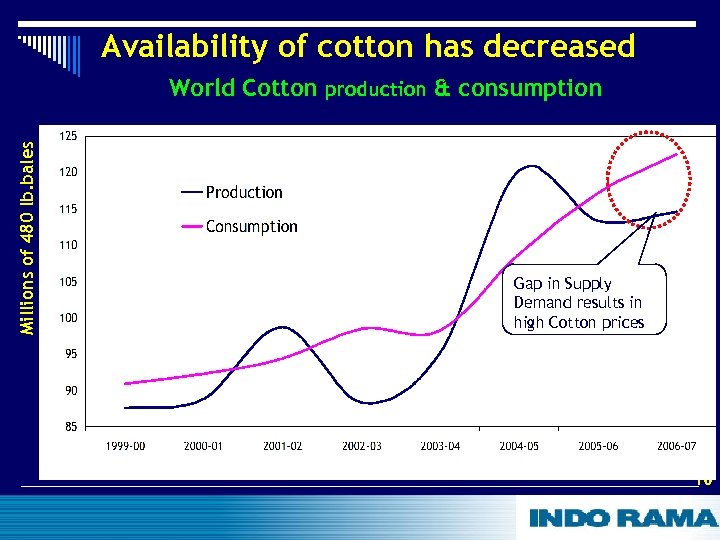 Availability of cotton has decreased Millions of 480 lb. bales World Cotton production & consumption Gap in Supply Demand results in high Cotton prices 10 10
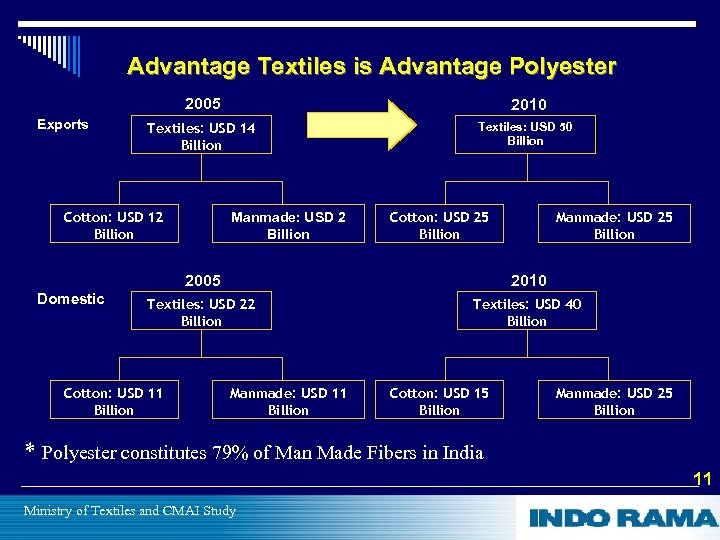 Advantage Textiles is Advantage Polyester 2005 Exports 2010 Textiles: USD 14 Billion Textiles: USD 50 Billion Cotton: USD 12 Billion Manmade: USD 2 Billion Cotton: USD 25 Billion Manmade: USD 25 Billion 2005 Domestic 2010 Textiles: USD 22 Billion Textiles: USD 40 Billion Cotton: USD 11 Billion Manmade: USD 11 Billion Cotton: USD 15 Billion Manmade: USD 25 Billion * Polyester constitutes 79% of Man Made Fibers in India 11 Ministry of Textiles and CMAI Study 11
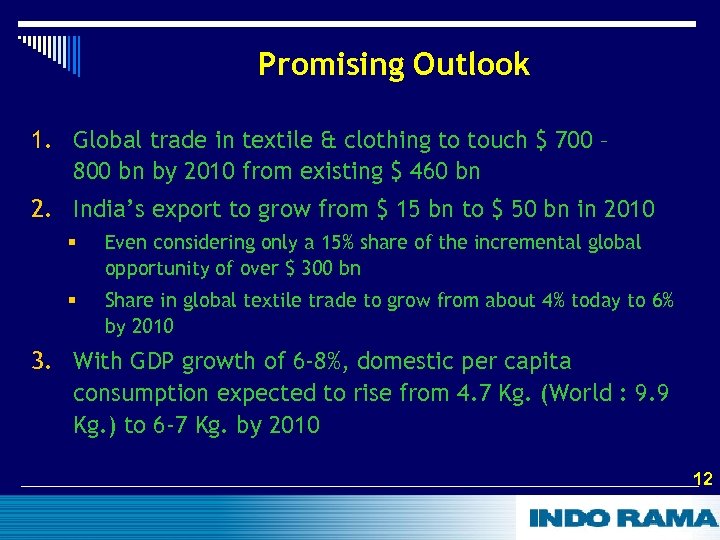 Promising Outlook 1. Global trade in textile & clothing to touch $ 700 – 800 bn by 2010 from existing $ 460 bn 2. India’s export to grow from $ 15 bn to $ 50 bn in 2010 § Even considering only a 15% share of the incremental global opportunity of over $ 300 bn § Share in global textile trade to grow from about 4% today to 6% by 2010 3. With GDP growth of 6 -8%, domestic per capita consumption expected to rise from 4. 7 Kg. (World : 9. 9 Kg. ) to 6 -7 Kg. by 2010 12 12
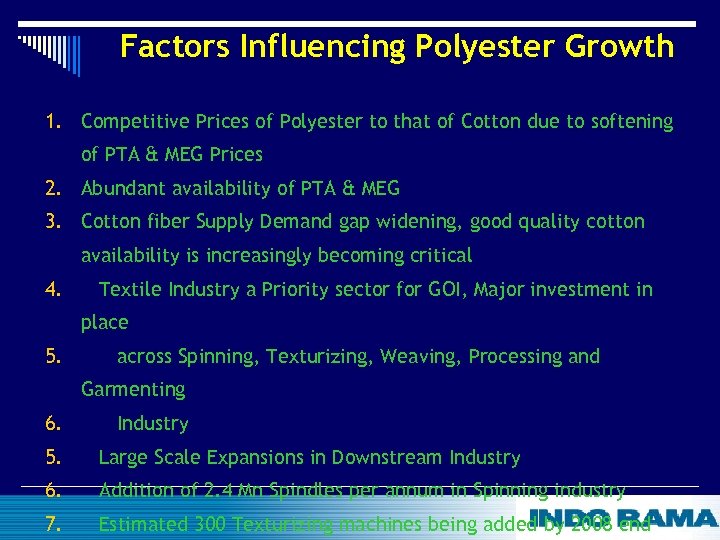 Factors Influencing Polyester Growth 1. Competitive Prices of Polyester to that of Cotton due to softening of PTA & MEG Prices 2. Abundant availability of PTA & MEG 3. Cotton fiber Supply Demand gap widening, good quality cotton availability is increasingly becoming critical 4. Textile Industry a Priority sector for GOI, Major investment in place 5. across Spinning, Texturizing, Weaving, Processing and Garmenting 6. Industry 5. Large Scale Expansions in Downstream Industry 6. Addition of 2. 4 Mn Spindles per annum in Spinning industry 7. Estimated 300 Texturizing machines being added by 2008 end
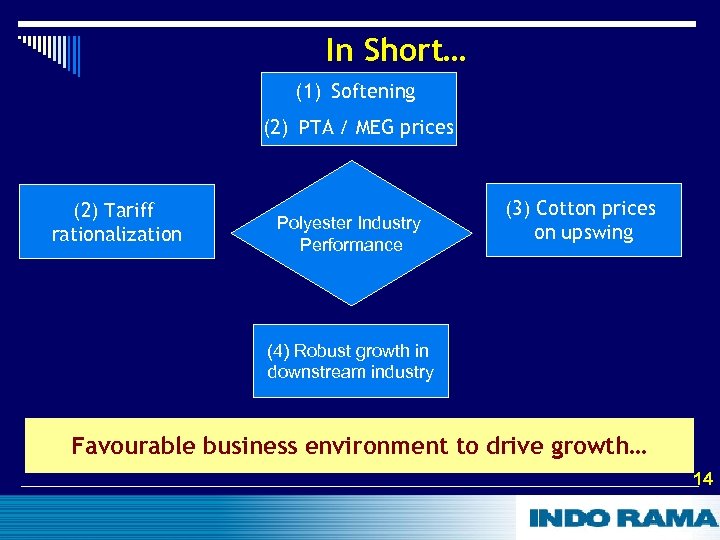 In Short… (1) Softening (2) PTA / MEG prices (2) Tariff rationalization Polyester Industry Performance (3) Cotton prices on upswing (4) Robust growth in downstream industry Favourable business environment to drive growth… 14 14
 Factors influencing the performance of Indo Rama and the path ahead… 15 15
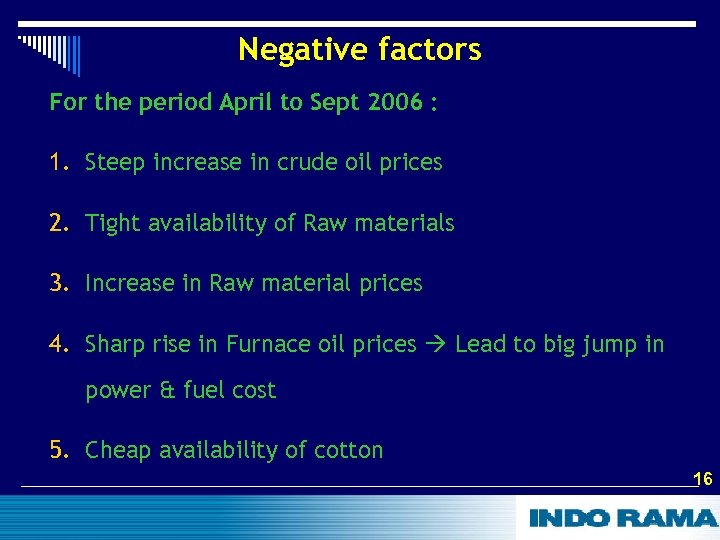 Negative factors For the period April to Sept 2006 : 1. Steep increase in crude oil prices 2. Tight availability of Raw materials 3. Increase in Raw material prices 4. Sharp rise in Furnace oil prices Lead to big jump in power & fuel cost 5. Cheap availability of cotton 16 16
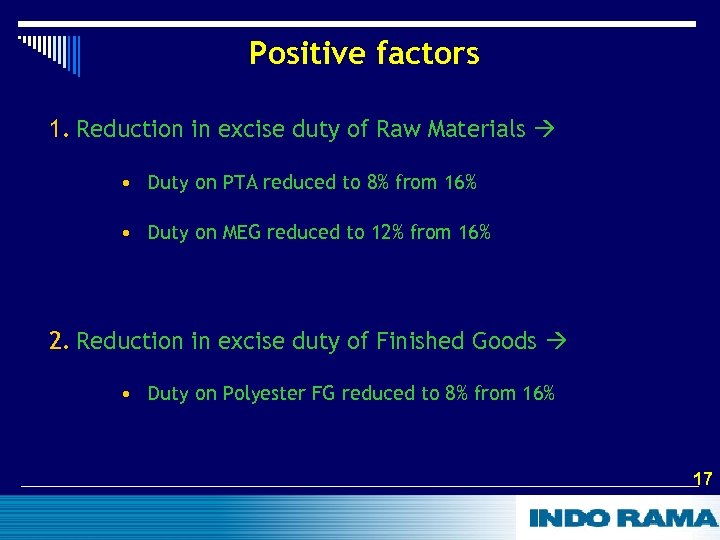 Positive factors 1. Reduction in excise duty of Raw Materials • Duty on PTA reduced to 8% from 16% • Duty on MEG reduced to 12% from 16% 2. Reduction in excise duty of Finished Goods • Duty on Polyester FG reduced to 8% from 16% 17 17
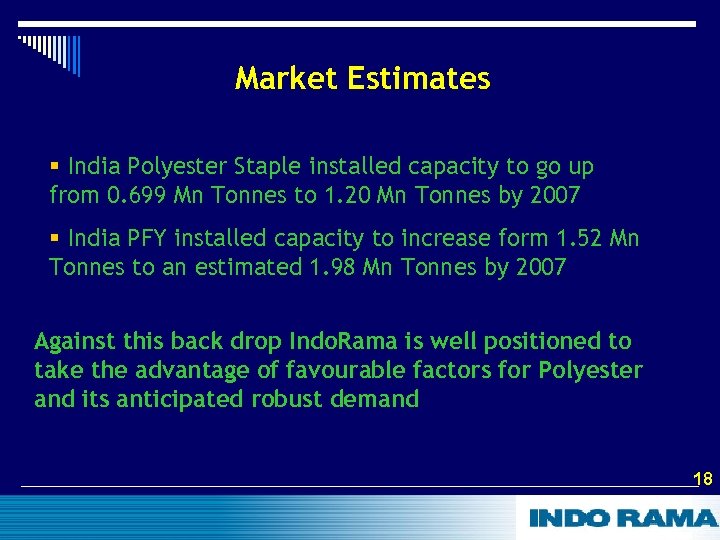 Market Estimates § India Polyester Staple installed capacity to go up from 0. 699 Mn Tonnes to 1. 20 Mn Tonnes by 2007 § India PFY installed capacity to increase form 1. 52 Mn Tonnes to an estimated 1. 98 Mn Tonnes by 2007 Against this back drop Indo. Rama is well positioned to take the advantage of favourable factors for Polyester and its anticipated robust demand 18 18
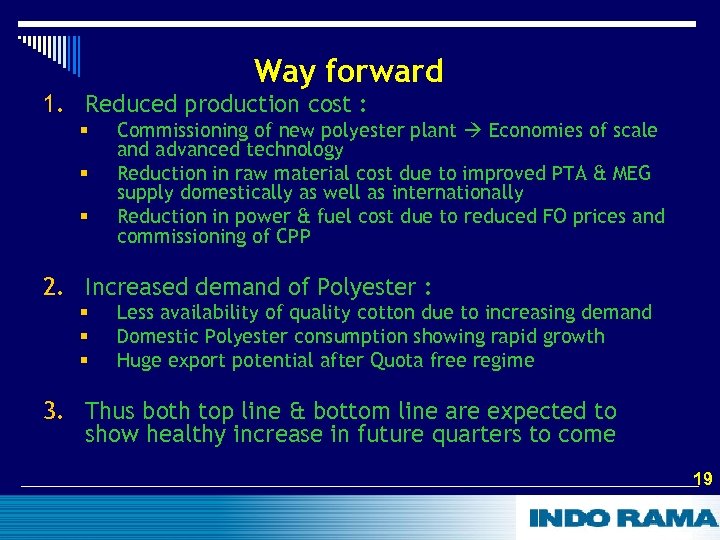 Way forward 1. Reduced production cost : § § § Commissioning of new polyester plant Economies of scale and advanced technology Reduction in raw material cost due to improved PTA & MEG supply domestically as well as internationally Reduction in power & fuel cost due to reduced FO prices and commissioning of CPP 2. Increased demand of Polyester : § § § Less availability of quality cotton due to increasing demand Domestic Polyester consumption showing rapid growth Huge export potential after Quota free regime 3. Thus both top line & bottom line are expected to show healthy increase in future quarters to come 19 19
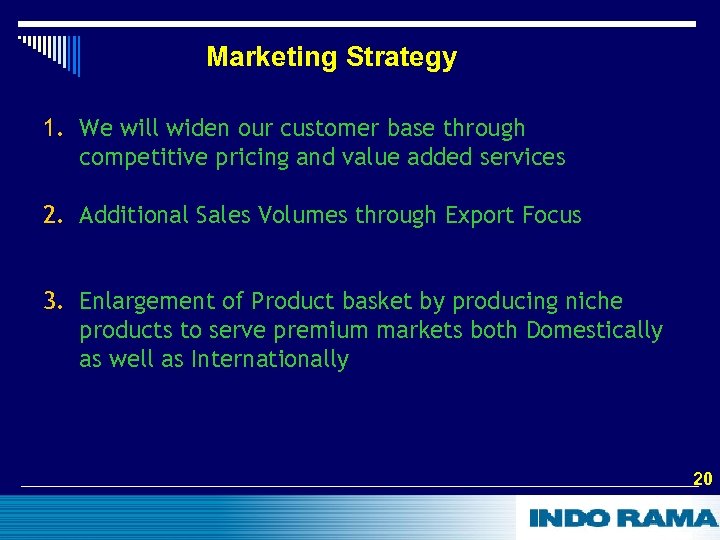 Marketing Strategy 1. We will widen our customer base through competitive pricing and value added services 2. Additional Sales Volumes through Export Focus 3. Enlargement of Product basket by producing niche products to serve premium markets both Domestically as well as Internationally 20 20
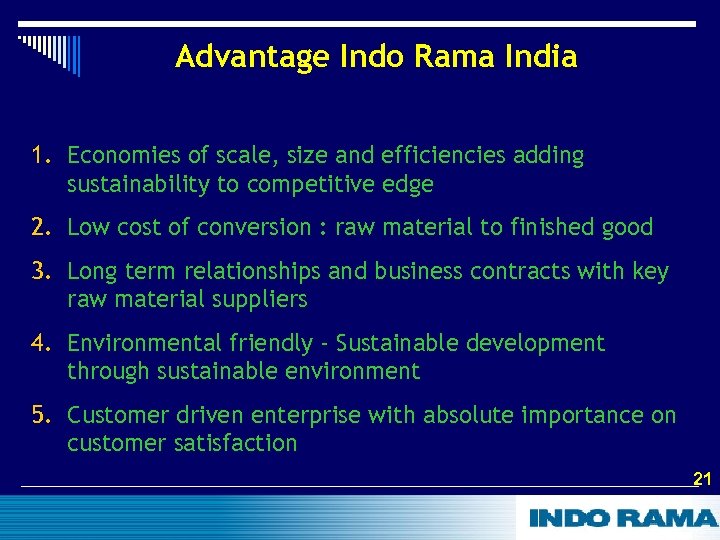 Advantage Indo Rama India 1. Economies of scale, size and efficiencies adding sustainability to competitive edge 2. Low cost of conversion : raw material to finished good 3. Long term relationships and business contracts with key raw material suppliers 4. Environmental friendly - Sustainable development through sustainable environment 5. Customer driven enterprise with absolute importance on customer satisfaction 21 21
 Performance Update 22 22
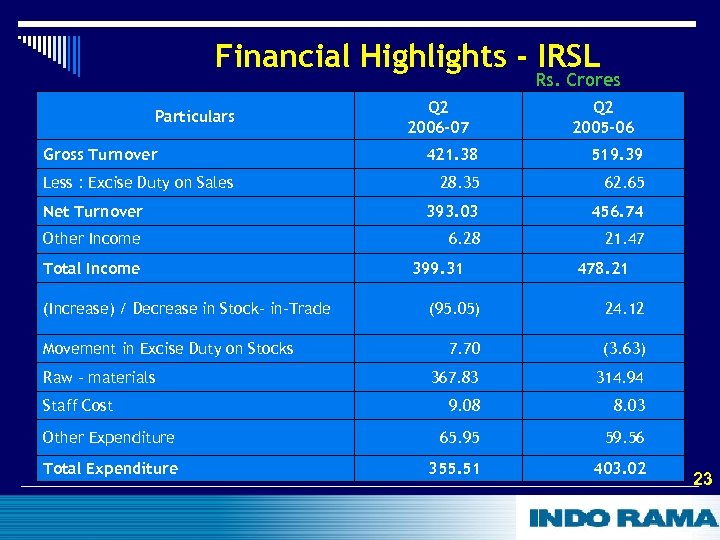 Financial Highlights - IRSL Rs. Crores Particulars Gross Turnover Q 2 2006 -07 Q 2 2005 -06 421. 38 519. 39 28. 35 62. 65 Net Turnover 393. 03 456. 74 Other Income 6. 28 21. 47 Less : Excise Duty on Sales Total Income (Increase) / Decrease in Stock- in-Trade 399. 31 478. 21 (95. 05) 24. 12 7. 70 (3. 63) 367. 83 314. 94 9. 08 8. 03 Other Expenditure 65. 95 59. 56 Total Expenditure 355. 51 403. 02 Movement in Excise Duty on Stocks Raw - materials Staff Cost 23 23
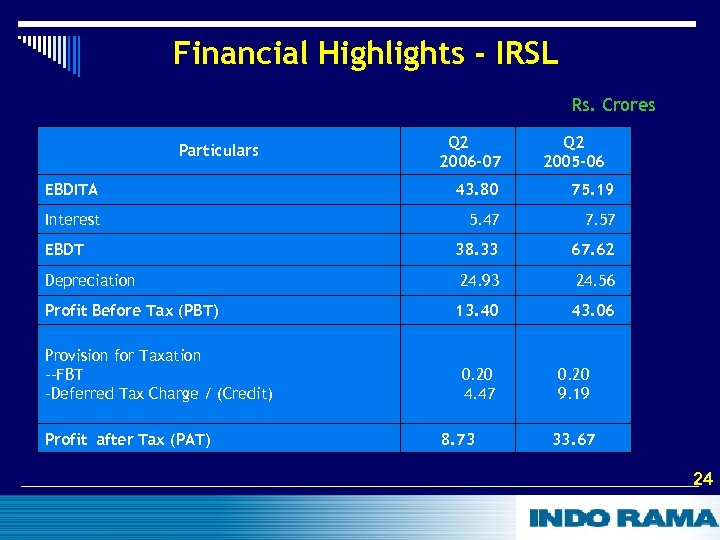 Financial Highlights - IRSL Rs. Crores Particulars Q 2 2006 -07 Q 2 2005 -06 EBDITA 43. 80 75. 19 Interest 5. 47 7. 57 EBDT 38. 33 67. 62 Depreciation 24. 93 24. 56 Profit Before Tax (PBT) 13. 40 43. 06 Provision for Taxation --FBT -Deferred Tax Charge / (Credit) Profit after Tax (PAT) 0. 20 4. 47 8. 73 0. 20 9. 19 33. 67 24 24
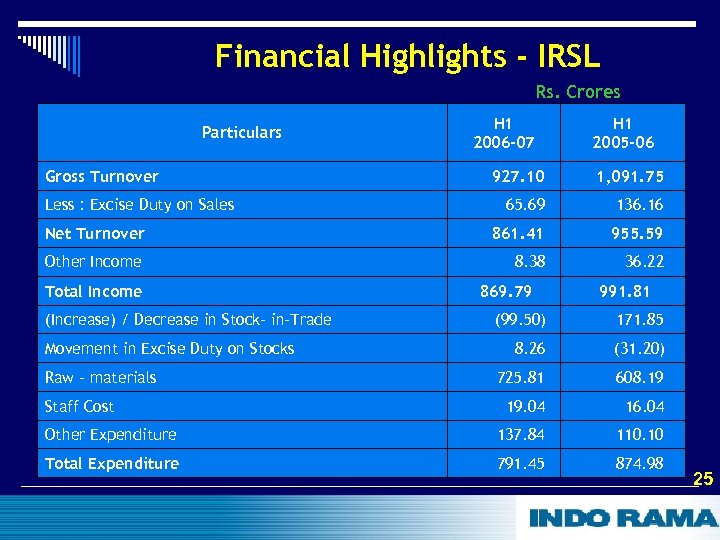 Financial Highlights - IRSL Rs. Crores Particulars Gross Turnover H 1 2006 -07 H 1 2005 -06 927. 10 1, 091. 75 65. 69 136. 16 Net Turnover 861. 41 955. 59 Other Income 8. 38 36. 22 Less : Excise Duty on Sales Total Income (Increase) / Decrease in Stock- in-Trade 869. 79 991. 81 (99. 50) 171. 85 8. 26 (31. 20) 725. 81 608. 19 19. 04 16. 04 Other Expenditure 137. 84 110. 10 Total Expenditure 791. 45 874. 98 Movement in Excise Duty on Stocks Raw - materials Staff Cost 25 25
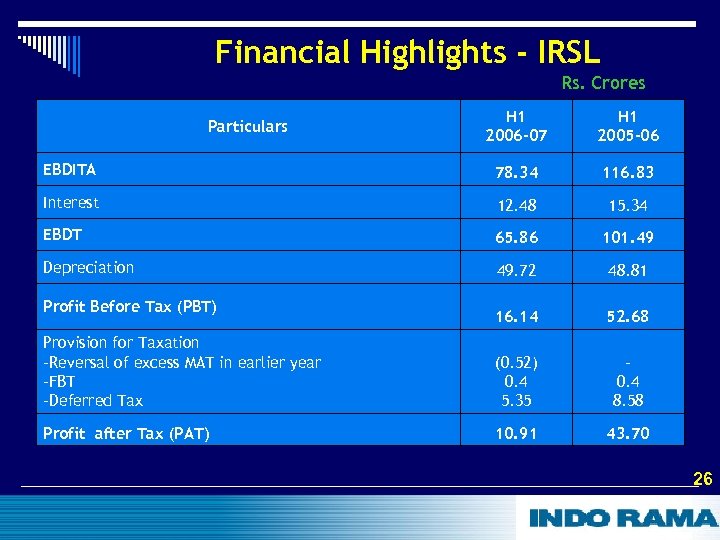 Financial Highlights - IRSL Rs. Crores H 1 2006 -07 H 1 2005 -06 EBDITA 78. 34 116. 83 Interest 12. 48 15. 34 EBDT 65. 86 101. 49 Depreciation 49. 72 48. 81 16. 14 52. 68 Provision for Taxation -Reversal of excess MAT in earlier year -FBT -Deferred Tax (0. 52) 0. 4 5. 35 0. 4 8. 58 Profit after Tax (PAT) 10. 91 43. 70 Particulars Profit Before Tax (PBT) 26 26
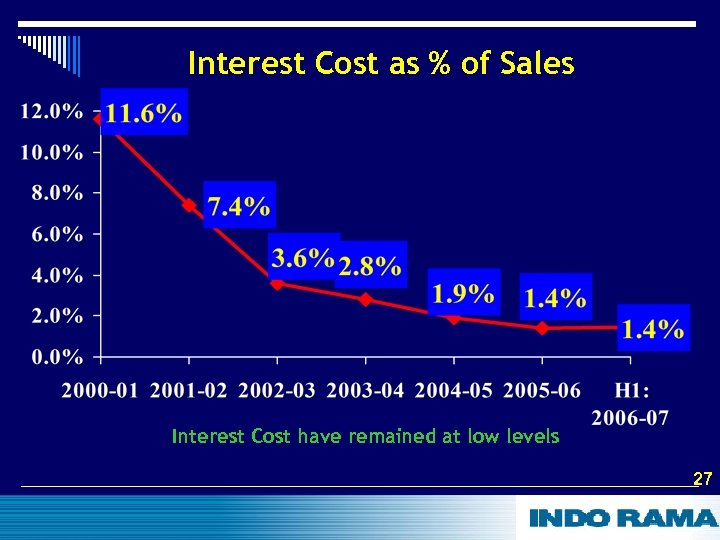 Interest Cost as % of Sales Interest Cost have remained at low levels 27 27
 Indo Rama’s Expansion Project
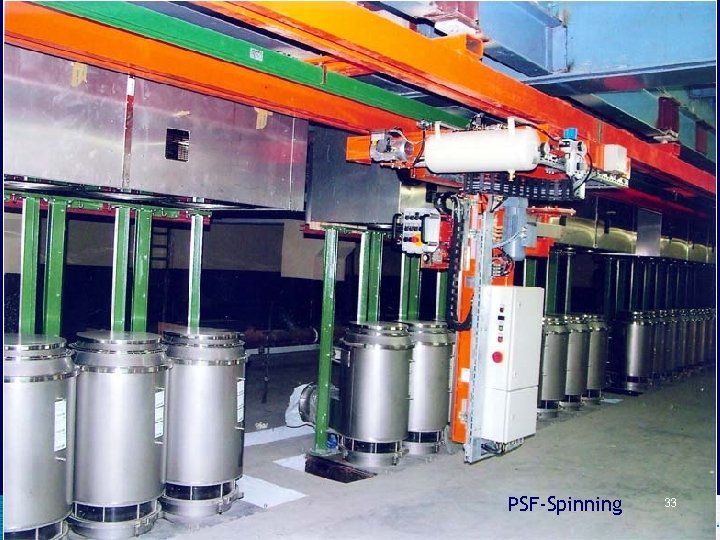
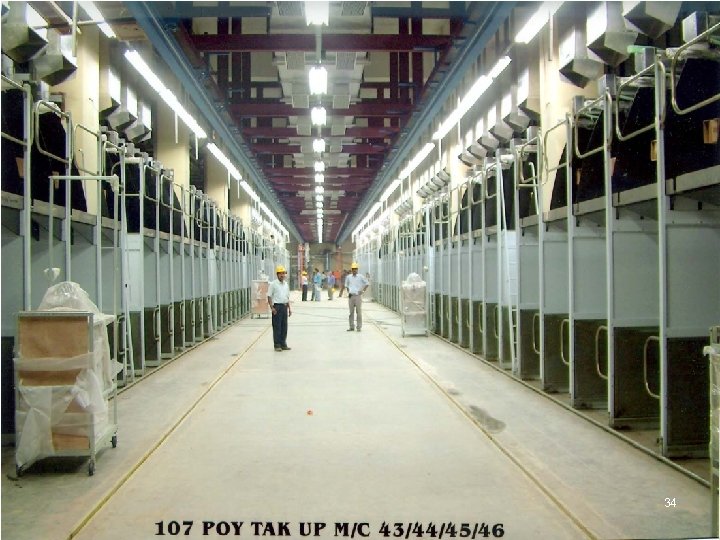
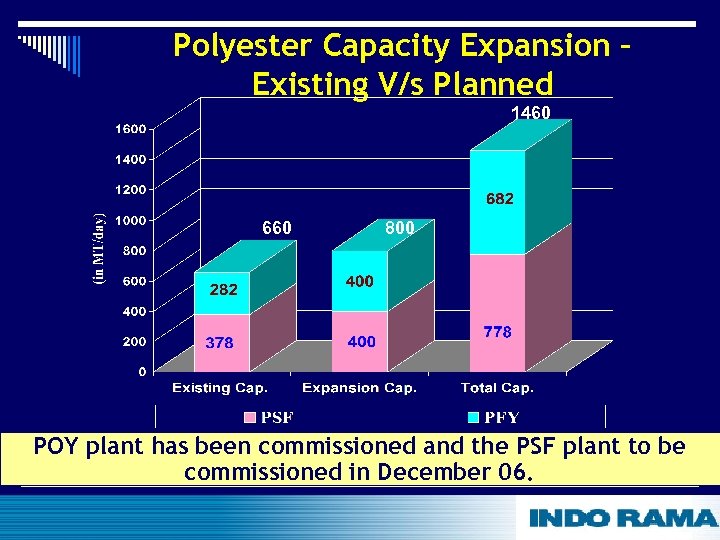 Polyester Capacity Expansion – Existing V/s Planned 1460 660 800 POY plant has been commissioned and the PSF plant to be commissioned in December 06. 29 29
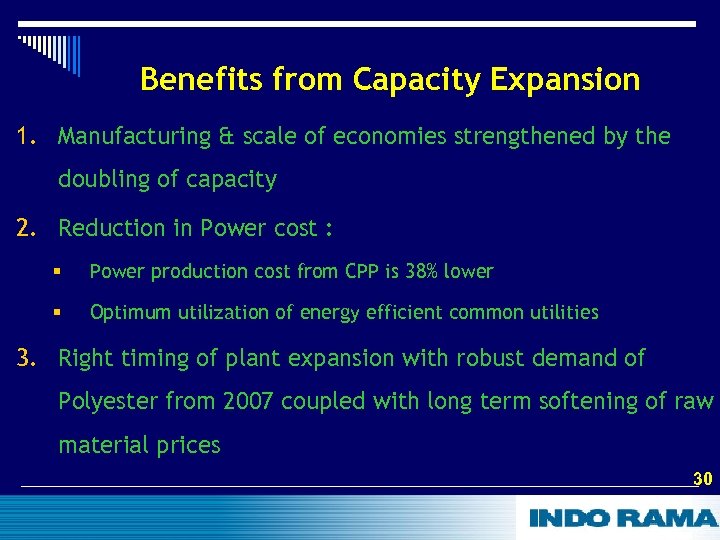 Benefits from Capacity Expansion 1. Manufacturing & scale of economies strengthened by the doubling of capacity 2. Reduction in Power cost : § Power production cost from CPP is 38% lower § Optimum utilization of energy efficient common utilities 3. Right timing of plant expansion with robust demand of Polyester from 2007 coupled with long term softening of raw material prices 30 30
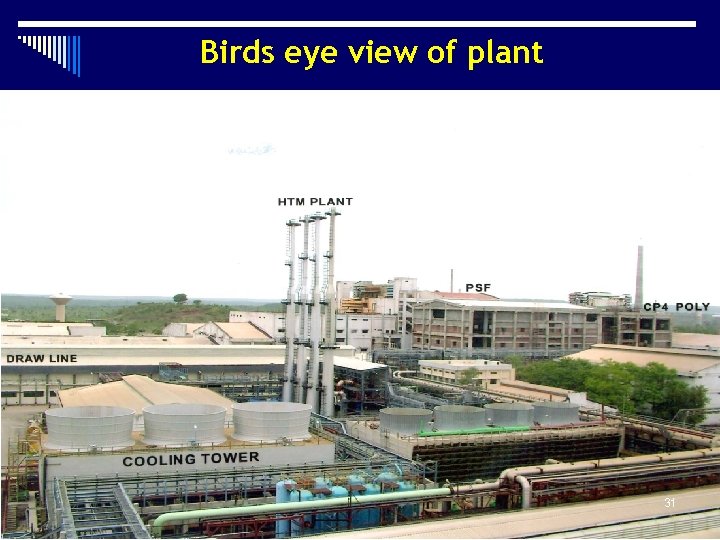 Birds eye view of plant 31 31
 32 32
32 32
 33 PSF-Spinning 33
 34 34
34 34
 House Open for Questions 35 35